U.S. Law School Enrollments Fall; Lack of Jobs Has Students Steering Away From Legal Career

U.S. Law School Enrollments Fall

Lack of Jobs Has Students Steering Away From Legal Career

JENNIFER SMITH 

Dec. 17, 2013 7:41 p.m. ET

MK-CI666A_LAWSC_NS_20131217182103

First-year enrollment at U.S. law schools plunged this year to levels not seen since the 1970s as students steered away from a career that has left many recent graduates loaded with debt and struggling to find work. Read more of this post

Three things long/short hedge funds cannot do (well)

Three things long/short hedge funds cannot do (well)

Dan McCrum

| Dec 18 11:17 | 16 comments | Share

ScreenShot031-590x262 ScreenShot032

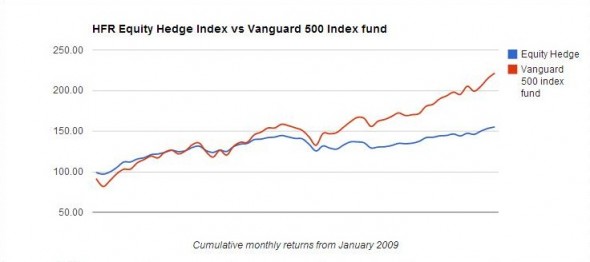
We have mentioned the five-year problem before. However, we suspect that theranks of the zombies will be swelling again soon, because of the simple fact that the five-year track record of stock-trading hedge funds is horrible.

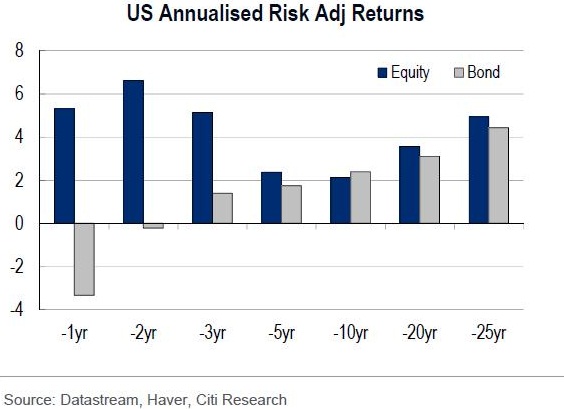
Your $100 would be worth $220 if you lodged it with Vanguard — while the Long-Short industrial complex would have turned it into $155 (after taking at least $25 in fees).

This matters because, having worked to justify hedge funds as a separate asset class, the sector is effectively competing with stocks. And as Jonathan Stubbs at Citi has been pointing out, asset-class returns for equities now look pretty good for almost every period you choose to consider, a fact which tends to be followed by higher allocations of capital.

But we are looking for reasons to explain the enormous gap between the performance of stocks and highly-paid stock traders. In particular, we think there are three fundamental things that Long/Short funds should be able to do, but clearly cannot:

1. Manage risk.

We don’t mean risk in the month-to-month trading exposure sense. We mean in the deciding when to go big and when to stay at home sense.

It may be that the desire of big institutions for monthly reporting, tight risk limits and safety has become counterproductive – that in trying to build something of “institutional quality” you destroy the nimbleness the institutions are after in the first place.

But equity hedge funds have not done a good job of managing risk. A case in point: with hindsight it is clear that the biggest risk to portfolios at the start of the year was having too little market exposure.

See also the whole of 2011.

2. Short stocks on a systematic basis

Want to go long the market? There are a host of strategies you can use – value, quality, earnings momentum, monkey darts.

To go short though, not so easy. There is no inherent return, and over the long term you are fighting the market. For the long-short model to work, hedge funds must constantly have short positions in place, and to do that well is hard to the point of impossibility for most.

One thought also for discussion. We suspect there is a temptation to use low-beta stocks for shorts as the lack of volatility makes such positions cheaper. But low beta stocks have also proved to be good performers a lot of the time.

3. Stop trading.

Friction is a killer, as those trading commissions and little losses add up. For the individual investment experts who were nimble and rose to the top in the early days, making the industry’s reputation, this was not a problem.

Scale up to thousands of funds and more than a trillion dollars in capital at work, however, and the friction will start to tell at the industry level. You might also classify this as the prime broker’s cut from the use of our imaginary investor’s $100…

The Volcker rule: More questions than answers; A push to make America’s banks safer creates new uncertainties

The Volcker rule: More questions than answers; A push to make America’s banks safer creates new uncertainties

Dec 14th 2013 | NEW YORK | From the print edition

THE 37 words inserted into the 848-page Dodd-Frank law overhauling the regulation of America’s financial institutions seemed innocent enough. Lawmakers wanted regulators to come up with strictures that would prevent banks from gambling with deposits insured by the federal government. The resulting rule, named after a prominent proponent, Paul Volcker, a former head of the Federal Reserve, prohibits banks from “proprietary trading”, meaning transactions conducted purely for their own gain, rather than to serve clients. On December 10th five different regulatory agencies approved the Volcker rule; it will come into force, awkwardly enough, on April 1st. Read more of this post

The politics of low pay: Raising the floor; America’s minimum-wage debate has rolled round again

The politics of low pay: Raising the floor; America’s minimum-wage debate has rolled round again

Dec 14th 2013 | BALDWIN PARK, CALIFORNIA, AND NEW YORK | From the print edition

HE LIKES the work; but at $9.60 an hour, stacking the shelves at a Walmart in east Los Angeles does not pay Anthony Goytia enough to cover the bills for his family of five, he says. He supplements his fortnightly pay of $560-600 with the odd catering job, by subjecting himself to clinical trials of a treatment for his psoriasis, and with federal and state assistance. He was recently approved for food stamps; that should make Christmas a little jollier.
20131214_USC023 (1) 20131214_USM944

America is going through one of its periodic fits of agony over the minimum wage. In recent weeks several states and municipalities have approved rate rises; most dramatically in SeaTac, a suburb of Seattle consisting of a large airport, where voters raised the hourly figure to $15. On December 4th Barack Obama called for a higher federal minimum wage. He has previously suggested that it rise from $7.25 to $10.10. It has lost 5.8% of its purchasing power since it was last raised, in 2009.

Between 1979 and 2007 the incomes of the top 1% of American earners rose by 275%, according to the Congressional Budget Office. Those of the bottom 20% rose by 18%. Had the federal minimum wage kept up with productivity gains since 1968 it would have reached $21.72 last year, estimates the Centre for Economic and Policy Research (CEPR), a leftish think-tank. Campaigners gripe that the government should not have to top up the pay of workers like Mr Goytia (who agrees); this “hidden subsidy” amounts to $7 billion in the fast-food industry alone, according to one study.

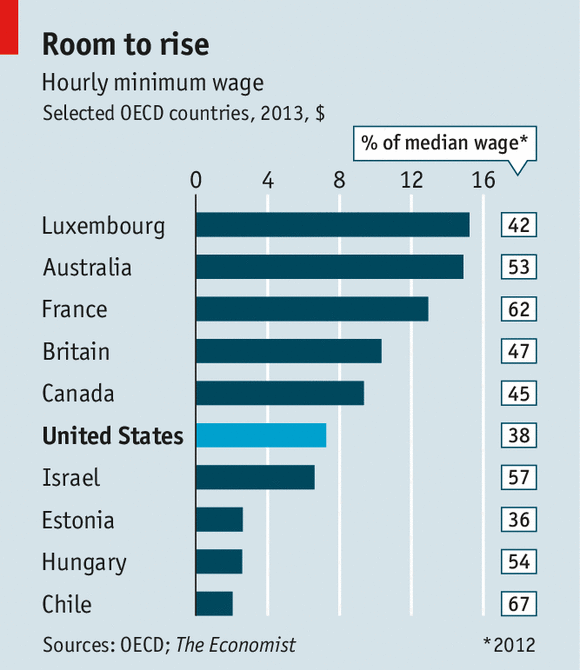
There is no consensus among economists about the extent to which minimum wages kill jobs. But recent research suggests that relatively low rates (America’s is 38% of the median wage) are not harmful, and that small increases can be beneficial. They not only lift workers’ purchasing power; they also make them more loyal, and so reduce the amount companies must spend recruiting new people.

Mr Obama will not convince Republicans in the House of Representatives to vote for an increase. But by raising the idea he may help Democrats in next year’s midterm elections, particularly in red states where local minimum-wage rises are on the ballot. Republican voters do not recoil at the prospect; 58% told Gallup in November that they would support a rise to $9 an hour; overall, 78% of Americans agree.

Advocates for a higher federal minimum wage point out that, in real terms, it is well below its peak in 1968. That is true, but misleading. First, the big drop came in the 1970s and early 1980s, not recently. Second, as David Neumark of the University of California, Irvine, has pointed out, the earned-income tax credit, a federal subsidy for low-wage workers, makes up for a lot of the losses.

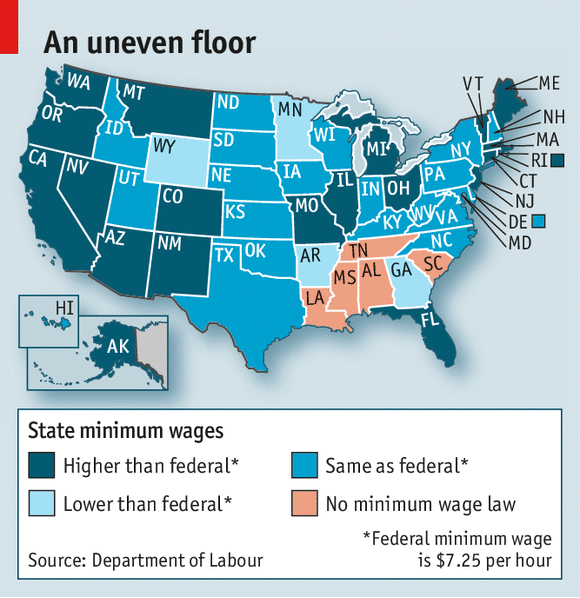
Moreover, the proliferation of state and municipal minimum wages means that the federal rate covers far fewer people than it once did. In 1979 7.9% of workers toiled at or below the federal minimum wage; last year 2.8% did. From January 1st 21 states will have a minimum wage higher than the federal one (see map). More may introduce one next year; others will raise theirs further.


Variable minimum wages make sense for a large country with variable costs of living. But they can have unexpected consequences. The campaign in SeaTac became a big issue during the concurrent mayoral race in Seattle; there, both candidates backed a $15 rate. John Burbank of the Seattle-based Economic Opportunity Institute now reckons the city will approve a $15 rate next year. Washington, DC and two neighbouring counties recently co-ordinated huge rate rises to stop firms playing them off against each other.

Such quirks are inevitable when politicians are left in charge. Most countries with a minimum wage outsource rate-setting to independent technocrats. Eleven American states and several cities index their rates to inflation; this can be awkwardly inflexible when economies stumble, but it does mean firms and workers avoid nasty shocks. Elsewhere, and at the federal level, minimum wages are subject to the fancies of politicians and voters.

Some agitators for higher pay focus on specific industries or companies, such as McDonald’s. Last week hundreds of union-backed workers went on the latest of a series of nationally co-ordinated strikes calling for a $15 wage. That figure, according to a recent business-backed survey, would lead to “personnel decisions” (management-speak for cutting jobs or hours) at 86% of fast-food and other franchises. Ron Shaich, the boss of Panera, a chain of 1,800 eateries, is an exception in the industry; he backs an increase in the minimum wage so long as it applies to everyone.

Other business leaders feel differently. The solution to the “wage problem” said Jim McNerney, the boss of Boeing, this week, is not a minimum wage but “an economy that’s growing”. But John Schmitt of the CEPR says the demand for a $15 wage is best understood as a broader push for collective-bargaining rights. Perhaps some employers can be convinced to pay higher wages as part of a strategy to reduce job churn, he suggests.

This happened with caretakers (janitors) in the late 1990s, after a decade of campaigns. An industry once staffed by ill-paid part-timers now pays workers in unionised cities $15 or more an hour.

The Hubble bubble theory of the continuous expansion of the financial universe

The Hubble bubble theory of the continuous expansion of the financial universe

Izabella Kaminska | Dec 06 19:28 | 29 comments | Share

Part of the BITCOINMANIA SERIES

Or something like it. We’re not, after all, physicists. Though, feel free to read about the Hubble Bubble theory here. What we probably should be referring to is Hubble’s flow, the rate at which expansion of the universe occurs. Read more of this post

The Hedge Fund Way: Pay More, to Get Less, and Be Unable to Access Your Money

The Hedge Fund Way: Pay More, to Get Less, and Be Unable to Access Your Money

By Nick Summers December 06, 2013

Another month, another marker that hedge funds are having an annus horribilis: With returns of 7.1 percent so far this year, the industry is badly trailing the broader market, where the Standard & Poor’s 500-stock index has gained 29.1 percent. If the pace continues, 2013 will be the worst year for the asset class, compared with stocks, in nearly a decade. Hedge fund manager Stanley Druckenmiller called the results a “tragedy” on Bloomberg TV on Nov. 22. Read more of this post

The future of the Paris Bourse: France fights for its stock exchange

The future of the Paris Bourse: France fights for its stock exchange

Dec 7th 2013 | PARIS | From the print edition

FRENCH moneymen were in Beijing in November talking up their financial wares to the people who have the cash these days. Whether the Chinese will snap up French stocks, bonds and asset management as readily as they do Hermès scarves remains to be seen. In fact, Paris’s very future as a financial centre is in doubt. Read more of this post

The first world war: A century on, there are uncomfortable parallels with the era that led to the outbreak of the first world war

The first world war: A century on, there are uncomfortable parallels with the era that led to the outbreak of the first world war

Dec 21st 2013 | From the print edition

AS NEW YEAR approached a century ago, most people in the West looked forward to 1914 with optimism. The hundred years since the Battle of Waterloo had not been entirely free of disaster—there had been a horrific civil war in America, some regional scraps in Asia, the Franco-Prussian war and the occasional colonial calamity. But continental peace had prevailed. Globalisation and new technology—the telephone, the steamship, the train—had knitted the world together. John Maynard Keynes has a wonderful image of a Londoner of the time, “sipping his morning tea in bed” and ordering “the various products of the whole earth” to his door, much as he might today from Amazon—and regarding this state of affairs as “normal, certain and permanent, except in the direction of further improvement”. The Londoner might well have had by his bedside table a copy of Norman Angell’s “The Great Illusion”, which laid out the argument that Europe’s economies were so integrated that war was futile. Read more of this post

The Federal Reserve at 100: Age shall not weary her; America’s central bank has become ever more powerful over the past century

The Federal Reserve at 100: Age shall not weary her; America’s central bank has become ever more powerful over the past century

Dec 21st 2013 | From the print edition

AS THE holiday season of 1913 drew near, only one thing stood between Woodrow Wilson and a long-awaited vacation on the Gulf of Mexico. Congress was still fighting over a bill to create the Federal Reserve, and Wilson had threatened to keep it in session over Christmas until the bill was ready for his signature. Read more of this post

The Economist’s country of the year: Resilient Ireland, booming South Sudan, tumultuous Turkey: our country of the year is…

The Economist’s country of the year: Resilient Ireland, booming South Sudan, tumultuous Turkey: our country of the year is…

Dec 21st 2013 | From the print edition

HUMAN life isn’t all bad, but it sometimes feels that way. Good news is no news: the headlines mostly tell of strife and bail-outs, failure and folly.

Yet, like every year, 2013 has witnessed glory as well as calamity. When the time comes for year-end accountings, both the accomplishments and the cock-ups tend to be judged the offspring of lone egomaniacs or saints, rather than the joint efforts that characterise most human endeavour. To redress the balance from the individual to the collective, and from gloom to cheer, The Economist has decided, for the first time, to nominate a country of the year. Read more of this post

Smart beta-blocking; The ugly truth about smart beta

Smart beta-blocking

Dan McCrum

| Dec 06 13:57 | 4 comments | Share

ScreenShot0141-590x337

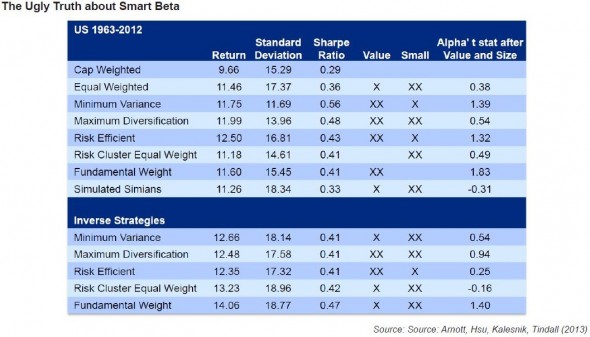
We are big fans of index tracking, particularly for those cash strapped and socially sensitive large pension funds, and we are far from alone: passive is massive for a reason. But where there’s a fee there’s a way. As alternative investments suffer the slowzombification of poor performance, active managers have been trying to find a way into this passive game, prompting some elegant demolition. Read more of this post

Risks of QE are in the descent; Too slow a removal of stimulus could generate risky asset bubbles

December 20, 2013 8:32 am

Do not get wrongfooted on descent from QE

John Authers

Too slow a removal of stimulus could generate risky asset bubbles

The expected Christmas rally in the stock market finally arrived this week. US stock markets hit yet another all-time high, after sagging for several weeks. Read more of this post

Path to a stronger financial system still strewn with dangers

Path to a stronger financial system still strewn with dangers

Fri, Dec 20 2013

By Huw Jones

LONDON (Reuters) – “What a week”, tweeted European Union financial services chief Michel Barnier on Thursday after securing an agreement on how to wind up failed banks without making the region’s taxpayers foot the bill. Read more of this post

Bond Sales Slump to 2002 Low in Europe as Banks Cut Debt Piles

Bond Sales Slump to 2002 Low in Europe as Banks Cut Debt Piles

Bond sales dropped to the least since 2002 in Europe this year, with financial institutions curbing issuance as they cut debt to meet capital demands from regulators. Read more of this post

Banks Said to Snitch on FX Competitors in Race to Avoid EU Fines

Banks Said to Snitch on FX Competitors in Race to Avoid EU Fines

Banks are racing to betray their competitors to avoid possible European Union fines for rigging foreign-exchange markets, according to a person with knowledge of the EU’s preliminary investigation. Read more of this post

As stocks hit record highs, so do profit warnings; There are 10 companies warning of a profit shortfall per each positive call

As stocks hit record highs, so do profit warnings

Adam Shell, USA TODAY7:54 a.m. EST December 12, 2013

Even though CEOs are warning of profit misses at a pace not seen since 2001, Wall Street pros say cautious CEO guidance won’t derail the mighty bull.

STORY HIGHLIGHTS

Profit warnings spike; on track for worst showing since 2001

There are 10 companies warning of a profit shortfall per each positive call

Wall Street takes note, but says market won’t be derailed by CEO profit confessions Read more of this post

A bull market without buyers

A bull market without buyers

Dan McCrum

| Dec 16 13:34 | 1 comment | Share

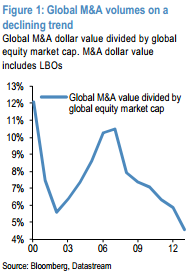
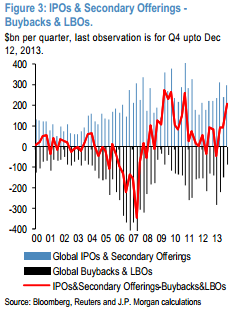
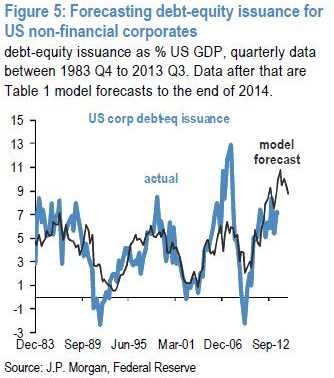
A particular kind of buyer, at any rate. Talk of corporate cash piles has become cliché, while private equity has been turning a corner for so long it has entered some sort of fee-paying mobius strip. But it remains the case that stock markets have gone up without many purchases of companies in their entirety.

2013-12-16-09.16.31-am 2013-12-16-09.20.29-am ScreenShot027

Read more of this post

Index Effect Raises New Concerns

Index Effect Raises New Concerns

Paul Amery

December 05, 2013

In the 1970s an economic advisor to the Bank of England defined a rule that is still used. According to Charles Goodhart, “when a measure becomes a target, it ceases to be a good measure”. Read more of this post

How Turkey’s Troubles Could Spread in Emerging Markets

DECEMBER 20, 2013, 7:32 PM

How Turkey’s Troubles Could Spread in Emerging Markets

By LANDON THOMAS JR.

As Turkey struggles to contain its latest political crisis, fears of a run on its currency — dormant since the summer — have quickly re-emerged. After arrests this week of Prime Minister Recep Tayyip Erdogan’s political and economic allies, the Turkish lira has plunged. The dollar reached a high of 2.092 against the lira, as foreign investors sold Turkish stocks and bonds and Turks shifted their savings into dollars. Read more of this post

Fidelity’s feverish fee cuts a bid to cure market share woes; How low will it go? Battle against Vanguard becomes a war of basis points

Fidelity’s feverish fee cuts a bid to cure market share woes

How low will it go? Battle against Vanguard becomes a war of basis points

By Jason Kephart   |  December 6, 2013 – 11:54 am EST

“Vanguarditis,” the asset manager infection that leads to fee cuts and happier advisers, has worked its way into the heart of the Boston Behemoth. Over the past few weeks, Fidelity Investments has made strategic fee cuts and launched new products to ensure that its products are the cheapest in two categories in which the Vanguard Group Inc. has been eating their lunch for a decade. Read more of this post

Christmas trees are a small but highly profitable part of the timber industry, where profit can be decades in coming

December 20, 2013

How Lucrative Thy Branches

By PAUL SULLIVAN

Chris Botek, a tree grower in Leighton, Pa., is used to people being shocked by how much his Christmas trees cost. “People come from the city and they’re used to paying $150 to $200 a tree,” he said. They look at you and say, ‘Are you kidding me?’ ” Mr. Botek gets $6.25 a foot — that’s $50 for a fresher version of that eight-foot tree sitting on an urban sidewalk. Read more of this post

Investment Fads and Themes, 1996-2013

Investment Fads and Themes, 1996-2013

Joshua M Brown

December 12th, 2013

investment-fads-themes

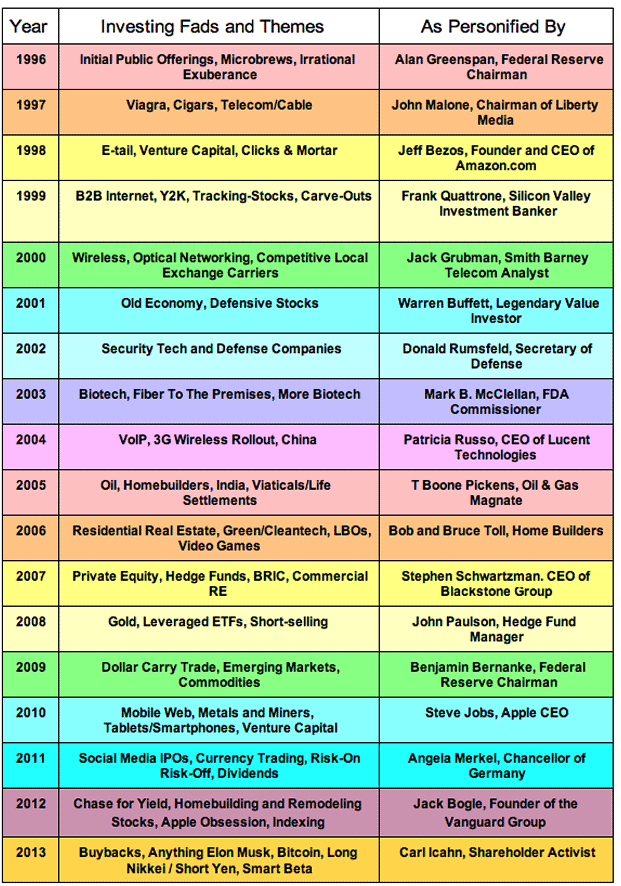
Another year in the books and I’ve updated my Investing Fads and Themes by Year guide accordingly. It begins with 1996 because that was my first summer working on The Street and my earliest exposure to the market. I do this every December because I agree with the eminent philosopher Bob Marley when he reminds us “If you know your history, then you would know where you’re coming from.” If we don’t keep tabs and learn from the lunacy that grips us from year to year, then how can we truly say that we’ve grown as investors? Read more of this post

Death of the contrarian

Death of the contrarian

Dan McCrum

| Dec 19 16:30 | 3 comments | Share

ScreenShot035-590x403

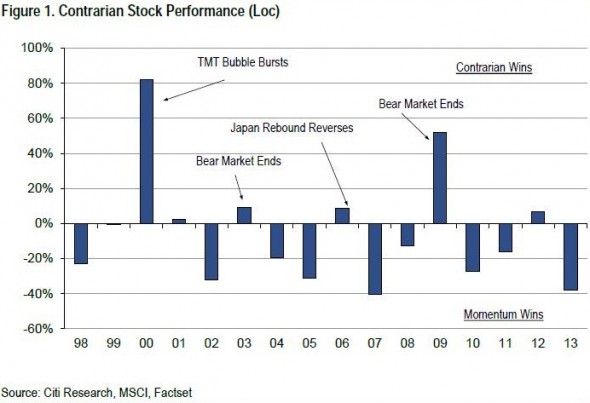
It has been a year to jump on a bandwagon sailing with the wind at the heart of the pack. Momentum, baby. Let Citi paint you a picture: A two-year, 40 per cent rally in global equities is not the time to be a contrarian (unless you were the bold type calling for it back in the dog days of 2012). Still, Citi warns that the contrarians do tend to do well in January, and they won’t give up: Read more of this post

Bursting the Stock-Market-Bubble Bubble

Bursting the Stock-Market-Bubble Bubble

JUSTIN LAHART

Dec. 15, 2013 1:46 p.m. ET

MI-CA230_BUBBLE_G_20131215203605

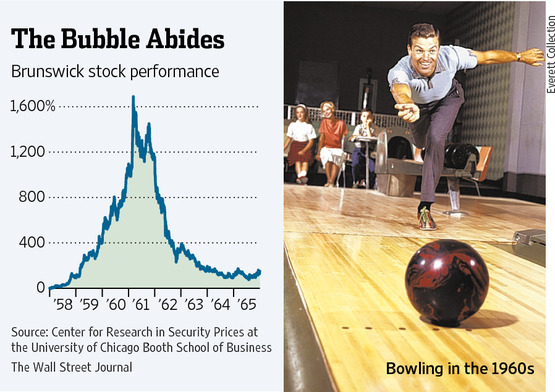
No, stocks are not in a bubble. But that doesn’t mean investors must like them. With the S&P 500 up a blistering 25% this year, and with stocks like Tesla MotorsTSLA +1.79% sporting valuations that strain belief, the word “bubble” has been getting batted around a lot lately. Case in point: Over the past three months, a Factiva search returns 391 news articles with “bubble” in close proximity to “stock market”, up from 130 over the same period last year. Read more of this post

Is the stock market still a playground for the rich? Everyday investors are wary of stock investing

Dec. 13, 2013, 6:15 a.m. EST

Is the stock market still a playground for the rich?

Opinion: Everyday investors are wary of stock investing

By Howard Gold

As stocks keep hitting new milestones, more and more pundits worry we’re in another stock market bubble.

They cite record margin debt, euphoria over initial public offerings like that of Twitter (NYSE:TWTR)  , and, of course, the big run we’ve already seen in the major indices. Read more of this post

Corporate Culture Matters in Investing

Corporate Culture Matters in Investing

By Brian Stoffel | More Articles | Save For Later
December 18, 2013 | Comments (1)

gdoor_large

Lots of investors think the key to finding wealth-creating returns is to meticulously study a company’s financial statements. That strategy may work, but if you’re a beginning investor who isn’t sure where to start, know that this is far from the only way to succeed in the stock market. Investigating a company’s culture can be just as important — if not more so — than studying its income statement. Read more of this post

You Win By Thinking Everyone Else Is Wrong

You Win By Thinking Everyone Else Is Wrong

By Morgan Housel | More Articles | Save For Later
December 13, 2013 | Comments (17)

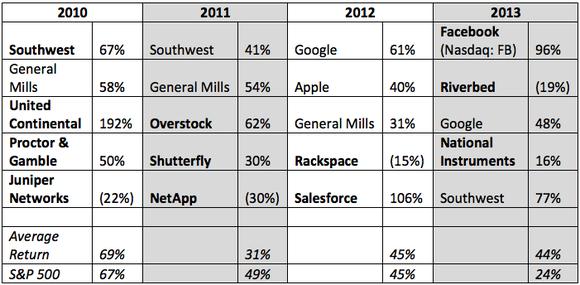
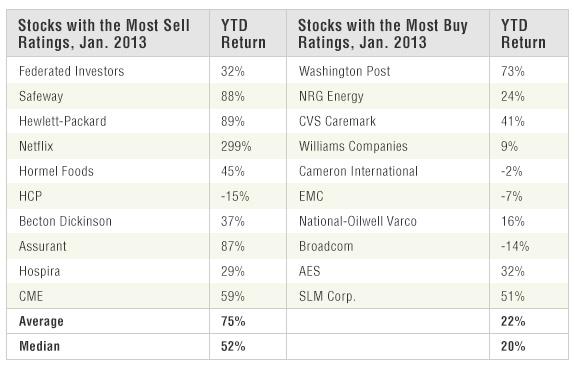
I heard an amazing statistic earlier this year. According to Bloomberg, the 50 stocks with the lowest Wall Street analyst ratings at the end of 2011 outperformed the S&P 500 by seven percentage points in 2012. Think about that. Warren Buffett’s goal was once to outperform the market by 10 percentage points a year. Doing the opposite of what Wall Street’s smartest minds recommended last year got you two-thirds of the way there. As we head toward bonus season, how did finance’s top analysts do this year? I dug through FactSet data on companies with the most buy and sell recommendations as of January. Drum roll…

unnamed1_large

Includes dividends, through December 11, 2013. Read more of this post

This is How Warren Buffett Interprets Financial Statements

This is How Warren Buffett Interprets Financial Statements

by Jae JunDecember 19, 2013

Warren Buffett is one of a kind and while he provides amazing insight and knowledge year after year in his letters and speeches, details about how to choose companies and what to look for is lacking. Warren Buffett and the Interpretation of Financial Statements is a book that manages to explain how Warren Buffett interprets financial statements which we will go through. Read more of this post

Local Government Handbook: How to Create an Innovative City

Local Government Handbook: How to Create an Innovative City

Dec 20, 2013 Latin America

In 2012, Citibank and The Wall Street Journal awarded Medellín, Colombia, the prestigious title of “Innovative City of the Year.” In just a short period of time, Medellín has transformed itself from a violence-ridden, global drug capital to a model cosmopolitan metropolis with an award-winning public transportation system, a growing entrepreneurial ecosystem, and an increasingly attractive environment for foreign investment. How did Medellín, the second-largest city in Colombia, with more than 2.7 million residents, make this quantum leap forward? What factors are necessary to ensure the success of such a large-scale effort? What lessons from Medellín’s example can other emerging cities adopt to execute this type of sustainable change? Read more of this post

Seeking driven soulmates

Seeking driven soulmates

He was first sent to Asia to “turn around a crisis of confidence” at public relations and advertising firm Ogilvy & Mather’s Taiwan office. He did so well that in two-and-a-half years — a relatively short period of time — adman Stephen Mangham was sent to lead the Singapore regional office.

BY ALICIA WONG –

5 HOURS 10 MIN AGO

He was first sent to Asia to “turn around a crisis of confidence” at public relations and advertising firm Ogilvy & Mather’s Taiwan office. He did so well that in two-and-a-half years — a relatively short period of time — adman Stephen Mangham was sent to lead the Singapore regional office. Read more of this post