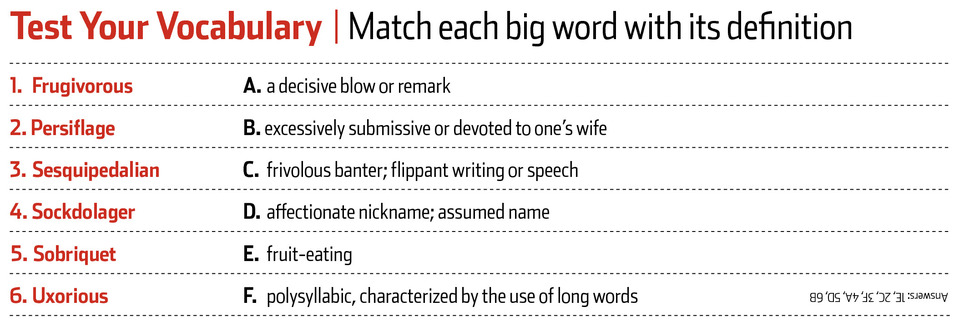
Big Words Are Fading, But Many People Still Love Them; Can those who enjoy sesquipedalian words, and those who find them annoying, learn to connect
April 4, 2014 Leave a comment
Big Words Are Fading, But Many People Still Love Them
Can those who enjoy sesquipedalian words, and those who find them annoying, learn to connect
ELIZABETH BERNSTEIN
March 24, 2014 6:54 p.m. ET
I love big words. It started when I was a kid and first heard “supercalifragilisticexpialidocious.” (“Something to say when you don’t know what to say,” according to the movie “Mary Poppins.”)
I quickly moved on to real words: “Ebullient,” “innocuous” and “malodorous” were some of my favorites. If I came across a word I didn’t know in a book, I looked it up. I made flashcards to help myself remember the ones I particularly liked. Now I’m worried that big words—the challenging, expressive and interesting ones—might start going away.
Big words can be tough on relationships. Messy versus neat, early bird versus night owl—add to this list language junkies versus those with a tweet-ready vocabulary. The problems that big words cause are overlooked. Can people who enjoy using big and obscure words, and those who are annoyed by them, get through to each other?
Technology is largely to blame for big words’ fade out. We are being conditioned to communicate faster and in shorter bursts. There isn’t room for big words in a text or a tweet or even a quickly dashed-off email. We’re communicating across so many different channels that, by sheer necessity, our language is becoming abbreviated (“R u with me?”).
Earlier this month, the College Board, which runs the SAT tests, said among other changes it will drop obscure vocabulary words. Instead of quizzing students on definitions of words such as “prevaricator,” “sagacious,” and “ignominious,” the test will focus more on reading comprehension and understanding words whose meanings shift in context, like “synthesis” and “empirical.”
In grammar school, Jack Bonneman studied a Scripps-Howard spelling bee booklet every night because he liked to learn new words; he went on to become a spelling bee champ. One of his all-time favorite words, which he spelled correctly in fifth grade, is “otorhinolaryngology,” the study and treatment of diseases of the ears, nose and throat.
But big words—the words that others perceive to be obscure or “fancy”—have also caused him trouble. In college, he bought his girlfriend the hair-straightening iron she had been hinting about for Christmas and told her, “I thought it was perfect for you, given your fastidious nature when it comes to your appearance.”
Mr. Bonneman says she threw the gift on the couch, snapped, “Well, aren’t you smart?” and stormed out of the room. Then she broke up with him.
“She claimed it had largely been due to my constant use of big words, which made her feel stupid,” says the 28-year-old, who is chief executive of a Miami digital-design agency.
Several years later, Mr. Bonneman says, he received some advice from a colleague before an interview for an IT job. “Don’t use any words that are more than three syllables long—you don’t want the hiring manager to think you are smarter.”
Mr. Bonneman dismissed the advice and during the interview dropped “esoteric,” “penultimate,” “non sequitur,” “didactic and “circumlocute” on the interviewer.
Can language junkies, who are comfortable using big and obscure words every day, live happily with people who are put off by big words? Bonds columnist Elizabeth Bernstein has some tips for using big words. Photo: AP.
“Using ‘vocabulary words’ feels much more natural to me than trying to force the use of shorter words in their stead,” he says. He didn’t get the job.
One reason word nerds aren’t intimidated by sesquipedalian language is that they like discovering new words and looking them up.
“I think we should be glad there are people in the world who can teach us new things,” says Ellen Jovin, co-founder of Syntaxis, a communication-skills training firm in New York. “If I hear a word I don’t know—as long as it is not merely a silly business buzzword that obfuscates rather than illuminates—I am happy to have the opportunity to learn something that I didn’t know before,” Ms. Jovin says.
When choosing your words, Ms. Jovin says it’s important to consider your motivation. “If you are using $50 words to show off, and you know people will not understand them, then that is unkind and annoying, and they have a reason to react negatively,” she says.
Be absolutely sure of the definition. “Misuse of big words is a disaster,” she says. “You are not only a phony but you are bad at being a phony,” she says.
Consider your audience. You can’t be absolutely certain which words will be familiar to the person you are speaking with. But you can get close, Ms. Jovin says. As you are speaking, make adjustments based on who is listening. Your goal is to communicate well. You can’t do that if the other person has no idea what you are saying.
Ramsey Bahrawy, a 59-year-old elder-law attorney in North Andover, Mass., says he learned to love big words from his mother, who taught him to look up any word he didn’t know. Still, he now uses big words only when he is speaking with family members or friends he knows will understand them. Words that he saves for people he knows well include “perfidiousness,” “excogitate,” “perspicacious” and “remunerative.”
“Big words have an intimidation factor,” Mr. Bahrawy says. “And to be effective, I need to communicate on a level everyone understands.”
When speaking with clients, jury members and even other attorneys, Mr. Bahrawy says he limits himself to a vocabulary appropriate for someone with a fifth-grade education. He stays away from “vicissitudes” and instead refers to “the changes that occur in your life.”
To determine what type of words to use, Mr. Bahrawy says he will “throw a big word out there and engage a person’s reaction. If the reaction is a blank stare, I will adjust what I have to say.”
“I want people to feel comfortable,” he says. “I want them to feel like they want to be my friend and be around me.”
 About bambooinnovator

