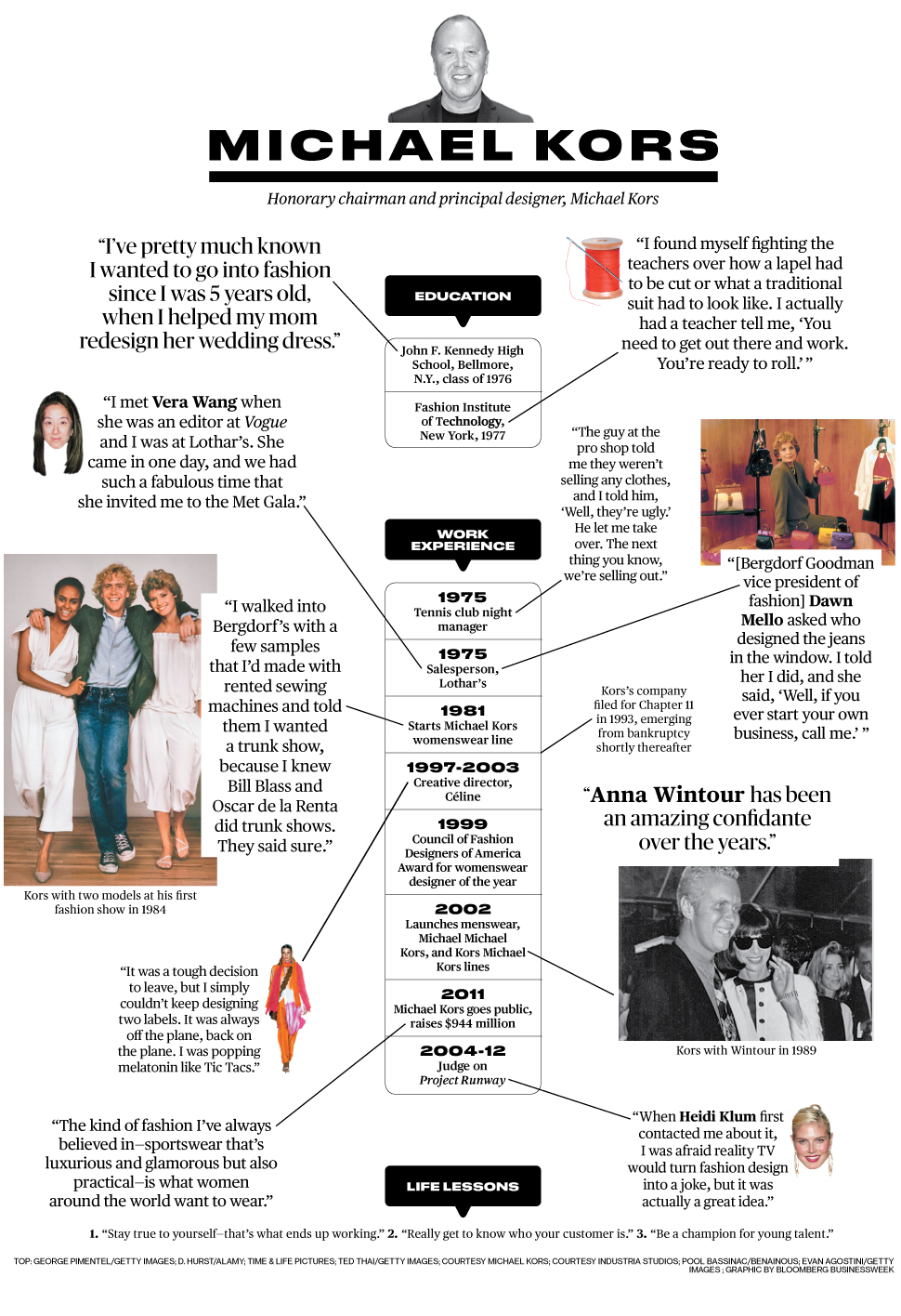
Michael Kors: How Did I Get Here?
August 30, 2013 Leave a comment
Michael Kors: How Did I Get Here?
August 29, 2013
The fashion designer on his first trunk show, joining Project Runway, and other high points of his career.
R.E.S.-ilience in Value Creation 《竹经:经商经世离不得立根创新》
August 30, 2013 Leave a comment
Michael Kors: How Did I Get Here?
August 29, 2013
The fashion designer on his first trunk show, joining Project Runway, and other high points of his career.
August 30, 2013 Leave a comment
Ways to Fend Off The Wealth-Sapping Costs of a Disability
Lynn Francis was worried when her 81-year-old mother Joann started forgetting things a few years ago. Her fear turned to panic as her mother began inviting strangers into her house and giving away bank account information to just about anyone on the other end of the phone. Joann has become increasingly reclusive, afraid even to leave her house to go to the supermarket lest she forget how to find her way back. Lynn, who lives four hours away in Beaverton, Oregon, now takes turns with her sister buying her mother groceries. “Living alone has really become a safety issue for her,” says the 58-year-old yoga instructor. She’s trying to convince her mother to move into an assisted living facility. Read more of this post
August 30, 2013 Leave a comment
August 29, 2013, 6:16 p.m. ET
Noonan: Work and the American Character
We need political leaders who can speak to the current national unease.
Two small points on an end-of-summer weekend. One is connected to Labor Day and the meaning of work. It grows out of an observation Mike Huckabee made on his Fox show a few weeks ago. He said that we see joblessness as an economic fact, we talk about the financial implications of widespread high unemployment, and that isn’t wrong but it misses the central point. Joblessness is a personal crisis because work is a spiritual event. Read more of this post
August 30, 2013 Leave a comment
Michael Mauboussin, Interview No. 4
by SHANE PARRISH on AUGUST 28, 2013
Michael Mauboussin is the author of numerous books, including More Than You Know: Finding Financial Wisdom in Unconventional Places, Think Twice: Harnessing the Power of Counterintuition, and most recently The Success Equation: Untangling Skill and Luck in Business, Sports, and Investing (a book that found its way to Warren Buffett’s desk.)
While Michael is well known in investment circles for his knowledge of biases and clarity of thinking, a lot of others are missing out on his insight. In his latest book he takes a look at how both skill and luck play a role — they are, on a continuum. For instance, he believes that basketball is 12% luck whereas hockey is 53% luck. Skill still plays a certain role but talent might mean more in certain places. I was fortunate to have an opportunity to interview Michael over email. In this wide-ranging interview we talk about what advice he’d offer his younger self today, the definition of luck, decision journals, and how organizations can improve their decisions and more. Let’s get started. Read more of this post
August 30, 2013 Leave a comment
Did life on Earth start on Mars? A scientist lays out the evidence
By Deborah Netburn
August 29, 2013, 7:09 p.m.
Did life as we know it start on Mars? Are we all Martians? These are the questions some serious scientists are considering. Speaking at an international conference of geochemists, chemist Steven Benner of the Westheimer Institute of Science and Technology argued Thursday that early Mars provided a more hospitable environment for life to spring up than early Earth. “The evidence seems to be building that we are actually Martians; that life started on Mars and came to Earth on a rock,” he said in a statement. Read more of this post
August 30, 2013 Leave a comment
The Brazilian Billionaire Who Controls Your Beer, Your Condiments, and Your Whopper
By Alex Cuadros August 29, 2013

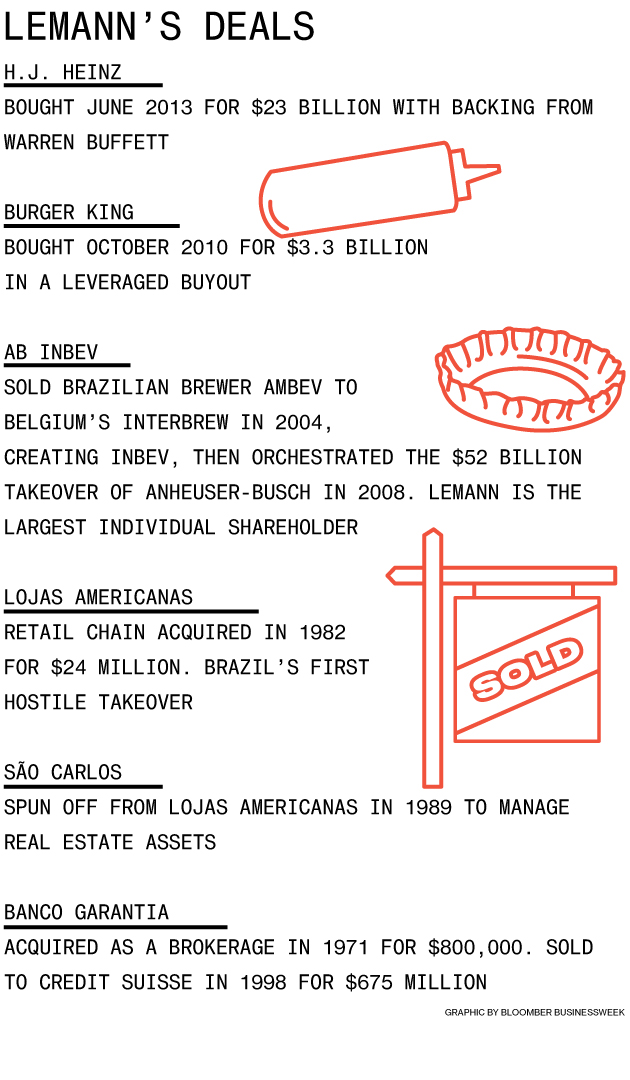
After they sold H.J. Heinz to Warren Buffett and a bunch of Brazilians in June, the ketchup manufacturer’s outgoing board of directors met for dinner at Pittsburgh’s Duquesne Club to congratulate themselves on a job well done. Twenty-three billion dollars had just changed hands. The takeover price, at $72.50 a share, was almost 20 percent higher than the company’s recent all-time high. “We said we’re all going to miss each other, but we felt we had done right by the shareholders,” says Dean O’Hare, who’d sat on the board since 2000. Heinz is an institution in Pittsburgh—the Steelers play at Heinz Field, locals of means like to get married at Heinz Memorial Chapel—and Buffett’s presence allayed fears that the 144-year-old company would be dismantled. “Seeing the name on the letter was very important to us,” O’Hare says.
August 30, 2013 Leave a comment
August 29, 2013 6:36 pm
Hedge funds should invest in smoother handovers
By Gillian Tett
The sector’s stars tend to be mavericks with outsized egospower-sharers
This summer Glenn Dubin, the co-founder of the hedge fund Highbridge Capital Management, has been kicking back – a bit. The reason? Twenty-one years after the 56-year-old created the fund, Mr Dubin recently handed control of his $32bn “baby”, as he calls it, to a former Goldman Sachs banker, Scott Kapnick. But Mr Dubin has not stormed off in a tantrum. He is still working in Highbridge’s Manhattan office to support Mr Kapnick, his handpicked successor.
August 30, 2013 Leave a comment
The Most Surprising Things About America, According To An Indian International Student
GUS LUBIN AUG. 29, 2013, 9:18 PM 10,584 26
Aniruddh Chaturvedi came from Mumbai to Carnegie Mellon University in Pittsburgh, Penn., where he is majoring in computer science. This past summer he interned at a tech company in Silicon Valley. During two years in the U.S., Chaturvedi has been surprised by various aspects of society, as he explained last year in a post on Quora. Chaturvedi offered his latest thoughts on America in an email to Business Insider. Read more of this post
August 30, 2013 Leave a comment
Food companies and innovation: The Greek-yogurt phenomenon in America left big food firms feeling sour. They are trying to get better at innovation
Aug 31st 2013 |From the print edition
A Kurd and his whey-free way to success

FEW business careers have been as spectacular as Hamdi Ulukaya’s. He bought an 85-year-old yogurt factory in upstate New York in 2005 and sold his first pot of Chobani “Greek” yogurt 18 months later. This year he expects to sell more than $1 billion-worth of it. Greek-style yogurt’s share of America’s $6.1 billion market has risen from negligible when Chobani started to nearly half. “No category changed faster,” boasts Mr Ulukaya, the sole owner of the firm that makes Chobani. Read more of this post
August 30, 2013 Leave a comment
The entrepreneurial state: A new book points out the big role governments play in creating innovative businesses
Aug 31st 2013 |From the print edition

APPLE is generally regarded as an embodiment of everything that is best about innovative businesses. It was started in a garage. For years it played a cool David to Microsoft’s lumbering Goliath. Then it disrupted itself, and the entire entertainment industry, by shifting its focus from computers to mobile devices. But there is something missing from this story, argues Mariana Mazzucato of Sussex University in England, in her book, “The Entrepreneurial State”. Steve Jobs was undoubtedly a genius who understood both engineering and design. Apple was undoubtedly a nimble innovator. But Apple’s success would have been impossible without the active role of the state, the unacknowledged enabler of today’s consumer-electronics revolution. Read more of this post
August 30, 2013 Leave a comment
Updated: Friday August 30, 2013 MYT 9:11:05 AM
Herbalife Billionaire Brawl Puts Spotlight On N.J. Professor
BOSTON/NEW YORK: In the battle of investors who’ve made opposite bets on the shares of Herbalife <HLF.N>, both sides – including firms led by billionaires Bill Ackman and George Soros – have consulted a New Jersey college professor and studied his research. For decades, William Keep, dean of the School of Business at the College of New Jersey, has pursued a relatively obscure marketing specialty known as multilevel marketing businesses, or MLMs. But as a new go-to adviser for some of Wall Street’s biggest players, Keep has been suddenly thrust into the spotlight. Read more of this post
August 30, 2013 Leave a comment
What Stops Leaders from Showing Compassion
by Roger Schwarz | 8:00 AM August 29, 2013
Most good people want to act compassionately at work. And recent research suggests that compassion also creates positive outcomes in organizations: People who experience compassion feel more committed to the organization and feel more positive emotions at work; when people receive bad news that is delivered with compassion, they remain more supportive of the organization; and acting with compassion can increase your own satisfaction and mitigate your own stress at work. And yet even if you want to be compassionate with others at work, you may find it difficult. You may find yourself either judging others or making assumptions about what will happen if you are compassionate. This can be especially challenging for leaders. As a leader, you get paid for your judgment. You are constantly evaluating situations and people. But that strength can become a liability when others need your compassion. If you find yourself thinking any of the thoughts below, chances are you’re letting your judgment get too much in the way of your compassion:
“Your suffering isn’t that serious.” When you tell yourself that others’ suffering isn’t serious enough, you’re saying they don’t deserve compassion. When your direct reports say, “We’re totally overwhelmed with work and can’t get any cooperation from the other divisions,” do you think, “Your workload is nothing; you have no idea how much I’m working. Stop complaining and make it happen”? Suffering isn’t a competition. Other people’s suffering doesn’t have to exceed yours for you to be compassionate. Remember that acting with compassion can also reduce your own stress. Read more of this post
August 30, 2013 Leave a comment
Cancer’s Primeval Power and Murderous Purpose
It was 2010 and I was driving through the badlands of northwest Colorado, far from the cool, green Rocky Mountains. This was the land where the oldest known example of cancer had been found: inside of a bone of a Jurassic Age dinosaur. About 150 million years ago, the malignant growth had eaten away at the beast. It died and was buried under the layered debris of the ages. But a fragment of its petrified skeleton chanced to survive. It was discovered by an unknown rock hunter, cut and polished in a rock shop, and purchased by a man on vacation — a doctor who knew bone cancer when he saw it. Read more of this post
August 30, 2013 Leave a comment
August 28, 2013, 6:59 p.m. ET
Wine Consultant Charles Curtis on Spotting a Wine Fake
The Signs a Wine Isn’t What Its Label Says It Is
JASON CHOW

As the market for fine wine grows, so does the opportunity for making money from passing off a cheap blend as pricey aged Bordeaux. Wine counterfeiters “are getting really sophisticated,” says Charles Curtis, a New York-based wine consultant who, through his company Wine Alpha, offers a service that checks for fakes in the cellars of wealthy collectors throughout the world. “People are reusing old bottles, reapplying labels and corks—it’s complex.” Few wine collectors have seen as many old bottles as Mr. Curtis, a former head of wine for Christie’s auction house in Asia and the Americas. He now advises private clients on how to start or sell a collection as well as verifying the wines they own. Read more of this post
August 30, 2013 Leave a comment
Naming and shaming: Macau website targets deadbeat gamblers
5:59am EDT
By Farah Master
HONG KONG (Reuters) – Hustler, cheater, robber, rogue. Gamblers who skip out on casino debts in Macau risk being branded with these monikers and having personal details made public by a website that says it has helped to recover 50 million yuan ($8 million) so far. But the novel strategy to combat bad debts in the world’s largest gambling destination is under scrutiny from the police for possibly breaking the law and from the Chinese territory’s gaming authority over privacy concerns. The bilingual website, called Wonderful World in English, features a blacklist of more than 70 people from across China who it says have failed to repay gambling debts ranging from thousands to millions of yuan. Photographs of alleged deadbeats, along with their date of birth and marital status, are displayed prominently. A bounty is often offered for help in tracking them down. Read more of this post
August 29, 2013 Leave a comment
Innovation Isn’t an Idea Problem
by David Burkus | 8:00 AM July 23, 2013
When most organizations try to increase their innovation efforts, they always seem to start from the same assumption: “we need more ideas.” They’ll start talking about the need to “think outside the box” or “blue sky” thinking in order to find a few ideas that can turn into viable new products or systems. However, in most organizations, innovation isn’t hampered by a lack of ideas, but rather a lack of noticing the good ideas already there. It’s not an idea problem; it’s a recognition problem. Read more of this post
August 29, 2013 Leave a comment
Is Bias Fixable?
by Nilofer Merchant | 10:16 AM August 28, 2013
“As a brown woman, your chances of being seen and heard in the world are next to nothing,” he said. “For your ideas to be seen, they need to be edgier.” He paused, as if to ruminate on this, before continuing. “But if you are edgy, you will be too scary to be heard.” This was the advice I got from a marketing guru when I asked for his help with titling my second book. I was confused, as I couldn’t figure out how this answer had any relationship to my original question. I walked — somewhat dazed — to my next meeting and repeated what I’d just heard. In return, I received only blank stares. It wasn’t that these people affirmed his point of view; it’s that they stayed silent. My confusion gradually turned to fear. Was someone finally doing me a service by telling me … The Truth? For months after hearing this “… you’ll never been seen” message, I was a mess seeing his “truth” into every missed opportunity or unexpected obstacle. Read more of this post
August 29, 2013 Leave a comment
Startups are a young person’s game: Leasing a soul to build better companies
BY OPHIR TANZ
ON AUGUST 28, 2013
Institutional investment in tech entrepreneurs dates back half a century, and during that period the average age of funded entrepreneurs has plummeted. The first Silicon Valley entrepreneurs were in their middle age. Today a typical early stage venture capital investment, $1 million or more, is pooled from pension funds, charities, endowments and sovereign wealth funds and entrusted to a 20-something with zero work experience, no real understanding of how to manage people or capital, no ability to command a room, garner press, or even put together decent financials. Read more of this post
August 29, 2013 Leave a comment
How JoJo Maman Bebe founder Laura Tenison shunned university to start a business
Laura Tenison’s upbringing was “pretty sexist”, she jokes, with her mother teaching her only the girlie jobs of sewing and cooking. She is now arguably one of Britain’s most successful entrepreneurs. Emma Sinclair asks her how she did it.
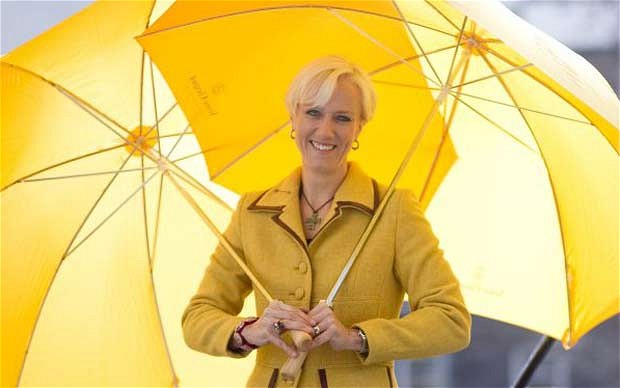
Laura Tenison is the founder of JoJo Maman Bebe, the maternity, baby and nursery company she started in 1993.
3:39PM BST 27 Aug 2013
Laura Tenison is the founder of JoJo Maman Bebe, the baby clothing retailer she started in 1993. The company has 46 stores across the UK, expanding at a rate of eight new stores a year in the UK and selling to 37 countries – and growing. In 2010, when Ms Tenison won Veuve Clicquot’s Business Woman of the Year trophy, the company had a turnover of £20m and 27 UK stores. The retailer has forecast revenue of £44m for 2014. All this on start-up capital of £50,000, conceived in a hospital bed. Read more of this post
August 29, 2013 Leave a comment
August 28, 2013 7:10 pm
The strategy consultants in search of a strategy
By John Gapper
Consultancy is in a funk as midsized partnerships realise they have to do something to survive
Did you hear the one about the strategy consultancy that could not work out a strategy for itself? It might make chief executives being billed $500 an hour for the wisdom of McKinsey & Co or Boston Consulting Group chuckle, but it is not a joke for the industry. Consultancy is in a funk as midsized partnerships with venerable names, such as Booz & Co and Roland Berger, realise they have to do something but cannot decide on what. Just carrying on is not an option – they face the spectre of Monitor, the consultancy that went bankrupt last year, and was bought by Deloitte for only $120m. Read more of this post
August 29, 2013 Leave a comment
August 28, 2013 6:00 pm
Scientists create human ‘mini-brain’
By Clive Cookson, Science Editor
Biomedical scientists have turned human stem-cells into pea-sized mini-brains with a neural structure similar to the brain of a developing embryo. These “cerebral organoids”, as they are termed formally, are the best living model of a human brain created so far. The scientists at the Institute of Molecular Biotechnology of the Austrian Academy of Sciences (IMBA) in Vienna have already used their mini-brains to investigate one neuronal disorder, microcephaly, in which the brain does not grow properly. They hope to apply the technique to more complex conditions such as autism and schizophrenia, for which no good animal models are available. Read more of this post
August 29, 2013 Leave a comment
Researchers take on crucial question: Are haters gonna hate?
By Sarah Kliff, Updated: August 27, 2013
It is an age-old adage of Twitter, which apparently traces its roots back to a 3LW video from 2000: Haters gonna hate.
Now, scientists have taken it upon themselves to figure out whether this is true. Do verified haters tend to hate everything else they stumble upon? Yes, according to a new study in the Journal of Personality and Social Psychology. People who tend to hate things they already know about are (surprise!) more disposed to hate things they have not yet come in contact with. To test out this theory, a team of psychologists asked study participants how they felt about a number of mundane and unrelated subjects that included (but was not limited to) architecture, health care, crossword puzzles, taxidermy and Japan. Read more of this post
August 29, 2013 Leave a comment
A Light Footprint Can Lead to Powerful Business Gains
by Charles-Edouard Bouée | 12:00 PM August 28, 2013
Some of the best current lessons on how to adapt to our changing business environment come from the realm of military doctrine. And one key methodology stems from mid-1990s, when students at the U.S. Army War College were told repeatedly they were preparing for leadership roles in a “Volatile, Uncertain, Complex, and Ambiguous” (VUCA) world. Barack Obama’s “Light Footprint” doctrine of warfare, featuring novel uses of drones, cyberweapons, special forces, allies, and proxies, is an early adaptation to the VUCA world. Read more of this post
August 29, 2013 Leave a comment
This Story Of A Government Worker Writing Letters To Himself May Be The Craziest-Ever Example Of Bureaucratic Waste
MAMTA BADKAR AUG. 28, 2013, 1:52 PM 6,189 14

Indian bureaucracy is famously the worst in Asia, and one of the worst in the world. Businessmen will often complain about how long it takes to get things done in India. And how it typically involves greasing someone’s palm. An incident involving Bhaskar Rao, the Inspector General of Police for Internal Security, is a truly epic case of bureaucratic waste. The Deccan Chronicle reports that in addition to being the Inspector General of Police, for Internal Security on August 1 the government made him the Inspector General in charge of training. Since then, Rao has been writing letters to himself. From the Deccan Chronicle:
“As the Inspector General of Police, Internal Security Division, Bhaskar Rao has to write to IGP, Training, Bhaskar Rao that his men from the Karnataka State Industrial Security Force need to be sent for training for which the date should be fixed at the earliest.
“He then goes back to the office of IGP, Training in Carlton House and replies to the letter that he had sent to himself a day before from his office as IGP, ISD on Richmond Road with the training schedule for the KSISF.
“In a letter addressed to IGP, ISD, Bhaskar Rao states that in response to “your letter seeking dates for training of your men we are sending you the following schedule as under. This cannot be changed…” s/d IGP, Training, Bhaskar Rao.” Read more of this post
August 29, 2013 Leave a comment
Updated: Thursday August 29, 2013 MYT 8:54:20 AM
Duo’s efforts lead to the creation of one of the country’s largest musical instrument supply companies
BY JOY LEE
JOYLMY@THESTAR.COM.MY
PHOTOS BY LOW BOON TAT
Customised to the tee: Eizaz Azhar (left) and Ray Lee of Guitar Empire have their eyes set firmly on becoming one of the biggest suppliers of musical instruments in the country. Growing ambition: Guitar Empire currently takes up 17,000sq ft of space in Endah Parade, but Lee and Eizaz hope to eventually turn the whole building into a music hub. Bestsellers : Guitars are the best-selling instrument in the store. Guitar Empire sells about 600 to 700 guitars a month. A turning point: Guitar Empire got a boost when a client placed an order for 300 violins, opening a door for the company to meet manufacturers.

Sometimes an unexpected diversion can turn out to be not just an enjoyable journey, but a profitable one as well. Ray Lee and Eizaz Azhar can attest to that. Lee and Eizaz are founders and directors of Guitar Empire, one of the largest musical instrument suppliers in the country. The company also runs a studio and a music school. Ironically, both do not have much of a musical background. Thirty-six-year old Lee grew up playing the guitar on his own and had frequented functions with his brothers as a group of buskers. He remembers getting kicked out of those functions a lot. As an adult, he took up photography, but remained passionate about music. He later left his job as a photographer to pursue his passion and started a small music school called Mama Treble Clef Studio. Eizaz, on the other hand, only took up classical piano at the age of 18 upon his mother’s insistence. The 27-year-old was in the middle of a degree in electronic engineering when he met Lee at his music school. They became fast friends and eventually discussed the possibility of starting a music studio. Eizaz decided to drop his education, and in 2006, the duo pulled together RM4,000 to start a small rehearsal studio in Endah Parade, Sri Petaling. Lee maintained his music school as it was generating enough revenue to sustain their new project. Read more of this post
August 28, 2013 Leave a comment
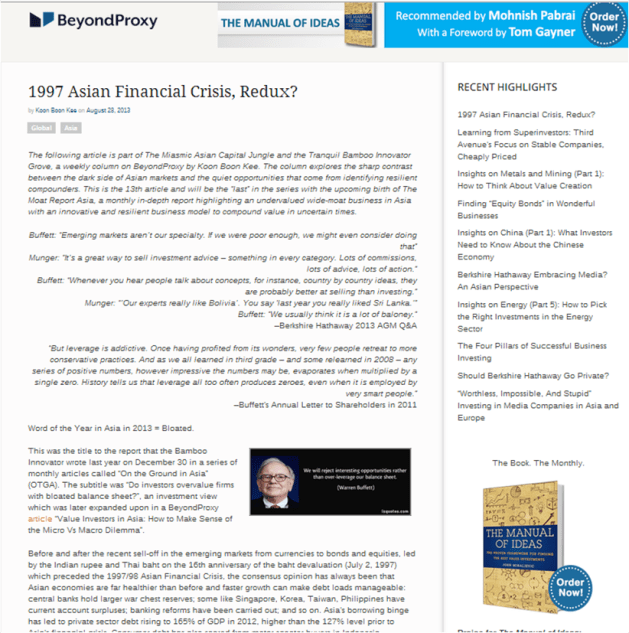
Bamboo Innovator is featured in BeyondProxy.com, where value investing lives:
August 28, 2013 Leave a comment
August 27, 2013 4:37 pm
The small start-ups are as vital as the stars
By Luke Johnson
In the 19th and 20th centuries, Britain and the US were dynamic and open to novelty
Are entrepreneurs freaks of nature? Jim Clifton thinks so. He is the boss of research firm Gallup, and recently wrote about studies it is undertaking to find those especially talented individuals who can build the next Google, Ryanair or Bloomberg. Gallup estimated that such “super-entrepreneurs” number just three out of 1,000 across a sample population. These are the risk-takers capable of founding so-called gazelle companies: the fastest-growing breakthrough organisations that create a high proportion of the new jobs and genuine innovation in an economy. Read more of this post
August 28, 2013 Leave a comment
BY FRANCISCO DAO
ON AUGUST 27, 2013
Do you hate small talk? If you do, you’re definitely not alone, perhaps not even in the minority, and yet many people feel guilty about disliking meaningless conversation. We are so conditioned to view social behavior as an absolute good that avoiding small talk is considered rude. This is part of something I call “the tyranny of extroverts,” a set of expected behaviors that are assumed to be superior, simply because they are louder or more visible. As someone who despises small talk, I’d like to debunk the myth that it is necessary or even useful. Read more of this post
August 28, 2013 Leave a comment
The One Thing You Need To Know To Be A Great Manager
JENNA GOUDREAU AUG. 27, 2013, 2:53 PM 3,981 3
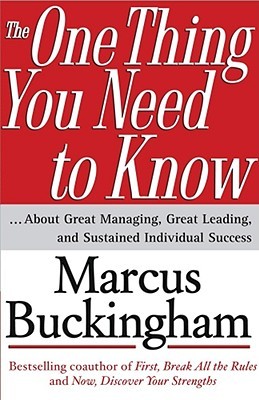
Marcus Buckingham aimed in 2005 to boil countless professional insights down to one piece of advice for managers, leaders, and individual contributors. His best-selling book, “The One Thing You Need to Know: …About Great Managing, Great Leading, and Sustained Individual Success,” pulled this off, and it holds up remarkably well. For managers, Buckingham says the most important thing is to discover what is unique about each person, and capitalize on it. Read more of this post
August 28, 2013 Leave a comment
August 27, 2013, 8:07 p.m. ET
What Happens When Co-Workers Are Nasty to Each Other
Hostile Work Environments Cost Companies in Productivity, Creativity; Using the ‘No Venting’ Rule
Workers have new tasks on their to-do list: Say hello to colleagues. Don’t forget to smile. Companies may be reluctant to admit their offices are anything less than pleasant, but incivility—think belittling barbs or gruff responses—can lead to lost productivity, creativity and talent. As employees who are forced to do more work with fewer resources become more stressed, the rudeness is ramping up. So firms are urging staffers to play nice. Read more of this post

咬定青山不放松,立根原在破岩中。 千磨万击还坚劲,任尔东西南北风。

