Jeff Bezos Will Walk Out Of A Meeting If You Don’t Get To The Point

Jeff Bezos Will Walk Out Of A Meeting If You Don’t Get To The Point

VIVIAN GIANG AUG. 9, 2013, 10:47 AM 14,307 16

Reuters

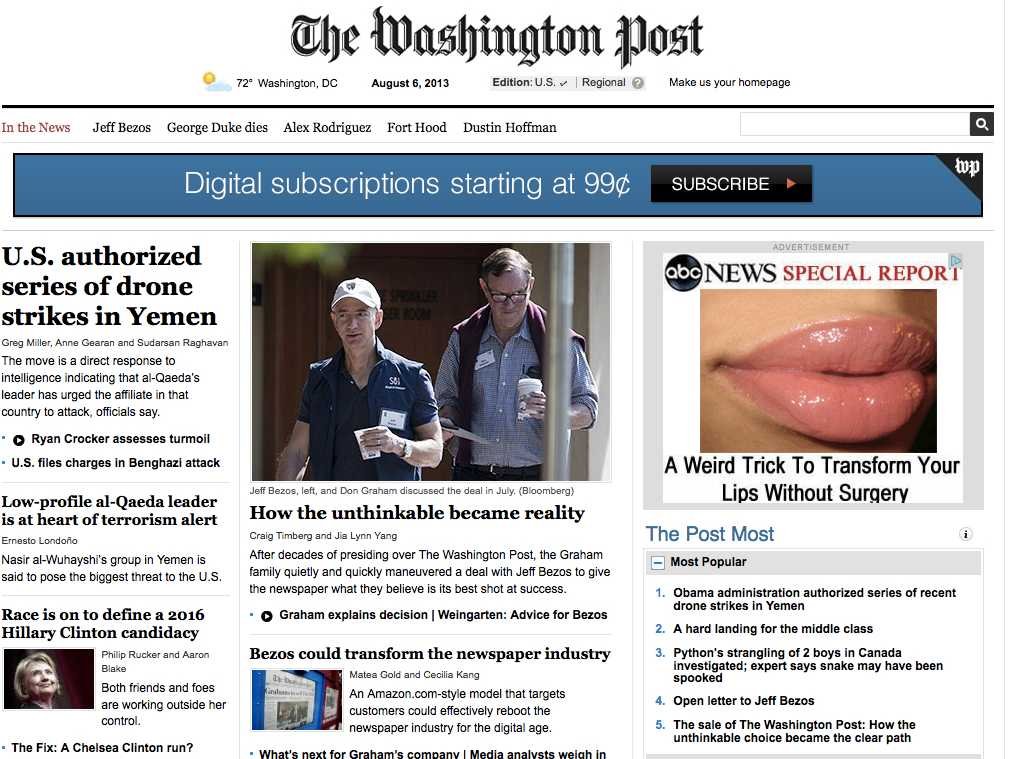
Jeff Bezos won’t waste any time in a meeting with you if he doesn’t fully understand where the conversation is going or how it will make Amazon better. Craig Timberg and Jia Lynn Yang write about Bezos’ demanding management style in The Washington Post: “In the relentlessly efficient world of Jeffrey P. Bezos, Amazon employees quickly learn when they have overtaxed the attention of their chief executive. He quietly pulls out his smartphone and starts replying to e-mails. In extreme cases, Bezos will walk out.” Nadia Shouraboura, formerly a part of Bezos’ senior executive team tells Timberg and Yang that you “better be ready” if you have a meeting with Bezos. “He will figure out something you haven’t thought of … If you haven’t thought through exactly how to delight our customer, that’s a bad thing.”

Jeff Bezos, The Post’s incoming owner, known for a demanding management style at Amazon

By Craig Timberg and Jia Lynn Yang, Published: August 8

In the relentlessly efficient world of Jeffrey P. Bezos, Amazon employees quickly learn when they have overtaxed the attention of their chief executive. He quietly pulls out his smartphone and starts replying to e-mails. In extreme cases, Bezos will walk out. Read more of this post

Cactus Needles Inspired A Super-Efficient New Way To Clean Up Oil Spills

Cactus Needles Inspired A Super-Efficient New Way To Clean Up Oil Spills

ROBERT FERRIS AUG. 9, 2013, 2:25 PM 1,187 1

screen shot 2013-08-07 at 5.00.21 pm

Scientists may have just invented an amazing new way to clean up oil spills by mimicking the ingenious physics of cactus needles. Cactus needles are not just for warding off animals trying get a taste of the plant’s moist flesh. They also use a trick from physics to help them draw water from the air to keep the plant hydrated in its harsh desert environment. Cactus needles are shaped like cones with — as many unfortunate victims have found — a sharp tip facing outward. The spines widen as they get closer to the body of the plant. Read more of this post

It’s So Hot In Shanghai That People Are Camping Out In Air Conditioned Subway Stations

It’s So Hot In Shanghai That People Are Camping Out In Air Conditioned Subway Stations

ADAM TAYLOR AUG. 9, 2013, 3:15 PM 2,083 1

Almost 400 people have been camping out a Shanghai Metro station, making use of the air conditioning that many don’t have at home, Shanghaiist reports, hoping to beat a horrible heatwave that has hit the city. Looking at pictures, the people at Xingzhong Road station appear to have planned ahead, bringing cardboard and sheets to lie on. Amazingly, the station seems to be pretty cool about it — though a Shanghai Metro spokesperson did ask that those enjoying the A/C refrain from drinking, smoking or playing cards. It may seem like extreme behavior, but the weather may well merit it. The Washington Post’s Capital Weather Gang reports that Shanghai saw its hottest July in 140 years, with temperatures soared to 100ºF or higher for 10 straight days between July 23 and August 1. All across China’s east record temperatures are being set. These photos, shared to Weibo, capture the scene:

6c2e55bbjw1e7gbhp0wq4j20ic1ouqhm (1)

Property confiscated from some of Sicily’s notorious criminals is being used to build a growing ethical tourism business

August 9, 2013 3:24 pm

In the mafia’s footsteps

By Kabir Chibber

Property confiscated from some of Sicily’s notorious criminals is being used to build a growing ethical tourism business

Ayoung Alexis de Tocqueville, just 22 and travelling around Sicily in the 1820s, wrote: “One is surprised, after crossing in almost complete isolation for eight or ten hours, to enter suddenly in a town of twenty thousand souls, without a highway, with no noise to proclaim your arrival.” These days, little has changed. About an hour from Palermo, the tiny town of San Giuseppe Jato suddenly appears from nowhere after a succession of rolling hills that reach out into the distance. The town is the base of Francesco Galante and the team at Libera Terra, a loose web of Italian co-operatives and non-profit organisations dedicated to fighting the mafia. At any given time, this ragtag bunch of agronomists, labourers and student volunteers can be found drinking espresso in industrial quantities in their office above a petrol station, while building a small ethical tourism empire from lands seized by the state from the Cosa Nostra. They now run vineyards, farms and guest houses throughout Sicily. Read more of this post

Here’s Why Tesla Motors Is Named For A Famous Serbian Inventor

Here’s Why Tesla Motors Is Named For A Famous Serbian Inventor

ALEX DAVIES AUG. 8, 2013, 5:40 PM 2,460 10

By making two remarkable electric cars and becoming the first new American auto company to turn a profit in decades, Tesla Motors has made itself into a household name. But why did founders Martin Eberhard and Marc Tarpenning (CEO Elon Musk joined the company soon after it was incorporated) choose the name Tesla? It’s an homage to Nikola Tesla (1856-1943), the Serbian inventor and engineer who created the induction motor and alternating-current (AC) power transmission. According to an old post on the automaker’s website (archived here): Without Tesla‘s vision and brilliance, our car wouldn’t be possible. We’re confident that if he were alive today, Nikola Tesla would look over our 100 percent electric car and nod his head with both understanding and approval. CEO Elon Musk, who was not involved in the founding of the company, has told PBS he counts Thomas Edison, a Tesla rival, as a personal hero, along with Winston Churchill. Musk does have love for Tesla, though, pledging last year to donate to a project to turn the inventor’s old lab into a museum, according to Jalopnik. An inveterate inventor, Tesla filed more than 700 patents for everything from wireless communication to fluorescent lighting. Some of his ideas never came to fruition, including a “death-beam.” In July 1934, he told the New York Times he had invented a way to “send concentrated beams of particles through the free air,” powerful enough to bring down 10,000 planes from 250 miles away, or kill millions of soldiers. All in all, Tesla was a very cool dude. He hung out with Albert Einstein when they and other scientists took a tour of a wireless station in New Jersey, in 1921: There’s a plaque there to honor him:

screen shot 2013-08-08 at 2.59.40 pm nikola-tesla-plaque

Elon Musk And Richard Branson Give Their Best Advice To Entrepreneurs

Elon Musk And Richard Branson Give Their Best Advice To Entrepreneurs

MAX NISEN AND ALEXANDRA MONDALEK AUG. 8, 2013, 12:53 PM 3,572

Tesla CEO Elon Musk and Virgin Chairman Sir Richard Branson, two of the tech world’s most lauded entrepreneurs, just gave their best advice on how to start a company during a Google + hangout this afternoon. It was sponsored jointly by Google for Entrepreneurs, the company’s set of programs and tools to support startups, and Virgin’s not for profit foundation Virgin Unite. Here are some of the most interesting tips and exchanges.

Their core advice for entrepreneurs

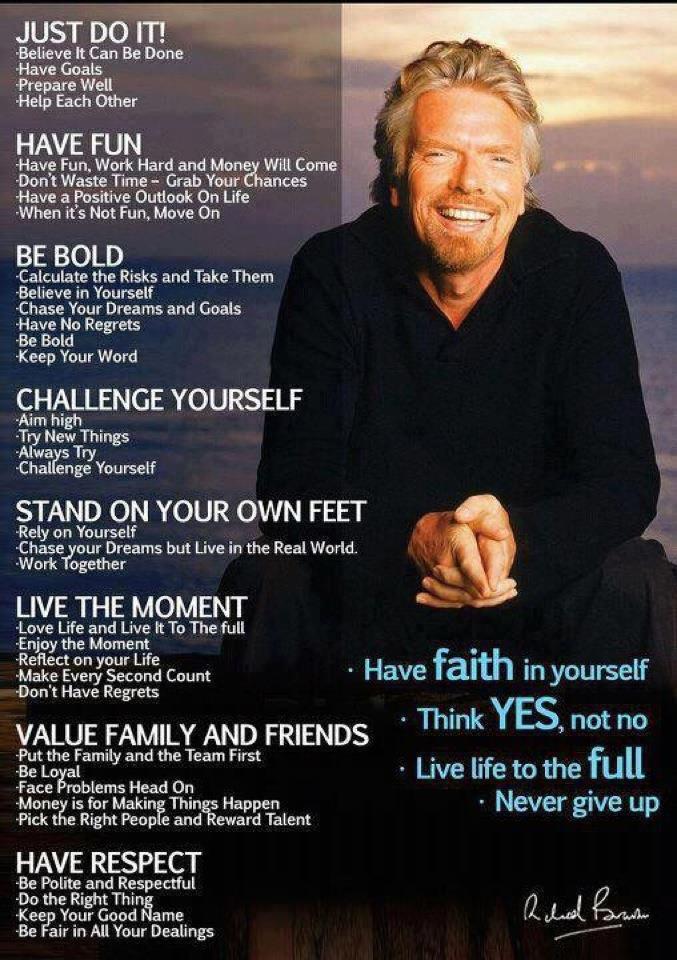
Branson: “If you’ve got a great idea that would improve people’s lives, just do it.”

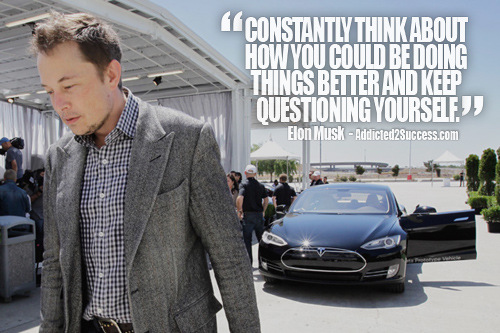
Musk: “You want to be extra rigorous about making best possible thing you can, find everything that’s wrong with it and fix it. Seek negative feedback, particularly from friends”

Elon-Musk-Entrepreneur-Picture-Quote-For-Successquote_yourself-17292just-do-itimages (34)Richard-Branson-Entrepreneur-Picture-Quote-For-Success

Read more of this post

Michael Hayman, co-founder of StartUp Britain, draws inspiration from six innovators who show what entrepreneurs can achieve

Meet the innovators changing our world

Michael Hayman, co-founder of StartUp Britain, draws inspiration from six remarkable people who show what entrepreneurs can achieve .

By Michael Hayman

6:00AM BST 07 Aug 2013

wandisco

“The people who are crazy enough to think they can change the world, are the ones who do.” That was the clarion call of the campaign that relaunched one of the 21st century’s best-loved brands: Think Different was the defining moment for Apple and Steve Jobs. It saved a corporation and, for me, captured the essence of the entrepreneur. It can be hard to define the attributes of an entrepreneur, but you certainly know when you’ve met one. They are an impatient tribe who constantly challenge the status quo – fuelled by a driving intensity to invent or invest, to build or conquer. To get the job done. If you work for an entrepreneur, you might very well see them in extremes, perhaps as a saviour, perhaps a sociopath, very possibly both. One thing is for sure: they are far from ordinary. Steve Jobs caught the swashbuckling characteristics of the breed perfectly when he said: “It’s better to be a pirate than join the navy.” And in these turbulent times, where technology and trade make for a combustible mix, those who have hoisted the Jolly Roger rather than opting for corporate conformity are winning the battle of ideas. You don’t have to look far to find the evidence that entrepreneurs are building the titans of tomorrow. It is estimated that two thirds of the companies that will make up the S&P 500 in 10 years’ time haven’t even been created yet. Or take the Fortune 500 – almost 87pc of the companies that made up the original list in 1955 no longer feature. The lifespan of a S&P 500 company has declined from 67 years in the 1920s to just 15 years today. And it is entrepreneurs who are filling the void. As Carl Schramm, former president and chief executive of the Kauffman Foundation points out, big business has not created one net job in the US during the past 40 years. Not one. For the last four years, I have enjoyed an unparalleled vantage point from which to observe the influence entrepreneurs have on our everyday lives. The firm I co-founded, Seven Hills, is one of the fastest growing in its sector; I helped to create StartUp Britain, the national campaign for early-stage businesses; and I’ve been behind two of the biggest festivals for entrepreneurs in the UK – MADE and Accelerate. My work gives me the chance to meet some of the most exciting and innovative founders in the world. Here are six of them who have most inspired me over the past year. One you will almost certainly have heard of, the rest quite possibly not. They do not cover every sector or innovation that is changing how people across the world live and work. But they each illustrate how entrepreneurship is making a difference, and why it matters. They are the “crazy ones” who change lives. Read more of this post


Bill Gates on His Foundation’s Health and Education Campaigns

Bill Gates on His Foundation’s Health and Education Campaigns

By Brad Stone on August 08, 2013

You recently tweeted that very rare clip of FDR being pushed in his wheelchair in 1944. Why did you find that to be a powerful image?
Polio eradication is this amazing effort. We’re raising the money to get it done by 2018. When these problems leave the rich world, they’re out of sight, out of mind. And reminding people of what a big problem it was and how amazingly others responded—which is why we have these tools at all—helps people, saying this can be the second disease to be eradicated.

What are the prospects for the eradication of polio and malaria?
Polio is where we have a very concrete plan. It’s raising $5.5 billion—of which the [Bill & Melinda Gates] Foundation is going to give $1.8 billion. If we get credibility from the polio success, we can be more articulate about a malaria or measles elimination plan. The big one would be malaria, but that’s a long-term, in-my-lifetime-type thing, not imminent. Read more of this post

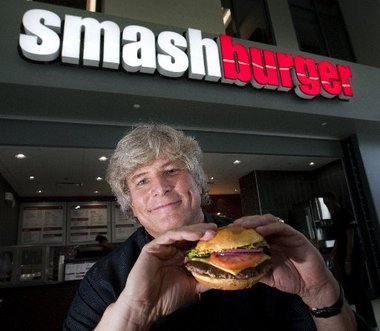
Smashburger CEO Attributes Success To Unorthodox Marketing Strategy; Smashburger focuses heavily on events, such as when it offered a free sandwich to anyone with “burger” or “berger” in their name on National Cheeseburger day

Smashburger CEO Attributes Success To Unorthodox Marketing Strategy

MICHAEL THRASHER AUG. 8, 2013, 5:53 PM 1,429

Smashburger has opened more than 200 restaurants in the past seven years.  Founder Tom Ryan told Nation’s Restaurant News the fast-casual chain’s success can be attributed to an unconventional marketing philosophy that relies heavily on social media and old-fashioned word of mouth. Ryan said the chain still uses some radio and television advertising. But Smashburger focuses heavily on events, such as when it offered a free sandwich to anyone with “burger” or “berger” in their name on National Cheeseburger day, he said. Ryan said these events become a topic of conversation for bloggers and social media. “From the beginning, we wanted Smashburger to be a defining brand for the next generation, and the marketing mix for how you engage them is different than for how you engaged the last generation,” Ryan said.

9788675-large

The Nudge Debate: Considering how mentally lazy most of us are, a little soft paternalism that forces us to choose what’s good for us is probably just what we all need

August 8, 2013

The Nudge Debate

By DAVID BROOKS

This has been a great era for the study of error. We know that people can be induced to buy more cans of soup if you put a “Limit: 12 per customer” sign on the display. We know that if you ask people what movie they want to see next week, they’re likely to mention a classy art film. But, if you ask them what movie they want to see tonight, they’re more likely to mention a mindless blockbuster. In addition, people are pretty bad at sacrificing short-term pleasure for long-term benefit. We’re bad at calculating risk. We’re mentally lazy. We make decision-making errors when thinking in our own language that we don’t make when thinking in another language. When asked to think in a second language, we’re forced to put in a little more mental effort. Read more of this post

Events for Weekend Warriors Become a Gold Mine; Forget Silicon Valley—In the Latest Startup Craze, Fortune Is Being Spun from a Sport of the Cave Man

August 8, 2013, 8:14 p.m. ET

Events for Weekend Warriors Become a Gold Mine

Forget Silicon Valley—In the Latest Startup Craze, Fortune Is Being Spun from a Sport of the Cave Man

KEVIN TRAHAN and KEVIN HELLIKER

The foot race isn’t new. Cave men probably invented it. But suddenly it’s gushing wealth for entrepreneurs, big companies and private-equity firms. The weekend-warrior market is a gold mine, and tapping into it doesn’t require Silicon Valley-style geek credentials or venture capital. Nor must a sports-business career begin anymore in the mail room of a sports network or big-league franchise. Joe Reynolds was 27 when he launched Red Frog Events, a Chicago-based producer of adventure races. In 2012, its sixth year, Red Frog posted revenue exceeding $50 million, prompting Inc. magazine to call it the nation’s ninth-fastest growing company. It can’t add races fast enough to satisfy demand for its $60-and-up slots. Read more of this post

UPS’s Scott Davis on Shipping Sharks, Work Rules, and the Post Office

UPS’s Scott Davis on Shipping Sharks, Work Rules, and the Post Office

By Devin Leonard on August 08, 2013

Have you shipped live sharks?
Yeah. We probably ship a little bit of everything, whales, you name it. We’ve got to be able to handle any precious commodity, and health care is obviously the area we’re moving into. So while we’re doing sharks and lobsters and whales, at the same time people are waiting on the operating table for some things that we’ve got to get to them.

Isn’t that dangerous, shipping live sharks?
It can be. You’ve got to have experts help you.

How do you ship a live whale?
It’s a big container. Read more of this post

Family businesses with succession plans in place are more likely to achieve a better credit rating and as such able to borrow easier than those with no plan

SUCCESSION PLANS KEY TO RATINGS FOR FAMBIZ

ARTICLE | 8 AUGUST, 2013 12:11 PM | BY JESSICA TASMAN-JONES

Family businesses with succession plans in place are more likely to achieve a better credit rating and as such able to borrow easier than those with no plan, according to report from the ratings agency Standard & Poor’s. The report said that family businesses were susceptible to so-called “key man” syndrome, whereby a dominant family figure is associated with the success of the business. But Trevor Pritchard, managing director of corporate ratings at S&P said that this risk can be mitigated by a family business having a clear succession plan in place and this would give help to reassure the ratings agency that the business wasn’t too reliant on one individual. Read more of this post

Investor Loses It Over Adulation And Sympathy For ‘Newspaper Families’ Like The Grahams — This Is A Story Of Incompetence!

Investor Loses It Over Adulation And Sympathy For ‘Newspaper Families’ Like The Grahams — This Is A Story Of Incompetence!

HENRY BLODGET AUG. 8, 2013, 8:02 AM 2,691 12

post-front-page

I was minding my own business last night when I got the note below from a respected investor. As you will see, the investor has had it with all the adulation and sympathy being showered on newspaper families like the Grahams, who are being extolled for their decades-long “stewardship” of institutions like the Washington Post and New York Times and pitied for the terrible misfortune they and society have recently endured. In the common telling, the investor observes, the Grahams and other newspaper families are cast as victims of an unforeseeable and horrible trend–the unstoppable rise of an invasive technology that has crippled the newspaper business and threatened a profession that has held society together for decades. The Grahams have done their heroic best, this story goes, but the forces of evil have just been too numerous and overwhelming. Now, finally, the brave and intrepid Grahams have had no choice but to surrender. So the world will now go to the dogs. Read more of this post

To Move Ahead You Have to Know What to Leave Behind

To Move Ahead You Have to Know What to Leave Behind

by Nick Tasler  |  12:00 PM August 7, 2013

Decisions are the most fundamental building blocks of successful change in our organizations, our teams, and our careers. The faster and more strategically we stack those blocks, the faster and more successfully we achieve change. Yet, change efforts often stall precisely because those decisions don’t happen. The question is why?

Avoid Changing By Addition. The Latin root of the word “decide” is caidere which means “to kill or to cut.” (Think homicidesuicidegenocide.) Technically, deciding to do something new without killing something old is not a decision at all. It is merely an addition. When an executive announces that her business will change to become a luxury service provider, technically it is not a decision until she also states that they will not provide low cost services to price-sensitive customers anymore. When a sales manager declares that his strategy this quarter will require his salespeople to spend more time strengthening existing customer relationships, he has only made an addition until he also declares that they should spend less time on something else like hunting for new prospects. Your palms might be sweating at the mere thought of telling your team to ignore some group of paying customers or to not spend time hunting for new business, even if you really want to see the change happen. Research has shown that making tradeoffs is so mentally exhausting that most people try to avoid them whenever possible. That’s why a manager who is no stranger to long hours and hard work will escape the discomfort simply by piling on new change objectives without killing any of the current priorities. But this change-by-addition approach can be a death blow. Read more of this post

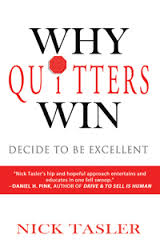
Why Quitters Win: Decide to be Excellent

Why Quitters Win: Decide to be Excellent [Paperback]

Nick Tasler (Author)

Why Quitters Win

Publication Date: September 10, 2013

What is your strategic direction?

Why are some necessary changes so hard to make?

Are you pursuing too many top priorities?

How do you avoid irrational traps without getting bogged down by over-analysis?

Why Quitters Win reveals why Nick Tasler s elegantly simple 3-part Strategic Behavior framework is already driving excellence for everyone from Fortune 500 executives and middle managers to busy moms, small business owners and church leaders.
Decades of research in social science and business strategy, as well as Tasler s own findings from surveying the decisions of hundreds of thousands of working adults reveal that the most successful people, teams, and companies are not those with access to the widest variety of opportunities or the steadiest supply of creative ideas. Surprisingly, the opposite is true. Too many exciting opportunities, good ideas, and top priorities erode our focus, confuse our teams, and keep us swirling around on a plateau of mediocrity.
Why Quitters Win addresses these critical topics with a brilliantly simple approach that has the power to profoundly change your life one decision at a time. Read more of this post

Monasteries decline as TV and smartphones grip Bhutan; monastic materialism also to blame for a decline

Monasteries decline as TV and smartphones grip Bhutan

Thursday, August 8, 2013 – 12:57

AFP

THIMPHU, Bhutan – Kencho Tshering, a red-robed Buddhist monk, takes a call from the King of Bhutan’s office, then duly dashes off to start a ceremony praying for a break in the monsoon rains. But while he may be on speed dial for royal requests, the clout of his fellow monks is on the wane in the remote kingdom as it absorbs the impact of technology and democracy as well as an abuse scandal. “Bhutan is changing. The monastic body is going down and down,” Tshering told AFP at Dechen Phodrang, the monks’ school where he is principal, which is perched with majestic views over the capital Thimphu. “Even for senior monks, there’s no respect in the city,” he sighed. Read more of this post

Many Americans have no friends of another race: poll

Many Americans have no friends of another race: poll

1:06am EDT

By Lindsay Dunsmuir

NEW YORK (Reuters) – About 40 percent of white Americans and about 25 percent of non-white Americans are surrounded exclusively by friends of their own race, according to an ongoing Reuters/Ipsos poll. The figures highlight how segregated the United States remains in the wake of a debate on race sparked by last month’s acquittal of George Zimmerman in the shooting of unarmed black Florida teenager Trayvon Martin. President Barack Obama weighed in after the verdict, calling for Americans to do some “soul searching” on whether they harbor racial prejudice. There are regions and groups where mixing with people of other races is more common, especially in the Hispanic community where only a tenth do not have friends of a different race. About half of Hispanics who have a spouse or partner are in a relationship with non-Hispanics, compared to one tenth of whites and blacks in relationships. Looking at a broader circle of acquaintances to include coworkers as well as friends and relatives, 30 percent of Americans are not mixing with others of a different race, the poll showed. Read more of this post

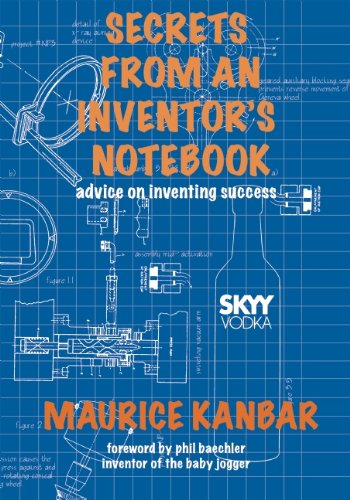
Secrets from an Inventor’s Notebook: Advice on Inventing Success – from the creator of SKYY Vodka, the D-Fuzz-It sweater comb, and scores of innovative products

Secrets from an Inventor’s Notebook: Advice on Inventing Success – from the creator of SKYY Vodka, the D-Fuzz-It sweater comb, and scores of innovative products Hardcover – Illustrated

by Maurice Kanbar  (Author) , Phil Baechler (Author)

51FuNydhonL

When the fuzz from his sweater was pulled off by a brick wall he was leaning against, Maurice Kanbar had a brainstorm. Soon he had patented, produced and successfully promoted the D-Fuzz-It sweater comb, and made his first fortune at the age of twenty-two. In this engaging “master class” Kanbar’s real world hits and misses illustrate the concrete steps every inventor must follow to successfully take his product to market. Read more of this post

Should a business invest in growth, or save money for the next economic crisis? Lessons for small businesses from the bacteria living on wounds in France

Lessons for small businesses from the bacteria living on wounds in France

By Christopher Mims @mims 8 hours ago

Should a business invest in growth, or save money for the next economic crisis? In any given economic environment, is there one best strategy or is it ok to be doing something different than your competitors? And just how much power do business leaders have to predict the consequences of making one choice over another, especially as conditions change? These are among the most basic questions of microeconomics, and their mathematical answers—production possibility frontiers and opportunity costs—can be difficult to grasp in the abstract. But for the first time ever, scientists have demonstrated that the same tradeoffs faced by small businesses are also faced by bacteria, which solve the challenge of scarce resources in a way that matches what economists have long predicted for small business owners. Read more of this post

Building Middle-Manager Morale: Training sessions for middle managers tend to be part leadership lesson, part pep rally and part strategy session. Here’s a glimpse into how some companies do it

August 7, 2013, 7:17 p.m. ET

Building Middle-Manager Morale

Inspiring the Ranks With Trips, Computer Simulations, and Roller-Coaster Rides

RACHEL FEINTZEIG

It is 8 a.m. on a summer Friday and AT&T Inc. T +0.31% vice president Ken Fenoglio is trying to pump up a crowd of 400 at the convention center in downtown Dallas. “Who runs this company?” he asks. “We do, right here.” The men and women in the audience aren’t executives, nor are they on the front lines dealing with customers. They are in between: middle managers on the corporate ladder of a vast organization. And Mr. Fenoglio wants them to feel like that is a good thing. “You’re right in the middle,” he says. “You’re right where the action is.” Scenes like AT&T’s training session are becoming familiar at companies from telecom to health care to retail—especially those attempting rapid change. According to a study by research and consulting group Bersin by Deloitte, 50% of midlevel leaders received formal leadership development in 2012. The average spending per midlevel leader across the U.S. was $2,700 in 2012, up from $1,000 in 2009. The hope is that managers will attend talks and tackle problems, learn negotiation skills and become better leaders. And if managers walk away with a rosier view of their company, that is a plus. Read more of this post

Best-selling crime novelist Patricia Cornwell’s eight-figure, two-book deal underscores the continued appeal of major brand-name authors at a time when discovering new writers online and digitally remains difficult for consumer

August 6, 2013

Patricia Cornwell Leaves Publisher, Strikes Deal With William Morrow

Crime Novelist Strikes Eight-Figure Deal with Imprint of HarperCollins Publishers

JEFFREY A. TRACHTENBERG

MK-CF348_CORNWE_G_20130806213952

Patricia Cornwell has struck an eight-figure deal with William Morrow. Best-selling crime novelist Patricia Cornwell has left her longtime publisher and struck an eight-figure, two-book deal for world English rights with William Morrow, an imprint of HarperCollins Publishers. The move underscores the continued appeal of major brand-name authors at a time when discovering new writers online and digitally remains difficult for consumers. Ms. Cornwell is best-known for her long-running series featuring medical examiner Kay Scarpetta, but she has also written two other series, a nonfiction work about the identity of Jack the Ripper, and two cookbooks, including “Food to Die For.” Read more of this post

This Story Of A Wheelchair-Bound Woman Using Google Glass Will Move You To Tears

This Story Of A Wheelchair-Bound Woman Using Google Glass Will Move You To Tears

JULIE BORT AUG. 7, 2013, 7:50 PM 750 3

We hear a lot of stories about people using Google Glass, sometimes for awesome reasons and sometimes to the horror of their their friends and coworkers. But here’s one that really shows how the device can help someone. Alex Blaszczuk owns Glass as part of Google’s Explorer program, where Google allowed about 8,000 people to purchase the device at $1,500 a pop. Blaszczuk is a law student whose life was changed in the fall of 2011. She was on her way to a camping trip when a car accident left her paralyzed from the chest down, unable to use her hands. Last month, Alex finally made it camping, helped in large part by the confidence she regained by using Glass. She shared her story and video of the trip taken with Glass. (Seriously, after watching this, we have tears in our eyes.) Congrats to Blaszczuk!

A ‘scalable’ career is one where growth is not dependent on the number of hours of work put in but where our growth is “dependent on the quality of our decisions”. What’s getting monetized is your ability to recognize patterns and wield your intellect, rather than spending your time pushing through rote tasks

SUCCESSFUL FOUNDERS SHARE 4 MUST-HAVE SKILLS TO BOLSTER ANY CAREER

EVERY CAREER IS DIFFERENT. BUT SOME SKILLS CUT ACROSS ALL OF THEM. HERE ARE FOUR.

BY: DRAKE BAER

Some skills may be awesome but not in demand: While a sonnet might take your breath away, iambic pentameter doesn’t have a high market demand. But some skills by any industry are wanted just as sweetly–and as founders of Pandora, Quora, and White Rabbit suggest, we can start developing them today. Here’s where to start:

1) LEARN TO TALK IN FRONT OF PEOPLE

Pandora cofounder Tim Westergren, who pitched his idea 348 times before securing crucial funding, reports that public speaking is one of the most universally useful skills. Why? “Whether you’re pitching a group of investors, rallying your employees, selling a customer, recruiting talent, addressing consumers, or doing a press tour, the ability to deliver a great talk is absolutely invaluable,” he says. And if you’d rather eat a microphone than have to speak into one, fret not: Quietauthor Susan Cain is here to help cure your oratory woes. Read more of this post
3 Keys to Repurposing Content on SlideShare

3 Keys to Repurposing Content on SlideShare

By Marisa Wong on July 31, 2013 | 5 Comments

Whether it’s Facebook updates, tweets, blog posts, research reports, newsletters, video, white papers or more, we all produce content these days. How do you reach your audiences on each platform without completely exhausting yourself? Most likely your content and ideas are already there — it’s just a matter of crafting them for the desired channel and reach. For SlideShare, that largely means turning your content into visual stories. SlideShare can host many forms of content, including long form writing, videos, presentations and PFDs. But if you’re going after number of views, there are a few things you could and should do to ignite the SideShare audience and attract more traffic.

Read more of this post

Berkshire’s Fruit of the Loom vs. Gildan, or How to Avoid Value Traps in Low-Cost Businesses; Bamboo Innovator is featured in BeyondProxy.com, where value investing lives

Bamboo Innovator is featured in BeyondProxy.com, where value investing lives:

  • Fruit of the Loom vs. Gildan, or How to Avoid Value Traps in Low-Cost Businesses, Aug 7, 2013 (BeyondProxy)

Fruit

Ambition is not served on a silver spoon; The provision from birth of just about every material want creates a sense of entitlement

August 6, 2013 5:09 pm

Ambition is not served on a silver spoon

The provision from birth of just about every material want creates a sense of entitlement

Many agonised articles and books have been written in recent years about the decline of social mobility and the rise of the super rich, especially in countries such as the US and Britain. The authors typically recommend government intervention to improve equality and life chances for the less well-off. While the poor may need help, I think the wealthy almost invariably sow the seeds of their own relative decline – even without punitive taxation. In my experience, working with many successful entrepreneurs over three decades, the children of self-made parents almost never possess the same level of ambition or capacity for enterprise. Consequently family fortunes tend to wither rather than expand without end. I once spoke at an event organised by a private bank in the City of London, attended by about 100 young adult children of its multimillionaire clients. The listeners were an unimpressive lot from all over – the Middle East, Russia, Africa, Europe and Asia. Generally speaking they struck me as spoilt and deficient in energy or experience of the real world. Their parents were mostly from modest backgrounds but had created substantial companies, by dint of huge effort and ingenuity. My audience never felt the need to make such sacrifices – and it showed in their attitudes. Read more of this post

What every company can learn from Lego; Lego has built an open community of robotics enthusiasts who have helped make the company’s products better

What every company can learn from Lego

August 6, 2013: 11:28 AM ET

Lego has built an open community of robotics enthusiasts who have helped make the company’s products better.

By John Hagel and John Seely Brown

FORTUNE — By now, many businesses are aware of the benefits of ecosystems — communities of suppliers, partners, vendors, and customers — and the idea that there’s value to connecting participants with each other. One fax machine alone, for example, has no value. Connect that fax machine to another, however, and suddenly the machine has value even though nothing about it has changed. The value grows with each additional machine connected. Now imagine that the fax machines can learn from each other, gaining additional capabilities and getting better at what they do with each interaction. The more fax machines connected, the greater potential for interactions and the greater the rate of learning. That is the fundamental power of a dynamic ecosystem: Participants interact with each other with the goal of learning faster, getting better, and increasing the capabilities of each participant and the value of the entire community. Read more of this post
What Jeff Bezos learned from Warren Buffett

What Jeff Bezos learned from Warren Buffett

By Patricia Sellers August 6, 2013: 1:42 PM ET

FORTUNE — Jeff Bezos’ decision to buy the Washington Post isn’t so surprising given that he has long seen the value of making money slowly. The Amazon.com (AMZN) founder and CEO built his $61.1 billion-a-year business by plowing short-term profits back into the business, restless investors be damned. Way back in 1999, actually, Bezos displayed an interest in old-line industries. He was at Allen & Co.’s conference in Sun Valley, Idaho when he heard Warren Buffett (BRKA) — the Washington Post Co.’s (WPO) largest outside shareholder — warn that transforming industries often fail to reward investors over time. I wrote the following in Fortune in 1999:

Bezos was so intrigued by Buffett’s talk…that he asked Buffett for his lists of the automakers and aircraft manufacturers that didn’t make it. “When new industries become phenomenons, a lot of investors bet on the wrong companies,” Bezos says. Referring to Buffett’s 70-page catalog of mostly dead car and truck makes, he adds, “I noticed that decades ago, it was de rigueur to use ‘Motors’ in the name, just as everybody uses ‘dot-com’ today. I thought, Wow, the parallel is interesting. Read more of this post

Monotasking Is The New Multitasking In This Age of Distraction

MONOTASKING IS THE NEW MULTITASKING

HOW CAN YOU GET ANYTHING DONE WHEN YOUR “TASKS” TURN INTO COMPETING PREOCCUPATIONS? IN THIS AGE OF DISTRACTION, IT’S ALL ABOUT MONOTASKING. HERE ARE SIX TIPS FOR DOING IT RIGHT.

BY: LAURA VANDERKAM

We all know multitasking is inefficient. A classic 2007 study of Microsoft workers found that when they responded to email or instant messaging alerts, it took them, on average, nearly 10 minutes to deal with their inboxes or messages, and another 10-15 minutes to really get back into their original tasks. That means that a mere three distractions per hour can preclude you from getting anything else done. Then there’s the relationship “inefficiency” that comes from multitasking. You can spend hours rebuilding the good will torched by a single glance at your phone during an inopportune time. Read more of this post