Wan Long: Former factory worker who rose to lead Shuanghui as chairman to take over US pork producer Smithfield

Last updated: May 30, 2013 1:47 pm

Wan Long: Former factory worker who rose to lead Shuanghui

By Paul J Davies in Hong Kong

wanlong pledges

For Wan Long, the $4.7bn deal to take over US pork producer Smithfield is a long way from the Shuanghui International chairman’s simple beginnings. “What I do is kill pigs and sell meat,” he told a local paper last year. A native of Luohe in Henan province, home to the group’s headquarters, he joined Shuanghui as an ordinary factory worker in 1968 after a stint in the army. It was a single money-losing plant, ranked ninth out of 10 state-owned meat processing companies in Henan, according to the Chinese magazine Caixin. Mr Wan, now in his early seventies, was elected plant manager in 1985. That year it reported profits of Rmb5m, the magazine said. He now runs a business that turned a net profit of Rmb2.9bn last year. As China’s biggest meat producer, it produces 2.7m tonnes of meat annually from 30m pigs. It also gets through 300,000 heads of cattle, 600,000 tonnes of chicken, 50,000 tonnes of eggs and 50,000 tonnes of soy protein in processing pork into an array of cooked, fresh and frozen products. “Our goal is to achieve sales revenue of Rmb100bn within the period of the 12th five-year plan [ending in 2015], then I’ll retire,” Mr Wan told Caixin in an interview two years ago. Shuanghui is forecast to hit Rmb50bn ($8.2bn) in sales this year, according to Bloomberg data, whileSmithfield should generate $13bn – so this deal will help Mr Wan hit his target two years early. It is by far the largest takeover ever pursued by a Chinese company overseas in the food and beverage sector, according to Dealogic. Given China’s population and its growing appetite for a higher protein diet as it becomes wealthier, bankers expect to see many more deals for meat, fish and dairy producers. The past decade was about China’s hunt for energy and metals, but the next could well be about its need to secure safe food supplies. “This deal looks like a wonderful opportunity for two complementary companies to come together and for Shuanghui to access the technology it needs to take its food safety and productivity to a higher level,” says a Beijing based agri-industry expert. The homespun charm of the companies’ two executives appear to complement each other as well, with Mr Wan’s simple take on the pig industry chiming with words from Larry Pope, Smithfield’s chief executive. “We’re not exporting tanks and guns and cyber security,” he said on Wednesday in assessing concerns about US regulatory intervention. “These are pork chops.” Read more of this post

The new number crunchers; One of the world’s first data scientists turned his geeky love of maths into a lucrative career

May 30, 2013 5:12 pm

The new number crunchers

By Emma Jacobs

When Jeff Hammerbacher lies in bed at night trying to sleep, he meditates on a maths problem. “I find it peaceful,” he says. Reflecting on “timeless entities in your brain allows you to get to the objective truth. It makes me calm inside my head”. Relaxation can be a problem for Mr Hammerbacher, who was diagnosed with general anxiety disorder. “I do have a lot of thoughts in my head, metaphysical dilemmas.”

Meditating on numbers is more than a cure for insomnia. It drives the 30 year old professionally. He is a “data scientist”, the hottest job title in Silicon Valley. Harvard Business Review ran an article co-authored by data scientist D.J. Patil, calling it “the sexiest job of the 21st century”. Mr Hammerbacher actually coined the term in 2008 with Mr Patil, who was the head of data and analytics at LinkedIn when he was leading Facebook’s team.

Mr Hammerbacher calls good data scientists “data rats”. Athletes are often considered “gym rats” if they spend a lot of time in the gym, so Mr Hammerbacher believes “data rats” need to spend a lot of time with data. So, when he has downtime he tries to get in some data science. Read more of this post

An Economy of Microserfs: Your Facebook ‘likes’ and Twitter witticisms are making tech companies super-rich. Shouldn’t you get a cut?

May 30, 2013, 4:44 p.m. ET

An Economy of Microserfs

Your Facebook ‘likes’ and Twitter witticisms are making tech companies super-rich. Shouldn’t you get a cut? Steven Levy reviews Jaron Lanier’s “Who Owns the Future.”

By STEVEN LEVY

Critics of technology abound, but none cuts as deeply as a Geek Apostate. During the 1990s that role was held by a Berkeley astronomer named Clifford Stoll, who outsmarted a destructive hacker and wrote a book about it. Not satisfied with one best seller, Mr. Stoll staked out ground as a professional tech skeptic. He zeroed in on what he considered the ludicrously optimistic predictions of Internet enthusiasts. He failed to notice that such predictions were not fantasies but understatements. His 1995 essay in Newsweek—in which he mocked the idea that people would ever buy a book, make a restaurant reservation or look up a historical fact online—periodically goes viral on the social networks that Mr. Stoll insisted would never take off.

Jaron Lanier, our current alpha Geek Apostate, is on firmer ground. His tech credentials are impressive: At an early age he found himself in MIT artificial-intelligence guru Marvin Minsky’s circle. After a stint as a dreadlocked and dreamy game designer, he rose to prominence in the early 1990s as the father of virtual reality. (I wrote a profile of him for Rolling Stone in that period.) But something snapped. Now, despite holding a day job at Microsoft‘s MSFT +0.43% research division, he blasts the tech world he helped create. Read more of this post

BCG Classics Revisited: The Experience Curve and its relevance to today’s business environment

BCG Classics Revisited: The Experience Curve

by Martin Reeves, George Stalk, and Filippo L. Scognamiglio Pasini

MAY 28, 2013

To mark The Boston Consulting Group’s fiftieth anniversary, BCG’s Strategy Institute is taking a fresh look at some of BCG’s classic thinking on strategy to explore its relevance to today’s business environment. This second in a planned series of articles examines the experience curve, an idea developed by BCG in the mid-1960s about the relationship between production experience and cost.

Experience_Curve_Ex1_lg_tcm80-135019Experience_Curve_Ex2_lg_tcm80-135022

The experience curve is one of BCG’s signature concepts and arguably one of its best known. The theory, which had its genesis in a cost analysis that BCG performed for a major semiconductor manufacturer in 1966, held that a company’s unit production costs would fall by a predictable amount—typically 20 to 30 percent in real terms—for each doubling of “experience,” or accumulated production volume. The implications of this relationship for business, argued BCG’s founder, Bruce Henderson, were significant1.  In particular, he said, it suggested that market share leadership could confer a decisive competitive edge, because a company with dominant share could more rapidly accumulate valuable experience and thus achieve a self-perpetuating cost advantage over its rivals.

The experience curve theory proved a valuable descriptor and predictor of competitive dynamics across much of the business landscape through the 1970s, providing a sound guide for investment and pricing decisions and an invaluable tool for strategists. Is the idea applicable to today’s environment? Yes, but in some industries it is no longer sufficient by itself as a blueprint for competitive advantage. In contrast to the 1960s and 1970s, when the general business environment was relatively stable and new-product introduction relatively infrequent, today’s business climate is characterized by higher volatility, less stable industry structures, and frequent product launches in response to rapidly changing technologies and tastes. Read more of this post

The Incredible Story Of This Woman’s Meteoric Rise From Receptionist To CEO

The Incredible Story Of This Woman’s Meteoric Rise From Receptionist To CEO

Laura Stampler | May 29, 2013, 7:00 PM | 15,299 | 23

screen shot 2013-05-24 at 4.59.20 pmscreen shot 2013-05-24 at 5.03.52 pm

Karen Kaplan (right) on the reception desk in photo on the left. Karen Kaplan now in photo on the right.

When Karen Kaplan, 53, first walked through the doors of Hill Holliday in 1982, she had no advertising experience, or even the shorthand skills to work as a secretary. The 22-year-old was placed at the front desk of the Interpublic-owned shop as a receptionist — the bottom of the agency ladder.

Her first week on the job, two mean girls who worked hidden behind the closed doors of the switchboard room wanted to make sure Kaplan knew just how low she was.

“They come on my second day, and they stand in front of my desk,” Kaplan recalled. “They’re looming over me with hands on their hips with their little headbands, and I remember they were like, ‘Just so you know, just because you’re out here and everyone can see you, you are still on the bottom of the totem pole. You are below us, you are below the guy in the mail room, you’re below the guy who delivers the packages.’” Read more of this post

Starbucks toilet coffee prompts anger in Hong Kong; It has been using the water from a tap in a toilet to make beverages since its opening in October 2011

Starbucks toilet coffee prompts anger in Hong Kong

It has been using the water from a tap in a toilet to make beverages since its opening in October 2011. -AFP
Thu, May 30, 2013
AFP

HONG KONG – A Starbucks cafe in Hong Kong’s posh financial district which used water from a tap near a urinal to brew coffee prompted a torrent of angry reactions from customers Thursday. The coffee shop, in the famous Bank of China Tower, has been using the water from a tap in a toilet to make beverages since its opening in October 2011. Images from local newspaper Apple Daily showed the tap with a sign that said “Starbucks only” a few feet away from a urinal in the dingy washroom, which the paper said was in the building’s carpark. “Totally disappointed! The initial decision by Starbucks to use water from toilet is a clear sign of your company’s vision and the level of (dis)respect your company has for the health and mind of your customers.” Kevin L wrote on the Starbucks Hong Kong Facebook wall. Read more of this post

“China Dream” rhetoric by President Xi: “There are some people in this country who become others’ punchbags and their biggest Chinese dream is simply to live with a bit more dignity”

China Officials Probed for ‘Parading’ Arrested Girl: Media

By Agence France-Presse on 2:37 pm May 29, 2013.
Beijing. Two Chinese officials allegedly paraded a 13-year-old girl through the streets in handcuffs for splashing a government vehicle, state media reported on Wednesday after images of the incident provoked outrage online. A party secretary in Kele, in the southern province of Guizhou, and a policeman were being investigated over the matter, the Global Times said. The girl was accused of deliberately splashing “dirty water” on a government car, drenching another local official, after a row about her family’s street stall, the Sichuan Daily reported. Party secretary Yuan Zehong ordered the girl arrested and told more than 30 policemen to “beat up” her aunt after she protested at the handcuffing, claimed a post on Sina Weibo, China’s Twitter-like social messaging service. It included photos of the incident and alleged that the girl had been made to walk for 20 minutes in public while wearing the handcuffs. Read more of this post

If investing is poker, fund managers are a busted flush; The structure of the industry condemns many of them to underperform

May 17, 2013 3:36 pm

If investing is poker, fund managers are a busted flush

By Merryn Somerset Webb

The structure of the industry condemns many of them to underperform

Imeet a lot of fund managers. I tend to like them. Fund managers are mostly charming company. They are, on the whole, clever, interesting and full of sensible sounding ideas. And if you see them at a conference they often have something nice you can take home for your kids.

I’ve written here before about how all these nice men purport to be into value investing (buying cheap stuff) or at least quality value investing (buying good stuff at fair prices) at the moment. They tend to tell me they are running their fund just as Warren Buffett used to run his before it got way too big. They have strict valuation criteria they aren’t going to deviate from. They defy consensus, shut their ears to short-term noise and focus on the long term. Read more of this post

Courage under fire: Learning from a real Thai hero

Courage under fire: Learning from a real thai hero

Published: 30 May 2013 at 00.00

506125

Many stories have been told of heroism during World War II. The bold and courageous action of Oskar Schindler, who saved 1,200 lives, was the basis of a novel and blockbuster movie, Schindler’s List, which won seven Oscars including Best Picture in 1994. Irena Sendler, a Polish nurse, is also praised as a heroine who smuggled 2,500 children to save them from the Holocaust.

In Thailand, there is a local hero who dared to risk his life and his family fortune to save the lives of numbers of Allied prisoners of war. It is estimated that at least 12,000 Allied PoWs died during almost three years, from late 1942 to August 1945, building the infamous Death Railway for the occupying Japanese. But many more would have perished had Boonpong Sirivejjabhandu not risen to the occasion.

Crises make heroes: Boonpong Sirivejjabhandu was a businessman who owned a Thai traditional medicine business and a general store in Kanchanaburi province, which had been passed to him by his father Mor Khein, a Thai traditional doctor. He was also a mayor of Kanchanaburi from 1942-45 during World War II. His public responsibilities brought him into contact with the Japanese troops, who were determined to build a bridge across the River Kwai to improve the logistics capability of the Japanese army. Read more of this post

C.E.O.’s Don’t Need to Earn Less. They Need to Sweat More.

May 29, 2013

C.E.O.’s Don’t Need to Earn Less. They Need to Sweat More.

By ADAM DAVIDSON

mag-02Economy-t_CA0-popup

One recent Thursday, G. Steven Farris, the chairman and C.E.O. of the poorly performing oil-and-gas company Apache, stood before a few hundred shareholders who were about to vote on his salary. Farris, who was hoping to earn well over $10 million for this year, listed a number of his accomplishments. “We’re the No. 1 driller in the Permian Basin,” he said, referring to the oil reserves in West Texas and New Mexico. But some shareholders, most likely mindful of the company’s falling stock price, noted that the proposed pay package seemed out of whack. Still, the tally was a nail-biter: 49.8 percent of the votes favored giving Farris the bump.

Most C.E.O.’s used to be able to handle their pay negotiations in private, but the Dodd-Frank reforms, which were passed in 2010, now give shareholders the right to vote on executive compensation. This has helped usher in a so-called “say on pay” revolution, which tries to stop executives from making more money when their companies don’t do that well. In Switzerland, a recent nationwide referendum, passed 2 to 1, gave shareholders the right to restrict the pay for the heads of Swiss companies. The European Union is likely to vote on a similar measure by the end of the year. Read more of this post

Sales straight from ‘the farm gate’; Some creative industry entrepreneurs are using direct-to-consumer business models

May 29, 2013 3:42 pm

Sales straight from ‘the farm gate’

By Ian Sanders

In a hot and sweaty basement in Brighton, on the English south coast, visitors to The Great Escape music festival are attending a keynote address about how to “do it yourself” in the music industry. “You’ve got to think like a small business because that’s what you are,” singer-songwriter Billy Bragg tells his audience. Mr Bragg, also famous for his political activism and his support for striking coalminers in the 1980s, might seem an unlikely entrepreneurial role model, but he recently started cutting out intermediaries in order to sell his music direct to the consumer. Now in his fourth decade touring and selling records, he has had to reinvent his business model to survive.

Content-creators, from musicians to authors, have the opportunity to sell their work themselves, with fast and effective digital tools for everything from ecommerce to promotion. Mr Bragg’s latest album Tooth&Nail , released in March, was launched in record stores and via Amazon, but he also encouraged fans to buy direct from his website by including a signed print of the album artwork. Read more of this post

Coursera partners with 10 new US universities not just for online courses, but to add MOOC to their classes too

https://www.coursera.org/course/accounting

Coursera partners with 10 new US universities not just for online courses, but to add MOOC to their classes too

Emil Protalinski 30 May 2013

Coursera today announced it has partnered with 10 US state university systems and public university flagships to bring their faculty and course content online, plus a little more. The massive open online course (MOOC) provider regularly expands the list of its schools, but this time, it’s a two-way street: the schools are going to be adding MOOC to their own courses, too, collaborating on existing content.

The startup says the goal with this latest round is to “explore the possibilities” of using MOOC technology and content to “improve completion, quality, and access to higher education,” both across the combined audiences of these schools (approximately 1.25 million enrolled students) as well as among Coursera’s global classroom of learners (over 3.6 million as of May 2013). The schools are already pushing pilot programs, which will be evaluated based on their effectiveness in enhancing student success. Read more of this post

The More You Think About Money, The Less People Like You

The More You Think About Money, The Less People Like You

Denise ChowLiveScience | May 29, 2013, 9:51 PM | 1,425 | 3

WASHINGTON — Subtle reminders of money can affect the way people behave in social settings, causing them to be less engaged with others, suggests new research.

A group of researchers discussed results from ongoing investigations into how money impacts social relationships here at the 25th annual meeting of the Association for Psychological Science (APS) on Sunday (May 26).

“Money holds lots of different associations for different people,” said Kathleen Vohs, an associate professor of marketing in the Carlson School of Management at the University of Minnesota in Minneapolis, who moderated an APS panel on the topic. “There can be social benefits and social costs to reminders of money.” Read more of this post

As Glaciers Melt, Alpine Mountains Lose Their Glue, Threatening Swiss Village

May 29, 2013

As Glaciers Melt, Alpine Mountains Lose Their Glue, Threatening Swiss Village

By JOHN TAGLIABUE

swiss-articleLarge

Tourists walking along a stream originating from the Lower Grindelwald Glacier in Switzerland. The glacier once extended  through the gorge.

GRINDELWALD, Switzerland — Marco Bomio recalls that bright Sunday morning in June 2006 as if it were yesterday. Mr. Bomio, 59, a school principal and mountain guide, attended a religious service on a high mountain meadow to mark the founding of a local guide group.

“Suddenly we saw this immense cloud,” he said over coffee in a wood chalet typical of this Alpine village. “Normally, it might have been snow. But in June?”

“Then we saw that it wasn’t snow,” he went on. “It was rock dust: part of the mountain had come down.”

Grindelwald, population 3,800, lies in the foothills of a wall of Alpine peaks, rising to more than 13,000 feet. It is also home to two of Switzerland’s largest glaciers, the Upper and Lower Grindelwald Glaciers, which for millenniums have snaked their way through Alpine gorges toward the town.

With global warming, the glaciers are melting. Once stretching to the edge of town, they now end high in the mountains. Moreover, their greenish glacial water is forming lakes. In summer, when the melting accelerates, floodwaters threaten the area. But the avalanche witnessed by Mr. Bomio shows that the shrinking of the glaciers removes a kind of buttress supporting parts of the mountains, menacing the region with rock slides. Read more of this post

13-yr-old Guizhou girl in China handcuffed for spilling water on official

13-yr-old Guizhou girl handcuffed for spilling water on official

Staff Reporter  2013-05-29

zyb13052811-164635_copy1

The girl was handcuffed for allegedly spilling water inside a government car. (Internet photo)

A 13-year-old girl in a county of southwest China’s Guizhou province was handcuffed by the police and “paraded” in public for 20 minutes before being taken away, reports Boxun, a Chinese-language citizen journalism website. A county secretary and a police officer involved allegedly have been suspended pending investigation.

According to a netizen’s report, the girl had spilled some Coke or water on a vehicle that belonged to the government of Kele county. She was handcuffed by the police, who were following orders from the Kele party secretary, surnamed Yuan. The girl reportedly was forced to walk on the street handcuffed for 20 minutes. Read more of this post

Kibbutz to Kardashian Turns Caesarstone, Maker of Kitchen Countertops, Into World Beater

Kibbutz to Kardashian Turns Caesarstone Into World Beater

The kibbutz that controls Caesarstone Sdot Yam Ltd. (CSTE), the maker of Kim Kardashian’s quartz kitchen countertops, is taking advantage of a 34 percent surge in profit since selling shares in New York last year to build a factory in the U.S. and start paying residents’ salaries.

Instead of the socialist ideals of its founders, the northern Israeli community has joined kibbutzim courting investors and listing on stock exchanges in Tel Aviv, London and New York (ISRA25BN). The farm collectives central to establishing the state in 1948 now make everything from drip irrigation systems to home furnishings for reality TV stars, contributing about 7 percent of industrial output in an economy growing faster than the average of advanced economies since 2003.

Caesarstone rose 44 percent in 2012, the second-best return among foreign initial public offerings in the U.S. after Guangzhou, China-based Vipshop Holdings Ltd. (VIPS) It’s up 83 percent this year and was named the exclusive provider of non-laminate countertops for the U.S. unit of Ikea Group. The combination of the 1980s financial crisis that bankrupted hundreds of kibbutzim and the country’s move to an export-led economy forced collectives to embrace free market strategies, said Gal Maharshak, the head of the non-profit organization desk at Excellence Nessuah Asset Management in Ramat Gan. Read more of this post

The most famous brand states have produced

tumblr_mmxqdtoglu1rasnq9o1_1280 (1)

Mission vs Ambition: Our vision in life defines the quality and direction of your thoughts; Mother Teresa at a tender age of 12 years, took a vow to commit herself to a religious life

Mission vs Ambition

by Ashu Khanna | May 29, 2013

Our vision in life defines the quality and direction of your thoughts

mother-teresa-wallpapers

“The very essence of leadership is that you have vision. You can’t blow an uncertain trumpet.” Hesburg

Our vision in life defines the quality and direction of your thoughts. If our vision in life is to be successful, every action will be directed from the need to be successful. Similarly, if our vision in life is being happy and peaceful, the quality of our thoughts will be governed by this need. Based on our circumstances and desires, we all have a different vision for our life. The vision for life often changes with stages of life. In the early years, we are driven by fun and learning and gradually, this changes to ambition and success.

Mother Teresa at a tender age of 12 years, took a vow to commit herself to a religious life. Having established a higher ideal for her life at such an early age, all her actions from thereon gravitated towards learning the order of the nuns and the language of the mission.  Read more of this post

Creative companies: What are the 10 secrets of innovative offices? Allow Time for Ideas to Emerge; Improvise at the Edge of Chaos; Manage Knowledge for Innovation; Ditch the Organizational Chart; Build Decentralized Networks

Creative companies: What are the 10 secrets of innovative offices?

by Eric Barker

What do creative companies do right?

Keith Sawyer got his PhD studying under Mihaly Csikszentmihalyi — the researcher who coined the idea of Flow. I’ve posted about his research on top creative teams and how brainstorming is broken. What did he find when he studied creative companies?

1) Keep Many Irons in the Fire

“In 1997, Shona Brown of McKinsey and Company, working with Kathleen Eisenhardt of Stanford University’s business school, compared three collaborative organizations with three organizations that didn’t innovate. The collaborative organizations constantly experimented, and they always had several different low-cost projects in the works. But instead of a grand plan that organized all the projects, they responded to what emerged. The contrast with the noninnovative companies couldn’t have been more stark— those companies didn’t have any experimental projects under way. And their managers dealt with the future by planning the future— spending months on elaborate strategy and product development plans. The problem was that if the future didn’t unfold according to plan, they were doomed to fail.” Read more of this post

How to build an “agile” culture

How to build an “agile” culture

BY BOB GOWER 
ON MAY 28, 2013

In 1987, when Paul O’Neill took over as CEO of Alcoa — a once great giant of American industry — he vowed to put all his energy behind improving one metric and one metric only: worker safety. When his tactics were questioned by a group of concerned investors, he explained, “If we bring our injury rates down, it won’t be because of cheerleading or the nonsense you sometimes hear from other CEOs. It will be because the individuals at this company have agreed to become part of something important: They’ve devoted themselves to creating a habit of excellence.”

O’Neill chose safety as his metric — instead of profits, efficiency, inventory or cost of goods sold — because he recognized that safety is core to culture and that culture in turn is core to success. Transform the culture, he believed, and you’d transform the bottom line. Read more of this post

Enduring lessons from the legend of Rothschild’s carrier pigeon

May 28, 2013 5:58 pm

Enduring lessons from the legend of Rothschild’s carrier pigeon

By John Kay

In an era of high-frequency trading, it is differences in perception that offer opportunities

In 1815, the combined forces of Britain and Prussia defeated Napoleon’s army at the Battle of Waterloo. It was, said the Duke of Wellington, a damn close run thing. But even before the dust had settled on the battlefield, a carrier pigeon belonging to the House of Rothschild was on its way across the Channel to London. Nathan Rothschild, informed ahead of other traders that the country was not to be over-run by the French, consequently made a killing by buying British government bonds.

Little of this legend is true but there are elements that are accurate. There was a battle at Waterloo, which ended Napoleon’s career. Wellington did not say it was a damn close run thing but there is evidence he thought so. The Rothschilds used carrier pigeons but that was not how they learnt the battle’s outcome. Rothschild did have early knowledge of the outcome, and may have used it to advantage, but that knowledge was not the source of the house of Rothschild’s fabled wealth. It did, however, earn a great deal, helping governments of all complexions to fund the Napoleonic wars. Read more of this post

Self-made millionaire and Pimlico Plumbers founder Charlie Mullins shares how he made his first million and how he’s grown his business significantly despite the economic gloom

Charlie Mullins: How I made my first million

Self-made millionaire and Pimlico Plumbers founder Charlie Mullins shares how he made his first million.

pimlico-plumbers_15

By Emma Wall

3:45PM BST 28 May 2013

Charlie Mullins was Britain’s first “millionaire plumber”. Pimlico Plumbers was started from a basement of a London estate agent in 1979; it now employs 200 people and has an £18m turnover.

Charlie decided at the age of nine that he wanted to be a plumber, after noticing that his local plumber was well respected, had a great lifestyle and money. So, he took to ‘bunking off’ school to earn “two bob a day”’ working with the local plumber.

After leaving school at 15 with no qualifications – “a big mistake, I should have left at 14,” he said – and completing a four year apprenticeship in plumbing Charlie started out with a second hand van and a bag of tools. In 1979 he started Pimlico Plumbers from a basement of an estate agent in Pimlico. Read more of this post

Export Champions: My Carry Potty is an overseas hit; Amanda Jenner, founder of My Carry Potty, explains how she turned her “back of a cigarette packet” sketch into a business that’s exporting to 30 markets

Export Champions: My Carry Potty is an overseas hit

Amanda Jenner, founder of My Carry Potty, explains how she turned her “back of a cigarette packet” sketch into a business that’s exporting to 30 markets.

potty2_2575398b

Amanda Jenner started My Carry Potty four years ago

By James Hurley

6:05PM BST 28 May 2013

A fledgling exporting strategy can go too well. Just ask Amanda Jenner. Three years ago, when she took the children’s travel potty she had designed to an overseas trade show for the first time, she was overwhelmed by interest and orders.

“We had an astronomical response – I was shocked at the strength of it. It was just me and one product next to all these established businesses but we got orders from South Korea, America, Germany and Italy.”

“Hugely exciting”, the Bournemouth-based entrepreneur recalls, yet she admits she was “naive” to take on “everyone who said yes”. “People will order 1,000 units but don’t want to build the brand. Now we’ve realised exporting is not all about volume.” Read more of this post

JCPenney Forced To Deny Tea Kettle Looks Like Hitler

JCPenney Forced To Deny Tea Kettle Looks Like Hitler

Jim Edwards | May 28, 2013, 2:56 PM | 16,439 | 17

JCPenney has officially denied that a tea kettle being advertised on a billboard on the 405 Interstate near Culver City, Calif., is intended to represent Adolf Hitler, the Nazi dictator during World War II. The notion that the kettle looked a bit like the architect of the Holocaust caught on after someone posted a photo on Imgur, the photo sharing site, showing what the image of the kettle looks like if you squint at it. Sure enough, a black sweep of hair, a moustache and a saluting “arm” appear, sort of. The Telegraph wrote a story about it, and JCP responded in a tweet that said, “Certainly unintended. If we’d designed the kettle to look like something, we would’ve gone w/a snowman.” (It’s a rare day when a major retailer can get away with tweeting a Hitler joke — but JCP has pulled this off.) Here’s the Imgur photo:

pcnsqt3


25 Psychological Traps That Lead ‘Good’ People To Commit Fraud

25 Psychological Traps That Lead ‘Good’ People To Commit Fraud

Max Nisen and Aimee Groth | May 28, 2013, 1:27 PM | 18,389 | 3

Former Enron CEO Jeff Skilling (R) was convicted for conspiracy and securities fraud

Many white collar crimes aren’t committed by hardened criminals. It’s often normally moral people under financial strain, those under severe pressure from their bosses or shareholders, or people who get away with something minor then try to to test their limits.

So what exactly leads otherwise normal and hardworking people to cross the line? That’s the subject of a paper by Dr. Muel Kaptein of the Rotterdam School Of Management.

We’ve collected some of the key insights and cognitive biases as a guide of what to look out for in a workplace.  Read more of this post
To disrupt an industry, it’s best to know it well

To disrupt an industry, it’s best to know it well

BY ERIN GRIFFITH 
ON MAY 27, 2013

The word “disruption” gets tossed around so often in the tech blogosphere that it’s become practically meaningless. But there’s plenty of room in the world for legit disruption, i.e., starting a company that eats away at, and maybe even topples, a dominant industry.

The problem is that too many people set out to disrupt industries that they don’t understand.Often VCs worship the idea of a naive 20-year-old engineer who is unfamiliar how an old industry is set in its ways. It takes that kind of naiveté to shake up the old dominant players who aren’t incentivized to innovate, the thinking goes. Execs in the hospitality industry can list thousands of reasons why something like Airbnb would never work. It took a crazy, determined and somewhat desperate group of recent college grads to build something like Airbnb; now those same hotel execs are wondering if their businesses are under threat from the site and its many copycats. Read more of this post

Museums, long reluctant to post good-quality images of their artworks online, are rethinking that strategy as innovators like the Rijksmuseum in Amsterdam make a range of copying and clipping services available

May 28, 2013

Masterworks for One and All

By NINA SIEGAL

AMSTERDAM — Many museums post their collections online, but the Rijksmuseum here has taken the unusual step of offering downloads of high-resolution images at no cost, encouraging the public to copy and transform its artworks into stationery, T-shirts, tattoos, plates or even toilet paper.

The museum, whose collection includes masterpieces by Rembrandt, Vermeer, Mondrian and van Gogh, has already made images of 125,000 of its works available through Rijksstudio, an interactive section of its Web site. The staff’s goal is to add 40,000 images a year until the entire collection of one million artworks spanning eight centuries is available, said Taco Dibbits, the director of collections at the Rijksmuseum. Read more of this post

Talent Management: Boards Give Their Companies an “F”

Talent Management: Boards Give Their Companies an “F”

by Boris Groysberg and Deborah Bell  |  12:00 PM May 28, 2013

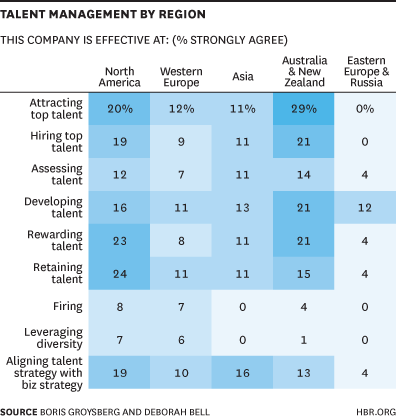
talentbyregion3-thumb-396x419-4096talentbyindustry-thumb-580x419-4067

What is top of mind for corporate boards worldwide? In one of the most comprehensive global surveys of corporate directors to date, we found that they were very worried about developing and enacting strategic plans that will enable their organizations to succeed. And what did they say was their biggest concern? Not competitive threats. Not rising costs. Not innovation, risk management, technology, debt, or the regulatory environment. Corporate directors identified talent management as their single greatest strategic challenge.

In our survey, conducted in partnership with WomenCorporateDirectors and Heidrick & Struggles, we asked over 1,000 board members across the globe to rate their companies’ performance in each of nine dimensions of talent management: attracting top talent; hiring top talent; assessing talent; developing talent; rewarding talent; retaining talent; firing; aligning talent strategy with business strategy; and leveraging diversity in company’s workforce. Read more of this post

NYC Commuters Ride to Work as Public Bikeshare Begins

NYC Commuters Ride to Work as Public Bikeshare Begins

New York City’s newest public-transit option, which allows commuters to rent bicycles to get to work, got its first real road test today as businesses reopened after the Memorial Day holiday weekend.

Tim McGlinn, a 44-year-old equities analyst at U.S. Steel & Carnegie Pension Fund, stuck his blue plastic key in the docking station outside Pennsylvania Station this morning to release one of 25 gleaming new two-wheelers for the first time. He takes the train from Maplewood, New Jersey, each day and had longed for the opportunity to swap his subway trip for a bike ride on the two-mile trek uptown to his office. Read more of this post

Bayern Ousts Manchester United From Soccer Brand-Value Throne

Bayern Ousts Manchester United From Soccer Brand-Value Throne

Bayern Munich, which won the Champions League title four days ago, has ousted Manchester United from first place in brand value, according to a survey of the world’s top soccer teams.

Brand Finance Plc gave Bayern a brand valuation of 668 million euros ($860 million), up 8 percent from last year, the company said in an e-mailed statement, citing its annual report. Manchester United, which won a record 20 English league titles, fell to second place with a brand estimated at 650 million euros.

“Bayern Munich is still very much a story of domestic dominance, however its continued presence in the Champions league has provided the club with access to a global audience,” Dave Chattaway, London-based Brand Finance’s Head of Sports Valuation, said in the statement. “The challenge now for all Bundesliga clubs and the league itself, is to see if they can export their domestic brand strength into global opportunities.” Read more of this post