What is the difference between Sunni and Shia Muslims?

What is the difference between Sunni and Shia Muslims?

May 28th 2013, 23:50 by S.B.

CLASHES between Islam’s two big sects, the Sunni and the Shia, take place across the Muslim world. In the Middle East a potent mix of religion and politics hassharpened the divide between Iran’s Shia government and the Gulf states, which have Sunni governments. Last year a report by the Pew Research Centre, a think tank, found 40% of Sunnis do not consider Shia to be proper Muslims. So what exactly divides Sunni and Shia Islam and how deep does the rift go?

The argument dates back to the death in 632 of Islam’s founder, the Prophet Muhammad. Tribal Arabs who followed him were split over who should inherit what was both a political and a religious office. The majority, who would go on to become known as the Sunnis, and today make up 80% of Muslims, backed Abu Bakr, a friend of the Prophet and father of his wife Aisha. Others thought Muhammad’s kin the rightful successors. They claimed the Prophet had anointed Ali, his cousin and son-in-law—they became known as the Shia, a contraction of “shiaat Ali”, the partisans of Ali. Abu Bakr’s backers won out, though Ali did briefly rule as the fourth caliph, the title given to Muhammad’s successors. Islam’s split was cemented when Ali’s son Hussein was killed in 680 in Karbala (modern Iraq) by the ruling Sunni caliph’s troops. Sunni rulers continued to monopolise political power, while the Shia lived in the shadow of the state, looking instead to their imams, the first twelve of whom were descended directly from Ali, for guidance. As time went on the religious beliefs of the two groups started to diverge. Read more of this post

Fed’s 100-Year Roots Grew From Virginia Congressman

Fed’s 100-Year Roots Grew From Virginia Congressman

As Carter Glass began to sketch out plans for a central bank in 1913, all the U.S. representative from Virginia had to do was read his mail to know he had nationwide support.

“As soon as money is needed in business in larger amounts than usual, the banks and business men begin to wonder if it is going to be possible to get the funds necessary to see us through,” Chas. K. Gleason of Edwin P. Gleason & Son, “Converters of Cotton Goods,” wrote from Philadelphia on March 26, 1913. “Currency Legislation is of utmost importance to business men and all the people connected with them.”

Gleason was just one of thousands of American bankers, coffee roasters, shoemakers, bed manufacturers, coal jobbers and hardware-store owners who were fed up with the way the financial system was strangling an otherwise booming economy at the turn of the 20th century.

The correspondence — in an archive of Glass’s papers at the University of Virginia’s Albert and Shirley Small Special Collections Library — leaves little doubt about why the Federal Reserve Act became a law 100 years ago. The public demanded it. Read more of this post

Bill Gates Fattens Wealth Gap Over Slim as Family Office Cascade’s Investments in Ecolab Surges

Bill Gates Fattens Wealth Gap Over Slim as Cascade Surges

Microsoft co-founder Bill Gates extended his lead yesterday over Mexico’s Carlos Slim as the world’s richest person to $5.1 billion, according to the Bloomberg Billionaires Index.

Almost all of Gates’s investments, including a 4.8 percent stake in Redmond, Washington-based Microsoft, have soared this year while Slim’s main holding, a 44 percent stake in America Movil SAB, the largest mobile-phone operator in the Americas, has fallen 14 percent.

One of the biggest gainers in Gates’s portfolio, which he controls through his Kirkland, Washington-based investment vehicle Cascade Investment LLC, is Ecolab Inc. (ECL) The St. Paul, Minnesota-based provider of sanitation and health services is up 22 percent this year, a performance that has added $423 million to the billionaire’s fortune.

“Ninety percent of what they produce gets flushed down the drain and you have to rebuy it,” Shlomo Rosenbaum, an analyst at Stifel Nicolaus & Co.’s Baltimore office, said in a telephone interview. “They have repositioned their portfolio of assets to be much more exposed to the energy market. That’s something that I think will help their top-line growth for years to come.” Read more of this post

Brazilian wine producer Miolo aims to cultivate customers at home by winning favour overseas

May 28, 2013 5:18 pm

A vineyard’s ambitions for a bouquet from Brazil

By Joe Leahy

When Morgana Miolo started doing business in China two years ago, the Brazilian was struck by the cultural differences of operating in the world’s second-largest economy.

“The Chinese close a deal with the most important person at the table raising a glass in toast higher than the others,” says the gaúcha, as people from Brazil’s southern state of Rio Grande do Sul are known. “My first time there, I didn’t know this stuff.”

More unusual than the vagaries of doing business in China, however, was the product Ms Miolo was selling. Hailing from a country best known in China for its savvy on the football field, this fourth-generation scion of a family of Brazilian viticulturists was in Shanghai to establish a market for her Miolo wine brands. Read more of this post

What Mad Over Donuts Learnt from India; the size of stores is not important. Engaging the customer is

What Mad Over Donuts Learnt from India

by Tarak Bhattacharya | May 29, 2013

topimg_21759_tarak_bhattacharya_600x400

For Tarak Bhattacharya, COO of Mad Over Donuts, the size of stores is not important. Engaging the customer is

Tarak Bhattacharya
Age:
 38
The Challenge: To create a pan-Indian brand from scratch
The Achievement: Has turned MOD into one of the most profitable doughnut chains in the country
How He Did It: Fly under the marketing radar, invest well in the product, keep customers engaged and open small stores in the country

India wasn’t one of the markets we had originally wanted to enter. We were looking for markets like Vietnam, Thailand, the UAE. But we thought that India had potential as there was a mass market and there was no one in the country in the doughnut sector; so the first-mover advantage was there.  Read more of this post

Why bosses should be careful when using performance-related pay

Why bosses should be careful when using performance-related pay

May 25th 2013 |From the print edition

20130525_FND000_0

OF ALL a firm’s inputs, its workers’ effort is perhaps the oddest. It is as vital as land, factories or machines, but much harder to control. It is often impossible even to measure. A manager can gauge the firm’s output, but not the effort people put in, beyond crude gauges such as the time they spend on the job. Employees have the informational edge, knowing their own effort, output and skill level. This asymmetry makes it hard for managers to distinguish, for instance, between the low-skilled but diligent and the skilled but lazy. Monitoring schemes to reward hard-working employees and punish slackers can boost effort, but they can backfire badly, too.

What should firms do? A good place to start is with the worst kind of behaviour: crime. In a paper published in 1968 Gary Becker, of the University of Chicago, set out the factors which policymakers should consider when deciding on what resources they should devote to detection. In his model criminals calculate the risks and benefits of bad behaviour, taking into account the possible monetary reward, the probability of being caught and the subsequent punishment. To cut crime authorities must increase the probability of being caught, the severity of the punishment, or both. This approach can also be applied to less extreme forms of bad behaviour, such as slow or sloppy work: firms may have to monitor individual workers, and then reward the good and punish the bad. Read more of this post

Do Shilajit, Other Rock Extracts Boost the Immune System?

May 27, 2013, 5:21 p.m. ET

Do Shilajit, Other Rock Extracts Boost the Immune System?

By LAURA JOHANNES

The Claim: Minerals and acids taken from rocks, including shale in the U.S. and tar from India, are good for your health. Rock ingredients vary, but can include fulvic and humic acids, and dozens of metals and minerals including iron, zinc, gold and silver, scientists say. Proponents say these ingredients soothe inflammation, boost the immune system and act as an antioxidant. A well-known rock-based treatment is shilajit, (pronounced shil-a-jeet), a tar-like substance scraped from rocks in the Himalayas.

The Verdict: “There is no known benefit of shilajit or other rock extracts” and they haven’t been adequately tested for safety in humans, says Philip J. Gregory, a pharmacist at ConsumerLab.com., which does independent testing on dietary supplements. Composition of rock-based therapies may vary from sample to sample, so it’s hard to be sure exactly what you’re getting, he adds.

PJ-BO502_ACHES_DV_20130527170737

Blk Enterprises’s Blk mineral-infused water sells for $2.49 for a 16.9-oz. bottle, while Pure Shilajit, a Himalaya tar-like resin which can be mixed in a liquid, sells for $380 for 90 grams.

The idea of consuming the nutrients in rocks for health benefits goes back thousands of years, says Dhaval Dhru, acting chairman of the department of Ayurvedic Sciences at Bastyr University in Kenmore, Wash. In ayurveda, or traditional Indian medicine, a small amount of shilajit is taken in warm milk, he says, to improve libido and treat a range of health problems such as diabetes and anemia. Read more of this post

A Better Way to Treat Anxiety; For Teens, Therapy Turns Parents Into ‘Exposure Coaches,’ Not Protectors

May 27, 2013, 5:42 p.m. ET

A Better Way to Treat Anxiety

For Teens, Therapy Turns Parents Into ‘Exposure Coaches,’ Not Protectors

By LAURA LANDRO

OB-XP842_INFORM_G_20130527185202

Getting up the nerve to order in a coffee shop used to be difficult for 16-year-old Georgiann Steely. Speaking in front of classmates was unthinkable.

The high-school sophomore overcame a crippling case of social anxiety as a patient in the Child and Adolescent Anxiety Disorders program at the Mayo Clinic in Rochester, Minn. Therapists there use an innovative approach early in treatment, gradually exposing children to things they fear most and teaching parents to act as “exposure coaches” rather than enable their children to avoid things and situations as a protective measure.

When parents help children to escape from feared situations, anxiety symptoms may worsen and children frequently become more impaired, says Stephen Whiteside, a Mayo pediatric psychologist. Read more of this post

New York rolled out a long-awaited bike-share program, an effort dubbed the city’s first new public-transit option in 75 years with $95 annual membership fee, $25 weekly passes and $9.95 day passes

May 27, 2013, 9:06 p.m. ET

Bike Share Gets Rolling Across City

Mayor Bloomberg Rolls Out Bike-Share Program With a Ding of a Bicycle Bell

By JOSH DAWSEY

NY-CJ227_BIKE_G_20130527162908

Toby Miller returns a bicycle to a bike-sharing kiosk on Monday. Straddling a bike but never pedaling, New York Mayor Michael Bloomberg rolled out a long-awaited bike-share program with a ding of a bicycle bell on Monday, an effort dubbed the city’s first new public-transit option in 75 years. A signature Bloomberg administration initiative, Citi Bike—named for its main sponsor, a financial-services company—made its debut with more than 6,000 bicycles available at 330 stations in Manhattan and Brooklyn for about 15,000 people who paid a $95 annual membership fee. Starting Sunday, others who don’t have annual memberships can buy day passes for $9.95 and weekly passes for $25.

Read more of this post

Idea Entrepreneur: The New 21st Century Career

Idea Entrepreneur: The New 21st Century Career

by John Butman  |  10:00 AM May 27, 2013

There is a new player emerging on the cultural and business scene today: the idea entrepreneur. Perhaps you are one yourself — or would like to be. The idea entrepreneur is an individual, usually a content expert and often a maverick, whose main goal is to influence how other people think and behave in relation to their cherished topic. These people don’t seek power over others and they’re not motivated by the prospect of achieving great wealth. Their goal is to make a difference, to change the world in some way.

Idea entrepreneurs are popping up everywhere. They’re people like Sheryl Sandberg (Facebook COO and author of Lean In), who is advocating a big new idea from within an organization. And like Atul Gawande (the checklist doctor), who is working to transform a professional discipline. Or like Blake Mycoskie (founder of TOMS shoes), who has created an unconventional business model. In my research into this phenomenon (which forms the basis of my book, Breaking Out), I have been amazed at how many different kinds of people aspire to be idea entrepreneurs. I have met with, interviewed, emailed or tweeted with librarians, salespeople, educators, thirteen-year-old kids, marketers, technologists, consultants, business leaders, social entrepreneurs — from countries all over the world — who have an idea, want to go public with it, and, in some cases, build a sustainable enterprise around it.

Read more of this post

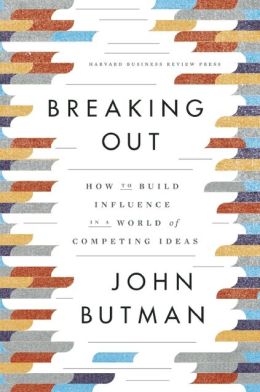
Breaking Out: How to Build Influence in a World of Competing Ideas

Breaking Out: How to Build Influence in a World of Competing Ideas [Hardcover]

John Butman (Author)

9781422172803_p0_v2_s260x420

Publication Date: May 21, 2013

How do you gain influence for an idea?
In Breaking Out, idea developer and adviser John Butman shows how the methods of today’s most popular “idea entrepreneurs”—including dog psychologist Cesar Millan, French lifestyle guru Mireille Guiliano (French Women Don’t Get Fat), TOMS founder Blake Mycoskie, and many others—can help you take an idea public and build influence for it.
It isn’t easy. Butman argues that the rise of the “ideaplex” (TED, Twitter, NPR, YouTube, online learning, and all the rest) has caused such an explosion in the creation and sharing of ideas that it has become much easier to go public—yet much harder to gain influence. But it can be done.
Based on his own experience in advising content experts worldwide, Butman shows how the idea entrepreneur breaks out—by combining personal narrative with rich content, creating many forms of expression (from books to live events), developing real-world practices, and creating “respiration” around the idea such that other people can breathe it in and make it their own. The resulting idea platform can reach many different audience groups and continue to build influence for many years and even decades.
If you have an idea and want to make a difference in your organization, build a change movement in your community, or improve the world in some way—this book will get you started on the journey to idea entrepreneurship. Read more of this post

Advice on Life and Creative Integrity from Calvin and Hobbes Creator Bill Watterson

May 20, 1990: Advice on Life and Creative Integrity from Calvin and Hobbes Creator Bill Watterson

by Maria Popova

billwattersoncalvinandhobbes1

“The truth is, most of us discover where we are headed when we arrive.”

‘Tis the season for glorious life advicedispensed by cap-and-gown-clad elders to cap-and-gown-clad youngsters, emanating a halo effect of timeless wisdom the rest of us can absorb any day, at any stage of life. On May 20, 1990, Bill Watterson, creator of the beloved Calvin and Hobbes comic strip, took the podium at Kenyon College — the same stage David Foster Wallace would occupy 15 years later to deliver one of history’s most memorable commencement addresses — and gave the graduating class a gift of equally remarkable insight and impact.

Watterson begins the speech by articulating the same sentiment at the heart ofthe most unforgettable commencement addresses: the notion that not-knowing is not only a part of the journey, but an integral part:

I have a recurring dream about Kenyon. In it, I’m walking to the post office on the way to my first class at the start of the school year. Suddenly it occurs to me that I don’t have my schedule memorized, and I’m not sure which classes I’m taking, or where exactly I’m supposed to be going.
As I walk up the steps to the postoffice, I realize I don’t have my box key, and in fact, I can’t remember what my box number is. I’m certain that everyone I know has written me a letter, but I can’t get them. I get more flustered and annoyed by the minute. I head back to Middle Path, racking my brains and asking myself, “How many more years until I graduate? …Wait, didn’t I graduate already?? How old AM I?” Then I wake up.

Experience is food for the brain. And four years at Kenyon is a rich meal. I suppose it should be no surprise that your brains will probably burp up Kenyon for a long time. And I think the reason I keep having the dream is because its central image is a metaphor for a good part of life: that is, not knowing where you’re going or what you’re doing. Read more of this post

Surfaces and Essences: Analogy as the Fuel and Fire of Thinking

Surfaces and Essences: Analogy as the Fuel and Fire of Thinking [Hardcover]

Douglas Hofstadter (Author), Emmanuel Sander (Author)

7711871

Release date: April 23, 2013

Analogy is the core of all thinking.

This is the simple but unorthodox premise that Pulitzer Prize–winning author Douglas Hofstadter and French psychologist Emmanuel Sander defend in their new work. Hofstadter has been grappling with the mysteries of human thought for over thirty years. Now, with his trademark wit and special talent for making complex ideas vivid, he has partnered with Sander to put forth a highly novel perspective on cognition.

We are constantly faced with a swirling and intermingling multitude of ill-defined situations. Our brain’s job is to try to make sense of this unpredictable, swarming chaos of stimuli. How does it do so? The ceaseless hail of input triggers analogies galore, helping us to pinpoint the essence of what is going on. Often this means the spontaneous evocation of words, sometimes idioms, sometimes the triggering of nameless, long-buried memories.

Why did two-year-old Camille proudly exclaim, “I undressed the banana!”? Why do people who hear a story often blurt out, “Exactly the same thing happened to me!” when it was a completely different event? How do we recognize an aggressive driver from a split-second glance in our rearview mirror? What in a friend’s remark triggers the offhand reply, “That’s just sour grapes”? What did Albert Einstein see that made him suspect that light consists of particles when a century of research had driven the final nail in the coffin of that long-dead idea?

The answer to all these questions, of course, is analogy-making—the meat and potatoes, the heart and soul, the fuel and fire, the gist and the crux, the lifeblood and the wellsprings of thought. Analogy-making, far from happening at rare intervals, occurs at all moments, defining thinking from top to toe, from the tiniest and most fleeting thoughts to the most creative scientific insights.

Like Gödel, Escher, Bach before it, Surfaces and Essences will profoundly enrich our understanding of our own minds. By plunging the reader into an extraordinary variety of colorful situations involving language, thought, and memory, by revealing bit by bit the constantly churning cognitive mechanisms normally completely hidden from view, and by discovering in them one central, invariant core—the incessant, unconscious quest for strong analogical links to past experiences—this book puts forth a radical and deeply surprising new vision of the act of thinking. Read more of this post

Uncommon Genius: Stephen Jay Gould On Why Connections Are The Key to Creativity; “The trick to creativity is to identify your own peculiar talent and then to settle down to work with it for a good long time.”

Uncommon Genius: Stephen Jay Gould On Why Connections Are The Key to Creativity

by Maria Popova

“The trick to creativity, if there is a single useful thing to say about it, is to identify your own peculiar talent and then to settle down to work with it for a good long time.”

“Originality often consists in linking up ideas whose connection was not previously suspected,” wrote W. I. B. Beveridge in the fantastic 1957 tomeThe Art of Scientific Investigation“The role of the imagination is to create new meanings and to discover connections that, even if obvious, seem to escape detection,” legendary graphic designerPaul Rand seconded. Indeed, longer ago than I can remember, I intuited the conviction that creativity is a combinatorial force — it thrives on cross-pollinating existing ideas, often across divergent disciplines and sensibilities, and combining them into something new, into what we proudly call our “original” creations. Paula Scher has likened the process to a slot machine; Dorion Sagan has asserted that science is about connections; Gutenberg has embodied it. And some of history’s most celebrated creators have attested to it with the nature of their genius. Read more of this post

Good Writing vs. Talented Writing; “Talented writing makes things happen in the reader’s mind — vividly, forcefully — that good writing, which stops with clarity and logic, doesn’t.”

Good Writing vs. Talented Writing

by Maria Popova

“Talented writing makes things happen in the reader’s mind — vividly, forcefully — that good writing, which stops with clarity and logic, doesn’t.”

The secrets of good writing have been debatedagain and again and again. But “good writing” might, after all, be the wrong ideal to aim for. In About Writing: Seven Essays, Four Letters, and Five Interviews (public library), celebrated author and literary critic Samuel Delany — who, for a fascinating factlet, penned thecontroversial 1972 “women’s liberation” issue of Wonder Woman — synthesizes his most valuable insights from thirty-five years of teaching creative writing, a fine addition tobeloved writers’ advice on writing. One of his key observations is the crucial difference between “good writing” and “talented writing,” the former being largely the product of technique (and we know from H.P. Lovecraft that “no aspiring author should content himself with a mere acquisition of technical rules”), the other a matter of linguistic and aesthetic sensitivity:

Though they have things in common, good writing andtalented writing are not the same. Read more of this post

The Essayification of Everything: Why has the form invented by Montaigne — searching, sampling, notoriously noncommittal — become a talisman of our times?

MAY 26, 2013, 3:00 PM

The Essayification of Everything

By CHRISTY WAMPOLE

Lately, you may have noticed the spate of articles and books that take interest in the essay as a flexible and very human literary form. These include “The Wayward Essay” and Phillip Lopate’s reflections on the relationship between essay and doubt, and books such as “How to Live,” Sarah Bakewell’s elegant portrait of Montaigne, the 16th-century patriarch of the genre, and an edited volume by Carl H. Klaus and Ned Stuckey-French called “Essayists on the Essay: Montaigne to Our Time.”

It seems that, even in the proliferation of new forms of writing and communication before us, the essay has become a talisman of our times. What is behind our attraction to it? Is it the essay’s therapeutic properties? Because it brings miniature joys to its writer and its reader? Because it is small enough to fit in our pocket, portable like our own experiences? Read more of this post

Brewing fortunes are not uncommon. But few of these fortunes have been turned into such a successful family office as Quilvest

BEER MONEY

ARTICLE | 23 MAY, 2013 02:43 PM | BY JEREMY HAZLEHURST

When Otto Bemberg set up a brewery in the Argentine town of Quilmes after leaving his native Cologne in 1850, he would no doubt have been pleased that a century and a half later the business he started would produce Argentina’s biggest selling beer, with 75% of the market, that it would sponsor the national football team, and appear in trendy bars the world over. He’d also be chuffed to see a family business in its seventh generation. As a savvy businessman, he might have been even happier that, through its investment arm, the family firm would also spawn one of the world’s largest family offices.

Quilvest, which has $22 billion (€17.1 billion) under management, including $4 billion in the private equity arm, almost 400 employees and 13 offices globally, started life in 1917 in Paris to look after the family’s wealth. These days, Quilvest is divided into two. One side is a multi family office with around 4,000 clients – around 100 of them use it as a one-stop-shop family office, while most of the others use it for individual investments. The other is a private equity house, which has been investing since 1972. And interestingly, the family, which now consists of around 150 members, is still intimately involved with all aspects of Quilvest. Read more of this post

Why People Hate The Google Bus

Why People Hate The Google Bus

Rory CarrollThe Guardian | May 26, 2013, 8:54 AM | 20,507 | 57

google-bus-7

Every morning and every evening the fleet glides through the city, hundreds of white buses with tinted windows navigating San Francisco’s rush hour. From the pavement you can see your reflection in the windows, but you can’t see in. The buses have no markings or logos, no advertised destinations or stops.

It doesn’t matter. Everyone knows what they are. “Transport for a breed apart. For a community that is separate but not equal,” said Diamond Dave Whitaker, a self-professed beat poet and rabble-rouser.

The buses ferry workers to and from Apple, Facebook, Google and other companies in Silicon Valley, an hour’s drive south. They hum with air-conditioning and Wi-Fi. They are for the tech elite, and only the tech elite. Read more of this post

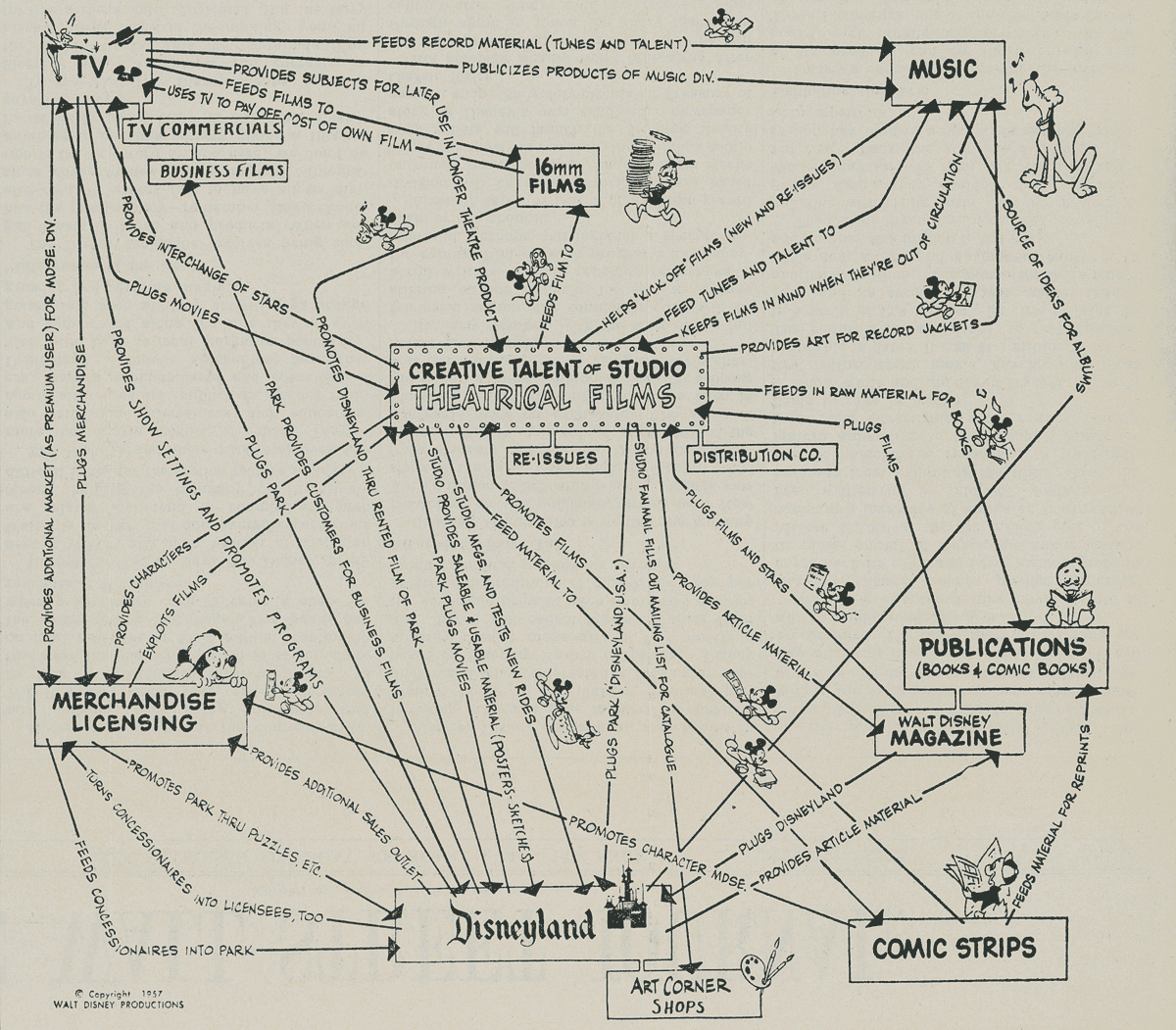
What Is the Theory of Your Firm? Walt Disney’s Theory of Value Creation in Entertainment (1957 Illustration)

What Is the Theory of Your Firm?

by Todd Zenger

R1306D_A_LG

Illustration: © 1957 Disney

If asked to define strategy, most executives would probably come up with something like this: Strategy involves discovering and targeting attractive markets and then crafting positions that deliver sustained competitive advantage in them. Companies achieve these positions by configuring and arranging resources and activities to provide either unique value to customers or common value at a uniquely low cost. This view of strategy as position remains central in business school curricula around the globe: Valuable positions, protected from imitation and appropriation, provide sustained profit streams.

Unfortunately, investors don’t reward senior managers for simply occupying and defending positions. Equity markets are full of companies with powerful positions and sluggish stock prices. The retail giant Walmart is a case in point. Few people would dispute that it remains a remarkable firm. Its early focus on building a regionally dense network of stores in small towns delivered a strong positional advantage. Complementary choices regarding advertising, pricing, and information technology all continue to support its low-cost and flexibly merchandised stores. Read more of this post

The Wave of Transient Advantage

Transient Advantage

by Rita Gunther McGrath

R1306C_B_LG

Strategy is stuck. For too long the business world has been obsessed with the notion of building a sustainable competitive advantage. That idea is at the core of most strategy textbooks; it forms the basis of Warren Buffett’s investment strategy; it’s central to the success of companies on the “most admired” lists. I’m not arguing that it’s a bad idea—obviously, it’s marvelous to compete in a way that others can’t imitate. And even today there are companies that create a strong position and defend it for extended periods of time—firms such as GE, IKEA, Unilever, Tsingtao Brewery, and Swiss Re. But it’s now rare for a company to maintain a truly lasting advantage. Competitors and customers have become too unpredictable, and industries too amorphous. The forces at work here are familiar: the digital revolution, a “flat” world, fewer barriers to entry, globalization.

Strategy is still useful in turbulent industries like consumer electronics, fast-moving consumer goods, television, publishing, photography, and…well, you get the idea. Leaders in these businesses can compete effectively—but not by sticking to the same old playbook. In a world where a competitive advantage often evaporates in less than a year, companies can’t afford to spend months at a time crafting a single long-term strategy. To stay ahead, they need to constantly start new strategic initiatives, building and exploiting many transient competitive advantages at once. Though individually temporary, these advantages, as a portfolio, can keep companies in the lead over the long run. Firms that have figured this out—such as Milliken & Company, a U.S.-based textiles and chemicals company; Cognizant, a global IT services company; and Brambles, a logistics company based in Australia—have abandoned the assumption that stability in business is the norm. They don’t even think it should be a goal. Instead, they work to spark continuous change, avoiding dangerous rigidity. They view strategy differently—as more fluid, more customer-centric, less industry-bound. And the ways they formulate it—the lens they use to define the competitive playing field, their methods for evaluating new business opportunities, their approach to innovation—are different as well. Read more of this post

You Make Better Decisions If You “See” Your Senior Self

You Make Better Decisions If You “See” Your Senior Self

by Hal Hershfield

F1306D_A

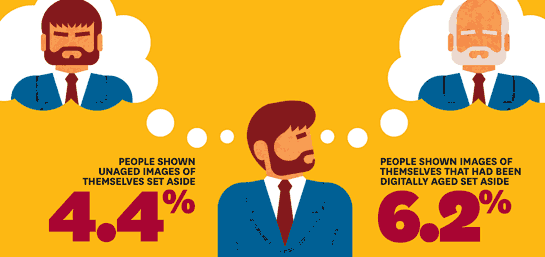
The finding: Many people feel disconnected from the individuals they’ll be in the future and, as a result, discount rewards that would later benefit them. But brief exposure to aged images of the self can change that behavior. 

The research: Hal Hershfield ran fMRI scans on subjects and found that the neural patterns seen when they described themselves 10 years in the future were markedly different from those seen when they described their current selves (but similar to those seen when they talked about actors). In a later asset allocation task, people whose brain activity changed the most when they began discussing their future selves were the least likely to favor large long-term gains over small immediate ones. However, in follow-up experiments, when subjects were shown aged images of themselves, that tendency disappeared. Read more of this post

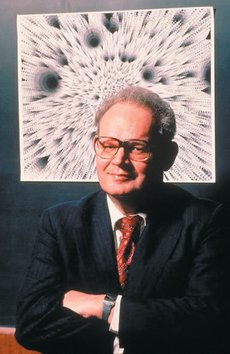
The Fractalist: Memoir of a Scientific Maverick

He Conceived the Mathematics of Roughness

MAY 23, 2013 Jim Holt

The Fractalist: Memoir of a Scientific Maverick
by Benoit B. Mandelbrot
Pantheon, 324 pp., $30.00

holt_1-052313_jpg_230x1466_q85

Benoit Mandelbrot, the brilliant Polish-French-American mathematician who died in 2010, had a poet’s taste for complexity and strangeness. His genius for noticing deep links among far-flung phenomena led him to create a new branch of geometry, one that has deepened our understanding of both natural forms and patterns of human behavior. The key to it is a simple yet elusive idea, that of self-similarity.

To see what self-similarity means, consider a homely example: the cauliflower. Take a head of this vegetable and observe its form—the way it is composed of florets. Pull off one of those florets. What does it look like? It looks like a little head of cauliflower, with its own subflorets. Now pull off one of those subflorets. What does that look like? A still tinier cauliflower. If you continue this process—and you may soon need a magnifying glass—you’ll find that the smaller and smaller pieces all resemble the head you started with. The cauliflower is thus said to be self-similar. Each of its parts echoes the whole. Read more of this post

TED curator Chris Anderson: How to Give a Killer Presentation

How to Give a Killer Presentation

by Chris Anderson

A little more than a year ago, on a trip to Nairobi, Kenya, some colleagues and I met a 12-year-old Masai boy named Richard Turere, who told us a fascinating story. His family raises livestock on the edge of a vast national park, and one of the biggest challenges is protecting the animals from lions—especially at night. Richard had noticed that placing lamps in a field didn’t deter lion attacks, but when he walked the field with a torch, the lions stayed away. From a young age, he’d been interested in electronics, teaching himself by, for example, taking apart his parents’ radio. He used that experience to devise a system of lights that would turn on and off in sequence—using solar panels, a car battery, and a motorcycle indicator box—and thereby create a sense of movement that he hoped would scare off the lions. He installed the lights, and the lions stopped attacking. Soon villages elsewhere in Kenya began installing Richard’s “lion lights.”

The story was inspiring and worthy of the broader audience that our TED conference could offer, but on the surface, Richard seemed an unlikely candidate to give a TED Talk. He was painfully shy. His English was halting. When he tried to describe his invention, the sentences tumbled out incoherently. And frankly, it was hard to imagine a preteenager standing on a stage in front of 1,400 people accustomed to hearing from polished speakers such as Bill Gates, Sir Ken Robinson, and Jill Bolte Taylor. Read more of this post

What Eisenhower Taught Me About Decision-Making; Bill Marriott Jr. says a 1954 chat with President Eisenhower taught him that when it comes to making decisions, it’s always important to be inclusive of others

May 25, 2013

What Eisenhower Taught Me About Decision-Making

By ADAM BRYANT

26-CORNER-popup

This interview with J.W. Marriott Jr., known as Bill, executive chairman and former C.E.O. of Marriott International, was conducted and condensed by Adam Bryant.

J.W. Marriott Jr., known as Bill, is executive chairman and former C.E.O. of Marriott International, says a brief chat with President Eisenhower in 1954 taught him the importance of always asking others, “What do you think we should do?

Q. Do you remember the first time you were somebody’s boss?

A. I guess it was in the Navy. I was in the Navy Supply Corps on an aircraft carrier. I eventually took over the officers’ mess. I had worked in my dad’s restaurant when I was in college, and I had all the recipe cards sent to me because I didn’t like the food they were serving on board. I went to these Navy stewards and said, “I want you guys to follow the recipes.” And they looked at me, they didn’t say much, and they didn’t follow the recipes. I came back a few weeks later and said, “You’ve got to start following these recipes.” And they didn’t follow the recipes. They were all World War II veterans, they’d been everywhere and they had learned not to pay attention to all these green, young ensigns. In later years, I realized I’d failed to get them on the team. I had walked in and said: “Here, do it. I’m an officer. Salute and do it.” They ignored me and didn’t do it, and we still had lousy food when I left the ship. I realized that I should have sat down with them and said, “What do you think we can do to improve the food?” Read more of this post

Intuition Pumps And Other Tools for Thinking

Intuition Pumps And Other Tools for Thinking [Kindle Edition]

Daniel C. Dennett (Author)

16241139

Publication Date: May 6, 2013

One of the world’s leading philosophers offers aspiring thinkers his personal trove of mind-stretching thought experiments. Over a storied career, Daniel C. Dennett has engaged questions about science and the workings of the mind. His answers have combined rigorous argument with strong empirical grounding. And a lot of fun.

Intuition Pumps and Other Tools for Thinking offers seventy-seven of Dennett’s most successful “imagination-extenders and focus-holders” meant to guide you through some of life’s most treacherous subject matter: evolution, meaning, mind, and free will. With patience and wit, Dennett deftly deploys his thinking tools to gain traction on these thorny issues while offering readers insight into how and why each tool was built.

Alongside well-known favorites like Occam’s Razor and reductio ad absurdum lie thrilling descriptions of Dennett’s own creations: Trapped in the Robot Control RoomBeware of the Prime Mammal, and The Wandering Two-Bitser. Ranging across disciplines as diverse as psychology, biology, computer science, and physics, Dennett’s tools embrace in equal measure light-heartedness and accessibility as they welcome uninitiated and seasoned readers alike. As always, his goal remains to teach you how to “think reliably and even gracefully about really hard questions.”

A sweeping work of intellectual seriousness that’s also studded with impish delights, Intuition Pumps offers intrepid thinkers—in all walks of life—delicious opportunities to explore their pet ideas with new powers. Read more of this post

Philosopher Daniel Dennett Presents Seven Tools For Critical Thinking

Philosopher Daniel Dennett Presents Seven Tools For Critical Thinking

in Philosophy | May 21st, 2013 7 Comments

Love him or hate him, many of our readers may know enough about Daniel C. Dennett to have formed some opinion of his work. While Dennett can be a soft-spoken, jovial presence, he doesn’t suffer fuzzy thinking or banal platitudes— what he calls “deepities”—lightly. Whether he’s explaining (or explaining away) consciousnessreligion, or free will, Dennett’s materialist philosophy leaves little-to-no room for mystical speculation or sentimentalism. So it should come as no surprise that his latest book,Intuition Pumps And Other Tools for Thinking, is a hard-headed how-to for cutting through common cognitive biases and logical fallacies. In a recent Guardian article, Dennett excerpts seven tools for thinking from the new book. Having taught critical thinking and argumentation to undergraduates for years, I can say that his advice is pretty much standard fare of critical reasoning. But Dennett’s formulations are uniquely—and bluntly—his own. Below is a brief summary of his seven tools.

1. Use Your Mistakes

Dennett’s first tool recommends rigorous intellectual honesty, self-scrutiny, and trial and error. In typical fashion, he puts it this way: “when you make a mistake, you should learn to take a deep breath, grit your teeth and then examine your own recollections of the mistake as ruthlessly and as dispassionately as you can manage.” This tool is a close relative of the scientific method, in which every error offers an opportunity to learn, rather than a chance to mope and grumble. Read more of this post

What Gets You Up in the Morning? Purpose is a uniquely powerful source of fuel – and satisfaction. That’s why we resonate so strongly with exhortations that speak to it

MAY 24, 2013, 11:41 AM

What Gets You Up in the Morning?

By TONY SCHWARTZ

In the last several weeks, I had two radically different experiences spending extended time with leaders at two large, global companies. A long, alcohol-fueled dinner with the first group was a pure downer: dull, rote and devoid of positive energy.

The day with the second — a group of young managers at Google — was utterly exhilarating. After eight hours together, discussing what it takes to be an inspiring leader, the conversation was still going strong.

What accounts for the difference?

The Google leaders were considerably younger than their counterparts in the first group, who worked for a financial services company. Also, Google is regularly recognized as a great place to work. But the most powerful difference, I’m convinced, is that the Googlers – hundreds of whom I’ve worked with over the years – feel they’re contributing to something meaningful and larger than themselves, and the other executives evinced no passion whatsoever for their work. Read more of this post

Hone the Job You Have Into One You Love

May 25, 2013

Hone the Job You Have Into One You Love

By SHANE J. LOPEZ

OVER the past few months, American workers have been suffering from a major case of spring fever. Many of them, for the first time in years, are thinking about testing the waters of the slowly improving economy. They are looking for better jobs than those they’ve been clinging to throughout the recession. Maybe, they think, they can even find a job they love. Read more of this post

Amma’s Multifaceted Empire, Built on Hugs; Amma is best known for literally embracing the masses; she has hugged millions of people around the world, a feat that has earned her the nickname “the hugging saint.”

May 25, 2013

Amma’s Multifaceted Empire, Built on Hugs

By JAKE HALPERN

26-AMMA-slide-VSMB-articleLarge

THERE are entourages — and then there is the retinue of Mata Amritanandamayi, a 59-year-old Indian guru known simply as Amma, or “mother.” On Friday, she began a two-month North American tour during which she will be accompanied by 275 volunteers. They plan to ride in four buses across the continent from Bellevue, Wash., to Marlborough, Mass., visiting 11 cities, including New York. And at each stop along the way, Amma will sit on stage for 15 hours at a stretch, greeting her thousands of devotees.

Amma is best known for literally embracing the masses; she has hugged millions of people around the world, a feat that has earned her the nickname “the hugging saint.” Her status as a spiritual therapist has attracted a large following in the United States. In India, however, what Amma offers is far more significant and complex. She has built a vast organization that is the envy of both India’s public and private sectors. As Oommen Chandy, the chief minister of the state of Kerala, told me: “From nothing, she has built an empire.” Read more of this post

The Hunt for Steve Cohen, founder of SAC Capital, the $14 billion hedge fund, who some regard as the most successful stock picker of his time.

June 2013

The Hunt for Steve Cohen

i.0.steve-cohen-andre-carrilho_0

With arrest after arrest in a massive, seven-year insider-trading investigation, U.S. Attorney Preet Bharara is getting closer to the biggest fish of them all: Steve Cohen, founder of SAC Capital, the $14 billion hedge fund, who some regard as the most successful stock picker of his time. C.E.O.’s have fallen, lives and companies have been upturned, but Cohen has thus far escaped. Bryan Burrough and Bethany McLean go deep inside Bharara’s probe—and SAC’s org chart—to reveal just how much blood is in Wall Street’s waters.

By Bryan Burrough AND Bethany McLeanIllustration by André Carrilho

THAR SHE BLOWS Steve Cohen has become a focal point of a seven-year probe into insider trading, led by U.S. Attorney Preet Bharara. So far, 71 people have been convicted or admitted guilt.  Twenty-five years ago Wall Street, and much of America, was transfixed by a sweeping set of insider-trading investigations centered on the greatest financier of the age, junk-bond king Michael Milken, of Drexel Burnham Lambert. Day after day, week after week, month after month, stories of U.S. Attorney Rudolph Giuliani’s relentless investigation dribbled out to the press. One by one, Giuliani picked off Milken’s minions, confronting them at their homes, handcuffing them at their offices, pulling them before secret grand juries, indicting a few, pressing for evidence that Milken had broken the law. It all took on an inexorable quality. In their hearts, most everyone knew that Milken was going down sooner or later—and he did, paying more than $1 billion in fines and spending 22 months in prison. He was banned for life from the securities industry, and his firm was dismantled. Read more of this post