Loyal cat won’t leave side of fatally struck companion

Loyal cat won’t leave side of fatally struck companion

2013-05-25 04:13:12 GMT2013-05-25 12:13:12(Beijing Time)  SINA.com

A pregnant cat was fatally struck by a vehicle and died on the side of a road in Changchun city, NE China’s Jilin province on May 23rd. A brown cat refused to leave the side of his companion for at least 7 hours and wouldn’t let any one, not even a dog, come close to the scene of tragedy.U47P5029T2D593509F28DT20130525121312U47P5029T2D593509F31DT20130525121312

P&G Looks for Steve Jobs-Like Sequel by Recalling ex-CEO

P&G Looks for Steve Jobs-Like Sequel by Recalling ex-CEO

Much like turning to Star Trek and Iron Man sequels for a safe way to ensure box-office sales, recalling popular former leaders has become a reliable corporate script in times of crisis.

“It’s about confidence,” said James Post, a professor at Boston University School of Management. “People have the confidence that they understand the challenges. They can put their reputation on the table and help stabilize the ship.” Read more of this post

China’s First Modern: Lu Xun was his country’s foremost revolutionary in literature, if not always in politics

May 24, 2013, 12:54 p.m. ET

China’s First Modern

Lu Xun was his country’s foremost revolutionary in literature, if not always in politics.

By JULIA LOVELL

It’s hard to find a precise Western analogue for Lu Xun (1881-1936). He is China’s Dickens, for his mercilessly sharp portrayals of the era he lived through; he is Joyce, a re-maker of language and form. He has a good deal of Orwell, too, for his political commentary and the plain vernacular style that he championed. And, as a writer who in his final years became a figurehead of the literary left and was sanctified by his the Chinese communist leadership after his death, he has a touch of Gorky.

Lu Xun owes his immense literary reputation in mainland China primarily to his satirical fiction but also to the prose poems and polemical essays that he wrote in the last two decades of his life. In 1918, his surreal first short story in vernacular Chinese, “Diary of a Madman,” portrayed Chinese culture as cannibalistically eating its young. Its iconoclastic premise propelled him to the center of the New Culture Movement of the late 1910s. The two volumes of short fiction he produced between 1918 and 1925, “Outcry” and “Hesitation,” were admired for their portrayals of a China in a state of spiritual emergency: backward, impoverished and complacent. Read more of this post

How to Set the Foundations for B Grimm’s Next 135 years; B Grimm was established in 1878 and now is one of the oldest corporate citizens in Thailand.

Ways to sustain family business

Kwanchai Rungfapaisarn
The Nation May 25, 2013 1:00 am

Academic offers advice at workshop on B Grimm

In the era of globalisation, family-owned businesses are facing major challenges to ensure long-term sustainability. Christine Blondel, adjunct professor of entrepreneurship and family enterprise at the global business school INSEAD, said family businesses had some specific strengths and weaknesses. She said the major problems in such ventures were caused by family fights that flared up because they had no clear rules of the game. These internal battles occur because some family members work for the business while some do not, and they have not communicated enough. They do not understand enough what is going on in the business. Another risk occurs when family members lose the entrepreneurial spirit that made their business a success. One of the most important points is that they have to ensure that this spirit is kept alive from generation to generation. Blondel this week held a workshop titled “How to Set the Foundations for B Grimm’s Next 135 years” for the management and executives of that family-owned business, which was established in 1878 and now is one of the oldest corporate citizens in Thailand. Owned by the third generation of the Link family – Harald Link, chairman of B Grimm, and Caroline Link, president of B Grimm Real Estate – it is a multifaceted business active in the fields of energy, cooling, healthcare, lifestyle, transport and real estate. Read more of this post

‘Meddling’ business owners hold back growth

‘Meddling’ business owners hold back growth

Entrepreneurs need to stop being “meddlers, heroes and artisans” and adopt more of a hands-off, “strategic” role so their businesses can grow, according to the Cranfield School of Management. Cranfield said “becoming a strategist is necessary for leaders to outline a vision in order to grow the business and effectively motivate employees”. Photo: © Chris Ryan / Alamy

By James Hurley

1:28PM BST 24 May 2013

Too many British business owners can’t let go of routine tasks and spend too little time managing staff and planning their organisation’s future, the business school said. Research by Cranfield, based on its work with more than 1,500 business owners, identified four common leadership styles among business leaders: ‘strategists’, ‘meddlers’, ‘heroes’ and ‘artisans’. Only a small proportion of entrepreneurs are ‘strategists’, the ideal category, Cranfield said. This group “gives their managers the tools to do their job”, leaving the business owner to carry out future planning. ‘Meddlers’ hold back the growth of their business by holding on to day-to-day management tasks. “Staff are hired to take responsibility but are not empowered to do so and the boss isn’t making time to plan,” Cranfield said. Read more of this post

Growth in Options Trading Helps Brokers but Not Small Investors; Brokerage firms say that options, traditionally used by professional traders, can be profitable for ordinary investors, but this does not square with many investors’ experience

May 24, 2013

Growth in Options Trading Helps Brokers but Not Small Investors

By NATHANIEL POPPER

Some of the brokerage firms that helped pique American’s interest in stocks are now luring them into something much riskier: stock options.

As the stock market soars to new heights, E*TradeAmeritrade and Charles Schwab are advertising the potential rewards of options, which give buyers the right to buy or sell stocks at predetermined prices in the future. Options, like their cousins, futures, have traditionally been the domain of Wall Street traders. But the brokerage firms say futures and options can be profitable for ordinary investors, too — a claim that, while true, does not square with many investors’ actual experience. Read more of this post

Zhang Yong, creator of the wildly popular Chinese hot-pot chain Hai Di Lao, may not have the global cult following Steve Jobs, but in China’s food and beverage industry, he isn’t far behind

May 24, 2013, 12:00 PM

Star Entrepreneur’s Business Advice: Don’t Listen to Me

OB-XO855_0523cr_G_20130523081442

Zhang Yong, the creator of the wildly popular Chinese hot-pot chain Hai Di Lao, may not have the global cult following of Apple founder Steve Jobs, but in China’s food and beverage industry, he isn’t far behind. In 2011, bookstores stocked the shelves with “Learn from Hai Di Lao.” Media outlets are clawing for an opportunity to interview him, a spokeswoman said.

The question for the entrepreneur—who has built a growing empire of 75 restaurants that serve sliced lamb, beef and vegetables to be boiled in spicy broth—is always, What’s next? And how did he come up with the idea to distinguish his chain with service perks like manicures, board games and noodle performances?

Mr. Zhang, who confesses that after 20 years of eating hot pot he doesn’t particularly like it, said he plans to take Hai Di Lao public, but isn’t sure in which market. The timing isn’t optimal right now, he adds, noting that other Chinese companies have listed and flopped almost instantaneously. Read more of this post

Keeping the Faith: The Mathematician Who Could Be a Movie Star; Yitang Zhang, a onetime accountant and part-time lecturer at the University of New Hampshire who used to make sandwiches in a Subway shop, solves one of the great math puzzles

The Mathematician Who Could Be a Movie Star

In the distraction of the scandal-fever swirling through Washington and the news media, you might have missed the announcement the other day that one of the great puzzles of number theory had been solved.

What makes the news most fascinating is that the solver isn’t on the faculty of a top university and wasn’t known until this month to others who work in the field. He is a Chinese immigrant in his 50s named Yitang Zhang, a onetime accountant and part-time lecturer at the University of New Hampshire who used to make sandwiches in a Subway shop. Said one leading number theorist: “Basically, no one knows him.”

Cue the agents and film producers.

Because the story gets better. Zhang’s accomplishment tracks our romantic vision of the dedicated genius working alone in his garage. The truth is even more unlikely.

Zhang hit upon the crucial idea not in his garage but at a friend’s house in Colorado, where he had gone to clear his head. He was sitting in the backyard, waiting to leave for a concert. (Imagine it cinematically: Zhang skips the concert, ignoring the entreaties of his skeptical hosts, and refuses to budge from the yard, where he sits all through the frigid Rocky Mountain night, feverishly scratching equations into tree bark.) Read more of this post

The Savior Generals: How Five Great Commanders Saved Wars That Were Lost; Instead of punishing them, the Byzantine general Belisarius recruited conquered peoples as allies to help defeat Germanic barbarians

May 23, 2013, 6:11 p.m. ET

The Tough Who Got Going

Instead of punishing them, the Byzantine general Belisarius recruited conquered peoples as allies to help defeat Germanic barbarians.

By MARK MOYAR

the_savior_generals

For a police chief, keeping the streets of Beverly Hills safe will probably never qualify as an act of great leadership, if only because the task itself lacks a certain degree of difficulty. The value of leadership is much clearer when circumstances are unfavorable—especially when failure seems imminent and is then somehow converted into success. For this reason, Victor Davis Hanson’s “The Savior Generals” focuses on five figures who faced an outsize challenge and rose to meet it with resolution and skill. “In some sense, winning against impossible odds—when most others cannot or would not try—is the only mark of a great general,” Mr. Hanson writes.

Mr. Hanson’s fluency with a broad range of historical epochs, which has made him one of his generation’s most notable historians, is on full display in “The Savior Generals.” Although his portraits come from the military realm—ranging from the classical period to the current day—they illustrate eternal verities that arise in all types of endeavor, and they capture attributes associated with master strategists in all walks of life, such as a disregard for conventional wisdom and an intuitive grasp of the big picture. Read more of this post

Lessons from an old master: As an art crimes investigator, former policeman Richard Ellis takes a traditional approach

May 23, 2013 3:45 pm

Lessons from an old master

By Emma Jacobs

Dick Ellis 12 and Bald

The art of the investigation: Richard Ellis is hired by collectors and insurers to retrieve stolen works

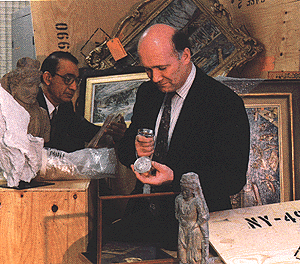
Criminals are both nemeses and friends to Richard “Dick” Ellis. After he leaves the Wallace Collection, the gallery in central London displaying paintings by Fragonard and Canaletto, the 63-year-old is going for a drink with one. Or, as he nonchalantly puts it, “someone who was classified as a former terrorist”.

The reason? “That is how you learn to do stuff.”

Mr Ellis traces stolen paintings and artefacts on behalf of collectors and insurers. Keeping up with criminal contacts helped him do his job as an investigator at New Scotland Yard, heading the art and antiques squad, and now it helps him to retrieve stolen property for private clients. Read more of this post

Ask a Billionaire: GoPro CEO Nick Woodman; A lot of people would ask me, “Are you really doing this?” So I put a Post-it note by the side of my bed that said, “I am doing this.” Every morning when I woke up, the first thing I’d look at was that Post-it note

Ask a Billionaire: GoPro CEO Nick Woodman

By Emma Rosenblum on May 23, 2013

etc_billionaire22__01__630x420

Nick Woodman
Chief executive officer, GoPro
Net worth: $1.73 billion

How much of your success would you chalk up to luck?
—@anne_norris

I was very lucky that I had my idea when I was young. I had very low overhead. I could go live out of my Volkswagen bus while I got my company going. But I had no idea how to bring this physical product from idea to reality and then sell it in the marketplace. A lot of people would ask me, “Are you really doing this?” So I put a Post-it note by the side of my bed that said, “I am doing this.” Every morning when I woke up, the first thing I’d look at was that Post-it note. And after three months of looking at it and getting myself pumped up to go to work, which was, you know, 5 feet across the room at my desk, I realized: I am doing this. Four months turned into four years turned into now 11 years. Dedicating myself to actually following through was my single biggest achievement.

John Doerr on the great entrepreneurs of the last half-century

John Doerr on the great entrepreneurs of the last half-century

BY MICHAEL CARNEY 
ON MAY 23, 2013

In his nearly 40 years in Silicon Valley, John Doerr has worked alongside many of the greatest entrepreneurs and leaders in history. The first: Former Intel CEO Andy Grove, with whom Doerr worked closely in roles ranging from intern to a leading sales person at the microchip company. Over the next four decades Doerr invested in, mentored, sat on boards of directors with, and otherwise observed Jeff Bezos, Larry Page (and Sergey Brin and Eric Schmidt), Reed Hastings, Steve Jobs and many other luminaries. Speaking to a packed house at tonight’s PandoMonthly fireside chat in San Francisco, Doerr shared his impressions of each of these men, as well as a few personal bits of wisdom.

Read more of this post

Spend time wisely: How to focus on the things that matter

Spend time wisely: How to focus on the things that matter

by Eric Barker

How can you spend time wisely?

We all wonder where the hours go. There’s a good reason for that — we’re absolutely terrible at remembering how we really spend our time.

Via What the Most Successful People Do at Work: A Short Guide to Making Over Your Career:

Hunting through data from the American Time Use Survey, conducted annually by the Bureau of Labor Statistics, and other time diary projects, I came to the inescapable conclusion that how we think we spend our time has little to do with reality. We wildly overestimate time devoted to housework. We underestimate time devoted to sleep. We write whole treatises glorifying a golden age that never was; American women, for instance, spend more time with their children now than their grandmothers did in the 1950s and 60s. Read more of this post

Fresh Water ‘More Precious Than Gold’ in Bangladesh

Fresh Water ‘More Precious Than Gold’ in Bangladesh

By Naimul Haq on 11:40 am May 23, 2013.
Chapainawabganj, Bangladesh. Fahima Begum rises each morning at dawn and walks two kilometers to a small pond, the nearest source of fresh water.

On her way she passes the rusty old hand-pumped tube well that used to supply water to her village in Bangladesh’s arid Barind region until the water table here dropped out of reach.Using a ragtag array of pots, she carries back as much as her frail body will allow, knowing that it will have to last her family all day.

Susma Sen, also a resident of the Hamidpur village, located in the Chapainawabganj district, about 330 kilometers from the capital, Dhaka, echoed her neighbor’s lamentation, adding that she rations out her family’s water use for a few days to avoid making the grueling trek again the next morning. Read more of this post

How Beetle Overcame Nazi Past to Become Americans’ Car

How Beetle Overcame Nazi Past to Become Americans’ Car

“Owning a VW is Like Being in Love,” Popular Mechanics announced after polling its readers in 1956. “These owners have actually fallen in love with a car.”

Popular Mechanics wasn’t alone in marveling at the U.S. reception of the small “made in Germany” car. The New York Times Magazine, Fortune, Business Week, Road and Track and the Nation added to a buzz that was vastly disproportionate to the vehicle’s market share at the time. Of the 7.9 million new automobiles sold in the U.S. in 1955, Volkswagen AG (VOW) had accounted for just 28,907.

Nonetheless, the excitement elicited by the “Volks” in the mid-1950s foreshadowed the car’s subsequent success. Annual U.S. sales rose to 120,422 in 1959 and peaked at 563,522 in 1968. The affectionately nicknamed “Beetle” or “Bug” became a lasting fixture of the cultural landscape.

For a product that started out as an initiative of Adolf Hitler’s National Socialist dictatorship, this is a surprising trajectory. Commissioned in 1934 as the Nazi “people’s car,” the vehicle owed its rounded shape and defining engineering traits — most notably its robust air-cooled rear engine — to Ferdinand Porsche, who oversaw its development. Even so, the car’s historical lineage did little to dampen its budding reputation in the U.S. during the 1950s, partly because the Nazis never mass produced it. Read more of this post

The Steve Jobs Emails That Show How To Win A Hard-Nosed Negotiation

The Steve Jobs Emails That Show How To Win A Hard-Nosed Negotiation

Zachary M. SewardQuartz | May 22, 2013, 1:15 PM | 31,749 | 20

The U.S. government’s price-fixing lawsuit against Apple goes to trial next month in New York. Ahead of its court date, the U.S. released emails that purport to show Apple was the “ringleader” in a scheme to set artificially high e-book prices with some of the largest American publishers, which have already settled the case.

The emails have mostly been viewed in the context of the lawsuit, but they also provide an extraordinary view of high-stakes negotiations between the leaders of two powerful firms, Apple and News Corp. They start far apart, but over the course of five days, Apple’s then-CEO Steve Jobs successfully pulls the son of News Corp. CEO Rupert Murdoch over to his side.

Jobs was a famously hard-nosed negotiator who won these kinds of battles all the time. Before book publishers, there was the movie industry. And before that, music record labels. But most of those negotiations were hidden from view. What follows are the emails released last week along with some context; spelling and grammar have been preserved from the originals.  Read more of this post

Wily Mutant Cockroaches Learn to Avoid Sugar to Outsmart Traps

Mutant Cockroaches Learn to Avoid Sugar to Outsmart Traps

Roaches that have been hard to exterminate may be a variety that have decided sugar doesn’t taste quite so sweet as bait anymore, researchers found.

Most cockroach baits cover poison in a layer of glucose, a sugar. Some mutant German roaches, the most common species of pest found in houses, apartments, restaurants and hotels, now taste glucose as bitter, researchers said in a study released in the journal Science. This change in palate enables them to avoid traps.

The scientists collected 19 roach populations, mostly from the U.S. and Puerto Rico, to look at how common the glucose-spurning had become. They found seven populations that had the taste trait, said Coby Schal, a study author and a professor of entomology at North Carolina State University in Raleigh. He expects the numbers would have been higher had his group asked exterminators to send sample roaches from infestations that had been difficult to control by ordinary means. Read more of this post

Prime Numbers Are The Secret To The Cicada’s Success

Prime Numbers Are The Secret To The Cicada’s Success

John MatsonScientific American | May 23, 2013, 5:24 PM | 1,746 | 

“Periodical cicadas have the longest life cycles known for insects. They are called ‘periodical’ because in any one population all but a trivially small fraction are exactly the same age. The nymphs suck juices from the roots of forest trees and finally emerge from the ground, become adults, mate, lay their eggs, and die, all within the same few weeks of every 17th (or in the South, every 13th) year. Not one species does this, but three, and they always do it together.” —Monte Lloyd and Henry S. Dybas, 1966

There is safety in numbers or, at least, there is survival in numbers. That is the maxim that periodical cicadas live by.

Periodical cicadas — insects of the genus Magicicada — are remarkable creatures. They develop extremely slowly, underground, before surfacing en masse at either 13- or 17-year intervals, when the ground temperature reaches 64 degrees Fahrenheit. As described in the epigraph above, they quickly mate, lay eggs and die, disappearing from view until their offspring crawl out of the ground more than a dozen years later. Read more of this post

Three Stories About Steve Jobs, Einstein, And Ben Franklin Prove That Creative Beats Smart

Three Stories About Steve Jobs, Einstein, And Ben Franklin Prove That Creative Beats Smart

Max Nisen | May 23, 2013, 1:55 PM | 2,948 | 6

There are few commencement speeches that last beyond the day they’re given. One is Steve Jobs’ 2005 address to Stanford’s graduating class, where he famously used three stories to memorably define his life.  Jobs’ biographer Walter Isaacson used the same format in his Sunday commencement speech at Pomona College. He spoke about Jobs and his other most recent biography subjects, Benjamin Franklin and Albert Einstein, to drive home an incredibly important lesson. “You are officially credentialed as smart,” Isaacson told graduates. “That’s the good news. The bad news, as you’ll learn, is that smart people are a dime a dozen, and they usually don’t amount to much.” Using one of the phrases most associated with Jobs, Isaacson argued that it’s something other than smarts that defines the most successful people.

“What really matters is those who are creative, those who are imaginative, those like Steve Jobs, who can think different,” he said. Read more of this post

The Plateau Effect: Getting from Stuck to Success; Down-to-earth advice for getting out of a rut

May 22, 2013 4:18 pm

Down-to-earth advice for getting out of a rut

By Trisha Andres

The Plateau Effect: Getting from Stuck to Success

Bob Sullivan and Hugh Thompson

Dutton Books, $27.95

You could call it being stuck in a rut. Or, as the authors of this new book put it, you could say that effort follows the law of diminishing returns, eventually causing both people and companies to reach a point of stagnation where marginal returns disappear.

In The Plateau Effect , Bob Sullivan, an NBC News columnist, and Hugh Thompson, a maths professor and IT security expert, argue they have found a cure for this condition. They call it “constant recalibration”, or always rethinking your approach to problems. Read more of this post

The terrifying rise of the political entrepreneur who “do play the political game, and do not necessarily build a successful business.”

The terrifying rise of the political entrepreneur

By Francisco Dao, Updated: May 23, 2013

In 1999, I decided to leave the headaches of entrepreneurship behind and get a regular Silicon Valley job in an attempt to ride the dot-com wave. My timing was terrible, and by 2001 I had started another company. In that time, however, I learned that the corporate world is comprised of two groups. In one group, there are the entrepreneurs, individuals judged by actual results and forced to live by Yoda’s famous line, “Do or do not, there is no try.” Then there are the corporate stooges, for lack of a better term, who are usually judged by their ability to play corporate politics, making nice to their various bosses.

How a corporate stooge actually performed, or whether or not they produced value, was of little importance. They only had to be good at crafting an appealing image. This is what made entrepreneurs a different breed from the people who made their bones climbing the corporate ladder. Entrepreneurs were judged strictly by their bottom line results. Read more of this post

Abruptly, P.&G. Chief Robert McDonald, 59, Ends Career of 33 Years and was being replaced by his predecessor, Alan G. Lafley, 65.

May 23, 2013

Abruptly, P.&G. Chief Ends Career of 33 Years

By MICHAEL J. de la MERCED

In a surprise move, Procter & Gamble, the world’s biggest consumer products company, said on Thursday that its chief executive had resigned and was being replaced by his predecessor, Alan G. Lafley. Robert A. McDonald, 59, the company’s chief executive and president since 2009, notified the board a few days ago of his decision to retire, said a P.& G. spokesman, Paul Fox. Procter & Gamble had been under pressure from the prominent hedge fund manager William A. Ackman, who has criticized Mr. McDonald for the company’s poor stock performance. Mr. Ackman is known for publicly challenging management teams, having agitated for change at the likes of J. C. Penney and Fortune Brands. Mr. Fox said he was unaware of any health or personal reasons behind the abrupt decision by Mr. McDonald, who had worked at the company for 33 years. He also said that Mr. McDonald’s decision was not spurred by pressure from company directors. Read more of this post

Snapple Guy’s Overnight Success Took Decades; Leonard Marsh transformed a tiny fruit-juice supplier into Snapple, a national brand of fruit-flavored beverages and iced tea powered by quirky marketing and bold flavors

May 22, 2013, 7:41 p.m. ET

Snapple Guy’s Overnight Success Took Decades

By STEPHEN MILLER

MK-CD460_REM_MA_G_20130522182400

Leonard Marsh transformed a tiny fruit-juice supplier into Snapple, a national brand of fruit-flavored beverages and iced tea powered by quirky marketing and bold flavors.

Leonard Marsh launched Snapple with two friends in the early 1970s. So successful was the brand that Snapple inspired dozens of imitators and prompted major soft-drink companies to introduce their own fruit and tea beverages to compete. Mr. Marsh, who died Tuesday at age 80, launched Snapple in New York with two friends in the early 1970s to supply natural fruit juices to health-food stores. After introducing lemonade and fruit-flavored ice tea in distinctive wide-mouth bottles, the company went public in a much-ballyhooed initial public offering in 1992. Snapple became a “New Age” beverage, touted by the company as “Made from the best stuff on earth.” Read more of this post

Why Do I Teach? We should judge teaching not by the amount of knowledge it passes on, but by the enduring excitement it generates

MAY 22, 2013, 11:45 AM

Why Do I Teach?

By GARY GUTTING

As I wind up another semester of teaching at Notre Dame, I’ve been thinking about what I’m actually accomplishing in the classroom.  The standard view is that teaching imparts knowledge, either knowing how (skills) or knowing that (information).  Tests seem important because they measure the knowledge students have gained from a course.  But how well would most of us do on the tests we aced even just a few years ago?  Discuss the causes of the Thirty Years War.  Mary is 20 years old, which is twice the age Ann was when Mary was the age Ann is now: how old is Ann?  How do Shakespeare’s early comedies differ from his late romances?  Give a quick summary of Mendel’s Laws.

Overall, college education seems a matter of mastering a complex body of knowledge for a very short time only to rather soon forget everything except a few disjointed elements. (To return to the test questions above: it was about religion; you would need to set up an equation; the comedies were supposed to be funny, the romances not so much; something about the genetics of peas).  Of course, almost everyone eventually learns how to read, write, and do basic arithmetic—along with the rudiments of other subjects such as history and geography.  But that’s because such knowledge is constantly reviewed as we deal with e-mail, pay bills and read newspapers— not because we learned it once and for all in, say, third grade. Read more of this post

Embrace the Business Model That Threatens You

Embrace the Business Model That Threatens You

by Leonard Fuld  |   8:00 AM May 22, 2013

If your company is already well established and has smart management, it is likely that it will become a hybrid in the next ten years, blending its legacy business with a new business model that is rising to threaten it. Take Walmart, for example. After suffering several years of Amazon’s online hegemony, Walmart responded with a hybrid approach. Merchandise ordered online can now be drop-shipped for same-day pickup at local stores. This and other creative solutions have driven over $9 billion of online sales to Walmart. (It’s no surprise that Amazon — which has no physical stores — has mirrored the move from the other direction, installing lockers in neighborhood stores to allow for direct pickup.)

Entertainment and medicine are other industries where hybrid models are beginning to emerge as resilient success stories. Netflix, formerly a media distributor increasingly threatened by the very entertainment companies whose programming it sells, has begun producing its own original programming (such as the recently released series House of Cards.) According to Netflix, offering popular original programming has attracted its customers to order more items from the rest of its media catalog — a hybrid win-win. The Veterans Administration hospital system has formed an alliance with Bosch Healthcare to offer a more efficient means to monitor and diagnose the elderly or infirm remotely, from their homes. Read more of this post

How to Create True Customer Advocates

How to Create True Customer Advocates

by Bill Lee  |  12:00 PM May 22, 2013

Who sells your products or services? This may seem like a silly question, the answer being of course, the sales & marketing team. But increasingly, the most important person selling what you’re offering is — your customer. More specifically, your customer advocates. And, as buyers increasingly expect to learn about products and services from their peers who are using them, companies are getting more creative at putting their happy customers in front of those buyers. The forms that this kind of community marketing can take are varied, and might include straightforward references and referrals, customer blogging or video (an area of exceptional creativity), participating in communities, associations or consortiums, speaking at industry events…it’s a growing list. One predictable result of this activity has been increasing demand from marketing and sales leaders to find more such advocates to showcase, in some cases creating a “beast that needs to be fed” similar to what you see in traditional media channels — like sports or the entertainment industry — that experience rapid growth in popularity. So the question becomes: in order to keep the advocate pipeline filled, should you incent customers with rewards, discounts, even payments of some sort? My strong suggestion — based on actual experiences from companies who are not incenting customers to advocate — is to avoid this slippery slope. It’s not good for them, or for your business. So then, how do you make this happen? How do you create the conditions that generate not only happy customers, but true customer advocates? Here are some key elements for creating an overarching value proposition that fosters customer advocates and preserves the integrity of their advocacy:  Read more of this post

How Email App Mailbox Turned A Desperate Situation Into An ~$100 Million Exit 37 Days After It Launched

How Email App Mailbox Turned A Desperate Situation Into An ~$100 Million Exit 37 Days After It Launched

Alyson Shontell | May 22, 2013, 5:09 PM | 2,593 | 1

8551241646_ec6ceb9795_b

Gentry Underwood, co-founder of Mailbox

In January, an email organization app called Mailbox launched, and it promised to help users reach inbox zero. Thirty-seven days later, cloud storage company Dropbox acquired it for a reported $100 million. We sat down with the app’s founder, Gentry Underwood, who told us how he was able to flip the app so quickly and what it is like working for $4 billion Silicon Valley company, Dropbox. To summarize:

Underwood isn’t sure if his app is actually worth $100 million. He also wouldn’t confirm if that was the actual sale price.

Underwood says the quick sale was the result of Underwood’s team being able to determine product-market fit.

Mailbox went viral before the app even launched. Here’s how he drummed up attention for it: Read more of this post

The husband and wife behind Zaggora used social media to build a hot activewear brand

May 21, 2013 7:08 pm

A start-up that is fit for purpose

By James Pickford

©Charlie Bibby

Image matters: when deciding who should be the public face of the company, Malcolm and Dessislava Bell calculated that a female entrepreneur would generate more publicity

It was while road-testing the 21st prototype of her brainchild in the gym that Dessislava Bell realised she had made a breakthrough. “I lost a couple of inches off my waist in two weeks,” she says. Mrs Bell had alighted on an idea that, at first glance, holds little consumer appeal: skin-tight women’s exercise shorts designed to retain so much body heat that the wearer breaks into profuse, free-flowing sweat. Prompted by the effect of heat on physical performance and the fashion for high-sweat Bikram yoga, she spent months researching heat-inducing fabrics and design on the internet. The buying public appears to have reacted with anything but distaste to the calorie-burning “HotPants” produced by Zaggora, the London-based company founded by Mrs Bell, a 28-year-old former investment banker at JPMorganChase, and her husband Malcolm, an ex-investment manager. Read more of this post

Hai Di Lao, a successful Chinese hot pot restaurant chain featuring waiters who swing 10-foot-long noodles around tables, tries to make the jump to the U.S.

May 21, 2013, 6:49 p.m. ET

Chinese Hot Pot Chain Hai Di Lao Makes Move to U.S.

By LAURIE BURKITT

PJ-BO413_HOTPOT_G_20130521172845

A Hai Di Lao employee, near right, performs a ‘noodle dance’ at a table of diners at a Beijing branch of the restaurant.

If P.T. Barnum had ever opened a restaurant, it might look a lot like Hai Di Lao, the popular chain of 75 Chinese eateries planning its first foray into the U.S. market this fall. Talk about a three-ring circus: Diners pass the time in the waiting area with Internet terminals, board games and kids’ toys. They can nibble on unlimited free snacks. Or kick back for a shoeshine, manicure or hand massage. In the dining room, patrons wearing full-size aprons provided by the restaurant lean together over the boiling caldrons embedded in each table, dropping morsels of uncooked meat, fish, vegetables or tofu in a spicy steaming broth, then dipping them in flavorful sauces. On special holidays, magicians in colorful, traditional masks perform tricks. Patrons order using iPads. Periodically, a server breaks into the restaurant’s signature Olympic-style “noodle dance.”

Such showmanship, along with service, has set Hai Di Lao apart in China’s burgeoning restaurant landscape and has distinguished it from competitors that also sell hot pot, the traditional communal cuisine that originated in Mongolia centuries ago. Spicy versions emerged from the southwestern city of Chongqing and expanded in neighboring Sichuan province and then across China. Hot pot is particularly popular with groups of young people and families. The act of pulling food from the caldron lends to the chain’s name, which in Mandarin means “fishing in the bottom of the sea.” Read more of this post

Buffett, With His Magic Touch, May Be Irreplaceable

MAY 21, 2013, 6:50 PM

Buffett, With His Magic Touch, May Be Irreplaceable

By STEVEN M. DAVIDOFF

Acquisitions usually come with a nice premium for the seller. But when Warren E. Buffett is the buyer, there is typically something of a discount.

The ability to make acquisitions on favorable terms is a testament to Mr. Buffett’s personality and skills as a deal maker. It also highlights an almost unsolvable problem for his company, Berkshire Hathaway, and its shareholders. When its 82-year-old chief executive is gone, who will negotiate such sweet deals?

A case in point is the $28 billion buyout of the H.J. Heinz Company by Berkshire Hathaway and a partner, the investment firm 3G Capital. The deal, announced in February, is expected to be completed by the end of the summer. Read more of this post