How Hello Kitty Conquered the World; The cutesy Hello Kitty character came to be popular with everyone from small children to motorcycle gangs

April 12, 2013, 2:11 p.m. ET

How Hello Kitty Conquered the World

The cutesy Hello Kitty character came to be popular with everyone from small children to motorcycle gangs.

By MEGHAN KEANE

Hello Kitty, Japan’s most recognizable cartoon cat, prefers to be seen and not heard—a consequence of being drawn without a mouth. Created by Japanese merchandiser Sanrio in 1974, Hello Kitty is made up of nothing more than a few simple strokes: a black circle with ears, two button eyes, whiskers and a lopsided bow. Yet those features have been imposed on millions of products in the decades since, and millions of fans around the world use the image as a canvas for their personal expression. Hello Kitty has served as a mascot for adult women, gay men and punk enthusiasts. While most cartoon characters have a distinctive personality—Mickey Mouse, Ronald McDonald, Garfield—Hello Kitty is a cipher.

Pink Globalization

By Christine R. Yano
Duke, 336 pages, $24.95

978-0-8223-5363-8_pr Read more of this post

Wise advice from 1899: Sack the slothful and incompetent

Wise advice from 1899: Sack the slothful and incompetent

Created: 2013-4-13

Author:Wang Yong

AMERICA is known for its can-do spirit, but there’s never been a shortage of can’t-doers.

“A Message to Garcia,” written by artist and publisher Elbert Hubbard (1856 – 1915) in 1899, remains a definitive work, even today, on why a boss must honor the can-doers and curb, or can, the can’t-doers in the workplace.

A central message of the book: If the boss does not dismiss the less fit, that is, the can’t-doers, the business will never survive.

In fact, Hubbard wrote the book of about 30 pages in an hour in 1899 after an indifferent employee irritated him.

He said the book idea “leapt hot from my heart, written after a trying day when I had been endeavoring to train some rather delinquent villagers.” Read more of this post

Who’s Sorry Now? Everyone, Apparently; Apple Chief Executive Tim Cook shocked the world a couple of weeks ago when he apologized to the entire country of China. Joe Queenan thinks apologies by other corporate and cultural stars are badly needed

April 12, 2013, 8:29 p.m. ET

Who’s Sorry Now? Everyone, Apparently

By JOE QUEENAN

Apple Chief Executive Tim Cook shocked the world a couple of weeks ago when he apologized to the entire country of China after complaints about Apple’s warranty policies, off-putting customer service and general haughtiness.

“We are aware that a lack of communications…led to the perception that Apple is arrogant and doesn’t care or attach enough importance to consumer feedback,” Mr. Cook wrote in an apology posted in Chinese on Apple’s Chinese website. Back on these shores, Apple has not yet issued any apology to U.S. consumers for being arrogant. Not in English, at least.

Ideally, Apple’s unexpected servility might inspire other putatively arrogant companies to issue apologies to entire societies. Particularly gratifying would be if the U.S. Postal Service posted a similarly worded mea culpa on its website. Read more of this post

Beyond Good and Evil; How vanity became “confidence,” and wrath a reason for therapy, rather than moral condemnation.

April 12, 2013, 3:07 p.m. ET

Beyond Good and Evil

How vanity became “confidence,” and wrath a reason for therapy, rather than moral condemnation.

By ELIZABETH LOWRY

Sin isn’t what it used to be. St. Paul counted 17 things that would automatically scupper a sinner’s chances of getting into the kingdom of heaven; by the fourth century, that catalog had shrunk to eight: wrath, greed, sloth, pride, lust and gluttony, as well as sorrow and boasting. Pope Gregory I dropped the last two offenses and added envy, giving us the shortlist of seven that we have been feeling guilty about ever since. Or at least professing to.

The Seven Deadly Sins

Edited by Rosalind Porter
Union Books, 203 pages, $24.95 Read more of this post

For a Sick Friend: First, Do No Harm; Conversing with the ill can be awkward, but keeping a few simple commandments makes a huge difference. Don’t pressure them to practice ‘positive thinking.’

April 12, 2013, 7:12 p.m. ET

For a Sick Friend: First, Do No Harm

Conversing with the ill can be awkward, but keeping a few simple commandments makes a huge difference

By LETTY COTTIN POGREBIN

‘A closed mouth gathers no feet.” It’s a charming axiom, but silence isn’t always an option when we’re dealing with a friend who’s sick or in despair. The natural human reaction is to feel awkward and upset in the face of illness, but unless we control those feelings and come up with an appropriate response, there’s a good chance that we’ll blurt out some cringe-worthy cliché, craven remark or blunt question that, in retrospect, we’ll regret.

Take this real-life exchange. If ever the tone deaf needed a poster child, Fred is their man.

“How’d it go?” he asked his friend, Pete, who’d just had cancer surgery.

“Great!” said Pete. “They got it all.”

“Really?” said Fred. “How do they know?”

Later, when Pete told him how demoralizing his remark had been, Fred’s excuse was, “I was nervous. I just said what popped into my head.”

We’re all nervous around illness and mortality, but whatever pops into our heads should not necessarily plop out of our mouths. Yet, in my own experience as a breast-cancer patient, and for many of the people I have interviewed, friends do make hurtful remarks. Marion Fontana, who was diagnosed with breast cancer eight years after her husband, a New York City firefighter, died in the collapse of the World Trade Center, was told that she must have really bad karma to attract so much bad luck. In another case, upon hearing a man’s leukemia diagnosis, his friend shrieked, “Wow! A girl in my office just died of that!”

You can’t make this stuff up.

If we’re not unwittingly insulting our sick friends, we’re spouting clichés like “Everything happens for a reason.” Though our intent is to comfort the patient, we also say such things to comfort ourselves and tamp down our own feelings of vulnerability. From now on, rather than sound like a Hallmark card, you might want to heed the following 10 Commandments for Conversing With a Sick Friend. Read more of this post

Will Google’s Ray Kurzweil Live Forever? In 15 years, the famous inventor expects medical technology will add a year of life expectancy every year.

Updated April 12, 2013, 6:44 p.m. ET

Will Google’s Ray Kurzweil Live Forever?

In 15 years, the famous inventor expects medical technology will add a year of life expectancy every year.

By HOLMAN W. JENKINS, JR.

Ray Kurzweil must encounter his share of interviewers whose first question is: What do you hope your obituary will say?

This is a trick question. Mr. Kurzweil famously hopes an obituary won’t be necessary. And in the event of his unexpected demise, he is widely reported to have signed a deal to have himself frozen so his intelligence can be revived when technology is equipped for the job.

Mr. Kurzweil is the closest thing to a Thomas Edison of our time, an inventor known for inventing. He first came to public attention in 1965, at age 17, appearing on Steve Allen’s TV show “I’ve Got a Secret” to demonstrate a homemade computer he built to compose original music in the style of the great masters.

In the five decades since, he has invented technologies that permeate our world. To give one example, the Web would hardly be the store of human intelligence it has become without the flatbed scanner and optical character recognition, allowing printed materials from the pre-digital age to be scanned and made searchable. Read more of this post

Tan Sri Andrew Sheng: What is New Economic Thinking? Schumpeter’s great insight about capitalism is that there is creative destruction. He only restated the old Asian philosophy that change is both creative and destructive. But out of change comes new life.

Saturday April 13, 2013

What is New Economic Thinking?

THINK ASIAN, By ANDREW SHENG

LAST weekend, over 400 top economists, thought leaders, three Nobel Laureates and participants gathered in Hong Kong for the fourth Annual Institute for New Economic Thinking (INET) conference, co-hosted by the Fung Global Institute, entitled “Changing of the Guard?”

So what was new?

In the opening session, Dr Victor Fung, founding chairman of Fung Global Institute, quoted Henry Kissinger as saying, “Americans think that for every problem, there is an ideal solution. The Chinese, and Indians and other Asians think there may be multiple solutions that open up multiple options.”

That quote summed up the difference between mainstream economic theory being taught in most universities and the need to build up a new curriculum that teaches the student to realise that there is no flawless equilibrium in an imperfect world and that there is no “first-best solution”.

Instead, what is important is to teach the aspiring economist to ask the right questions, and to question what it is that we are missing in our analysis. It is important to remember that theory is not reality, it is only a conceptualisation of reality. Read more of this post

Making great decisions: Stanford’s Chip Heath and McKinsey’s Olivier Sibony discuss new research, fresh frameworks, and practical tools for decision makers

Making great decisions

Stanford’s Chip Heath and McKinsey’s Olivier Sibony discuss new research, fresh frameworks, and practical tools for decision makers.

April 2013 • Dan Lovallo and Olivier Sibony

Every few years, Stanford University professor Chip Heath and his brother, Dan, a senior fellow at Duke University’s Center for the Advancement of Social Entrepreneurship (CASE), distill decades of academic research into a tool kit for practitioners. The bicoastal brothers offered advice on effective communications in Made to Stick, on change management in Switch, and now, in their new book, Decisive, on making good decisions. It’s a topic that McKinsey’s Olivier Sibony has been exploring for years in his work with senior leaders of global companies and in a number of influential publications.1

Chip and Olivier recently sat down to compare notes on what matters most for senior leaders who are trying to boost their decision-making effectiveness. Topics included Heath’s new book, research Sibony and University of Sydney professor Dan Lovallo have under way on the styles of different decision makers, and practical tips that they’ve found make a big difference. The discussion, moderated by McKinsey’s Allen Webb, represents a state-of-the-art tour for senior executives hoping to help their organizations, and themselves, become more effective by benefiting from the core insight of behavioral economics: systematic tendencies to deviate from rationality influence all of our decision making. Read more of this post

Tokyo Disneyland, now 30, still casts spell; Park keeps loyal fans, adds new ones by keeping its magic fresh

Tokyo Disneyland, now 30, still casts spell

Park keeps loyal fans, adds new ones by keeping its magic fresh

BY KAZUAKI NAGATA

APR 13, 2013

p3-disney-a-20130413-200x200

Tokyo Disney Resort, comprising Tokyo Disneyland and Tokyo DisneySea, celebrates its 30th anniversary Monday with no signs that its magic spell has worn off, as figures show the wildly popular venue lured a record 27.5 million visitors in fiscal 2012, which ended in March.

While some theme parks built over the past 30 years, including Universal Studios Japan in Osaka and Huis Ten Bosch in Nagasaki Prefecture, have struggled to make a profit, Disney operator Oriental Land Co. has dominated the industry and aims to attract even more visitors this year.

Industry observers attribute the Disney success to instilling in visitors a sense that they are in dreamland — a place they will seek to return to again and again. Read more of this post

Who says accountants are boring? How one student’s accounting-based video game took the online world by storm with over a quarter million downloads in just over two weeks

Who says accountants are boring? How one student’s accounting-based video game took the online world by storm

Caitlyn Coverly, Special to Financial Post | 13/04/12 | Last Updated:13/04/12 11:08 AM ET

2-17-13-arena-e1365723930411

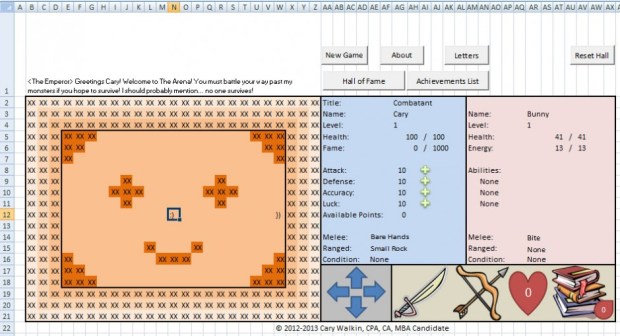
Cary WalkinA screenshot of Arena Xlsm, the Microsoft Excel-based video game created by Schulich School of Business student Cary Walkin.

When Cary Walkin went back to school to complete an MBA, his main goal was to strengthen and diversify his business acumen. Working as a chartered accountant for the past five years, Mr. Walkin was in a stable, secure profession he enjoyed. What he ended up doing, however, was realizing a childhood dream by combining his two passions, accounting and video game design, by creating a computer game based on Microsoft Excel spreadsheets and promoting it through a specialized marketing course within the Schulich School of Business MBA program.

Now set to graduate in two weeks, Mr. Walkin’s game, Arena.Xlsm, has gone viral, generating international buzz in the gaming industry and turning his accounting career upside down.

I had a party when it reached 3,000 views and then it just exploded overnight

“I was completely shocked at the attention the game received,” said Mr. Walkin. “I had a party when it reached 3,000 views and then it just exploded overnight.”

In just over two weeks, Arena.Xlsm has received over a quarter of a million downloads and has garnered media attention from GizmodoBBC News, Cnet, and the Sydney Morning Herald, to name just a few. Read more of this post

10-yr-old Chinese boy Wang Ke drives motorcycle over 18m-wide platform

10-yr-old boy drives motorcycle over 18m-wide platform

2013-04-12 09:21:57 GMT2013-04-12 17:21:57(Beijing Time)  SINA English

At the age of ten, Wang Ke cherishes ambition that most adults dare not to even give it a thought. Wang comes from Huaibei, a city famous for its abundance of coal in E China’s Anhui Province. He began to practice driving MTX motorcycle when he was only four. He succeeded in driving his motorcycle over a platform, 6 meters in height and 18 in width, in a national tournament on April 11th, marking a high point in the initial phase of his career. Wang said his dream is to participate in the racing game hosted by the American Motorcyclist Association.

U158P5029T2D581127F24DT20130412172157U158P5029T2D581127F32DT20130412172157

Steal Like Picasso: How Outside Inspiration Can Fuel True Innovation

STEAL LIKE PICASSO: HOW OUTSIDE INSPIRATION CAN FUEL TRUE INNOVATION

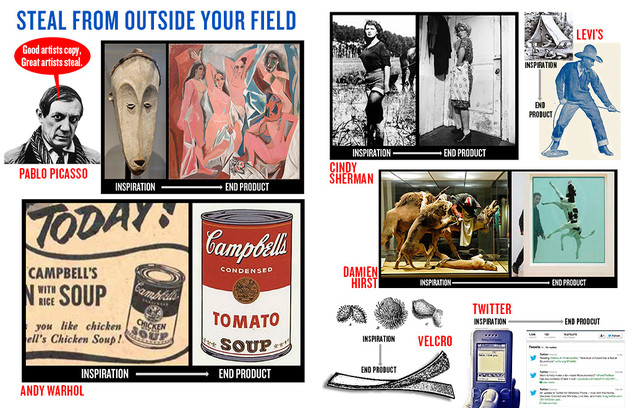
PICASSO’S APOCRYPHAL LINE, “GOOD ARTISTS BORROW, GREAT ARTISTS STEAL,” CAN APPLY TO ANY INDUSTRY, NOT JUST ART–AND IT CAN CREATE REAL INNOVATION, NOT JUST DERIVATIVE KNOCK-OFFS, IF DONE CORRECTLY.

3008207-inline-inine-1-steal-art

BY: CAMILLE SWEENEY AND JOSH GOSFIELD

Austin Kleon, author of Steal Like an Artist, has quoted Steve Jobs, who cited Picasso’s apocryphal line, “Good artists borrow, great artists steal.” No one knows for sure exactly what Picasso meant (or, for that matter, if he ever even spoke those words), but what is not in dispute is that Picasso was very clever when it came to theft. Instead of stealing from the celebrated artists of his day, which would have made him a second-rate version of Cézanne or Van Gogh, Picasso stole ideas from artists far outside his own milieu. Read more of this post

Cities as ideas; founding visions are vulnerable. The more their realisation depends on the will and power of a single leader (or a colonial power), the more likely they are to be subverted

Cities as ideas

When Peter the Great visited Amsterdam in 1697, he was dazzled. It was the richest city in the world, a maritime superpower and a global trade hub — confirmation of the West’s superiority in technology, education and the arts.

Amy Bernstein is the editor of Harvard Business Review.

20 HOURS 22 MIN AGO

When Peter the Great visited Amsterdam in 1697, he was dazzled. It was the richest city in the world, a maritime superpower and a global trade hub — confirmation of the West’s superiority in technology, education and the arts.

The contrast between the brilliance and worldliness of Amsterdam and the dreariness and xenophobia of his own capital, Moscow, was not to be borne. He wanted an Amsterdam of his own. So he built one.

As Daniel Brook describes in A History of Future Cities, St Petersburg was the czar’s bid to modernise (read: Westernise) his empire, and he supervised every detail of its construction. He brought in architects from Switzerland and Germany and engineers from England, Germany and Italy. He established the empire’s first secular, coeducational university and the world’s first public museum. He introduced his people to newspapers, salons and instrumental music concerts. In just a few years, St Petersburg grew into a model of European sophistication and a monument to its founder’s vision and audacity. Peter’s accomplishment, Brook argues persuasively, illustrates the notion that cities are “metaphors in steel and stone”. St Petersburg — along with Shanghai, Mumbai (formerly Bombay) and Dubai, the other three cities profiled in Brook’s engaging book — served as a gateway to the West. Through it, Peter imported non-native attitudes, approaches and behaviours in order to build the future.

But founding visions are vulnerable. The more their realisation depends on the will and power of a single leader (or a colonial power), the more likely they are to be subverted. And cities founded on ideas can suddenly, sometimes violently, come to represent entirely different ones. St Petersburg, Shanghai and Mumbai, for example, all turned against the West. Read more of this post

Blind Spots and How to Work at Them

Blind Spots and How to Work at Them

by Karen Christensen | Apr 12, 2013

Douglas Stone, the Boston-based consultant and ‘difficult conversations’ expert talks about blind spots (the bad news: we all have them) and the best way to give and receive feedback

Positive self-regard helps us feel good about who we are, but it can get in the way of learning and improving.  Why is that?
Stanford Psychologist Carol Dweck has done some interesting research on this.  She had middle school students take a test and then gave them feedback on the results.  Some were told that they were “smart,” while others were praised for how hard they worked.  The ones who were praised for their intelligence were less likely to want to take on a next set of challenges; the ones who were praised for their effort were excited to exert more effort.  So, Dweck says, “praise the process,” rather than intelligence or natural ability.   Read more of this post

The Power of Talking to Your Baby

APRIL 10, 2013, 3:25 PM

The Power of Talking to Your Baby

By TINA ROSENBERG

By the time a poor child is 1 year old, she has most likely already fallen behind middle-class children in her ability to talk, understand and learn. The gap between poor children and wealthier ones widens each year, and by high school it has become a chasm. American attempts to close this gap in schools have largely failed, and a consensus is starting to build that these attempts must start long before school — before preschool, perhaps even before birth.

There is no consensus, however, about what form these attempts should take, because there is no consensus about the problem itself. What is it about poverty that limits a child’s ability to learn? Researchers have answered the question in different ways: Is it exposure to lead? Character issues like a lack of self-control or failure to think of future consequences? The effects of high levels of stress hormones? The lack of a culture of reading?

Another idea, however, is creeping into the policy debate: that the key to early learning is talking — specifically, a child’s exposure to language spoken by parents and caretakers from birth to age 3, the more the better. It turns out, evidence is showing, that the much-ridiculed stream of parent-to-child baby talk — Feel Teddy’s nose! It’s so soft! Cars make noise — look, there’s a yellow one! Baby feels hungry? Now Mommy is opening the refrigerator! — is very, very important. (So put those smartphones away!) Read more of this post

From bust to boom, how Kate Swann transformed one of Britain’s oldest companies WH Smith

From bust to boom, how Kate Swann transformed WH Smith

After an extraordinary decade at the helm of WH Smith, Kate Swann is preparing to say goodbye to a retailer that has been transformed.

whsmith_2366273b

By Graham Ruddick, Retail Correspondent

8:15PM BST 11 Apr 2013

WH Smith is one of Britain’s oldest companies and began life in 1792 as a small shop in Little Grosvenor Street, London.

Its unique mix of stationery, entertainment, books, and confectionary made it a high street institution, but by the time Swann arrived in 2003, the company was on its knees, outmanoeuvred by supermarkets and the internet. Read more of this post

Rosabeth Moss Kanter: The Happiest People Pursue the Most Difficult Problems

The Happiest People Pursue the Most Difficult Problems

by Rosabeth Moss Kanter  |   9:00 AM April 10, 2013

Lurking behind the question of jobs — whether there are enough of them, how hard we should work at them, and what kind the future will bring — is a major problem of job engagement. Too many people are tuned out, turned off, or ready to leave. But there’s one striking exception.

The happiest people I know are dedicated to dealing with the most difficult problems. Turning around inner city schools. Finding solutions to homelessness or unsafe drinking water. Supporting children with terminal illnesses. They face the seemingly worst of the world with a conviction that they can do something about it and serve others.

Ellen Goodman, a Pulitzer Prize-winning journalist (and long-time friend), has turned grief to social purpose. She was distraught over the treatment of her dying mother. After leaving her job as a syndicated columnist, she founded The Conversation Project, a campaign to get every family to face the difficult task of talking about death and end-of-life care. Read more of this post

Does Money Really Affect Motivation? A Review of the Research

Does Money Really Affect Motivation? A Review of the Research

by Tomas Chamorro-Premuzic  |   9:50 AM April 10, 2013

How much should people earn? Even if resources were unlimited, it would be difficult to stipulate your ideal salary. Intuitively, one would think that higher pay should produce better results, but scientific evidence indicates that the link between compensation, motivation and performance is much more complex. In fact, research suggests that even if we let people decide how much they should earn, they would probably not enjoy their job more.

Even those who highlight the motivational effects of money accept that pay alone is not sufficient. The basic questions are: Does money make our jobs more enjoyable? Or can higher salaries actually demotivate us? Read more of this post

If You’re Confident About Competence, Admit Your Flaws; IBM’s Lou Gerstner’s, “I don’t know IT but I know management” was pure genius. Here’s why

If You’re Confident About Competence, Admit Your Flaws

by Steven Berglas  |  11:00 AM April 10, 2013

Within moments of seeing white smoke billow from the Sistine Chapel, media outlets were inundated with a slew of reports about the former Cardinal Bergoglio. The Vatican PR machine noted that Pope Francis was an incredibly humble Cardinal who, as was befitting a Jesuit, had an abiding concern for the poor, rode the subway, and cooked his own meals. Oh… and that he was missing most of one lung.

This certainly runs contrary to conventional wisdom about how best to conduct impression management; i.e. “Put your best foot forward.” With Catholics already anxious about the new Bishop of Rome’s wellbeing, doesn’t pointing-out a condition that begs the question, “Was it cancer?” constitute impression mismanagement?

Actually, I think it’s something leaders should do more of. Let’s take an example from history to see why: Back in 1999, Louis V. Gerstner “let out” word that he had a deficiency immediately prior to taking the helm at IBM. Big Blue had been among the nation’s foremost enterprises, but when Gerstner was picked for the top spot it was bleeding red ink. Conventional wisdom would say that to redress the blue mood IBMers were suffering, Gerstner should have greeted them with bravado to boost morale. Instead, Gerstner exposed his soft underbelly by stating, “I don’t completely understand the technology [of IBM’s product line]. I’ll need to learn it, but don’t expect me to master it… unit leaders must translate it into business terms for me.”

Gerstner’s, “I don’t know IT but I know management” was pure genius. Here’s why: Read more of this post

The Shibumi Seven Design Principles, Inspired By Zen Wisdom

7 Design Principles, Inspired By Zen Wisdom

WRITTEN BY: Matthew May

WANT TO BECOME THE NEXT STEVE JOBS–OR JUST UNDERSTAND HIS NEAR-SPIRITUAL DEVOTION TO SIMPLICITY? THIS PRIMER, OUTLINING THE MAIN TENETS OF “ZEN DESIGN,” WILL HELP.

One of the best-known photographs of the late Steve Jobs pictures him sitting in the middle of the living room of his Los Altos house, circa 1982. There isn’t much in the room, save an audio system and a Tiffany lamp. Jobs is sipping tea, sitting yoga-style on a mat, with but a few books around him. The picture speaks volumes about the less-is-more motive behind every Apple product designed under his command.

As Warren Berger wrote on Co.Design, Jobs’s love for elegantly simple, intuitive design is widely attributed to his appreciation of Zen philosophy (Jobs was a practicing Buddhist). But while many people might be familiar with Zen as a broad concept, far fewer are knowledgeable of the key aesthetic principles that collectively comprise the “Zen of design.”

To understand the Zen principles, a good starting point is shibumi. It is an overarching concept, an ideal. It has no precise definition in Japanese, but its meaning is reserved for objects and experiences that exhibit in paradox and all at once the very best of everything and nothing: Elegant simplicity. Effortless effectiveness. Understated excellence. Beautiful imperfection.

James Michener referred to shibumi in his 1968 novel Iberia, writing that it can’t be translated and has no explanation. In his 1972 book, The Unknown Craftsman, Soetsu Yanagi talked about shibumi in the context of art, writing that a true work of art is one whose intentionally imperfect beauty makes an artist of the viewer. In the 1979 best-selling spy novelShibumi, the author Trevanian (the nom de plume of Dr. Rodney William Whitaker) wrote, “Shibumi has to do with great refinement underlying commonplace appearances.”

Shibumi was first introduced to the West by House Beautiful in 1960. Nearly 40 years later, architect Sarah Susanka reintroduced shibumi in her 1998 book The Not So Big House: “The quality of shibumi evolves out of a process of complexity, though none of this complexity shows in the result. It often seems to arise when an architect is striving to meet a particular design challenge. When something has been designed really well, it has an understated, effortless beauty, and it really works. That’s shibumi.”

The process may be complex, but these seven Zen principles can help you approach shibumi in your own designs:

THE SHIBUMI SEVEN Read more of this post

26 Time Management Hacks

Daily Rituals: How Artists Work

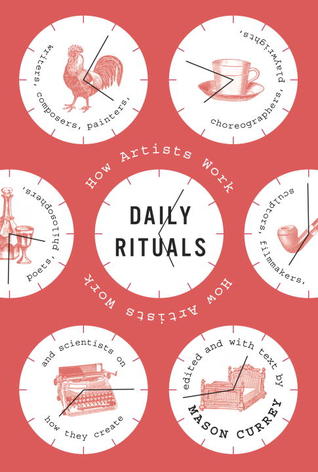
Daily Rituals: How Artists Work [Hardcover]

Mason Currey (Editor)

15799151tumblr_ml3greMwIs1qbxxuao1_500

Release date: April 23, 2013

Franz Kafka, frustrated with his living quarters and day job, wrote in a letter to Felice Bauer in 1912, “time is short, my strength is limited, the office is a horror, the apartment is noisy, and if a pleasant, straightforward life is not possible then one must try to wriggle through by subtle maneuvers.”

Kafka is one of 161 inspired—and inspiring—minds, among them, novelists, poets, playwrights, painters, philosophers, scientists, and mathematicians, who describe how they subtly maneuver the many (self-inflicted) obstacles and (self-imposed) daily rituals to get done the work they love to do, whether by waking early or staying up late; whether by self-medicating with doughnuts or bathing, drinking vast quantities of coffee, or taking long daily walks. Thomas Wolfe wrote standing up in the kitchen, the top of the refrigerator as his desk, dreamily fondling his “male configurations”. . . Jean-Paul Sartre chewed on Corydrane tablets (a mix of amphetamine and aspirin), ingesting ten times the recommended dose each day . . . Descartes liked to linger in bed, his mind wandering in sleep through woods, gardens, and enchanted palaces where he experienced “every pleasure imaginable.”

Here are: Anthony Trollope, who demanded of himself that each morning he write three thousand words (250 words every fifteen minutes for three hours) before going off to his job at the postal service, which he kept for thirty-three years during the writing of more than two dozen books . . . Karl Marx . . . Woody Allen . . . Agatha Christie . . . George Balanchine, who did most of his work while ironing . . . Leo Tolstoy . . . Charles Dickens . . . Pablo Picasso . . . George Gershwin, who, said his brother Ira, worked for twelve hours a day from late morning to midnight, composing at the piano in pajamas, bathrobe, and slippers . . .

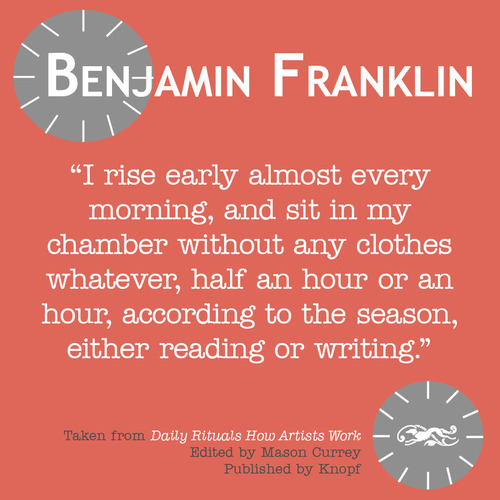
Here also are the daily rituals of Charles Darwin, Andy Warhol, John Updike, Twyla Tharp, Benjamin Franklin, William Faulkner, Jane Austen, Anne Rice, and Igor Stravinsky (he was never able to compose unless he was sure no one could hear him and, when blocked, stood on his head to “clear the brain”).

Brilliantly compiled and edited, and filled with detail and anecdote, Daily Rituals is irresistible, addictive, magically inspiring.

How to Live Like an Artist, by Author Mason Currey

How to Live Like an Artist, by Author Mason Currey

By Mason Currey on April 11, 2013

You’d do well to find a supportive spouse. While there are people who had day jobs—Anthony Trollope worked at the post office for 35 years—most were either independently wealthy or had a spouse (a wife, usually) who took care of day-to-day operations so they could go about writing or painting or composing. Sigmund Freud’s wife even put toothpaste on his toothbrush.

You do have to carve out a few hours a day to work. Most artists don’t work long hours, often just three or four a day, but they work every day. They have routines. Frank Lloyd Wright designed his buildings around 4 a.m. Ernest Hemingway stopped when he felt he could go on. He believed in leaving something in the tank, so to speak, that makes you want to pick up the next day where you left off.

You don’t have to cultivate an eccentric habit, but if you have one, you’re in good company. Friedrich Schiller kept rotting apples in his workroom. He said he needed their decaying smell to feel the urge to write, whatever that’s about.

Not many drink while they work, but a lot seem to pull off an amphetamine habit. W.H. Auden took Benzedrine every morning like a multivitamin. Jean-Paul Sartre used Corydrane, fashionable among Parisian intellectuals at the time. He’d take 20 a day, chewing them like candy. It made him really, really productive. It’s tempting to look into that.

• Currey is author of Daily Rituals: How Artists Work. As told to Claire Suddath

How to Follow Your Instincts, by Net-A-Porter’s Natalie Massenet

How to Follow Your Instincts, by Net-A-Porter’s Natalie Massenet

By Natalie Massenet on April 11, 2013

OB-JQ887_magazi_G_20100823114840

Before I launched Net-A-Porter I came up with a number of different ideas that business associates deemed ridiculous, and I ignored my instinct and lost opportunities. When it came to starting Net-A-Porter, I found strength in being a loner, initially, and then even more strength in finding and hiring people who shared my vision. At the beginning it’s better to have fewer people who are on your side than many people who want to change what you feel is right.

In our early days, instinct was everything. Slowly experience took over, and I’ve had to work hard to ensure that I value experience but allow it to coexist with gut reaction. My instinct has told me to hire people I trust—those who have strong belief in their own convictions and the experience to back it up, but not necessarily the relevant résumé. Sometimes I make mistakes, and with hindsight I can say those decisions were made when I didn’t listen to the voice inside. The priority is creating time for silence so we can process ideas, react instinctively to them, give them strong business foundations, and ensure they are in line with the idea that launched us in the first place.

• Massenet is the founder and executive chairman of the Net-A-Porter Group.

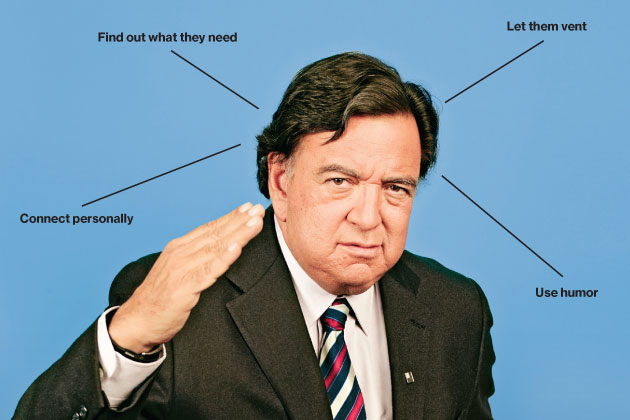
How to Sweet-Talk a Shark: Strategies and Stories from a Master Negotiator, by former governor of New Mexico and US Ambassador to the United Nations Bill Richardso

How to Sweet-Talk a Shark: Strategies and Stories from a Master Negotiator [Hardcover]

Bill Richardson (Author), Kevin Bleyer (Author)

Release date: October 15, 2013

1ht_talktoadictator16__01__630x420

Former governor of New Mexico and US Ambassador to the United Nations Bill Richardson has engaged in high-stakes, face-to-face negotiations with Castro, Saddam, the Taliban, North Korea leaders, Slobodan Milosevic, and many other of the world’s “crazy people”—and done it so well he’s been nominated for the Nobel Peace Prize three times. Now he tells these stories—from Washington, DC to the Middle East to Pyongyang—in all their intense and sometimes absurd glory.

Readers also get a fine lesson in the art of negotiation: How to prepare, how to size up your opponent, understanding the nature of power in a standoff, how to give up only what is necessary while getting what you want, and many other strategies Richardson has mastered through at-the-table experience.

Richardson’s co-writer, Kevin Bleyer, is an Emmy Award-winning writer on The Daily Show, so this book will be as entertaining as it is revelatory. It’s part memoir, part instructional guide, part humor book, and the perfect read for anyone who wants to understand how the world really works.

Editorial Reviews

About the Author

BILL RICHARDSON is a two-term governor of New Mexico, former US ambassador to the UN, and former secretary of the Department of Energy. He spent 15 years in Congress and has successfully won the release of hostages, American servicemen, and prisoners in North Korea, Iraq, Cuba, and Sudan.

KEVIN BLEYER is an Emmy Award-winning writer for The Daily Show with Jon Stewart and author of Me The People: One Man’s Quest to Rewrite the Constitution of the United States of America.

How to Get People to Listen, by Newark Mayor Cory Booker; “Statistics tell, and stories sell.” The real communicators are the ones who can motivate people to act—and ultimately to lead themselves.

How to Get People to Listen, by Newark Mayor Cory Booker

Cory Booker on April 11, 2013

1ht_getpeopletolisten16__01__630x420

My mom told me very early in life, “Who you are speaks so loudly, I can’t hear what you say.” What she meant was you’ve really got to embody what you’re trying to communicate. Ultimately, that’s more important than mere words. You also have to have passion and belief. My dad worked for IBM (IBM). He said, “Look, I can’t sell products I don’t believe in. People will see right through me. But if I’m passionate and have a deep conviction about what I’m doing, I’m the greatest salesman there is.” I’ve found it to be the same way for me.

If that doesn’t work, sometimes you have to do things that push people out of their comfort zone. I’ll ask for a handheld microphone because I don’t want to be behind that podium. Sometimes I’ll jump off the stage and walk in the audience. I’ll start with a joke and get people laughing, or I’ll tell a story. Again, I go back to my father. He used to say, “Statistics tell, and stories sell.”

When I was a Newark councilperson in my late 20s and felt impotent because I couldn’t get anything done, I had to use my creativity to get people’s attention. I engaged in a hunger strike at a housing project to get people to listen. I moved into a mobile home and parked it on the worst drug corner to get people to pay attention and address the issue. My goal is to motivate people to act.

In the end, it’s not about you; it’s not about getting people to listen to you. That’s just an ego indulgence. As a society, we’ve gotten into this state of what I call sedentary agitation—we’re often upset about what’s going on but not getting up and taking action. The real communicators are the ones who can motivate people to act—and ultimately to lead themselves.

• Booker is mayor of Newark, N.J. As told to Devin Leonard

How to Create a Workplace People Never Want to Leave, by Google’s Christopher Coleman

How to Create a Workplace People Never Want to Leave, by Google’s Christopher Coleman

By Christopher Coleman on April 11, 2013

The No. 1 thing is to listen to what employees need. We found that they need a lot of diversity. There are so many ways to work—as a team, solo—and so many kinds of workers, from introverts to extroverts and so on. We create many different places so people can be as productive as possible—from formal and informal conference rooms to open spaces to stretching and yoga areas and gyms. One trick is to design spaces with a diversity of scale, light, and mood. It’s really hard to do, and it looks like we’re just making up these crazy spaces, but it’s very scientific. We have information from Googlers on what works and what doesn’t, we do post-occupancy surveys, we ask questions, and we listen very closely. When we design a space, we usually offer a few solutions people can react to. We go back to the drawing board, go down to two or three options, and pick one. Next we define aspects like mood, lighting, and furniture. Then we build it, and people are happy—hopefully.

With all this input, they’re basically designing their own space. One of the earlier amenities we provided were micro-kitchens. It was an amazing, vibrant place where people connected before they started their workday. Now we have micro-kitchens that are libraries, micro-kitchens that are game rooms. Also, health is very important. A few years ago we introduced sit-stand desks, and they’re used extensively now. It changes the worker’s environment all through the day and gives them flexibility to work how they want to work.

We look at every single detail through the Living Lab, which is a space where the Real Estate and Workplace Services team can experiment with innovative ideas for the office. We’re trying out three ventilation systems, six lighting systems, and furniture from 10 manufacturers. In the end, though, we’re actually very frugal in our approach to design. It’s more about creating character than money spent.

• Coleman is global design director at Google (GOOG). As told to Venessa Wong

How to Overcome Fear, by Skydiver Felix Baumgartner

How to Overcome Fear, by Skydiver Felix Baumgartner

By Felix Baumgartner on April 11, 2013

Fear isn’t something to be eliminated. It’s something to be managed. In my line of work, skydiving, fear is what keeps you from getting careless. A healthy amount of apprehension has helped me to stay safe over a 20-year career. I am cautious enough to plan each one of my jumps carefully and to reject ideas when the risks were unacceptably high. Fear gets problematic when it becomes your focal point, dominating your thoughts and distracting you from the task at hand.

Training for my Red Bull Stratos jump, I went through a period where I hated wearing the spacesuit. It’s something a lot of high-altitude pilots deal with. The suit creates a sort of sensory deprivation, and in my case its rigidity made it impossible to use techniques I’d worked my whole life to develop. Subconsciously, I think maybe the suit came to represent everything that could defeat me. It became a trigger for what was fear. As soon as I put it on, I was itching to take it off.

Photograph by Redbull/CorbisThat fear itself wasn’t irrational: It pointed out some significant operational challenges we had to address. What I needed was to get out of the endless loop of negative thinking. Our psychologists taught me some simple techniques. Sometimes in training they’d ask me a question totally unrelated to the mission, maybe a question that didn’t even make sense, just to break the cycle of negative thoughts in my head. Then I could come back to see the situation more objectively. Another technique was to actively look for the positives. At 24 miles above earth, where my blood would boil without protection, the benefits of that suit were going to far outweigh its drawbacks. Eventually the suit came to represent not potential problems but the technological solution that would keep me alive and let me accomplish my goals. We moved forward, and the program was a success.

Let your fear inform you. Get outside help if you need it. And be patient with yourself. Dealing with it might be one of the smartest things you do.

• During his record-breaking, nine-minute fall from a balloon more than 24 miles above the earth, Baumgartner broke the speed of sound, reaching almost 834 miles per hour.

How to Ask Difficult Questions, by Senator Carl Levin; A lot of people can’t afford to lose their job by being too harsh or unsubtle with questioning

How to Ask Difficult Questions, by Senator Carl Levin

By Carl Levin on April 11, 2013

In the workplace, you’ve got to consider your relationships and impacts on your career. A lot of people can’t afford to lose their job by being too harsh or unsubtle with questioning. Regardless of the environment, it’s best to be direct and clear. Don’t be arrogant or domineering; be firm.

I put an awful lot of time into preparing questions. We’ll spend days before a major hearing, like for JPMorgan (JPM) or Enron or any of the other dozen hearings we’ve had in recent years. The point of the hearing is to gather information. I master the material, to know as much as the witness. Then I listen very carefully. You’ve got to focus on what someone is saying to determine whether they’re being responsive. That’s part of listening, but that’s also part of being determined to not allow a witness to avoid answering. I focus on words. I believe that words matter. It’s important that you have time. Being chairman on a subcommittee is a big advantage: I can keep a hearing going as long as necessary—we can go hours. Time becomes the essence.

• U.S. Senator Levin (D-Mich.) is chairman of the Permanent Subcommittee on Investigations. As told to Keenan Mayo

How to Read a Financial Statement, by Oracle’s Mark Hurd

How to Read a Financial Statement, by Oracle’s Mark Hurd

By Mark Hurd on April 11, 2013

We covered over the company name, Smith & Wesson (SWHC), on the statements and asked Hurd how he would review them.

There are two sets of financial statements, the income statement and the balance sheet, and they work in concert. If you want to get to the health of a company, you have to look at both. What we have here is an income statement. It’s going to take you through things like revenue and expenses and tell you about the profitability of the company. That profitability generally turns into cash flow and brings you to the balance sheet.

The more years of financial data you can get, the better, because you get to see a flow. You look at things like revenue, and you look at expenses, and you can start to ask, “What happened year to year?” and start looking at the deltas between the numbers. That’s one methodology for looking at a business.

Another is to simply take the expenses and say, “If you’ve got $1 of revenue and 80¢ of expenses and your profit is 20¢, just tell me what you spend the 80¢ on.” How much on sales? How much on overhead? How much of it do you spend on R&D?

Instead of taking a line-by-line view, take a look at the relationship between expenses to revenue and gross margin to revenue. It will tell you a lot about the choices the company is making about where to invest.

This all comes with a note of caution. Even when you start to analyze these lines for their incremental ups or downs, you may not get clarity. People see a sales expense go up and assume that means there are more salespeople or more selling effort like advertising. Well, frankly, that may not be true, because inside sales expenses there could be other costs that are categorized in sales expenses, but they’re not giving you sales effort in the marketplace. Like office overhead or IT upgrades for the sales team, for example. It’s the same thing with R&D. People think R&D being up or down is some surrogate for the amount of innovation in a company. Not necessarily so: There are things that go on in the R&D line that could be overhead or some other kind of spending that’s not valuable, such as duplicative real estate or human resources costs inherited as part of an acquisition.

There are a lot of people who don’t want to spend time on this type of stuff, but the great thing about numbers is they typically don’t mislead you. They don’t purposely lie to you. If you interrogate them, they’ll reveal things to you, so you have to be able to have enough different looks at them that you can get absolute clarity.

Clearly, what we have here is a manufacturer. They have a large cost of sales, so they’re building a product of some type. They’re not a services company. I would guess they sell their products through some sort of channel. So because they have big [general and administrative] costs, and G&A exceeds their sales and marketing, my inclination would be they must sell at retail or sell through some sort of aggregator process. They have a small relative R&D bill. When you look at this from an R&D perspective, they’re spending less than 1 percent, so this must be a conveyor-belt-oriented branded product. It’s some sort of hard good.

But again, even with those two statements you may never get a complete picture. As I’m here to tell you, many people even inside have a hard time getting all the detail you’d like to get a full view of the health of the company. Then the thing always when you’re running these companies is the quality of the people driving this income statement.

The nice thing about the income statement is that if you understand the strategy, the income statement is the X-ray that shows the health of the patient.

• Hurd is president of Oracle (ORCL) and former CEO of Hewlett-Packard (HPQ). As told to Ashlee Vance