Online shopping provides way round China’s ban on giving gifts

Online shopping provides way round China’s ban on giving gifts

Hsieh Ai-chu and Staff Reporter

2013-09-21

Buying gifts through online shopping was popular in China during this year’s Mid-Autumn Festival as the country’s government prohibited the use of public funds to be spent on festival gifts. People’s Daily reported that the volume of gifts purchased with government money was down compared to previous years. Yet the practice, linked to the culture of giving face in order to consolidate influential relationships could not be fully curtailed as gift givers found ways to present their gifts in a more discreet manner. Read more of this post

Nine ways to make money ‘Chinese style’

Nine ways to make money ‘Chinese style’

Staff Reporter

2013-09-21

Chinese investment web portal Eastmoney.com has come up with the nine most impressive ways the nation’s entrepreneurial spirit manifests itself in a country where laws are not universally applied and where looking after oneself and one’s own trumps other ethical considerations. Here are the top tips for making money “Chinese style”:

1. Selling tax invoices

To avoid taxes, many enterprises in China collect tax invoices or sales receipts to deduct expenses, with some companies even requiring their staff to provide tax invoices of equivalent value before they can receive their end-of-year bonus. The sale of tax invoices and receipts has become a growing underground industry, with some vendors reportedly making several thousand dollars a month in this way. Read more of this post

Marketizing China’s Elder Care Conundrum; Rising demand for nursing homes and other senior care services has forced policymakers to seek market solutions

09.20.2013 17:23

Marketizing China’s Elder Care Conundrum

Rising demand for nursing homes and other senior care services has forced policymakers to seek market solutions

By staff reporter Lan Fang

(Beijing) — Weaving market forces into the complex tapestry of health care services for China’s growing population of senior citizens – including the poor and feeble – has emerged as a definitive goal for government policymakers. “Marketization” was stressed by the State Council, China’s cabinet, in a policy document released in mid-September that focused on the need to “accelerate development of the senior care service industry.” Read more of this post

Leading mainland beverage maker JDB Group has been dubbed “China’s Coca-Cola” because of its business model, which is similar to that of the American giant, and its huge success in its home market

Herbal drink giant’s recipe for home-grown success

Saturday, 21 September, 2013, 12:00am

Celine Sun in Beijing celine.sun@scmp.com

With its focus on its only product initially, JDB’s red-canned beverage has become so popular that the company is dubbed ‘China’s Coca-Cola’

847a8f8712769a305475fd042f2ae0f8

Leading mainland beverage maker JDB Group has been dubbed “China’s Coca-Cola” because of its business model, which is similar to that of the American giant, and its huge success in its home market. Over the past six years, the fast-growing company has unseated Coca-Cola to become the top seller of canned beverages on the mainland. And most of its success comes from a single product – a traditional herbal tea – much as Coca-Cola achieved with its homonymic product for more than a century. Read more of this post

How long can the Communist party survive in China?

September 20, 2013 7:04 am

How long can the Communist party survive in China?

By Jamil Anderlini

As the economy slows and middle-class discontent grows, it is the question that’s now being asked not only outside but inside the country. Even at the Central Party School there is talk of the unthinkable: the collapse of Chinese communism

Tucked away between China’s top spy school and the ancient imperial summer palace in the west of Beijing lies the only place in the country where the demise of the ruling Communist party can be openly debated without fear of reprisal. But this leafy address is not home to some US-funded liberal think-tank or an underground dissident cell. It is the campus of the Party School of the Central Committee of the Communist Party of China, the elite training academy for the country’s autocratic leaders that is described in official propaganda as a “furnace to foster the spirit of party members”. Read more of this post

Dual release of iPhone 5S in US, China puts scalpers out of business

Dual release of iPhone 5S in US, China puts scalpers out of business

Staff Reporter

2013-09-21

The number of scalpers seeking to make money from Apple’s latest iPhone 5S has decreased significantly as most buyers are targeting the gold version of the smartphone. The fact that the smartphone was released in China and the United States simultaneously has also reduced scalpers’ leverage in raising prices, according to Chinese web portal Tencent. The iPhone 5S and 5C were released on Friday in the US, Australia, Canada, China, Hong Kong, France, Germany, Japan, Singapore and Britain, nine days after Apple unveiled its latest models to the world. Read more of this post

Boart Longyear, the world’s largest drilling services company, living on the edge

Boart Longyear living on the edge

September 20, 2013

Michael West

If Boart Longyear was a mate down at the pub, he’d be the sort of mate who’d hit you up for a few dollars, just to tide him over. Then he’d nip down to the TAB, punt the lot on the fourth at Doomben and be back in no time at all with another hard-luck story. But shareholders in the world’s largest drilling services company are unlikely to be quite as kind and patient as the proverbial mate at the pub. The stock went into a trading halt this morning. Another debt deal was struck overnight in the US to keep it afloat but the pricing is yet to be revealed. And even when it is, Boart Longyear’s survival is not assured, except perhaps in the optimistic eventuality of a sharp rebound in demand for drill rigs. Read more of this post

Wealthy Asians snub bank capital bonds

Wealthy Asians snub bank capital bonds

Fri, Sep 20 2013

* Private banks reduce leverage for bank hybrids

* Fears of fallout in case write-downs are triggered

* Clients turn to corporate perpetuals instead

By Christopher Langner

SINGAPORE, Sept 20 (IFR) – Tougher lending policies are threatening to drive Asia’s private-banking clients away from bank capital and towards corporate hybrids. Private bankers said they are reducing the margin loans, or leverage, they make available to buyers of loss-absorbing capital instruments that expose investors to the risk of permanent principal losses. “They are seeing that some of these bonds will trade to zero if the loss-absorbing features are triggered,” said one fixed-income specialist at a private bank. “If my collateral may be completely gone, I will give zero leverage, as well.” Read more of this post

Bank Century Owner Claims Lender Allowed to Collapse by ‘Invisible Hands’; “In the banking world there are what you call fictitious accounting reports.”

Bank Century Owner Claims Lender Allowed to Collapse by ‘Invisible Hands’

By Novianti Setuningsih on 5:24 pm September 21, 2013.
A former owner of Bank Century, Robert Tantular, has suggested the bank was allowed to collapse so that the government could initiate a bailout. “We suspect there were ‘invisible hands’ that intentionally caused the bank’s collapse and made Bank Century unable to meet its daily obligations. ‘‘Such a possibility is related to the events that led to the government’s intervention in the mid-sized bank,” said Robert’s attorney Andi F. Simangunsong at the Corruption Eradication Commission (KPK) office in Jakarta on Friday. Andi said the Rp 6.7 trillion ($600 million) bailout is suspicious because Rp 2.2 trillion of the amount was immediately placed at the central bank in the form of a Bank Indonesia promissory note (SBI). “In the banking world there are what you call fictitious accounting reports. We need to ascertain if BI had a report on Bank Century’s Rp 2.2 trillion SBI or whether it was just a fictitious report. We are going to ask KPK to see if they can trace those funds,” said Andi. Read more of this post

A discord between Korean and Chinese creditors over the fate of STX Dalian may develop into a political dispute between the two countries

2013-09-17 16:17

Korea, China at odds over STX

By Choi Kyong-ae
A discord between Korean and Chinese creditors over the fate of STX Dalian may develop into a political dispute between the two countries. Chinese creditors have asked their Korean counterparts to share the financial burden of putting the moribund shipyard back to normal but Korean banks called the request a “tall order” as their exposure to the shipyard is very small compared to Chinese banks, according STX officials, Tuesday. Read more of this post

Problems deferred become millstone for Indonesia

Problems deferred become millstone for Indonesia

September 21, 2013

Tim Colebatch

Indonesia has been one of the five strongest sources of global growth since the GFC hit in 2008. But now its failure to reform its economy and tackle its infrastructure backlog has seen it take a dumping on global markets, as its economy slows, and inflation and its trade deficit rise. And with a new parliament and president to be elected in 2014, the future of one of the world’s biggest developing economies could be clouded for some time, the Australian National University’s annual Indonesia update has been told. Read more of this post

There was a time when Time Engineering Bhd was the hottest stock on the stock exchange. Investors wanted it, punters chased it and bankers went all-out to give the telecommunication firm loans to expand

Updated: Saturday September 21, 2013 MYT 10:51:30 AM

Can Censof bring back the good Time?

BY YVONNE TAN AND JOHN LOH

THERE was a time when Time Engineering Bhd was the hottest stock on the stock exchange. Investors wanted it, punters chased it and bankers went all-out to give the telecommunication firm loans to expand, thanks largely to a flurry of excitement on the then “new-economy” stocks such as itself. It was only the second fixed line operator in the country after Telekom Malaysia Bhdat that time, riding on its backbone – the 5,200km fibre-optic spanning across Peninsular Malaysia. The Time story was so well played out that it attracted the attention of telcos from all over the world including that of Singapore Telecommunications Ltd (SingTel). It spun off subsidiary Time dotCom Bhd and things went south from there on. It underwent a couple of restructuring exercises and yo-yoed between profitability and losses. Fast forward a decade, the Time of today is a pale shadow of its once illustrious past, a stock now known more for failing to live up to its hype. It’s star completely faded when it was identified by Khazanah Nasional Bhd as a company it no longer wanted and had put its stake for disposal. A number of companies had made its pitch to buy over Time and finally Censof Holdings Bhd was chosen to be its new owner. Read more of this post

Willis Group, MSG, United Rentals, Ashland, and Millennium & Copthorne Hotels find fans at a value-investing congress, while critics target K12 and LifeLock as stocks to short

SATURDAY, SEPTEMBER 21, 2013

A Wealth of Stocks to Love…or Hate

By ANDREW BARY | MORE ARTICLES BY AUTHOR

Willis Group, MSG, United Rentals, Ashland, and Millennium & Copthorne Hotels find fans at a value-investing congress, while critics target K12 and LifeLock as stocks to short.

ON-BC204_BARY09_G_20130921005924

Even as the Standard & Poor’s 500 was heading for record levels early last week, a group of investors found plenty to recommend at the ninth annual Value Investing Congress in New York, including Willis Group Holdings , MSG , United Rentals , and AshlandThere also were a few short recommendations, including K12, the online-education company, and LifeLock, the provider of identity-theft-protection services. Read more of this post

Sharpe Ratio Shows Rupiah Is Worst Carry Trade Bet: Asean Credit

Sharpe Ratio Shows Rupiah Is Worst Carry Trade Bet: Asean Credit

Indonesia’s rupiah is delivering the developing world’s worst carry trade returns this month and Barclays Plc says volatility won’t end just because the U.S. Federal Reserve is maintaining stimulus. The currency’s Sharpe ratio, which measures returns adjusted for price fluctuations, was 0.18, the least among 23 emerging markets tracked by Bloomberg. That compares with 13 for the Philippine peso and the Thai baht’s 12, placing them in the top 10. One-month implied volatility in the rupiah almost tripled to 17 percent this year, at least double the readings for Thailand and the Philippines. Read more of this post

The paradox of over-production in a world of QE

The paradox of over-production in a world of QE

Izabella Kaminska

| Sep 20 17:40 | 14 comments | Share

The Fed’s taper no-show this week resulted in a plethora of commentaries and articles flagging the risks of the world’s collective addiction to QE. To name a few:

1) Felix Salmon noted the dangers of the growing QE multiple — the incremental sugar hit the market gets from every anticipated unit of QE.

2) Tyler Cowen didn’t like that very much either.

3) Gillian Tett, meanwhile, suggested that all that QE does in its current form is provides credit for existing infrastructure and capacity, rather for new investment.

4) And HSBC’s chief economist Stephen King argued that QE only exacerbates the conditions that lead to savings glut conditions, which arguably created the crisis in the first place.

Either way, the idea that the economy is now somehow dangerously addicted to QE is a pervasive theme, and QE bashing is becoming the definitive vogue in town.  Read more of this post

The Case for Cash: Once shunned, putting cash on the sidelines now looks shrewd to some investors

September 20, 2013, 10:53 a.m. ET

The Case for Cash

Once shunned, putting cash on the sidelines now looks shrewd to some investors. Brett Arends explains

BRETT ARENDS

OB-YX811_money0_E_20130916132142

A FRIEND WAS recently considering a potential investment for her portfolio and asked a simple question: Is it better than any of the alternatives that are currently out there?  My answer surprised her: The real question is whether it’s also better than any of the alternatives that you are likely to see in the next year or two. For most mainstream investment professionals—including many of those with some pricey clients—that kind of an argument is near-sacrilege. It means, they say, trying to “time” the market. Their advice is usually along the lines of investing everything, everything, immediately, in the (high fee) products they make available. But this is flawed thinking. If the events of the last 15 years have shown anything, it is that turmoil and financial bargains seem to come along with great frequency. If there are no compelling opportunities on offer at the moment, wait a while. One will be coming along soon—in the next great panic about Europe, or emerging markets, or U.S. subprime mortgages, or gold, or China, or commodities, or high oil prices, or low oil prices, or inflation, or deflation or something else entirely. Read more of this post

Roger Lowenstein: The Long, Sorry Tale of Pension Promises; How did states and cities get into this mess? It’s a simple case of human frailty; where to go from here

September 20, 2013, 8:35 p.m. ET

The Long, Sorry Tale of Pension Promises

How did states and cities get into this mess? It’s a simple case of human frailty; where to go from here

ROGER LOWENSTEIN

Fifty years ago, the auto industry suffered a massive pension bust. The numbers back then were small, but pension failures are never about the numbers—they’re about human frailty. People are tempted to promise more than they can deliver. Today, cities and states across the country are way behind on the promises they made to their employees. Several—including Detroit—are in bankruptcy. Back in 1963, Studebaker, an independent auto maker in South Bend., Ind. was struggling to compete with the Big Three. Desperate to stay afloat, the company had increased the benefits it was promising to its retirees four times in the 1950s and early 1960s. What was desperate about this? Pension benefits aren’t paid out of thin air; sponsors are supposed to set aside a sum of money proportional to the benefits that will eventually come due. If the money is invested prudently, the fund will have enough assets to meet its obligations. Read more of this post

For Migrants, New Land of Opportunity Is Mexico; With Europe sputtering and China costly, the “stars are aligning” for Mexico as broad changes in the global economy create new dynamics of migration

September 21, 2013

For Migrants, New Land of Opportunity Is Mexico

By DAMIEN CAVE

MEXICO CITY — Mexico, whose economic woes have pushed millions of people north, is increasingly becoming an immigrant destination. The country’s documented foreign-born population nearly doubled between 2000 and 2010, and officials now say the pace is accelerating as broad changes in the global economy create new dynamics of migration. Rising wages in China and higher transportation costs have made Mexican manufacturing highly competitive again, with some projections suggesting it is already cheaper than China for many industries serving the American market. Europe is sputtering, pushing workers away. And while Mexico’s economy is far from trouble free, its growth easily outpaced the giants of the hemisphere — the United States, Canada and Brazil — in 2011 and 2012, according to International Monetary Fund data, making the country more attractive to fortune seekers worldwide. Read more of this post

Jobless recoveries are here to stay, economists say, but it’s a mystery why

Jobless recoveries are here to stay, economists say, but it’s a mystery why

By Jim Tankersley, Published: September 20

The U.S. economy just hasn’t looked like its old self lately, especially when it comes to regaining the jobs lost during a recession. It looks a lot more like 1980s-era Europe — slow to rebound and hire after a downturn, leaving workers to flail for years in a weak job market. The United States is stuck in its third consecutive “jobless recovery,” stretching back to the rebound from the 1990 recession. And Americans might need to get used to them: A major new study from economists at the University of Texas at Austin and the University of California at Berkeley suggests that vintage Europe is the new American normal for recessions and recoveries. But even after an exhaustive series of tests, the economists still can’t explain what has gone wrong. Read more of this post

Jeremy Grantham called the Internet bubble, then the housing bubble. What alarm bell is the chief investment strategist at GMO ringing about now?

September 20, 2013, 10:31 a.m. ET

Our Chat With Jeremy Grantham

He called the Internet bubble, then the housing bubble. What alarm bell is Jeremy Grantham, the chief investment strategist at GMO, ringing about now?

IAN SALISBURY

JEREMY GRANTHAM’S GOT A TRACK RECORD that’s impossible to ignore—he called the Internet bubble, then the housing bubble. While moves like those have earned the famed forecaster the nickname “perma-bear,” in early 2009 he also told clients at GMO, his $100 billion, Boston-based money-management firm, to jump back into the market. It was the same week that stocks hit their post-Lehman low. Now, however, the outspoken Yorkshireman, who is chief investment strategist at GMO, is making headlines with a new prediction: Dire, Malthusian warnings about environmental catastrophe. To hear him tell it, the world is running out of food. Resources will only keep getting more expensive. And climate change looms over it all. Indeed, at times he sounds like someone Greenpeace would send door-to-door with a clipboard. (He’s not above likening the coal-industry spin to the handiwork of Goebbels.) If it were anyone else, Wall Street would probably laugh him off. But because it’s Jeremy Grantham, they just might listen. Read more of this post

It’s Not Too Early to Start Worrying About Banks Again; Washington regulators are publicly raising alarms about banks’ accounting practices

It’s Not Too Early to Start Worrying About Banks Again

By Jonathan Weil  Sep 20, 2013

You don’t often see Washington regulators publicly raising alarms about banks’ accounting practices. That’s why a speech this week by the comptroller of the currency, Thomas Curry, deserves more attention. The way Curry described the situation, you get the sense that some banks’ numbers may be too good to be true. He made clear he wasn’t warning about an imminent crisis. Yet he cautioned that some banks seemed to have been “scrimping on their allowances against their loan losses,” which is a fancy way of saying they may be fudging their numbers. Read more of this post

Fed reveals weak spot in superhero powers

September 20, 2013 5:18 pm

Fed reveals weak spot in superhero powers

By Ralph Atkins in London and Michael MacKenzie in New York

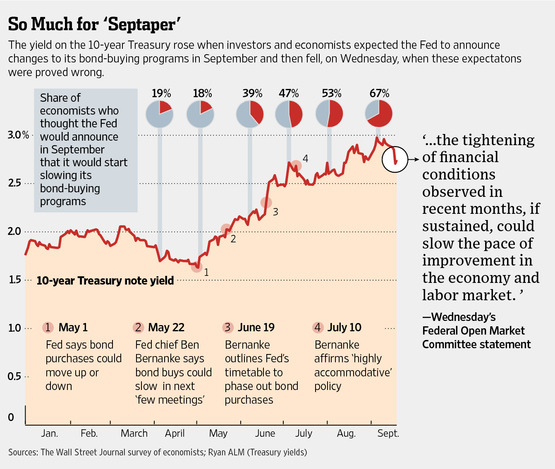
Superman had issues with Kryptonite. For Achilles, it was his heel. With central bankers, is it communicating with markets? The US Federal Reserve startled investors round the globe this week by deciding not to start scaling back its $85bn a month of asset purchases, or quantitative easing. Bond and share prices jumped sharply on the prospect of unexpectedly undiminished Fed largesse. But even as they pocketed gains, investors wondered if they had misunderstood Ben Bernanke, Fed chairman. Based on hints dropped since May, the consensus view had been for a $10bn to $15bn reduction in the pace of purchases. Read more of this post

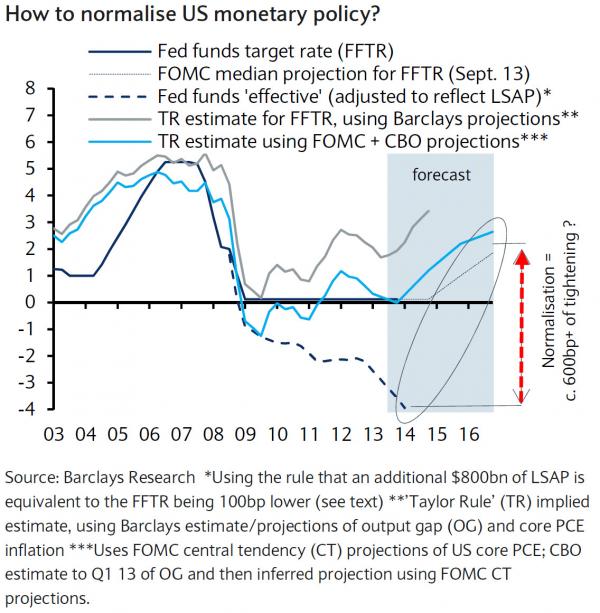
Chart Of The Day: The Fed’s “Renormalization” Shock (All 600 bps Of It)

Chart Of The Day: The Fed’s “Renormalization” Shock (All 600 bps Of It)

Tyler Durden on 09/21/2013 15:21 -0400

20130921_beniscornered_0

As we noted earlier, Bernanke’s actions this week make it very clear that between “financial conditions” and the fragility of growth, the US is incapable of surviving without ZIRP and QE (for now). As Barclays notes, ultimately, normalisation should proceed according to a timeline that does not threaten recovery, yet will result in a neutral monetary policy by the time the economy reaches full capacity and the desired inflation rate. However, there are many uncertainties along this path. Read more of this post

CEOs to Reveal Their ‘Cheap Number’; SEC Wants to Compare CEO Pay with Average Worker’s

September 21, 2013, 8:30 p.m. ET

CEOs to Reveal Their ‘Cheap Number’

SEC Wants to Compare CEO Pay with Average Worker’s

AL LEWIS

BF-AF837_PAYGAP_NS_20130920201814

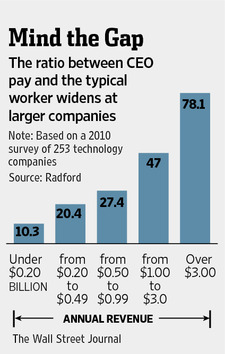
Perhaps you’ve seen those commercials for the Sleep Number mattress. What’s your Sleep Number? Learn it and you’ll have pleasant dreams. There is another number that’s giving the chief executives of America’s largest companies nightmares. It expresses the ratio of their pay to that of their employees. I call it the Cheap Number. In 1977, renowned management thinker Peter Drucker wrote a piece for The Wall Street Journal complaining that this number had grown as high as 50 at many companies. “A ratio of 25-to-1…is well within the ratio most people in this country…consider proper and indeed desirable,” he wrote. Today the number is 354, according to a study touted by the AFL-CIO. Other studies show it well over 1,000 at some companies. A recent analysis by Bloomberg compared a former J.C. Penney CEO to a former J.C. Penney cashier and pegged the number there at 1,795. Knowing this number raises a salient question: If you own a business, what would you rather have for your money? An army of more than 1,000 workers, or one delusional jerk in a suit? The world is filled with enterprises paying fortunes to chief executives, but relatively little to almost everyone else. Read more of this post

Wash, Rinse, Rebrand: Electrolux Spiffs Up Appliances in China; Company Has Been Stuck in Slow Sales Cycle

September 19, 2013, 7:09 p.m. ET

Wash, Rinse, Rebrand: Electrolux Spiffs Up Appliances in China

Company Has Been Stuck in Slow Sales Cycle

JAMES R. HAGERTY

MK-CG438_ELECTR_NS_20130919180604

Fifteen years ago, Electrolux AB ELUX-B.SK +2.30% dreamed of being a major mass-market supplier of washers, refrigerators and other home appliances in China. Now, conceding that its initial strategy was a flop, the Swedish appliance maker is preparing to reintroduce itself in China as a premium brand. Before year-end, Electrolux plans to launch a variety of appliances aimed at people seeking more style and features. The company says it will apply lessons it has learned in Brazil, where it has been far more successful. Read more of this post

Adidas profits warning cites EM currencies

September 19, 2013 10:21 pm

Adidas profits warning cites EM currencies

By Alice Ross

Adidas, the world’s second largest sportswear group by sales, issued a profit warning last night blaming the slump in emerging market currencies for lower than expected projected sales for the year. Investors in the German company should brace themselves for income payouts up to 11 per cent lower than previously forecast, the group said, as it lowered its net income projection for shareholders to €820m-€850m for 2013, down from an estimate of €890m-€920m. Read more of this post

Auto Makers in India Increasing Prices to counter higher costs, caused mainly by a sharp fall in the rupee currency’s value

Updated September 19, 2013, 12:23 p.m. ET

Auto Makers in India Increasing Prices

SANTANU CHOUDHURY

NEW DELHI—Hyundai Motor Co., 005380.SE +0.39% Tata Motors Ltd.500570.BY +2.75% and General Motors Co. GM -0.93% are raising their vehicle prices in India to counter higher costs, caused mainly by a sharp fall in the rupee currency’s value. Prices of Hyundai’s cars such as the Eon and i20 subcompact hatchbacks will rise between 4,000 rupees ($65) and 20,000 rupees effective Oct. 1, India’s second-largest car maker by sales said. Read more of this post

Indonesia to Run World’s Biggest Gas Deficit by 2018

Indonesia to Run World’s Biggest Gas Deficit by 2018

By Tito Summa Siahaan on 8:55 pm September 19, 2013.
Indonesia will emerge as the main driver in the international gasoline market as imports to Southeast Asia’s biggest economy increase to meet domestic demand, according to a forecast from Wood Mackenzie, a global energy think tank. “From 2012 to 2018, Indonesia’s gasoline deficit will grow from 340,000 barrels per day (bpd) to around 420,000 bpd,” Sushant Gupta, Wood Mackenzie’s Asia Pacific head of downstream research, said in a statement released on Thursday. Read more of this post

Taxis Vanish in Rain as Singapore Gets Congested: Southeast Asia

Taxis Vanish in Rain as Singapore Gets Congested: Southeast Asia

At 6 a.m. one weekday morning, 64-year-old taxi driver Koh Chia Hock set out to ply Singapore’s roads when it started raining. So he turned around and went home. “If I go and fetch a customer, it’s very risky,” said Koh, as the heavy traffic raises the chance of an accident that could leave him without earnings while the car is repaired. “I don’t have the stomach for it. I don’t want to drive when it rains.” Cab drivers like Koh are avoiding the traffic jams that have become a hallmark of Singapore’s tropical rainstorms after a jump in the city’s population and a surge in vehicles clogged roads. As the government shuts the center of the city this weekend for the annual Formula One street race, residents are bracing for even more delays. Read more of this post

Debt explosion real story of Fed QE dance; Western finance cannot be fixed without tackling credit addiction

September 19, 2013 5:14 pm

West’s debt explosion is real story behind Fed QE dance

By Gillian Tett

Western finance cannot be fixed without tackling credit addiction

NA-BY134_Fed_G_20130919182710

The danger with addictions is they tend to become increasingly complusive. That might be one moral of this week’s events. A few days ago, expectations were sky-high that the Federal Reserve was about to reduce its current $85bn monthly bond purchases. But then the Fed blinked, partly because it is worried that markets have already over-reacted to the mere thought of a policy shift. Faced with a choice of curbing the addiction or providing more hits of the QE drug, in other words, it chose the latter. Read more of this post