Private schools are heading for a crunch; Soaring fees were fine during the boom – but now no one can stop the race

August 14, 2013 6:45 pm

Private schools are heading for a crunch

By Jonn Elledge

Soaring fees were fine during the boom – but now no one can stop the race, says Jonn Elledge

If you wanted a single sentence to sum up why Britain’s world-renowned private schools deserve just a little bit of the sneering they attract, you could do worse than this gem. “Fees rose by 3.9 per cent last year,” the Independent Schools Council’s last survey breezily announced, “the lowest rise for almost 20 years.” Only 3.9 per cent? Well done. Have a gold star. Read more of this post

Of 15 popular measures of equity valuation, CAPE (which compares share prices to a 10-year moving average of real earnings) was the only one that made stocks look expensive

The CAPE of Less Hope

August 13, 2013 6:31 pmby John Authers

Cyclically-adjusted price/earnings multiples (CAPEs), as made famous by Yale’s Professor Robert Shiller, are growing inconvenient for the brokerage community. Last week, BofA Merrill Lynch’s Savita Subramanian pointed out that of 15 popular measures of equity valuation, CAPE (which compares share prices to a 10-year moving average of real earnings) was the only one that made stocks look expensive. Read more of this post

NYU President’s Exit Signals Shift From High-Spending Era

NYU President’s Exit Signals Shift From High-Spending Era

New York University’s announcement that President John Sexton will leave in three years could signal a shift from an era of bold plans and big spending in U.S. higher education.

Sexton, under fire from the faculty amid criticism of a campus expansion and college administrators’ pay and perks, will step down after his term ends in 2016, when he will be 74. The school will also stop lending hundreds of thousands of dollars to executives and faculty for vacation homes, the board of trustees said in a letter this week.

Under Sexton, New York University has become symbolic of colleges’ focus on expansion and prestige with little regard to cost, and the school’s announcement may suggest the start of a change, said Richard Vedder, an Ohio University economics professor. The university costs $64,000 a year to attend, making it among the most expensive colleges in the nation. Read more of this post

Hundred-Dollar Stocks Double as U.S. CEOs Dismiss Splits

Hundred-Dollar Stocks Double as U.S. CEOs Dismiss Splits

Stock splits are losing their allure with American executives amid one of the broadest rallies ever, sending the number of shares trading above $100 to a record and showing the rising dominance of institutions in equity markets.

Gains of 20 percent or more pushed Boeing Co. (BA) and Amgen Inc. past $100 in 2013, joining 64 companies in the Standard & Poor’s 500 Index above the threshold, twice the level in 2010, according to data compiled by Bloomberg. Nine companies have split their stock this year, compared with 42 annually since 1996, data from S&P show, helping send the average share price to $65.96 last quarter, the highest on record. Read more of this post

Free Work Entices Businesses to Hire Long-Term Unemployed

Free Work Entices Businesses to Hire Long-Term Unemployed: Jobs

After conducting almost 10,000 job interviews during 10 years as a human resources manager, Tom Kaminski says he thought he knew enough about the labor market to keep his own bout of unemployment short.

Instead, he wound up out of work for three years before enrolling in Platform to Employment, or P2E, a privately-funded Connecticut program to help long-term unemployed workers land jobs. The attraction for employers: A fully paid-for audition of as long as eight weeks for job applicants who complete the five-week program. Read more of this post

Fidelity Asks How Long Can Draghi’s Bond-Buying Bluff Hold?

Fidelity Asks How Long Can Draghi’s Bond-Buying Bluff Hold?

Tyler Durden on 08/15/2013 12:59 -0400

Authored by Michael Collins, Investment Commentator at Fidelity,

Capitalist banking systems are built on the confidence trick that people can get their money back at any time. Of course, if everyone sought their money at once, no one would get anything because the financial system would collapse.

The eurozone is being held together by a more-fragile bluff. This is the European Central Bank’s “outright monetary transactions” scheme that was announced in September last year. The scheme pledges to buy unlimited amounts of bonds of distressed sovereigns, a plan that was enacted by Mario Draghi to back up his comments two months earlier that the ECB would “do whatever it takes” to save the euro. Read more of this post

Deflating housing bubble at heart of Netherlands’ economic blues

August 15, 2013 3:58 pm

Deflating housing bubble at heart of Netherlands’ economic blues

By Matt Steinglass in Haarlem

Haarlem, officially the best shopping city in the Netherlands, looks like many picturesque Dutch towns: a medieval church surrounded by a hedonistic cornucopia of pedestrian shopping streets. Normally those streets are filled with confident window-shoppers, but these are not normal times, and Dutch consumers are feeling anything but confident. Household spending has been falling for three straight years, and it dropped again 2.4 per cent year on year in the second quarter, dragging the entire economy down with it. Read more of this post

‘Alternative’ Investments Draw Flak;Individual investors are pouring tens of billions of dollars into a new generation of complex investment products, and regulators are raising concerns that not all buyers understand the costs and risk

August 15, 2013, 8:49 p.m. ET

‘Alternative’ Investments Draw Flak

Investors Flock to New Risky Products, and Regulators Are Raising Concerns

JAMES STERNGOLD

MI-BX897_ALTINV_NS_20130815183602

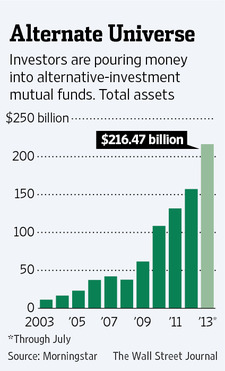
Individual investors are pouring tens of billions of dollars into a new generation of complex investment products, and regulators are raising concerns that not all buyers understand the costs and risks. Outside scrutiny is intensifying on securities firms’ sales practices and whether so-called alternative products—ranging from certain types of mutual funds to vehicles that invest in highly indebted companies—are suitable for all of the Americans flocking to them. Some state securities regulators are focusing their examinations on alternative-product brokers, while officials at Wall Street’s self-funded watchdog, the Financial Industry Regulatory Authority, say they are planning to file civil enforcement actions by year-end. Read more of this post

Coin Star/Outerwall’s Redbox video-rental kiosks could surprise short sellers and others betting on the DVD’s extinction. The owner of Redbox video-rental kiosks now controls 50% of the market

| SATURDAY, AUGUST 10, 2013

A Box Full of Money

By DAVID ENGLANDER | MORE ARTICLES BY AUTHOR

Outerwall’s Redbox video-rental kiosks could surprise short sellers and others betting on the DVD’s extinction. Why the shares could rally 20%.

DVD, R.I.P.? Think again. Outerwall’s Redbox video-rental business could surprise legions of skeptics.

BA-BC639_SmCaps_DV_20130810012016

Outerwall, formerly known as Coinstar, has emerged as the king of video rentals. The owner of Redbox video-rental kiosks now controls 50% of the market, having benefited from the demise of traditional video stores and a decline in the DVD business atNetflix (ticker: NFLX). Redbox’s low daily rental rate of $1.20 per video has made it a hit with cost-conscious consumers. Many on Wall Street think this movie will end badly, as viewers migrate to video on demand delivered by cable TV and the Internet. Investors betting on the DVD’s eventual extinction have sold short 40% of Outerwall’s public stock float. Read more of this post

It is Independence Day in India, a holiday during which the national flag is raised on everything from the ramparts of Delhi’s monuments to the bonnets of Mumbai’s battered black cabs

The Indian rupee

Dependence day

Aug 15th 2013, 8:23 by P.F. | MUMBAI

INDIA-POLITICS-INDEPENDENCE-FLAGS

IT IS Independence Day in India, a holiday during which the national flag is raised on everything from the ramparts of Delhi’s monuments to the bonnets of Mumbai’s battered black cabs. This year it may be remembered for India’s enslavement to global capital markets. Yesterday evening, August 14th, after most people had left work, the central bank imposed new capital controls to try to stem a balance-of-payments crisis. Psychologically the manoeuvre feels like a step back in time, to India’s pre-reform era of the 1980s, when Indians were fenced off from the rest of the world by their government, entrepreneurs had to beg pompous officials for foreign exchange and the rich had to ask their servants to buy malt whiskey from the black market.

Read more of this post

Crowded skies, frustrated passengers: Military control of airspace and a risk-averse culture threaten to cripple China’s rapid growth in aviation

Crowded skies, frustrated passengers: Military control of airspace and a risk-averse culture threaten to cripple China’s rapid growth in aviation

Aug 10th 2013 | BEIJING |From the print edition

20130810_CNC186

ON AN average day, more than 1,500 planes take off and land at Beijing’s Capital International Airport, the second-busiest in the world (by passenger traffic) after Atlanta. Many of those take-offs and landings are late. According to FlightStats, a travel industry monitor, China’s big airports have the worst delays in the world, with only 18% of flights from Beijing departing on time in July (arrivals fared better). The strain is showing, especially on the faces of delayed passengers. Tales of airport rage are frequent media and online fodder; most popular are videos of officials or other bigwigs punctuating their impatience with invective and spittle. Planes pull away from gates on time without clearance to take off and remain on the tarmac for up to 30 minutes, just so the flight can say it is not delayed. Such tricks explain why official figures state that 75% of all arrivals and departures were on time in 2012. Independent estimates put the figure closer to 30%. Airline staff often give no reason for delays. Read more of this post

Oceanus suspends trading over ‘abnormal deaths’ of abalones; Oceanus operates the Ah Yat Tian Xia chain of restaurants, with outlets in mainland China, Hong Kong, Taiwan and Singapore

Oceanus suspends trading over ‘abnormal deaths’ of abalones

Thursday, Aug 15, 2013

Jonathan Kwok

The Straits Times

CHINA – Abalone producer Oceanus Group has suspended trading of its shares after it received a report of unnatural deaths of its abalones in China. An announcement by the firm on Sunday evening also made reference to an executive director who was recently forced to step down from the board but remains as a key manager. The statement did not link the reports of abalone deaths with the executive director’s departure except to say they had happened at around the same time. Mr Wu Yong Shou had stood for re-election at the Oceanus annual general meeting on July 31. But the motion was defeated by a 95.51 per cent majority of the shareholders present and voting – so he had to step down as an executive director. Read more of this post

The fraudulent actions of Taiwanese family business Rebar Group has landed five next-gens with prison sentences, while their father remains on the run

REBAR GROUP NEXT-GENS SENTENCED TO PRISON

ARTICLE | 15 AUGUST, 2013 11:20 AM | BY JESSICA TASMAN-JONES

The fraudulent actions of Taiwanese family business Rebar Group has landed five next-gens with prison sentences, while their father remains on the run. On Wednesday, Taiwan’s Supreme Court upheld the verdicts of a lower court, which handed out sentences between five and a half and 30 years to the children of Wang You-theng for violations of the Securities and Exchange Act. According to court findings, the Wang family members, who had held senior positions in various companies controlled by Rebar Group, defrauded investors and banks of billions of dollars by means of false accounting and other fraudulent actions over a number of years. The children include Gary Wang, Wang Lin I, Wang Lin-tai, Wang Lin-mei and Wang Lin-chiao. Wang You-theng, 86, who founded Rebar Group in 1959, fled Taiwan in late 2006, days before prosecutors began their investigation into the group. He is listed as one of Taiwan’s 10 most wanted economic criminals. Rebar Group began in the steel industry, but later expanded into textiles, hotels, real estate, insurance, banking and telecommunications.

Hong Kong’s Crisis of Governability

Updated August 14, 2013, 4:44 p.m. ET

Hong Kong’s Crisis of Governability

Lack of democracy turns a kerfuffle into an uproar.

Tensions are running high in Hong Kong as the government dithers over how to implement full democracy by 2017. A coalition of citizen activists promises a showdown in the streets of the business district next summer if the promise to elect the chief executive by universal suffrage is not kept. One sign of just how acrimonious the city’s crisis of legitimacy could become is the way a minor dispute over a teacher’s foul-mouthed tirade against a policeman has become a tug-of-war between pro-Beijing and pro-democracy forces. Read more of this post

Hong Kong Rents Hinder Billionaire Li’s Supermarket Sale

Hong Kong Rents Hinder Billionaire Li’s Supermarket Sale

Soaring Hong Kong rents helped make Li Ka-shing Asia’s richest man. They’re now becoming a hindrance as he looks to sell the city’s No. 2 grocery chain. His biggest company, Hutchison Whampoa Ltd. (13), is seeking $3 billion to $4 billion for its ParknShop supermarkets and has asked potential buyers to submit bids by Aug. 16, according to people with knowledge of the process. Hong Kong’s surging rents and a slowing grocery market could deter buyers from offering top price for the chain that sells everything from eggs to pork chops to whiskey. Shop leases have doubled over the past four years in the city, according to property agent Savills Plc. (SVS) And broker Cushman & Wakefield Inc. last year said Hong Kong’s Causeway Bay area had overtaken New York’s Fifth Avenue as the world’s most expensive district for retail rents. Read more of this post

Corporate China taps can-do spirit of innovation; “In China, the most common phrase in conversations is xiang ge ban fa (let’s find a way), not guanxi”

Corporate China taps can-do spirit of innovation

By Wang Yong | August 15, 2013, Thursday |  PRINT EDITION

FOR many decades until the end of June this year, I had bought into a popular stereotype of Corporate China as a haven of copycats and guanxiology. Indeed, even today, if you look at domestically designed cars and high-rises, they are more often than not copies of Western designs. If you look at business deals, a lot of them are done with guanxi (connections) and greasing of palms. But that’s far from the whole story. I learned about a different Corporate China, which is surprisingly innovative, at the weeklong Orchestrating Winning Performance (OWP) program I attended at IMD (International Institute for Management Development), Lausanne, Switzerland, at the end of June.

Xiang ge ban fa

“In China, the most common phrase in conversations is xiang ge ban fa (let’s find a way), not guanxi,” said Winter Nie, professor of operations and service management at IMD. “Everything is difficult, but nothing is impossible.” Read more of this post

Chinese Banks Feel Strains After Long Credit Binge; Rapid Loan Growth Has Led to Serious Debt Problems at Local Governments

Updated August 14, 2013, 6:05 p.m. ET

Chinese Banks Feel Strains After Long Credit Binge

Rapid Loan Growth Has Led to Serious Debt Problems at Local Governments

LINGLING WEI and DANIEL INMAN

EM-AW785_CBANKS_G_20130814134809

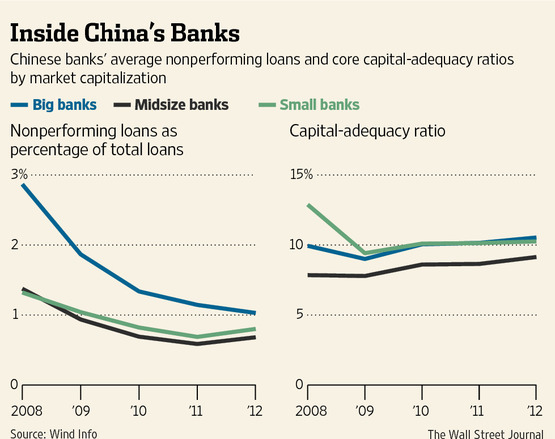
A cornerstone of China’s financial edifice is beginning to show some cracks. The country’s banking sector, a key part of a financial system that has powered China through three decades of breakneck expansion, is feeling the strain of years of rapid credit growth. Bank-fueled lending to state enterprises and local governments has led to overcapacity; serious debt problems for local governments, companies and lenders alike; and numerous white-elephant projects, from nearly empty malls and resorts to bridges to nowhere.

Chinese banks now are trying to strengthen their balance sheets ahead of an expected rise in bad loans coupled with slower earnings growth. Raising capital will likely be expensive for the banks because investors, who have sold off shares of banks, are worried about their deteriorating health and China’s slowing growth. Read more of this post

China Raises Scrutiny on Foreign Firms

August 14, 2013, 2:09 p.m. ET

China Raises Scrutiny on Foreign Firms

Regulators Expand Inquiry Into Drug Sector and Seek Data on Car Pricing

LAURIE BURKITT

BEIJING—China’s regulators are increasing their scrutiny of foreign companies in industries from drugs to cars to baby formula as part of a drive to push down prices for consumers. The intensifying effort could help China’s new leaders win favor at home and give Beijing a greater say in global commerce. The latest move came Wednesday, when officials at China’s State Administration for Industry and Commerce said they would open a three-month probe into possible bribery in the pharmaceutical and medical-device industries, citing public dissatisfaction with high prices. Read more of this post

China Drugmakers Decline on Corruption Crackdown

China Drugmakers Decline on Corruption Crackdown: Shanghai Mover

Jiangsu Hengrui Medicine Co. fell the most in almost three years in Shanghai trading as drugmakers declined after the Xinhua News Agency reported China is starting a campaign to crack down on illegal competition in the industry. Jiangsu Hengrui dropped 5.9 percent to 32.76 yuan at the close, the biggest loss since Oct. 11, 2010. Beijing SL Pharmaceutical Co. slid 5.8 percent to 55.59 yuan. A gauge of health-care companies fell 3 percent, the most among 10 industry groups on the CSI 300 index. The Shanghai Composite index dropped 0.9 percent and CSI 300 index lost 1.2 percent. “The crackdown on irregularities in the medical sector has undermined confidence among some investors and they expect drug prices to fall,” said Wu Kan, a Shanghai-based fund manager at Dragon Life Insurance Co., which oversees $3.3 billion. Read more of this post

China could target oil firms, telecoms, banks in price probes: report

China could target oil firms, telecoms, banks in price probes: report

6:29am EDT

By Kazunori Takada

BEIJING (Reuters) – China’s powerful price regulator could target the petroleum, telecommunications, banking and auto sectors next in its investigations into violations of the country’s anti-trust laws, state media quoted a senior official as saying. The National Development and Reform Commission (NDRC) would look at industries that have an impact on the lives of ordinary Chinese, China Central Television (CCTV) quoted Xu Kunlin, head of the anti-monopoly bureau at the NDRC, as saying on one of its programs. The NDRC has launched nearly 20 pricing-related probes into domestic and foreign firms in the last three years, according to official media reports and research published by law firms. But the scope of its investigations in the world’s second-biggest economy have gathered pace in recent months and coincide with criticism in official media about the price of goods such as milk powder, medicine, luxury cars and jewellery. Read more of this post

Asia’s great investor rotation flows to North from South

Asia’s great investor rotation flows to North from South

3:56am EDT

By Vidya Ranganathan and Vikram Subhedar

SINGAPORE/HONG KONG (Reuters) – Alongside the great rotation from bonds to equities and from emerging to developed markets that has been 2013’s overriding investment theme, Asia is seeing its own migration in portfolio flows: from the South to North. Foreign investment flows have lifted stock markets in China, South Korea and Taiwan since July, the first and tentative signs that investors still see pockets of value at a time the outlook for emerging markets is glum. The appeal of these markets comes from several factors. While the consensus calls are still for an outperformance of equity markets in Japan, the United States and the rest of the developed world, a growing number of investors believe there is scope for Asia’s trade-driven, open economies to do well as U.S. growth recovers. Read more of this post

Asia Faces Higher Borrowing Costs; Rising U.S. Rates Make it Harder for Asian Issuers To Raise Funds Cheaply

August 15, 2013, 12:18 a.m. ET

Asia Faces Higher Borrowing Costs

Rising U.S. Rates Make it Harder for Asian Issuers To Raise Funds Cheaply

MICHAEL S. ARNOLD And NATASHA BRERETON-FUKUI

AI-CC875_ARATES_NS_20130814225706

HONG KONG—Governments and companies across Asia are facing an era of tighter credit that could impact the region’s growth prospects. Since the financial crisis, low global rates have been a significant motor of Asia’s developing economies. Now, rising U.S. rates, amid expectations the Federal Reserve will taper its massive bond-buying program later this year, are making it harder for Asian issuers to raise funds cheaply. Countries and firms across the region have had to pay higher rates to attract investors, or shelve bond issuances, as investors pulled some $6 billion out of regional debt in June and July, according to data provider EPFR Global. Read more of this post

JPMorgan And Goldman Sachs Are Playing Whack-A-Mole With Everyone Suing Them Over Their Metal Warehousing Businesses

JPMorgan And Goldman Sachs Are Playing Whack-A-Mole With Everyone Suing Them Over Their Metal Warehousing Businesses

LINETTE LOPEZ AUG. 13, 2013, 2:16 PM 1,554 6

As if on cue, around the country individuals and companies have started filing lawsuits against JP Morgan and Goldman Sachs for allegedly delaying deliveries of aluminum stored in their metals warehouses, thus manipulating the price of the commodity. Lawsuits have been filed in Michigan, Florida and Louisiana. On top of that, The Commodities Futures Trading Commission has subpoenaed JPM, Goldman, and commodities trading firm Glencore for documents related to their warehouse businesses, Bloomberg reports. The thing is — usually, when an issue is this obscure and hard to understand, it’s easily swept under the rug. Read more of this post

Intermittent Nature of Green Power Is Challenge for Utilities

August 14, 2013

Intermittent Nature of Green Power Is Challenge for Utilities

By DIANE CARDWELL

The 21 turbines at the Kingdom Community Wind farm in Vermont soar above Lowell Mountain, a testament in steel and fiberglass to the state’s growing use of green energy. Except when they aren’t allowed to spin at their fastest. That has been the case several times in the farm’s short existence, including during the record July heat wave when it could have produced enough much-needed energy to fuel a small town. Instead, the grid system operator held it at times to just one-third of what it could have produced. “We were being told to turn on diesel-fired units that are very expensive and dirty and told to ramp down what is renewable, cost-effective energy for our customers,” said Mary Powell, chief executive of Green Mountain Power, the utility that owns and operates the wind plant. “We should go with the sources that can have the highest value, especially during peak times.” Read more of this post

Following a setback in the South Korean government’s efforts to raise taxes against the middle-income class, the new tax code plan has angered those who inherit family business

New tax code angers long-lasting family firms

Lee Sang-deok, Jeon Jung-hong

2013.08.14

Following a setback in the South Korean government’s efforts to raise taxes against the middle-income class, the new tax code plan has angered those who inherit family business. Earlier, the government said it will raise the threshold for inheritance tax reduction in case of family business succession from the current 200 billion won ($178.5 million) in sales to 300 billion won. The measure would benefit 400 companies. But the government also introduced a carryover of transfer tax years in the new tax code. Under this system, if children who inherit family business from their parents inevitably sell the inherited asset, they will have to pay a transfer tax calculated from the date of acquisition by parents, not by children. According to the finance ministry and Korea Federation of Small and Medium-sized Businesses on Wednesday, small companies requested the government to re-examine the calculation method. “Strict conditions, including a 10-year job security program, should be met in order to get tax deduction in family business succession, but the carryover system is too harsh for heirs because it is applied at any time when they sell the inherited asset after inheritance,” said Kang Sang-hoon, Chairman of Dongyang Foods.

Care for some pineapple juice or fermented milk in your beer? Big Brewers Make Summer Wacky Beer Season in Japan

August 14, 2013, 6:51 p.m. ET

Big Brewers Make Summer Wacky Beer Season in Japan

Kirin and Asahi Test Innovations Like Soft-Serve Foam, Extra-Cold Brew and Beer Cocktails

HIROYUKI KACHI

PJ-BP968_BEER_G_20130814175236

At a Kirin Ichiban Garden, a temporary restaurant in downtown Tokyo, a server offers two experimental summer brews from Kirin.

Care for some pineapple juice or fermented milk in your beer? Strange brews are on tap in Japan this summer, as the country’s biggest beer-makers—Asahi Breweries Ltd. 2502.TO -2.23% and Kirin Brewery Co.2503.TO -2.18% —experiment with novelty beers they hope will appeal to younger Japanese drinkers, particularly women, who prefer drinks sweeter than the average pint. The gimmicky concoctions are available mainly at bars and temporary beer gardens the companies have set up for the peak quaffing season in cities across Japan. The drinks are becoming a regular summer feature, a way for Asahi and Kirin to promote and test new-product ideas, the most promising of which can be sold more broadly later. Kirin is selling 12 cocktails featuring its Ichiban Shibori beer leavened with mixers like pineapple, grapefruit or tomato juice, as well as cassis or lemon liqueur. The company calls them Ichiban Shibori Two-Tone Drafts, for the layers of color created in the glass before the beer and mixer are stirred. Read more of this post

Indonesia, a former net oil exporter and OPEC member, has been trying for years to reverse the decline at its aging oil fields. Its annual oil output has fallen about 50% from peak levels reached in the 1990s

August 15, 2013, 1:15 PM

Indonesia’s Energy Watchdog Admits Taking Money

Top of Form

By I Made Sentana and Joko Hariyanto

JAKARTA–Rudi Rubiandini, who until Wednesday was the head of Indonesia’s upstream oil and gas watchdog, has denied he is guilty of corruption but admitted to accepting money in comments to reporters after he was questioned by the country’s antigraft agency. “I didn’t commit an act of corruption, but [what I did] seems to be categorized as [accepting] gratification,” Mr. Rubiandini said to reporters in brief comments late Wednesday after he emerged from the Corruption Eradication Commission’s office and before he was transported to the agency’s jail. “There was a friend who came bringing money,” said Mr. Rubiandini, without elaborating. Read more of this post

Western Financial Firms Sour on Indian Investments

Aug 14, 2013

Western Financial Firms Sour on Indian Investments

By Kenan Machado and Nupur Acharya

AM-AZ857_Amoney_NS_20130814143013

Exasperated by a lack of growth and profitability, Western firms, mostly financial institutions, are selling their Indian investments, with a weakening rupee expediting the departures. And bankers and analysts said more exits are expected. AvivaAV.LN +1.56% PLC and New York Life Insurance Co. are among insurers that are selling or have sold their India franchises in the past year. A person close to Aviva said last week that the U.K. insurer was leaving India because its venture hadn’t grown as much as expected. Banks, too, are scaling back, including BarclaysBARC.LN +0.63% PLC and Royal Bank of Scotland GroupRBS.LN +3.51% PLC, which said on Friday it would sell some of its Indian assets to a local bank as part of its strategy to exit noncore investments. Read more of this post

Take a closer look at the hand that gives; An arbitrary target for Indian corporate giving may do harm not good

August 14, 2013 4:07 pm

Take a closer look at the hand that gives

By James Crabtree

An arbitrary target for Indian corporate giving may do harm not good, writes James Crabtree

Last week, India’s ill-functioning parliament passed a bill rejigging the country’s companies laws. It included an especially eye-catching proposal: all businesses are now expected to give 2 per cent of their net profits to corporate social responsibility projects. The rule is not mandatory but even so, any large enterprise that fails to meet this minimum threshold will have to explain its shortcomings in its annual reports. If not, the company will be fined. It sounds like a splendid means of nudging stingy businesses to greater heights of public spiritedness. Unfortunately, the generally cozy, often inefficient and occasionally corrupt systems through which some Indian companies support worthy causes mean it may do more harm than good. Read more of this post

Jagdeep Chhokar: Why Does Our Political Process Produce Rotten Leaders? By resisting reforms and efforts to introduce transparency in their functioning, the political establishment is defeating the purpose of democracy

Jagdeep Chhokar: Why Does Our Political Process Produce Rotten Leaders?

by Jagdeeep S Chhokar | Aug 15, 2013

By resisting reforms and efforts to introduce transparency in their functioning, the political establishment is defeating the purpose of democracy

Jagdeep S Chhokar
Profile: 
Jagdeep S Chhokar is founder and trustee of Association for Democratic Reforms (ADR). He has been central to ADR’s success in bringing political parties under the ambit of RTI and the Supreme Court ruling barring convicted criminals from contesting elections. He is a former professor, dean, and director in-charge of IIM-A.
The question asked in the title of this piece is obvious, even embarrassing. But it is unequivocal. It says, without any hesitation, that our political process produces rotten leaders and corrupt folk. This is a strong statement, but true. The more complex question is: Why? The answer is not easy but I will attempt an answer. But first, a clarification: The title does not apply to all political leaders; obviously there are exceptions, politicians who are not rotten or corrupt; but those are few and far between. Read more of this post