India’s Quick-Fix Steps Aren’t Helping the Rupee

August 14, 2013, 2:58 AM

India’s Quick-Fix Steps Aren’t Helping the Rupee

By Sudeep Jain and Shefali Anand

India this week announced several steps aimed at shrinking its large current-account gap and stabilizing the rupee, but economists and markets have reacted with a shrug.
The rupee has continued to slide. On Wednesday, it was trading at 61.57 rupees for one U.S. dollar, versus 60.80 for a dollar, before India outlined its plans late Monday. It is not far from a record low of 61.80, reached last week. Read more of this post

Concerns grow over Indian industrials’ debt burdens

August 14, 2013 2:22 pm

Concerns grow over Indian industrials’ debt burdens

By James Crabtree

Concerns are growing in India that a worsening economic slowdown in Asia’s third-largest economy may be increasing debt burdens at some of the country’s most important industrial companies to unsustainable levels. New research from Credit Suisse reveals that 10 of the country’s most heavily indebted industrial conglomerates, including billionaire Anil Ambani’s Reliance companies along with the Vedanta and Essar groups, had combined gross debts of $102bn at the end of the last financial year, up 15 per cent from the year before. Many Indian industrialists have struggled amid the nation’s recent decline in economic growth, which has been exacerbated by chronic regulatory problems delaying crucial investments in power plants and infrastructure projects. Read more of this post

Welcome to the golden age of activist investors

Welcome to the golden age of activist investors

CNBC.com | Wednesday, 14 Aug 2013 | 3:37 PM ET

Carl Icahn moves stocks with tweets now.

Yesterday Icahn tweeted that he had taken a position in Apple. The stock immediately was bid upward. This much is clear: we’re living in the golden age of activist investors. Almost every day there’s a new story that runs like this: hedge fund manager “X” has purchased a stake in an iconic American company that he thinks will be worth more—if only the company will follow his plan. It’s now a familiar part of the Wall Street landscape. The names are familiar to anyone reading the financial headlines: David Einhorn of Greenlight Capital. Nelson Peltz of Trian Partners. Dan Loeb of Third Point. Paul Singer of Elliot Management. Bill Ackman of Pershing Square.  Read more of this post

Old Economies Rise as Emerging Markets’ Growth Falters

August 14, 2013

Old Economies Rise as Emerging Markets’ Growth Falters

By NATHANIEL POPPER

The balance of world economic growth is tipping in another direction. Just as economists have begun lowering their forecasts for China and many other developing economies, the American economy is bouncing back. Japan appears to have turned a corner and is ending almost two decades of grinding deflation. Economic data out of Europe on Wednesday provided the first solid indication that many countries in the euro zone may be escaping the clutches of recession. Read more of this post

Germany Fights Population Drop

August 13, 2013

Germany Fights Population Drop

By SUZANNE DALEY and NICHOLAS KULISH

SONNEBERG, Germany — At first glance, this town in central Germany, with rows of large houses built when it was a thriving center of toy manufacturing, looks tidy and prosperous. But Heiko Voigt, the deputy mayor here, can point out dozens of vacant homes that he doubts will ever be sold.

The reality is that the German population is shrinking and towns like this one are working hard to hide the emptiness. Mr. Voigt has already supervised the demolition of 60 houses and 12 apartment blocs, strategically injecting grassy patches into once-dense complexes. Read more of this post

Bullet Trains Attract Customers From Chinese Airlines

Bullet Trains Attract Customers From Chinese Airlines

For two decades, Liu Yueping flew first class on China Southern Airlines Co. (1055) between Changsha and Shenzhen. This year, she took a bullet train and spent a fifth of the 2,000 yuan ($327) she would have paid to fly.

Money wasn’t the issue. The 3 1/2-hour ride on the high-speed rail between Changsha in central China and Shenzhen in the south is never late and allows phone calls unlike on a plane, she said. “Now that we have the bullet train, who will take flights?” said Liu, 50, who owns a property investment company and travels eight to 10 times a year between the cities. Read more of this post

Finance: Balance sheet battle; Regulators are reviving an old measure to gauge banks’ ability to withstand a crash but bankers are crying foul

August 14, 2013 7:18 pm

Finance: Balance sheet battle

By Tom Braithwaite and Patrick Jenkins

Regulators are reviving an old measure to gauge banks’ ability to withstand a crash but bankers are crying foul

When Anshu Jain finally buckled in April and agreed to raise €3bn of newDeutsche Bank shares, he was rewarded with a surge in the stock price. The market took heart that the bank was now one of the best capitalised of its peer group, instead of one of the worst. Burnished with new equity, Deutsche even leapfrogged JPMorgan Chase, which has long boasted of a “fortress balance sheet”. But the victory of Mr Jain, co-chief executive of Germany’s largest lender, was shortlived. Within weeks it became clear that Deutsche’s capital raising had been overtaken by a new regulatory agenda. Read more of this post

EM decoupling story was always over-hyped

August 14, 2013 9:51 am

EM decoupling story was always over-hyped

By John Plender

Fed taper talk reaction shows EMs still linked to developed world

Emerging market equities have not had a congenial summer. Since Ben Bernanke, chairman of the Federal Reserve, broached the subject of tapering the Fed’s asset purchasing programme back in May, they have notably underperformed developed world equities. It looks suspiciously as though the emerging market growth story is tarnished.

The story was, in truth, over-hyped. The suggestion that emerging markets could somehow decouple from the developed world and deliver self-sustaining high growth rates for the foreseeable future was always a nonsense. With the developed world now experiencing mediocre sub-trend growth the nonsense has become palpable, most notably in Europe where the travails of the eurozone have hurt the emerging market economies of central and eastern Europe, together with Turkey. Read more of this post

Britain has ‘Alice in Wongaland’ economy; Britain has an “Alice in Wongaland” economy in which people are taking out payday loans and raiding their savings to fuel shopping sprees

Britain has ‘Alice in Wongaland’ economy

Britain has an “Alice in Wongaland” economy in which people are taking out payday loans and raiding their savings to fuel shopping sprees.

piggy-bank_2644422b

Britain has an “Alice in Wongaland” economy in which people are taking out payday loans and raiding their savings to fuel shopping sprees. Photo: Alamy

By Steven Swinford, Senior Political Correspondent

9:58AM BST 15 Aug 2013

Retail figures, published by the Office for National Statistics this morning, showed that people are returning to Britain’s High Streets. Sales rose at their fastest annual rate in over two years in July, official data showed on Thursday. Volumes rose 1.1pc on the month, almost twice as fast as expected to give an annual rise of 3pc and the highest since January 2011. The Office for National Statistics said feedback from supermarkets suggested the sunny weather had boosted sales of food, alcohol and clothing. Experts have said that the warm weather, increased consumer confidence and the “feel good factor” created by the Royal Wedding stimulated growth. Read more of this post

Diageo to Qatar Pouncing on India as Debt Woes Weigh on Sellers

Diageo to Qatar Pouncing on India as Debt Woes Weigh on Sellers

India’s economy is growing at the slowest pace in a decade, companies are burdened by record debt and governance is so bad that even local cement billionaire Kumar Mangalam Birla is reluctant to invest in the country. Yet some foreign entities, from Diageo Plc (DGE) to Qatar’s government, are undaunted, finding buying opportunities as Indian firms look to shed assets to free up cash. Inbound acquisitions of Indian assets reached $9.9 billion in the first half, the most for a six-month period in two years, data compiled by Bloomberg show. A tumbling Indian currency and falling valuations have made deals cheaper for overseas companies, who are drawn by the long-term promise of rising consumption by a swelling middle class. More transactions may come as Indian companies from Reliance Communications Ltd. to DLF Ltd. (DLFU) prepare to sell assets. “This is a good time for international companies to look at India,” said Ajay Saraf, head of investment banking at ICICI Securities Ltd. in Mumbai. “Indian corporate owners are more open to dialogue than before.” That was the case with liquor baron Vijay Mallya, who sold a stake in United Spirits Ltd. (UNSP), the maker of Bagpiper whiskey, to London-based Diageo. Mallya had been under financial pressure after his Kingfisher Airlines Ltd. (KAIR) had racked up more debt than it could repay. The transaction gave Diageo, the world’s biggest distiller, effective control of United Spirits. Read more of this post

India Restricts Foreign-Exchange Outflows

India Restricts Foreign-Exchange Outflows

India announced restrictions on foreign-currency outflows by local companies and individuals after measures to contain a record current-account deficit and attract overseas investors failed to steady the rupee.

The Reserve Bank of India reduced the amount that companies can invest overseas without seeking approval to 100 percent of their net worth from 400 percent, according to an e-mailed statement today. Residents can remit $75,000 in each financial year, from a previous limit of $200,000. The rupee erased losses in the offshore market after the announcement. Read more of this post

Penny-Stock Fraud Operators Mastered The Art Of Cross-Selling

13 Aug 2013 at 1:37 PM

Penny-Stock Fraud Operators Mastered The Art Of Cross-Selling

By Matt Levine

Today the Justice Department indicted nine people for operating “one of the largest international penny stock frauds and advance fee schemes in history” and as you’d expect from that description it was a very professional multinational operation.1 I mean, y’know, it was a penny-stock pump-and-dump scheme, one involving “distributing false press releases, announcing non-existent business ventures and fake mergers, posting false information on social media sites and bribing stock promoters and brokers,” but it was a penny stock pump-and-dump scheme that made $120 million, so that’s impressive.2

So, fine. Here you are having successfully executed a pump-and-dump scheme. You pumped, then you dumped. You have $120 million, other people have worthless stock. You could stop there and call yourself a pretty successful criminal. But then you get to thinking: the people you defrauded have something else, in addition to their worthless stock. They have something that is actually extremely valuable. They have: an abnormal willingness to piss away money on terrible ideas! They have a complete lack of common sense! And you know who they are! Read more of this post

SPAC: A Thriving Financial Product, Despite a Record of Failure; Promoters of SPAC often make bad choices, earning almost no returns for investors

AUGUST 13, 2013, 4:38 PM

A Thriving Financial Product, Despite a Record of Failure

By STEVEN M. DAVIDOFF

On Wall Street, strange financial products sometimes exist not because they are good for investors or companies, but because they offer their promoters a way to profit. One of those products may be the Silver Eagle Acquisition Company, which just completed a $325 million initial public offering. Silver Eagle is a special purpose acquisition company, or SPAC, which raises money through an I.P.O. and then casts a wide net in search of a private company to buy. Silver Eagle’s I.P.O. is the largest in the past seven years for a SPAC and sure to earn its promoters millions, but the outcome is not so clear for its investors or even the company itself. Read more of this post

Trading losses by Singapore teenager spark negligence suit against private bank

PUBLISHED AUGUST 14, 2013

Trading losses by teenager spark negligence suit

MICHELLE QUAH

Negligence suits taken out by private banking clients are hardly unusual these days; but a case being heard before the High Court today comes with a couple of twists – PHOTO: SPH

The Ows are claiming $2.6 million, the losses which they claim they suffered as a result of the defendants’ actions.

[SINGAPORE] Negligence suits taken out by private banking clients are hardly unusual these days; but a case being heard before the High Court today comes with a couple of twists. At the heart of the matter are losses of $2.6 million suffered by a father and son on account of trades entered into by the son – who had not turned 21 then. Credit Suisse, one of the two defendants, is claiming that Swiss law rather than Singapore law governs its relationship with its clients, the plaintiffs. And that, as such, the younger plaintiff, who was 19 years old at the time, is considered an adult under Swiss law and that the trades he entered into – which resulted in the losses – are valid and binding. Read more of this post

Student-Loan Load Kills Startup Dreams

August 13, 2013, 8:08 p.m. ET

Student-Loan Load Kills Startup Dreams

RUTH SIMON
MI-BX805_STULOA_G_20130813182404

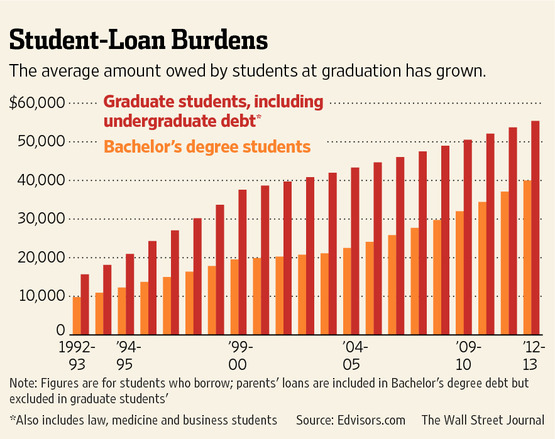
The rising mountain of student debt, recently closing in on $1.2 trillion, is forcing some entrepreneurs to abandon startup dreams and others, including Christine Carney of Orono, Maine, to radically reshape their business plans. Ms. Carney, 29 years old, and her husband, John, 31, started Thick & Thin Designs, making and selling food picks in the shapes of zombies, bikes and deer antlers after a brainstorming session while she was cooking dinner. The couple, both students at the University of Maine, where he is earning a master’s degree in fine arts and she is earning her second undergraduate degree, in zoology, sell the picks for about $12 a dozen as decorative cupcake toppers. But they chose not to purchase a laser cutter, because doing so would require them to take out a business loan—and together they have $140,000 in leftover student debt. Instead, they use a university-owned laser cutter, which limits the size of the acrylic sheets they can work with. Having the student-loan debt “is preventing me from being able to take a lot of chances or risks that are usually necessary when starting a business,” Ms. Carney says. The average student who borrows has piled up about $40,000 in debt by graduation, including parents’ loans, nearly double the levels of a decade ago, according to Edvisors.com, which runs college-planning and financial-aid websites. Recipients of graduate and professional degrees who borrow average more than $55,000 in debt at graduation, including undergraduate loans, but not parent loans. That is up from $40,800 some 10 years ago. Read more of this post

Chinese auto parts maker Huayu Automotive to buy Visteon’s stake in their car-interiors JV and interests in other car-parts businesses for $1.25 billion in cash

August 13, 2013, 10:18 a.m. ET

Auto-Parts Maker Visteon to Receive $1.2 Billion as It Refocuses Its China Strategy

PRUDENCE HO And JEFF BENNETT

HONG KONG—Chinese auto parts maker Huayu Automotive Systems Co.600741.SH +10.05% agreed to buy Visteon Corp.’s VC +6.65% 50% stake in their car-interiors joint venture and interests in other car-parts businesses for $1.25 billion in cash. The sale highlights the continuing global expansion of Chinese auto parts makers. Wanxiang Group won U.S. government approval on Monday to complete its acquisition of advanced automotive battery maker A123 Systems Inc. The company paid $256.6 million for the business trumping a lower offer made by Milwaukee auto-parts manufacturer Johnson Controls Inc. JCI +0.07% Huayu, 60% owned by SAIC Motor Corp., 600104.SH +4.17% China’s largest domestic auto maker, is acquiring Visteon’s share of Yanfeng Visteon Automotive Trim Systems Co. The unit makes car-interior components such as dashboards and door panels, as well as low-end electronics./  Visteon said it would use most of the proceeds to buy back stock until the end of 2015 and its board of directors raised the authorization of Visteon’s remaining share repurchase program by $875 million to $1 billion. Read more of this post

Closer Look: How Best to Manage the Rise of Bad Loans

08.12.2013 16:44

Closer Look: How Best to Manage the Rise of Bad Loans

Creating a market-driven method for dealing with certain debts will mean building the necessary infrastructure and letting investors judge risk

By staff reporter Li Tao

The top three regions where banks’ bad loans increased the fastest in the first half of the year are all in the Yangtze River Delta. This is primarily because of the economic slowdown and excess output capacity in the steel trading, solar energy and shipbuilding industries. To a certain extent, it is good that the risks have been exposed because it implies that we did not choose to continue covering them up by exacerbating oversupply and taking on new debts to repay old ones. The three regions, Shanghai and the provinces of Jiangsu and Zhejiang, are among the most market-oriented areas in the country. Their disposal of non-performing loans should thus be handled in a more market-driven manner. Read more of this post

Trust Company Forced to Repay Investors Out of Own Pockets

08.13.2013 16:57

Trust Company Forced to Repay Investors Out of Own Pockets

Shaanxi International forks over nearly 600 million yuan of its own money, then asks court to seize collateral behind failed offering

By intern reporter Liu Zhuozhe

(Beijing) – A trust company says it used its own money to buy a trust product back from investors after the issuing firm fell behind on repayments.  Shaanxi International Trust Co. Ltd. (SIT) said on August 12 it spent 597.9 million yuan acquiring outstanding units of a trust product sold in two phases by Henan Yufeng Compound Fertilizer Co. Ltd. in 2012.  Yufeng started falling behind on payments in December. The final payment of the first phase, which had an interest rate of 18 percent, was due in April. The second phase (16.2 percent) came due in July. SIT said it asked Xian Intermediate People’s Court to seize Yufeng’s assets, including land and office buildings it used as collateral to issue the trust product. It is unclear how SIT will dispose of the assets. Read more of this post

Electronics retail giant Suning aims to enter the e-finance arena after the wild success of Alibaba’s Yu E Bao service

08.08.2013 16:31

Suning Plans to Offer Money Market Funds to Online Shoppers

Retail giant aims to enter the e-finance arena after the wild success of Alibaba’s Yu E Bao service

By intern reporter Li Huiling

(Beijing) – The e-commerce platform of retail giant Suning Commerce Group Co. Ltd. said it will soon add a service to its payment system that allows shoppers to buy money market funds online. This follows Alibaba launching Yu E Bao, which lets users invest in money market funds offered by Tian Hong Asset Management Co. through their payment accounts with Alibaba. Suning’s Yi Fu Bao payment system could offer users more choice because it will provide access to more funds from different companies, said Min Juanqing, executive deputy director of Suning’s marketing department. More importantly, she said, the service will be available to both individuals and companies. Suning may also promote the online investment service in its brick-and-mortar stores. Read more of this post

The Other Chinese Interest Rate Nobody Is Talking About: China 5Y Bond Yield Surges

The Other Chinese Interest Rate Nobody Is Talking About

Tyler Durden on 08/13/2013 18:54 -0400

20130813_chinarepo_0

While all the attention of the world’s investing public – focused on the short-term repo markets in China – has been ameliorated by the PBOC’s ‘fold’ thanks to ~CNY600bn in liquidity provision (or an equivalent 65bp RRR cut), liquidity concerns remain high (and not so hidden if one knows where to look). Not only has there been a surge in copper imports – based on the cash-for-copper deals replacing short-term funding but concerns raised by investors and the PBOC over duration mismatches (exposed by the recent crisis) has forced Chinese banks to seek longer-term funding. Banks are now raising longer-term deposit rates in order to attract stickier term-deposits and this is causing medium-term Chinese bond yields to surge. While inflation remains ‘under control’ (if one looks at the official data – as opposed to reality), growth hopes and inflation fears may also be impacting Chinese bonds though the timing suggests this remains evidence of a Chinese banking system in distress. And so, in a vicious circular manner, the cost of funding for Chinese firms is rising rapidly; implying (all things being equal) that end-users’ pocket books will be pressured as firms are forced to raise prices (raising inflationary expectations) and driving interest-rates up still further. The margin compression that banks alone will suffer will also mean more PBOC liquidity will be needed as capital floods out on risk-aversion.


Luxury-Car Market Shifts Gear in China Ultra-High-End Has Ruled, but Now More-Affordable Is in Fashion

August 13, 2013, 7:20 a.m. ET

Luxury-Car Market Shifts Gear in China

Ultra-High-End Has Ruled, but Now More-Affordable Is in Fashion

ABHEEK BHATTACHARYA

AM-AZ832_CHINAH_G_20130813055404

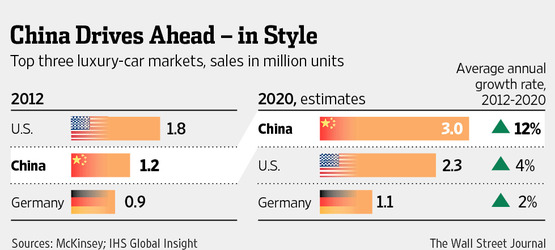
In recent years, luxury-car makers have been all fired up over China. The likes of Ferrari, Rolls-Royce and Aston Martin rolled out models carrying images of dragons or other auspicious symbols. Lately, though, their fortunes have taken a turn for the worse. China’s economic slowdown and Beijing’s drive against conspicuous consumption are taking a toll. Ferrari’s China sales volume in the first six months of 2013 was down 12.5% from a year earlier. Bentley’s China sales were down 23%. At Lamborghini, sales growth has ground to a stop. While the top end of the luxury-auto market is stalling, though, less pricey cars are faring much better. BMW‘s BMW.XE +1.11% China sales volume for January-June was up 15% from a year earlier. At Jaguar-Land Rover, the increase was 16%; atAudi, NSU.XE -0.26% 17.7%. Read more of this post

China Plans Faster Capacity Cuts Even as Growth Slows

China Plans Faster Capacity Cuts Even as Growth Slows

China will push ahead with efforts to cull excess industrial capacity a year earlier than planned even as economic expansion slows, and will promote spending on information products to stabilize growth, an official said.

The government will complete by the end of 2014 its overcapacity reduction plan for the five years through 2015, and will seek to cut further outdated capacity, China National Radio said yesterday, citing Industry Minister Miao Wei. Read more of this post

China Investigates Foreign-Car Pricing; Regulator Asks Dealers Association for Data; on the Lookout for Anticompetitive Practices

August 14, 2013, 12:19 a.m. ET

China Investigates Foreign-Car Pricing

Regulator Asks Dealers Association for Data; on the Lookout for Anticompetitive Practices

SHANGHAI—The China Automobile Dealers Association has been asked to compile prices for foreign cars sold locally so any overcharging can be exposed, the organization said Wednesday. The National Development and Reform Commission wants to see whether foreign car makers are manipulating prices or setting minimum retail prices for dealers, said Luo Lei, the association’s deputy secretary-general, noting that those practices are illegal. Read more of this post

A handful of foreign entrepreneurs have gone into rural China to operate boutique hotels in restored properties with historic or vintage appeal

August 13, 2013

From Outsiders to Innkeepers in China’s Sleepy Countryside

By MIKE IVES

Hotel-articleLarge

Brian Linden and his wife, Jeanee, converted a courtyard residential complex in Yunnan Province, built before the Communist revolution, into the Linden Centre hotel.

XIZHOU, China — Brian Linden welcomed the guests to his boutique hotel in one of its courtyards at the end of a cobblestone alley here, surrounded by old stone walls and polished wood balconies. He invited the group, from Greenwich, Conn., to peruse the hotel’s book collection, which he created years ago as a doctoral candidate in Sinology at Stanford University. “And if any of you are light sleepers, what I recommend is, turn on the fan for some white noise,” Mr. Linden said. “Because there’s no white noise here at all.”

The hotel is far from the noise of any major city, which Mr. Linden, an American who first arrived in China in 1984 as a student, thinks is one of its draws. He and his wife, Jeanee, are among a small number of foreign entrepreneurs in rural China who operate boutique hotels in restored properties that have historic charm. They converted a courtyard residential complex in Yunnan Province, built before the Communist revolution, into the Linden Centre. Read more of this post

The pressure on big auto makers to squeeze more miles out of a gallon of gas is powering a surge in profit at U.S. auto-parts makers.

August 13, 2013, 6:34 p.m. ET

Mileage Boosters Give Second Wind to Car-Parts Makers

Engine TurboCharger, Start-Stop Battery Makers Gain New Sales, Profit as Auto Industry Seeks Improved Fuel-Economy

JEFF BENNETT

TRAVERSE CITY, Mich.—The pressure on big auto makers to squeeze more miles out of a gallon of gas is powering a surge in profit at U.S. auto-parts makers. Once dismissed by Wall Street, companies including BorgWarner Inc., BWA +2.32%Delphi Automotive PLC, DLPH +2.01% Federal-Mogul Corp. FDML -0.75% and TRW Automotive Holdings Corp. TRW -0.18% are today beating Wall Street’s profit forecasts, hiring workers and making acquisitions. At an industry conference here earlier this month, industry executives said the appetite for fuel-saving technology such as turbochargers, easy-rolling tires and advanced fuel injectors is providing a second wind for companies already benefiting from booming car sales. Read more of this post

YTL’s Francis Yeoh: Key public services have to be opened up to private competition

August 13, 2013 4:32 pm

Why Asia needs a few doses of Thatcherite rigour

By Francis Yeoh

Key public services have to be opened up to private competition, writes Francis Yeoh

Everyone is talking about the incredible economic miracle taking place in Asia. It is true that the continent has made huge strides. But while millions more people move up into the middle classes, huge swaths of its population are being left behind. To realise their full economic potential, Asian nations must free public utilities from the clutches of the governments that control them – often simply for political or ideological reasons. Read more of this post

In Asia, Locals Rise Only So Far at Western Firms; Multinationals Still Rely on Expatriates to Fill Top Jobs Decades After Expanding Into Region

August 13, 2013, 7:52 p.m. ET

In Asia, Locals Rise Only So Far at Western Firms

Multinationals Still Rely on Expatriates to Fill Top Jobs Decades After Expanding Into Region

MARIKO SANCHANTA and RIVA GOLD

HONG KONG—As Western multinationals ratchet up their operations in Asia, there is one glaring omission from the upper ranks of management: Asians. Asians are employed by multinationals in greater numbers than ever before at lower levels, but when it comes to the top roles, companies from food to finance tend to pick Westerners. When Western companies first started expanding to Asia, headquarters sent an executive to Asia to show employees how the business should run. Decades later, not much has changed. In part, that’s because leaders tend to promote people in their own image and culture, perpetuating a cycle of white, male bosses, according to consulting and executive-search firms. Many executive-search firms say their clients would leap at the chance to hire locally, but few firms are taking steps to develop and groom talent. Read more of this post

Foreign beer brands growing fast; Rising popularity poses threat to OB-Hite duopoly who account for over 90 percent of the market

2013-08-13 16:40

Foreign beer brands growing fast

Rising popularity poses threat to OB-Hite duopoly
By Yi Whan-woo
Two local powerhouses ― Oriental Brewery (OB) and Hite-Jinro ― are facing a growing challenge from foreign makers. The two Korean breweries account for over 90 percent of the market, but market observers anticipate the share of foreign alcoholic beverage firms will consistently rise as more consumers become willing to spend money on premium beers.
The market share of foreign firms reached 5.7 percent in the first quarter of this year, up from 4 percent in 2010, according to Korea Alcohol & Liquor Industry Association (KALIA).
Japan’s Asahi tops the list of international beer brands in terms of sales. Its average annual sales in Korea increased by 47 percent from 2005 to 2012. Read more of this post

South Korea’s $15-billion wedding industry is wooing an image-conscious slice of the Chinese jet set seeking a wedding with a South Korean touch

Image industry weds Korean cool to China’s nouveaux riches

BY ELIZABETH SHIM

AP, AUG 13, 2013

an20130814s1a-870x552

Gangnam-style: A Chinese couple pose during their wedding shoot at a studio in Seoul. South Korea’s $15-billion wedding industry is wooing an image-conscious slice of the Chinese jet set seeking a wedding with a South Korean touch. | AP

SEOUL – Standing by a French château’s window, the bride-to-be glows in the afternoon sun as she gazes into her fiancé’s eyes. This Chinese couple’s fairytale moment, however, isn’t unfolding at a Bordeaux estate. The 20-something Beijing lawyers and fans of South Korean pop idol Rain are part of a small but growing number of affluent Chinese for whom the craze for all things South Korean means flying to Seoul for the weekend to have wedding pictures taken. Read more of this post

Cleanup Attempt At Japan’s Fukushima Plant Could Release 14,000 Times As Much Radiation As Atomic Bomb

After disaster, the deadliest part of Japan’s nuclear clean-up

10:16pm EDT

By Aaron Sheldrick and Antoni Slodkowski

fukushima-7

An aerial view shows workers wearing protective suits and masks work at a construction site (C) of the shore barrier to stop radioactive water from leaking into the sea, at the tsunami-crippled Fukushima Daiichi nuclear power plant in Fukushima, in this photo taken by Kyodo August 9, 2013. Highly radioactive water from Japan’s crippled Fukushima nuclear plant is pouring out at a rate of 300 tons a day, officials said on Wednesday, as Prime Minister Shinzo Abe ordered the government to step in and help in the clean-up. The revelation amounted to an acknowledgement that plant operator Tokyo Electric Power Co (Tepco) has yet to come to grips with the scale of the catastrophe, 2 1/2 years after the plant was hit by a huge earthquake and tsunami. Tepco only recently admitted water had leaked at all.

TOKYO (Reuters) – The operator of Japan’s crippled Fukushima nuclear plant is preparing to remove 400 tons of highly irradiated spent fuel from a damaged reactor building, a dangerous operation that has never been attempted before on this scale.

Containing radiation equivalent to 14,000 times the amount released in the atomic bomb attack on Hiroshima 68 years ago, more than 1,300 used fuel rod assemblies packed tightly together need to be removed from a building that is vulnerable to collapse, should another large earthquake hit the area. Read more of this post