Yes Bank Loses Almost Half Its Market Value on India Crunch; Indian Banks to Drop on Record Yield Inversion

Yes Bank Loses Almost Half Its Market Value on India Rate Surge

Yes Bank Ltd. (YES), the best-performing Indian bank stock last year, has lost almost half its market value in less than a month on investors’ concern that a record surge in interest rates will erode profits and boost defaults.

The stock has tumbled 43 percent, the most in the S&P BSE Bankex Index, since the Reserve Bank of India on July 15 began taking emergency steps to tighten liquidity and bolster the rupee. Mumbai-based Yes Bank, which gets 69 percent of its funding from bulk deposits and debt, is among lenders that are most vulnerable if rates remain high, according to Espirito Santo Securities India Pvt. Read more of this post

India’s Path to Prosperity Doesn’t Run Through Cities

India’s Path to Prosperity Doesn’t Run Through Cities

Indian leaders often warn that they need to shift the majority of their country’s population — almost 70 percent — from rural to urban areas. “Our salvation,” Prime Minister Manmohan Singh claims, “lies in moving people out of agriculture.” Finance Minister P. Chidambaram confirms, “My vision is to get 85 percent of India into cities.”

These dedicated urbanizers claim to have history on their side: the shift from agriculture to urban industry and manufacturing is how Europe, the U.S. and, more recently, China enhanced their productivity and created capital for broader investments to modernize their economies. Read more of this post

What Korean and Japanese literatures tell about countries

2013-08-11 13:55

What Korean and Japanese literatures tell about countries
By Yoon Sung-won, Kim Da-ye
John Treat, a professor of East Asian languages and literature at Yale University, is a rare Western scholar with extensive insight into Korean literature, especially that from the Japanese colonial period. His association with Korea was formed almost accidentally, partly because he had long hair in his youth. In 1971, Treat was sent to Vietnam to serve as a civilian employee in a military hospital. After six months of service, he went to Japan for “rest and recreation” where he witnessed a stark contrast between the war-torn Vietnam and the peaceful, affluent and liberated Japan. Treat went back to Japan as a student, and his girlfriend and he planned to travel to Taiwan during the summer vacation. He wasn’t granted a visa because of his lengthy hair. The couple decided to visit Korea instead, taking a boat from Kobe to Kyushu and then to Busan. They spent a week in Korea, hitchhiking around. More than 20 years later, Korea revisited Treat’s life. The scholar specialized in Japanese literature back then, and a Japanese colleague recommended him to study Korean writers under the Japanese colonial rule who wrote both in Korean and in Japanese. Treat found the idea interesting and began learning the Korean language in his 40s. The author of several works of fiction  and non-fiction is now an authority in the study of pro-Japanese Korean writers under the colonial rule. Last year, he published a paper on Yi Kwang-su, a prominent writer whose reputation has been tainted for having collaborated with the Japanese regime, in the Journal of Asian Studies. In the abstract, Treat wrote, “Yi Kwang-su, Korea’s most distinguished modern novelist as well as one of its more notorious pro-Japanese partisans during the colonial period, offers a compelling test case for how we might attempt to not only understand, but also morally adjudicate, his support of Japan’s occupation of his country. With the ongoing debate over collaboration with the German Reich in mind, I contend that the case of colonial Korea presents us with important first-order ethical issues to resolve.” The professor is now working on a book dealing with the same subject, “Collaboration, Conversion and Modernity: Korean Writers under Japanese Rule.” Treat visited Korea this summer for a special purpose — teaching at Ewha Womans University. He taught an unusual subject, “Same Sex Desire in East Asian Literature.” He said he had a “wonderful experience” at Ewha. On the day of the interview, he was going to grade final papers. He said he previewed the papers in class and he found the level of analysis was as high as he would get at Yale. The professor talked to The Korea Times further about how Japanese and Korean literature differ from each other; why Korea hasn’t won a Nobel Prize in literature; and what he thinks of pro-Japanese Korean writers during the colonial period. The following questions and answers have been edited. Read more of this post

Korean Companies Struggle to Gain Traction in Japan

August 11, 2013

Korean Companies Struggle to Gain Traction in Japan

By ERIC PFANNER

TOKYO — Brandishing a new Sony Xperia as she left a mobile phone shop in a trendy part of Tokyo, Nisako Hanawa, a 17-year-old student, explained that she had chosen that brand “because of its cool design and its good reputation.”

Asked about another leading smartphone maker, Samsung Electronics of South Korea, she and a friend exchanged quizzical looks. “Samsung?” Miss Hanawa asked. “I haven’t heard of it.”

Samsung Electronics may be the largest consumer electronics company in the world, selling one out of every three smartphones and one in five televisions. LG, the other giant electronics maker in Korea, has a significant share of TV and washing machine markets in Europe and the United States. But here in trend-obsessed Japan, consumers have not caught on that elsewhere in the world some Korean products are knocking Japanese rivals off the shelves.

Many Japanese explain away the absence of Korean brands by claiming the quality is inferior. “South Korean products are still affected by a ‘cheap and nasty’ image, which remains prevalent among Japanese above a certain age,” wrote Hidehiko Mukoyama, an economist at the Japan Research Institute, in a research paper about Japan-South Korea trade relations.

The evidence says otherwise. Korean-made TVs, phones, washers and cars rate higher than many Japanese brands in independent tests by Consumer Reports, CNet and others. LG TVs have been getting favorable reviews in Japan. A local magazine, HiVi, recently rated a 32-inch, high-definition, 3-D-capable LG set-top ahead of televisions in its category from Mitsubishi and Sharp.

The unfamiliarity is not because tariffs make Korean products costlier. Japan eliminated the import duty on many Korean electronics products, including TVs and smartphones.

But this last holdout is finally being cracked open. In 2008, LG stopped selling its televisions in Japan, but it reintroduced them two years later. Now many of the biggest electronics retailers in Japan, including the No. 1 player, Yamada Denki, and the second-biggest chain, Biccamera, sell LG TVs.

At a suburban Tokyo branch of Nojima, a major Japanese retail chain, LG televisions are displayed prominently alongside sets from domestic brands like Sony, Sharp, Panasonic and Toshiba.

Kohei Tomizawa, a sales clerk, said LG TVs were selling briskly, though not as well as those from Sony. LG sets “tend to be more popular with younger people, and younger people don’t buy as many televisions as older customers, who tend to prefer well-known Japanese brands, like Sony,” Mr. Tomizawa said.

The quality myth may be less believable to a younger generation of consumers. With South Korean food and television shows popular in Japan, LG has latched on to the popularity of K-pop music across Asia and beyond. It has run ads for its smartphones in Japan that feature Kara, a Korean group that is popular in Japan.

“I think things have improved compared to the old days, thanks to the influence of Korean popular culture,” said Byoung-Uk Lee, assistant director of the Korea Trade-Investment Promotion Agency in Japan.

LG said it sold about $675 million worth of TVs, smartphones, washing machines, vacuum cleaners and other goods in Japan last year, up about 45 percent from 2010.

Samsung also pulled out of Japan in 2007, after failing to make much of a dent here. (The biggest Korean carmaker, Hyundai Motor, also beat a retreat from Japan shortly thereafter.)

But Samsung has come back for a second shot in Japan, starting with its smartphones. NTT Docomo, the largest mobile phone carrier in Japan, has turned to Samsung to try to fend off rising competition from two rival network operators, SoftBank and KDDI.

Those two companies have been poaching customers from Docomo, which does not offer the popular iPhone. “Docomo needs Samsung, and that is giving it an opening,” said Michito Kimura, an analyst at IDC, a research firm.

Starting in May, Docomo plastered Japanese cities with advertising posters featuring the flagship Samsung Galaxy S4 smartphone alongside a Sony Xperia A. The campaign, for what Docomo bills as its “summer collection,” is the first time that any Japanese carrier has given such prominence to a Samsung phone.

So far, the results of Docomo’s embrace of Samsung have been mixed. Analysts say Samsung smartphones have been a tougher sell in Japan than in other countries where consumers are familiar with the brand through the televisions and other goods.

Docomo said that under its summer promotion, it had sold 400,000 Galaxy S4 phones through mid-July, but that was less than half the total of Sony Xperia A handsets.

Apple dominates the Japanese smartphone business, holding a 40 percent market share in the first quarter, according to IDC. Sharp, with 15 percent, and Sony, with 13 percent, follow. Samsung has not cracked the top five vendor ranks.

Japanese and Korean news media have reported that Samsung is considering re-entering the Japanese television market. Samsung declined to comment.

To succeed in Japan, Samsung will have a lot of work to do changing a mind-set. But some analysts, like Sea-Jin Chang, the author of “Sony vs. Samsung: The Inside Story of the Electronics Giants’ Battle for Global Supremacy,” are convinced that South Korean companies have a brighter future in Japan.

“Japanese customers favor domestic producers,” said Mr. Chang, executive director of the Center for Governance, Institutions and Organization at National University of Singapore. “No Korean or Western firms were good enough for them, except Apple. But you will find more Korean firms accepted in the Japanese mainstream in the future.”

Falsified Reports After Fukushima Fan Anti-Nuclear Korea

Falsified Reports After Fukushima Fan Anti-Nuclear Korea

For Seoul residents, South Korea’s decision to keep four nuclear reactors offline because of faked safety reports means power shortages, and a summer of sweltering homes and offices. Lee Jin Gon has bigger concerns.

“We feel unsafe day and night,” Lee said, pointing at the cause of his nervousness, one of the closed reactors in the town of Yangnam, a four-hour journey southeast of the capital. “We became worried about nuclear safety after the Fukushima accident. Now it’s worse,” he said, adding that locals have held protests to close the whole plant. Read more of this post

Mantra to Expand in Indonesia Amid Tourism Boom: Southeast Asia

Mantra to Expand in Indonesia Amid Tourism Boom: Southeast Asia

Mantra Group, the Australian hotel operator controlled by CVC Asia Pacific Ltd., plans to open 20 hotels in Indonesia in the next three years and manage about the same number of properties in Thailand in six years.

The closely-held company, which opened its first resort under its four-star Mantra brand in March in Bali, is in talks to add six more hotels in the resort province, Chief Executive Officer Bob East said in an interview in Sydney. The Gold Coast, Queensland-based company, which is also in initial talks to run a hotel in Jakarta, will either sign management agreements or take minority stakes in properties in the country, he said. Read more of this post

Indonesia: A delicate succession; In next year’s presidential election, all eyes will be on the governor of Jakarta

August 11, 2013 4:30 pm

Indonesia: A delicate succession

By Ben Bland

In next year’s presidential election, all eyes will be on the governor of Jakarta, writes Ben Bland

Almost every Thursday for the past six years, Maria Katarina Sumarsih has stood outside Indonesia’s presidential palace with a group of other victims of human rights abuses, calling for justice. Some protest about the hundreds of thousands who were killed in the anti-leftist purges of the late 1960s, which cemented the rise to power of General Suharto, who ruled Indonesia from 1966 to 1998. Ms Sumarsih is mourning the loss of her son, who was one of more than a dozen student protesters shot dead by the army while calling for political and economic reforms in central Jakarta during the chaotic period that followed the ousting of Suharto. Read more of this post

Taiwan struggles to win over Chinese students

August 11, 2013 1:45 pm

Taiwan struggles to win over Chinese students

By Sarah Mishkin in Taipei

When Taiwan opened its universities to mainland Chinese students two years ago, many in the Taipei government hoped the decision might help the small democracy to influence its authoritarian neighbour. Many of the hundreds of mainland students who have since arrived say their studies have been an eye-opening look at how democracy and an open civil dialogue can work in Chinese society. But Taiwan’s anxiety about its growing economic dependence on China, which has never relinquished its claim to the island, is hampering its soft power push, say students and professors. Read more of this post

Even Dead Feel the Weight of Debt Crisis in Spain; Funeral services carry the highest VAT tax rate, alongside entertainment like nightclubs, and luxury products

Even Dead Feel the Weight of Debt Crisis in Spain

By Alexandra Di Stefano Pironti on 12:05 pm August 10, 2013.
Barcelona,Spain. Even in death, people in Spain cannot escape the economic crisis. Funeral services carry the highest VAT (value added tax) rate, alongside entertainment like nightclubs, and luxury products. “I paid over 7,000 euros ($9,300) for my husband’s funeral, and it was a simple service, with one of the simple coffins, which cost 2,600 euros ($3,450), without mementos or music, and only a few flowers. Besides, instead of a burial, we had him cremated, which is even less expensive,” Ana Mara Robles, a 66-year-old pensioner, told IPS. “For a middle-class family, that price is abusive,” said Robles, who retired a few months ago after working for years in the Barcelona traffic department. Jordi Valmana general manager of the “Cementiris de Barcelona” municipal company that administers the cemeteries in this city in northeast Spain, said: “Funeral services are essential for society and the public.” “The fact that VAT was raised from eight to 21 percent in late 2012 is appalling, and I think it’s a political mistake for funeral services to be charged the same tax as discotheques,” he told IPS. Read more of this post

They come for the politics, but stay for the money; Washington transforms political believers into members of the get-rich club

August 11, 2013 6:58 pm

They come for the politics, but stay for the money

By Jacob Weisberg

Washington transforms political believers into members of the get-rich club, says Jacob Weisberg

It’s a funny thing about Washington: everyone complains about it, but no one ever seems to leave. Take former House leader Richard Gephardt. The Missouri Democrat twice ran for president as a voice of organised labour. Today he pockets $7m a year to lobby on behalf of corporate clients and advise them on busting unions. Or consider former journalist Jeffrey Birnbaum, who used to write exposés of the lobbying trade for The Wall Street Journal. Today he works for Haley Barbour, Mississippi’s Republican former governor who is now one of the most influential lobbyists in Washington. Read more of this post

Bond Hubris Overwhelms Fed in Riskiest Sectors of Credit Markets

Bond Hubris Overwhelms Fed in Riskiest Sectors of Credit Markets

Bond investors trying to divine when the Federal Reserve will reduce its unprecedented monetary stimulus are increasingly looking to the riskiest parts of the debt market, which are booming like before the financial crisis.

The amount of loans made this year that lack standard protections for lenders exceed the all-time high set in 2007, and only one other time have investors pumped more money into funds that buy lower-rated loans than they did last week. Bonds rated in the lowest category of junk accounted for the greatest percentage of speculative-grade offerings last month since 2011. Read more of this post

The Next Private-Equity Investors: Mom and Pop

 | SATURDAY, AUGUST 10, 2013

The Next Private-Equity Investors: Mom and Pop

By LAWRENCE C. STRAUSS | MORE ARTICLES BY AUTHOR

Private-equity holdings, which are illiquid and usually take many years to bear fruit, normally aren’t associated with mutual funds, which provide daily liquidity. But the day is fast approaching when mom-and-pop investors will be able to invest in private-equity holdings, says David M. Rubenstein, co-CEO

The Carlyle Group’s David Rubenstein sees mutual funds eventually offering small investors a chance to get a piece of the action. The Carlyle Group (ticker: CG), a Washington, D.C.–based private-equity firm that went public in 2012. Since Rubenstein, now 64, helped found the firm in 1987, its assets have gone from $5 million to about $180 billion. Carlyle is one of the industry’s behemoths, along with rivals such as Blackstone Group (BX) and KKR (KKR). Carlyle’s portfolio includes stakes in TCW Group, an asset manager; HCR ManorCare, which owns and operates nursing homes and assisted-living facilities; and Accudyne Industries, whose products include air compressors. Rubenstein says that while flows from institutional investors, such as pension funds, haven’t returned to pre-financial-crisis levels, more money now is pouring in from sovereign wealth funds and private banks. Last week, while announcing a disappointing second-quarter loss of seven cents a unit, the firm disclosed that it had raised $7 billion for future investments. Although Carlyle invests all over the world, the U.S. “is by far the most attractive place in which to invest, certainly for the types of things that we do,” Rubenstein adds. Barron’s spoke with him recently in his midtown Manhattan office. Read more of this post

Deutsche Börse’s News Service for Traders Draws Scrutiny of Investigators; A look at Need To Know News sheds light on growing concerns about data releases

August 11, 2013, 10:38 p.m. ET

Deutsche Börse’s News Service for Traders Draws Scrutiny of Investigators

A look at Need To Know News sheds light on growing concerns about data releases

BRODY MULLINS  and SCOTT PATTERSON

Need To Know News was formed in 2004 by a Chicago investment firm, Allston Trading, whose traders thought they sometimes weren’t getting economic data as fast as some competitors. John Harada, pictured here, is an Allston co-founder who later became the news service’s owner.

P1-BM656A_NEWS_G_20130811180035

WASHINGTON—Several times a month, the Labor Department invites news reporters to a sealed room for an early look at soon-to-be-released reports such as the unemployment rate. One organization attending in recent years stands out from the rest. Founded by an investment firm and now owned by the Deutsche Börse stock exchange, Need To Know News has operated with an overriding mission: sending data directly from the government through high-speed lines to financial firms that are able to trade on it instantly. Some have paid $375,000 a year for the service. The ability of such an organization to gain a position at the heart of the government’s system for releasing economic reports turns on its head an embargo arrangement created decades ago to give writers time to digest complex data and produce reports for broad public dissemination. Read more of this post

Money managers trying to gauge the stock market’s direction have started looking to the buyout business for signals, and they don’t like what they are seeing

Aug 11, 2013

Stock Investors Take a Cue From Private Equity

By E.S. Browning

Money managers trying to gauge the stock market’s direction have started looking to the buyout business for signals, and they don’t like what they are seeing. With the Dow Jones Industrial Average up 18% this year and the Federal Reserve planning to cut back on the bond-buying it uses to stimulate markets, some investors worry that the stock market has gotten pricey and could pull back. They see evidence in the behavior of buyout firms that specialize in taking companies private. “There are a lot of people who think this is a better time to sell than to buy,” and in particular the buyout firms, said David Joy, chief market strategist at Ameriprise Financial Inc., which oversees $700 billion for its clients. When sophisticated investors pull back, some analysts believe, it is a sign that the smart money is growing skeptical on the outlook for stocks. Read more of this post

Insider Case Highlights Ties of Friends, Family; Prosecutors Allege a U.S. Couple Made More Than $1 Million on Tips From a Banker

August 11, 2013, 5:42 p.m. ET

Insider Case Highlights Ties of Friends, Family

Prosecutors Allege a U.S. Couple Made More Than $1 Million on Tips From a Banker

JEAN EAGLESHAM

Married in 2007, millionaires in 2012, fugitives in 2013—now, Shawn Hegedus and Danielle Laurenti sit in Mecklenburg County jail in North Carolina, awaiting federal trial.

In one hot week last summer, prosecutors allege, the couple made more than $1 million from insider trading, spent most of it on 550 gold bars in midtown Manhattan and laundered $100,000 in a Las Vegas casino. Read more of this post

Emerging World Loses Growth Lead

August 11, 2013, 9:46 p.m. ET

Emerging World Loses Growth Lead

Global-Trade Decline Dulls Developing Markets as Outlook Brightens in More-Established Economies

ALEX FRANGOS in Hong Kong, SUDEEP REDDY in Washington, and JOHN LYONS in São Paulo

Momentum in the global economy is shifting to the developed world, away from the emerging economies that had led growth since the financial crisis. For the first time since mid-2007, the advanced economies, including Japan, the U.S. and Europe, together are contributing more to growth in the $74 trillion global economy than the emerging nations, including China, India and Brazil, according to an estimate by investment firm Bridgewater Associates LP. The turnabout may reshape world capital flows and upend forecasts that corporations had built around ebullient hopes for emerging markets. Read more of this post

NZ PM John Key Says Fonterra Scare Affected All of New Zealand’s Exports

Key Says Fonterra Scare Affected All of New Zealand’s Exports

New Zealand’s entire export industry has suffered from the contamination scare that prompted China to halt imports of milk powder made by Fonterra Cooperative Group Ltd., Prime Minister John Key said.

Damage from the incident would be hard to quantify as it affected all of New Zealand’s exports around the world, rather than just dairy sales to China, Key said in an interview with Television New Zealand yesterday. In a separate interview, Fonterra Chief Executive Officer Theo Spierings put the cost at “tens of millions” of New Zealand dollars. Read more of this post

Is China’s great wall of capital controls keeping money in or out?

Is China’s great wall of capital controls keeping money in or out?

Aug 10th 2013 |From the print edition

20130810_FNC187

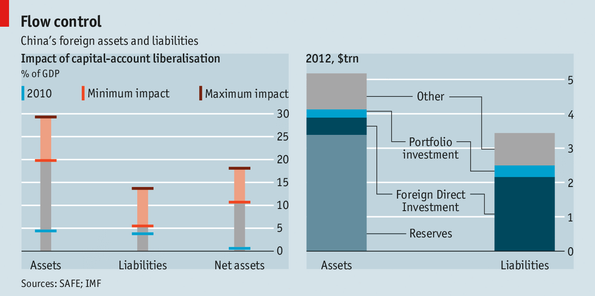
AT ITS recent mid-year meeting, China’s State Administration of Foreign Exchange (SAFE), which helps to regulate the flow of capital across the country’s borders, weighed the task ahead. China is committed to making its currency, the yuan, fully convertible, relaxing the controls that keep foreign money out and domestic money in. A plan is expected this year. At its meeting, SAFE concluded that the next phase of foreign-exchange management will be “glorious and arduous”. It will certainly be the latter. China first promised to make the yuan fully convertible in 1993, setting the end of that decade as a deadline. Back then the Asian financial crisis helped undermine the case for quick and early capital-account liberalisation. But China’s peculiarities have also reduced the sense of urgency. Most emerging economies relaxed capital controls because they wanted to invite money in. By importing foreign capital, poor countries could invest more than they themselves could afford to save. Read more of this post

A new prescription: New Zealand’s plan to regulate designer drugs is better than trying to ban them and failing

A new prescription: New Zealand’s plan to regulate designer drugs is better than trying to ban them and failing

Aug 10th 2013 |From the print edition

AS THE world’s drug habit shows, governments are failing in their quest to monitor every London window-box and Andean hillside for banned plants. But even that Sisyphean task looks easy next to the fight against synthetic drugs. No sooner has a drug been blacklisted than chemists adjust their recipe and start churning out a subtly different one. These “legal highs” are sold for the few months it takes the authorities to identify and ban them, and then the cycle begins again. In June the UN reported more than 250 such drugs in circulation.

Read more of this post

Can China clean up fast enough? The world’s biggest polluter is going green, but it needs to speed up the transition

Can China clean up fast enough? The world’s biggest polluter is going green, but it needs to speed up the transition

Aug 10th 2013 |From the print edition

“HELL is a city much like London—a populous and a smoky city,” wrote Percy Bysshe Shelley in 1819. It is a description that would suit many Chinese cities today for, like Britain in the early 19th century, China is going through an industrial-powered growth spurt. Like Britain back then, the urge to get rich outweighs the desire for clean air, so the Chinese are chucking all manner of filth into the atmosphere. And, rather sooner than Britain did, China is beginning to clean up its act (see article).

Read more of this post

Years of crisis have reinforced the pressure on Italy’s once-envied industrial base

Years of crisis have reinforced the pressure on Italy’s once-envied industrial base

Aug 10th 2013 | ROME |From the print edition

THE traditional August shutdown of Italian factories usually lifts the spirits of blue-collar workers, who can look forward to up to four weeks away from toiling on the production line. In recent years, however, many have spent their holidays wondering if there will be a job to come back to at the end of summer. Almost one manufacturing firm in five shut between 2009 and 2012, and the carnage continues unabated. Italy has long been Europe’s second-biggest manufacturing power, beaten only by Germany. It still is, just about, but its production base is being jeopardised by competition from abroad and the downturn at home. Read more of this post

Fish are getting more expensive, but they do not all move at the same speed

Fish are getting more expensive, but they do not all move at the same speed

Aug 10th 2013 |From the print edition

20130810_FNC193

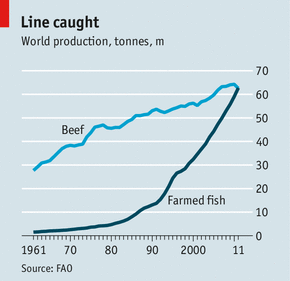
IT IS a good time to be a fisherman. The global fish-price index of the UN’s Food and Agricultural Organisation (FAO) hit a record high in May. Changing consumer diets, particularly in China, explain much of the sustained upward movement. High oil prices, which increase the cost of fishing and transportation, also add to the price of putting fish on the table. Not all fish are created equal, however. There are two types of fish production: “capture” (or wild) and “aquaculture” (or farmed). And they seem to be on different trajectories. Fish such as tuna, the majority of which is caught wild, saw much bigger price increases than salmon, which are easier to farm. Overall, the FAO’s price index for wild fish nearly doubled between 1990 and 2012, whereas the one for farmed fish rose by only a fifth. What explains this big difference? Read more of this post

What Angela isn’t saying: Euro-zone rescues have left sovereign debt too high to be sustainable

What Angela isn’t saying: Euro-zone rescues have left sovereign debt too high to be sustainable

Aug 10th 2013 |From the print edition

20130810_FNC192_0

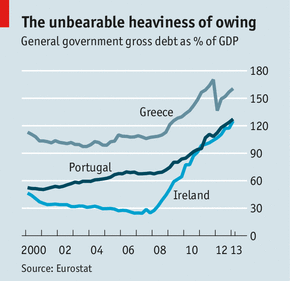
AN ORCHESTRATED hush has descended over the euro area as Angela Merkel, the German chancellor who conducts its troubled band of 17 states, campaigns for a third term in the election on September 22nd. The calm also stems from signs that the euro-zone economy may gradually be emerging from recession. But discord will reappear after the poll as it becomes clear that Europe’s bail-out programmes won’t be unwound harmoniously and that more big bills are on their way.

Of the first three rescued euro-zone countries—Greece in the spring of 2010, Ireland at the end of that year and Portugal in mid-2011—only one should be able to leave its bail-out programme as planned. Helped by its resilient economy, Ireland, whose rescue amounted to €67.5 billion ($90 billion), looks set to bow out at the end of this year. In practice, however, it will be only a partial departure. Read more of this post

Squeezing the hourglass: Growth is back. But for many Britons, it does not feel like it

Squeezing the hourglass: Growth is back. But for many Britons, it does not feel like it

Aug 10th 2013 | SOLIHULL |From the print edition

20130810_BRD001_0

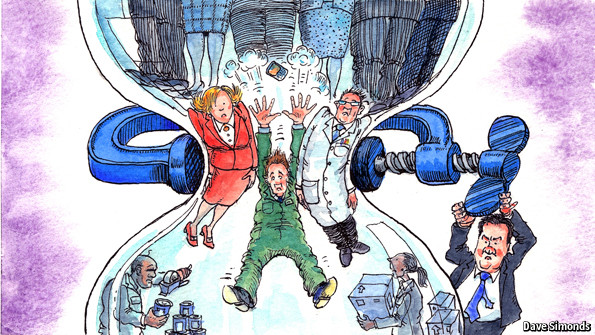
MARK CARNEY is a man on a macroeconomic tightrope. On August 7th the new governor of the Bank of England promised that interest rates will stay low until the unemployment rate, now 7.8%, has fallen to 7.0% or lower. He gave himself two get out clauses: his pledge is off if inflation gets out of hand or if Britain’s banks start to wobble. Mr Carney’s announcement reflected the balancing act demanded of him: he must spur economic confidence without allowing inflation to erode wages and savings. The severity of the slump in British living standards shows just how tricky that task will be. Read more of this post

Can Japan finally make special economic zones work?

Can Japan finally make special economic zones work?

Aug 10th 2013 | TOKYO |From the print edition

20130810_FNM936

THE world’s best-known and most successful special economic zone is China’s Shenzhen. After 1979, when Deng Xiaoping chose the small farming and fishing town north of Hong Kong to test free-market economics, it grew rapidly into an industrial metropolis. Japan, though long converted to capitalism, has also used special zones to test ideas too radical for the rest of the country. Shinzo Abe, the prime minister, has now put them at the heart of his plan for economic revival. After decades of not achieving much, can they finally help Japan manage a Shenzhen-like transformation? If the zones’ expected size is any guide, they could indeed have an impact. The final locations will soon be announced, with the vast cities of Tokyo, Osaka and Nagoya said to be likely candidates. A new cabinet minister may even be chosen to oversee the tokku, as such areas are known in Japanese. Read more of this post

Boundary problems: America has changed the way it measures GDP

Boundary problems: America has changed the way it measures GDP

Aug 3rd 2013 |From the print edition

ECONOMICS is a messy discipline: too fluid to be a science, too rigorous to be an art. Perhaps it is fitting that economists’ most-used metric, gross domestic product (GDP), is a tangle too. GDP measures the total value of output in an economic territory. Its apparent simplicity explains why it is scrutinised down to tenths of a percentage point every month. But as a foundation for analysis it is highly subjective: it rests on difficult decisions about what counts as a territory, what counts as output and how to value it. Indeed, economists are still tweaking it. This week America’s GDP rose by $560 billion, or 3.6%, mainly because the “boundary” that defines what counts as an economic asset was moved. Read more of this post

Myanmar Faces Difficult Balance in Financial Overhaul

August 10, 2013, 4:35 a.m. ET

Myanmar Faces Difficult Balance in Financial Overhaul

NATASHA BRERETON-FUKUI And SHIBANI MAHTANI

Myanmar has come a long way in revamping its financial system since the military gave up formal power two and a half years ago. The country’s new civilian leaders made its central bank independent last month and ushered in several other changes meant to smooth the way for more foreign investment. And over the past two weeks, the government has allowed foreign-exchange trading between local banks, according to state media, and appointed a new management team for the central bank. Read more of this post

Ex-Top Official Says China’s Xi Not Serious in Tackling Graft; “I can only see one thing: he has continued suppression. Besides that, I can’t see what else he wants to do. So I think he probably just wants to do one thing: to maintain his stability, maintain his position.”

Ex-Top Official Says China’s Xi Not Serious in Tackling Graft

By Sui-Lee Wee on 2:47 pm August 10, 2013.

File photo of Bao, a former member of the Central Committee of the Communist Party of China, smoking at home during an interview in Beijing

Bao Tong, former member of the Central Committee of the Communist Party of China, smokes at home during an interview in Beijing, in this February 20, 2013 file photo. (Reuters Photo/Petar Kujundzic/Files)

Beijing. Chinese President Xi Jinping is not serious about fighting corruption and is more intent on maintaining his position than curing the country’s “sickness,” the most senior official jailed over the 1989 Tiananmen Square protests said on Friday. Bao Tong, the most trusted aide to purged reformist Communist Party chief Zhao Ziyang, characterized the new president as no different from Mao Zedong — the leader who led China into the chaos of the Cultural Revolution. It was Bao’s harshest criticism to date of Xi, who many liberals and intellectuals are hoping will emerge as a reformer, like his father, Xi Zhongxun, a liberal-minded former vice premier. “I can only see one thing: he has continued suppression,” Bao, 80, told Reuters in his apartment in Beijing. “Besides that, I can’t see what else he wants to do. So I think he probably just wants to do one thing: to maintain his stability, maintain his position.” Read more of this post

End of QE will drive a bond sell-off to remember; Debt losses will accelerate as equity markets gradually accept Fed taper

August 9, 2013 11:52 am

End of QE will drive a bond sell-off to remember

By Michael Mackenzie in New York

Debt losses will accelerate as equity markets gradually accept Fed taper

Bond investors hurt by this summer’s interest rate turmoil may be surprised to find the damage was small by previous standards. The rapid rise in bond yields from May fails to crack the top 10 list of fixed income routs for the past 50 years, according to Liberty Street Economics, a website that publishes research from economists at the Federal Reserve Bank of New York.* Of the 15 largest bond market debacles since 1961, this year’s interest rate shock ranks at number 13, based on the economists’ criteria for defining such events. Before fixed income investors take umbrage at such a lowly ranking for the hefty losses they have just experienced, Liberty Street has not yet called time on this year’s stampede out of bonds. Just like a sleeper song or film, the bond market’s current affliction could climb further up the hit parade, with September delivering another employment report and a Fed policy meeting that could well launch a reduction, or taper in the central bank’s $85bn of monthly bond buying. Read more of this post

Investors shun advice as costs are laid bare; Financial advisers are being forced to spell out their charges and many customers think they are too high

Investors shun advice as costs are laid bare

Financial advisers are being forced to spell out their charges and many customers think they are too high.

Richard Mills: ‘I was paying commission to the adviser and not really getting anything for it.’ 

By Richard Dyson

7:45AM BST 10 Aug 2013

Now that consumers can see more clearly how much they pay for financial advice, many no longer want it. One in three investors who have taken financial advice in the past five years says they will never consider paying for the service again. These findings – part of an authoritative survey into thousands of investors’ intentions – emerge just six months after new rules were introduced requiring financial advisers to declare their charges explicitly to clients, rather than receiving payment in the form of commissions. Read more of this post