City of London Investment Trust, one of the oldest and largest generalist investment trusts, said this week it would remove its performance fee and charge only a management fee, prompting analysts to predict that more would follow

August 2, 2013 6:31 pm

Trust performance fees axed

By Jonathan Eley

City of London Investment Trust, one of the oldest and largest generalist investment trusts, said this week it would remove its performance fee and charge only a management fee, prompting analysts to predict that more would follow. Henderson, which manages the trust, said it hoped the move would make it “more attractive to a wider audience of retail investors.” The annual management fee will henceforth by 0.365 per cent and the ongoing charges in respect for this year should be around 0.45 per cent – less than some tracker funds. Read more of this post


Buffett-Like Buyers Seen Lured to Hanesbrands

Buffett-Like Buyers Seen Lured to Hanesbrands: Real M&A

Boxers and bras may be next on the shopping list for private-equity buyers with Hanesbrands Inc. (HBI) offering one of the cheapest valuations in the retail industry.

The underwear maker’s $6.2 billion market value is 12 times its free cash flow from the past year, lower than all but two similar-sized U.S. apparel companies, according to data compiled by Bloomberg. While Warren Buffett’s Berkshire Hathaway Inc. has 43 percent of the U.S. industry through brands including Fruit of the Loom, suitors would get a second-place share of 19 percent by buying Hanes, data compiled by IBISWorld Inc. show. Read more of this post

Prepping for a bank bailout in China; China to let banks sell off loans in bid to tackle debt overhang

Prepping for a bank bailout in China

Izabella Kaminska

| Aug 09 16:01 | 5 comments | Share

A very intriguing little exclusive from Reuters on Friday:

(Reuters) – China is developing a new trading platform to enable banks to sell off loans to a wider range of investors, in a move that could pave the way for a government bailout of lenders or distressed asset sales to private investors. The trading platform, now in the testing phase, is designed to introduce banks to a new class of investors, including non-bank financial institutions and large companies. Currently, the lack of well-established precedents for asset disposals effectively leaves banks only two options: sell non-performing loans in private deals, mostly with big state-backed asset management firms, or keep rolling them over indefinitely to avoid booking a loss. Read more of this post

China’s Gleaming Ghost Cities Draw Neither Jobs Nor People

August 8, 2013, 11:02 p.m. ET

China’s Gleaming Ghost Cities Draw Neither Jobs Nor People

DINNY MCMAHON

P1-BM630_CURBAN_G_20130808195233 P1-BM632_CURBAN_G_20130808195321

China seeks economic gain through urbanization, but when one city, Tieling, built a whole new city nearby, it drew few residents. Urban planners spent millions of yuan to clean up surrounding marshland in this small city in northeastern China. Four years later, Tieling New City is virtually a ghost town.

TIELING, China—When this small city in northeastern China launched a plan to build a satellite city 6 miles down the road, it got off to a promising start. Urban planners spent millions of yuan to clean up surrounding marshland that had become a dumping ground for the city’s untreated sewage. A pristine environment, they hoped, would help attract the businesses that would raise incomes and swell the population. Four years later, Tieling New City is virtually a ghost town. Read more of this post

State Firms Cloud Chinese Growth Hopes

August 9, 2013, 3:22 p.m. ET

State Firms Cloud Chinese Growth Hopes

WO-AO924A_CSTAT_G_20130809164509

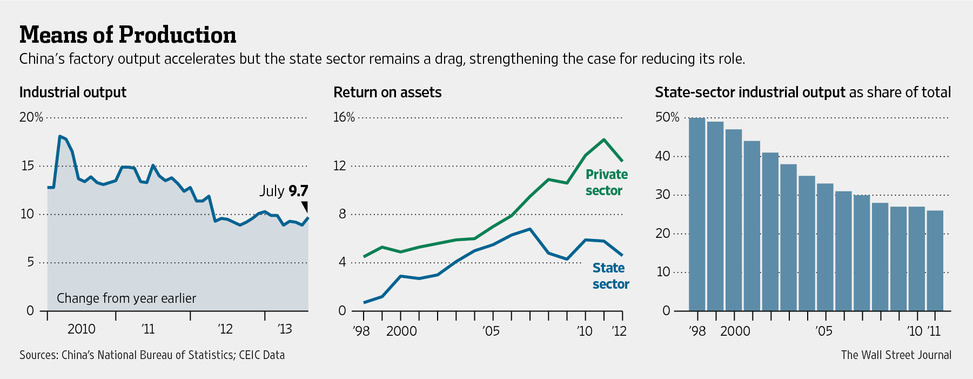
BEIJING—China added to its growing string of evidence of an economic rebound Friday with strong industrial-production figures, but the good news masked problems in its sprawling state sector that is increasingly seen as a major drag on growth. Factory output rose 9.7% in July from a year earlier, up from the June figure of 8.9%. Those results, taken together with strong trade numbers a day earlier, increasingly suggest the worst of the China’s slowdown is over. But the same data show that state-owned firms grew barely half as much as private firms—up 5.6% from 2012 for the year so far, compared with 10.9% for private firms. And all of the figures appear boosted by massive lending, which was up strongly in the first half before falling back in July. The recent decline in lending followed a cash crunch, engineered by China’s leaders to draw a line under spiraling credit. Read more of this post

Why the US is turning into a subscription-based economy

Why the US is turning into a subscription-based economy

By Gina Chon @GinaChon August 9, 2013

Rapid changes are taking place in the way people buy things, and companies are reacting accordingly. Increasingly, the US is moving toward a subscription-based economy in which firms will focus less on selling things, and more on gaining recurring customers—a trend seen in companies like Netflix, Zipcar and Spotify. That’s according to Tien Tzuo, an evangelist for the subscription-based economy who built his startup, Zuora, around that philosophy.

Tzuo is CEO of Zuora, a cloud-based billing and finance software company that caters to companies with recurring revenue streams. Tzuo got his training from Salesforce.com, the cloud-based customer management software company, as its 11th employee and was with the firm through its IPO in 2004. Salesforce.com founder Marc Benioff is an investor in Zuora. The name Zuora, by the way, came out of a bag of Scrabble letters used to spell the founders’ last names. The founders pulled from the bag and fiddled with the letters until settling on a URL they liked. The name seemed exotic, says Tzuo, until Quora, the crowdsourced Q&A site, popped up in 2009. Read more of this post

Is beauty subscription e-commerce Asia’s next hot trend?

Is beauty subscription e-commerce Asia’s next hot trend?

August 6, 2013

by Anh-Minh Do

It is well known that women are among the most voracious and influential online groups. They’re online more often, and they are avid purchasers. In Asia, that’s especially true with women, where female web users are making, in every country, more than 60 percent of their online purchases on fashion. That’s right, fashion dominates online spending for women. With stats like these, it’s no wonder that fashion e-commerce in general is taking off. Another specific new niche, beauty subscription e-commerce, is peeking over the horizon. Currently, we’re seeing beauty subscription e-commerce sites emerging from South Korea, where Memebox, which has just over 100,000 users, has generated up to $2 million in revenue. And those guys are headed to Thailand next. In other news, Singapore’s VanityTrove has acquired Vietnam’s Glamyboxand Taiwan’s Glossybox. In Indonesia, Lolabox and BeautyTreats are battling it out with new entrant VanityTrove. In China, there’s MyLuxBox with over 10,000 paying subscribers. In other words, beauty subscription is a huge regional trend, chasing after female e-shoppers. Read more of this post

China dream sours for foreign companies

August 9, 2013 11:44 am

China dream sours for foreign companies

By Tom Mitchell in Beijing

The “Chinese dream” articulated by China’s new president, Xi Jinping, is fast becoming a nightmare for some of the world’s most powerful corporations. Mr Xi’s speech, on his accession to the presidency in March, hinted at a more assertive approach to match China’s economic power – and since then, government investigations and state media exposés targeting foreign investors have become a regular feature of the country’s business landscape. Public officials say this simply reflects broader efforts to tackle bad practice, but some executives complain that foreign groups appear to be encountering particularly heavy scrutiny under the new leadership. Read more of this post

China’s Credit Expansion Slows as Li Curbs Shadow Banking

China’s Credit Expansion Slows as Li Curbs Shadow Banking

By Bloomberg News – Aug 9, 2013

China’s broadest measure of new credit fell to a 21-month low as Premier Li Keqiang extended a campaign to curb a record expansion of lending that’s added dangers to the nation’s financial system. Aggregate financing was 808.8 billion yuan ($132 billion), the People’s Bank of China said in Beijing yesterday, compared with the 925 billion yuan median estimate of analysts surveyed by Bloomberg News. New yuan loans exceeded forecasts and accounted for about 87 percent of the total, the most since September 2011. M2 money supply growth unexpectedly accelerated to 14.5 percent. Read more of this post

‘Cycling is the new golf’: Gel-Squeezing Cyclists in Lycra Fuel Science in Sport IPO

Gel-Squeezing Cyclists in Lycra Fuel Science in Sport IPO

Science in Sport Ltd. broke away from its parent company, Provexis Plc (PXS), and began trading today after an initial public offering as the maker of nutritional sports gels rides a surge in Britain’s Lycra-clad cyclists.

Provexis, a maker of nutritional additives, spun off the company so SiS could focus on expanding the market for Go brand gels, powders and bars. SiS rose 8 percent to 60.5 pence in London, giving the Windsor, England-based company a market value of about 11.7 million pounds ($18.1 million). Read more of this post

Orders Evaporate for Celebrity Perfumes

August 8, 2013, 8:16 p.m. ET

Orders Evaporate for Celebrity Perfumes

SERENA NG and SHELLY BANJO

MK-CF416A_PERFU_G_20130808183611

Wall Street smells trouble in the fragrance business. Shares of perfume makers tumbled Thursday, after Elizabeth Arden Inc.RDEN +0.30% —the producer of fragrances including Justin Bieber’s “Girlfriend,” Taylor Swift’s “Wonderstruck Enchanted” and Nicki Minaj’s “Pink Friday”—said orders from one of its biggest customers, a major U.S. mass-market retailer, had been cut sharply in recent months. Executives at the company didn’t name the retailer, but Wal-Mart Stores Inc.WMT -0.45% is its biggest customer, according to Elizabeth Arden securities filings, accounting for 13% of its $1.24 billion sales in the year to June 2012 and about a fifth of its sales in North America. The cutback in so-called replenishment orders, Elizabeth Arden said, effectively reduced the retailer’s inventory on hand “with orders significantly below their pace of their retail sales.”

Read more of this post

Eating McDonald’s Is A Major Status Symbol Overseas

Eating McDonald’s Is A Major Status Symbol Overseas

JOHN W. SCHOEN, CNBC AUG. 9, 2013, 12:18 PM 1,411 4

Along the upward journey to middle-class status, a growing number of people around the world are working up quite a voracious appetite. The developing world has fallen big time for all-American exports like Footlongs, Big Macs and Extra Crispy Chicken Tenders. Despite early signs that a fast-food diet is no healthier in Beijing than it is in Boston, consumers who are new to middle-class dining seem less concerned about the health risks of the high-fat, high-sodium fare that many Americans now seek to avoid.

As the U.S. economy slogs along at a tepid pace, household incomes in much of the developing world are leaping ahead. Over the next two decades, those gains are expected to introduce billions of new consumers to menus from fast-food chains that are among some of the most iconic American brands. Read more of this post

Family restaurants chains in crisis in Korea; T.G.I. Friday’s, Tony Roma’s and Bennigan’s have closed down stores located in central Seoul; Marche and Sizzler, the first generation of family restaurants in Korea, recently went out of business

2013-08-09 18:15

Family restaurants chains in crisis

Marche, Sizzler shut down amid prolonged slump
By Rachel Lee

Gone are the times when family restaurants led the country’s dining industry and its culture. They are now on the brink of a precipice. According to the industry, major family restaurant chains such as T.G.I. Friday’s, Tony Roma’s and Bennigan’s have closed down stores located in central Seoul, reportedly due to the inability to pay higher rent under unfavorable economic conditions. “We decided not to renew our contact because we were not happy with the terms of lease offered by landlords,” said a T.G.I. Friday’s spokesman. T.G.I. Friday’s is an American casual restaurant chain that entered the country in 1992. The local franchise, taken over by the fast food chain Lotteria in 2009, currently operates 46 branches in the country. Its competitors Marche and Sizzler, the first generation of family restaurants in Korea, recently went out of business after failing to overcome business difficulties. “It’s true that we have had financial difficulties, but I think it’s the same everywhere in the saturated dining market,” a Marche spokesman said. “We acted quickly to prevent further trouble. “I am sure other big restaurant chains have also found it difficult to survive, except those run by conglomerates.” Marche, a Swiss restaurant chain that ran about 100 branches nationwide, closed in May, having operated in Korea since 1996. Sizzler, a family restaurant chain run by a TS Corp. subsidiary, also closed recently. Ashley, an American-style salad bar chain that Korean conglomerate E-Land runs, has the most outlets, 129, while CJ Foodville’s VIPS, which operates 87 stores, ranks first in sales. Read more of this post

Most Korean firms use UBS for bogus companies

2013-08-09 18:00

Most Korean firms use UBS for bogus companies

By Kim Tae-jong
An activist group of journalists said Friday that most Korean firms used UBS, the biggest banking group in Switzerland, to set up paper companies in off-shore tax havens.
Newstapa, run by the Korea Center for Investigative Journalism, said 32 out of 369 paper companies in off-shore tax havens were set up for Koreans through UBS branches in Singapore and Hong Kong. Lee Soo-young, chairman and CEO of OCI, a major chemical firm, and Choi Eun-young, Hanjin Shipping chairwoman, are some of the Korean corporate executives who used UBS to establish paper companies in tax havens, it said. The number is much higher than comparable figures by other international banks including German-based Deutsche Bank with eight and Singapore-based DBS with seven. Newstapa argued that these international banks also created secret accounts for bogus firms by Korean customers. “The accounts with false identities would not have been possible without the agreement from each bank. We suspect those banks played an important role in supporting their Korean customers to dodge due taxes through paper companies,” an official from Newstapa said. But he said UBS denied the allegation, saying that it was not involved in any illegal services for Korean customers. The online news outlet, working with the U.S.-based International Consortium of Investigative Journalists, has revealed names of Koreans who allegedly set up paper companies in an apparent move to dodge due taxes and creating slush funds.

Hollywood Takes Spanish Lessons As Latinos Stream to the Movies

August 9, 2013, 10:31 p.m. ET

Hollywood Takes Spanish Lessons As Latinos Stream to the Movies

BEN FRITZ

P1-BM643_LATFIL_G_20130809172107 P1-BM642_LATFIL_NS_20130809164803

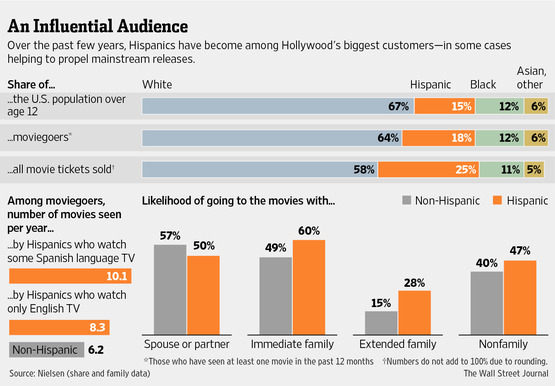
LOS ANGELES—In a small room on the Paramount Pictures lot here, postproduction work is under way on a movie that sounds as derivative as they come: the fourth sequel to “Paranormal Activity.” But flickering on an editor’s monitor are the types of scenes rarely seen in Hollywood: Characters are shown visiting botanicas—storefronts where witchcraft is practiced. One woman tries to cure her possessed grandson by ritualistically rubbing a raw egg on him. Much of the dialogue is in Spanish, with no subtitles. The four previous “Paranormal Activity” films grossed a total of more than $350 million, thanks in large part to packed theaters in Hispanic neighborhoods. Now, with the next installment, “Paranormal Activity: The Marked Ones,” some of the series’ most fervent fans will see people who look and speak like them on screen. The bilingual film, from Viacom Inc.’s VIAB +0.06% Paramount division, marks the first time a big studio has taken a mainstream franchise and spun it into one about Latino characters and culture. Read more of this post

The Rolling Student Loan Bailout; A consumer guide to all the ways you can avoid repaying Uncle Sam

Updated August 9, 2013, 7:08 p.m. ET

The Rolling Student Loan Bailout

A consumer guide to all the ways you can avoid repaying Uncle Sam.

The Consumer Financial Protection Bureau performed a genuine public service this week by alerting taxpayers to the tidal wave of student loan defaults coming their way. Too bad the intention was also to alert student borrowers to ways they can avoid repaying those loans.

A new analysis by the bureau shows federal-backed student loan debt surpassing $1 trillion, which is nearly double what it was at the start of the Obama Presidency. As college costs have continued to balloon in tandem with federal loan and grant subsidies, students have assumed more debt. Many jobless Americans have also sought asylum from the Obama economy by returning to school. Read more of this post

Japan’s Debt Exceeds 1 Quadrillion Yen as Abe Mulls Tax Rise

Japan’s Debt Exceeds 1 Quadrillion Yen as Abe Mulls Tax Rise

Japan’s national debt exceeded 1,000 trillion yen for the first time, underscoring the case for Prime Minister Shinzo Abe to proceed with a sales-tax increase to shore up government finances.

The country’s outstanding public debt including borrowings reached a record 1,008.6 trillion yen ($10.46 trillion) as of June 30, up 1.7 percent from three months earlier, the finance ministry said in Tokyo today. Larger than the economies of Germany, France and the U.K. combined, the amount includes 830.5 trillion yen in government bonds. Read more of this post

The Dark Side of Higher Yields; Income-hungry investors have flocked to energy-focused master limited partnerships and MLP funds this year. Yet risks are rising, and taxes can be hazardous

August 9, 2013, 6:52 p.m. ET

The Dark Side of Higher Yields

Income-hungry investors have flocked to energy-focused master limited partnerships and MLP funds this year. Yet risks are rising, and taxes can be hazardous.

LAURA SAUNDERS and JASON ZWEIG

BF-AF545_10WIws_G_20130809204654

Master limited partnerships, the publicly traded energy firms offering the steady high income many people crave, have been hotter than a wellhead fire. Investors should proceed carefully, however, or they might get scorched. Lured by generous quarterly cash payouts, investors poured nearly $8 billion into mutual funds and exchange-traded products specializing in MLPs in the first half of 2013, according toMorningstar, MORN +0.09% the investment-research firm. More than one-quarter of the roughly $26 billion in the total assets at these funds has arrived since Dec. 31. Read more of this post

Master limited partnerships have benefited from low rates and an energy boom. But what’s next?

SATURDAY, AUGUST 10, 2013

Boom… or Bust?

By DIMITRA DEFOTIS | MORE ARTICLES BY AUTHOR

ON-BB798_PANELI_G_20130810013558

Master limited partnerships have benefited from low rates and an energy boom. But what’s next?

Income-oriented investors have had a tough time recently. Low bond yields and pricey dividend stocks have made it tough for an investor to find a little yield, let alone growth. Except, that is, in master limited partnerships. This quirky corner of the market beat the Standard & Poor’s 500 for 11 years running, by an average of 20 percentage points, until 2012. Read more of this post

China Builds All in Changsha Rail to Top-Tower Projects

China Builds All in Changsha Rail to Top-Tower Projects

Yang Feng takes a drink from his water bottle as he rests in the shade of a tree near the foot of the Poly International Plaza building where he’s installing lights on the roof of the $653-million real estate development in the central Chinese city of Changsha.

From his perch atop a 150-meter (492 feet) residential tower, he can make out workers rushing to complete a tunnel project under the city’s Xiangjiang River that will cost 1.3 billion yuan ($212 million). About 30 minutes’ drive away, preparatory work has begun on what a local company says will be the tallest building in the world, with 202 floors. And China Development Bank Corp., the state lender, has pledged 14.25 billion yuan for completion of an intercity rail line connecting Changsha with other cities in Hunan province. Read more of this post

Americans Giving Up Passports Jump Sixfold as Tougher Rules Loom

Americans Giving Up Passports Jump Sixfold as Tougher Rules Loom

Americans renouncing U.S. citizenship surged sixfold in the second quarter from a year earlier as the government prepares to introduce tougher asset-disclosure rules.

Expatriates giving up their nationality at U.S. embassies climbed to 1,131 in the three months through June from 189 in the year-earlier period, according to Federal Register figures published today. That brought the first-half total to 1,810 compared with 235 for the whole of 2008. Read more of this post

China Factories Turn to Undocumented Foreign Labor as Local Wages Jump

China Factories Turn to Undocumented Labor as Local Wages Jump

China’s embrace of higher wages to help bolster consumer spending has sparked a jump in factories along the east-coast export corridor bringing in undocumented and lower-paid workers from Myanmar and Vietnam.

Border police found 59 illegal immigrants from Vietnam in a bus heading for the Pearl River Delta on July 29, the official Xinhua news agency reported on Aug. 6. “Thousands” of workers from Vietnam and Myanmar were discovered working illegally in Shenzhen between 2010 and 2012, the state-run China News Service reported, citing a local prosecutor. Read more of this post

German Regulators Said to Review Off-Balance-Sheet Loans

German Regulators Said to Review Off-Balance-Sheet Loans

German regulators will review how the country’s banks made loans that didn’t appear on their balance sheets, obscuring the risk to investors, said two people briefed on the talks.

The inquiry, led by the Bundesbank and Bafin, will focus on whether banks properly applied accounting rules when making the loans, said one of the people, who asked not to be identified because the investigation hasn’t been made public. The review is likely to take several months, the person added. Read more of this post

China H-Shares to Drop 30% in 2013, Societe Generale Says

China H-Shares to Drop 30% in 2013, Societe Generale Says

Chinese companies traded on the Hong Kong stock market will slide the most in five years in 2013 as an economic slowdown weighs on profits and banks curtail credit, according to Societe Generale SA.

The Hang Seng China Enterprises Index will drop to 8,000 by year-end, said Guy Stear, Hong Kong-based head of Asia research at Societe Generale. That’s 16 percent below yesterday’s close and would extend the gauge’s 2013 decline to 30 percent, the biggest tumble since 2008. China’s manufacturing will contract this year, while bad loans will keep rising until late 2014, Stear said. Read more of this post

Taiwanese authorities said a water leak that began 3 1/2 years ago inside a state-owned atomic power plant is yet to be halted, as lawmakers debate whether to put the island’s nuclear future to an island-wide vote.

Taiwan Says Nuclear Water Still Leaking Inside Power Plant

Taiwanese authorities said a water leak that began 3 1/2 years ago inside a state-owned atomic power plant is yet to be halted, as lawmakers debate whether to put the island’s nuclear future to an island-wide vote.

About 19.8 liters (5.2 gallons) has been collected from two leaking used-fuel pools inside Taiwan Power Co.’s No. 1 plant in the period, according to a report from the state oversight body, the Control Yuan. The Ministry of Economic Affairs was faulted for failing to properly supervise the utility, the report shows. Read more of this post

The $1M Check That Sat in a Drawer: How Detroit Went Bust; Underlying poor service is a government that lacks modern technology and can’t perform such basic functions as bill collecting

The $1M Check That Sat in a Drawer: How Detroit Went Bust

In late February, cash-strapped Detroit received a $1 million check from the local school system that wasn’t deposited. The routine payment wound up in a city hall desk drawer, where it was found a month later.

This is the way Detroit did business as it slid toward bankruptcy, which it entered July 18. The move exposed $18 billion of long-term obligations in a city plagued by unreliable buses, broken street lights and long waits for police and ambulances. Underlying poor service is a government that lacks modern technology and can’t perform such basic functions as bill collecting, according to Kevyn Orr, Detroit’s emergency manager. Read more of this post

Norway’s oil fund has raised its holdings in equities to a record level as the world’s largest sovereign wealth fund continues to demonstrate its dislike of bond markets. Norway Fund Says Emerging Market Slump Curbed Returns

Last updated: August 9, 2013 12:04 pm

Norwegian oil fund raises equity holdings

By Richard Milne in Oslo

Norway’s oil fund has raised its holdings in equities to a record level as the world’s largest sovereign wealth fund continues to demonstrate its dislike of bond markets. Equities accounted for 63.4 per cent of the fund at the end of the second quarter while bonds represented just 35.7 per cent, a record low. “I have said before it is less a reflection of enthusiasm for the equity markets and more a lack of enthusiasm for the bond markets,” said Yngve Slyngstad, chief executive of the $760bn oil fund. Read more of this post

After 9 years, Tesco gives up on cracking China alone

After 9 years, Tesco gives up on cracking China alone

6:19am EDT

By Denny Thomas, Donny Kwok and Neil Maidment

HONG KONG/LONDON (Reuters) – After nine years in China, British supermarket firm Tesco (TSCO.L: Quote,Profile, Research, Stock Buzz) is to fold its unprofitable operation into a state-run company as a minority partner, becoming the latest foreign retailer to give up on trying to crack China on its own. Lured by the prospect of a rapidly growing middle class in the world’s second-biggest economy, many foreign firms have waded into China’s retail market only to find they lack local expertise, particularly in building supplier relationships. The world’s No.3 retailer said on Friday it was in talks to team up with China Resources Enterprise Ltd (CRE) (0291.HK: Quote, Profile, Research, Stock Buzz), a move that follows decisions to abandon the United States and Japan and focus on investing in its British home market. Read more of this post

Chinese official warns of excessive “empty cities”

Chinese official warns of excessive “empty cities”

(Xinhua)    15:31, August 10, 2013

Reckless expansion of cities in China has left many of them empty, according to a Chinese economic planning official. Qiao Runling, deputy director of the China Center for Urban Development under the National Development and Reform Commission, said local governments had relied on quick urbanization to stimulate economic growth and generate fiscal revenue. “Nearly every big or medium-sized city across China has plans to erect a new town,” Qiao said, quoting the result of his research at a forum on urban development held in Jiangxi Province this week. According to the official, new towns are usually bigger than old ones and many cities are left empty as a result. “China now has an oversupply of cities, given the number of new urban districts that we have,” Qiao said, adding that the excess of new urban districts are especially serious in medium and small-sized cities in central and western parts of the country. Qiao warned that China’s modern urbanization should no longer be bolstered by investment or construction projects but focus on structural reform.
Official statistics showed that land used for urban construction rose by 83.41 percent from 2000 to 2010, while the urban population saw an increase of 45.12 percent in the period


$1 bn stolen in China low-cost housing programme: govt

$1 bn stolen in China low-cost housing programme: govt

Friday, August 9, 2013 – 17:24

AFP

BEIJING – China’s affordable housing programme lost nearly $1 billion to embezzlement last year, the national auditor reported on Friday, underscoring the obstacles to official efforts to fight graft. About 5.8 billion yuan ($950 million) went towards “loan repayment, foreign investment, land requisition and house demolitions, office cash flow and other expenses not related to affordable-housing projects”, the National Audit Office said on its website. Read more of this post