China may not overtake America this century after all; world’s tallest tower in Changsha should have been built by now when officials announced said last year the great edifice would be erected in 3 months

China may not overtake America this century after all

Doubts are growing about whether China can pass the US to become the world’s biggest economy this century amid warnings that the country’s 30-year miracle is nearing exhaustion.

China’s catch-up spurt has a few more years to run in the Western hinterlands perhaps, but when the full story comes out we may find that nationwide growth has already fallen below 7pc. Photo: Getty

By Ambrose Evans-Pritchard

3:21PM BST 08 May 2013

The world’s tallest tower should have been built by now. Officials said last year that the great edifice with 220 floors would be erected in three months flat in China’s inland city of Changsha by March, snatching the crown from Dubai’s Burj Khalifa. The deadline has come and gone, yet the wasteland sits untouched. It now looks as if the fin d’époque project – using prefab blocs – may never be approved. Even China knows its limits. Read more of this post

The US will match China on the cost of manufacturing by 2015. Companies in both countries must adapt

The parity puzzle

Thursday, May 9, 2013

The US will match China on the cost of manufacturing by 2015. Companies in both countries must adapt, write Ivo Naumann and Steve Maurer

Ivo Naumann and Steve Maurer are managing directors at AlixPartners, a global business advisory firm. Naumann heads the firm’s activities in mainland China, and Maurer leads the firm’s manufacturing practice for the Americas.

It happens regularly in virtually every segment of every industry: A newcomer arrives, offers an advantage that competitors in the segment can’t match and rapidly begins to build both its business and market share.

What often follows, however, is also predictable: The market adapts, the advantage diminishes and the newcomer finds that it is in a vulnerable, rather than valued, situation. Read more of this post

U.S. taxpayers employ more low-wage workers than Wal-Mart, McDonald’s combined

Study: U.S. taxpayers employ more low-wage workers than Wal-Mart, McDonald’s combined

By Jim Tankersley and Marjorie Censer, Published: May 8

_tn_1001.7.822064553_Ud14mreGEeKS8_KRgBk2uA_w-cheapgov

Federal taxpayers employ more low-wage workers than Wal-Mart and McDonald’s combined, a new study calculates.

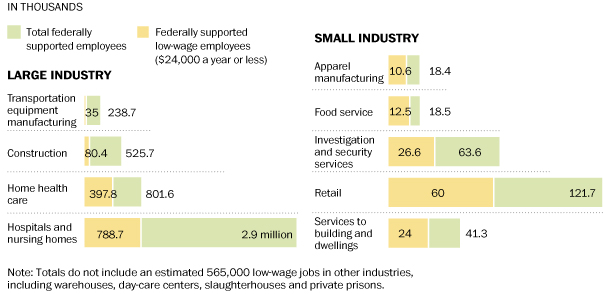
The report from a public policy organization Demos, set to be released Wednesday, estimates that taxpayer dollars fund nearly 2 million private-sector jobs that pay $24,000 a year — about $12 an hour — or less. Those workers owe their incomes to government contracts, Medicare and Medicaid spending, and federal infrastructure funds, among other public sources. In contrast, Demos estimates that about 1.4 million workers earn that amount or less at Wal-Mart and McDonald’s, which are two of the largest employers of low-wage workers.

The findings highlight inequality within the government contracting industry; as chief executives of major contractors rake in millions, many contract employees are struggling to get by, according to the report from Demos, which advocates for worker-friendly policies. It is a situation that could be worsened by the budget pressures of sequestration, which is pushing the federal government to spend fewer dollars and pursue lower-priced contracts. Read more of this post

Huawei founder gives first ever interview

Huawei founder gives first ever interview

May 9, 2013 – 2:21PM

Tom Pullar-Strecker

The founder and president of Chinese technology giant Huawei, Ren Zhengfei, has used a visit to New Zealand to speak to the media for the first time in his career.

Ren, 68, had never previously consented to media interviews inside or outside of China, but this morning fielded questions from a handful of journalists at Wellington’s Museum Hotel on topics ranging from his personal view of China’s human rights record to a rumour he will soon retire.

Responding to speculation about Huawei’s relations with the Chinese government, he said they were no different to those that might exist between a New Zealand firm and the New Zealand government.

His visit follows a trade trip to China by Prime Minister John Key and a large entourage last month to celebrate the fifth anniversary of the countries’ free-trade agreement, during which relations between the governments appeared to hit a new high. Read more of this post

Kuroda stimulus policies backfire as mortgage costs rise

Kuroda stimulus policies backfire as mortgage costs rise

BY YUMI IKEDA

BLOOMBERG

MAY 9, 2013

Bank of Japan Gov. Haruhiko Kuroda’s stimulus policies are backfiring in the housing market, where mortgage rates are rising even as the central bank floods the financial system with cash. Fixed 35-year home-loan costs rose to 1.81 percent this month, the first increase since February and up from an all-time low of 1.8 percent in April, according to data compiled by the Japan Housing Finance Agency. The BOJ’s April 4 announcement that it would double bond buying to generate 2 percent inflation unleashed the highest government-debt volatility in a decade and pushed 10-year yields up by five basis points. The benchmark lending rate for large corporations, known as the prime rate, increased five basis points from its record low to 1.2 percent on April 10, despite the BOJ’s aim of stoking the economy through cheaper funding.

“It makes little economic sense for rates to decline when the BOJ says it will raise consumer prices,” said Toru Suehiro, a market economist at Mizuho Securities Co. “Yields are higher than before the monetary easing to reflect the volatility risk, and lending rates have risen because they are set based on bond yields.” Read more of this post

Meltdown of company triggers suicides in India; Failing to repay investors’ money after the Saradha Group meltdown, an agent and a director of two different deposit mobilising companies committed suicide

Meltdown of company triggers suicides in India


Thu, May 09, 2013
The States Man/Asia News Network

Indian activists of the Congress party shout slogans against the arrested Chairman of Saradha group, Sudipta Sen, outside the court in Kolkata on April 25, 2013.

Failing to repay investors’ money after the Saradha Group meltdown, an agent and a director of two different deposit mobilising companies committed suicide. Ten persons have committed suicide in the state so far following the multi-million dollar scam.

Indrajit Roy, one of the directors of Hello India, a chit fund company, committed suicide by hanging himself from the ceiling of a room in his residence off 14 Brindaban Mallick Lane at Amherst Street today. Read more of this post

Next Wal-Mart CEO Faces Challenges Sam Walton Never Saw

Next Wal-Mart CEO Faces Challenges Sam Walton Never Saw

As Wal-Mart Stores Inc. (WMT) prepares to anoint the fifth chief executive in its history, the world’s largest retailer is grappling with challenges founder Sam Walton never faced.

Wal-Mart’s board has identified international chief Doug McMillon, 46, and Bill Simon, 53, who runs the U.S. operations, as leading candidates to succeed Chief Executive Officer Mike Duke, according to a person familiar with the situation. While Duke, 63, isn’t expected to step down immediately, Wal-Mart may name his successor in the coming months, said the person, who asked not to be identified because the matter is private.

Wal-Mart is trying to goose slowing sales gains in the U.S. as such rivals as Amazon.com Inc. (AMZN) and the dollar stores lure its customers. Overseas, the company is struggling to ignite growth in China and other emerging markets even as it probes allegations of bribery in Mexico and possible violations of the Foreign Corrupt Practices Act.

The next CEO will face “tough decisions globally,” said David Strasser, a New York-based analyst for Janney Montgomery Scott LLC. “They have to pick and choose. China has been a big struggle. What do you do? Double down? Back out?” Read more of this post

Fed Council Warned of Credit Risk, Asset Price Bubble

Fed Council Warned of Credit Risk, Asset Price Bubble

A Federal Reserve (TREFTOTL) panel of bankers warned policy makers in February that record stimulus was pushing financial institutions to take on more credit risk and creating a “bubble” in the price of U.S. farmland.

“The margin pressures that the low-rate environment has put on financial institutions, coupled with dramatically increased compliance and other infrastructure costs, have caused many to seek higher returns by accepting greater interest-rate or credit risk,” the bankers said on Feb. 8, following a Federal Open Market Committee meeting on Jan. 29-30.

The minutes of the meeting by the Federal Advisory Council trace how the 12 bankers’ views evolved from opposition to the Fed’s announcement of new bond buying in September to support for Fed efforts in February to boost an economic expansion beset by a “drag” from fiscal tightening. Read more of this post

Aquino Hunts ‘Big Fish’ to Bury Philippines’ Sick-Man Tag

Aquino Hunts ‘Big Fish’ to Bury Philippines’ Sick-Man Tag

The Philippines, Asia’s fastest-growing economy after China, needs to do more to finally lose its decades-old tag as the “Sick Man of Asia,” according to the country’s president.

“We’ll have to be able to prove that this is not cyclical, or a temporary aberration,” President Benigno Aquino said in an interview yesterday of the country’s economic revival. “We’ll have to be able to do it year in, year out.” His point was illustrated when the lights went out during the 90-minute meeting at the presidential compound in Manila, as the capital suffered a major power failure. Aquino, 53, who is campaigning to expand his support in elections for the Senate on May 13, said more needs to be done to jail the “big fish” in his anti-corruption drive. Reducing the number of Filipinos who travel abroad to find work is also a key benchmark of success in the three years that remain in his single six-year term, he said. In the first half of his presidency, Aquino has overseen a resurgence in the economy, which expanded 6.6 percent last year. While the growth rate and a shrinking budget deficit helped earn the country a ratings upgrade, they mask an unemployment rate that is among the highest in Asia-Pacific and poverty levels unchanged since before he took office in 2010.  Read more of this post

SAT Scandal Shines Harsh Light on South Korean Academics

May 9, 2013, 4:28 a.m. ET

SAT Scandal Shines Harsh Light on South Korean Academics

By JEYUP S. KWAAK

AI-CA829_SKCHEA_NS_20130508035708

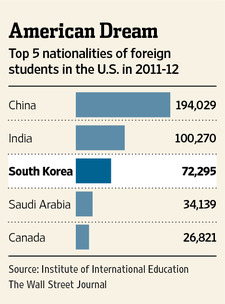
SEOUL—The recent cancellation of U.S. college entrance exams in South Korea—the first time SAT tests have been called off nationwide anywhere in the world for suspected cheating—is throwing the spotlight back on the country’s hyper-competitive academic environment. The May 4 sessions of the SAT, the most widely used standardized evaluation tool for high-school students applying to American universities, were scrapped three days before the test date across South Korea after the U.S.-based administrator discovered questions from the tests circulating in test-prep centers in the country.

The cancellation has thrown college-entrance preparations for thousands of students into disarray. Some students now plan to travel to other countries in the region to ensure they are able to take the next test in the summer. Read more of this post

Shale Boom a Bust for Europe’s Gas Plants; European utilities are forced to mothball modern gas-fired power plants that can’t compete with growing imports of cheap coal dislodged from the U.S.

May 8, 2013, 11:44 a.m. ET

Shale Boom a Bust for Europe’s Gas Plants

By JAN HROMADKO
EI-CA770_EUPOWE_G_20130508140906

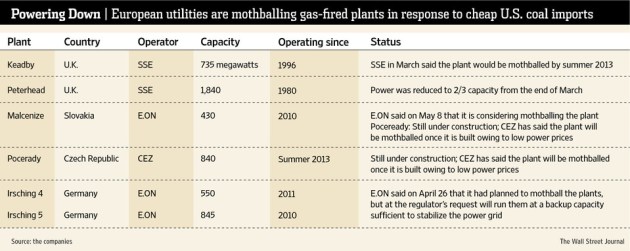
FRANKFURT—The ripples of the North American shale boom continue to spread, as a growing number of European utilities are forced to mothball modern gas-fired power plants that can’t compete with growing imports of cheap coal dislodged from the U.S.

Norwegian state energy company Statkraft said Wednesday it has idled a gas-fired power station in Germany that couldn’t compete with its coal-fired rivals, while German utility E.ON EOAN.XE -0.60% SE said it is seriously considering mothballing more gas-fueled plants, including a state-of-the-art facility in Slovakia.

Other European utilities have taken similar action, presenting policy makers with a dilemma—cheaper coal-fired power could provide some relief for the region’s struggling economies, but might be incompatible with long-term goals for carbon emissions and renewable energy.

The closures across Europe are another example of the far-reaching effects of the North American energy-supply boom. Surging supplies of natural gas in North America, unlocked from shale rock by a new combination of technology known as hydraulic fracturing, have prompted many U.S. power generators to switch away from coal, pushing increasing amounts of the fuel into Europe as cheap imports.

In 2012, U.S. exports of coal to Europe rose 23% to 66.4 million short tons, according to data from the U.S. Energy Information Administration.

Much of this coal is displacing natural gas as a fuel for electricity generation in Europe. In the U.K., for example, the proportion of electricity generated from coal rose to its highest level in 17 years in 2012, while gas fell to a corresponding low.

“The economic situation of our legacy business in Europe, particularly in conventional power generation, remains difficult,” said E. ON Chief Executive Johannes Teyssen.

Gas-fired power plants are losing out to coal-fueled rivals, which are more competitive at present electricity and commodity prices. Additionally, the expansion of renewable energies is reducing the operating hours of gas power plants; wind and solar energy output is generally higher at peak demand hours, a market gas plants are designed to serve. “Companies are struggling to operate gas-fired power plants economically, even in case of modern, state-of-the-art facilities,” said IHS Energy analyst Kash Burchett. Read more of this post
Giant Australian property trust GPT agreed to pay its shareholders $75 million for allegedly failing to disclose in 2008 that the company was financially underperforming its previous forecasts.

Davids win in giant fight with GPT

May 9, 2013

Elizabeth Knight

The final chapter in the legal brawl between giant property trust GPT and its shareholders drew to a close on Wednesday. The Davids won and the Goliath agreed to pay $75 million for allegedly failing to disclose in 2008 that the company was financially underperforming its previous forecasts. It was a two-year battle and it went to the wire. In class action cases, neither party wants the outcome to be determined by the courts and this was no exception. Allowing the courts to set precedents presents hazards for both sides. The corporate defendant would have to accept liability if it lost and the damages could be more onerous. For the shareholder plaintiffs, a poor outcome could be every bit as damaging if an unfavourable precedent was set.

Corporate continuous disclosure is an area in which the phrase ”the lawyers always win” is particularly apposite. This class action was mounted in 2011 by lawyers Slater & Gordon and bankrolled by a US litigation funder who, for its troubles, will probably get about 25 per cent of the proceeds. Thanks to the newly intense focus in this area, legal firms are raking in fees for ensuring companies adhere to legal disclosure responsibilities. For the legal fraternity, corporate disclosure is lucrative business. Read more of this post

Latest China bailout reveals risk of local government’s hidden debts; A Chinese local government has apparently used public funds to repay the debt of a private firm

Latest China bailout reveals risk of local government’s hidden debts

Tue, May 7 2013

By Gabriel Wildau

SHANGHAI (Reuters) – A Chinese local government has apparently used public funds to repay the debt of a private firm, in a case that raises fresh questions about whether recent estimates of local government debt properly account for the full range of local liabilities. It is not the first time local officials have bailed out a private enterprise, but the fact that the municipal government had formally guaranteed the debt highlights the lack of visibility on the extent of localities’ hidden commitments. Read more of this post

Bankers Warn Fed of Farm, Student Loan Bubbles Echoing Subprime

Bankers Warn Fed of Farm, Student Loan Bubbles Echoing Subprime

A group of bankers that advises the Federal Reserve’s Board of Governors has warned that farmland prices are inflating “a bubble” and growth in student-loan debt has “parallels to the housing crisis.” The concerns of the Federal Advisory Council, made up of 12 bankers who meet quarterly to advise the Fed, are outlined in meeting minutes obtained by Bloomberg through a Freedom of Information Act request. Their alarm adds to a debate on the Federal Open Market Committee about whether the benefits from their monthly purchases of $85 billion in bonds outweigh the risk of financial instability. While Chairman Ben S. Bernanke has argued the program is worth pursuing, Fed Governor Jeremy Stein and Kansas City Fed President Esther George are among those who have voiced concerns that an extended period of low interest rates is heightening the risk of asset bubbles. “Agricultural land prices are veering further from what makes sense,” according to minutes of the council’s Feb. 8 gathering. “Members believe the run-up in agriculture land prices is a bubble resulting from persistently low interest rates.” Read more of this post

Brazilian pension funds go global

May 7, 2013 7:11 pm

Brazilian pension funds go global

By Joseph Leahy in São Paulo

As little as a year ago, Brazil’s greatest concern was the currency war – a tsunami of international funds that it believed was threatening to inundate its financial markets and those of other emerging countries.

Now, Brazilian real interest rates have fallen so low that, in a dramatic reversal, the country’s own pension funds are looking abroad. While their initial offshore investments will not amount to anything like a tsunami, it marks the start of what may prove to be an important step in the maturing of Brazil’s financial industry. Read more of this post

Korean firms far behind in creativity

2013-05-07 16:25

Korean firms far behind in creativity

By Kim Rahn

The government is aiming to achieve a “creative economy” by adopting more creative and innovative ideas in all industries. In reality, however, employees think Korea’s working culture is far from creative. If the corporate cultures of global firms famous for creativity, such as Google or Facebook are graded at 100, the average score for Korean companies would be 59.2, mainly due to hierarchism, a survey showed Tuesday. The survey was conducted recently on 500 workers by the Korea Chamber of Commerce and Industry (KCCI). According to the study, the smaller the size of a company, the lower a score it obtained. Asked the reasons for such low grades, 61.8 percent of those surveyed cited the country’s hierarchical culture or rigid communication system in which juniors always have to obey superiors. When multiple responses were given, 45.3 percent said the corporate culture puts more value on the organization than on individuals. “Seniors give orders and juniors follow. That’s all. Some seniors even think that juniors who make suggestions about work are impertinent,” said a steel company worker who asked not to be named. Read more of this post

The liquidity crisis at the STX Group, Korea’s 13th largest conglomerate, is weighing heavily on creditor banks amid dismal earnings outlook for the banking sector

2013-05-07 18:12

STX crisis may spill into banking sector

Credit extended to cash-strapped group reaches W13 tril.

By Na Jeong-ju

The liquidity crisis at the STX Group, the country’s 13th largest conglomerate, is weighing heavily on creditor banks amid dismal earnings outlook for the banking sector.

Creditors of STX may suffer losses totaling 13.2 trillion won ($12.1 billion) if the group collapses, according to the Financial Supervisory Service (FSS). Read more of this post

China Export Gains Spur Renewed Skepticism of Figures

China Export Gains Spur Renewed Skepticism of Figures: Economy

By Bloomberg News – May 8, 2013

China’s export growth unexpectedly accelerated in April even as shipments to the U.S. and Europe fell, spurring Bank of America Corp. and Mizuho Securities Co. analysts to say the figures were inflated by fake reports. The 14.7 percent increase, reported by the General Administration of Customs in Beijing today, was led by a 57.2 percent jump in shipments to Hong Kong that highlighted suspicions of false transactions used to mask capital flows into China. A customs spokesman said last month that the agency would investigate the “extraordinary” gain in trade with Hong Kong. The report deepens skepticism on the reliability of trade data from the world’s largest exporting nation, with Royal Bank of Scotland Group Plc saying export gains may be overstated by 9 percentage points. Regulators announced a crackdown this week on companies using trade reports to disguise speculative money inflows chasing a yuan that’s already exceeded last year’s gains against the dollar. “Exports actually haven’t done all that well,” Louis Kuijs, the RBS chief China economist who previously worked for the World Bank, said on Bloomberg Television from Hong Kong. That reflects a “pretty weak global picture, weak demand for Chinese exports” and the impact from yuan appreciation on China’s shipments, he said. Today’s report showed a 0.1 percent drop in U.S. shipments and 6.4 percent decline in exports to the European Union. Previous figures showed China’s shipments to Hong Kong rose 92.9 percent in March, while Hong Kong said imports from China rose 13.8 percent.  Read more of this post

What keeps Israeli companies out of China? A survey by Globes Research and PwC Israel reveals the opportunities, and the difficulties in exploiting them.

What keeps Israeli companies out of China?

A survey by Globes Research and PwC Israel reveals the opportunities, and the difficulties in exploiting them.

6 May 13 18:06, Avi Temkin

“There is a real fear that Israeli companies will not be astute enough to exploit the huge opportunities that have been created by China’s economic growth, especially in the light of the government’s twelfth five-year plan, because of lack of knowledge or fear of failure. The companies need to understand however that those are the markets where the big growth will happen, and if the management doesn’t understand this, then the board of directors should take action,” says Gerry Seligman, an international tax partner in the New York office of PwC US residing in the Tel Aviv office of PwC Israel, following the publication of a broad survey of business models of Israeli companies in China. The survey, by Globes Research and PwC Israel, is based on dozens of interviews with company managers, government officials, and researchers.

Israel Export Institute director Ofer Sachs explains that exports to China are concentrated in three main sectors: electronic components; minerals; and chemicals. These account for 71% of total Israeli exports to China. In other industries, it seems that Israeli companies are finding it hard to expand exports to China, and in some cases they are actually declining. Read more of this post

China’s struggling automakers jump on SUV boom

China’s struggling automakers jump on SUV boom

2013-05-08 01:44:44 GMT2013-05-08 09:44:44(Beijing Time)  SINA.com

BYD is known for electric cars but this year’s flagship model is the S7, a gasoline-powered SUV. It comes with an interior air purifier, radar to help with backing and digital TV. An onboard hard drive can hold 1,000 films. This is China’s Year of the SUV. Whatever their specialties used to be, automakers ranging from global brands to China’s ambitious rookies are scrambling to cash in on the explosive popularity of sport utility vehicles. “We are selling vehicles that have extensive technologies,” said Isbrand Ho, BYD’s director of export sales. “These are all on … premium models for European marques but we are making it available to the everyday person.” Read more of this post

JOLTS Jolts Jobs Report Cheerleaders, Implies Worst Job Growth Since September 2010

JOLTS Jolts Jobs Report Cheerleaders, Implies Worst Job Growth Since September 2010

Tyler Durden on 05/07/2013 12:49 -0400

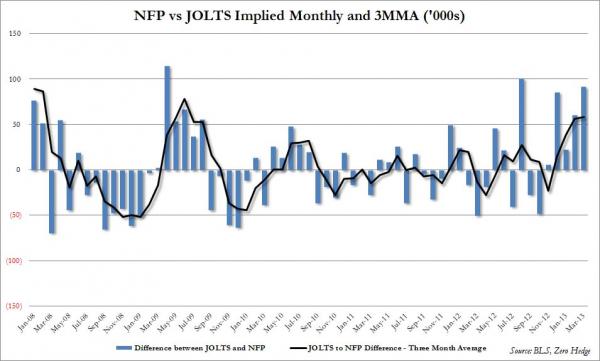
In the aftermath of last week’s decidedly weak unemployment report (pre-spun to appear strong while ignoring the major drop in average weekly hours worked, which would have resulted in a massive drop in payrolls had total demand for labor stayed constant from March), many were looking for some confirmation, or denial, from today’s Job Openings and Labor Turnover (JOLTS) survey which provides the labor breakdown by new job openings, hires, separations, quits and layoffs for the preceding month. On the surface, the March JOLTS survey was a disappointment – analysts look at the report to see how the Job Openings trend is doing as an indication of labor demand (a decline from 3.899MM to 3.844MM, and down from a year ago, or 3.848MM, as well). More importantly, New Hired tumbled to the lowest since December, printing at 4.259MM, down from 4.451MM in February, and down from 4.435MM a year earlier.  On the exit side, workers indicates less leverage as well, with voluntary Quits, or worker-initiated departures, down 126K from 2.286MM to 2.160MM, while involuntary discharges, or terminations, spiked by 121K from 1.572MM to 1.693MM. As Stone McCarthy explains, this “hints at a less favorable environment for the labor market, especially when the increase in the number of layoffs (+121,000) is taken into consideration.” However, the biggest surprise from the JOLTS report is not in any of the standalone series, but in the time progression of the Net Turnovers number, which is simply the total new hires less total separations. Historically, the Net Turnover number tracks the total monthly nonfarm payroll change (establishment survey) on a almost tick for tick basis. Not this time. In fact as the chart below showed, the upward revised March NFP number to 138K, which preceded the even more optimistic, and much cheered April print of 165K, which sent the S&P and the DJIA soaring to new all time highs on Friday, not only did not get a confirmation, but in fact the JOLTS survey for Net Turnovers  – which came at only 46K in March compared to a revised 138K jobs added per the establishment survey – implied that the real NFP number in March should have tumbled to a level last seen in September of 2010! Looking at only the difference between the monthly NFP change and the implied JOLTS monthly job change, we find only the third highest discrepancy since the Great financial crisis, as can be expected implying a far greater bullish upside bias reported by the BLS in the non-farm payroll data. In fact, on a three monthly moving average, the “bullish bias” difference to NFP reported data is now only as big as it was just after the Lehman failure!  Of course, this data only looks back through March. It is quite possible that the April JOLTS data will be so strong, that it overwhelms the time series on both a monthly, and a moving average basis, promptly catches up to where it should be… Somewhere 150K higher than what the April payroll print of +165K suggested. Somehow, we doubt it.

NFP to Jolts Difference_0 NFP to Jolts_1_0 Read more of this post

Australia: Rising debt weighs heavily on any future boom

Rising debt weighs heavily on any future boom

May 8, 2013

Clancy Yeates

When confidence is building in the property market, as it has been lately, it can be easy to get swept up in the hype. Many of us know people who have made small fortunes on property. After all, house prices rose 6 per cent each year in the boom years between 1995 and 2005. Might this happen again?

Household indebtedness

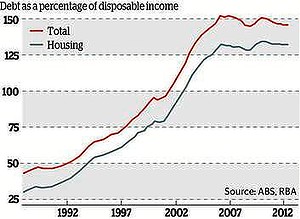
There are entire industries – from real estate agents to mortgage brokers – that like to believe so. Some of the less scrupulous operators even like to mention this boom era in their sales pitch, implying it may soon return. While there are signs the housing market could be strengthening at the moment – prices are up 2.7 per cent nationally in the past year – a long-term view suggests we won’t see a return to the boom days of old. Why not? Perhaps the biggest reason is household debt. There were several reasons prices rose so quickly in the past, but the big one was that people bid them up by borrowing more. As this week’s graph shows, we went from borrowing about 50 per cent of disposable income in the early 1990s to 150 per cent – where it has settled. This increase occurred because we were taking out bigger home loans. Such a staggering rise was only possible because debt became a lot cheaper, thanks to a one-off drop in interest rates, and competition in banking.

But both these factors are highly unlikely to be repeated, and here’s why.

RH-353-clancy_20130507155153601145-300x0 Read more of this post

Indian economy: An unfinished project; New Delhi has introduced reforms to revitalise business. But many disillusioned investors are not convinced

May 7, 2013 6:58 pm

Indian economy: An unfinished project

By James Crabtree and Victor Mallet

New Delhi has introduced reforms to revitalise business. But many disillusioned investors are not convinced

At a private meeting in Mumbai’s seafront Taj Mahal hotel last month, finance minister Palaniappan Chid­ambaram made corporate India an unusual offer. Sitting in the hotel’s ballroom were most of the country’s leading industrialists, including billionaires Anil Ambani and Kumar Birla, who were gathered to discuss how to re-energise their nation’s flagging economy. “I’ve come here with one mission: to understand your problems and to fix them,” Mr Chidambaram said, according to one of those present. The finance minister then offered a bouquet of flowers to any participant able to report that none of their big investments was held up by bureaucratic obstacles linked to the government. As the conversation progressed round the table, and one tycoon after another complained of multibillion-dollar projects lying unfinished for the want of some official clearance or other, the flowers went unclaimed. Read more of this post

Malaysian Prime Minister Najib Razak’s election win without the bulk of ethnic Chinese voters is set to pose the biggest test yet

Najib Win Masks Biggest Test After Malaysian Chinese Exodus

Malaysian Prime Minister Najib Razak’s election win without the bulk of ethnic Chinese voters is set to pose the biggest test yet for the pro-Malay affirmative action policies instituted by his father more than three decades ago. The May 5 ballot left Najib’s United Malays Nasional Organisation with 109 parliamentary seats, almost enough to govern without any of its 12 allies in the Barisan Nasional coalition, Election Commission data showed. At the same time, the alliance as a whole took just 47 percent of the popular vote, the lowest since 1969, when Sino-Malay race riots flared. With opposition chief Anwar Ibrahim — ally of the mainly ethnic-Chinese Democratic Action Party that expanded its seats – – planning protests tonight over electoral fraud concerns, Najib, 59, is calling for national reconciliation. To get that, he may need to temper the same preferential-contract and job rules that helped secure his victory among rural Malays.

“UMNO is looking strong, but it’s a false dawn,” said Edmund Terence Gomez, a professor at the University of Malaya in Kuala Lumpur who edited a book on the race-based programs. “They know they need structural changes, and if they don’t do it they will face serious consequences in the next election.” Gomez said the biggest change needed is the removal of policies that restrict certain government contracts to Malays and indigenous groups together known as Bumiputera, or “sons of the soil.” They make up about 60 percent of Malaysia’s 29 million people. Abdul Razak, Najib’s father and Malaysia’s second prime minister, initiated the preferences in the wake of the 1969 riots that killed hundreds. Read more of this post

Bears Keep a Distance From Great White Short; Canada looks like a tempting target for short sellers

Updated May 7, 2013, 6:54 p.m. ET

Bears Keep a Distance From Great White Short

By GREGORY ZUCKERMAN and ALISTAIR MACDONALD

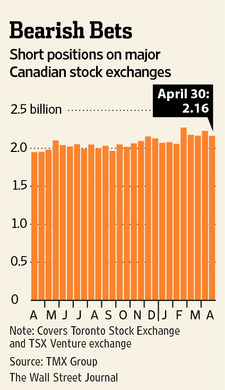
Canada looks like a tempting target for short sellers. The country’s commodity-and-debt-fueled boom has slowed, and consumer debt is at records. There are concerns about a housing bubble after residential-property prices surged nearly 90% over the past decade. And some analysts smell trouble from the economy’s reliance on natural resources, as commodities prices fall and the U.S., long an importer of Canadian crude, produces more of its own oil. Despite all that, some hedge funds and other big investors are agonizing over whether to make big bets against, or sell short, Canadian investments. “I want to [short Canada] very badly,” said Vishaal Bhuyan, who runs Nariman Point, a New York hedge fund that manages more than $20 million. “But their housing bust is more slow-moving than ours was and there are no” perfect ways to bet against the Canadian housing market. The fund has held off on betting against Canadian investments.

MI-BV815_CANADA_NS_20130507175411 Read more of this post

Soros’ billion dollar bet on Aussie rate cut pays off

Billion dollar bet on rate cut pays off

May 8, 2013 – 9:46AM

Mark Hawthorne

screen shot 2013-05-07 at 9.57.07 pm

It may go down as one of the great currency bets in Australian dollar history – a $US1 billion gamble on a Reserve Bank rate cut that has delivered a $US19 million ($18.65m) profit in 36 hours. The beneficiary, if you believe the rumour mill, is investment legend George Soros. Best of all, it appears the 82-year-old American pulled off the deal three times, all with different foreign exchange brokers in Asia, for a tidy profit of almost $US60 million. Read more of this post

This Is Your S&P; This Is Your S&P Without Tuesdays

This Is Your S&P; This Is Your S&P Without Tuesdays

Tyler Durden on 05/07/2013 12:02 -0400

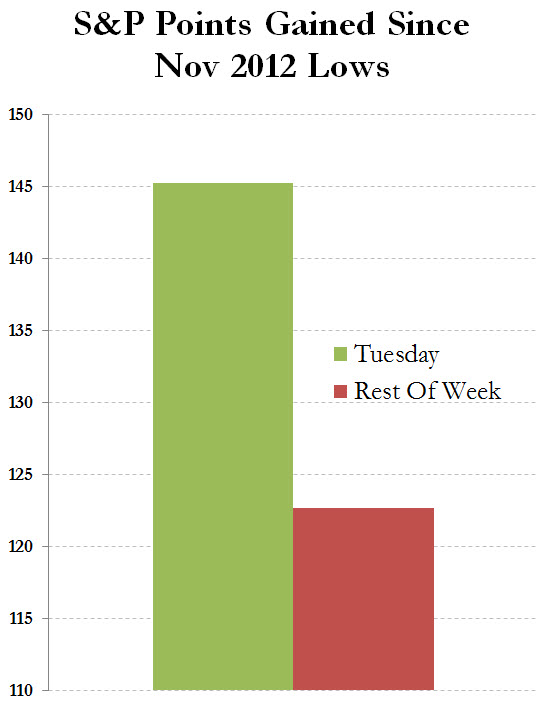
Since the mid-November lows, the S&P 500 has gained a remarkable 268 points on the back of faith, hope, and Bernanke/Kuroda charity. But perhaps what is more mind-numbing is that this efficient market has given us more than 50% of those gains on Tuesdays. With 17 up-days in a row, Tuesday is the Monday dip-buyers dream. Since 1/18, absent Tuesdays, the S&P 500 has gone nowhere. Maybe Bob Geldof needs to write a new song for the US investor “I do like Tuesdays”, or at least a slightly revised cover version of the Bangles’ “Manic Tuesday”. What would we do without Tuesdays? Tuesday is a massive outperformer… and just to be clear… Tuesday’s gains dwarf the rest of the week’s total gains…

20130507_SPX1_0 20130507_SPX2

Policy battle rages in China as slowdown feeds ‘sense of crisis’

Policy battle rages in China as slowdown feeds ‘sense of crisis’

Anti-reform hardliners in China’s Communist Party have become seriously alarmed by the sharp slow-down in economic growth, creating a “task-force” to crank up production.

China’s Caixin Magazine reports that there is a growing “sense of crisis” not felt since the depths of the global banking crash in 2008-2009. Photo: Quirky China News / Rex Features

By Ambrose Evans-Pritchard

4:17PM BST 06 May 2013

China’s Caixin Magazine reports that there is a growing “sense of crisis” not felt since the depths of the global banking crash in 2008-2009. The State-owned Assets Supervision and Administration Commission (SASAC) has assembled a team to “protect economic growth” and pressure state companies to boost jobs at all costs. Read more of this post

Chinese president Xi Jinping emperor photo lands The Economist in hot water

Xi Jinping emperor photo lands The Economist in hot water

Staff Reporter, 2013-05-07

XiJinpingEmperor-161247_copy1

Xi Jinping as Qianlong, left, and a previous cover from The Economist likening Xi to an emperor in waiting in October 2010. (Photos courtesy of The Economist)

A doctored photo featuring China’s new president, Xi Jinping, wearing a traditional emperor’s robe is said to have deeply offended the Communist Party leadership. Xi, who is also the party’s general secretary and commander of the People’s Liberation Army, was featured on the front page of the May issue of The Economist magazine wearing a yellow robe with an illustrated dragon on the chest, and a glass of champagne in hand. “Let’s party like it’s 1793,” reads the magazine’s headline, a reference to the year the Qing emperor Qianlong rejected British envoy Lord Macartney’s request to open an embassy because China does not have “the slightest need for your country’s manufactures.” The title of the feature article is “Xi Jinping and the China dream,” and questions exactly what Xi means by his new doctrine, noting that it seems to “include some American-style aspiration, which is welcome, but also a troubling whiff of nationalism and of repackaged authoritarianism.” The article, which outlines the difficulties Xi faces in realizing his dream of unifying a diverse and growing China, seems to have hit a nerve with the Communist Party, as The Economist’s website was blocked in the country shortly after its publication. Detractors of Xi’s regime have said online that his “China dream” and emperor’s robe are both figments of the imagination. Despite calls for more freedom and fairness, the Chinese government continues to target free speech and rights activists and remains plagued by official excess and corruption, netizens said.

Listed companies under fire over reception costs; China Railway Construction topped the list with a total spend of 837 million yuan, or 10% of the company’s profits

Listed companies under fire over reception costs

(Xinhua)

08:36, May 07, 2013 Read more of this post