People Not In Labor Force Soar By 663,000 To 90 Million, Labor Force Participation Rate At 1979 Levels

People Not In Labor Force Soar By 663,000 To 90 Million, Labor Force Participation Rate At 1979 Levels

Tyler Durden on 04/05/2013 08:58 -0400

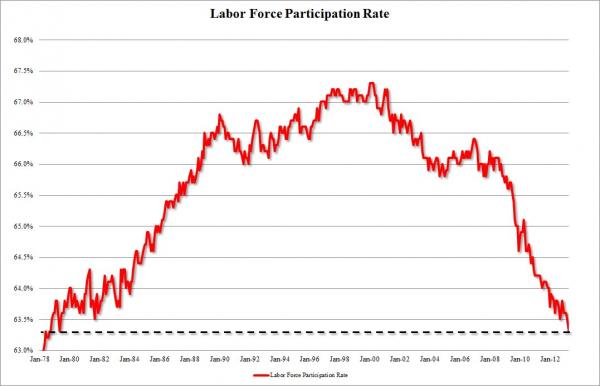
Things just keep getting worse for the American worker, and by implication US economy, where as we have shown many times before, it pays just as well to sit back and collect disability and various welfare and entitlement checks, than to work .The best manifestation of this: the number of people not in the labor force which in March soared by a massive 663,000 to a record 90 million Americans who are no longer even looking for work. This was the biggest monthly increase in people dropping out of the labor force since January 2012, when the BLS did its census recast of the labor numbers. And even worse, the labor force participation rate plunged from an already abysmal 63.5% to 63.3% –the lowest since 1979! But at least it helped with the now painfully grotesque propaganda that the US unemployment rate is “improving.”
Labor Force Rate_0Labor Force_0

U.S. Company on How to Go Broke Despite Dominating Vodka Sales in Russia; The company’s unlikely troubles show how timing and local knowledge are crucial

U.S. Company on How to Go Broke Selling Vodka in Russia

Going broke while dominating vodka sales in Russia and Poland may seem tough to do. A company founded by a Florida golfer, listed on Nasdaq Stock Market and until recently based in New Jersey, is almost there.

Unable to repay $258 million in bonds due last month, Central European Distribution Corp. (CEDC), which owns vodka brands including Bols, Zubrowka and Parliament and once imported Dom Perignon to Russia, is preparing to file for bankruptcy. Creditors will vote by April 4 on a restructuring plan that would hand CEDC to Russian billionaire Roustam Tariko, solidifying his control of the distiller and distributor he’s toyed with for years.

The company’s unlikely troubles show how timing and local knowledge are crucial. After almost two decades of success in Poland, CEDC expanded into Russia via acquisitions just as Poles began drinking less vodka and the Russian government raised taxes and costs to discourage alcohol consumption. The global financial crisis, a 37 percent collapse in Russia’s currency, and accounting errors that followed didn’t help either.

“If we had to do it over, we probably should have bought one company to see how it went, rather than buying three within six months,” CEDC co-founder William V. Carey, who resigned in July as chief executive officer, said in a phone interview from Warsaw, where he still lives. Russia’s “new regulations weren’t there when we invested, making it much more difficult to manage growth and profitability over the last three years.” Read more of this post

Taiwan asset managers under scrutiny on suspicion of insider trading, manipulation of stock prices and breach of trust from 2010-2012 and profiting from state fund trades

Taiwan asset managers under scrutiny for profiting from state fund trades
(32 mins ago)

Taiwan prosecutors said they launched an investigation into alleged wrongdoing by fund managers at two securities firms that caused massive losses to a government fund.
Prosecutors raided the firms and questioned eight people on suspicion of insider trading, manipulation of stock prices and breach of trust from 2010-2012, they said in a statement yesterday. The suspects actions allegedly resulted in more than T$1 billion (US$34.5 million) in losses to the government while allowing them to make illegal profits of nearly T$100 million on the stock market, AFP reports.  Taiwan’s financial regulators started reviewing 13 securities firms trusted with handling government investment funds after a similar case surfaced late last year.

Isaac Newton’s Nightmare During the South Sea Stock Bubble (Dec 1718 – Dec 1721)

Isaac Newton’s Nightmare — Charted By Marc Faber

Sam Ro | Apr. 2, 2013, 4:43 PM | 6,414 | 3

The parabolic move in Bitcoin prices has us thinking about some of the most notorious asset bubbles in history. We were thumbing through some of Jeremy Grantham‘s old research and saw this great chart from Marc Faber. “I can calculate the movement of stars, but not the madness of men,” Newton apparently said after he lost his fortune.

screen shot 2013-04-02 at 4.29.11 pm

Bond Traders Club Loses Cachet in Most Important Market; In the same way technology eroded the middleman role once played by travel agents and stock-market specialists, increased use of the direct-bidding system threatens government-bond traders

Bond Traders Club Loses Cachet in Most Important Market

Primary dealers, the select group of banks and brokers that have held a seat at the center of the U.S. government debt market since 1960, are losing influence.

More than 20 percent of the $538 billion of Treasury notes auctioned this year have been awarded to bidders who bypassed the dealers by using a website to place their orders, according to data provided by the U.S. Treasury Department. That’s almost double the 2011 level and up from 5.6 percent in 2009.

In the same way technology eroded the middleman role once played by travel agents and stock-market specialists, increased use of the direct-bidding system threatens government-bond traders at firms ranging from Bank of America Corp. to UBS AG. (UBSN) It also has eaten into profits from a business that’s among the least affected by the regulatory changes and new capital requirements reshaping the industry.

“You’ll see clients do a lot more things in a self- sufficient manner than they used to do before,” said Richard Prager, global head of trading at BlackRock Inc. (BLK), the world’s largest asset manager with $3.8 trillion. “It’s just the realities of today.” Read more of this post

Is Innovation Killing the Soap Business? New products ought to expand the revenue pie for manufacturers and retailers, not shrink it

Updated April 3, 2013, 7:51 p.m. ET

Is Innovation Killing the Soap Business?

By PAUL ZIOBRO and SERENA NG

MK-CC128A_LAUND_G_20130403181811

The laundry-soap business has a problem—it is shrinking—thanks to premeasured pod detergents from Procter & Gamble Co. PG -1.06% and others that keep consumers from overdosing. For years, consumer-product makers could count on extra sales from shoppers who poured in too much detergent with every load. The phenomenon became more pronounced when manufacturers rolled out increasingly concentrated detergent.

But the bubble burst when P&G introduced its new laundry product—Tide Pods capsules—which fixed the amount of detergent used per wash and ushered in the era of “unit dose” products. Total U.S. sales of laundry detergents fell 2.1% in the 12 months to March, according to market-information firm Nielsen, whose data excludes sales from Costco Wholesale Corp. COST -1.23% and some other retailers. Compared with the pre-pod age three years ago, detergent sales are down 5.1% in dollar terms, to $7.06 billion from $7.44 billion. The sales downturn has set off an unusually frank debate in the industry over when innovation goes too far, and it has led to finger-pointing about who might be at fault. James Craigie, the outspoken chief executive of Church & Dwight Co., CHD -0.90% which sells low-price detergents under the Arm & Hammer and Xtra brands, has an answer: P&G.

“Pod is killing the laundry detergent category,” Mr. Craigie said at an industry conference in February.

New products ought to expand the revenue pie for manufacturers and retailers, not shrink it, he said. That is what innovation always did in the past, he said. The last round of more-concentrated liquid, in 2008, drove laundry detergent sales up 5%, he said. At the same conference,Clorox Co. CLX -2.43% noted that concentrated bleach helped lift overall bleach sales, a fact that Mr. Craigie reiterated. Read more of this post

An Auctioneer Showdown Looms in Asia; “I don’t think we’ll ever see it like it was two years ago. You now just don’t see that crazy mainland Chinese buyer who bids up and up.”

April 4, 2013, 6:58 AM

An Auctioneer Showdown Looms in Asia

By Jason Chow

OB-WX592_HKAUCT_G_20130403012021

‘Mao’s Song Poem of Snow, No.2′ by Zeng Fanzhi. See more of what’s hitting Hong Kong auction blocks this season

HONG KONG  – Sotheby’s and three Asian auction houses expect to sell more than $300 million in art, antiques, wine and jewelry this week, with a Mao portrait by Zeng Fanzhi and a Qing dynasty bowl among the most expensive items.

Despite the flurry of activity and glut of high estimates, art insiders are watching nervously for signs of China’s luxury appetite. Last year, art-auction sales in Greater China, which includes Hong Kong, fell 37% from 2011, according to data compiled by Art Market Monitor of Artron.

“Everybody’s looking at these sales—Sotheby’s, mostly—as a test to see if the market is coming back,” said Catherine Kwai, a gallery owner in Hong Kong. “I don’t think we’ll ever see it like it was two years ago. You now just don’t see that crazy mainland Chinese buyer who bids up and up.” Read more of this post

Growth in ‘Frontier Asia’ Highlights Overheating Risk, IMF Says

Updated April 3, 2013, 12:12 p.m. ET

Growth in ‘Frontier Asia’ Highlights Overheating Risk, IMF Says

By NATASHA BRERETON-FUKUI

BANDAR SERI BEGAWAN, Brunei—Parts of Southeast Asia are experiencing very high credit growth and surging property sectors, and policy makers there should monitor conditions carefully, a senior official at the International Monetary Fund said on Wednesday.

IMF Deputy Managing Director Naoyuki Shinohara didn’t say which countries were at greatest risk of overheating, but he noted that lower-income countries in “frontier Asia” were experiencing stronger growth than other members of the Association of Southeast Asian Nations. Cambodia, Laos and Myanmar all grew faster than 6% last year.

“I don’t think the risk is imminent, but once these things start moving it’s very difficult to unwind,” Mr. Shinohara said in an interview on the sidelines of regional meetings in Brunei. “So policy makers should be careful in monitoring how the market develops, how the economy grows, and take necessary measures as the situation develops.”

Surging capital inflows—the result of loose monetary policy in industrialized nations and global investors’ hunt for yield—have sparked concerns about overheating across emerging Asia and led to preemptive steps in many countries. Read more of this post

Chinese Deluge U.S. Master’s Programs; Overseas Students Seek Specialized Degrees to Win Competitive Edge, and B-Schools Enjoy Revenue in Tough Time

Updated April 3, 2013, 8:36 p.m. ET

Chinese Deluge U.S. Master’s Programs

Overseas Students Seek Specialized Degrees to Win Competitive Edge, and B-Schools Enjoy Revenue in Tough Time

By MELISSA KORN

MK-CC126_MASTER_G_20130403180005

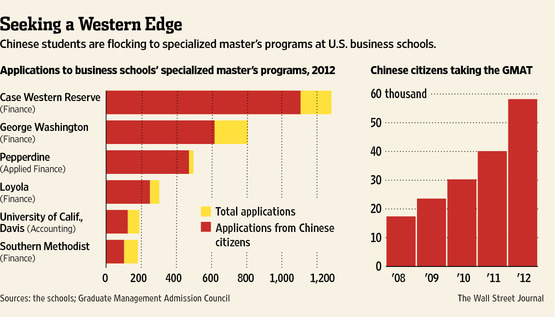
When the business school at the University of California, Davis, started its master’s program in accounting last year, administrators expected to attract aspiring accountants from nearby colleges. What they got instead was a wave of interest from overseas: Roughly two-thirds of the 189 applications received for last fall’s entering class came from Chinese citizens. “Frankly, we were shocked at the deluge of applications…for what we saw as a program that prepared students for a U.S. credential,” says James Stevens, assistant dean of student affairs. Davis has plenty of company. Specialized master’s degrees in accounting, finance and other disciplines—generally aimed at students just out of college and lasting one year—have found tremendous popularity in recent years among Chinese nationals seeking a competitive edge and U.S. experience.

Such demand has provided steady revenues for business schools at a time when traditional M.B.A. programs are losing their appeal among U.S. students. But the uneven applicant pool has left many schools weighing financial goals against uninspiring classroom experiences for both Chinese and local students and worrying about weak job-placement rates. Read more of this post

Japan’s Car Makers Struggle in China

April 2, 2013, 9:47 a.m. ET

Japan’s Car Makers Struggle in China

OB-WX256_0402ca_G_20130402105213

An overturned Honda police car takes a beating at an anti-Japan protest in Shenzhen last August; lingering bad feelings are still hurting Japanese car makers’ sales in China.

Japan’s three major auto makers suffered continued sales setbacks in China last month, adding urgency to efforts to reignite sales in the vast but increasingly competitive market. Toyota Motor Corp., 7203.TO +1.46% Nissan Motor Co. 7201.TO +1.24% and Honda Motor Co. 7267.TO +1.99% reported year-over-year declines in March as they grapple with a territorial dispute between China and Japan over a group of rocky islands in the East China Sea, a row that inflamed anti-Japanese sentiment in China and caused boycotts and general wariness of Japanese car brands. Read more of this post

Why Grocers Like Tesco Find Trouble in the U.S. Market; The American grocery market has tempted foreigners for almost a century. Many foreign companies have also arrived with a superiority complex, seeing hundreds of small, unsophisticated enterprise that seemed to be easy prey for international entrants with deep pockets and industry know-how

Why Grocers Like Tesco Find Trouble in the U.S. Market

Any day now, Tesco (TSCO) Plc, the U.K. grocery giant, may announce the closure of the 200 or so Fresh & Easy food stores it has opened in California, Arizona and Nevada since 2007.

When it does, Tesco will join a long list of international grocers that have met their match in the U.S. In every case, these companies wrongly assumed that strategies honed abroad would succeed in America, and they underestimated the resources and management attention required to make headway in a vast and fast-changing market.

The American grocery market has tempted foreigners for almost a century. One reason is the obvious potential: For a grocer that had exhausted the possibilities in its home market, expansion in the U.S. offered a means to boost profits. Many foreign companies have also arrived with a superiority complex, seeing hundreds of small, unsophisticated enterprises that seemed to be easy prey for international entrants with deep pockets and industry know-how. Read more of this post

North Korea Says It Has Final Approval For Nuclear Attack On US

North Korea Says It Has Final Approval For Nuclear Attack On US

Tyler Durden on 04/03/2013 15:40 -0400

This is merely the latest headline in what may well culminate with the wettest dream Paul Krugman has ever had.

AFP: North Korean Army has approval to launch “mercilesss” nuclear strike on U.S. involving possible use of “cutting edge” nuclear weapons

— Sky News Newsdesk (@SkyNewsBreak) April 3, 2013

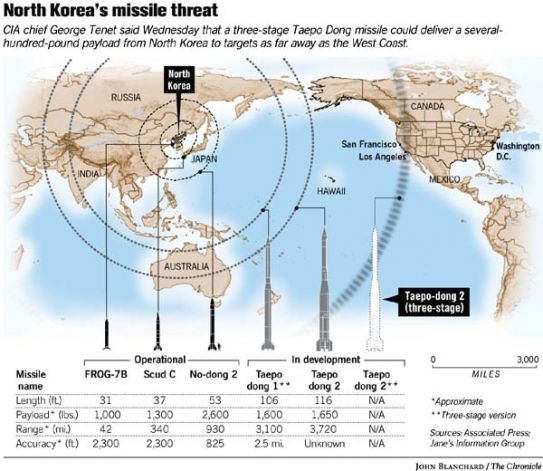
For those concerned, here is a map showing the range of North Korean missiles. It is safe to assume that GETCO’s collocated servers are safe, and will ramp the ES limit up on any flashing red headline launch news. Just think of the fixed income investment and epic resulting GDP boost, on both a real and seasonally adjusted basis.

Korea-missiles-SFC


Data Discrepancy Clouds China’s Report of Export Boom; “Fake exporting is rampant,” said an export-agency owner in the city of Foshan in China’s southern Guangdong province

April 3, 2013, 2:32 p.m. ET

Data Discrepancy Clouds China’s Report of Export Boom

AI-CA108_CEXPOR_NS_20130403134803

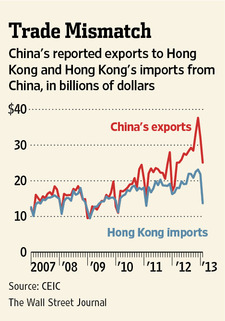
BEIJING—A discrepancy between China’s export data and Hong Kong import numbers has raised doubts about what appeared to be booming overseas demand for Chinese goods, amid uncertainty about the strength of the recovery in the world’s second largest economy.

China’s customs bureau reported in March that exports rose 19.8% year-to-year in the three months through February, despite a fragile recovery in the U.S. and Europe. The report has buoyed confidence that China’s economy is strengthening, after growth in gross domestic product touched a three-year low of 7.4% year-to-year in the third quarter of 2012.

A resurgence in exports has been a bright spot for the economy, suggesting demand for goods remained strong enough to keep production lines humming and provide jobs for tens of millions of migrant workers.

But some exporters, trade agents and economists said the export numbers were likely to be inaccurate because of false reporting by exporters and local governments. They point in particular to mismatching trade figures with Hong Kong, the first destination for many mainland Chinese goods.

In the three months through February, mainland customs reported $94.9 billion in exports to Hong Kong, but Hong Kong customs reported only $58.7 billion in imports from the mainland. The discrepancy during the period was significantly greater than at any other time in recent years.

China’s export growth for February could be overstated by around seven percentage points, based on an analysis of data discrepancies, Louis Kuijs, China economist at RBS, estimated.

Some exporters exaggerate invoices to gain tax rebates and evade controls on bringing cash into the country, and some local governments claim higher export numbers to look good, people familiar with reporting practices said.

“Fake exporting is rampant,” said an export-agency owner in the city of Foshan in China’s southern Guangdong province.

“It’s really easy to inflate export data if you want to,” said a customs official in China’s eastern Zhejiang province, an export powerhouse. Read more of this post

China Turns Graveyard From Goldmine Hurting Ship Makers: Freight

China Turns Graveyard From Goldmine Hurting Ship Makers: Freight

For shipbuilders such as STX Group, China was once a goldmine. Now it’s a graveyard.

China’s lower appetite for commodities undermined the group’s plan to sell its shipping line, wiping out a combined $435 million of investor wealth at the South Korea-based conglomerate’s three main companies this week. That also threatens the group’s ability to repay $1.2 billion of debt by the end of the year.

STX’s crisis comes after last decade’s boom prompted the group to set up a shipbuilding and offshore complex in Dalian, northeastern China. With Asia’s biggest economy slowing down and the European crisis adding to a plunge in cargo rates, China Cosco Holdings Co. (1919), the nation’s biggest mover of bulk commodities and containers, last week reported a loss for 2012, a third straight annual loss.

“China was the promised land, something STX Group saw as an opportunity to help it become much bigger,” said Park Moo Hyun, an analyst at E*Trade Securities Korea in Seoul, who doesn’t rate any of the group companies. “It’s turned into a nightmare, a big investment that is coming back to bite them.”

STX, a conglomerate that owned $23 billion in assets as of April last year, is trying to raise 2.5 trillion won ($2.2 billion) through asset sales. It will know this week whether creditors will accept a request for a voluntary debt rescheduling by its shipbuilding unit. The group has 1.37 trillion won of bonds due this year, it said. Read more of this post

Canada Seen Beating U.S. in $150 Billion Asia LNG Race; “The smart money is going to Canada” to export LNG. “They don’t have any objections to exporting gas and it’s closer to Asia, which cuts down on shipping costs.”

Canada Seen Beating U.S. in $150 Billion Asia LNG Race

Canada is pulling ahead of the U.S. in a contest to be the first exporter of liquefied natural gas from the North American shale bonanza to Asia’s $150 billion LNG market.

An LNG terminal being built at a cove north of Vancouver financed by a Houston private-equity firm is scheduled to begin shipping the fuel across the Pacific Ocean in mid-2015, eight months before the first continental U.S. plant is slated to start. Canada’s government has approved twice as much LNG export capacity as its southerly neighbor, evincing a friendlier attitude toward selling domestic gas to the highest bidder and positioning the nation as the go-to source of gas in North America for overseas buyers.

International energy giants from Exxon Mobil Corp (XOM). to Malaysia’s Petroliam Nasional Bhd (PET) are considering terminal projects in western Canada to supply Asian utilities and factories that are paying more than four times the price of U.S. markets. Chevron Corp (CVX). said it’s focusing all of its North American LNG efforts north of the U.S. border because of the more favorable regulatory climate and closer proximity to Asia, making exports more profitable for producers.

“The smart money is going to Canada” to export LNG, said Michelle Foss, chief energy economist at the Center for Energy Economics at the University of Texas’ Bureau of Economic Geology. “They don’t have any objections to exporting gas and it’s closer to Asia, which cuts down on shipping costs.” Read more of this post

Malaysian Prime Minister Najib Invokes 7th Century Battle in Poll Warning; PM urges party members to learn from the seventh century Battle of Uhud, in which Prophet Mohammed’s army was defeated by the Meccans because his archers didn’t obey orders

Najib Invokes 7th Century Battle in Poll Warning: Southeast Asia

Malaysian Prime Minister Najib Razak urged party members four months ago to learn from the seventh century Battle of Uhud, in which Prophet Mohammed’s army was defeated by the Meccans because his archers didn’t obey orders.

Now, with elections just weeks away and facing an invigorated opposition, party leaders are amplifying Najib’s message: After ill-discipline and sabotage cost the ruling coalition its two-thirds majority in the 2008 election, this time round it could end their 55-year hold on power.

The 13-party governing alliance plans to announce candidates a week before nomination day, a break from past elections when nominees were declared 48 hours in advance, to allow enough time to purge troublemakers, said Khairy Jamaluddin, son-in-law of former Prime Minister Abdullah Ahmad Badawi. Infighting five years ago produced a flood of spoiled ballots, contributing to the coalition’s narrowest election win since independence in 1957 and Abdullah’s resignation, he said. Read more of this post

Najib Calls Malaysia Election With Five-Decade Rule on Line; The KLCI index has gained 82 percent during Najib’s three years as leader as of yesterday’s close, about three times less than benchmarks in Thailand, Indonesia and the Philippines.

Najib Calls Malaysia Election With Five-Decade Rule on Line

Malaysian Prime Minister Najib Razak dissolved parliament in preparation for elections that will determine whether his ruling coalition extends its unbroken hold on power since independence in 1957. Under Malaysian law the contest must be held within 60 days of the dissolution of the legislature. The Election Commission will meet in a few days to announce a date for the poll, spokesman Sabri Said said in a text message. “The ultimate power of choosing the government lies in the peoples’ hands,” Najib said in a televised address. “Over the past five decades we’ve achieved stability and prosperity in this country. I hope we’ll continue this tradition.”

The 13-party Barisan Nasional coalition, which won the 2008 national vote by its slimmest margin, faces a resurgent opposition alliance led by former deputy prime minister Anwar Ibrahim. The prospect of an even closer election result has helped make the FTSE Bursa Malaysia KLCI Index one of the worst performing Asian benchmarks this year. The gauge fell as much as 3.1 percent today, the most since October 2011. “We expect the Barisan Nasional coalition to have less seats in the aftermath of the 13th general election, but not enough to lose their majority,” said Anand Pathmakanthan, head of Malaysia research at CLSA Asia-Pacific Markets. “If you talk to most investors, their best case scenario is that Najib stays as well because they can’t see what comes after.” The KLCI index has gained 82 percent during Najib’s three years as leader as of yesterday’s close, about three times less than benchmarks in Thailand, Indonesia and the Philippines. Read more of this post

Vanguard raises the possibility of free ETFs

April 2, 2013 1:08 pm

Vanguard raises the possibility of free ETFs

By Madison Marriage

Exchange traded fund providers have room to reduce charges to zero and could even pay clients to invest in their products, according to US firm Vanguard. Nick Blake, head of retail at Vanguard Investments, says revenues from securities lending alone are sufficient to make ETFs profitable. Mr Blake says: “I would like to think the cost of investing [in ETFs] could come down to zero. “There will always be a fixed cost in there, but if [a firm’s asset] volume is big [enough], the total expense ratio can come right down.” Vanguard, which has been building its footprint in Europe and now has ETFs registered in Ireland, the UK and Switzerland, currently charges investors an average management fee of 28 basis points.

Read more of this post

Value of China’s documentary market quadruples in 4 years to 1.5 billion yuan (US$242 million)

Value of China’s documentary market quadruples in 4 years

Xinhua 2013-04-03

C319N0005H_2010資料照片_N71_copy1

On location for a documentary about the Mogao Caves in Dunhuang, northwestern Gansu province. (Photo/CNS)

Sales for China’s documentary film industry soared from 400 million yuan (US$64 million) in 2009 to 1.5 billion yuan (US$242 million) last year, according to a recent report. Read more of this post

Chinese Local Governments Face Greater Financial Risks as Land Sales Drop; “A significant amount of local government debts are maturing this year, as debt due in the last two years are transferred to 2013 through re-financing. This year could be a peak of debt repayment. ”

Chinese Local Governments Face Greater Financial Risks as Land Sales Drop

04-02 15:36 Caijing

Declining land sales and squeezed house transactions under property regulations are adding increasing financial pressures to local governments as their debt repayment is coming to a peak in the following two years.

Chinese local governments could face an unprecedented financial challenge in 2013 as the country’s land-selling activities have showed signs of cooling down and a large amount of debts are maturing this year, according to a study by eHouse, a leading real estate services provider in China. China collected 2.69trillion yuan from selling land in 2012, a remarkable 15% drop from a year earlier, contributing to 31% of local government’s total revenue, 7 percentages lower compared with the previous year, but still at historical high, the report said. Read more of this post

Record numbers of British workers are being employed on “zero hours” contracts which keep staff on standby and deny them regular hours, official figures disclose

Number of Britons on ‘zero hours’ contracts hits record high

Record numbers of British workers are being employed on “zero hours” contracts which keep staff on standby and deny them regular hours, official figures disclose.

The number of workers employed on a zero hours contract almost doubled between the quarter to June and the three months to December last year.  Photo: AFP

By Hayley Dixon

11:23PM BST 02 Apr 2013

The number of workers in jobs without any guarantee of regular hours or pay nearly doubled during last year to reach 200,000, according to data from the Office for National Statistics. The contracts – now used by almost a quarter of Britain’s major employers – legally allow firms to employ staff, often in low paid jobs, without any guarantee of actual work, or income. Read more of this post

SocGen: The End of the Gold Era; The Nightmare Scenario For Gold Investors That Could Cause The Market To Crash

PRESENTING: The Nightmare Scenario For Gold Investors That Could Cause The Market To Crash

Matthew Boesler | Apr. 2, 2013, 10:58 AM | 5,471 | 13

Société Générale analysts are quite bearish on gold. Their $1375-per-ounce price target for the end of 2013 puts them well below most of the Street. Today, the SocGen team, led by Patrick Legland and Michael Haigh, released a new report titled “The End of the Gold Era.”

screen shot 2013-04-02 at 10.41.22 am Read more of this post

Asia royalty rises provoke investor fury; Dramatic hikes viewed by many as worrying trend to remove funds from emerging markets

April 2, 2013 6:23 pm

Inside Business: Asia royalty rises provoke investor fury

Dramatic hikes viewed by many as worrying trend to remove funds from emerging markets

By Jeremy Grant

If you are a fund manager investing inAsia’s emerging markets, one way to gain exposure is by holding shares in a multinational company’s locally listed subsidiary.

Want some concrete action in India? Buy shares in Ambuja Cements, a Mumbai-listed company controlled by Holcim, the Swiss cement maker.

How about shampoo in Indonesia? Simple. Buy a chunk of Unilever Indonesia, which has been listed on the Jakarta stock exchange since 1981.

For years, this arrangement worked well for fund groups such as Aberdeen Asset Management and Arisaig Partners, a Singapore-based boutique investor with a focus on the consumer companies that are such a big part of the emerging market growth story. Unilever Indonesia made sales of $2.6bn last year from selling Dove soap, Surf detergent and Wall’s ice cream across the country’s vast archipelago. Its market capitalisation makes it one of Asia’s biggest companies. It is also highly profitable. Net profit has risen every year bar one since 1999, hitting $432m in 2011 – the last year for which figures are available. Dividends have rolled in nicely.

However, in the past few months, this neat way of investing in emerging markets has been upset. A chorus of funds is furious that Unilever and Holcim, as parent companies, have recently decided to take much bigger royalty payments from their Indonesian subsidiaries. Similar noises have been made in India where the two companies are also seeking higher royalty payments. Royalties are levied by multinationals on local units to recoup the cost of providing “shared services” – research and development, marketing, branding and so forth. But changes to royalties are not unusual and are perfectly legal. Read more of this post

Martin Wolf: Why China’s economy might topple

April 2, 2013 6:42 pm

Why China’s economy might topple

By Martin Wolf

As Japan has shown, shifting to a lower-growth model is risky

Over the next decade, China’s growth will slow, probably sharply. That is not the view of malevolent outsiders. It is the view of the Chinese government. The question is whether it will do so smoothly or abruptly. On the answer depends not only China’s own future, but also that of much of the world.

Official Chinese thinking was on display at last month’s China Development Forum, organised by the Development Research Center of the State Council (DRC), which brought influential foreigners together with high-level officials. Among the background papers was one prepared by economists at the DRC, entitled “Ten-year Outlook: Decline of Potential Growth Rate and Start of a New Phase of Growth”. Its proposition is that China’s growth will slow from more than 10 per cent a year from 2000 to 2010 to 6.5 per cent between 2018 and 2022. Such a decline, notes the paper, is consistent with the slowdown since the second quarter of 2010 (see chart).

The authors note two possible reasons for the decline: either China has fallen into the “middle income trap” of aborted industrialisation; or it is managing the “natural landing” that occurs when an economy begins to catch up with advanced economies. This latter scenario played out in Japan in the 1970s and South Korea in the 1990s. The DRC paper argues that, after 35 years of 10 per cent growth, it is at last happening to China.

Here are a few reasons why the authors say this view is plausible. Read more of this post

Key Bond Index Gets Bitten; Investors Are Pulling Funds Tied to ‘the Agg’ as Safe Bonds Look Anything But

Updated April 2, 2013, 9:51 p.m. ET

Key Bond Index Gets Bitten

Investors Are Pulling Funds Tied to ‘the Agg’ as Safe Bonds Look Anything But

By CAROLYN CUI And PATRICK MCGEE

The guiding star for many bond investors is starting to flicker. The Barclays BARC.LN +2.18% U.S. Aggregate Bond Index, known as “the Agg”—which tracks the broader debt market the way the Standard & Poors-500 follows stocks—declined 0.12% in the first quarter, its first negative return in that period since 2006. And with many large investors yanking funds tied to the Agg, the index’s flagging popularity is having repercussions for how hundreds of billions of dollars are allocated in fixed-income portfolios. The move is perhaps the most stark indication yet that the safest bonds are scaring investors.

MI-BV106_BARAGG_NS_20130402184804 Read more of this post

Silver Bears Pounce as Manufacturing Sputters

Updated April 2, 2013, 8:10 p.m. ET

Silver Bears Pounce as Manufacturing Sputters

By TATYANA SHUMSKY

MI-BV112_SILVER_NS_20130402194507

Silver prices plunged deeper into bear-market territory, as weak manufacturing data from the world’s major economies stoked investor fears that the metal’s gradual decline this year is turning into a rout.

Silver has shed over 20% of its value since October and its losses this year surpass most other commodities, including gold. Bets that silver will decline are on the verge of outnumbering bullish positions for the first time since September 2007, according to the U.S. Commodity Futures Trading Commission. On Tuesday, silver ended 2.5% lower at $27.217 a troy ounce on the New York Mercantile Exchange.

JMAT Read more of this post

Thailand’s Securities and Exchange Commission (SEC) lacks ability to nab share price manipulators as it has no authority to file charges against perpetrators

SEC lacks ability to nab manipulators

Published: 3 Apr 2013 at 00.00

The securities regulator wants to put more effort into cracking down on share price manipulators during the bull market, but its work remains limp as it has no authority to file charges against perpetrators.

The Securities and Exchange Commission (SEC) is only the starting point for a stock manipulation crackdown, as these matters go to court, said secretary-general Vorapol Socatiyanurak.

The SEC just filed its first criminal complaint this year against Shine Bunnag and 12 others for manipulating the share prices of Mida Leasing Plc (ML) from March-May 2008 and in August 2010 and doing the same to Max Metal Corporation (MAX) shares in September 2010. There are growing worries over the irregular movements of several stocks now that the market is skyrocketing. Read more of this post

Asia Soaring Wages Stoke Inflation as Factory Costs Rise; “The wage increases I hear about in Asia are astronomical, and our American customers just laugh because they cannot relate to it. This is not over yet.”

Asia Soaring Wages Stoke Inflation as Factory Costs Rise

Koda Ltd (KODA). Executive Director Ernie Koh has a message for clients in 50 countries who complain about the Singapore-based furniture maker’s first price increase in two years: Take it or leave it.

Koda’s factories in China, Malaysia and Vietnam are battling rising costs as governments in Asia increase minimum wages to curb discontent over a widening wealth gap. While weak global growth and increased competition limited the ability of producers to raise prices during the past five years, Koh says they can’t go on absorbing the additional expenses.

“We aren’t even passing on the full costs,” said Koh, who counts U.S. retailer Williams-Sonoma Inc (WSM)., owner of Pottery Barn, and Cost Plus Inc. among customers. “Wage escalation in China these past few years has been crazy. We have collective bargaining with the union in Vietnam, and in Malaysia there is a big outcry among manufacturers over the minimum wage.”

Average pay in Asia almost doubled between 2000 and 2011, compared with a 5 percent increase in developed countries and about 23 percent worldwide, according to the International Labour Organization in Geneva. The gain was led by China, where average remuneration more than tripled during the period. Southeast Asia is catching up, with new minimum pay levels in at least five nations eroding companies’ ability to make cheap toys, clothes and furniture. Read more of this post

The failed $740 million funds management empire overseen by flamboyant Gold Coast businessman Peter Drake lent $301 million to Mr Drake and his companies, administrators have revealed.

Related-party loans probed in LM fund

April 3, 2013, Ben Butler

The failed $740 million funds management empire overseen by flamboyant Gold Coast businessman Peter Drake lent $301 million to Mr Drake and his companies, administrators have revealed.

Administrators John Park and Ginette Muller, of FTI Consulting, said the loans were made from the LM Managed Performance Fund, which operated outside Australian company law.

The related-party loans, representing about three-quarters of the $397 million fund, included $17 million lent directly to Mr Drake, the administrators said.

They said they would apply to the Queensland Supreme Court on April 12 to take control of the fund as its receivers.

”MPF has to date been operating as an unregulated fund outside the Corporations Act,” the administrators said. ”The administrators are continuing to work with ASIC [the Australian Securities and Investments Commission] to address the regulatory concerns.” Read more of this post

Suntech Unit Bankruptcy Had Roots in Deadbeat Customers linked to the founder who couldn’t pay their bills and the company booked the sales as revenue anyway

Suntech Unit Bankruptcy Had Roots in Deadbeat Customers

Suntech Power Holdings Co. (STP), forced to put its Chinese solar unit into bankruptcy last month, began that slide into insolvency in 2009 when customers linked to the founder couldn’t pay their bills and the company booked the sales as revenue anyway, regulatory filings show.

Seven buyers backed by an investment firm funded by Suntech and its founder, Shi Zhengrong, accounted for 29 percent of Suntech’s uncollected bills as 2009 ended, according to correspondence between the solar company and the U.S. Securities and Exchange Commission. Those customers hadn’t yet received enough money to proceed with their projects and Suntech, once the world’s largest solar-panel maker gave them more time to pay, the letters show.

The SEC correspondence provides clues to Suntech’s prospects and a road map to business practices that left the company vulnerable to a 560 million-euro ($720 million) fraud and a $541 million bond default. Anyone with Internet access could have learned that Suntech was booking revenue from sales to related companies with unbuilt projects in the fledgling solar industry, while also guaranteeing loans to those related companies. It relied on a former sales agent to secure one guarantee with bonds it never saw.

“Digging through SEC correspondence is one of the most important things an investor should do before investing in any company — especially in companies that are higher risk or more opaque,” said short seller Carson Block of Muddy Waters LLC, whose analyst reports starting in November 2010 triggered $7 billion in losses for Chinese stocks in two years. Read more of this post