Pacific Asset Management MD Shawn Mesaros: Why stimulus won’t make gardeners work faster

Why stimulus won’t make gardeners work faster

Created: 2013-3-11 0:45:08

Author:Shawn Mesaros, managing director, Pacific Asset Management.

WE would like to consider what US$6 trillion in stimulus has gotten the USA over the past five years.

Same static joblessness of around 14 percent unemployment and a higher stock market despite a record (48 million) Americans on food stamps.

How can this be?

Service sector economies simply do not respond well to stimulus.

Consider the wisdom of lending money to a runner, expecting him to run faster as a result of being more in debt?

Consider the wisdom of lending money to a shoe shine boy expecting him to personally shine more pairs of shoes?

Consider the wisdom of lending money to a group of gardeners expecting them to clip rose bushes faster as a result of their being further indebted?

Rubbish? Absolutely rubbish.  Read more of this post

Preparing for Day When Rates Rise; “We don’t subscribe to the view that once the fire starts, we’ll be able to outrun everybody through the door,”

March 10, 2013, 5:25 p.m. ET

Preparing for Day When Rates Rise

By MATT WIRZ

“Don’t fight the Fed” has been a market mantra for the past four years. But some bond investors are starting to lace on their gloves.

Figuring that the Federal Reserve won’t be able to keep a lid on interest rates forever, large money managers such as BlackRock Inc., BLK -0.08% TCW Group Inc. and Pacific Investment Management Co. are getting ready for the day when rates take their first turn higher.

It isn’t coming anytime soon, these investors say. But when it does, they worry, the ascent will be swift and steep.

Rather than trying to guess exactly when that moment will happen, they are pre-emptively making investments that will pay off when it does. The moves include buying debt with floating interest rates that rise as overall rates climb, as well as interest-rate swaps and inflation-protected bonds that will also increase in value.

Other investors are hedging against potential bond losses by making bearish bets on U.S. Treasury bonds through derivatives that gain when rates rise. As rates rise, prices of bonds fall. Because rates are so low now, many investors are worried that even a small rise could be particularly painful for anyone holding Treasurys.

“We don’t subscribe to the view that once the fire starts, we’ll be able to outrun everybody through the door,” said Stephen Kane, managing director for U.S. fixed income at TCW in Los Angeles. “Rates could be up 50 basis points before your traders can get all the sell orders through.” Read more of this post

China: Beyond The Miracle

China: Beyond The Miracle

03/10/2013 20:04 -0400

by Larry Kantor, Head of Research, Barclays,

China has become a key locomotive for global growth, in many ways taking over the role traditionally played by the United States in business cycles. It is now the world’s second largest economy, and has grown much faster than any other major economy over the past couple of decades.China’s role as a key driver of global growth brings with it increased scrutiny by investors and economists: a significant slowdown in China – never mind a collapse – would have significant implications for economies and financial markets around the world. This was most recently seen in 2012, when slower economic growth – fostered in large part by policy tightening to alleviate inflation pressures and structural imbalances – generated fears of a “hard landing” that served as a headwind to financial market performance for much of last year.

The extremely rapid growth in China – as welcome as it has been during an otherwise disappointing recovery from the Great Recession – represents the first stage of development in the evolution of the economy from closed to open, from fully controlled to market, and from agrarian to industrial. This initial stage is already giving way to a new phase of slower, more sustainable growth, with different drivers. It is critical for the global economy and financial markets that China’s transition is managed in a way that allows the necessary adjustments to happen gradually and without de-stabilizing effects.

The Beyond the Miracle series – written by Barclays Yiping Huang, Jian Chang and Steven Lingxiu Yang and launched in September 2011 – carefully analyzes the transition that China is undergoing from various perspectives, and also discusses the economic and financial market implications. It argues that China will successfully make the transition from ‘economic miracle’ to normal development in the next decade (Chapter 1). But there is an important caveat: China must embark on a multi-pronged set of reforms if the country is to move to a slower, more sustainable growth rate that deemphasizes trade, construction and investment and instead places a greater weight on consumer spending as a source of growth.

Each chapter provides an in-depth analysis of the task at hand – from financial reform (Chapter 2), to housing reform (Chapter 3), to the pivotal role of consumption in rebalancing China’s economy (Chapter 4). For China to avoid becoming a source of inflation in the future, its monetary policy-making, too, will need to be reformed (Chapter 5). China’s ageing population will also mean an end to its surplus of cheap labor, heralding a new era of rapidly rising wages (Chapter 6). In turn, this could put additional pressure on the country’s fiscal outlook, as it seeks to meet growing pension liabilities (Chapter 8).

These challenges notwithstanding, the Beyond the Miracle series is optimistic on the outlook for China. It argues that the Chinese economy is in the middle of a major and broad-based structural transformation that will lead the country to a more sustainable growth potential of 6-8%, from a double-digit pace previously. As China continues to grow and upgrade, its outward direct investment should rise quickly (Chapter 7). And by narrowing the technological gap with the advanced economies, China should be able to avoid the “middle income trap” and graduate to the global high-income group within the next decade (Chapter 9).

China’s Beyond the Miracle series is ambitious, both in scope and depth. Given the critical role now played by China in the world economy and financial markets, I highly recommend it as essential reading for investors, as well as anyone interested in current and future economic and market trends. Everything you wanted (and need) to know about China but were afraid to ask…

Could Bed Bath & Beyond Be Buffett Bait? With strong profits and steady growth, Bed Bath & Beyond was a great retailing story in the 20th century. The moves it’s making could make it an even better story in the 21st.

SATURDAY, MARCH 9, 2013

Could Bed Bath & Beyond Be Buffett Bait?

By ANDREW BARY | MORE ARTICLES BY AUTHOR
ON-BA282_BBBY03_G_20130309012113

With strong profits and steady growth, Bed Bath & Beyond was a great retailing story in the 20th century. The moves it’s making could make it an even better story in the 21st.

One of the country’s most successful retailers is on the bargain counter.

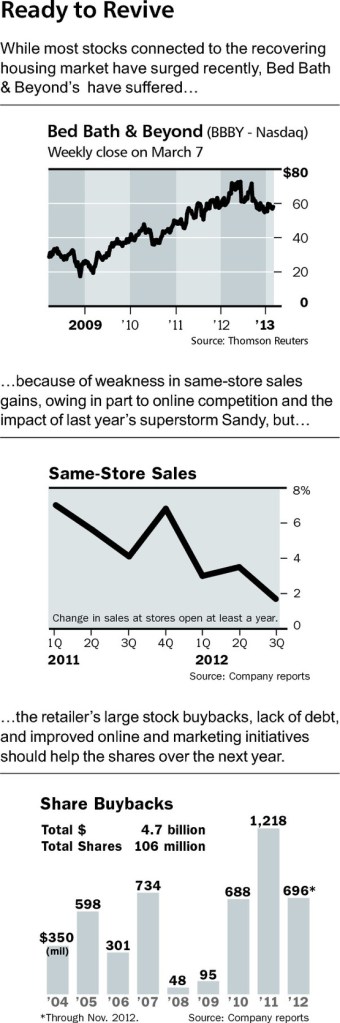
Bed Bath & Beyond has generated 16% annual growth in earnings per share over the past 10 years. But its shares, at $59, trade for less than 12 times projected profit for its fiscal year that ends in February 2014. The stock (ticker: BBBY) trades at a discount to other top retailers’, including Costco Wholesale (COST) and Target (TGT), neither of which has such a good profit history.

The shares could trade into the $70s in the next year, simply based on projected earnings gains and a higher price/earnings multiple. The insular company could attract interest from private-equity investors or even Berkshire Hathaway (BRK.A) if Bed Bath & Beyond’s co-founders, Leonard Feinstein, 75, and Warren Eisenberg, 82, decide to sell. However, there is no indication that the company is looking to sell.

A BUYER MIGHT PAY $85 a share—roughly 10 times this fiscal year’s projected earnings before interest, taxes, depreciation, and amortization (Ebitda)—consistent with prices paid for other quality companies, versus Bed Bath & Beyond’s current modest valuation of 6.5 times. The company’s $13 billion market value makes it large, but digestible. “This is a high-quality, cash-rich company that could see improving margins this year, particularly in the back half,” says Laura Champine, an analyst at Canaccord Genuity who carries a $74 price target on the stock. Bed Bath & Beyond has commanded an average of 15 times forward earnings in the past seven years.

The company, based in Union, N.J., operates 1,469 stores, including 1,004 Bed Bath & Beyonds, in all 50 states. The other 400-plus stores include World Market, which sells home furnishings, wine, and gourmet food; the fast-growing buybuy Baby chain, Christmas Tree Shops, and Harmon discount shops.

Bed Bath & Beyond has fallen from favor on Wall Street because of slowing comparable-store sales gains, mild profit disappointments, and concern that its weak Website makes it vulnerable toAmazon.com (AMZN) and other top Internet retailers. The company’s shares have slid 6% in the past year, even as virtually all stocks connected to the improving housing sector have surged.

Nonetheless, the company’s earnings in its just-concluded fiscal year ended in February likely rose a healthy 12%, to $4.56 a share, and are projected to increase 10% in its current fiscal year to $5.03.

Bed Bath & Beyond could be the most financially conservative big retailer in the U.S. It has no debt and it hasn’t carried a smidgen of debt for nearly all of the two decades since it went public in 1992. And it has $859 million—nearly $4 a share—in cash and marketable securities. The company has grown enormously, with revenue hitting an estimated $10.9 billion last year, versus $216 million in 1992 and it has accomplished this entirely with internally generated funds. Longtime investors have huge gains; the split-adjusted initial-offering price was $1 a share.

Management, led by CEO Steve Temares, plus co-Chairmen Feinstein and Eisenberg, run Bed Bath as if it were a private company. There are no investor days, limited financial disclosure, and no opportunity for questions on earnings conference calls. Want to know the sales breakdown among its chains? Bed Bath doesn’t disclose it. The retailer didn’t return Barron’s calls seeking comment. Read more of this post
Rigging the I.P.O. Game: What a decade-old dot-com I.P.O. case says about Wall Street today

March 9, 2013

Rigging the I.P.O. Game

By JOE NOCERA

ONCE upon a time, in a very different age, an Internet start-up called eToys went public. The date was May 20, 1999. The offering price had been set at $20, but investors in that frenzied era were so eager for eToys shares that the stock immediately shot up to $78. It ended its first day of trading at $77 a share.

The eToys initial public offering raised $164 million, a nice chunk of change for a two-year-old company. But it wasn’t even close to the $600 million-plus the company could have raised if the offering price had more realistically reflected the intense demand for eToys shares. The firm that underwrote the I.P.O. — and effectively set the $20 price — was Goldman Sachs.

After the Internet bubble burst — and eToys, starved for cash, went out of business — lawyers representing eToys’ creditors’ committee sued Goldman Sachs over that I.P.O. That lawsuit, believe it or not, is still going on. Indeed, it has taken on an importance that transcends the rise and fall of one small company during the first Internet craze. Read more of this post

Why fund names can’t always be trusted; ‘Absolute return’ funds that lose money, ‘smaller companies’ funds that hold FTSE 100 members, we look at the funds that don’t live up to their moniker.

Why fund names can’t always be trusted

‘Absolute return’ funds that lose money, ‘smaller companies’ funds that hold FTSE 100 members, we look at the funds that don’t live up to their moniker.

By Emma Wall

7:00AM GMT 09 Mar 2013

Fund managers have received a slap on the wrist for failing to achieve their investment goals. “Absolute return” funds aim to achieve positive returns in all market conditions – but the majority simply have not done what they claimed.

Angry investors accused the industry of misleading advertising, as funds such as BlackRock UK Absolute Alpha and GLG Alpha Select, which both sit in the Absolute Return sector, failed to deliver positive funds over the past three years.

In light of this poor performance, the Investment Management Association (IMA) has changed the sector’s name to “targeted absolute return” – a solution derided by critics.

Gina Miller, a co-founder of SCM Private, the fund manager, and a campaigner for transparency on charges, said the IMA had “taken 643 days to change one word”. She called the review an “absolute farce”. Read more of this post

How John Lewis found fashion and became never knowingly underdressed; Clothing boss Peter Ruis tells how the stores known for good sense and slippers became the fashionistas’ darling

How John Lewis found fashion and became never knowingly underdressed

Clothing boss Peter Ruis tells how the stores known for good sense and slippers became the fashionistas’ darling

Sarah Butler

The Observer, Sunday 10 March 2013

Peter Ruis

Peter Ruis in the John Lewis chain’s Peter Jones store, Sloane Square. Photograph: David Levene

Fashionistas queuing round the block, a sell-out designer collection and breathless reviews by the style press. Can this really be John Lewis? As 84,700 partners working at the department stores celebrate their 17% bonus this weekend, they can rest assured they are back in fashion in a big way. A 9% rise in clothing sales helped drive a bumper year for John Lewis as it increased its market share, mainly at Marks & Spencer’s expense. The chain accounted for 2.1% of the UK clothing market in 2012, according to retail analysts Verdict, 10% up on a year before.

Once associated with sensible knitwear and cosy slippers, the 40-store chain has polished up its fashion credentials through designer collaborations, classy own-label products and the addition of upmarket brands that had previously steered clear of the store.

As a result, fashion sales topped £1.1bn last year – up from about £700m in 2005. That’s still only about a quarter of what Marks & Spencer sells, but it indicates the kind of growth that rivals can only dream of in the economic downturn.

Under the guidance of buying and brand director Peter Ruis, who took charge of fashion in 2007, John Lewis has created a buzz by recognising that shoppers of all ages now want to look trendy – and that older customers no longer want gold buttons and elasticated waistbands. Read more of this post

Retiring workers are being “ripped off” by financial companies making huge profit margins on annuities, campaigners have warned

Pensioners being ‘ripped off’ by profit margins on annuities

Retiring workers are being “ripped off” by financial companies making huge profit margins on annuities, campaigners have warned.

Experts warn that the industry is concealing large profits. Photo: PA

By Richard Evans, and James Kirkup

9:47PM GMT 08 Mar 2013

A Telegraph investigation has raised concerns about the profits that insurance companies and other firms are making on annuities. Only one annuities provider, Standard Life, has disclosed its margins on annuities, revealing that it pockets almost 20p of every pound a customer pays for an annuity. Other firms refuse to reveal their margins, and experts warn that the industry is concealing large profits. Ros Altmann, a pensions campaigner, said: “These huge margins are outrageous.” Annuities rates have tumbled in recent years as the Bank of England’s quantitative easing programme pushes down returns on the government bonds that are the basis of annuity income. Financial experts say that people can significantly boost their retirement income by shopping around. Steve Webb, the pensions minister, said: “Annuities are increasingly important. More openness on rates should help consumers get a better deal.” Standard Life pays an income of £4,990 on a £100,000 annuity for a 65-year-old. The market leader, Aviva, pays £5,600.

A ‘Politically Explosive’ Secret: Italians Are More Than Twice As Wealthy As Germans

A ‘Politically Explosive’ Secret: Italians Are More Than Twice As Wealthy As Germans

Wolf Richter, Testosterone Pit | Mar. 9, 2013, 7:17 AM | 6,192 | 29

In December 2006, the ECB established the HFSC network of survey specialists, statisticians, and economists from its own ranks, national central banks of the Eurozone, and statistical institutes. The acronym stood for Household Finance and Consumption Survey.

It would collect “micro-level structural information” on household wealth. A massive bureaucratic undertaking. Surveys went out in 2010. Results are now ready. No one in Europe had ever done a survey on that scale before.

And no one might ever do it again. Because, in the era of bailouts and wealth-transfers, the results are so explosive that the Bundesbank is keeping its report secret—and word has leaked out why.

The surveys were conducted on a national basis, with each central bank publishing its own report. They would then be combined and summarized by the ECB into a cohesive picture of how wealthy—or how poor—people in various parts of the Eurozone were. A number of countries already published their reports, including Italy and Austria.

What the Austrian National Bank found was not pretty (20-page PDF). The considerable wealth in Austria was very unevenly distributed. The wealthiest 5% owned nearly half of the country’s wealth. Their median wealth was €1.7 million in diversified assets. The lower 50% owned only 4% of the country’s wealth. Of them, 83% rented their homes. Their median wealth was a measly €11,000 consisting usually of a car and a savings account. That’shalf of the people! And 10% had a net wealth of less than €1,000.

This unequal distribution of wealth created a huge gap between median income (half the people earned more, the other half less) of €76,000 and average income of €265,000 (pushed up by a small number of extremely wealthy households). And that’s why some countries don’t even publish average income values. Too much truth would hurt.

Germany’s data is likely to be similar—but the Bundesbank is treating its report like a secret. Because the results are, let’s say, awkward for two reasons.

The highly unequal distribution of wealth is one of them. The German government already went through wild gyrations late last year, and now again, over its Poverty Report that exposed some inconvenient facts that were then edited out—something that was leaked immediately, and it caused a ruckus [read…. Censored: Poverty Report in Germany].

Italy is the other issue. But it may be too hot for the Bundesbank to touch. Italy’s report (142-page PDF) finds that median household net wealth has increased 56% since 1991. And from 2008 to 2010, it increased by about 5% annually, despite the crisis!

But the wealth of German households stagnated during much of that time while they paid taxes out of their noses. And now they might learn that Italy’s median household wealth is €163,875—while Germany’s is closer to Austria’s, around €76,000. Less than half!

“Politically explosive,” sources at the Bundesbank whispered to the FAZ. Read more of this post

The Price of Marriage in China: China’s economic surge — and vast wealth inequality — have bred a new type of matchmaker, referred to as a love hunter

March 9, 2013

The Price of Marriage in China

By BROOK LARMER

LOVEHUNTERS-articleLarge10-LOVEHUNTERS-JP1-popup

In a Beijing shopping mall, the “love hunter” Yang Jing, right, and an assistant talked to a woman about joining the database of Diamond Love and Marriage, a matchmaking service.

FROM her stakeout near the entrance of an H & M store in Joy City, a Beijing shopping mall, Yang Jing seemed lost in thought, twirling a strand of her auburn-tinted hair, tapping her nails on an aquamarine iPhone 4S. But her eyes kept moving. They tracked the clusters of young women zigzagging from Zara to Calvin Klein Jeans. They lingered on a face, a gesture, and then moved on, darting across the atrium, searching.

“This is a good place to hunt,” she told me. “I always have good luck here.”

For Ms. Yang, Joy City is not so much a consumer mecca as an urban Serengeti that she prowls for potential wives for some of China’s richest bachelors. Ms. Yang, 28, is one of China’s premier love hunters, a new breed of matchmaker that has proliferated in the country’s economic boom. The company she works for, Diamond Love and Marriage, caters to China’s nouveaux riches: men, and occasionally women, willing to pay tens and even hundreds of thousands of dollars to outsource the search for their ideal spouse.

In Joy City, Ms. Yang gave instructions to her eight-scout team, one of six squads the company was deploying in three cities for one Shanghai millionaire. This client had provided a list of requirements for his future wife, including her age (22 to 26), skin color (“white as porcelain”) and sexual history (yes, a virgin).

“These millionaires are very picky, you know?” Ms. Yang said. “Nobody can ever be perfect enough.” Still, the potential reward for Ms. Yang is huge: The love hunter who finds the client’s eventual choice will receive a bonus of more than $30,000, around five times the average annual salary in this line of work.

Suddenly, a signal came.

From across the atrium, a co-worker of Ms. Yang caught her eye and nodded at a woman in a blue dress, walking alone. Ms. Yang had shaken off her colleague’s suggestions several times that day, but this time she circled behind the woman in question.

“Perfect skin,” she whispered. “Elegant face.” When the woman walked into H & M, Ms. Yang intercepted her in the sweater aisle. “I’m so sorry to bother you,” she said with a honeyed smile. “I’m a love hunter. Are you looking for love?”

Three miles away, in a Beijing park near the Temple of Heaven, a woman named Yu Jia jostled for space under a grove of elms. A widowed 67-year-old pensioner, she was clearing a spot on the ground for a sign she had scrawled for her son. “Seeking Marriage,” read the wrinkled sheet of paper, which Ms. Yu held in place with a few fragments of brick and stone. “Male. Single. Born 1972. Height 172 cm. High school education. Job in Beijing.”

Ms. Yu is another kind of love hunter: a parent seeking a spouse for an adult child in the so-called marriage markets that have popped up in parks across the city. Long rows of graying men and women sat in front of signs listing their children’s qualifications. Hundreds of others trudged by, stopping occasionally to make an inquiry. Read more of this post

Chinese consumers account for 50% of all LV sales

Chinese consumers account for 50% of all LV sales

Staff Reporter

2013-03-10

More than half of all Louis Vuitton purchases in the world are made by Chinese people, according to the Hurun Report, a magazine best known for its rankings of wealthy individuals in China. According to Rupert Hoogewerf, founder of the Hurun Report and chairman of the Hurun Research Institute, the 33 billionaires on their new Hurun Luxury Tycoon Rich List owe much of their success to Chinese shoppers and their notorious overseas shopping sprees. “The Chinese luxury consumer is today the most important customer group in the world for luxury brands, especially now that the Chinese luxury consumer has started to travel around the world,” Hoogewerf said. Read more of this post

State-owned firms ignore Beijing order to exit property sector

State-owned firms ignore Beijing order to exit property sector

Staff Reporter

2013-03-10

A 2010 order issued by the Chinese government requiring state-owned companies to exit the property sector if it is not their core business has failed to prevent such companies from winning bids for prime-location land across the country, reports the Guangdong-based Southern Weekly newspaper.

According to recent reports, less than a quarter of the 78 state-owned enterprises asked to terminate their property business operations more three years ago have complied. Read more of this post

China to split rail ministry after scandals; China Plans Overhaul of Debt-Laden Railways; China Unveils Government Agency Shake-Up Proposal

China to split rail ministry after scandals
Posted: 10 March 2013 0930 hrs

BEIJING: China will split its scandal-plagued railways ministry in two and bring its administrative functions under the control of the transport ministry, state media said on Sunday.

The plan is to “dismantle” the ministry, the official Xinhua news agency reported, citing a report on institutional reform to be submitted to the National People’s Congress parliament meeting in Beijing later.

The ministry’s commercial functions will be taken over by a new China Railway Corporation, it added.

The railway system has been one of China’s flagship development projects in recent years and the country now boasts the world’s largest high-speed network.

But the expansion — which has cost hundreds of billions of dollars — has seen widespread allegations of corruption and former railways minister Liu Zhijun, who was sacked in 2011, is awaiting trial on graft charges.

In July 2011 a high-speed crash in the eastern city of Wenzhou killed at least 40 people, sparking a torrent of public criticism that authorities compromised safety in their rush to expand the network. Read more of this post

BHP Billiton Plans to Sell 10 Assets After Debt Rises to Record; BHP has gone from holding $200 million in net cash at the end of 2010 to net debt of $30.4 billion at the end of 2012

BHP Billiton Plans to Sell 10 Assets After Debt Rises to Record

BHP Billiton Ltd. (BHP), the world’s largest mining company, is planning to sell about 10 of its assets amid a rise in debt levels after a two-year metals boom driven by Chinese demand stuttered.

The Gregory-Crinum coal mine in Australia’s Queensland state is among the assets being considered for sale, spokeswoman Eleanor Nichols said by phone today. The Australian newspaper first reported that Chief Financial Officer Graham Kerr told equity analysts last week the divestment program was focused on at least 10 BHP assets. The company owns mines, oil and gas wells, and processing plants.

Global mining companies are selling off businesses after slumping metal prices triggered more than $60 billion of writedowns to mineral resources. BHP’s debt has risen to a record $30.4 billion and Chief Executive Officer Marius Kloppers last month joined his counterparts at Rio Tinto Group and Anglo American Plc in stepping down from his role. Read more of this post

US professors lose it on CNBC over China real estate

US professors lose it on CNBC over China real estate

  • Staff Reporter

2013-03-09

images-121628_copy1

Professors Peter Navarro and Lee Ann show off their letters. (Internet Photo)

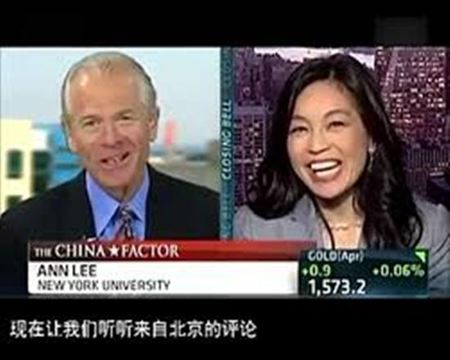
What was supposed to be civilized debate turned into an indecipherable cacophony of egos in a live show on CNBC. Peter Navarro, a professor at University of California at Irvine, and Ann Lee, a professor at the New York University, came to an impasse on the topic of the impact of the Chinese housing bubble on the global economy, reports Shanghai-based Xinmin Evening News. China released recently new regulations to curb China’s rising real estate prices, including an increase in down payments and loan rates for buyers of a second piece of property in cities. These policy measures worry investors and generate fears of a bubble building in China’s property market.

CNBC invited Navarro and Lee to share their perspectives over the concern, which kicked off well until Ann Lee started speaking. Before finishing her first sentence, Navarro began and kept up a string of snide comments about her affiliation with Beijing, and continously cut off Ann’s every attempt at an argument. The brawl boiled over when she said, “I don’t think there was a bubble at all. The Chinese government has been trying to slow and cool this part of the economy for years.” Navarro, a seasoned academic at a respectable university, came back with an extraordinary rebuttal in the middle of Ann’s sentence, “This is the most bullshit I have ever heard,” and “shame on you, Ann.” Eventually the hostess Michelle Caruso-Cabrera gave up trying to exact something viewers could understand and cut short the show.

China’s new leaders: Don’t get your hopes up; The only good news coming from the pending leadership changes is the near certainty of the end of China’s one-child policy

China’s new leaders: Don’t get your hopes up

March 8, 2013: 3:11 PM ET

The only good news coming from the pending leadership changes is the near certainty of the end of China’s one-child policy.

By Minxin Pei

FORTUNE — Ever since Xi Jinping, China’s new leader, ascended to the top spot of the ruling Communist Party’s hierarchy last November, he has promised repeatedly to restart China’s long-stalled economic reforms. With the opening of the annual session of China’s rubber-stamp parliament (officially known as the National People’s Congress), Xi and his colleagues finally have a chance to show the Chinese people what kind of reforms they have been thinking about.

Of course, it may be too early to analyze the pronouncements coming out of the congress since its most important business, such as announcing the restructuring of the State Council (the cabinet) and appointments of key economic officials, has not concluded. However, based on the information leaked to the press, it appears that the new leadership will not embark on a bold course of reform. Caution, not risk-taking, will remain the modus operandi of Chinese leadership. Read more of this post

Currency swings are rising in Malaysia at the world’s fastest pace as concern mounts that the ruling coalition will lose its 55-year grip on power after attracting more foreign capital than any other emerging market except Mexico

Volatility Rises Most in Malaysia as Flows Imperiled: Currencies

Currency swings are rising in Malaysia at the world’s fastest pace as concern mounts that the ruling coalition will lose its 55-year grip on power after attracting more foreign capital than any other emerging market except Mexico.

Three-month implied volatility for the ringgit, a measure of expected exchange-rate moves used to price options, jumped 2.2 percentage points to 7.4 percent in 2013, more than any of the 47 currencies tracked by Bloomberg. The ringgit has lost 1.6 percent this year and reached a five-month low in February as Credit Suisse Group AG and ING Groep NV cut their forecasts.

Polls show support for Prime Minister Najib Razak, who embarked on a $444 billion development plan to build railways and power plants, is the lowest since 2011 ahead of elections due before the end of June. Investors may pull from the local bond market as much as $10 billion, or 24 percent of their total holdings, as opposition leader Anwar Ibrahim pledged to review highway-toll contracts and the granting of tax permits to large companies, according to Credit Suisse. Read more of this post

Hong Kong Prison Homes Spur Virus Risk Decade After SARS; “Life is hard. I hope that more can be done to level the playing field in this city.”

Hong Kong Prison Homes Spur Virus Risk Decade After SARS

Chan Sung-ming says the coughs and sneezes echoing through the plywood walls of his windowless, 60- square foot Hong Kong apartment get him thinking: is there a bug going around and could it be deadly?

A decade after SARS began a lethal odyssey via Hong Kong, which has the world’s most-densely populated urban areas, Chan says his apartment — one of eight in a space about the size of a squash court — makes him feel more prone to airborne germs.

Even as the city spends HK$1.6 billion ($206 million) a year on a disease-tracking center to prepare for future contagions, a tripling in the price of homes in the past decade have forced its 7.2 million residents closer together. That’s stoking the potential for a rapid rise of bugs like the severe acute respiratory virus that exploded there in early 2003.

“In Hong Kong, we live vertically, not horizontally,” said Sian Griffiths, director of the Chinese University of Hong Kong’s school of public health. “It’s as if we’ve turned a village street on its end. People are so close together here, the risk of transmission is greater.”

Chan’s apartment is smaller than some of the city’s prison cells. The 36-year-old electrician says the cramped living arrangements mean he hears his neighbors’ every cough and bowel movement, and sometimes shares their pathogens too. Read more of this post

PBOC’s Rise to Top a Story of Deft Politics Amid Turmoil; “It’s hard to believe that just three decades ago the PBOC was only a minor institution in the labyrinthine Chinese bureaucracy.”

PBOC’s Rise to Top a Story of Deft Politics Amid Turmoil

As of November 2012, the People’s Bank of China had total assets of $4.8 trillion, more than the European Central Bank or the Federal Reserve. The PBOC now supplies more than half the world’s total liquidity and manages foreign reserves worth almost $3.3 trillion.

Increasingly, the PBOC has become an international lender of last resort, particularly as European politicians try to persuade the Chinese to buy their bonds. No wonder that Zhou Xiaochuan, the bank’s governor, has been dubbed “the world’s central banker,” a man whose statements can move global markets.

It’s hard to believe that just three decades ago the PBOC was only a minor institution in the labyrinthine Chinese bureaucracy. Its ascension is a story of turbulent economic transition, skillful leadership and, above all, deft political strategy. And its most significant challenges may still lie ahead. Read more of this post

India’s Kumbh Mela festival, which attracts the likes of Unilever and Vodafone, generates about $2.8 billion in revenue for businesses

Coke, Unilever, Colgate-Palmolive Seize India’s Biggest Marketing Opportunity

By Adi Narayan on March 07, 2013

news_comp11_kumbhmela_405inline

About 8 percent of India’s population—everyone from billionaire Anil Ambani, brother of India’s richest man, to hardscrabble peasants—has trekked to the Ganges in the past eight weeks, seeking salvation at a religious festival called the Maha Kumbh Mela. Companies including Coca-Cola (KO), Hindustan Unilever (HUVR), and Colgate-Palmolive (CL) have made the same journey in a quest for profits.

Billed as the world’s largest gathering, the Kumbh is expected to draw about 100 million people before its conclusion on March 10. For advertisers, that’s roughly a once-a-decade chance to reach millions of new consumers. “The Kumbh is like an advertising bliss,” says Vipul Salvi, national creative director for OgilvyAction, a unit of Ogilvy & Mather (WPPGY). “It’s some 100 million people in one place, and that never happens anywhere else on the globe.”

The Hindu gathering offers a way to reach shoppers from rural India, where the World Bank estimates about 70 percent of the country’s 1.2 billion people live. Explains Espirito Santo Securities analyst Nitin Mathur: “Here you are reaching the mass end of the consumers directly.” That’s important because for the past two years, per-capita spending by India’s villagers grew faster than that of urban dwellers for the first time in two and a half decades, according to ratings agency Crisil. Rural spending was 12.9 trillion rupees ($235.7 billion) in the two years ended last March 31, compared with 10.4 trillion in urban areas, the Mumbai-based unit of McGraw-Hill Companies (MHP) reported in August. Read more of this post

Thai Bulls Beat Bears Selling Most in Asia as SET Hits 1994 High; Never before have Thai stocks rallied so much at a time when foreign investors were heading for the exit.

Thai Bulls Beat Bears Selling Most in Asia as SET Hits 1994 High

Never before have Thai stocks rallied so much at a time when foreign investors were heading for the exit.

The benchmark SET Index (SET) rose 4.6 percent last month even as international money managers sold a net $583 million of the nation’s shares, the biggest outflow among 10 Asian markets tracked by Bloomberg. The advance, propelled by $611 million of purchases by domestic investors, is the largest for any month when net overseas withdrawals exceeded $500 million. The index fell an average 5.5 percent during such periods since Bloomberg began compiling the data in 1999.

“Local investors are prepared to step in and hunt for bargains,” Petcharat Powattanasatien, who helps oversee about $30 billion as the head of equity investment at Bangkok-based Kasikorn Asset Management Co., said by phone on March 4. Her firm is the nation’s biggest money manager.

Thai citizens are driving equity gains as the nation’s $377 billion economy grows at the fastest pace since at least 1993 and local incomes climb. While Morgan Stanley is advising clients to cut stock holdings after valuations rose to record highs, Aberdeen Asset Management and ING Investment Management are still bullish. The SET index has recovered every time when foreign selling coincided with monthly losses since September 2008, rallying an average 22 percent in the next 12 months, data compiled by Bloomberg show. Read more of this post

BofAML: Leverage Approaches 2007 Levels

BofAML: Leverage Approaches 2007 Levels

Mar 5 2013 | 3:07pm ET

Leverage, as measured by NYSE Margin Debt data, was up 31.6% on the year in January and 10.2% on the month to $364 billion, approaching the July 2007 peak of $381 billion.

Excessive cash draw-down has led to a contrarian sell signal, according to the latest Hedge Fund Monitor from Bank of America Merrill Lynch. Read more of this post

Korea: Is era of ‘Mofia’ gone under Park administration? The compound word of an acronym of the Ministry of Finance (MOF) and mafia referred to the financial bureaucrats who dominated key positions and wielded great influence in the local financial sector

Is era of ‘Mofia’ gone under Park administration?

By Yi Whan-woo

Is the era of “mofia” gone?

The compound word of an acronym of the Ministry of Finance (MOF) and mafia referred to the financial bureaucrats who dominated key positions and wielded great influence in the local financial sector.

Seemingly, the mofia don’t have the same level of power under the Park Geun-hye administration as in the past.

Park’s recent selection of her top financial nominees has raised speculation that she may not rely on the officials who built their careers at the finance ministry. Read more of this post

Crisis caution over urban push; The urbanization drive could fuel social unrest over land disputes and pose financial risks if money is thrown around recklessly

Crisis caution over urban push

Friday, March 08, 2013

The urbanization drive could fuel social unrest over land disputes and pose financial risks if money is thrown around recklessly, a senior Communist Party official and a leading economist warned.

Shifting people from the countryside to cities is a policy priority for new leaders as they seek to sustain economic growth that last year slowed to a 13-year low of 7.8 percent.

Beijing hopes 60 percent of the nation’s almost 1.4 billion population will be urban residents by 2020.

The urban population jumped to above 700 million from less than 200 million in the previous 30 years but the explosion triggered sometimes violent clashes over seizures of farmland for development, as well as water shortages, pollution and other problems.

“These are severe challenges as we try to sustain the urbanization process,” said Chen Xiwen, head of the Office of Central Rural Work Leading Group, the top body guiding farm policy.

“Many people have worries and such worries are understandable,” he told a news conference on the sidelines of the annual parliament session. Read more of this post

Price slash sparks peak buzz; A surprise cut in unit prices at the latest project of Cheung Kong Holdings (0001) has prompted speculation that the home market has peaked.

Price slash sparks peak buzz

Karen Chiu

Friday, March 08, 2013

A surprise cut in unit prices at the latest project of Cheung Kong Holdings (0001) has prompted speculation that the home market has peaked.

Prices at One West Kowloon in Cheung Sha Wan were reduced by an average of 11 percent.

Cheung Kong became the first developer to trim prices following the latest round of government curbs imposed on the property sector from February 22.

The first batch of around 50 flats – now all sold – was put in the market in November at an average price of HK$9,750 per square foot in terms of gross floor area.

Yesterday Cheung Kong offered another 20 apartments for sale at an average price of HK$9,147 psf. One Kowloon West consists of 286 units.

A three-bedroom 1,160 sq ft flat saw the sharpest cut. It is now priced at HK$10.17 million – 17.5 percent lower than the original HK$12.31 million. Read more of this post

An Unhappy Middle in the Middle Kingdom; In between China’s billionaires and peasants is a surprisingly thin and unhappy middle class, which poses a big social and economic challenge

March 7, 2013, 10:15 a.m. ET

An Unhappy Middle in the Middle Kingdom

By WEI GU

China has the world’s largest number of billionaires and 700 million peasants. In between is a surprisingly thin and unhappy middle class, which poses a big social and economic challenge.

Among the 3,000 delegates of the 2013 National People’s Congress, the percentage of blue-collar workers and peasants has risen to 13% from 8% in 2012. The number of migrant workers has jumped to 30 from just three last year. Wealthy Chinese continue to be well represented. China’s richest man, Zong Qinhou, is attending the annual powwow for the 11th time.

The squeezed middle class deserves more love. As many as 51% of Chinese working professionals suffered from some level of depression, the Ministry of Health said in 2011. They blame pressure from a rapidly changing society, increased competition, long work hours and high property prices.

“The biggest risk in the world is China’s middle class not being happy,” said Shaun Rein, the managing director of China Market Research, a consulting firm. “They are the most pessimistic group in the world.” Read more of this post

Thailand leads the world with its number of female CEOs; In Thailand, 49% of CEOs are women, which is the highest proportion in the world

Thai female CEOs on top of the world

Published: 8 Mar 2013 at 00.00

  • Thailand leads the world with its number of female CEOs, according to Grant Thornton’s International Business Report (IBR).

The new research is being announced globally today on International Women’s Day.

In Thailand, 49% of CEOs are women, which is the highest proportion in the world, the research showed.

Globally, 24% of senior management roles are now filled by women, which is up from 21% last year and 20% in 2011.

China is the only country where women occupy more than half (51%) of senior management roles, while Japan remains at the bottom with 7%. Read more of this post

Nestle pushes into Indochina; Nestle: “Thailand is the centre of Asean countries”

Nestle pushes into Indochina

Positions itself to take advantage of AEC

Nestle Group (Thailand), the Swiss conglomerate’s Bangkok-based arm that also oversees operations in neighbouring countries, plans to double its business size in Indochina within 2016.

479283

Mr England (right) and Nopadol Sivabutr, the corporate affairs director, at yesterday’s briefing. PAWAT LAOPAISARNTAKSIN

The move is aimed at capturing a huge market opportunity when Asean becomes a single market in 2016, its top executive said yesterday.

“Thailand is one of the strategic countries for Nestle. We see a big opportunity to grow business and double our size by 2016, as Thailand is the centre of Asean countries,” said Wayne England, who was recently appointed chairman and chief executive of Nestle Group (Thailand). Read more of this post

Oaktree Billionaire Founder Howard Marks’ Full Presentation On “Investing In Uncertain Times”

Howard Marks’ Full Presentation On “Investing In Uncertain Times”

Tyler Durden on 03/07/2013 12:58 -0500

In the following presentation, given by Howard Marks – the world’s largest distressed debt investor – he warns of the perils of “investing in uncertain times.” As Reuters notes, he fears the “unsound practices” from before the financial crisis are creeping back into credit markets, with private equity firms bidding increasingly high prices for companies. Marks points out the ease with which lowly rated companies were issuing debt this year, how companies were paying out record dividends to their shareholders and the increasingly high debt-to-equity multiples private equity firms were paying for companies amid a resurgence in deals. “We have a world in which nobody is thinking bullish. Everybody’s worried and yet people are acting bullish,” and predicts a looming “shake-out” in the hedge fund industry as he asks rhetorically, “today there are 8,000 hedge funds. Are there really 40,000 exceptional people (working for hedge funds)?” In conclusion, Oaktree Capital’s founder warns that investors, in their search for returns, were becoming overly confident while the economic background was still gloomy.

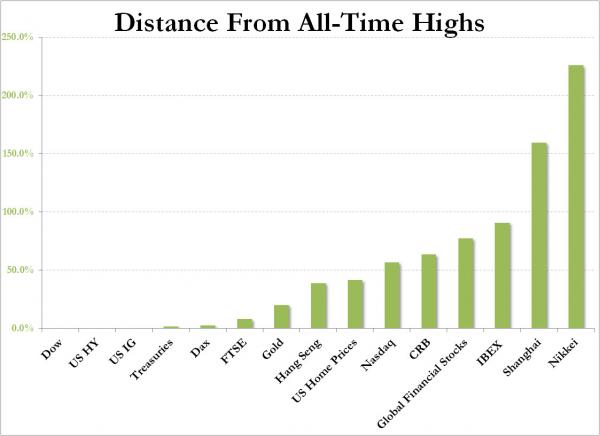
Distance from All-Time Highs

Who Is Absent (For Now) From The Record High Party?

Tyler Durden on 03/07/2013 18:06 -0500
Four years from the lows and with US risk assets melting up, BAML notes that at this rate the S&P 500 will end 2013 above 2013! The low growth, high liquidity environment has, however, only benefitted some asset classes. As the following table shows, there are a few markets that have a long way to go still…

20130307_highs_0