Why Your Computer Slows Down Over Time

Why Your Computer Slows Down Over Time

KEVIN SMITH AUG. 11, 2013, 9:14 AM 31,478 37

One of the biggest computer annoyances is when your machine gets slow over time. This can start to happen years after you get a PC, but sometimes it happens in just a few short months. Since we all use our computers for different tasks and activities, there isn’t one single reason that pinpoints why this happens. The thing is, when you first get a new computer and boot it up it works lightning fast. That’s because it doesn’t have anything on it. Regardless of whether you have a PC or Mac, over time as you download files, install software, and surf the Internet, your computer gets bloated with files that hog system resources. In addition, there are many other things that contribute to a slowdown. We explored some of the major causes. We started by speaking with Rachel, a tech expert who works at New York City authorized Apple repair shop Tekserve. Rachel told us that software and hard drive corruption are two reasons why your computer may slow down over time. Corruption can be caused by a host of things but it’s mostly bugs in the operating system, corrupted RAM data, static electricity (from carpet or other fabrics), power surges, failing hardware, and for Windows users, normal operating system decomposition with age. Two other huge culprits are not having enough RAM (memory to run programs) and simply running out of hard disk space. Not having enough RAM causes your hard drive to try to compensate for a lack of memory. The computer will constantly seek more RAM taking away resources from other tasks. Another thing users fall victim to is installing unnecessary software. This will fill up your hard drive, causing you to run out of space at the price of speed. There are useful free programs that help you easily identify what is taking up space on your hard drive: For Mac users try: OmniDiskSweeper, a free program that breaks down exactly which files take up the most space. For PC users try WinDirStat, a disk usage statistics viewer and cleanup tool. But what if you don’t have a lot of apps or programs on your computer and it’s still going slow? Read more of this post

To Stay Afloat, Bookstores Turn To Web Donors

August 11, 2013

To Stay Afloat, Bookstores Turn To Web Donors

By JULIE BOSMAN

For years, independent bookstores have taken creative steps to fight off challenges from Amazon and the superstores by building in-house espresso bars, hosting members-only lunches with authors and selling birthday cards, toys and trinkets. In 2013, it has come to this: Asking their customers for donations. Crowdfunding is sweeping through the bookstore business, the latest tactic for survival in a market that is dominated by Amazon, with its rock-bottom prices, and Barnes & Noble, with its dizzying in-store selection. It’s hardly a sustainable business model; but it buys some time, and gives customers a feeling of helping a favorite cause and even preserving a civic treasure. In San Francisco, a campaign for Adobe Books successfully raised $60,000 on Indiegogo.com in March after the store faced a rent increase and nearly went out of business. In Asheville, N.C., the Spellbound Children’s Bookshop collected more than $5,000 when it appealed to customers for help moving to a new location. Read more of this post

Tiny screens are growing in importance for television viewers

August 11, 2013 1:51 pm

Tiny screens are growing in importance for television viewers

By Emily Steel in New York

Television viewers are trading the small screen for the tiny screen, with a growing proportion of smartphone owners watching full-length television programmes on mobile devices. New research shows a surge in people watching not just short clips but entire television episodes and films on tablets and smartphones. While 38 per cent ofsmartphone owners regularly watch videos on their device, about a tenth now watch full-length television programmes, according to Magid Advisors, a consulting group whose clients include large media and technology companies. “Mobile is the connected television that we all carry in our pockets,” said Amir Ashkenazi, chief executive of Adap.tv, the digital video advertising company thatAOL said it would acquire for $405m last week. Read more of this post

Technology Industry Extends a Hand to Struggling Print Media

August 11, 2013

Technology Industry Extends a Hand to Struggling Print Media

By NICK WINGFIELD

From classifieds to display ads to subscriptions, the digital age has broken the financial pillars of print journalism, leaving the industry struggling to stand on its own. But more frequently — and with a boom last week, when Jeffrey P. Bezos, the founder of Amazon.com, bought The Washington Post — the tycoons who have led the digital revolution are giving traditional print outlets a hand. Call it a sense of obligation. Or responsibility. Or maybe there is even a twinge of guilt. Helping print journalism adapt to a changed era is becoming a cause de jour among the technology elite. Read more of this post

One Hour Translation’s Patented Tech Enables Speedy And Accurate Real-Time Translation Of Online Content

One Hour Translation’s Patented Tech Enables Speedy And Accurate Real-Time Translation Of Online Content

CATHERINE SHU

posted 10 mins ago

ounded in 2008, One Hour Translation is one of the oldest and largest online translation companies, with more than 15,000 active translators in 100 countries who cover more than 75 languages. The Cyprus-based company processes 100,000 projects a month for customers ranging from large corporations (including Toyota and Shell) that need enterprise-grade multilingual content management systems to smaller companies in search of a more polished alternative to cutting-and-pasting content into Google Translate.

Over the last five years, CEO and founder Ofer Shoshan, who bootstrapped One Hour Translation, has seen an increase in demand for online translation as companies seek to diversify into global markets. Read more of this post

Monster Zombie Spider to Crush Super Mario’s China Dreams: Tech

Monster Zombie Spider to Crush Super Mario’s China Dreams: Tech

He’s pudgy, middle aged and wears dungarees. So what makes investors believe Nintendo Co. (7974)’s Super Mario can take on Tencent Holdings Ltd. (700)’s giant, undead spider Vilemaw in his Chinese lair?

Nintendo shares have risen 36 percent since state-run China Daily on Jan. 28 said the country was ready to end a 13-year ban on consoles. Meant to shelter China’s youth from the violence and perceived corrupting influence of video games, the ban instead spawned a generation of gamers grown used to a free online model and increasingly migrating to mobile devices. Read more of this post

Currency broker FxPro is set to become the latest investment platform to dive into the world of “social trading”, in a bid to lure investors who are immersed in Twitter and other forms of social media

August 11, 2013 5:09 pm

Currency broker FxPro set to enter world of social trading

By Vanessa Kortekaas

Currency broker FxPro is set to become the latest investment platform to dive into the world of “social trading”, in a bid to lure investors who are immersed in Twitter and other forms of social media . The online foreign exchange broker is planning to launch a “Super Trader” platform this autumn featuring about 200 forex traders, whose positions can be copied by other FxPro traders. “The whole concept is to give clients access to different [trading] strategies in order to diversify their risk,” said Charalambos Psimolophitis, chief executive of the Cyprus-based platform. Read more of this post

Cashing in on health scares, China online food sales boom

Cashing in on health scares, China online food sales boom

Sun, Aug 11 2013

By Dominique Patton

BEIJING (Reuters) – Chinese consumers are responding to a powerful new marketing tactic that plays to a widespread fear of food contamination – the promise of safe groceries sold online. Pledging produce direct from the farm, vendors have found food is becoming one of the fastest-growing segments of Internet retailing as they cash in on scares from cadmium-tainted rice to recycled cooking oil. The trend is adding momentum to a Chinese online retail boom driven by a rapidly expanding middle class, with companies such as COFCO Ltd and Shunfeng Express betting that a decent slice of a 1.3 billion population will pay for the peace of mind they say their services offer. Read more of this post

Catalogue shopping finds new life in digital age

August 11, 2013 12:43 pm

Catalogue shopping finds new life in digital age

By Andrew Bounds

In the vast reception area of Express Gifts’ head office in Accrington, Diana, Princess of Wales, beams down from the wood panelled wall with her trademark Mona Lisa smile. The princess opened the building in June 1983, while catalogue shopping was in its heyday.

Today more than half its sales are online. But the group, part of listed conglomerateFindel, has adapted and returned to growth.

It joins NBrown, established in 1859, and the biggest of all, Shop Direct, founded as Littlewoods in 1932, in proving there is life in the oldest form of remote shopping in its northwest heartland.

NBrown, which employs 3,500 in Manchester, has become a model stock market performer, with the shares doubling in a year after five years of rising sales and dividends. It made £96.4m in pre-tax profit on revenues of £784.7m in the year to March 2.

Angela Spindler, the new chief executive, admits stepping into the retiring Alan White’s shoes will not be easy. She also cannot step into the company’s products – it caters for size 14 and above only, a growing market with little competition.

“It is a great place to be in terms of our relationship with customers. They are at best ignored and at worst actively alienated by the fashion industry,” she said.

Some 57 per cent of sales to its 6m customers are online, with 10 per cent still by post and the rest over the telephone. It sends out 70m publications a year. Ms Spindler, who arrived from the Original Factory Shop chain, said: “We are not a catalogue retailer. We are a multi-channel retailer.” But a catalogue arriving can still be a “trigger” to purchase, even if that is done online.

NBrown has launched a series of brands such as SimplyBe for women and Jacamo for men, promoted by cricketer Andrew “Freddie” Flintoff, to attract younger customers. It has learnt lessons, says Ms Spindler, chiefly that high street retail is about “location, location, location”.

Its next push could be international. It has trial sites in Germany and the US. While the rate of returned goods in Germany has been high – they “order four sizes and send three back” – Ms Spindler says in the US SimplyBe is “really resonating, we are seeing strong growth there”.

It may follow where Tesco retreated, with Ms Spindler set to unveil her strategy at the interim results announcement in October.

Express Gifts, which owns the Studio catalogue business, added 8 per cent more customers in the year to March 29. Sales were up 13.4 per cent from £231.9m to £263m and operating profit grew by 15.9 per cent from £18.8m to £21.8m.

It has two advantages. A 375,000 sq ft Accrington facility, fully automated, allows it to make money on even small items such as mop heads and can openers. It also services Kleeneze, Findel’s army of door to door salesmen.

But the main one is its ability to personalise its products by adding names or initials to everything from dolls houses to dressing gowns for “free”.

“It’s a point of difference. People are so price sensitive. You can’t go on the web and compare prices directly,” Phil Maudsley, chief executive, said. Some 40 per cent of goods are personalised, with a 48 hour turnround.

The catalogue retailers have another secret weapon: credit. Express has a 48 per cent APR, which is not atypical. Shop Direct, where 90 per cent of customers buy with credit, has hired Alex Baldock from Lombard, the asset-based lender, as chief executive to develop its offering still further.

Shop Direct, which is owned by the Barclay brothers and has merged with Great Universal Stores, its Manchester based rival, is also back on the path to profitability.

“It was like merging Liverpool and Manchester United,” Mr Baldock says of the challenge of bringing together the two biggest competitors in the market. “But it is done now.”

Mr Baldock is also talking about personalisation. But to him, it means using the vast amount of data the business has on its customers to tailor its selection of the 50,000 products it stocks, especially as more people buy through mobile devices with smaller screens.

It could suggest curtains to match a sofa bought last year, for example.

It is working with IBM to perfect the offering. “We intend to be a world class digital retailer. We have a strong foundation, a very clear strategy based on unique strength and support from our shareholders.”

He says the typical customer is an “aspirer and striver, female, aged 25-55”.

“This business has been focused on her for 80 years. We know her better than anyone else.”

Watch Out Publishers: Here Comes LinkedIn, With Original Content; The World’s Largest Rolodex Is Becoming a Go-To Spot for Information

Watch Out Publishers: Here Comes LinkedIn, With Original Content

The World’s Largest Rolodex Is Becoming a Go-To Spot for Information

Published: August 09, 2013

SHAFQAT ISLAM

Publishers, there’s a new sheriff in town. Yesterday, LinkedIn was a social network. Today, it is a powerhouse publishing brand. And with the kind of scale and audience targeting that it’s built, it will be an advertising juggernaut that can’t be stopped. This past year LinkedIn rolled out a game-changing feature, theInfluencer program, which has made it a go-to site that offers far more than just the world’s largest virtual Rolodex. The Wall Street Journal, Financial Times and other top-tier business publishers should be worried. LinkedIn is arguably the world’s largest business publication (or any publication for that matter). With a registered audience of more than 230 million, LinkedIn has more than 50 times the number of registered users as the Financial Times. LinkedIn drives around 10 billion page views per month, compared to 133 million for The Wall Street Journal. LinkedIn had 116 million unique visitors last quarter, compared to 13 million average monthly uniques for The Journal. Read more of this post

Christie’s CEO Steven Murphy: ‘Why shouldn’t I take Amazon going into the art business seriously?’

Christie’s CEO Steven Murphy: ‘Why shouldn’t I take Amazon going into the art business seriously?’

August 9, 2013: 11:23 AM ET

The storied auction house reacts to Amazon entering the fine art biz.

By Ryan Bradley, senior editor

FORTUNE — On Tuesday Amazon announced the launch of Amazon Art, a partnership with 150 U.S. dealers and galleries that currently features some 40,000 works from 4,500 artists. There’s a Monet selling for $1.45 million (user reviews are appropriately snarky: “BUYER BEWARE: THIS ITEM IS IN FRENCH. There is no English version. I purchased this product and couldn’t understand a word of it.”) and a Norman Rockwell for $4.85 million, the most expensive piece on the site, so far. On Wednesday Fortune sat down with Christie’s CEO Steven Murphy, who is especially well-suited to consider the magnitude of Amazon (AMZN) entering the fine art space. Before arriving at Christie’s in 2010, Murphy worked in music and book publishing — first at the publishing house Simon & Schuster, then as a president at EMI Records, and finally as the CEO of Rodale. So he’s seen, firsthand, his industries hugely affected by the online retail Goliath. Edited excerpts follow: Read more of this post

Microsatellites: What Big Eyes They Have; By expanding Earth imaging, low-cost satellites could help many businesses keep track of their operations. But frequent updating of those images may also raise privacy questions

August 10, 2013

Microsatellites: What Big Eyes They Have

By ANNE EISENBERG

11-NOVEL1-articleLarge

Kelley Alwood, project manager, worked on the SkySat-1 satellite in Skybox Imaging’s clean room.

PEOPLE already worried about the candid cameras on Google Glass and low-flying drones can add a new potential snooper to the list: cameras on inexpensive, low-orbiting microsatellites that will soon be sending back frequent, low-cost snapshots of most of Earth’s populated regions from space. They won’t be the first cameras out there, of course. Earth-imaging satellites the size of vans have long circled the globe, but those cost millions of dollars each to build and launch, in part because of their weight and specialized hardware. The new satellites, with some of the same off-the-shelf miniaturized technology that has made smartphones and laptops so powerful, will be far less expensive. The view from high up is rich in untapped data, said Paul Saffo, a forecaster and essayist. He expects the new satellite services to find many customers. Insurance companies, for example, could use the satellites’ “before” and “after” views to monitor insured property and validate claims after a disaster. Businesses that update online maps for geologists, city planners or disaster relief officials could be customers, too. The images could also be used to monitor problems like deforestation, melting icecaps and overfishing. Read more of this post

Chrome rules the web: What Google’s browser has in common with Queen Victoria

Chrome rules the web: What Google’s browser has in common with Queen Victoria

Aug 10th 2013 |From the print edition

20130810_WBM200

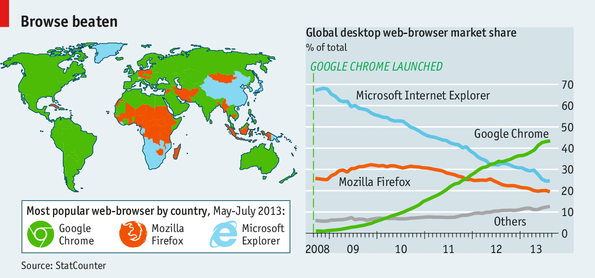
EMPIRES rise and fall swiftly on the internet. Google’s Chrome browser, which celebrates its fifth birthday next month, has captured much of the territory of older browsers and is now responsible for about 43% of all the web traffic generated by the world’s desktop computers. When Chrome was launched the dominant browser was Microsoft’s Internet Explorer (IE), with a 68% share—it is now down to just 25%. It is only 20 years since Mosaic, the first browser capable of combining words and images in a single page, was made available. Some of its developers went on to launch Netscape, an improved version, in 1994, just as the internet was taking off. But Netscape’s dominance quickly crumbled after Microsoft started bundling IE with its Windows operating system. IE and Microsoft’s other software became so prevalent that in 2000 an American court briefly contemplated breaking the company into two. By 2010, when the European Commission forced Microsoft to start offering Windows users a choice of browsers, many were switching anyway, especially to Mozilla’s Firefox. Now Chrome is increasingly pushing Firefox to the margins. Measuring browser use is difficult and subjective: one source shows that IE is still in front in terms of numbers of visitors to websites. But for e-commerce, share of traffic matters more. By this measure Chrome now dominates much of the planet. Like the boast made of the British empire in Queen Victoria’s time, the sun never sets on its dominions.

This is how Samsung’s “Galaxy Gear” looks like!

013-08-09 14:09

This is how Samsung’s “Galaxy Gear” looks like!

By Ko Dong-Hwan

Samsung Smartwatch

galaxy-watch-gear-2-450 galaxy-watch-gear-3-450 Read more of this post

Chinese tech startup unveiled smartwatch inWatch One with a price tag of $292

Chinese tech startup unveiled smartwatch inWatch

Updated: 2013-08-09 17:09

( technode.com)

0023ae606c3e136ef37d0f Read more of this post

Why the US is turning into a subscription-based economy

Why the US is turning into a subscription-based economy

By Gina Chon @GinaChon August 9, 2013

Rapid changes are taking place in the way people buy things, and companies are reacting accordingly. Increasingly, the US is moving toward a subscription-based economy in which firms will focus less on selling things, and more on gaining recurring customers—a trend seen in companies like Netflix, Zipcar and Spotify. That’s according to Tien Tzuo, an evangelist for the subscription-based economy who built his startup, Zuora, around that philosophy.

Tzuo is CEO of Zuora, a cloud-based billing and finance software company that caters to companies with recurring revenue streams. Tzuo got his training from Salesforce.com, the cloud-based customer management software company, as its 11th employee and was with the firm through its IPO in 2004. Salesforce.com founder Marc Benioff is an investor in Zuora. The name Zuora, by the way, came out of a bag of Scrabble letters used to spell the founders’ last names. The founders pulled from the bag and fiddled with the letters until settling on a URL they liked. The name seemed exotic, says Tzuo, until Quora, the crowdsourced Q&A site, popped up in 2009. Read more of this post

Is beauty subscription e-commerce Asia’s next hot trend?

Is beauty subscription e-commerce Asia’s next hot trend?

August 6, 2013

by Anh-Minh Do

It is well known that women are among the most voracious and influential online groups. They’re online more often, and they are avid purchasers. In Asia, that’s especially true with women, where female web users are making, in every country, more than 60 percent of their online purchases on fashion. That’s right, fashion dominates online spending for women. With stats like these, it’s no wonder that fashion e-commerce in general is taking off. Another specific new niche, beauty subscription e-commerce, is peeking over the horizon. Currently, we’re seeing beauty subscription e-commerce sites emerging from South Korea, where Memebox, which has just over 100,000 users, has generated up to $2 million in revenue. And those guys are headed to Thailand next. In other news, Singapore’s VanityTrove has acquired Vietnam’s Glamyboxand Taiwan’s Glossybox. In Indonesia, Lolabox and BeautyTreats are battling it out with new entrant VanityTrove. In China, there’s MyLuxBox with over 10,000 paying subscribers. In other words, beauty subscription is a huge regional trend, chasing after female e-shoppers. Read more of this post

The Most Remarkable Comeback Story In Internet History Is Located In … Norwalk, Connecticut; Priceline Nears Bubble-Era Record on European Bookings

The Most Remarkable Comeback Story In Internet History Is Located In … Norwalk, Connecticut

HENRY BLODGET AUG. 9, 2013, 10:00 AM 14,203 19

screen shot 2013-08-09 at 9.34.39 am

Proponents and beneficiaries of the Silicon Valley hype machine will often tell you that what matters is “buzz.” You have to get people talking about your company, this story goes. You have to fake it until you make it. You have to create an aura of invincibility and inevitability. You have to get the press swooning and scrambling for interviews and scoops. You have to make your founders and CEO celebrities. You have to own the conference circuit. You have raise ever-bigger pots of money at ever-more-massive valuations. You have to create the perception that you’re going to be the next world-changing moonshot worth quabillions of dollars…and the reality will follow from that. Nope. You don’t have to do any of that. You just have to put up the numbers. If you’re not convinced, take a look at the company that is without a doubt the most remarkable comeback story in the history of the Internet industry. Way back in the 1990s, this company was the hype machine to end all hype machines. It went public in a massive IPO, and its stock valuation immediately shot up to nearly $50 billion. But then the numbers collapsed. And so did the hype. And so did the stock. And so did the company. A couple of years after the peak of the dot-com boom, the company’s stock had fallen 99%. And the company itself had been left for dead. But then an amazing thing happened. The company found a management team that was less interested in “buzz” and “ideas” and “stories” than it was in actual performance. The company stabilized its business, and then went looking for a new growth engine. And found it. And, now, a decade later, with shockingly little fanfare, the company’s value is about to exceed the level it hit back in the wild dotcom days. The company, in other words, is about to be worth $50 billion again. The company is located, of all places, in… Norwalk, Connecticut. The company is, of course, Priceline. And its CEO, Jeff Boyd, is so press shy that you’ve probably never heard of him. A $50 billion company! In Norwalk, Connecticut! That almost no one ever talks about! If ever you needed proof that, over the long haul, perception is NOT reality, reality is reality, Priceline is it. Congratulations to Jeff Boyd and the rest of the team at Priceline. What a remarkable success story.  Read more of this post

PayPal co-founder finds fertile ground for growth with Glow app

August 8, 2013 2:00 pm

PayPal co-founder finds fertile ground for growth with Glow app

By April Dembosky in San Francisco

One of Silicon Valley’s most successful entrepreneurs has had enough of mobile payments and social media – he now wants all the data he can get on ovulation. Max Levchin, the co-founder of PayPal and Slide, is partnering with clinics in the US to promote his new fertility tracking mobile app, Glow, which launched on Thursday. The 38-year-old did not put any of his own money directly into the company but has attracted a $6m investment from his friends at venture capital groups Founders Fund and Andreessen Horowitz. Mr Levchin said he is tapping into an increasing willingness among consumers to track their own health patterns with digital apps and gadgets, including people who want to lose weight or sleep better, but especially women who have trouble conceiving. Read more of this post

Online businesses promoting a ‘sharing economy’ face a regulatory backlash

August 7, 2013 7:02 pm

Start-ups: Shareholder societies

By April Dembosky and Tim Bradshaw

Online businesses promoting a ‘sharing economy’ face a regulatory backlash

For Allison and Dave Shuttleworth, Airbnb has been a financial saviour. When Mr Shuttleworth lost his job at a hospital last year, the income from renting out the spare room in their house in San Francisco through the online rental site replaced his salary. The year before, the side job covered three rounds of in vitro fertilisation, at $15,000 each. They are now considering saving up for another round. For Ms Shuttleworth, who works as an emergency room nurse in her day job, the extra cash has not been easy money. She or her husband gives every guest a 45-minute introduction to the house and the city, maps out bus routes, lays out plush dressing gowns and chocolates and cooks a hot breakfast every morning. “Airbnb is pretty much a full-time job right now, in addition to my full- time job,” she says. “Dave and I are housekeeping, security, concierge, cook, tour guide. We are a five-star establishment.” People have long rented out their spare rooms but anew generation of technology start-ups, driven by easy-to-use software, has made sharing more attractive than ever. People are finding customers to rent not only rooms but office space and seats on car journeys. They are even turning idle assets such as drills and lawnmowers into revenue generators. They are selling their own time, too, hiring themselves out to walk dogs, pick up dry cleaning or assemble Ikea furniture. Read more of this post

At LinkedIn, big data meets human resources

At LinkedIn, big data meets human resources

By Sarah Halzack, Published: August 9

linkedin-WEB

MOUNTAIN VIEW, CALIF. — Every second, more than two more people join LinkedIn’s network of 238 million members. They are head hunters in search of talent. They are the talent in search of a job. And sometimes, the career site for the professional class is just a hangout for the well-connected worker. LinkedIn, using complex, carefully concocted algorithms, analyzes their profiles and site behavior to steer them to opportunity. And corporations parse that data to set business strategy. As the network grows moment by moment, LinkedIn’s rich trove of information also grows more detailed and more comprehensive. Read more of this post

AmazonFresh Is Jeff Bezos’ Last Mile Quest For Total Retail Domination

AMAZONFRESH IS JEFF BEZOS’ LAST MILE QUEST FOR TOTAL RETAIL DOMINATION

AMAZON UPENDED RETAIL, BUT CEO JEFF BEZOS — WHO JUST BOUGHT THE WASHINGTON POST FOR $250 MILLION — INSISTS IT’S STILL “DAY ONE.” WHAT COMES NEXT? A RELENTLESS PURSUIT OF CHEAPER GOODS AND FASTER SHIPPING. THE COMPETITION IS ALREADY GASPING FOR BREATH.

BY: J.J. MCCORVEY

The first thing you notice about Jeff Bezos is how he strides into a room.

A surprisingly diminutive figure, clad in blue jeans and a blue pinstripe button-down, Bezos flings open the door with an audible whoosh and instantly commands the space with his explosive voice, boisterous manner, and a look of total confidence. “How are you?” he booms, in a way that makes it sound like both a question and a high-decibel announcement. Read more of this post

News Corp Australia chief resigns after less than two years; Newspaper publishers have been under pressure in the wake of rapidly falling print circulations and declining advertising revenues, as readers migrate to the internet

August 9, 2013 6:19 am

News Corp Australia chief resigns after less than two years

By Neil Hume in Sydney

Kim Williams, the head of News Corp’s Australian business, has resigned after less than two years in the job and will be replaced by a former newspaper executive. News Corp said Mr Williams would be succeeded by Julian Clarke, a former chairman of its Herald and Weekly Times division, which publishes Australia’s biggest selling paper, Melbourne’s Herald Sun. Newspaper publishers in Australia have been under pressure in the wake of rapidly falling print circulations and declining advertising revenues, as readers migrate to the internet. Read more of this post

Hollywood Takes Spanish Lessons As Latinos Stream to the Movies

August 9, 2013, 10:31 p.m. ET

Hollywood Takes Spanish Lessons As Latinos Stream to the Movies

BEN FRITZ

P1-BM643_LATFIL_G_20130809172107 P1-BM642_LATFIL_NS_20130809164803

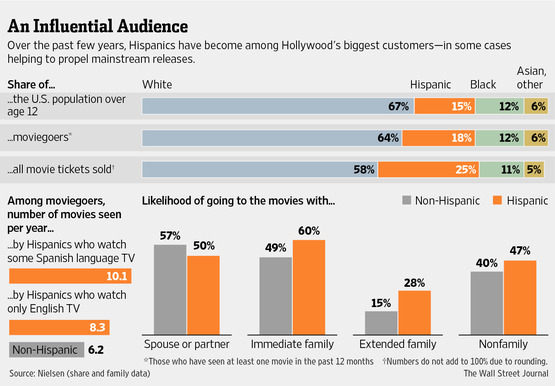
LOS ANGELES—In a small room on the Paramount Pictures lot here, postproduction work is under way on a movie that sounds as derivative as they come: the fourth sequel to “Paranormal Activity.” But flickering on an editor’s monitor are the types of scenes rarely seen in Hollywood: Characters are shown visiting botanicas—storefronts where witchcraft is practiced. One woman tries to cure her possessed grandson by ritualistically rubbing a raw egg on him. Much of the dialogue is in Spanish, with no subtitles. The four previous “Paranormal Activity” films grossed a total of more than $350 million, thanks in large part to packed theaters in Hispanic neighborhoods. Now, with the next installment, “Paranormal Activity: The Marked Ones,” some of the series’ most fervent fans will see people who look and speak like them on screen. The bilingual film, from Viacom Inc.’s VIAB +0.06% Paramount division, marks the first time a big studio has taken a mainstream franchise and spun it into one about Latino characters and culture. Read more of this post

Google Glass likely to be priced at US$299: researcher; The device’s display component supplied by Taiwan-based Himax Display will cost between US$30 and US$35 and will account for the biggest share of the total cost in the near term

Google Glass likely to be priced at US$299: researcher

CNA

2013-08-08

Google’s eyeglass-shaped mobile computing device will likely be priced at an affordable level when it officially goes on sale, a local researcher at the Taipei-based Topology Research Institute said on Wednesday. The Google Glass is expected to carry an initial price tag to consumers of US$299, Topology researcher Jason Tsai told reporters on the sidelines of a local seminar on wearable devices. The device’s display component, which will probably be supplied by Taiwan-based Himax Display, will cost between US$30 and US$35 and will account for the biggest share of the total cost in the near term, he said. Google announced on July 22 that it had agreed to buy a 6.3% stake in Himax Display, which produces liquid crystal on silicon chips and modules used in devices such as the Google Glass, head-up displays and handheld projectors. Read more of this post

Spotify: Eating Google’s Lunch and Loving It; CEO Daniel Ek says music recommendations and discovery are as important as a massive song vault

August 6, 2013, 8:14 p.m. ET

Spotify: Eating Google’s Lunch and Loving It

JOHANNES LEDEL and JOHN STOLL

OB-YL516_SPOTIF_G_20130806232104

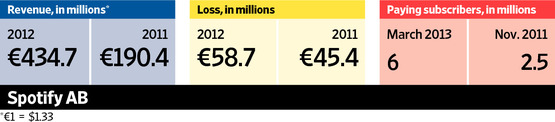
STOCKHOLM—As music lovers turn to cheap streaming services to access songs, some of the most prominent names in tech are crowding in for a piece of the pie. One of the biggest streaming-music sites, Spotify AB, now boasts 20 million songs and 24 million users, a quarter of whom pay about $10 a month for extra features, such as listening on mobile devices. The Swedish company’s revenue more than doubled to €434.7 million ($576.4 million) in 2012, but its loss widened to €58.7 million. A recent fundraising round valued Spotify at $3 billion, but Daniel Ek, the company’s 30-year-old chief executive and co-founder, doesn’t see bigger as better. He believes that music recommendations and discovery are as important as a massive song vault, and has enlisted 200 human curators to organize music for a new browsing feature. Read more of this post

Priceline Travels Road Back to High Hit in Dotcom Era

Updated August 8, 2013, 10:21 p.m. ET

Priceline Travels Road Back to High Hit in Dotcom Era

DREW FITZGERALD

It has taken more than 14 years, but Priceline.com PCLN +0.67% is about to complete a round trip. Fueled by a strong second-quarter earnings report, the company’s stock is closing in on its dotcom-era high after a wild ride that took it from nearly $1,000 a share down into the single digits—and back. The catalyst for the most recent leg was a jump in summer travel bookings, which helped the online airline and hotel reservation service post a 24% increase in profit to $437 million on Thursday. Revenue jumped 27% to $1.68 billion. Bookings surged 38% in the second quarter, driven by strong demand in Asia and resilient spending in Europe. The performance sent shares toward their all-time high. In after-hours trading, Priceline rose 5.4% to $984.04. The stock, which has climbed 50% since the start of the year, hit $990 in 1999, then fell below $10 after the Internet bubble burst. Read more of this post

IBM and others facing the cloudy business of accounting for the cloud

IBM and others facing the cloudy business of accounting for the cloud

By Michal Lev-Ram, writer August 8, 2013: 11:00 AM ET

More questions than answers have been raised about methods used to account for software-as-a-service products.

FORTUNE — Last week’s disclosure that the Securities and Exchange Commission is conducting an investigation into how IBM reports its cloud computing revenue poses more questions than answers. The New York-based tech giant admitted it has been cooperating with the SEC since last May but said little else about the particulars of the case. One thing is clear: It’s likely this won’t be the last probe into the often inconsistent methods used to account for software-as-a-service products. Read more of this post

EBay’s John Donahoe on E-Commerce and Mobile Payments’ Future

EBay’s John Donahoe on E-Commerce and Mobile Payments’ Future

By Brad Stone on August 08, 2013

What’s the next set of goals, beyond returning to growth?
In the eyes of the consumer, e-commerce and retail are now one. It’s just shopping, right? And that’s why you see us taking steps to get more involved in the full commerce environment. An example would be EBay (EBAY) doing one-hour delivery. You buy online, but you get it delivered to you from an offline store. Another example would be PayPal being accepted by offline merchants. Read more of this post

Kiwi IT-millionaire Tim Williams was the first foreigner to list a company ValueCommerce on the Japanese stock exchange

Tim Williams: Japan’s Internet Pioneer

By Skye Wishart, July 22, 2013 @ 11 am

Kiwi IT-millionaire Tim Williams was the first foreigner to list a company on the Japanese stock exchange – a wild ride that taught him business and gave him a lifelong bent to jump into an unfamiliar industry. We interviewed him in the lead up to his role as a judge in the New Zealand International Business Awards 2013. Twenty-three-year old molecular geneticist Tim Williams’ plan was not to jump into IT, but to study Chinese medicine in Beijing – and strike it rich by engineering the raw components. But on the way over there, a stop-off in Japan foiled his plans – he loved the culture and stayed, teaching English for a couple of years. That is, until he met fellow Kiwi Jonathan Hendriksen, and together they decided to start a business in internet hosting. Back in 1996, the Internet was still quiet in Japan, and the boys set up the first domestic rental server company in the country. Read more of this post