The future of advertising agencies: Omnipotent, or omnishambles? Omnicom and Publicis are combining to try to stay on top of a rapidly changing industry, but sheer size will be no guarantee of success

The future of advertising agencies: Omnipotent, or omnishambles? Omnicom and Publicis are combining to try to stay on top of a rapidly changing industry, but sheer size will be no guarantee of success

Aug 3rd 2013 | LONDON AND NEW YORK |From the print edition
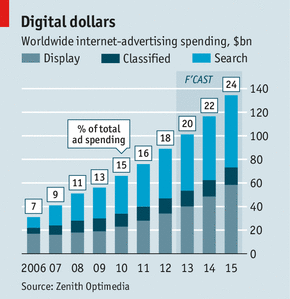
20130803_WBC166

CROSS-COUNTRY deals in the advertising industry can be painful affairs. Look what happened to Guy MacKendrick, the young executive sent by his London-based agency to oversee its acquisition of a New York rival, in “Mad Men” (yes, it is now compulsory to refer to the hit television series in all articles about the ad business). The staff throw a party to celebrate the takeover, and a drunken secretary drives a lawnmower through the office, shredding Mr MacKendrick’s foot.

On July 28th, however, there were no bizarre gardening accidents as executives of two real-life advertising firms toasted their merger with champagne in Paris. Maurice Lévy, the boss of the French Publicis Group, and John Wren, the head of its American competitor Omnicom, toasted the birth of Publicis Omnicom, which will overtake British-based WPP as the world’s largest advertising and marketing agency, with combined 2012 revenues of $23 billion and a market value of $35 billion. Read more of this post

The New Explosion in Audio Books; People are buying audio books to listen to, syncing them with their Kindles, and snapping up original audio-only productions

Updated August 1, 2013, 7:41 p.m. ET

The New Explosion in Audio Books

How They Re-emerged as a Rare Bright Spot in the Publishing Business

ALEXANDRA ALTER

For a new generation of readers, the best way to devour a book may be to not read it at all. Alexandra Alter joins Lunch Break to explain the new surge in audio books

Cory Wilbur, a 25-year-old software engineer in Boston, never used to read much. He barely cracked a book in college and would read one or two a year on vacation, at most. But in the past year, he’s finished 10 books, including Dan Brown’s “Inferno,” Walter Isaacson’s biography of Steve Jobs and George R.R. Martin’s fantasy series “A Song of Ice and Fire.” He listens to audio books in snippets throughout the day on his iPhone during his morning workout, on his 20-minute commute to work, and while he’s cooking dinner or cleaning up. Before he falls asleep, he switches to an e-book of the same story on his Kindle, and starts reading right where the narrator left off. “I fly through a lot more books than I used to,” Mr. Wilbur said.

Read more of this post

Tipping point for media viewing as couch potatoes go digital; US digital media use overtakes TV viewing

Last updated: August 1, 2013 8:14 pm

Tipping point for media viewing as couch potatoes go digital

By Emily Steel in New York

The amount of time people in the US spend consuming digital media is set to overtake hours spent watching television for the first time this year, marking a significant tipping point in the shift away from traditional forms of media. The average adult will spend five hours and nine minutes a day online or consuming other types of digital media this year, an increase of 38 minutes or 16 per cent compared with 2012, according to new estimates from eMarketer. The amount of time spent watching TV is projected to fall by seven minutes to four hours and 31 minutes. Read more of this post

Asian mobile chat apps challenge western dominance; “When you use Asian mobile chat apps, you have a certain sense of joy and fun communicating with your loved ones, whereas western apps focus more on pure functionality”

August 1, 2013 1:56 pm

Asian mobile chat apps challenge western dominance

By Ben Bland in Jakarta, Nguyen Phuong Linh in Hanoi and Simon Mundy in Seoul

Nguyen Tung Lam, a 16-year-old high school student in Hanoi, uses Japanese mobile messaging service Line to chat with his girlfriend because she “likes the cute icons such as the teddy bear and bunny”. Doan Nguyen Trang, another Vietnamese teenager, prefers South Korea’s KakaoTalk app because it is promoted by a wildly popular Korean boy band. “I use KakaoTalk because Big Bang also use it and they are number one; I love them,” says the 14-year-old. KakaoTalk, Line and WeChat, a mobile messaging app developed by China’s Tencent, are spending tens of millions of dollars on television advertising, online promotions and celebrity endorsements as they fight for the attention of tech-savvy southeast Asian teenagers. Read more of this post

Andreessen-Backed Tutor Matching Service Is Working With Colleges To Upend The Tutoring Industry, Starting With Cost

Andreessen-Backed Tutor Matching Service Is Working With Colleges To Upend The Tutoring Industry, Starting With Cost

RIP EMPSON

posted 7 hours ago

Of the many ways that technology is disrupting education, one area that’s changing a lot, is rife with potential, but doesn’t get as much play as it should is tutoring. Mostly, this involves the attempt to make high-quality, local tutors accessible to a wider range of students online, without having to turn to traditional channels, like Craigslist or those pesky, expensive SAT-focused private networks. There are a million marketplaces for tutors, and many startups that have joined in the struggle to make connecting with quality tutors possible, from TutorspreeIAC’s Tutor.com and the increasing number of services like StudyBlue to WyzAnt and Chegg. But a new startup is launching out of beta today with backing from Andreessen Horowitz and others that wants to help push the space forward by creating a tutoring marketplace that is not only affordable for students but is a sort of official “Tutor List” for universities.

Read more of this post

Upworthy Goes Viral by Optimizing Optimism; Upworthy attracted 26 million unique views in May by testing headlines and using social media to promote its content

Upworthy Goes Viral by Optimizing Optimism

By Sam Grobart on August 01, 2013

tech_upworthy32__02inline__405

Doctors gave Zach Sobiech bad news just after his 17th birthday last year: His rare bone cancer had progressed so far that he had only a year to live. In December, Sobiech posted a music video of Clouds, a song he wrote and recorded about struggling with the disease. He became the subject of a short online video documentary, which garnered tens of thousands of views after being featured on FoxNews.com (FOX) and People.com (TWX). Sobiech died on May 20. Then the editors at viral-media site Upworthy saw the documentary. They repackaged it with the headline “This Kid Just Died. What He Left Behind Is Wondtacular.” Since then more than 15 million people have watched the documentary on Upworthy, which aggregates and popularizes videos and other online content. Sobiech’s song went to No. 1 on Apple’s(AAPL) iTunes Store, and a link Upworthy put next to the video raised more than $300,000 for cancer research. “The whole Internet heard his story,” says Upworthy co-founder Peter Koechley. Read more of this post

SAP Invades Silicon Valley via Acquisitions

SAP Invades Silicon Valley via Acquisitions

By Matthew Campbell and Aaron Ricadela on August 01, 2013

German software giant SAP (SAP), the 41-year-old maker of financial and supply-chain software, has been slow to shift to cloud computing and has struggled for years to catch up to U.S. competitors such as Oracle (ORCL) and Salesforce.com(CRM). Among other things, it’s broken some of its brightest engineers into startup-like teams far from its main campuses. While waiting for them to spawn new products, the company is doubling down on plan B, for “buyout.” Read more of this post

Instead of buying expensivekaraoke equipment bundled with soon-to-be-outdated tunes, iKala reinvents karaoke via the internet so users can enjoy it on their Samsung and LG smart TVs, PCs, and mobile devices (iOS and Android)

How a Taiwanese Startup is Riding on Asia’s Karaoke Culture

August 2, 2013

by Willis Wee

Founded in 2007, Taiwan’s iKala is a cloud-based online karaoke service. Instead of buying expensivekaraoke equipment bundled with soon-to-be-outdated tunes, iKala reinvents karaoke via the internet so users can enjoy it on their Samsung and LG smart TVs, PCs, and mobile devices (iOS and Android). Today, iKala has grown to become a 36-person team, serving around 600,000 users and with about five percent of them paying NT$129 ($4.30) each month for its premium service to have full access to the song library (which includes several thousand tunes in Chinese and English). Alternatively, users can just pay $1 to sing for an entire day. On average, each user spends about 10 minutes a day singing and sharing their creations (users can also record and upload their singing). About half of them visit iKala on mobile and another half from the web.

Read more of this post

How Tiket Became Indonesia’s Biggest Ticketing Platform In Under 2 Years

How Tiket Became Indonesia’s Biggest Ticketing Platform In Under 2 Years

July 31, 2013

by Dewi Yuliani

Tiket1

Tiket is one of the biggest players in the online travel industry and has become an award winning platform for hotel, flight, and train ticket booking online in Indonesia. We just heard that June 2013 is definitely the best month for Tiket. Why? The Tiket teams reveals that it brought in more revenue last month (June) than it did in the whole of 2012. Natali Ardianto, the co-founder and CTO of Tiket was excited to say that “the growth is exponential!” and he also shared more figures with us. Read more of this post

As time goes on, our Google Dashboards will tell us more and more about who we are, and who we were.

July 31, 2013, 12:37 PM

64,019 Searches: A Dark Journey Into My Google History

By Tom Gara

Corporate Intelligence is the WSJ’s business news blog. Follow it on Twitter,@WSJCorpIntel, or its editor, @tomgara

ivsLwRW

Let’s run through a little thought experiment. Imagine there’s a list somewhere that contains every single webpage you have visited in the last five years. It also has everything you have ever searched for, every address you looked up on GoogleGOOG +1.86% Maps, every email you sent, every chat message, every YouTube video you watched. Each entry is time-stamped, so it’s clear exactly, down to the minute, when all of this was done. Now imagine that list is all searchable. And imagine it’s on a clean, easy-to-use website. With all that imagined, can you think of a way a hacker, with access to this, could use it against you? And once you’ve imagined all that, go over to google.com/dashboard, and see it all become reality. Read more of this post

Financial-technology firms: Tech start-ups promise to transform finance, if regulators will let them

Financial-technology firms: Tech start-ups promise to transform finance, if regulators will let them

Aug 3rd 2013 |From the print edition

20130803_LDC174_0

TWO millennia after the Temple was cleansed of money-changers, the Archbishop of Canterbury, Justin Welby, plans to open his churches to moneylenders. This is no capitulation in the struggle between God and Mammon. It is an effort to “compete out of existence” payday lenders that offer expensive loans by supporting not-for-profit credit unions.

The archbishop is right that more competition is needed, but old-fashioned credit unions are unlikely to be able to beat the slick systems and snappy service of online providers, like Wonga. A more effective way of pushing down rates would be lighter regulation to allow more lenders to flourish. Read more of this post

New Zealand Pushes Technology to Head Off Mislabeling of Meat; Producers Work to ‘Fingerprint’ Products as Mislabeled and Tainted Food Eat Into Customer Confidence

July 31, 2013, 11:01 p.m. ET

New Zealand Pushes Technology to Head Off Mislabeling of Meat

Producers Work to ‘Fingerprint’ Products as Mislabeled and Tainted Food Eat Into Customer Confidence

LUCY CRAYMER

AI-CC640_NZMEAT_G_20130801040306

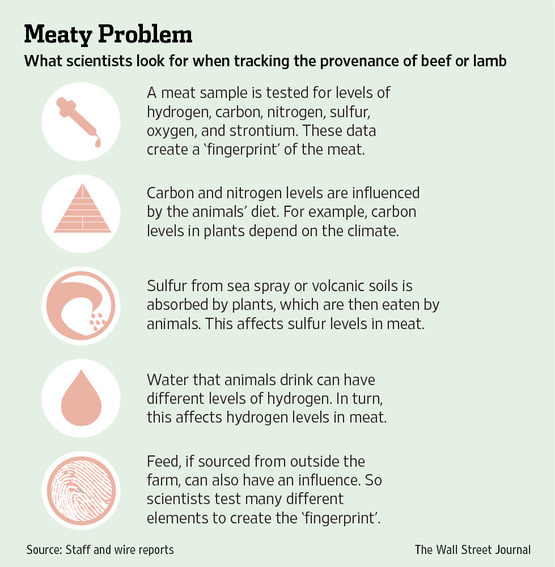
WELLINGTON, New Zealand—Beef and lamb producers are at the forefront of a global push to try to verify scientifically the provenance of the meat that people buy, as a series of scandals over mislabeled and tainted food eat into consumer confidence. Farm groups from the highlands of Scotland to the pastures of New Zealand are investing in technology that tries to “fingerprint” meat by looking for chemical traces of the soil, grass, water and air where the animals once roamed. The move shows how economies dependent on farm income are battling to retain their reputation for high quality—and their premium prices—in an increasingly complex and opaque global food chain. Read more of this post

Snapchat Lawsuit Details How One Founder Discovered He Had No Equity In The Company — Which Is Now Worth $800 Million

Snapchat Lawsuit Details How One Founder Discovered He Had No Equity In The Company — Which Is Now Worth $800 Million

JIM EDWARDS JUL. 31, 2013, 7:06 PM 3,872 6

brown-may-8-2012-email-copy

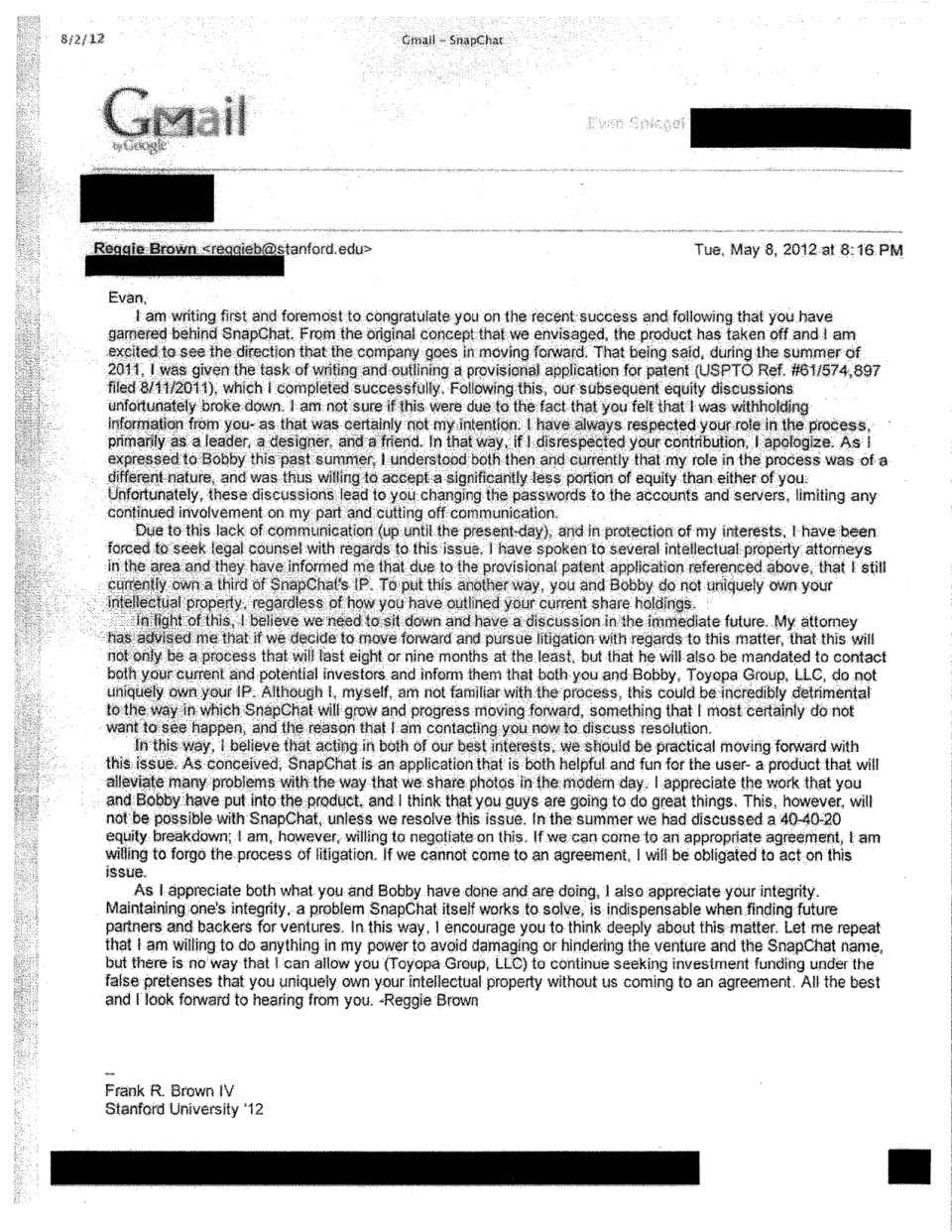
Frank “Reggie” Brown, the ousted third alleged founder of Snapchat, never had equity in the company even though he allegedly came up with the idea for the disappearing messages app, filed for its patent, and had some role in designing the company’s logo, according to Techcrunch. Brown is suing CEO Evan Spiegel and CTO Bobby Murphy for one third of the super-hot company, which is valued at $800 million. The story is complicated, as lawsuits tend to be. Basically, Brown was intimately involved with the founders of Snapchat right at the beginning. How much work he actually did for the company is in dispute. Read more of this post

Amazon Is Raking In A Huge Amount Of Profit On Its Cloud, Competitor Says

Amazon Is Raking In A Huge Amount Of Profit On Its Cloud, Competitor Says

JULIE BORT JUL. 31, 2013, 7:31 PM 1,886 3

Amazon is notoriously tight-lipped when talking about its cloud business. It’s cloud prices are cheap and the company has vaguely said it keeps prices low by charging a low margin of profit. But the folks at cloud computing competitor ProfitBricks say that Amazon’s low margins are a myth. They say that the company is really making 60-80% profit. To prove that, ProfitBricks cut its prices in half on Wednesday, to a measly 3.25 cents an hour for compute time including 1G RAM (yes, less than 4 cents). And it says at that rate, it’s still making plenty of profit. This compares to somewhere between 6 cents and 60 cents an hour for Amazon.  Read more of this post

The trouble with Zuckism

The trouble with Zuckism

KEVIN KELLEHER 
ON JULY 31, 2013

zuckism1

If no one ever complained about lies, damn lies, and anecdotal evidence, it’s because no one ever had to. Our reliance on numbers, math, and the order they impose on the messier parts of the business world make stats necessary, if sometimes also the subject of skepticism. Whenever we feel especially skeptical, we lean on anecdotal evidence as a kind of correction. A pretty much imperfect correction. Read more of this post

Fab.com Raises $10M From Singaporean Telecom Giant SingTel at $1 billion valuation; Fab.com’s layoffs in Europe also come at a time when some reports have been critical of Fab.com’s missteps, as well as its company highhanded culture

Eyeing Potential Growth In Asia, Fab Raises $10M From Singaporean Telecom Giant SingTel

LEENA RAO

posted 2 hours ago

Amidst layoffs, and shortly following a new $150 million round in new funding, Fab is announcing an additional contribution to its Series D round of financing. Singaporean telecommunications giant SingTel Group has put $10 million into Fab, and according to the design-focused ecommerce company, the Asian company will will be a key partner wIn helping Fab explore expansion opportunities in Asia. CEO and co-founder Jason Goldberg explains that SingTel will be instrumental in helping Fab expand to Asian markets. He writes: He also addressed some of the changes taking place at the company, namely the layoffs and ditching the flash sales model: Most importantly, we announced the centralization of our operations at our New York headquarters, underscoring our shift from a flash sales model to more of a comprehensive global online lifestyle shop. We have momentum, we have growth, we have a solid team in place, and we have millions of customers worldwide that we want to continue to fall in love with Fab.SingTel has a lot in common with Fab – they serve a growing, young, and sophisticated population of consumers who are looking for lifestyle products to reflect their optimistic, dynamic and vibrant approach to life. That matches well with the predominantly 25-45-year-olds who come to Fab to browse and buy unique and compelling items they’ll live with in their homes, wear, and gift. Read more of this post

New Tools for Keeping the Lights On; New instruments have been installed to try to prevent another huge power failure like the one that cut off electricity for 50 million people in 2003

July 31, 2013

New Tools for Keeping the Lights On

By MATTHEW L. WALD

RENSSELAER, N.Y. — After the lights went out for 50 million people from the Northeast to the Midwest on Aug. 14, 2003, investigators found readings from two obscure instruments that would have given them an hour’s warning — plenty of time to solve the problem if the devices had been wired to provide a stream of critical data. Now, a decade after the largest blackout in American history, engineers are installing and linking 1,000 of those instruments, called phasor measurement units, to try to prevent another catastrophic power failure. When the work is done, the engineers say, they will have a diagnostic tool that makes the old system seem like taking a patient’s pulse compared with running a continuous electrocardiogram. Read more of this post

Chromecast, Simply and Cheaply, Flings Web Video to TVs

July 31, 2013

Chromecast, Simply and Cheaply, Flings Web Video to TVs

By DAVID POGUE

POGUE-JP1-articleLarge

A demonstration of Google’s Chromecast, which can display Netflix and YouTube on your television.

Ever hear the old saying, “Information wants to be free?” Well, here’s a corollary for you: “TV wants to be à la carte.” Take the story of the iTunes store. The instant somebody offered the chance to buy songs individually, the world changed forever. Hello, music à la carte. Goodbye, Tower Records. Now it’s cable TV’s turn. We are engaged in a great civil movement, testing whether that business, or any business so conceived and so dedicated, can long endure. The number of people who cut the cord, or cancel the satellite, in favor of getting all their TV from the Internet is still small — maybe 1 percent of us a year. But the online alternatives to cable TV are growing. And once it becomes simple and easy to get Internet video from our laptops and phones to the actual television, well, the term “TV drama” will have a whole new meaning. Read more of this post

Chinese mobile games: fit to burst?

Chinese mobile games: fit to burst?

Jul 31, 2013 4:23pm by Lydia Guo

Shanghai is having a particularly hot summer this year but that didn’t stop game lovers by the tens of thousands from queuing up to get into ChinaJoy 2013 – The 11th China Digital Entertainment Expo & Conference. “Everyone was talking about mobile games this year,” says Xue Yongfeng of consulting firm Analysys. He says China’s mobile games industry is booming – creating a bubble that’s likely to burst next year. The mobile games industry developed quickly in 2012. Sun Shoushan of China’s Administration of Press, Broadcasting Stations and Radio said in a speech at the event that revenues had surged more than 90 per cent to Rmb3.24bn ($530m); in the first half of this year, revenue from mobile games more than doubled. Read more of this post

Old newspaper era is over, Obama says via Kindle

Old newspaper era is over, Obama says via Kindle
He says the old way of doing business is gone forever.

AFP | 01-08-13

WASHINGTON – President Barack Obama acknowledged the problems facing the US newspaper industry on Wednesday, ironically in an interview that was distributed via online retail giant Amazon’s Kindle e-reader. With the Internet dominant and print sales in decline, Obama said traditional media was grappling with a new reality and, much like the manufacturing and retail sectors, the old way of doing business was gone forever. “People trying to get into the middle class are having a tougher and tougher time,” Obama said. “You see that in every profession. You see that in journalism. It used to be there were local newspapers everywhere. “If you wanted to be a journalist, you could really make a good living working for your hometown paper. “Now you have a few newspapers that make a profit because they’re national brands, and journalists having to scramble to piece together a living, in some cases as freelancers and without the same benefits that they had in a regular job for a paper.” The US newspaper industry has suffered the same problems which have hit papers worldwide, notably falling sales and a collapse in advertising revenues due to the growth of online classified ads. Several major metropolitan newspapers have closed their doors in recent years or ceased publishing print editions. Others have slashed editorial staff. “What’s true in journalism is true in manufacturing and is true in retail,” Obama said. “What we have to recognise is that those old times aren’t coming back.”

Sina Weibo’s Failure: Why Chinese Companies Should Take the Rest of the World Seriously

Sina Weibo’s Failure: Why Chinese Companies Should Take the Rest of the World Seriously

July 29, 2013

by C. Custer

Last week, we reported that Sina Weibo has added Facebook login to its service to make it easier for overseas users to sign up. My response? Way too little, way too late. A couple of years ago, Weibo was buzzing. Even outside China, lots of people were talking about it. But despite the interest from overseas pundits, brands, and social media watchers, Sina made pretty much no attempt to make the service accessible to anyone other than Chinese people. It didn’t even bother to localize the service in other languages (which would have been easy), let alone push more strongly into any new markets. And at the time, everyone seemed to think that made a lot of sense. China’s market, after all, was gigantic and still growing. Why should Sina even bother with foreigners when there was so much work still to be done in the Chinese market? Read more of this post

Silicon Valley or Demand Mountain?

Silicon Valley or Demand Mountain?

Edward Jung, former Chief Architect at Microsoft, is Chief Technology Officer at Intellectual Ventures.

24 July 2013

BELLEVUE, WASHINGTON – Everyone wants to know how to build the next Silicon Valley: an innovation hub that draws talent and capital, and that creates jobs, companies, and whole new industries. Developed-country governments scramble to subsidize technology that could be the Next Big Thing. Emerging-market policymakers hope that incentives like tax breaks and free land will induce innovators to settle and prosper there. But most of these well-meaning schemes are missing an essential ingredient: demand. Read more of this post

IBM Says SEC Investigating Its Cloud-Computing Revenue Figures

IBM Says SEC Investigating Its Cloud-Computing Revenue Figures

International Business Machines Corp. (IBM) said the Securities and Exchange Commission is investigating how it reports revenue from offsite cloud-computing services. IBM is cooperating with the SEC in the probe, which it learned about in May, it said today in a filing, without providing further details. Revenue from cloud services, such as storing clients’ data and software applications remotely, rose 70 percent in the first half of 2013 from a year earlier, it said in the filing, repeating a figure it has disclosed before. IBM Chief Executive Officer Ginni Rometty has identified cloud computing as one of the company’s chief sources of growth amid a slowdown in demand for services such as consulting. The Armonk, New York-based company is banking on such faster-growing markets, along with buybacks and acquisitions, to help reach profit of $20 a share by 2015, up from $15.25 last year. IBM fell as much as 1.3 percent in early trading today. It had closed yesterday little changed at $196.01.

To contact the reporter on this story: Crayton Harrison in New York at tharrison5@bloomberg.net

As Work Habits Change, Software Makers Rush to Innovate

July 30, 2013

As Work Habits Change, Software Makers Rush to Innovate

By QUENTIN HARDY

Every day, millions of office workers prepare memos and reports using scissors and paste, and store data on floppy disks, though they have plenty of digital memory in their computers and the cloud. Smartphone-toting executives have their mail dumped into in-boxes, one corporate message atop another.

They are not using these objects, of course, but clicking on the pictures of them in popular word-processing programs like Microsoft Word or Google Docs. The icons linger like vestigial organs of an old-style office, 31 years after I.B.M.’s personal computer brought work into the software age. They symbolize an old style of office software, built for the time when the desktop computer was new and unfamiliar. Read more of this post

Biotech growth fuels need for sophisticated software

Biotech growth fuels need for sophisticated software

BY STEVEN OVERLY

THE WASHINGTON POST

JUL 30, 2013

WASHINGTON – When Qiagen scooped up Ingenuity Systems this year, the acquisition of the Redwood City, California-based firm marked the first time the biotechnology giant had purchased a firm that exclusively makes software. The purchase allows Qiagen to analyze information it derives from the genetic maps of organisms, which can be used to detect variations and mutations that point to the cause of certain diseases or new ways to treat them. The deal is indicative of the increasing interdependency of the life-science and information-technology industries. Read more of this post

ICar Dream Downsizes to Dashboards as Apple Takes on Foes

ICar Dream Downsizes to Dashboards as Apple Takes on Foes

While Steve Jobs regretted not making an iCar, Apple Inc. (AAPL) for years was ambivalent about the auto industry. Now it’s vying for dashboard space held by Microsoft (MSFT) Corp., BlackBerry Ltd. and Pandora Media Inc. (P)

By year end carbuyers will be able to choose from several vehicles that incorporate Apple’s iPhone functions, using Siri voice controls for navigation, texting, e-mails and music. Displacing competitors in the car may be more difficult than in desktop computing or mobile phones, as the technology giant grapples with challenges including extreme temperatures, noisy cabins and long product cycles. Read more of this post

Armed with billions in cash and promising advanced features, Intel, Google, Apple and Sony are gunning to take on cable, phone and satellite companies by offering pay TV via the Web. TV networks are “deathly afraid”

Silicon Valley’s Bid for $100 Billion Slowed by Hollywood

Armed with billions in cash and promising advanced features, Intel Corp. (INTC), Google Inc. (GOOG), Apple Inc. (AAPL) and Sony Corp. (6758) are gunning to take on cable, phone and satellite companies by offering pay TV via the Web.

The tech giants plan to use existing cable, fiber and wireless networks, just as Netflix does, to offer Web-based TV in living rooms and on tablets and smartphones. In just the latest sign of change in TV viewing, Google last week introduced Chromecast, a $35 device that lets mobile-phone and tablet owners watch YouTube and Netflix on their TV sets. Read more of this post

Steve Jobs Spurs Harvard MBA to Ditch McKinsey for China Website

Steve Jobs Spurs Harvard MBA to Ditch McKinsey for China Website

Qin Zhi says Steve Jobs’s “Stay Foolish” commencement speech at Stanford University in 2005 was so inspiring, the Harvard MBA left his consulting job at McKinsey & Co. in New York for an Internet startup in China.

“After reading those words I thought to myself what I was doing then was absolutely not my passion,” Qin, now chief executive officer of Autohome Inc., which operates China’s largest vehicle-comparison website, said in an interview last week in Beijing, where he was born. “What I did had no risks and I felt like I was wasting my life. So I decided to seek a change.” Six years after joining Autohome in 2007 as employee No. 38, Qin has helped oversee a 100-fold increase in revenue that topped 1 billion yuan ($163 million) last year. Today, the company employs more than 1,000 people and its namesake website attracts an estimated 6 million unique users a day, about double that of the online car section of top Chinese Internet company Tencent Holdings Ltd. (700). Read more of this post

In the post-PC era, is Microsoft toast?

In the post-PC era, is Microsoft toast?

July 30, 2013 – 9:53AM

Timothy B. Lee

Microsoft’s Surface: Tablet computing is an example of what Harvard business guru Clay Christensen dubs a disruptive innovation. 

When Microsoft announced its financial results for the second quarter, the market panicked. The firm’s stock dropped 10 per cent in after-hours trading, even though revenue and profits both topped their numbers from the second quarter of 2012. Why did the market freak out? The biggest reason was that Microsoft booked a $US900 million charge for “inventory adjustments” for its Surface tablets. In plain English, Microsoft admitted that its heavily promoted tablet is selling poorly. And that’s an ominous sign for the firm’s long-term prospects. Tablets and smartphones are the future of computing, and Microsoft is falling farther behind the market leaders, Apple and Google. Read more of this post

Digital camera makers are coming to realize they will have to adapt to a world where smartphones trump the classic point-and-shoot

July 29, 2013, 9:13 p.m. ET

The Point-and-Shoot Camera Faces Its Existential Moment

As More Users Opt for Smartphones, Companies Wonder What’s Next

DAISUKE WAKABAYASHI

MK-CF118_JCAMER_NS_20130729183606 MK-CF119_JCAMER_NS_20130729183610

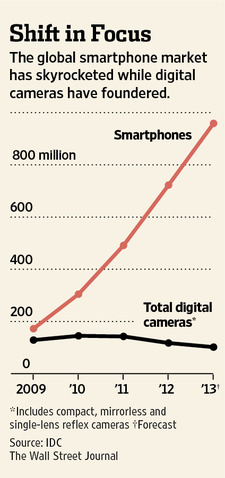
The compact digital camera is fading fast. As global shipments plummet—down 42% in the first five months of 2013, according to the Camera and Imaging Products Association, a Tokyo-based industry group—manufacturers are scrambling to adapt to a world where customers value the convenience of smartphones for quick shots they can share on social networks likeFacebook FB +4.18% and Instagram. The changes are forcing some of the biggest camera makers, including Fujifilm Holdings Corp. 4901.TO +1.11% and Panasonic Corp., to pare product lines and adapt offerings. Some are choosing to focus on more high-end cameras as interest in the classic compact, or “point-and-shoot,” fades.

Read more of this post