Alibaba Duels With Tencent for Online Dominance in China

Alibaba Duels With Tencent for Online Dominance in China

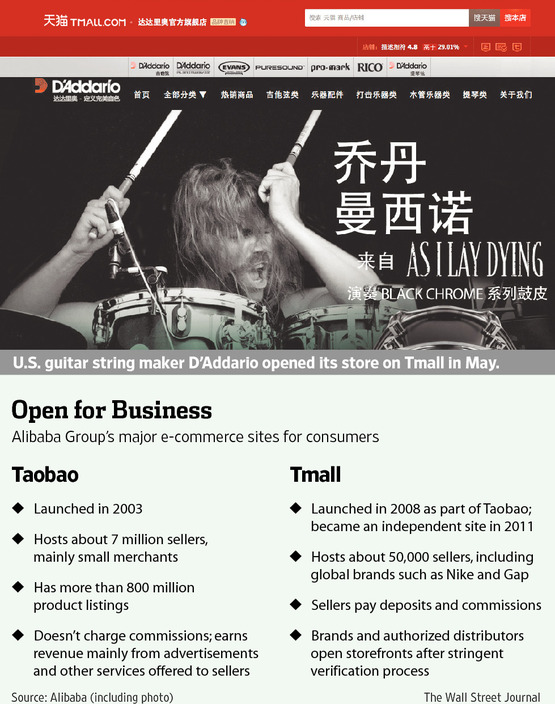
Two of China’s richest men are intensifying their rivalry over the world’s biggest Internet market. Jack Ma’s Alibaba Group Holding Ltd., the country’s largest e-commerce company, on Aug. 1 said it blocked Tencent Holdings Ltd. (700)’s WeChat to sellers. Four days later, billionaire Pony Ma’s Tencent introduced online payment features to mainland China users of its WhatsApp-like chat software. Alibaba is headed for what may be the biggest initial share sale since Facebook Inc., while Tencent is China’s biggest Internet company, with more than 300 million users for WeChat, which started in 2011. Both have made purchases and encroached on each other’s established markets in the battle for dominance of the country’s online spending. McKinsey & Co. estimates China’s Internet retail will triple to $395 billion from 2011 to 2015. Read more of this post


South Korea Newspaper Hankook Ilbo Media Group Owner Arrested for Embezzlement

South Korea Newspaper Owner Arrested for Embezzlement

By Agence France-Presse on 9:31 am August 6, 2013.
Seoul. Police have arrested the chairman of one of South Korea’s major newspapers on charges of embezzling millions of dollars, prosecutors said Tuesday. Chang Jae-Ku, owner of the Hankook Ilbo media group which includes several well-known dailies, magazines and a cable channel, was arrested on Monday night. Chang, 65, is accused of embezzling company funds worth 13 billion won ($11.6 million) for his personal use and causing the group a further financial loss of 30 billion won by offering business benefits to his creditors. The labour union of the Hankook Ilbo — the group’s flagship newspaper — had asked Seoul prosecutors to investigate Chang back in April. The management responded by firing the paper’s editor-in-chief, banning most unionised reporters from entering the newsroom and withholding their salaries. The group — the longtime organizer of the Miss Korea beauty pageant — has suffered financial troubles for years.


Don Graham: Here’s Why My Family Just Sold The Washington Post, A Paper We’ve Owned For 80 Years; Bezos Outbid A Half-Dozen and was deemed the “highest and best”

Don Graham: Here’s Why My Family Just Sold The Washington Post, A Paper We’ve Owned For 80 Years

ALYSON SHONTELL AUG. 5, 2013, 5:22 PM 2,648 1

Don Graham, former owner of The Washington Post, wrote a letter to the paper’s employees about his family’s tough decision to sell the news property they’ve owned for 80 years. Here it is, below:

All,

I have a most surprising announcement. Our company is making it public right now that we have sold The Washington Post to Jeff Bezos, the founder of Amazon. To be clear, the buyer is not Amazon, but a company owned by Jeff personally. The price is $250 million and what we are selling includes the weekly papers called for shorthand The Gazettes and Robinson Terminal… This leaves me with two questions: why are we selling and why to Jeff? The first question is much the harder. All the Grahams in this room have been proud to know since we were very little that we were part of the family that owned The Washington Post. We have loved the paper, what it stood for, and those who produced it. But the point of our ownership has always been that it was supposed to be good for the Post. As the newspaper business continued to bring up questions to which we have no answers, Katharine and I began to ask ourselves if our small public company was still the best home for the newspaper. Our revenues had declined seven years in a row. We had innovated and to my critical eye our innovations had been quite successful in audience and in quality, but they hadn’t made up for the revenue decline. Our answer had to be cost cuts and we knew there was a limit to that. We were certain the paper would survive under our ownership, but we wanted it to do more than that. We wanted it to succeed.

Don  Read more of this post

Accounting For Pensions, The Boston Globe Sold For Negative $40 Million, 20 Years After Selling For $1.1 Billion

Accounting For Pensions, The Boston Globe Sold For Negative $40 Million, 20 Years After Selling For $1.1 Billion

MATTHEW YGLESIAS, SLATE AUG. 5, 2013, 8:26 AM 1,306 4

Like everyone else I’ve seen the headlines remarking on the fact that a New York Times Company which bought The Boston Globe for over a billion dollars is selling it this weekend for just $70 million. But if you read the body text of those articles you’ll see that the paper actually sold for much less than $70 million. It in fact sold for a negative quantity of money. That’s because the terms under which John Henry is buying the paper stick the New York Times Company with the Globe‘s pension obligations, which are said to amount to around $110 million. Which is to say that the worth of the overall Globe enterprise is negative $40 million, not $70 million. That’s shocking. What’s even more shocking is that the Globe has been doing great journalism—winning Pulitzers, etc.—and even turning a modest profit. But that’s the difference between a growing industry (where Tumblr can sell for $1 billion with no profits or even meaningful revenue in sight) and a shrinking one.

Bezos In 2012: People Won’t Pay For News On The Web, Print Will Be Dead In 20 Years

Bezos In 2012: People Won’t Pay For News On The Web, Print Will Be Dead In 20 Years

GREGORY FERENSTEIN

posted 8 hours ago

Before Jeff Bezos bought the Washington Post for $250 million, he had some choice words for the ailing print news industry. In a wide-ranging interview with the German paper, Berliner-Zeitung, the newly-minted media mogul said at the time that no one would bother paying for news online and print would be dead in 20 years (translation from our awesome writer, Frederic Lardinois). “There is one thing I’m certain about: there won’t be printed newspapers in twenty years. Maybe as luxury items in some hotels that want to offer them as an extravagant service. Printed papers won’t be normal in twenty years.” said Bezos. That’s a pretty long timeline (think what happened in technology since 1993), but it does given an indication that Bezos may pressure his new newspaper to accelerate abandonment of their print version. Read more of this post

3D printing reaches tipping point; 3D printing was used in the Melbourne production of King Kong

3D printing reaches tipping point

August 1, 2013

Larissa Ham

Once cost-prohibitive, 3D printing is now affordable and becoming mainstream.

Kong-620x349

3D printing was used in the Melbourne production of King Kong. Photo: Photo by James Morgan/Global Creatures

He’s now a mammoth, six-metre-high gorilla pounding the boards at Melbourne’s Regent Theatre, but the latest version of King Kong had his features fine-tuned inside a small 3D printer. “There was a lot of debate about how he was going to look – not only his body but his face as well,” says Domenic Di Giorgio, head of digital design at The Creature Technology Company. “He had to convey so much emotion during the performance.” In the past, the West Melbourne business fashioned its maquettes – or small models – from clay, laboriously changing small details until it finally got the design right. However, thanks to the growing quality and affordability of 3D printers, designers are able to tinker with countless iterations of their creatures. Read more of this post

Taxi apps are gaining traction in everywhere but Indonesia. Why is that so?

Why is there a lack of taxi apps in Indonesia?

DailySocial 5, Aug 2013Indonesia 

Taxi apps are gaining traction in everywhere but Indonesia. Why is that so?

The proliferation of taxi apps and private car hire services around the world is inevitable with companies such as UberLyftHailoEasyTaxiGetTaxi, and myTaxi leading the charge. With these apps making their ways into cities across the world, Indonesia is one of the countries which have yet to see serious play by these apps and services.

The taxi industry in Indonesia is not very tightly regulated as it may be in many other countries. Cab drivers easily come and go and they easily switch not only between taxi companies but also outside of the industry. Unlike in other territories, there is no such thing as a medallion, certificate, or specific license that drivers need to apply for or purchase. Anyone with a driver’s license for a car can walk in to a cab company and apply to be a driver. Read more of this post

Memebox is Korea’s no. 1 beauty subscription commerce service that provides its customers with five to six beauty items every month for a nominal monthly fee of US$15; next stop: Thailand

Beauty curation service Memebox dominates Korea, next stop: Thailand

beSUCCESS 3, Aug 2013Asia 

With positive feedback from its home market in South Korea beauty curation service Memebox seeks global growth, starting from Southeast Asia.

Memebox-header

Memebox is Korea’s no. 1 beauty subscription commerce service that provides its customers with five to six beauty items every month for a nominal monthly fee of US$15. Memebox aims to deliver the most exciting beauty experience to consumers in a one-stop service for beauty shopping. Now they are looking to expand their sights beyond the borders of their home country and establish themselves globally, starting first by entering the Southeast Asian market. Read more of this post

Chinese mobile chat app WeChat’s first operator deal Weixin Woka SIM card attracts 700,000 customers within 24 hours

Chinese mobile chat app WeChat’s first operator deal attracts 700,000 customers within 24 hours

By Kaylene Hong, 3 hours ago, 05:33am

China Unicom’s joint SIM card collaboration with Chinese Internet giant Tencent, which includes an independent data package for its messaging service WeChat (known as Weixin in China), has received overwhelming response on the first day that pre-orders were opened to the public. A Techweb report notes that more than 700,000 users have already placed their orders for the SIM card, called Weixin Woka, by local time 10pm on August 5. The company started accepting pre-orders at midnight. Read more of this post

Specialized newsrooms abuzz on WeChat

Specialized newsrooms abuzz on WeChat

English.news.cn   2013-08-06

BEIJING, Aug. 6 (Xinhua) — Lu Jiuping starts working at 4 a.m. every day, but the retired 50-year-old businessman has never made a cent from his current occupation. He starts his day by reading several financial websites, picking out valuable bits of business or IT news. Not satisfied to digest the information alone, he posts these news items in “Tearoom 90,” an official account he registered on WeChat, a popular mobile social networking platform developed by Chinese IT giant Tencent. Since it was set up in February, Lu’s free subscriber service has attracted a readership of over 14,000, quickly turning it from a “tearoom” to a “newsroom,” much to the delight of the amateur media strategist. “I am working as the chief editor of an e-magazine,” Lu said. The Official Account is one built-in WeChat function that offers broadcast messaging. Operators of each account can share anything in any format with their subscribers and receive instant feedback. Read more of this post

Tencent Commercializes WeChat to Tap Mobile Users’ Pocket

Tencent Commercializes WeChat to Tap Mobile Users’ Pocket

Aug. 6 (Bloomberg) –Tencent Holdings Ltd. (700), China’s biggest Internet company, yesterday began allowing its WeChat users to make online payments, less than a week after Alibaba Group Holding Ltd. said it blocked the messaging app.

Users in mainland China — which excludes Hong Kong, Macau and Taiwan — can buy goods and games from some WeChat accounts, said Jerry Huang, an investor relations director for Tencent in Shenzhen. Accounts abroad will be limited to buying animation stickers, he said. WeChat has more than 300 million users with more than 70 million registered outside of mainland China. Read more of this post

IBM Gets Allies to Chip Away at Intel; Google, Others Join Effort to Break Big Blue’s Power Designs Out of a Niche

August 5, 2013, 8:35 p.m. ET

IBM Gets Allies to Chip Away at Intel

Google, Others Join Effort to Break Big Blue’s Power Designs Out of a Niche

DON CLARK

International Business Machines Corp. IBM +0.17% has enlisted Google Inc.GOOG -0.17% and some other high-tech allies for a collective effort to catapult an IBM chip technology out of a shrinking niche. The alliance the companies plan to announce Tuesday would allow many companies to license IBM microprocessor designs—based on a technology dubbed Power—that are now only found in Big Blue’s own server systems. Licensees could incorporate IBM-designed circuitry in their own chips, with members of the alliance working on related products such as servers, networking and storage devices, participants said. Read more of this post

Mobile Game Developers Enjoy Win Streak, but Analysts Are Skeptical

08.05.2013 16:34

Mobile Game Developers Enjoy Win Streak, but Analysts Are Skeptical

Profits are up, investors are keen and acquisitions are plentiful, but experts say the good times have to end some time

Liu Ran and Zheng Fei

(Beijing) – The country’s mobile game industry is sizzling hot with cash from investors apparently undaunted by analysts’ warnings that the business is volatile and may be overvalued. Rarely can a startup company in any other industry make a profit in its first year, an investment banker said. In the mobile game sector, however, this is common. He said one company he recently visited was set up in 2011. It turned in a profit that year, and in the next its earnings hit 40 million yuan. Read more of this post

China handsets take 20% of global smartphone sales

August 5, 2013 7:06 pm

China handsets take 20% of global smartphone sales

By Danie Thomas, Telecoms Correspondent

Surging sales of cut-price smartphones mass produced in China has meant that the country’s handset makers now account for about a fifth of global branded sales. Companies that few people know outside China, such as Yulong, which makes Coolpad devices, and Xiaomi, have soared in the past year, according to Canalys, the global research group.

Yulong, along with Chinese rival Lenovo, has entered the top five of global handset makers for the first time,pushing out better known Western names such asNokia and BlackBerry that once dominated the market. Along with Huawei, ZTE and Xiaomi, these Chinese companies make up a fifth of the total branded smartphone market, up from less than 15 per cent a year ago. Read more of this post

Ecommerce Giant Alibaba Tackles Counterfeits in China as Fake Goods Proliferate; “Counterfeiting is a cancer we have to deal with,” Alibaba founder Jack Ma said

August 5, 2013, 5:23 a.m. ET

Alibaba Tackles Counterfeits in China

E-Commerce Giant Faces Big Challenge as Fake Goods Proliferate

JURO OSAWA

AM-AZ729_ALIBAB_G_20130805055408

HONG KONG—Alibaba Group Holding Ltd. is stepping up its battle against rampant counterfeiting in China, as it gears up for one of the technology industry’s biggest initial public offerings. For the past several years, the Chinese e-commerce giant has been working to remove fake items from its Taobao shopping site. But counterfeiters are persistent, posing a challenge for Alibaba just as bankers and investors are raising their expectations for the company ahead of its initial public offering. The IPO is likely to raise about $70 billion based on analysts’ estimates and bankers said it could take place as soon as this year, but Alibaba hasn’t set a specific date. “Counterfeiting is a cancer we have to deal with,” Alibaba founder Jack Ma said at a news conference in April, when the company announced its partnership with government agencies to fight piracy online and offline. Later this month, a group of Alibaba officials will travel to the U.S. to meet with representatives from brands, industry associations and the government in Los Angeles, New York and Washington to discuss intellectual property issues, the company said. Read more of this post

KuaPay is banking on China to fatten its share of the mobile wallet market

KuaPay is banking on China to fatten its share of the mobile wallet market

By Tim Fernholz @timfernholz August 4, 2013

The mobile wallet business is crowded and tough to navigate, but Kuapay has a solution: find a monopolist and partner up. In 2014, the company will begin working with China UnionPay, the country’s sole payment processor, to tap into the sought-after Chinese market, which has more mobile users than any in the world. The big problem with using your cell phone to pay for physical purchases is that it’s hard to beat cash and credit cards for convenience. That means most mobile wallet businesses live and die with their partners—financial institutions, telecoms or merchants—which can put mobile wallet products in front of consumers, and give them a reason to use them with discounts and incentives. For an example, look no further than Square’s mobile wallet, which partnered with Starbucks to score a $25 million investment and placement in 7,000 locations in the US. Kuapay, which allows you to use your credit cards through a single, secure mobile app, lags behind its competitors, at least in the United States, where only 600 merchants are equipped to take its payments. But the company also has a presence in Spain, and in Chile, where CEO Joaquin Ayuso de Paul says it is the “official” mobile payments provider. What does that mean? It means that unlike in the US, where payment processors proliferate, in Chile the country’s payment processor has a monopoly, and Kuapay is its mobile wallet solution. Read more of this post

T.J. Maxx, others look past chaos to e-commerce bonanza

T.J. Maxx, others look past chaos to e-commerce bonanza

Sun, Aug 4 2013

By Phil Wahba

NEW YORK (Reuters) – Low-price retailer T.J. Maxx plans to open an online store this year, as does rival Saks Inc’s Off Fifth outlets, making 2013 the year technology may have caught up with the speed of fashion. For such chains, which feature clearance items, last-year’s fashions and overruns, their fast-moving and often unpredictable inventory has made selling goods over the web complex. “Retail is chaotic. Off-price retail is even more chaotic,” said Fiona Dias, a leading e-commerce expert and chief strategy officer at ShopRunner. Read more of this post

Shiny Chromecast Could Dim Cable TV; Chromecast offers a window into Google’s vision of making the Internet a platform for TV

August 4, 2013, 4:59 p.m. ET

Shiny Chromecast Could Dim Cable TV

Chromecast offers a window into Google’s vision of making the Internet a platform for TV.

MIRIAM GOTTFRIED

MI-BX631_CHROME_G_20130804173609

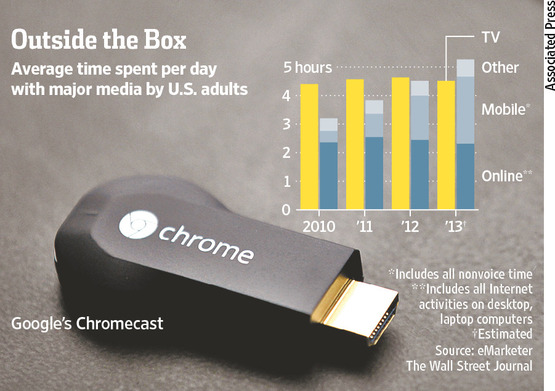
Even a simple innovation can sometimes help tip the scales toward revolution. GoogleGOOG +0.26% along with technology peers like Intel, Apple and Microsoft, is vying to shape the future of TV. Its latest gambit: the introduction of Chromecast, a $35 device that plugs into a TV and allows users to view content from mobile devices or computers on the big screen. On its own, Chromecast won’t suddenly upend the bundled-TV business model. For now, only Internet content and video from YouTube, Netflix NFLX -1.18% and the Google Play store can be watched via the device. And it doesn’t include sports or live programming. Read more of this post

Future of Cable Might Not Include TV

August 4, 2013, 7:38 p.m. ET

Future of Cable Might Not Include TV

At Cablevision, Broadband Could Become Primary Offering Eventually

SHALINI RAMACHANDRAN And MARTIN PEERS

Predicting that transmission of TV will move to the Internet eventually, Cablevision Systems Corp. CVC +5.20% Chief Executive James Dolan says “there could come a day” when his company stops offering television service, making broadband its primary offering. His comments may be the first public acknowledgment by a cable CEO of the possibility of such a shift, long speculated about by analysts. It comes amid growing tensions between cable operators and channel owners over rising programming costs, highlighted Friday night when Time Warner Cable Inc. TWC -0.49% dropped CBS from its channel lineup in major markets such as New York and Los Angeles.

Read more of this post

China Mobile launches own-brand smartphones

China Mobile launches own-brand smartphones

English.news.cn   2013-08-03

By Shen Jingting

BEIJING, Aug. 3 (Xinhuanet) — China Mobile Ltd officially entered the booming mobile terminal market on Friday as it unveiled its own-brand smartphone models. The China Mobile M701, a 5-inch screen Android-based smartphone equipped with MediaTek Inc’s 1.2-gigahertz quad-core processor, is priced at 1,299 yuan ($212). The China Mobile M601 is a 4-inch screen, dual-core Android smartphone that targets lower-end users with a price of 499 yuan. The two smartphones are produced by original equipment manufacturers, Hisense Group and Shenzhen-based BYD Co Ltd, respectively. They will hit the Chinese market through China Mobile’s online and offline outlets this month. Read more of this post

Apple’s ‘Mission Statement’ Is Making People Worry That The Company Has Gone To Hell

Apple’s ‘Mission Statement’ Is Making People Worry That The Company Has Gone To Hell

HENRY BLODGET AUG. 3, 2013, 11:41 AM 16,896 34

Where are we headed, Tim?

A tech-industry insider sent us the note below highlighting what Apple’s web site is describing as the company’s “mission statement.” The executive’s reaction to this mission statement was not positive. He took it as a sign that Apple has changed fundamentally — and for the worse — since Steve Jobs died. I don’t know what Apple’s official mission statement was when Steve Jobs was alive – but I’d be shocked if it was this pathetic piece of generic corporate mumbo jumbo drivel. It’s almost as if Tim Cook hated Jobs. The “mission statement” the executive was referring to is the paragraph below, which can be found on Apple’s investor relations site and at the bottom of Apple press releases: What is Apple’s mission statement?

Apple designs Macs, the best personal computers in the world, along with OS X, iLife, iWork and professional software. Apple leads the digital music revolution with its iPods and iTunes online store. Apple has reinvented the mobile phone with its revolutionary iPhone and App Store, and is defining the future of mobile media and computing devices with iPad.

If that really is Apple’s “mission statement,” it is indeed pretty lame. It’s not a mission statement so much as a list of product lines. And it would be hard to imagine a less-inspiring, more prosaic description of what Apple is (or used to be) all about. Read more of this post

The future of TV; Netflix, Google, Apple, and Intel think they can remake the industry, but there’s a lot of money and brain-power standing in their way

SATURDAY, AUGUST 3, 2013

Don’t Touch That Dial

By ALEXANDER EULE | MORE ARTICLES BY AUTHOR

Netflix, Google, Apple, and Intel think they can remake the industry, but there’s a lot of money and brain-power standing in their way.

BA-BC573I_futur_NS_20130803020905 ON-BB729_TV0805_G_20130803022940

Netflix is having a good summer. The Internet streaming service garnered 14 Emmy nominations last month, including a Best Actor nod for House of Cards star Kevin Spacey. Four days later, the company announced that U.S. subscribers to its video-streaming service hit 30 million.

Netflix shares (ticker: NFLX) are up 170% on the year, making them the best performer in the S&P 500. But it’s the future of TV that investors are really excited about, and Netflix is not shy about putting itself in the center, declaring on its Website, “Over the coming decades and across the world, Internet TV will replace linear TV….As Internet TV grows from millions to billions, Netflix is leading the way.” Read more of this post

China’s third-party payment market had total transactions reaching US$1.127tn in the first half of 2013; China UMS is the leader in the nation’s third-party payment industry, taking a market share of 46.3%, followed by Alipay with 17.8%

Third-party payment market in China worth RMB7tn so far this year

Liao Kuei-ju and Staff Reporter

2013-08-04

In the first half of 2013, China’s third-party payment market had total transactions reaching 6.91 trillion yuan (US$1.127tn), already achieving 66% of last year’s total, our sister paper Commercial Times reports, citing the China Electronic Information Industry Development Institute. The mainland is seeing slowing economic growth but its e-commerce industry has outperformed, with sales jumping more than 100% a year. To grab a slice of the pie, international credit card giant Visa in April began its certification program for third-party payment companies. On Aug. 1, Chinese third-party payment company Tenpay announced it will begin offering secure third-party payment services for international credit cards immediately. Read more of this post

With An Astounding $6 Billion Valuation, ServiceNow Has Become ‘The Next Salesforce.com’

With An Astounding $6 Billion Valuation, ServiceNow Has Become ‘The Next Salesforce.com’

JULIE BORT AUG. 2, 2013, 4:32 PM 2,648

It’s been over a year since ServiceNow’s IPO practically saved the post-Facebook IPO market single-handedly. In June 2012, with an opening share price of $18, the company had a jaw-dropping valuation of over $2 billion. (It was originally priced at $17 the night before the IPO.) And it and hadn’t even hit annual revenues of $100 million. Fast forward to this week: ServiceNow’s shares are trading at about $45, giving it a nearly $6 billion valuation. That makes it the fifth most valuable company in Bessemer Venture Partners new “Cloud Index” that tracks the 30 biggest software-as-a-service public cloud companies. At the time of its IPO, ServiceNow, which offers cloud apps that automate the help desk function for enterprises, was considered proof that the tech industry was in another bubble. But, it turns out, it was proof that ServiceNow is the next Salesforce.com, CEO Frank Slootman told Business Insider. Read more of this post

One Of The World’s Biggest Mobile Ad Companies Is In Huge Trouble And Has Stopped Paying Its Bills

One Of The World’s Biggest Mobile Ad Companies Is In Huge Trouble And Has Stopped Paying Its Bills

JIM EDWARDS AUG. 2, 2013, 10:46 AM 5,244 2

We first told you that Velti, the little-known but relatively massive mobile ad company, was in trouble back in June, when we demoted CEO Alex Moukas to 10th place on our annual ranking of the most important people in mobile advertising. The reason? The company cut about 300 of its 1,100+ jobs after Q1 2013 revenue collapsed 20% to $41 million. Velti is in the middle of a restructuring. Its stock, which once traded above $10, is now at $1.08. Its COO, Christos Kaskavelis, has been terminated. The company’s market cap is now less than its projected annual revenues. Read more of this post

The New York Times Company did the world of journalism a big favor today by finally disclosing the exact revenues of its digital business.

IT’S OFFICIAL: We Never Need To Worry About The Future Of Journalism Again!

HENRY BLODGET AUG. 1, 2013, 6:15 PM 10,620 24

The New York Times Company did the world of journalism a big favor today. The company finally disclosed the exact revenues of its digital business. The numbers were impressive. And they made clear that no one ever needs to fret about the future of journalism again. Specifically, the New York Times reported that the revenue of its digital business is now about $360 million a year. That’s composed of about $200 million of advertising revenue, which is basically flat, and another $150 million of digital subscription revenue, which is growing nicely. Assuming the digital subscription revenue continues to grow as the company rolls out new subscription products, which it will start to do next April, the New York Times Company should soon have a $400 million digital business. Why does that mean we never have to worry about the future of journalism again? Because a $400 million digital business is a healthy business, one that will support a large, talented newsroom. Even if the New York Times’ print paper, which still generates most of the company’s overall revenue of about $2 billion a year, were to shut down tomorrow, the company would still be able to fund an excellent newsroom. Read more of this post

Movie fans who were intrigued by director Peter Jackson’s use of high frame rates in “The Hobbit” are now getting a chance to see the superclear format online.

High frame rates debut online with special player

BY RYAN NAKASHIMA

AP

AUG 2, 2013

BURBANK, CALIFORNIA – Movie fans who were intrigued by director Peter Jackson’s use of high frame rates in “The Hobbit” are now getting a chance to see the superclear format online. The second season of the YouTube Web series “Video Game High School” is being released online at 48 frames per second (fps), double the 24 fps that has been standard in movie theaters for the past century. The season’s second episode debuted Thursday after the premiere episode attracted nearly 2 million viewers. Online video programming is growing fast as major networks and small upstarts go after young audiences who increasingly watch shows on laptops, tablet computers and mobile phones. Laying claim to the high-frame-rate niche could help “Video Game High School” stand out in a crowded field. By capturing moving objects on camera at higher frame rates, filmmakers are able to cut down on blurriness because the camera’s shutter opens and closes much faster. That reduces the amount of time that an object moves across an open lens and gives each image, or frame, more clarity. The experiment is partly a way to explore how to use high frame rates creatively while also pioneering a new business model online. Read more of this post

P&G Shifts Marketing Dollars to Online, Mobile; World’s Largest Advertiser Says as Much as 35% of Ad Budget Going to Digital Media

Updated August 1, 2013, 8:00 p.m. ET

P&G Shifts Marketing Dollars to Online, Mobile

World’s Largest Advertiser Says as Much as 35% of Ad Budget Going to Digital Media

SERENA NG and SUZANNE VRANICA

‘We need and want to be where the consumer is,’ says A. G. Lafley, CEO of P&G, maker of basics like Tide.

Procter & Gamble Co. is now spending more than a third of its U.S. marketing budget on digital media, an aggressive shift as Americans for the first time are expected to spend more time online this year than watching television. P&G chief executive A.G. Lafley said the consumer products giant’s digital spending on things like online ads and social media ranges from 25% to 35% of its marketing budget and is currently near the top of that range in the U.S., its biggest market. That is well beyond the estimated 20% to 25% share that digital ads typically claim of companies’ marketing budgets and highlights the threat to traditional advertising media like print. Read more of this post

Baidu and Sina are among Chinese Internet companies that have jointly created a website for refuting rumors, the latest step in government efforts to increase scrutiny of information spread online

China Starts Website to Refute Rumors as Scrutiny Grows

Baidu Inc. (BIDU) and Sina Corp. (SINA) are among Chinese Internet companies that have jointly created a website for refuting rumors, the latest step in government efforts to increase scrutiny of information spread online.

The website officially began operations yesterday under the oversight of the Beijing Internet Information Office and the Beijing Internet Association, the official Xinhua News Agency reported. Sohu.com Inc. (SOHU) and NetEase Inc. (NTES) also contributed to creating the site, which is hosted by Qianlong.com, a news portal controlled by the Beijing city government. Read more of this post

Neuromorphic computing: The machine of a new soul; Computers will help people to understand brains better. And understanding brains will help people to build better computers

Neuromorphic computing: The machine of a new soul; Computers will help people to understand brains better. And understanding brains will help people to build better computers

Aug 3rd 2013 |From the print edition

20130803_STD001_0

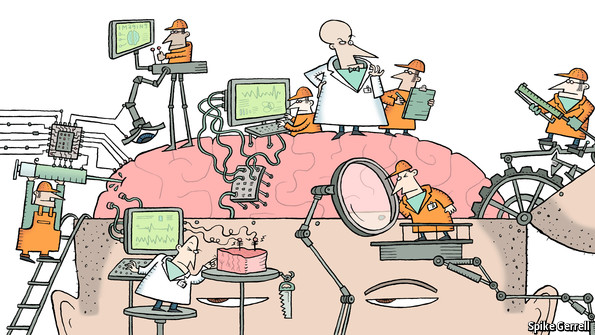
ANALOGIES change. Once, it was fashionable to describe the brain as being like the hydraulic systems employed to create pleasing fountains for 17th-century aristocrats’ gardens. As technology moved on, first the telegraph network and then the telephone exchange became the metaphor of choice. Now it is the turn of the computer. But though the brain-as-computer is, indeed, only a metaphor, one group of scientists would like to stand that metaphor on its head. Instead of thinking of brains as being like computers, they wish to make computers more like brains. This way, they believe, humanity will end up not only with a better understanding of how the brain works, but also with better, smarter computers. Read more of this post