Baidu and Tencent Thought to be Vying to Acquire Mobile Antivirus Expert NetQin

Baidu and Tencent Thought to be Vying to Acquire Mobile Antivirus Expert

May 20, 2013

by Steven Millward

Antivirus products and services have been a renewed battleground in China in the past couple of years, enveloping several of the country’s top web businesses. According to rumors in the industry heard byTechinAsia, that battle is now taking the form of these companies vying to acquire NetQin (NYSE:NQ), a China-based expert in mobile antivirus apps. Both Baidu (NASDAQ:BIDU) and Tencent (HKG:0700) are thought to be in the running, but the market value of NetQin is proving to be a bone of contention. NetQin executives even addressed the rumors late last week in the earnings call after revealing their Q1 2013 financials. Directly alluding to the suitors, NetQin co-CEO Omar Sharif Khan said during the call: Read more of this post
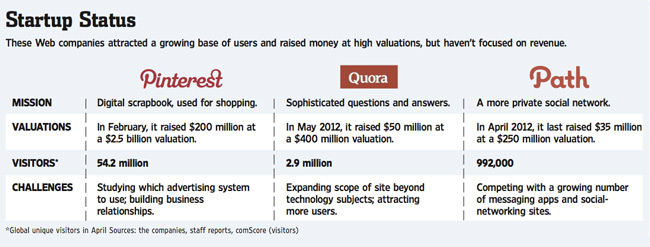
Hazards of the Buzzy Startup: Yahoo’s $1.1 billion deal for Tumblr is a fairy-tale ending for the blogging site, which fetched a rich price despite its meager revenue. Many other highflying Web startups may not be as lucky

May 20, 2013, 8:00 p.m. ET

Hazards of the Buzzy Startup

Yahoo’s Purchase of Tumblr Puts Spotlight on Highfliers Like Pinterest, Quora With Little Revenue

By AMIR EFRATISPENCER E. ANTE and EVELYN M. RUSLI

OB-XN856_Startu_G_20130520200007

Yahoo Inc.’s YHOO +0.23% $1.1 billion deal for Tumblr Inc. is a fairy-tale ending for the blogging site, which fetched a rich price despite its meager revenue. Many other highflying Web startups may not be as lucky.

Monday’s deal for New York-based Tumblr throws the spotlight on a cadre of other Web startups that have similar characteristics. Many of them raised money at sky-high valuations based on their huge user growth, before a spate of troubled Internet initial public offerings in 2011 and 2012 for social networkFacebook Inc., FB -1.87% daily-deals site Groupon Inc. GRPN +0.14% and online-gaming service Zynga Inc.ZNGA +0.59%

Since then, a damper has been put on the Internet market. And as these startups have burned through cash to sustain their user growth, they have been dealing with difficult questions about exactly how much value they command and whether to remain independent or sell themselves off. Read more of this post

INFOGRAPHIC: Inside The Massive Mobile Video Ecosystem

INFOGRAPHIC: Inside The Massive Mobile Video Ecosystem

Business Insider | May 20, 2013, 3:37 PM | 13,495 | 7

Mobile video has begun to accumulate scale, and has also turned out to be one of the few types of mobile content — along with games — that monetizes reliably and drives premium ad rates. That’s reflected in the much higher prices that mobile publishers can command for mobile video ads, compared to standard mobile formats like banners. eMarketer estimates mobile video will account for $520 million in ad spending in the U.S. this year, or 13% of the digital video ad market. In a new reportBI Intelligence breaks down the mobile video ecosystem, analyzing the behavior and devices behind the growth in consumption, and examining the demographics and behavior of mobile video consumers. We specifically detail how mobile video monetization is booming, and look at the new video ecosystem that is taking shape, with mobile devices — rather than television — at the center. Thanks in large part to this growing ecosystem, brands and agencies are becoming more familiar with mobile video ad formats and in putting together mobile video ad campaigns. Thanks to technology and better know-how among ad platforms, mobile video ad units are easier to deploy across the mobile landscape than they were in the past. As we detail in our report, tablet-specific ad units are beginning to proliferate, as are non-ad videos that brands push out on their own digital platforms. So are anecdotes about increased mobile video ad transaction volume: YuMe, a provider of brand video advertising services, saw its mobile video advertising revenue in France and the U.K. grow over 500 percent in 2012. Mobile video ad specialist AdColony also reported U.S. revenue growth above 500 percent in 2012.  Michael Bayle, senior vice president of ESPN Mobile, says he sees the automotive industry diving quickly into mobile video as a complement to TV spending. “We see automotive highly skewing in favor of mobile,” he told Business Insider. ESPN benefits because its audience is 85 percent men, and auto advertisers are often chasing male eyeballs.

themobilevideoecosystem-1 (1)

Global Brands: Online retailer Amazon grabs top spot from bricks and mortar rival Wal-mart

May 20, 2013 11:59 pm

Global Brands: Online retailer grabs top spot from bricks and mortar rival

By Barney Jopson

Calling Amazon the “Walmart of the web”, a common moniker for the online giant, is one way to make people from Walmart bristle. The bricks-and-mortar behemoth tends to think that if any company is going to be the Walmart of the web, then it should be Walmart.

That is why, after several false starts, the 50-year-old retailer from Arkansas is in the throes of its latest – and most serious-looking – effort to build a substantial online business. The results will help shape the evolution of the Walmart brand for years to come (as will the progress of its international bricks-and-mortar business).

But the 2013 BrandZ Top 100 ranking shows that Amazon still has more momentum. For the first time since the ranking began, Amazon, founded in 1994, has leapfrogged Walmart to become the most valuable retailer in the rankings: a 34 per cent rise in its brand value to $45.7bn lifted it to position number 14 overall. Read more of this post

But Wait. Didn’t Yahoo Try a Deal Like This Before? Yahoo’s deal for Tumblr raises questions about its ability to make money by selling ads, among other thorny issues

MAY 20, 2013, 9:00 PM

But Wait. Didn’t Yahoo Try a Deal Like This Before?

By ANDREW ROSS SORKIN

When Yahoo announced its headline-grabbing acquisition, it boasted that the deal gave it access to an “unduplicated” audience of users and that its target was a “popular personal publishing” platform.

“Yahoo will be able to integrate and distribute a powerful set of state-of-the-art editing tools and content published through personal home pages in an array of services,” the company declared.

But Yahoo wasn’t talking about Tumblr. Those quotes came from a news release Yahoo issued in 1999 when it acquired GeoCities, which allowed users to create their own Web pages — not unlike Tumblr — for $3.6 billion in stock. The site was closed in 2009. Read more of this post

All Yahoo’s spending can’t make it cool again; It’s time for the Web 1.0 icon to put down its credit card and get back to work

All Yahoo’s spending can’t make it cool again

May 20, 2013: 12:15 PM ET

It’s time for the Web 1.0 icon to put down its credit card and get back to work.

By Cyrus Sanati

FORTUNE — Yahoo’s $1.1 billion acquisition of Tumblr looks like an expensive and misguided attempt by chief executive Marissa Mayer to somehow make the Web 1.0 company “cool” again. Instead of innovating her way out of the mediocre corner of the Internet in which Yahoo currently resides, the former Google executive has instead decided to take the company’s debit card and go on a shopping spree, snapping up 10 companies in less than a year on the job. Tumblr is by far the most expensive bauble she has picked up so far and could prove a dud over the long term given its questionable content, much of which is “NSFA” — Not Safe For Advertisers.

When Mayer took the helm at Yahoo (YHOO) last year, investors were ecstatic. The company had been on a listless voyage over the previous decade as it struggled to move from awkward adolescence into adulthood. Ms. Mayer’s appointment gave investors hope that Yahoo could somehow be pulled back from the brink of technological irrelevance. She was seen as a bright star equipped with the magic Google (GOOG) touch that would, hopefully, help restore Yahoo’s rusty search engine as well as the hodgepodge of companies it acquired over the years. Read more of this post

Viewers Start to Embrace Television on Demand

May 20, 2013

Viewers Start to Embrace Television on Demand

By BRIAN STELTER and AMY CHOZICK

While companies weigh bids for Hulu and industry heavyweights complain that TV Everywhere isn’t going much of anywhere, another way to watch time-shifted television is quietly gaining traction: video-on-demand, or VOD.

Glittery, those three letters are not. VOD rarely gets media attention, partly because of past missteps by cable and satellite providers.

But more and more TV episodes and movies are becoming available through the on-demand systems that cable subscribers can tune in with their set-top boxes. Some shows, like Fox’s “The Following” and ABC’s “Scandal,” now gain hundreds of thousands of viewers every week because of VOD, part of a decades-long shift from television on a linear schedule to television on viewers’ own terms.

“On-demand isn’t always the shiniest new technology. But we are seeing tremendous growth,” said Matthew Strauss, who oversees digital strategy for Comcast, the nation’s largest cable company. Read more of this post

Samsung swipes 95% of total industry profits earned from Android phones

HOW MUCH? SAMSUNG SWIPES 95 PERCENT OF TOTAL INDUSTRY PROFITS EARNED FROM ANDROID PHONES

By Andy Boxall — May 16, 2013

Google revealed its own fair share of big numbers associated with Android during its Google I/O keynote presentation, saying as of 2013, there have been 900 million activations of the mobile OS, making it the world’s most popular operating system. That must mean there are a lot of companies out there getting rich and fat from selling Android hardware, right?

Well, yes, but if the latest research from Strategy Analytics is accurate, it’s only one company doing so, despite Android being licensed by dozens of firms. As you have probably guessed, the one making the most profit from Android is market leader Samsung, but the actual figure may come as a surprise, as it’s said to have taken almost 95 percent of the global profits earned from the mobile OS during the first quarter of 2013. Read more of this post

Amazon wins key cloud security clearance from US Govt

Published: Tuesday May 21, 2013 MYT 1:55:00 PM

Amazon wins key cloud security clearance from US Govt

SAN FRANCISCO: Amazon.com Inc has been given a security clearance by the U.S. government that will make it easier for federal agencies to use its cloud computing services.

Amazon Web Services, known as AWS, was certified to operate as a cloud service provider for three years under the government’s new FedRAMP program. The accreditation covers all AWS data centers in the United States, the company said on Tuesday.

“This will cut the cost and time for agencies to deploy our systems,” saidTeresa Carlson, vice president of Worldwide Public Sector at AWS. “It cuts costs for AWS too.”

Amazon, the world’s largest online retailer, has moved aggressively into the business of renting remote computing, storage and other IT services in recent years through AWS. The business has been a hit with startups, but the company is now going after big corporations and government agencies, a much larger opportunity. However, these organizations are more demanding, especially on issues like security and regulatory compliance. Read more of this post

NYC Startup Scene Boosted by 50-Fold Return on Tumblr Deal: Tech

NYC Startup Scene Boosted by 50-Fold Return on Tumblr Deal: Tech

Tumblr Inc.’s $1.1 billion purchase by Yahoo! Inc. (YHOO) marks the biggest deal for a venture-backed New York startup, bringing a windfall for East Coast investors Union Square Ventures and Spark Capital while laying a foundation for further investing in the region’s entrepreneurs.

Union Square, founded in New York in 2003, and Boston-based Spark, which opened two years later, first led an investment of $775,000 in Tumblr in 2007, and then $4.5 million the following year. The firms owned a combined 47 percent of the company, giving them about a 50-fold return, according to PrivCo, which tracks private companies and venture capital.

While about 40 percent of venture funding happens in Silicon Valley, twice the amount in New York and New England combined, Union Square and Spark have spent about a decade investing in a revival of the East Coast technology industry. Though not all of the joint bets have panned out, their success proves there’s still growth in New York’s startup scene. Read more of this post

How cognitive science and user empathy powered Google’s design breakthrough

How cognitive science and user empathy powered Google’s design breakthrough

By Devindra Hardawar | VentureBeat.com, Published: May 20

Google has gone from a company that approached design through cold, hard data to one that’s employing gorgeous, user-centric interfaces.

Design was a big theme at this year’s Google I/O developer conference, with over a dozen sessions exploring design in some fashion. And you can see Google’s new aesthetic focus in plenty of its products — like Gmail’s slight redesign and the upcoming Google Maps refresh — but Android serves as the fastest example of Google’s design turnaround.

Perhaps it’s because design matters all the more on a small smartphone screen. With Android, Google also had to do something about Apple’s head start with iOS. To get Android to look as good at the iPhone, Google had to radically reshape how it thought of design, and fast. Android 4.0 “Ice Cream Sandwich,” released in 2011, was Google’s first attempt to emphasize design in its mobile OS. Its aesthetic has only become more refined since then. Read more of this post

GrubHub to Merge With Seamless as Food Orders Go Mobile

GrubHub to Merge With Seamless as Food Orders Go Mobile

GrubHub Inc. and Seamless North America LLC, two of the top food-delivery websites in the U.S., have agreed to combine their companies to take on rivals in the growing market for online meal orders.

GrubHub Chief Executive Officer Matt Maloney will become CEO of the merged group, and Seamless CEO Jonathan Zabusky will serve as president, the two said in an interview. Neither company is paying to acquire the other, Maloney said, declining to share financial details of the agreement. The deal now awaits the approval of U.S. regulators, he said.

Food-delivery sites and mobile applications are gaining in popularity as more people order their meals online, instead of calling or picking up orders at restaurants. That’s also driving consolidation, as startups join forces to head off competition from review sites such as Yelp Inc. (YELP) The merger will help the combined company accelerate the addition of users and restaurants, said Maloney, who co-founded GrubHub in 2004. Read more of this post

China: E-commerce trumps retail; consumers in China’s lower tier cities actually spend as much online as higher tier cities even though their consumers have far less disposable income

China: E-commerce trumps retail

May 20, 2013: 11:12 AM ET

High-tech meets low-tech (bike messengers!) as new Chinese consumers embrace online shopping.

By Scott Cendrowski

FORTUNE — Just as cash-strapped consumers in the developing world bypassed so-called landline phones in favor of mobile devices, so China’s lower-income consumers are skipping physical stores in favor of e-commerce sites.

recent report by McKinsey & Co. shows that e-commerce sales in China reached an estimated $190 billion last year, almost equaling the U.S. market as largest in the world. China’s online retail industry is expected to grow to at least $420 billion by 2020—which would total more than the U.S., Japanese, U.K., German, and French markets combined. China will overtake the U.S. for the top spot next year, if it hasn’t already. Read more of this post

Amid frenzy over map apps, new focus on 16th century world view

Amid frenzy over map apps, new focus on 16th century world view

Sat, May 18 2013

By Deborah Zabarenko

Conservators at the Library of Congress prepare a map for its encasement in Washington

WASHINGTON (Reuters) – As online titans compete to deliver instant maps to smartphones, the Library of Congress in Washington is focusing attention on an antique “cosmology” printed in 1507 that serves as America’s birth certificate.

The black-and-white map created by Martin Waldseemuller, a French cleric, was the first time the name America had appeared on any map.

Waldseemuller was prescient enough to show the Rocky Mountains and the Pacific Ocean at a time when no one else in Europe thought they were there.

The map, purchased a decade ago at a cost of $10 million, is the centerpiece of an exhibit at the Library of Congress running through June 22 that features a collection of artifacts from Waldseemuller and his colleagues. Read more of this post

NEA Notches 3,000 Percent Return on Tableau Software Investment as Digital Chart Valuation hit $950 Million on Nasdaq Debut

NEA Notches 3,000 Percent Return on Tableau Software Investment

For New Enterprise Associates Inc., its investment return on Tableau Software Inc. (DATA) was off the charts.

NEA’s $29.2 million investment in the digital-chart provider, which made its stock-market debut today, was valued at more than $950 million at the close in New York, making the venture-capital firm the top winner so far this year, Bloomberg.com reported on its Tech Deals blog.

As any Silicon Valley pundit knows, the vast majority of venture-capital bets fail. What makes the business work is the very rare gain of more than 3,000 percent on an investment, like the return NEA has thus far achieved on Tableau.

NEA first backed Seattle-based Tableau in 2004, a year after the company was founded, gaining two board seats and providing $5 million to “expand sales operations and invest in product development,” according to a statement at the time. NEA, with offices in Menlo Park, California, and Chevy Chase, Maryland, put in another $10 million in 2008 and $14.2 million in 2010.

More than 10,000 companies including Apple Inc. (AAPL) to Bank of America Corp. have used Tableau’s software to create easy-to-use charts out of complex data. Read more of this post

Now You Can 3D Print Your Own Invisibility Cloak

Now You Can 3D Print Your Own Invisibility Cloak

Charles Q. ChoiTechNewsDaily | May 18, 2013, 12:00 PM | 2,110 | 1

Invisibility cloaks made of plastic can now be created at home using 3D printers, researchers show.

The first clues that cloaking devices might one day become more than science fiction, a la “Star Trek” began emerging seven or so years ago.

Since then researchers have made such cloaks a reality by smoothly guiding rays of electromagnetic radiation such as microwave beams completely around objects so they proceed along their original trajectory as if nothing were there.

The first working invisibility cloaks were demonstrated using complex lab experiments. They can now, in principle, get made at home using 3D printers. Read more of this post

Chinese cyber crime: More crooks than patriots

May 19, 2013 3:22 pm

Chinese cyber crime: More crooks than patriots

By Kathrin Hille

The biggest threat is posed by online criminals the state is ill-equipped to police, says Kathrin Hille

On a muggy spring night five years ago in the southern Chinese city of Shenzhen, six young men were slowly getting drunk. “We’d all had a few beers when someone first mentioned Foxconn,” one of them recalls. “But we immediately saw that it was a great idea.” The plan was to hack into the computer systems of the giant Taiwanese contract manufacturer, which assembles many of the world’s best-selling electronic gadgets, such as Apple’s iPhones. This was no drunken whim. Four months later, the six hackers had breached Foxconn’s email system, according to three people with knowledge of the operation. Foxconn’s position at the heart of the global technology value chain made it an alluring target for potential blackmailers. The company’s 1.4m workers assemble products for the cream of the global technology industry including HP, Dell, Cisco, Acer, IBM, Microsoft and Sony. Read more of this post

China’s King of All Social Media: Tencent is China’s Facebook, Twitter, Zynga, and Tumblr all rolled into one, and it’s pushing hard into e-commerce. How it stays on top

SATURDAY, MAY 18, 2013

China’s King of All Social Media

By RESHMA KAPADIA | MORE ARTICLES BY AUTHOR

Tencent is China’s Facebook, Twitter, Zynga, and Tumblr all rolled into one, and it’s pushing hard into e-commerce. How it stays on top, and why the shares could climb 20%.

Chinese Internet companies are facing growing pains, as new competitors emerge and new trends like mobile Internet turn their business models upside down. Tencent Holdings (ticker: 700.Hong Kong) is coping better than most, aided by a diversified mix of businesses, among them: China’s dominant, youth-oriented gaming operations; one of the nation’s largest instant-messaging services, QQ; and the wildly popular WeChat, a free mobile social-networking and messaging software that allows users to send photos, videos, and voice messages to each other, walkie-talkie style.

Tencent’s individual businesses put it on par with Facebook (FB), Twitter, Zynga(ZNGA), and Tumblr, but it has more power than these firms because its users, advertisers, and application developers can access them all on a single platform. “Tencent is the winner-take-all social player in China,” says Ravi Sarathy, Citigroup’s head of Asia Pacific entertainment, media, and telecom research. Read more of this post

You Can Do Too Much Due Diligence: The Case of Feedburner

May 132013

You Can Do Too Much Due Diligence

It’s Monday, time for another lesson I’ve learned in the venture capital business. Today I will tell a story that I love telling. It has some of my favorite people in it. Back in 2004, early in my blogging career, I heard about a service that had just launched called Feedburner. It provided a number of useful services for a blog’s RSS feed. So I went and signed up and AVC became one of the first users of the service. I immediately liked the service and the idea. So I contacted the founder/CEO Dick Costolo, who has gone onto bigger and better things. I told Dick that I was interested in making an investment in Feedburner. My friend Brad Feld was also talking to Dick about the same thing so we decided to do the investment together. As part of our investment process, we do a bunch of fact gathering/checking work that is called Due Diligence in the vernacular of the VC business. So my partner Brad Burnham and I put together a list of leading blogs and online publishers who had popular RSS feeds at the time. I think there were a dozen or so publications on that list. It included Weblogs (Engadget), Gawker (Gawker), NY Times, and a bunch more. We know most everyone who ran those operations so we called them. What we heard was surprising. Not one of them was willing to hand over their RSS feed to a third party for analytics and monetization. We were very surprised to hear that and thought a bit about it. But, we decided, we could not invest in something that the big publishers would not support. So regrettably, I called Dick and told him we had to pass and why. Brad Feld went ahead with the investment and Feedburner closed their round without USV. About six months later I ran into Dick at an industry conference. We decided to grab lunch together and during lunch he said to me “you know those dozen publishers you called?” I said “yes, what about them?” He said “every single one of them is on Feedburner now.” I was pissed. How could that be? So I said to Dick, “Would you consider letting us into that last round we walked away from.” He said “No, but I will let you invest at a 50% increase in price”. We did that and became an investor in Feedburner. And that worked out well when Feedburner was sold to Google a few years later. So what did I learn from this lesson? First, trust your gut. I was using Feedburner and knew it was a very useful service. I felt that others would see that too. They did, but it took some time. Second, I learned that a service can get traction with the little guys and in time, the big guys will come along. I have seen that happen quite a bit since then. And finally, I learned that you can do too much due diligence. It’s important to talk to the market and hear what it is saying. But you have to balance that with other things; the quality of the team, the product, the user experience, etc. You cannot rely alone on due diligence, particularly early on in the development of a company and a market.

Researchers at Princeton and Johns Hopkins universities used a 3-D printer to create bionic ears with auditory powers far beyond the natural human endowment. A look at the implications.

All Ears for a Revolution

By DANIEL AKST

The singularity may not be near, but it’s getting close enough that you might just hear it coming—if you had the kind of synthetic ears scientists recently developed.

The singularity is a term used by futurists for the merger of human and machine into an infinitely malleable, self-determining species with powers of intelligence that flesh-and-blood-mortals can only dream of. Although superhuman mental powers aren’t yet on the horizon, the new ears remind us that our future is very likely bionic.

Human ears are a problem for plastic surgeons. But writing in Nano Letters, researchers at Princeton and Johns Hopkins universities described how they used a standard 3-D printer to create bionic ears with auditory powers far beyond the natural human endowment. The technique lets scientists mimic the structural complexity of the ear while achieving a wider range of audible frequencies through the embedded electronics. They used the printed ear to culture genuine cartilage in vitro from calf cells. Read more of this post

How do you monetize a digital service?

Forget Ads! Here are the Money Making techniques every startup should know.

by Nick De Mey With 2 Comments

How do you monetize a digital service? Why would clients put their money on the table? In fact it doesn’t matter if you pick a freemium, subscription, license or any other model if you don’t understand the emotional context of your customers. You have to see what drives people to open up their wallet. Just look at other companies. The small nudges and psychological tricks they have in place can often be copied to your own product or service. In order to help you out we’ve selected 17 remarkable techniques documented with 36 cases.

Less guff, more puff: Thanks to new digital tools, marketing is no longer voodoo

Less guff, more puff: Thanks to new digital tools, marketing is no longer voodoo

May 18th 2013 |From the print edition

20130518_wbc573

WHEN a power cut interrupted this year’s Super Bowl, advertisers lit up. “Sending some LEDs to the @MBUSA Superdome right now,” tweeted Audi, swiftly plugging its own LED-accented car while taking a dig at its rival Mercedes, sponsor of the New Orleans Superdome. Tide, a detergent, came up with: “We can’t get your #blackout, but we can get your stains out.” But by general consent Oreo won the tweet-off with “Power out? No problem. You can still dunk in the dark.” The biscuit baker’s reward: 16,000 retweets and 20,000 Facebook likes.

Super Bowl TV commercials are the Broadway spectaculars of the marketing world, broadcast to millions. The blackout banter is more like improv, created on the fly for a select audience. Marketers these days must master both. It is not easy. Lightning reflexes have never been part of a marketer’s toolkit. Chief marketing officers (CMOs) “used to deliver big iconic brand ideas on a seasonal basis,” says Luke Taylor of DigitasLBi, a digital advertising agency. Some “are outside of their comfort zones”.

Nearly 40% of CMOs do not think they have the right people and resources to meet their goals, says an Accenture report entitled “Turbulence for the CMO”. Martin Sorrell, the boss of WPP, the world’s biggest marketing and advertising group, says that since the 2008 financial crisis marketers have been elbowed aside by finance and procurement chiefs. Dominique Turpin, the head of IMD, a Swiss business school, writes that “the CMO is dead”. Read more of this post

Korea still behind in software power; “The biggest issue is the lack of appreciation for intangible assets imbedded in Korean culture”

2013-05-17 17:23

Korea still behind in software power

State-run program needed to nurture software talent

By Cho Mu-hyun

Korea’s competiveness in the global IT industry has to date been from making durable, high quality hardware. Though many use Samsung Electronics’ Galaxy S3, few would say they’ve ever used a program made here and if they did, with satisfaction. The local industry has been well aware of the problem, even before big-named brands such as Samsung and LG kicked off abroad. But now that the new administration is pushing for a “creative economy,” there have been more visible initiatives for more software.
However, many say there is a fundamental issue that needs resolving. Hiring a bunch of software developers or pouring in money, which many conglomerates have been doing, doesn’t touch the heart of the matter, they say. “The biggest issue is the lack of appreciation for intangible assets imbedded in Korean culture,” said an executive of an enterprise software developer, requesting anonymity. “Piracy is embarrassingly high compared to other mature markets in the Asia Pacific region.” Read more of this post

Intel’s Outgoing CEO Says He Passed On A Chance To Get Intel Chips Inside The First iPhone

Intel’s Outgoing CEO Says He Passed On A Chance To Get Intel Chips Inside The First iPhone

Kevin McLaughlin | May 17, 2013, 7:48 AM | 2,765 | 2

When Steve Jobs unveiled Apple‘s first Intel-powered Macs at a January 2006 event in San Francisco, Intel CEO Paul Otellini made a dramatic entrance, emerging onstage from a cloud of smoke wearing a “bunny suit,” the protective outfit workers wear in Intel’s semiconductor fabrication plants. Otellini didn’t often engage in such bizarre pageantry during his 8-year tenure as Intel CEO, which officially ended Thursday. But the Apple Mac deal was a major coup for Intel, and the bunny suit helped Otellini drive that message home.  Now, as Otellini heads into retirement, he’s talking about an even bigger deal with Apple that he wasn’t able to close. When Apple was working on a prototype for the first iPhone, it approached Intel about making the processor for the device. But Intel passed on the opportunity because it didn’t make sense financially, Otellini told Alexis Madrigal of The Atlantic in an interview published Thursday.  “At the end of the day, there was a chip that they were interested in that they wanted to pay a certain price for and not a nickel more and that price was below our forecasted cost. I couldn’t see it,” Otellini told Madrigal. “It wasn’t one of these things you can make up on volume. And in hindsight, the forecasted cost was wrong and the volume was 100x what anyone thought.” While Otellini kept Intel on a profitable path, he wasn’t able to figure out how to make Intel relevant in smartphones, the majority of which are running ARM chips. Intel is still trying to figure out its mobile strategy, and incoming CEO Brian Krzanich said Thursday that he plans to fix this. Of course, Otellini isn’t the only tech executive who didn’t anticipate the impact the iPhone would have. Shortly before Apple launched the iPhone, Microsoft Steve Ballmer said it had “no chance” of gaining meaningful market share. Otellini told Madrigal his gut reaction was to pull the trigger on the Apple mobile deal. But he didn’t, and so it’s likely every time Otellini sees someone using an iPhone, he’ll cringe a little bit inside.

Target goes hunting in Silicon Valley, following Wal-Mart

Target goes hunting in Silicon Valley, following Wal-Mart

Fri, May 17 2013

By Alistair Barr

SAN FRANCISCO (Reuters) – Target Corp (TGT.N: Quote,ProfileResearchStock Buzz) said on Friday it opened a new San Francisco office to track down technology companies that can help the second-largest U.S. retailer grow its online commerce business. Target’s Technology Innovation Center is run by David Newman, an executive who spent six years at the online business of Wal-Mart Stores Inc (WMT.N: QuoteProfile,ResearchStock Buzz), which has had a major presence in Silicon Valley for several years. “Partnership is in our DNA and early-stage companies can sense that and are proving to be very willing to partner and co-develop,” said Newman. Many retailers are pouring money into new technology to help them catch up with Amazon.com Inc (AMZN.O:QuoteProfileResearchStock Buzz), which has become the world’s largest retailer by grabbing market share from traditional bricks-and-mortar stores. Mobile commerce, powered by smartphone-wielding shoppers, is a particular focus of retailers because this technology has the potential to revitalize in-store sales. Read more of this post

How China Fell in Love with Fruit Ninja, the #2 smartphone game of all time?

How China Fell in Love with Fruit Ninja

by KAI LUKOFF on 05/16/2013 · LEAVE A COMMENT

Fruit Ninja is the #2 smartphone game of all time, said Phil Larsen the CMO of Halfbrick Studios in an interview at the GMIC. So how did this slasher of satisfyingly squishy fruits move into China? For one, China is the only market in the world where Halfbrick does extensive internationalization. ”We’re not going to do a different version for Germany anytime soon,” says Larsen. But China’s both large enough (the second-largest market for the game) and different enough to justify the extra effort. The China-specific adaptations came in two steps: 1) monetization; and 2) new content. To enter China, Halfbrick turned to the publisher iDreamSky. CEO Jeff Lyndon told me that they spent the past year focused on adapting the monetization model of Fruit Ninja. To really thrive in China, the game required more than simple localization (translation, Chinese payment SDKs, Chinese game center). It also had to be internationalized–parts of the gaming experience had to be redesigned and rebuilt–for the China market. Read more of this post

Tencent Becomes World’s 4th Largest Internet Company by Market Cap on Strong Q1 Figure, higher than that of Facebook, only lagging behind Google, Amazon and eBay

Tencent Becomes World’s 4th Largest Internet Company by Market Cap on Strong Q1 Figure

05-16 15:42 Caijing

Market value for the Chinese Internet bellwether topped USD 69.85 billion, higher than that of Facebook, only lagging behind Google, Amazon and eBay

Tencent has risen to become the world’s fourth Internet company after its shares hit a record high Thursday following strong first quarter earnings. Market value for the Chinese Internet bellwether topped USD 69.85 billion, higher than that of Facebook, only lagging behind Google, Amazon and eBay, after its shares surged over 6% to close at HKD 293.4. It now worths twice as much as Baidu, China’s largest search engine, and is nearly in a tie with the country’s e-commerce empjire Alibaba Group, which is widely believed to have USD 70billion in valuation and is expected to go public as early as the next year. Tencent Wednesday reported total revenues of RMB13,547.6 million (USD 2,161) in the first three months, representing a remarkable 40.4% year-on-year growth, and an increase of 11.5% over the previous quarter. Q1 profit was RMB4,071.1 million (USD649.4 million), an increase of 17.3% QoQ or an increase of 37.4% YoY. Net margin increased to 30.1% from 28.6% last quarter. Monthly active user accounts (MAU) of instant messaging were 825.4million, an increase of 9.8% year-on-year, while MAU of Weixin and WeiChat surged 228.4% from a year earlier. The number of users of Weixin, Tencent’s increasingly popular instant text and voicing messaging service, has exceeded 300 million. The company is planning to take the service to a bigger stage in launching WeiChat targeting overseas market. The robust growth in the first three months has enabled the company to fund investments in longer-term opportunities such as WeChat international user acquisition, online video content aggregation, said chairman and CEO Ma Huateng. “We will continue to invest proactively in innovation and technology, and to cultivate our open platform, in order to capture the mobile opportunities ahead and cement our role as a leading Internet platform in China,” Ma said.

Going global: how one Melbourne start-up did it

Going global: how one Melbourne start-up did it

May 16, 2013

Valerie Khoo is a journalist, author and entrepreneur, offering insights into the minds of other small- to medium-sized business entrepreneurs.

Patrick Llewellyn was on a plane back to Australia from the US when a fellow passenger had a heart attack mid-flight. The plane was forced to turn back and stop in Hawaii so the passenger could get medical attention and Llewellyn found himself in a hotel room on an unexpected and extended stopover. “I was sitting there answering emails when I realised that I’d never been to Hawaii before,” says Llewellyn, who is the CEO of 99designs, a crowd-sourced marketplace for graphic design. Llewellyn, 40, decided to make the most of it, venturing on to Waikiki Beach where he took his very first surfing lesson. “As soon as I stood up, I was hooked,” says Llewellyn. It’s was a rare moment of relaxation for the CEO of a fast growing company that now experiences $1.8 million in transactions each month and has over 200,000 registered designers. Although 99designs was founded in 2008, Llewellyn didn’t join the team until September 2009 and then moved to the US in February 2010 to spearhead growth in North America. Shortly after, he became CEO, after founder Mark Harbottle stepped back to focus on his other entrepreneurial pursuits. At the time, 99designs had 10 staff in Melbourne and four in the US. Now, there are about 90 staff  spread across the globe including 46 in the US, 34 in Melbourne, eight in Berlin, and two in Paris. Read more of this post

How Microsoft, Google, and Square use hardware to market their software and services

How Microsoft, Google, and Square use hardware to market their software and services

BY NATHANIEL MOTT 
ON MAY 16, 2013

Hardware is becoming an increasingly important aspect of traditionally software-focused companies. Microsoft and Google have both introduced their own hardware over the last year, with the Surface tabletsand Chromebook Pixel; Square recently announced the Square Stand, which turns an iPad into a cash register; and Adobe announced its own stylus and a “smart ruler” around the same time it said that its design products would only be available by subscription.

It’s doubtful that any of these companies got into the hardware business just for kicks; despite lower barriers to the hardware business, entering the physical realm is still a challenge. But why, then, are these companies building their own hardware even as they work to increase software’s role in our everyday lives? The answer, it seems, is that hardware is the best advertising platform available for their software. Read more of this post

China’s Alibaba Makes Its Move Against Google’s Android

China’s Alibaba Makes Its Move Against Google’s Android

By Bruce Einhorn on May 16, 2013

Jack Ma, the founder of Chinese e-commerce giant Alibaba Group, has made a career of taking on big-name rivals from the U.S. As the company has grown since its 1999 founding into a hybrid of Amazon.com (AMZN) and EBay (EBAY) and become a leader in business-to-business sales, only Google (GOOG) has gotten the better of Ma. In September, Alibaba accused the search giant of scotching the debut of a smartphone using its homemade operating system just hours before its big coming-out party in Shanghai, prompting Android seller Acer (2353) to drop its partnership with Alibaba. The U.S. search company says the Chinese company’s system “is based on the Android platform and takes advantage of all the hard work that has gone into that platform,” as Google developer Andy Rubin wrote online at the time.

On May 10, Ma officially stepped down as chief executive officer, part of his plan to focus on longer-term strategy while handing day-to-day responsibilities to company veteran Jonathan Lu. Ma remains executive chairman, though, and his fight with Google isn’t over. In April, Alibaba announced deals with five lower-profile Chinese smartphone makers, including G’Five and Zopo, to sell devices using its operating system. The company maintains that its OS has always been a distinct creation. “Google is not the judge,” says Chief Technology Officer Wang Jian. “Let the market and the consumer decide.” Vendors who sell goods on Alibaba websites Taobao Marketplace and Tmall.com will be able to manage their online operations from apps built into the new mobile system, he says. Read more of this post