Making High-Speed Trains Work in the U.S. High-speed rail could work in the U.S., but planners need to follow some simple rules

Making High-Speed Trains Work in the U.S.

High-speed rail could work in the U.S., but planners need to follow some simple rules

TOM ZOELLNER

Jan. 31, 2014 9:40 p.m. ET

High-speed trains have always been a tough sell in the U.S. The technology is as old as Sputnik, but Congress and the states chose to keep the focus on interstate highways in the late 20th century. American critics still complain that bullet trains are too expensive, too underutilized and potentially unsafe. Read more of this post

A Height Gene? One for Smarts? Don’t Bet On It; Any given gene is likely to be unimportant, large-scale studies have found

A Height Gene? One for Smarts? Don’t Bet On It

Jan. 31, 2014 9:19 p.m. ET

As I skimmed my emails one morning—mostly Viagra ads and news of the three lotteries that I had won during the night—one stopped me in my tracks. “Is overeating in your genes? Take an online test.” I was curious—not about whether my genes prompted me to pig out, but about how the company’s test was supposed to determine that. Read more of this post

‘Frontier Markets’ Rope In Investors; Off-the-Beaten-Path Arenas Attract Fund Managers Hoping to Ride Their Years of Rapid Growth

‘Frontier Markets’ Rope In Investors

Off-the-Beaten-Path Arenas Attract Fund Managers Hoping to Ride Their Years of Rapid Growth

DAN KEELER

Updated Jan. 31, 2014 8:35 p.m. ET

Some investors are finding refuge from the recent emerging-markets turbulence in an unexpected place: even less-developed economies.

These “frontier markets” are luring money managers who are willing to delve into smaller markets with more difficult trading conditions in order to gain exposure to robust economic growth.

Because they are off the beaten path, frontier markets haven’t been swept up in the selloff that has pummeled emerging markets. Countries such as Nigeria, Pakistan and Bangladesh didn’t see much of the cash that poured into emerging markets after the financial crisis, when low-interest-rate policies in richer economies sent investors in search of better returns in the developing world.

Instead, frontier markets have seen a steady trickle of investment from fund managers hoping to ride years of rapid growth. As a result, these economies have come through relatively unscathed even as investors pull out of larger emerging markets such as Turkey and South Africa.

The MSCI Frontier Market Index is up 1.3% so far this year, compared with a 6.6% decline in the MSCI Emerging Market Index. Last year, frontier markets rose 16%, while emerging markets fell 12%.
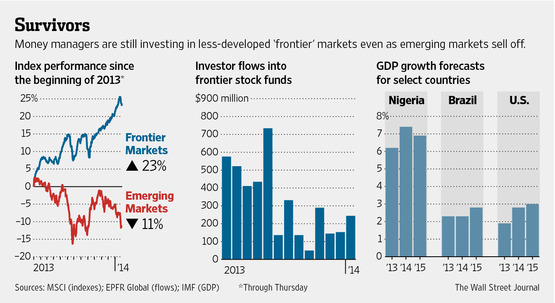
image001-31

Funds that buy frontier stocks in January drew in $244 million through Jan. 29, the most since October, according to EPFR Global. Over the same period, investors yanked $11.6 billion from emerging-market funds. Read more of this post
Escape from the Chronic Pain Trap: More than 100 million American adults live with chronic pain-most of them women. What will it take to bring them relief?

Escape from the Chronic Pain Trap

More than 100 million American adults live with chronic pain—most of them women. What will it take to bring them relief?

In a conversation with Gary Rosen, Judy Foreman, author of “A Nation in Pain,” discusses America’s chronic pain epidemic and why women suffer disproportionately.

JUDY FOREMAN

Jan. 31, 2014 9:09 p.m. ET

Several years ago, my neck suddenly went bonkers—bone spurs and a long-lurking arthritic problem probably exacerbated by too many hours spent hunching over a new laptop. On a subjective scale of zero to 10 (unfortunately, there is no simple objective test for pain), even the slightest wrong move—turning my head too fast or picking up a pen from the floor—would send my pain zooming from a zero to a gasping 10. Read more of this post

Investors Look Toward Safer Options as Ground Shifts

Investors Look Toward Safer Options as Ground Shifts

TOM LAURICELLA , KATIE MARTIN and TOMMY STUBBINGTON

Updated Jan. 29, 2014 10:37 p.m. ET

image001-30

Just one month into 2014, investors from Illinois to Istanbul are finding the tide going out fast for stocks and other riskier investments. Read more of this post

The Culture of Charade

The Culture of Charade

Posted on January 28, 2014

Robert P. Seawright

image001-29

We’ve all seen them, and they’re dreadful.

“Business television” – CNBC, Fox Business and the like – often bring on lower tier would-be experts from the hinterlands to fill time by opining on the latest news, the newest data release, or the ongoing market action in response to an anchor’s softball set-up.The interviewee typically ignores the set-up and plows ahead to pre-scripted and mundane (at best) talking points as quickly as possible. Such appearances are often arranged by PR firms, who brag about such “placements” and are paid well for doing so. These hits are worth doing for the networks because there is nothing like 24 hours per day of actual business and market news on offer. They have lots of time to fill. Read more of this post

The Absolute-Return Rip-Off

The Absolute-Return Rip-Off

By Larry Swedroe

January 30, 2014

How bad are absolute-return funds? Larry Swedroe counts the ways.

Investors would love to be able to achieve positive returns in both bull and bear markets, and that’s the “promise”—or at least the premise—of absolute-return funds. Read more of this post

Alibaba, Tencent spending big on taxi apps despite lack of profit model

Alibaba, Tencent spending big on taxi apps despite lack of profit model

Staff Reporter

2014-01-30

Alibaba Group and Tencent Holdings, China’s internet giants, are in a neck-and-neck fight in the taxi app market. On Jan. 20, Tencent’s Didi, its taxi hailing service, announced a plan to invest a further 200 million yuan (US$33 million) to benefit passengers. The very next day, Alibaba’s Kuaide swiftly announced it was investing 500 million yuan (US$82.5 million) for the good of passengers, Shanghai’s China Business News reports. Read more of this post

What an incredibly popular Lunar New Year’s gift – the Three Squirrels – tells us about China’s economy

What an incredibly popular Lunar New Year’s gift tells us about China’s economy

By Heather Timmons and Jennifer Chiu January 31, 2014

image001-28

What an incredibly popular Lunar New Year’s gift – the Three Squirrels – tells us about China’s economy

This year’s top Lunar New Year gift pack on China’s massive e-commerce website Tmall is a “Three Squirrels” brand nut assortment, which has racked up more than 150,000 sales.  A boxed set of seven packs of pecans and hazelnuts, decorated with a cartoon squirrel riding a horse, it weighs nearly 1,700 grams, or almost four pounds. Read more of this post

Why France is so afraid of Netflix

Why France is so afraid of Netflix

By Pascal-Emmanuel Gobry January 31, 2014

Pascal-Emmanuel Gobry is an entrepreneur, writer and analyst based in Paris.

Oh, France. You hate new things. You hate foreign things, particularly American things (or so you like to say). You hate business. Of course you’re going to hate Netflix.

Netflix is currently expanding around the world, and it wants to set up shop in France. The company has said it has aggressive expansion plans in Europe, and the French press has reported that executives from the company have met with President Hollande’s staff twice. To Reed Hastings I say: good luck, you’re going to need it. Read more of this post

Asia may not be able to fund its infrastructure needs without deeper credit culture: S&P

Asia may not be able to fund its infrastructure needs without deeper credit culture: S&P

The Jakarta Post, Jakarta | Business | Thu, January 30 2014, 4:06 PM

Asian governments in high-growth countries may face difficulties in maintaining growth and funding for all their infrastructure needs, Standard & Poor’s Ratings Services (S&P) said in its recently published report titled “Why Global Investors Aren’t Making Inroads Into Infrastructure Funding In Asia.” Read more of this post

Any Benjamin Franklins in Asia (Part 2)? Reflections from the Story of Linkabit-Qualcomm and the Inverted U-Curve of Singapore/Asia

Dear Friends and All,

Any Benjamin Franklins in Asia (Part 2)? Reflections from the Story of Linkabit-Qualcomm and the Inverted U-Curve of Singapore/Asia

Without Dr Irwin Jacobs, Sam Walton most probably cannot scale up Wal-Mart with the VSAT technology enabling Captain Sam to solve the inventory management problem that comes from scaling up at the VSAT-network of distribution centers and to video-call his managers to give pep talks for Saturday meetings; and San Diego will not be able to transform from a sleepy West Coast town to a successful innovation hub. That was one of the many insights that the Bamboo Innovator had gotten after hearing the presentation on Driving Growth Through Science and Innovation on 23 January at the Singapore Management University (SMU) by the billionaire inventor-entrepreneur of the CDMA technology that makes over 3 billion cell phones possible. Jacobs, Andrew Viterbi and five others have founded Qualcomm (Nasdaq: QCOM) (to deliver “QUALity COMMunications”), a super-compounder up over 130-fold to a market value of $125 billion or over 40% of the GDP of the country Singapore, and the fact of its scale and continued business model scalability has eluded most in the audience. Not surprisingly, Jacobs was told then that his big idea of CDMA digital wireless technology that creates a unique code for each call and so allows greater sharing of the airwaves simply violated the laws of physics. Thankfully he and his like-minded partners preserved. Qualcomm, through a combination of technological superiority, cunning business acumen to build an innovative business model that collects 3% of the price of virtually every handset sold in the world as royalty, and sheer tenacity, has become the undisputed standard by which telecom companies now measure themselves. Qualcomm’s rise mirrors that of the cell phone: Both are ubiquitous, both continue to evolve rapidly, and both turned the status quo on its head. Read more of this post

Nintendo desperate for a power-up Analysts and gamers worry company won’t recover mojo

Nintendo desperate for a power-up

Analysts and gamers worry company won’t recover mojo

BY KYOKO HASEGAWA

AFP-JIJI

JAN 31, 2014

There was a time when wherever Super Mario Brothers went, the gaming world followed, but an industry that has moved on in leaps and bounds since then just shrugged at the latest reset by Nintendo this week. Read more of this post

China’s internet vigilantes and the ‘human flesh search engine’; a Chinese official in charge of internet surveillance gave notice that mobs of web users who turn on individuals and make their lives a misery will not be tolerated

28 January 2014 Last updated at 20:07

China’s internet vigilantes and the ‘human flesh search engine’

By Celia HattonBBC News, Beijing

Last month a Chinese official in charge of internet surveillance gave notice that mobs of web users who turn on individuals and make their lives a misery will not be tolerated. In China it happens often and on a massive scale, earning the phenomenon the title of the “human flesh search engine”. Read more of this post

Have EM outflows only just begun?

Have EM outflows only just begun?

Izabella Kaminska

| Jan 31 10:01 | 9 comments Share

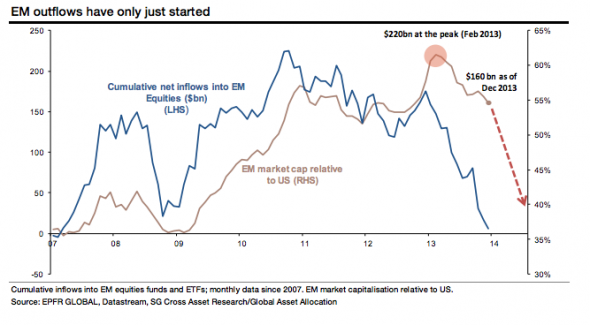
SocGen’s cross-asset research team believes that when it comes to EM outflows they may have only just begun:

image001-3

As the team notes on Friday, this is especially so given the Fed doesn’t appear to care about the EM sell-off: Read more of this post

Incidental Vs. Integral: Understanding your Emotions

Incidental Vs. Integral: Understanding your Emotions

by Karen Christensen | Jan 31, 2014

Stéphane Côté, a professor of Organizational Behaviour and HR Management talk about understanding emotions

Your recent research looks at emotionally-intelligent decision making. How do you define ‘emotional intelligence’?
Some of the most critical skills of emotional intelligence (‘EI’) include empathy, which is the ability to understand how other people feel; emotion understanding, which entails identifying the reasons for your own and other people’s emotions; and regulating your emotions, which involves coping with stress, modifying undesirable emotions and generating desired emotions. Getting rid of anger, for instance, and generating enthusiasm.   Read more of this post

Eight Essential Questions for Every Corporate Innovator

Eight Essential Questions for Every Corporate Innovator

by Scott Anthony  |   1:00 PM January 31, 2014

One of the first, and most lasting, pieces of career advice I received came from Linda Bush, my first project manager when I was a wee pup working at McKinsey & Company. “Ask a lot of questions,” Linda advised me. “You might think you are being annoying, but it’s the only way you learn. And trust me, people will tell you when you have crossed the line.” Read more of this post

Myer merger offer more about fear of future than great opportunity; The $3bn plan rejected by David Jones says much about the state of the department stores, though all may not yet be lost

Myer merger offer more about fear of future than great opportunity

The $3bn plan rejected by David Jones says much about the state of the department stores, though all may not yet be lost

Martin Farrer

theguardian.com, Friday 31 January 2014 08.08 GMT

One Citigroup analyst said Myer’s plan is basically a defensive move and doesn’t offer shareholders a big enough upside. Photograph: William West/AFP/Getty Images

If there was ever a sign that the glory days of Myer and David Jones were over, then it came with Thursday night’s merger story. Read more of this post

Strategic Humor: Cartoons from the March 2014 Issue

Strategic Humor: Cartoons from the March 2014 Issue

by Josh Olejarz  |   12:30 PM January 31, 2014

Enjoy these cartoons from the March issue of HBR, and test your management wit in the HBR Cartoon Caption Contest at the bottom of this post. If we choose your caption as the winner, you will be featured in the next magazine issue and win a free Harvard Business Review Press book. Read more of this post

All Quiet on the Amazon Front: Amazon is one of the most highly valued, most innovative and just plain most interesting companies in the country. It is also one that places a premium on saying nothing

JANUARY 31, 2014, 7:15 AM  11 Comments

All Quiet on the Amazon Front

By DAVID STREITFELD

Amazon is one of the most exciting companies in the country, redefining retail, web hosting, publishing and a bunch of other enterprises. When it says it is merely thinking of doing something — as it did Thursday with the first-ever price increase for Amazon Prime shipping service — it makes news. It also makes news when it talks about something that it is planning to do, maybe, a bunch of years from now, in the unlikely event everything works out. Yes, we’re talking drones. Read more of this post

We Are Giving Ourselves Cancer; Overused CT scans are exposing patients to dangerous levels of radiation

We Are Giving Ourselves Cancer

By RITA F. REDBERG and REBECCA SMITH-BINDMANJAN. 30, 2014

DESPITE great strides in prevention and treatment,cancer rates remain stubbornly high and may soon surpass heart disease as the leading cause of death in the United States. Increasingly, we and many other experts believe that an important culprit may be our own medical practices: We are silently irradiating ourselves to death. Read more of this post

Retailers Ask: Where Did Teenagers Go? Mainstays in the industry like American Eagle which has dominated teenage closets for years, has been among those hit hard

Retailers Ask: Where Did Teenagers Go?

By ELIZABETH A. HARRISJAN. 31, 2014

Mainstays in the industry like American Eagle which has dominated teenage closets for years, has been among those hit hard. Bryan Thomas for The New York Times

Luring young shoppers into traditional teenage clothing stores has become a tough sell.

When 19-year-old Tsarina Merrin thinks of a typical shopper at some of the national chains, she doesn’t think of herself, her friends or even contemporaries. Read more of this post

Motif, an investment site, tries to help small investors buy collections of stock based on long-term themes or trends

When Buying Stock in Gluttony Is a Good Investment

JAN. 31, 2014

image001-26

Clay Enos used the website Motif to make several themed investments

By PAUL SULLIVAN

ARTHUR LEVITT JR., the former chairman of the Securities and Exchange Commission, acknowledged that he found “The Seven Deadly Sins” irresistible — so much so that he plunked down $5,000 as an initial investment and has since put in more.

Read more of this post

5 Kinds Of Brilliance You Didn’t Know You Could Have

5 Kinds Of Brilliance You Didn’t Know You Could Have

BRAZEN LIFE

JAN. 30, 2014, 5:50 PM 4,433 1

Do you think of yourself as brilliant?

You know you’re different than everyone else in some way, but you’ve had a hard time putting your finger on it. And it’s not that you’ve got the kind of brain that publishes the next bestseller, drafts a peace agreement, discovers a particle or finds the largest prime number. Read more of this post

Google: Chromebooks Are Selling Like Crazy But We Don’t Make Money On Them

Google: Chromebooks Are Selling Like Crazy But We Don’t Make Money On Them

JULIE BORT 

JAN. 30, 2014, 10:03 PM 5,420 7

The growing popularity of Google Chromebooks doesn’t directly translate into more revenue for Google.

Google executives reminded Wall Street analysts of that fact on the company’s conference call on Thursday. Read more of this post

RYNO Motorcycles: changing the game one wheel at a time; RYNO Story 2014 Interview with CEO Chris Hoffmann

RYNO Story 2014 Interview with CEO Chris Hoffmann

Chris Hoffmann talks about the history and development of the RYNO. You can pre-order one of the first RYNO’s ever (right now) at www.rynomotors.com.

RYNO Motorcycles: changing the game one wheel at a time

By Jeff PerezJanuary 21, 2014 3:25 PM

image001-25

Anyone who rides a motorcycle will tell you that there’s nothing like the thrill of riding headlong on the open road with the wind in your face and worries at your back. A motorcycle is truly one of man’s best friends. But what if someone changed the formula — a formula, mind you, that’s been relatively unchanged for a over a hundred years. Read more of this post

How Jeff Bezos Can Take Over The World Without Earning A Profit

How Jeff Bezos Can Take Over The World Without Earning A Profit

MATTHEW YGLESIASSLATE
JAN. 31, 2014, 10:04 AM 3,071 8

E-commerce was king this past holiday season, with Christmas surge orders overwhelming UPS’s systems and forcing $100 million in upgrades to prevent future fiascos. So it was no surprise on Jan. 30 when Amazon reported it had become even more enormous than ever before. According to its latest earnings report, the online shopping giant’s net sales increased 20 percent compared with the previous holiday season—a number that would seem staggeringly high if it weren’t so routine for a company that’s been growing rapidly for years. Yet the company’s net income of $274 million for all of last year was tiny relative to its sales of $74.45 billion. Amazon’s profit margin was virtually nonexistent. Read more of this post

Daniel Pink Recommends These 5 Books To Improve Your Thinking

Daniel Pink Recommends These 5 Books To Improve Your Thinking

FARNAM STREET

JAN. 30, 2014, 12:42 PM 33,243 4

In Daniel Pink’s book, “To Sell Is Human,” he lists five books to help you frame arguments, identify problems, and curate information. Read more of this post

Netflix CEO Confesses He Tried To Sell The Company To Blockbuster … But Blockbuster Wasn’t Interested

Netflix CEO Confesses He Tried To Sell The Company To Blockbuster … But Blockbuster Wasn’t Interested

RYAN BUSHEY

JAN. 31, 2014, 5:22 PM 2,028 1

The New Yorker’s Ken Auletta wrote a profile of Netflix CEO Reed Hastings and revealed that the now-shuttered video chain Blockbuster missed out on a great chance to purchase the fledgling company in 2000. Read more of this post

Kicking Bill Gates Off The Board Is The Best Thing Microsoft Can Do

Kicking Bill Gates Off The Board Is The Best Thing Microsoft Can Do

JULIE BORT

JAN. 31, 2014, 6:19 PM 5,862 14

Microsoft is an insanely profitable company standing on the edge of disaster. It desperately needs new thinking.

With word that 22-year Microsoft veteran Satya Nadella is likely the new CEO, attention turns to the leadership of the company’s board of directors. It will have two former CEOs, Bill Gates and Steve Ballmer. Read more of this post