Morning Bamboo Insight: 10 Sep 2014

Morning Bamboo Insight: 10 Sep 2014

Macro

  1. Wage stagnation: The big freeze; Throughout the rich world, wages are stuck

http://www.economist.com/news/finance-and-economics/21615589-throughout-rich-world-wages-are-stuck-big-freeze

  1. Loss-making public companies by region in America, Europe and Japan

http://www.businessinsider.sg/percentage-of-stocks-losing-money-2014-9/#.VA6iqfmSyCk

  1. The wonky, absurd scales of (insider dealing) justice; Mathew Martoma was sentenced to nine years in prison for insider trading. And yet CEOs strategically time news releases to coincide with months in which their equity vests

http://ftalphaville.ft.com/2014/09/08/1962251/the-wonky-absurd-scales-of-insider-dealing-justice/

  1. Dreams on hold, Brazil’s ‘new middle class’ turns on Rousseff

http://uk.reuters.com/article/2014/09/09/uk-brazil-election-middleclass-insight-idUKKBN0H40A620140909

Asia Pacific

  1. (Korea) – Why so many Koreans are called Kim

http://www.economist.com/blogs/economist-explains/2014/09/economist-explains-5

  1. (India) – India revamps intellectual property policy in face of western anger

http://www.ft.com/intl/cms/s/0/458f833a-375a-11e4-8472-00144feabdc0.html#axzz3CnW1PNSH

  1. (China) – Better companies needed for China shares to shine; many listed Chinese companies continue to be the subject of allegations of wrongdoing, accounting fraud and corporate governance issues.

http://www.ft.com/intl/cms/s/0/3fe2e34c-3745-11e4-8472-00144feabdc0.html#axzz3CnW1PNSH

  1. (HK) – The Chan family controls Hang Lung, one of the biggest and oldest property developers in Hong Kong

http://www.ft.com/intl/cms/s/0/60f202fa-3729-11e4-8472-00144feabdc0.html#axzz3CnW1PNSH

  1. (HK) – Hong Kong must seize the first chance to elect its own leaders; Successive governments have been working towards universal suffrage, writes C Y Leung

http://www.ft.com/intl/cms/s/0/22864004-34ee-11e4-aa47-00144feabdc0.html#axzz3CnRThvlC

  1. (Australia) – Australia: Culture clash; The government seems preoccupied with policies that critics say amount to an ideological war

http://www.ft.com/intl/cms/s/0/18c9d234-3740-11e4-b45c-00144feabdc0.html#axzz3CnRThvlC

  1. (Japan) – Nissan building know-how at ‘global mother plant’

http://www.japantimes.co.jp/news/2014/09/08/business/corporate-business/nissan-shifts-manufacturing-cars-building-know-japanese-plants/#.VA6a4PmSyCk

  1. (HK/China) – A much-hyped idea to link bourses in HK and Shenzhen is not in the pipeline, China’s securities watchdog said, saying one of its current priorities is to hammer out taxation issues for the upcoming Shanghai-HK Stock Connect

http://www.thestandard.com.hk/news_detail.asp?we_cat=2&art_id=149222&sid=42944720&con_type=1&d_str=20140908&fc=1

  1. (Spore/HK) – Bad news in Hong Kong is good news for Singapore

http://www.cnbc.com/id/101963981

  1. (China) – Spectre of Corruption Haunts Huawei; Efforts to curb bribery in product rebate system nets 100 employees as series of corruption scandals engulf telecoms equipment giant

http://english.caixin.com/2014-09-08/100726114.html

  1. (Taiwan) – Perng Fai-nan, governor of Taiwan’s central bank, was named one of the world’s seven best central bankers in 2014 for 10th straight year

http://www.wantchinatimes.com/news-subclass-cnt.aspx?cid=1203&MainCatID=12&id=20140909000045

  1. (Taiwan) – Taiwan semiconductor firms may lose talent as China pays better

http://www.wantchinatimes.com/news-subclass-cnt.aspx?cid=1201&MainCatID=12&id=20140909000013

Life

  1. Marcus Aurelius’ 10 Rules For Being An Exceptional Leader

http://www.businessinsider.sg/marcus-aurelius-on-being-a-great-leader-2014-9/#.VA6ju_mSyCk

  1. The Most Frustrating Email in the World: “Please call me.”; add some details to an email to make it slightly less baffling and anxiety provoking.

https://www.linkedin.com/today/post/article/20140907235500-900547-the-most-frustrating-email-in-the-world

  1. Over the horizon: Three issues that should preoccupy managers in the next 50 years

http://www.economist.com/news/business/21615586-three-issues-should-preoccupy-managers-next-50-years-over-horizon

  1. Pardon the disruption: When firms succumb to new forms of competition, inflexible organisation is usually to blame

http://www.economist.com/news/finance-and-economics/21615587-when-firms-succumb-new-forms-competition-inflexible-organisation-usually

  1. Keeping it in the family: Patriarchs are reluctant to cede control of the companies they built

http://www.economist.com/news/business/21615594-patriarchs-are-reluctant-cede-control-companies-they-built-keeping-it-family

  1. Steve Jobs Was Depressed The Day After Apple Released The iPad

http://www.businessinsider.sg/steve-jobs-was-depressed-the-day-after-apple-released-the-ipad-2014-9/#.VA6iVfmSyCk

TMT

  1. (China/Tech) – After the float: The Chinese e-commerce firm faces growing competition

http://www.economist.com/news/business/21615597-chinese-e-commerce-firm-faces-growing-competition-after-float

  1. Digital news: Investors are taking an interest in journalism: now that is news

http://www.economist.com/news/business/21615595-investors-are-taking-interest-journalism-now-news-read-all-about-it

  1. The Aerospace Industry Is Betting Big On 3D Printing Technology

http://www.businessinsider.sg/heres-how-the-aerospace-industry-is-making-3d-printing-a-multi-billion-dollar-business-2014-9/#.VA6jq_mSyCk

  1. Amazon Is Under Attack Like Never Before

http://www.businessinsider.sg/amazons-new-competiton-2014-9/#.VA6ixPmSyCk

  1. CHART OF THE DAY: Most People Want Smartwatches To Track Their Activities

http://www.businessinsider.sg/chart-of-the-day-most-people-want-smartwatches-to-track-their-activities-2014-9/#.VA6irvmSyCk

  1. Graphene developers edge towards commercial breakthrough; Stronger than steel, tougher than diamond and yet lighter than paper, graphene has all the makings of a “miracle material”.

http://www.ft.com/intl/cms/s/0/db153064-291b-11e4-9d5d-00144feabdc0.html#axzz3CnW1PNSH

  1. Small step for Paypal, one giant leap for magic internet money

http://blogs.ft.com/tech-blog/2014/09/small-step-for-paypal-one-giant-leap-for-magic-internet-money/?hubRefSrc=permalink

  1. (China/Tech) – Tech Firms See Opportunity in China Stocks Link

http://online.wsj.com/articles/china-stocks-link-offers-tech-firms-opportunity-1409909768

  1. (China/Tech) – Online writing now a millionare business in China; The play to online novel series Grave Robbers’ Chronicles pocketed 28 million yuan (US$4.55 million) in ticket sales for 45 performances in Shanghai this summer alone

http://www.wantchinatimes.com/news-subclass-cnt.aspx?id=20140908000123&cid=1304

  1. (China/Tech) – Mobile phone gaming bubble poses risks in China

http://www.wantchinatimes.com/news-subclass-cnt.aspx?cid=1202&MainCatID=12&id=20140908000091

  1. (China/Tech) – Will Education Firm New Oriental Learn or Lose? Managers and even a CEO have defected from China’s biggest education company, which finds itself at a crossroads

http://english.caixin.com/2014-09-08/100726089.html

Consumer

  1. How Victoria’s Secret Will Continue To Crush The Competition

http://www.businessinsider.sg/victorias-secret-business-strategy-2014-9/#.VA6iyPmSyCk

  1. The enduring appeal of mechanical watches; Smartwatches have not stopped a trend from digital to clockwork

http://www.ft.com/intl/cms/s/0/0e850b12-336d-11e4-85f1-00144feabdc0.html#axzz3CnRThvlC

Investing Process

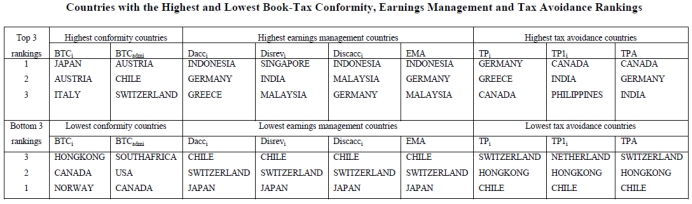
  1. Research – Strategic News Releases in Equity Vesting Months

http://papers.ssrn.com/sol3/papers.cfm?abstract_id=2489152

Commodities

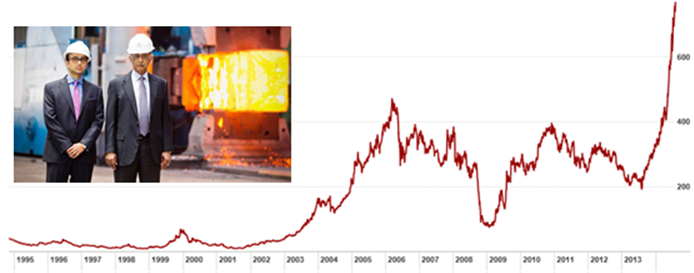
  1. End-to-end game: Commodity-trading houses are growing-and running more risks

http://www.economist.com/news/finance-and-economics/21615620-commodity-trading-houses-are-growingand-running-more-risks-end-end-game


Morning Bamboo Insight: 8 Sep 2014

Morning Bamboo Insight: 8 Sep 2014

Macro

1. Political booms, financial crises: Why popular governments are not always a good sign

http://www.voxeu.org/article/increasing-government-popularity-predicts-emerging-market-financial-crises

Asia Pacific

  1. (India) – Roll up for the one-man band: Narendra Modi is proving dynamic, but he cannot run India on his own

http://www.economist.com/news/asia/21615635-narendra-modi-proving-dynamic-he-cannot-run-india-his-own-roll-up-one-man-band

  1. (China) – China imposes ceiling on the wages of state-owned enterprise leaders

http://www.wantchinatimes.com/news-subclass-cnt.aspx?cid=1201&MainCatID=12&id=20140907000102

  1. (China) – Media, PR Executives ‘Arrested over IPO Blackmail Schemes’; Chief and deputy chief editors of 21st Century News Group’s website among the eight people detained, state media reports

http://english.caixin.com/2014-09-04/100725214.html

  1. (China) – Debts pile up, weighing on Chinese steelmakers; China’s steel industry now has an excess capacity between 180 million tonnes and 240 million tonnes

http://news.xinhuanet.com/english/china/2014-09/07/c_133626789.htm

  1. (India) – Why Modi Cares About India’s ‘Neo Middle Class’; Tax Breaks, Job Training Seek to Boost Some 380 Million ‘Aspirants’

http://blogs.wsj.com/indiarealtime/2014/09/07/new-delhi-courts-neo-middle-class/

http://online.wsj.com/articles/new-delhi-courts-neo-middle-class-with-incentives-1409961855

  1. (India) – How Jignesh Shah lost the plot & his empire; FTIL exits MCX completely, Shah is free and has time to reflect on the path ahead; Jignesh Shah could well have been India’s most mercurial financial market entrepreneur

http://forbesindia.com/printcontent/38573

  1. (Isia) – Across Indonesia, Local Chiefs Slam Plan to Stop All Direct Polls; Democratic Setback: Under a bill set to be passed this week, the House wants local leaders chosen by regional legislative councils

http://www.thejakartaglobe.com/news/jakarta/across-indonesia-local-chiefs-slam-plan-stop-direct-polls/

  1. (Isia) – Megawati’s Hand Seen in Jokowi’s Advisory Team; ‘Puppet President’: Fears that Megawati is the real power behind the scenes are only growing more acute; Editorial: Jokowi Should Avoid Diluting His Cabinet

http://www.thejakartaglobe.com/news/megawatis-hand-seen-jokowis-advisory-team/

http://www.thejakartaglobe.com/opinion/editorial-jokowi-avoid-diluting-cabinet/

  1. (Asean) – After 47 Years, Keeping Asean Relevant and Staying Together

http://www.thejakartaglobe.com/opinion/47-years-keeping-asean-relevant-staying-together/

  1. (Australia) – Meet Australia’s coffee pod tycoons; They’re part of a global market worth $10 billion and they’re spending millions on manufacturing facilities.

http://www.theage.com.au/small-business/entrepreneur/meet-australias-coffee-pod-tycoons-20140829-3ek33.html?promote_channel=edmail&mbnr=NDEzOTI1Mg

Life

  1. Why Walking Helps Us Think

http://www.newyorker.com/tech/elements/walking-helps-us-think

  1. Guess What: You Don’t “Implement” Innovation. It’s Created Through Principles

http://betabeat.com/2014/09/guess-what-you-dont-implement-innovation-its-created-through-principles/

  1. Seneca on Saving Time

http://www.farnamstreetblog.com/2014/09/seneca-on-saving-time/

  1. Maya Angelou on Haters, Life, Reading, and Love

http://www.farnamstreetblog.com/2014/09/maya-angelou-on-haters-life-reading-and-love/

  1. Thinking Straight in the Age of Information Overload

http://www.farnamstreetblog.com/2014/09/thinking-straight-in-the-age-of-information-overload/

  1. Why Flunking Exams Is Actually a Good Thing; To learn how to study, start by bombing a pretest.

http://www.nytimes.com/2014/09/07/magazine/why-flunking-exams-is-actually-a-goodthing.html?emc=edit_th_20140907&nl=todaysheadlines&nlid=36114517&_r=0

  1. Welcome to my genome: George Church is a genetics pioneer whose research spans treating diseases, altering bodies and a desire to breed woolly mammoths

http://www.economist.com/news/technology-quarterly/21615029-george-church-genetics-pioneer-whose-research-spans-treating-diseases-altering

  1. Crazy Is a Compliment: The Power of Zigging When Everyone Else Zags

http://www.amazon.com/Crazy-Is-Compliment-Zigging-Everyone/dp/1591846641/

  1. Books – Smartcuts: How Hackers, Innovators, and Icons Accelerate Success

http://www.amazon.com/Smartcuts-Hackers-Innovators-Accelerate-Success/dp/0062302450/

  1. Books – Your Inner Will: Finding Personal Strength in Critical Times

http://www.amazon.com/Your-Inner-Will-Personal-Strength/dp/0399171843/

TMT

  1. (Isia/Tech) – Online shopping in Indonesia flourishes despite scam concerns

http://digital.asiaone.com/print/digital/news/online-shopping-indonesia-flourishes-despite-scam-concerns

  1. The future of cars: Wireless wheels; Connected cars will make driving safer, cleaner and more efficient. Their introduction should be speeded up

http://www.economist.com/news/leaders/21615599-connected-cars-will-make-driving-safer-cleaner-and-more-efficient-their-introduction-should-be

  1. The connected car: Smartphones on wheels; The way cars are made, bought and driven is changing with mobile communications. This paves the way to a driverless future

http://www.economist.com/news/technology-quarterly/21615060-way-cars-are-made-bought-and-driven-changing-mobile-communications

  1. Demolition technology: New ways are being found to demolish old buildings in crowded cities

http://www.economist.com/news/technology-quarterly/21615066-new-ways-are-being-found-demolish-old-buildings-crowded-cities-bringing

  1. The language of the internet of things: More and more devices are becoming connected, but will they speak the same language?

http://www.economist.com/news/technology-quarterly/21615067-more-and-more-devices-are-becoming-connected-will-they-speak-same

  1. In the moment of the heat: One way to keep warm is to heat people rather than expending energy heating the buildings they are in

http://www.economist.com/news/technology-quarterly/21615065-one-way-keep-warm-heat-people-rather-expending-energy-heating

  1. How Big Companies and Their Tech Suppliers Are Changing Together; cloud and mobility are reshaping the workplace, as well as the tech companies themselves.

http://bits.blogs.nytimes.com/2014/09/06/how-big-companies-and-their-tech-suppliers-are-changing-together/?_php=true&_type=blogs&ref=technology&_r=0

  1. (China/Tech) – The Jack Ma Way: Alibaba, started by Jack Ma in 1999, is about to sell shares in the United States that could value the company at about $160 billion.

http://www.nytimes.com/2014/09/07/business/international/at-alibaba-the-founder-is-squarely-in-charge.html?ref=business&_r=0

  1. Three Marks Of Real Data Science

http://techcrunch.com/2014/09/06/three-marks-of-real-data-science/

  1. (Tech) – Too soon for consumer 3D printing, says Gartner; Consumer 3D printing adoption will be outpaced by business and medical applications that have more compelling needs in the short term

http://www.wantchinatimes.com/news-subclass-cnt.aspx?cid=1204&MainCatID=12&id=20140828000067

Consumer


Healthcare

  1. Biohackers of the world, unite: Following the example of maker communities worldwide, hobbyists keen on biology have started to get together

http://www.economist.com/news/technology-quarterly/21615064-following-example-maker-communities-worldwide-hobbyists-keen-biology-have

Investing Process

  1. How to Pick Stocks by Recognizing the Flaws in Investors’ Thinking; Joe Huber, Huber Capital’s boss, tries to avoid the big mistake that many investors make.

http://online.barrons.com/news/articles/SB51885783724964273656104580130022394100384

Medicines on Call in Asia

  image001

“Bamboo Innovators bend, not break, even in the most terrifying storm that would snap the mighty resisting oak tree. It survives, therefore it conquers.”

BAMBOO LETTER UPDATE | September 1, 2014
Bamboo Innovator Insight (Issue 48)

  • The weekly insight is a teaser into the opportunities – and pitfalls! – in the Asian capital jungles.
  • Get The Moat Report Asia– a monthly in-depth presentation report of around 30-40 pages covering the business model of the company, why it has a wide moat and why the moat may continue to widen, a special section on “Inside the Leader’s Mind” to understand their thinking process in building up the business, the context – why now (certain corporate or industry events or groundbreaking news), valuations (why it can compound 2-3x in the next 5 years), potential risks and how it is part of the systematic process in the Bamboo Innovator Index of 200+ companies out of 15,000+ in the Asia ex-Japan universe.
  • Our paid Members from North America, Europe, the Oceania and Asia include professional value investors with over $20 billion in asset under management in equities, some of the world’s biggest secretive global hedge fund giants, and savvy private individual investors who are lifelong learners in the art of value investing.
 

Can You Guess This Asian Wide-Moat Company? Medicines on Call in Asia

image010

If you live in North America, there’s a one in two chances that the medicine that you use is distributed by hidden giants McKesson (MCK US, MV $44.4bn) and AmerisourceBergen (ABC US, MV $17.4bn).

This Asian wide-moat company is the McKesson of its home country as the #1 private pharmaceutical wholesaler. For the business model of a pharmaceutical wholesaler-distributor, working capital management is critical. In terms of inventory management efficiency, at the inventory turnover period of 42 days, the company is nearly twice as efficient as state-linked giants and is nearly on par with world leaders McKesson and AmerisourceBergen, an impressive feat given the logistics challenge in emerging markets. The company’s 9.6% ROA is nearly double that of state-linked leader.


In an economy where business fortunes are built from government concessions or licenses, the company has forged a different path by relying on its own capabilities to provide quality pharmaceutical products and healthcare largely in the private sector. Dr K, the chairman and CEO, and his management team have exercised prudence and discipline in executing their operations and capex plans with a strong balance sheet fortified by net cash that’s around 10.5% of market value while deepening their core competencies in warehousing, logistics, sales and marketing to connect to the fragmented market of over 4,000 clients.


Public healthcare services in Asia face the problem of social and financial sustainability. The cost of medicare is pushed higher and higher, driving more and more people who cannot afford such healthcare into crowded public hospitals. Doctors get paid so well in private healthcare that public hospitals cannot afford to attract and hire the best. There is growing demand for reasonably-priced quality private healthcare services, generic drugs and consumer healthcare products of which the company is a key provider and beneficiary.


#1 Private Pharma Wholesaler and Integrated Manufacturing-Wholesale-Distribution Platform with New Growth in Making Orthopedic Components


Our latest monthly issue for the month of September investigates an Asian-listed company who is the #1 private pharmaceutical wholesaler and also one of the largest private sector manufacturer of off-patent medicines in its domestic market. Its integrated business model from pharma manufacturing to wholesale, distribution and marketing has carved out top-selling own-branded products such as #1 in medicated powder, #1 cough mixture, #1 cough expectorant etc. With its network of warehouses strategically located throughout the country, the company is able to provide comprehensive coverage and rapid access to markets and customers, delivering the “Medicines on Call” value proposition to over 4,000 private-sector customers from private hospitals, pharmacies to supermarkets and also serves as the long-term channel partner to international brands such as GSK, J&J, 3M, Colgate Palmolive, Nestle for over 30 years etc.


From FY2014 onwards, the company has operationalized the business to contract manufacture orthopedic components for top MNCs with the full array of machining, casting, coating and forging capabilities. In an economy where fortunes are built from government concessions or licenses, the company has forged a different path by relying on its own capabilities to provide quality pharmaceutical products and healthcare services largely in the private sector.


In an economy where fortunes are built from government concessions or licenses, the company has forged a different path by relying on its own capabilities to provide quality pharmaceutical products and healthcare. Dr K, the chairman and CEO, and his management team have exercised prudence and discipline in executing their operations and capex plans with a strong balance sheet fortified by net cash that’s around 10.5% of market value while deepening their core competencies in warehousing, logistics, sales and marketing to connect to the fragmented market of over 4,000 clients.


For the business model of a pharmaceutical wholesaler-distributor, working capital management is critical. In terms of inventory management efficiency, at the inventory turnover period of 42 days, the company is nearly twice as efficient as state-linked giants and is nearly on par with world leaders McKesson and AmerisourceBergen, an impressive feat given the logistics challenge in emerging markets. The company’s9.6% ROA is nearly double that of state-linked leader.


At EV/EBIT 10.1x, EV/EBBITDA 8.4x, PE14e 10.2x and P/Book 1.9x, the company is reasonably decent in valuations for its resilient earnings and cashflow growth. Giant drug dealers McKesson (MCK US, MV $44.4bn) and AmerisourceBergen (ABC, MV $17.4bn) are also on the global hunt for acquisition targets; McKesson has bought Germany’s Celesio, one of Europe’s largest drug distributors, for $5.4bn in 4Q13, to link up the supply chains of Europe and US; ABC has acquired a 19.9% stake in Brazilian drug wholesaler Profarma in March 2014 for $100m. More consolidation in the sector globally is likely and could be the catalyst to drive up the valuation of quality emerging market companies in the sector. Long-term downside protection in terminal value is provided by MNCs who will be interested to acquire or partner with the company to possess its valuable wide-moat advantage in its network of warehouses and wholesale-distribution know-how to reach the fragmented customers.


The company has achieved an impressively consistent and improving performance in difficult times and is well-positioned in the local pharmaceutical industry which is among the few industries quite unaffected by economic cycles as the demand for drugs will continue even in difficult times. Public healthcare services in Asia face the problem of social and financial sustainability and the overcrowded public hospitals and clinics have sparked growing demand for reasonably-priced and quality private healthcare services, generic drugs and consumer healthcare products of which the company is a key provider and beneficiary.


Warm regards,

KB

Managing Editor

The Moat Report Asia

www.moatreport.com

SMU: http://accountancy.smu.edu.sg/faculty/profile/108141/Kee%20Koon%20Boon

Evening Bamboo Insight: 4 Sep 2014

Evening Bamboo Insight: 4 Sep 2014

Macro

  1. Why Bill Gates And Warren Buffett Are Railroad Rivals

http://www.businessinsider.sg/why-bill-gates-and-warren-buffett-are-railroad-rivals-2014-9/#.VAgRrvmSxqU

  1. Watch out for companies splashing cash; They are underperformers, in company with cash hoarders

http://www.ft.com/intl/cms/s/0/002613f4-336d-11e4-9607-00144feabdc0.html#axzz3CKD4katP

  1. With Wikistrat, crowdsourcing gets geopolitical; A consultancy is trying to out-forecast intelligence agencies

http://www.ft.com/intl/cms/s/0/f3eb8908-2f9c-11e4-83e4-00144feabdc0.html#axzz3CKD4katP

  1. Germany’s taxis should not triumph over Uber; The problem is not that cabs are endangered but overly protected

http://www.ft.com/intl/cms/s/0/3ea68e1e-3350-11e4-85f1-00144feabdc0.html#axzz3CJRZCGQy

Asia Pacific

  1. (China) – Q. and A.: Ren Jianming on the Fight Against Corruption in China, and His Own Solution

http://sinosphere.blogs.nytimes.com/2014/09/02/q-and-a-ren-jianming-on-the-fight-against-corruption-in-china-and-his-own-solution/

  1. (Msia) – Najib: ‘Every citizen has a place under the Malaysian sun’

http://www.thestar.com.my/News/Nation/2014/09/04/Najib-1Malaysia/

  1. (China) – China Auto Industry Revved Up over Reports Rules for Imports May Change

http://english.caixin.com/2014-09-02/100724270.html

  1. (Korea) – Kumho brothers at each other again; Kumho Petrochem Chairman Park Chan-koo has asked local prosecutors to investigate his older brother and the chairman of Kumho Asiana Group, Park Sam-koo, for breach of trust.

http://koreajoongangdaily.joins.com/news/article/article.aspx?aid=2994495&cloc=joongangdaily|home|newslist1

  1. (Australia) – It’s change or die for Australia Post

http://www.theage.com.au/business/comment-and-analysis/its-change-or-die-for-australia-post-20140904-10cexf.html

  1. (HK) – HK University’s Law Professor Benny Tai leads fight for Hong Kong democracy, vows to push ahead with a Gandhi-style civil disobedience campaign

http://www.ft.com/intl/cms/s/0/a6927d22-335e-11e4-9607-00144feabdc0.html#axzz3CKFccaxE

  1. (China) – Wheels come off China’s bike-share schemes

http://www.ft.com/cms/s/0/815c5378-33e2-11e4-85f1-00144feabdc0.html#axzz3CKFccaxE

  1. (China) – China fraud unit questions Morgan Stanley arm over ‘princeling’

http://www.ft.com/intl/cms/s/0/4debfe4e-336a-11e4-9607-00144feabdc0.html#axzz3CKD4katP

  1. (China) – China fraud unit questions Morgan Stanley arm over ‘princeling’

http://www.ft.com/intl/cms/s/0/4debfe4e-336a-11e4-9607-00144feabdc0.html#axzz3CKD4katP

  1. (India) – India CEOs Look For Ways To Get Manufacturing Back On Growth Track

http://forbesindia.com/printcontent/38549

  1. (Korea) – Helping a Korean Electronics Giant Stay Nimble; feature of Young Sohn, President and Chief Strategy officer for Samsung Electronics

http://www.forbes.com/sites/brucerogers/2014/09/03/helping-a-korean-electronics-giant-stay-nimble/print/

Life

  1. If This Company Succeeds, We Won’t Be Fighting About Reclining Airline Seats

http://www.businessinsider.sg/company-succeeds-wont-be-fighting-about-reclining-airline-seats-2014-9/#.VAgSSfmSxqU

  1. 7 Hard Truths About Life That People Don’t Like To Admit; The world is full of suffering.

http://www.businessinsider.sg/hard-truths-people-dont-like-to-admit-2014-9/#.VAgRtPmSxqU

  1. If You Can Solve This Math Problem, You’ll Get A $1 Million Prize, And Change Internet Security As We Know It

http://www.businessinsider.sg/p-vs-np-millennium-prize-problems-2014-9/#.VAgPm_mSxqU

  1. History channel’s miniseries are finding a happy medium between actual history and mindless entertainment

http://qz.com/259390/history-channels-miniseries-are-finding-a-happy-medium-between-actual-history-and-mindless-entertainment/

  1. It’s draining men (and women): how staff loyalty took plumbing firm Cooke & Dowsett to nationwide success

http://www.brw.com.au/p/business/mid-market/success_draining_cooke_dowsett_women_LRScws8klB1nieuKa9xfVN

  1. “If you can get good at destroying your own wrong ideas, that is a great gift.” – Charlie Munger

http://awealthofcommonsense.com/charlies-munger-becoming-better-investor/

  1. Five Tips That Will Free You From Mediocrity

http://www.forbes.com/sites/theyec/2014/09/03/five-tips-that-will-free-you-from-mediocrity/print/

  1. Jeffrey Katzenberg: ‘Do good — just don’t do too good’

http://fortune.com/2014/09/03/jeffrey-katzenberg-do-good-just-dont-do-too-good/

TMT

  1. (China/Tech) – WeChat and third-party Android app stores: How China’s mobile ecosystem is different from the West

http://thenextweb.com/asia/2014/08/26/wechat-and-third-party-android-app-stores-how-chinas-mobile-ecosystem-is-different-from-the-west

  1. (China/Tech) – PPTV, a former industry leader, is slowly getting carved up among investors as it is forced to scrap some of its most promising new products.

http://www.youngchinabiz.com/en/pptv-carve-up-continues-as-crackdown-bites

  1. (China/Tech) – MIT professor looks into Baidu’s big data strategy

http://news.xinhuanet.com/english/china/2014-09/03/c_133617691.htm

  1. (China/Tech) – Baidu is a fixture of online life in China, but it wants to become a global power. Can one of the world’s leading artificial intelligence researchers help it challenge Silicon Valley’s biggest companies?

http://www.technologyreview.com/featuredstory/530016/a-chinese-internet-giant-starts-to-dream/?

  1. (Tech) – The Met Plans To Become The Most Digitally Influential Museum In The World

http://www.businessinsider.sg/digital-strategy-at-the-met-2014-9/#.VAgRV_mSxqU

  1. Salesforce.com Exec: ‘We’re Gonna Suck The Life Out Of’ Microsoft

http://www.businessinsider.sg/salesforce-exec-challenges-microsoft-2014-9/#.VAgQ_fmSxqU

  1. Google Glass supplier to develop new smart glasses with French firm

http://www.wantchinatimes.com/news-subclass-cnt.aspx?id=20140904000040&cid=1206

  1. (Korea/Tech) – Korean Gov’t reduces online verifications; Koreans, foreigners must only enter name and address to shop

http://koreajoongangdaily.joins.com/news/article/article.aspx?aid=2994496

  1. Why Apple’s mobile-payments system might actually work

http://qz.com/258475/why-apples-mobile-payments-system-might-actually-work/

  1. Arrowgrass Capital, the $5bn London hedge fund, is planning to develop an electronic invoicing service in the latest move into disruptive financial services businesses by alternative investors

http://www.ft.com/intl/cms/s/0/75156dcc-3381-11e4-85f1-00144feabdc0.html#axzz3CKD4katP

Consumer

  1. Luxottica’s board revamp exposes Renzi’s old concerns

http://www.ft.com/intl/cms/s/0/d155313c-3343-11e4-85f1-00144feabdc0.html#axzz3CJRZCGQy

Healthcare

  1. Letting Foreign Investors Open Wholly Owned Hospitals Hardly a Cure-All; The reform would not fix the big problems facing the health care industry and might not even appeal to the facilities’ backers

http://english.caixin.com/2014-09-02/100724274.html

Investing Process

  1. Shenguan Holdings (0829), a mainland- based sausage-casing maker, has been accused by short-seller Emerson Analytics of exaggerating revenue and concealing high costs of raw materials

http://www.scmp.com/print/business/money/markets-investing/article/1584660/shenguan-latest-hong-kong-listed-mainland-firm

http://www.scmp.com/print/business/companies/article/1584898/sausage-casing-firm-shenguan-respond-false-allegations-over

http://www.thestandard.com.hk/news_detail.asp?we_cat=2&art_id=149138&sid=42924170&con_type=1&d_str=20140904&fc=7

http://www.reuters.com/article/2014/09/04/china-shenguan-idUSL3N0R464G20140904

  1. Canada watchdog says Sino-Forest execs deceived investors

http://www.reuters.com/article/2014/09/02/sino-forest-regulator-canada-idUSL1N0R32DF20140902


Morning Bamboo Insight: 3 Sep 2014

Morning Bamboo Insight: 3 Sep 2014

Macro

  1. Sino-Forest tribunal will put fraud allegations – and the OSC’s reputation – to the test

http://business.financialpost.com/2014/09/01/sino-forest-tribunal-will-put-fraud-allegations-and-the-oscs-reputation-to-the-test/

Asia Pacific

  1. (China) – World’s largest duty-free shop opens in China’s Sanya

http://news.xinhuanet.com/english/china/2014-09/01/c_133612221.htm

  1. (Korea) – Samsung Group merges affiliates: Heavy industries arm absorbs engineering in latest restructuring

http://koreajoongangdaily.joins.com/news/article/article.aspx?aid=2994384

  1. (Australia) – Meet the new breed of Aussie manufacturers exporting to the world

http://www.brw.com.au/p/entrepreneurs/meet_the_new_breed_world_aussie_xNYJduWT8OdMpBiDGejLEN

  1. (Korea) – Korean conglomerates decrease the trend of merging together

http://www.koreatimes.co.kr/www/news/biz/2014/09/488_163985.html

  1. (Msia) – 1998’s tough moves by KL vindicated; Minister says they also enabled M’sia to go through 2007 crisis unscathed

http://www.nst.com.my/node/28644

  1. (Japan) – New GPIF investment manager drawn to cheap Japan mid-caps

http://www.reuters.com/article/2014/09/01/us-japan-funding-strategy-idUSKBN0GV0XT20140901

  1. (Taiwan) – Taiwan’s first budget airline set for maiden flight

http://www.channelnewsasia.com/news/business/taiwan-s-first-budget/1340436.html

  1. (Myanmar) – Myanmar city U-turns amid outcry over secret $8 bln housing deal

http://www.reuters.com/article/2014/09/01/myanmar-construction-idUSL3N0R22HL20140901

  1. (Asean) – Banking on the AEC

http://www.thejakartaglobe.com/opinion/banking-aec/

  1. (Isia) – Indonesia plays winning hand with global miners: Russell

http://www.reuters.com/article/2014/09/01/column-russell-indonesia-mining-idUSL3N0R21RO20140901

  1. (India/Japan) – Indian PM Modi’s Foolish Crush on All Things Japanese

http://www.thejakartaglobe.com/opinion/indian-pm-modis-foolish-crush-things-japanese/

  1. (India/Japan) – India, Japan Will Shape 21st Century: Modi

http://www.thejakartaglobe.com/international/india-japan-will-shape-21st-century-modi/

Life

  1. To be more productive at work, put a plant on your desk; Plants in offices increase happiness and productivity; Study suggests that minimalist offices produce miserable employees because ‘sometimes less is just less’

http://qz.com/258481/to-be-more-productive-at-work-put-a-plant-on-your-desk/

http://www.theguardian.com/money/2014/aug/31/plants-offices-workers-productive-minimalist-employees

  1. Yves Carcelle, the charismatic executive who transformed Louis Vuitton from a staid French maker of handbags and travel trunks into one of the world’s most recognizable luxury brands, died on Sunday in Paris. He was 66.

http://www.nytimes.com/2014/09/02/business/international/yves-carcelle-executive-who-made-louis-vuitton-a-status-symbol-dies-at-66.html?ref=business

  1. The No. 1 Reason Leaders Fall Short: Ego

http://www.forbes.com/sites/brucekasanoff/2014/08/27/the-1-reason-leaders-fall-short-ego/print/

  1. Culture Of Courage: Creating A Culture That Breeds Bravery

http://www.forbes.com/sites/margiewarrell/2014/08/31/building-brave-people/print/

  1. Boone Reborn: Rediscovering life at 85; At 85, T Boone Pickens has discovered a powerful source of energy: His own. He’s got a new love, a new natural gas empire and a continuing mission to change the world. All he needs now is time

http://forbesindia.com/printcontent/38533

  1. The Rise And Fall of Financial Technologies’ Jignesh Shah; The 47-year-old entrepreneur, who had taken on institutional forces such as the National Stock Exchange with his commodity exchanges, became a victim of his own break-neck ambition

http://forbesindia.com/printcontent/38535

  1. 9 Habits That Lead to Terrible Decisions

http://blogs.hbr.org/2014/09/9-habits-that-lead-to-terrible-decisions/

  1. Obama’s Cool Head in Crisis – Asset or Growing Liability?

http://www.thejakartaglobe.com/international/obamas-cool-head-crisis-asset-growing-liability/

TMT

  1. Brainy, Yes, but Far From Handy; Robots still lack a critical element that will keep them from eclipsing most human capabilities anytime soon: a well-developed sense of touch

http://www.nytimes.com/2014/09/02/science/robot-touch.html?ref=business&_r=0

  1. Synaptics Has the Right Touch; With technology for fingerprint identification and touchscreens, chip maker Synaptics is in the sweet spot for smartphones. The stock could leap by 35% or more.

http://online.barrons.com/news/articles/SB50001424127887323949604580113870140899254?mod=BOL_hp_mag

  1. Share a taxi with a stranger? Idea is catching in big cities

http://fortune.com/2014/09/01/share-a-taxi-with-a-stranger-idea-is-catching-in-big-cities/

Consumer

  1. Move over Amazon, HMV is getting people back in stores; The music retailer is on course to overtake Amazon as the UK’s biggest music and DVD retailer, just 18-months since its collapse. What’s behind the comeback?

http://www.theguardian.com/business/shortcuts/2014/sep/01/hmv-stores-overtake-amazon-uk-biggest-music-dvd-retailer

Morning Bamboo Insight: 2 Sep 2014

Morning Bamboo Insight: 2 Sep 2014

Asia Pacific

  1. (Australia) – An Australian equipment hire specialist, owned by one family for six decades, has won the top gong at Family Business Australia’s annual conference.

http://www.campdenfb.com/article/australian-rental-company-wins-family-business-award

  1. (Asean) – Wage Wars Unravel Stitches Of Cambodia’s $5B Garment Sector

http://www.forbes.com/sites/meghabahree/2014/08/27/cambodias-garment-sector-is-getting-torn-between-poor-labor-and-unyielding-foreign-owners/print/

  1. (India) – New Breed Of Operators Disrupt India’s Dilapidated On-Demand City Cab Services

http://www.forbes.com/sites/saritharai/2014/08/28/new-breed-of-operators-disrupting-indias-dilapidated-on-demand-city-cab-services/print/

  1. (HK/Asia) – Debate on a universal pension highlights need for tax reform

http://www.scmp.com/print/comment/insight-opinion/article/1579597/debate-universal-pension-highlights-need-tax-reform

  1. (Thai) – No room for corruption: Thai PM

http://news.asiaone.com/print/news/asia/no-room-corruption-thai-pm

  1. (Spore) – Lights off on Singapore’s billionaire row as luxury house prices plunge

http://news.asiaone.com/print/news/business/lights-singapores-billionaire-row-luxury-house-prices-plunge-0

  1. (India) – With Modi as PM, it is India’s Time in the World

http://forbesindia.com/printcontent/38531

  1. (India) – Maharajas use their wealth to script positive tales

http://forbesindia.com/printcontent/38489

Life

  1. Seneca on Wisdom: “Wisdom is a right understanding, a faculty of discerning good from evil, what is to be chosen and what rejected; a judgment grounded upon the value of things, and not the common opinion of them.”

http://www.farnamstreetblog.com/2014/08/seneca-on-wisdom/

  1. John Keats on the Quality That Formed a Man of Achievement: Negative Capability, the willingness to embrace uncertainty, mysteries and doubts.

http://www.farnamstreetblog.com/2014/08/john-keats-quality-man-of-achievement-negative-capability/

  1. Intellectual acupuncture for business survival

http://business.asiaone.com/print/news/intellectual-acupuncture-business-survival

  1. Controversial MLM founder now a monk – for a while

http://news.asiaone.com/print/news/malaysia/controversial-mlm-founder-now-monk-while

  1. An expert at the quick flip cooking up a whopper deal: Burger King’s chief has displayed both self-belief and financial wizardry

http://www.ft.com/intl/cms/s/0/e60bdc76-2e10-11e4-b330-00144feabdc0.html#axzz3BqgihCHz

  1. Don’t Get Left Holding The Bag: It is a term that is slowly gaining credence in the investment community: stranded assets. Put simply, the expression refers to an asset that has become obsolete or has ceased to perform in your portfolio.

http://www.campdenfb.com/article/don-t-get-left-holding-bag-or-oil-can

  1. Stanford Professors Want To Teach You How To Scale Your Business Without Screwing It Up

http://techcrunch.com/2014/08/29/stanford-professors-want-to-teach-you-how-to-scale-your-business-without-screwing-it-up/

http://www.gsb.stanford.edu/exed/landing/mooc090814.html?utm_source=press&utm_medium=pr&utm_campaign=mooc090814&utm_content=

  1. Brewing An Empire: Rohan Marley On Building His Sustainable Coffee Brand

http://www.forbes.com/sites/kerryflynn/2014/08/29/brewing-an-empire-rohan-marley-on-building-his-sustainable-coffee-brand/print/

  1. Welcome to the real Lego land: rebuilding the brand brick by brick; The tiny Danish town of Billund is creative cornerstone to the famous toy firm. With a new visitor centre opening, CEO Jørgen Vig Knudstorp explains how Lego returned to its foundations

http://www.theguardian.com/lifeandstyle/2014/aug/29/welcome-to-real-lego-land-rebuilding-brand-brick-by-brick

TMT

  1. (China/Tech) – Baidu Disconnects from Its Plan to Join Gov’t Telecoms Pilot; Search giant never partnered with a member of Big Three to resell phone service as part of mobile virtual network operator experiment

http://english.caixin.com/2014-08-27/100721873.html

  1. (China/Tech) – The Once-beloved Microsoft Messenger to Finally Shut Down in Mainland China

http://technode.com/2014/08/29/microsoft-messenger-shut-down-in-mainland-china/

  1. (China/Tech) – China’s Coolpad Races To Sell More Smartphones For Less Online

http://www.forbes.com/sites/hengshao/2014/08/27/click-for-coolpad/print/

  1. (Taiwan/Tech) – The Government of Singapore Investment Corp (GIC) has invested US$104 million in the popular Taiwan-based music streaming service KKBOX Inc.

http://www.taipeitimes.com/News/biz/print/2014/08/29/2003598494

Consumer

  1. (Korea/Consumer) – Starbucks in Korea costs twice as much as US; Korean Starbucks have a higher operating cost because customers tend to stay and sit in the stores longer.

http://www.koreatimes.co.kr/www/news/nation/2014/08/511_163822.html

Investing Process

  1. The four delusions that cost VCs money

http://pando.com/2014/08/29/the-four-delusions-that-cost-vcs-money/


Evening Bamboo Insight: 30 Aug 2014

Evening Bamboo Insight: 30 Aug 2014

Macro

  1. Shekeled and bound: The strong shekel is hurting Israel’s economy more than the conflict in Gaza

http://www.economist.com/news/finance-and-economics/21614169-strong-shekel-hurting-israels-economy-more-conflict

  1. Global property markets: Frothy again; Easy money is inflating house prices across much of the globe

http://www.economist.com/news/finance-and-economics/21614167-easy-money-inflating-house-prices-across-much-globe-frothy-again

  1. Fluid dynamics: America’s famously flexible labour market is becoming less so

http://www.economist.com/news/finance-and-economics/21614159-americas-famously-flexible-labour-market-becoming-less-so-fluid-dynamics

  1. Popping property bubbles: Choosing the right pin; House prices in Europe are losing touch with reality again. Deflating the bubbles will not be easy

http://www.economist.com/news/finance-and-economics/21614165-house-prices-europe-are-losing-touch-reality-again-deflating-bubbles

  1. Changes in Digital Television Are Model for Economy Itself

http://blogs.wsj.com/cio/2014/08/29/changes-in-digital-television-are-model-for-economy-itself/

Asia Pacific

  1. (Japan) – Japan’s bond market: Quantitative freezing; Japanese bond traders say the central bank is stifling their market

http://www.economist.com/news/finance-and-economics/21614221-japanese-bond-traders-say-central-bank-stifling-their-market-quantitative

  1. (China) – Fixing China Inc: Reform of state companies is back on the agenda

http://www.economist.com/news/china/21614240-reform-state-companies-back-agenda-fixing-china-inc

  1. (Spore) – Bank loans may have lower interest rates than Housing Board loans at the moment, but the fear that rates may rise has prompted more Singapore flat buyers to opt for the board’s fixed concessionary loans.

http://news.asiaone.com/print/news/singapore/more-choosing-hdb-loans-fear-bank-rates-may-rise

  1. (China) – China’s Toilet Paper Makers Flush With Cash

http://www.forbes.com/sites/shuchingjeanchen/2014/08/28/chinas-toilet-paper-makers-flush-with-cash/print/

  1. (Korea) – S. Korea gripped by ‘special syndrome’; mistrust and discontent with the system cause demand for special measures

http://news.mk.co.kr/english/newsRead.php?sc=30800001&cm=Top%20Story&year=2014&no=1148820&selFlag=&relatedcode=&wonNo=&sID=308

  1. (China) – Pester power drives lucrative market for children in China

http://www.wantchinatimes.com/news-subclass-cnt.aspx?cid=1202&MainCatID=12&id=20140830000051

  1. (China) – Executives of state enterprises in five of China’s major industries may take up to a 50% cut in their pay should a report alleging the government’s decision to place a salary cap at 600,000 yuan (US$97,500) a year turn out to true

http://www.wantchinatimes.com/news-subclass-cnt.aspx?id=20140830000031&cid=1201

  1. (China) – Li Xiaolin, daughter of former Chinese president Li Xiannian

http://www.wantchinatimes.com/news-subclass-cnt.aspx?id=20140828000030&cid=1601

Life

  1. Using Gambling to Entice Low-Income Families to Save; A growing number of credit unions and nonprofit groups are using lotteries to encourage low-income families to save.

http://www.nytimes.com/2014/08/31/business/using-gambling-to-entice-low-income-families-to-save.html?ref=business

  1. How the internet forces us to choose between science and religion

http://www.ft.com/intl/cms/s/0/672802f2-2e3f-11e4-b760-00144feabdc0.html#axzz3BvcdRus7

  1. Students reveal 50 most useful skills picked up at university in poll

http://www.dailymail.co.uk/news/article-2502847/What-students-REALLY-learn-university.html

  1. Paul Graham on Money vs. Wealth; Debunking the pie fallacy, or why there’s more to success than giving people what they want.

http://www.brainpickings.org/index.php/2014/07/02/how-to-make-wealth-paul-graham-hackers-painters/

  1. Cultural Realities Of Latin American Entrepreneurship

http://techcrunch.com/2014/08/30/cultural-realities-of-latin-american-entrepreneurship/

  1. When to Trust Your Gut

http://www.capitalideasonline.com/articles/index.php?id=4733

  1. Two Things I Learned From Reading Jim Manzi’s Uncontrolled

http://250words.com/2014/08/jim-manzi/?cp_type=250D&rmid=250_Words_Daily&rrid=6739702

  1. Why Successful Entrepreneurs Are Effective Delegators

http://businessjournal.gallup.com/content/174800/why-successful-entrepreneurs-effective-delegators.aspx

  1. Darwin’s Battle with Anxiety

http://www.brainpickings.org/index.php/2014/08/28/darwin-anxiety/

  1. The Psychology of Writing and the Cognitive Science of the Perfect Daily Routine

http://www.brainpickings.org/index.php/2014/08/25/the-psychology-of-writing-daily-routine/

  1. How Steve Jobs, Richard Branson, And Other Self-Made Billionaires Got Their Big Break

http://www.businessinsider.sg/steve-jobs-richard-branson-billionaires-big-break-2014-8/#.VAFdt_mSxqU

  1. Martin Wolf’s ‘The Shifts and the Shocks’; The Nobel laureate applauds a new analysis of the financial crisis by the FT’s chief economics commentator

http://www.ft.com/intl/cms/s/0/44772c4a-2e96-11e4-afe4-00144feabdc0.html#axzz3BqgihCHz

TMT

  1. In E-Sports, Video Gamers Draw Real Crowds and Big Money; Professional video gaming is becoming a worldwide spectator sport offering big prizes to competitors and helping the game industry gain even greater cultural and economic clout

http://www.nytimes.com/2014/08/31/technology/esports-explosion-brings-opportunity-riches-for-video-gamers.html?ref=technology

  1. Is Owning Overrated? The Rental Economy Rises

http://www.nytimes.com/2014/08/30/upshot/is-owning-overrated-the-rental-economy-rises.html?_r=0&abt=0002&abg=1

  1. Five Factors In Building Giants Of The Big Data Era

http://techcrunch.com/2014/08/30/five-factors-in-building-giants-of-the-big-data-era/

  1. How Siri’s Founders Could Have Built The Next Google

http://techcrunch.com/2014/08/30/how-siris-founders-could-have-built-the-next-google/

  1. The Man Who Created Google Maps And Facebook’s ‘Like’ Button Is Building A Google Docs and Microsoft Word-Killer

http://www.businessinsider.sg/man-created-google-maps-facebooks-like-building-google-docs-microsoft-word-killer/#.VAFegvmSxqU

  1. (China/Tech) – The Key Differences Between Alibaba And Amazon In One Chart

http://www.businessinsider.sg/alibaba-vs-amazon-2014-8/#.VAFduPmSxqU

  1. (China/Tech) – ‘Brushing’ casts doubt on Alibaba figures; ‘Brushing’ essentially consists of creating fake orders – the merchant sends out an empty box or delivery envelope accordingly, but refunds the money paid by the ‘purchaser’.

http://www.ft.com/intl/cms/s/0/d72ec42a-2f87-11e4-83e4-00144feabdc0.html#axzz3BqgihCHz

  1. (China/Tech) – Alibaba to test home textile ‘try-before-you-buy’ sales

http://www.wantchinatimes.com/news-subclass-cnt.aspx?id=20140830000005&cid=1206

Consumer

  1. No Canvas, No Leather: A Reboot for the Sneaker; Unconventional footwear materials, like Tyvek, are offering a new take on the minimalist shoe trend

http://www.nytimes.com/2014/08/31/business/Shoes-made-with-Tyvek.html?ref=business

  1. (China/Korea/Consumer) – Korean coffee shops moving into China challenge Starbucks

http://www.wantchinatimes.com/news-subclass-cnt.aspx?id=20140830000102&cid=1202

  1. Tim Hortons takes on the world: How going global could change the soul of Canada’s coffee chain; Burger King will turn Tim Hortons into ‘iconic global brand,’ Miles Nadal says

http://business.financialpost.com/2014/08/30/tim-hortons-takes-on-the-world-how-going-global-could-change-the-soul-of-canadas-coffee-chain/

http://business.financialpost.com/2014/08/30/burger-king-will-turn-tim-hortons-into-iconic-global-brand-miles-nadal-says/

Healthcare

  1. End-of-Life Talks May Finally Overcome Politics; Medicare may cover advance care planning that was once decried as “death panels,” and some private insurers are not waiting for the political process

http://www.nytimes.com/2014/08/31/health/end-of-life-talks-may-finally-overcome-politics.html?ref=health

  1. Thermo Fisher: Riding the Research Boom; nearly three-quarters of the company’s revenue comes from services and consumables, recurring sources that carry higher profit margins than lab equipment

http://online.barrons.com/news/articles/SB50001424127887323949604580122480638944038

Investing Process

  1. Superstitious investors: Black-cat market; Irrational investment habits lead to lower returns

http://www.economist.com/news/finance-and-economics/21614227-irrational-investment-habits-lead-lower-returns-black-cat-market

  1. RV Capital On The Bullish Case For BETT AG

http://www.valuewalk.com/2014/08/rv-capital-business-owner-tgv-vs-dax/

http://cdn1.valuewalk.com/wp-content/uploads/2014/08/Co-Investor_Letter_H1_2014_3.pdf

  1. Buffett’s investment by moat strategy gets a book

http://www.omaha.com/money/buffett/warren-watch-buffett-s-investment-by-moat-strategy-gets-a/article_f5415d12-1734-5d82-9e85-92d7ca5aacf5.html?mode=print

The Purging Rain on Asia’s SOEs and Implications for Value Investors

 image001

“Bamboo Innovators bend, not break, even in the most terrifying storm that would snap the mighty resisting oak tree. It survives, therefore it conquers.”

BAMBOO LETTER UPDATE | August 25, 2014
Bamboo Innovator Insight (Issue 47)

  • The weekly insight is a teaser into the opportunities – and pitfalls! – in the Asian capital jungles.
  • Get The Moat Report Asia– a monthly in-depth presentation report of around 30-40 pages covering the business model of the company, why it has a wide moat and why the moat may continue to widen, a special section on “Conversation with Management” to understand their thinking process in building up the business, the context – why now (certain corporate or industry events or groundbreaking news), valuations (why it can compound 2-3x in the next 5 years), potential risks and how it is part of the systematic process in the Bamboo Innovator Index of 200+ companies out of 15,000+ in the Asia ex-Japan universe.
  • Our paid Members from North America, Europe, the Oceania and Asia include professional value investors with over $20 billion in asset under management in equities, some of the world’s biggest secretive global hedge fund giants, and savvy private individual investors who are lifelong learners in the art of value investing.
 

The Purging Rain on Asia’s SOEs and Implications for Value Investors


They say reform is the painful rain that purges the ills; the resilient one emerges stronger and purified, while the corrupt dissolves under the cleansing process.


No one knows such pain more deeply than Deng Xiaoping, the reformist leader credited with opening up and transforming the Chinese economy. Deng’s 110th birthday last week on Aug 22 was celebrated by a poignant scene reacted and broadcast on national TV: Deng was drawing water in the rain to swab his disabled son who was tortured and thrown out of the window of a three-storeyed building at Beijing University by the Red Guards during the Cultural Revolution, when Deng was purged.

image011

State broadcaster CCTV has produced the 48-part drama Deng Xiaoping at History’s Crossroads 《历史转折中的邓小平》 in honor of Deng, with the propaganda campaign eclipsing the official remembrance of the 120th anniversary of Mao’s birth last December. While washing his son’s back, Deng asked, “Son, what is your level of competency in wireless telegraphy?” Deng’s son replied, “Dad, you don’t worry, if the policy permits, I can repair radios. Not only can I be independent, but I can also earn a living for the family.” Deng was comforted and said, “Good, to rely on real knowledge and capability to earn a living, it’s definitely reliable” (“靠真本事吃饭,靠得住”).


Come September, the final plan for the state-owned enterprise (SOE) reform in China will be published, a move to reform bloated inefficient SOE to rely on its own capability to compete. The pilot plan to improve corporate governance and attract private investment includes (1) “mixed ownership,” the Communist Party jargon for introducing more private capital into government assets in a partial privatization, (2) major asset restructuring such as asset purchases, sales and swaps can proceed without approval from the CSRC, (3) curbs on “unreasonably high” executive pay and perks such as spending on cars and accommodations, (4) board-led human resources management, which will allow the boards of directors to hire, evaluate and pay top executives, rather than SASAC (State-owned Assets Supervision and Administration Commission) to appoint senior management and set performance metrics. The goal is to reduce political interference in the management of SOEs by designing the holding companies to focus purely on maximising shareholder value rather than advancing the government’s policy goals and political agenda that seeks to first and foremost legitimize the party in power. The reform process is described in one of Deng’s immortal words: “crossing the river by feeling for the stones.” The launch of the pilot and implementation work is likely to start next year.


What are the implications for value investors in China and Asia? Will the valuation pendulum shift back in favor of selected SOEs? Will this be a re-run of the last round of SOE reform in the late 1990s? Between 1997 and 2003, premier Zhu Rongji oversaw China’s last round of SOE reform. Under the mantra of “Grasp the large, release the small,” thousands of poorly performing SOEs were privatised or liquidated. Stronger firms were restructured and often listed on the stock market. But since 2003 the government has drifted away from this model and shown unwillingness to exit from weak SOEs. Loose monetary policy during the 2008 economic stimulus plan, along with political directives for SOEs to support the economy with new investment, caused many state firms to become bloated and return on assets to decline. SOEs in Shanghai introduced management shareholding arrangements as incentive measures in 2000, but state assets were being lost. A case is Shanghai Lianhua Supermarket (980 HK, MV $676m) which was preparing for a listing in Hong Kong. More than 50 managers set up a company that was suspected of conducting illegal trading with Lianhua, causing the government a loss.


In China companies in which the state is a majority shareholder account for 60% of stockmarket capitalisation. SASAC is the powerful body who controls 113 central SOEs, compared to 98,554 companies owned at the local level, and central SOEs control 53% of overall SOE assets totalling RMB95.7tn. Chinese economists have estimated that the entire Chinese SOE sector – around half of China’s output – actually subtracts six to eight times as much economic value as it produces. SOEs are “value-subtractors” in the economy and would be only 30% as profitable as they are today if not for direct government subsidies, “Implicit guarantees” on cheap loans made to SOEs, trade protection and preferential government procurement deals.


China’s huge SOEs are seen by the public as both too corrupt to save and too powerful to fail. The latest crackdown on SOE corruption to clear obstacles in the push to reform wasteful and inefficient SOEs offers some hope for change. Former head of the SASAC…


<Article snipped>


China’s strategy for “indigenous innovation” has been to employ its organs of the state to tempt and coerce leading foreign firms to part with world-class technologies so that local firms can copy, adopt or steal them. Multinationals have poured in with Deng’s welcome to foreign firms, especially more so after…


This development caught our attention to explore the rise of selected Chinese automotive component suppliers, both SOE and privately-owned entrepreneurial companies. They are helped not only by the lost in trust with the price cartel breakup but also a Chinese rule: 40% of the components in cars produced in China had to be made by local companies. It is generally understood that aftermarket service and part contribute more than half of the profits to the global automotive industry. China is a bustling market for auto parts. In 2012, auto suppliers’ output in China totaled RMB2.2tr ($360bn), up from about RMB1.6tr yuan in 2010. The sector was dominated by foreign players. We believe that the domestic auto parts proportion will be higher in China going forward. To achieve economies of scale, the government is accelerating domestic consolidation and major vehicle manufacturers are restructuring their component operations to improve investment efficiency and accelerate development. One automotive component SOE beneficiary is The other automotive component company that we find interesting isFuyao Glass (600660 CH, MV $3.2bn), the Fujian-based entrepreneurial firm founded by Cao Dewang in 1987 that has a 50% domestic market share in automotive glass and is the world’s second largest auto glass firm by unit volume behind Saint-Gobain and after Japan’s Asahi Glass, supplying everyone from Toyota, Honda, VW, GM, Ford, BMW, Audi, Bentley….


Interestingly, Fuyao’s Cao credits his rise to Deng’s economic reform which allowed enterprising personalities to express themselves. After the Cultural Revolution, Fuyao’s Cao found a job at a factory that made…

image012


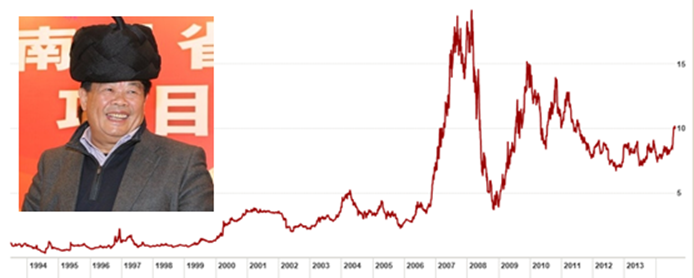
Fuyao Glass (600660 CH) – Stock Price Performance, 1993-2014


Cao has an interesting view about competitive advantage:


“I always think good faith is a kind of competitive ability. I carefully studied the Japanese industry development history in the 1960s. Many Japanese companies also once appeared to seek short-term profits and use unscrupulous tactics to make money. But a mighty wave crashing on a sandy shore calls their bluff and deceitful businesses have disappeared. Those that survive are truly honest business with integrity. Fuyao always adhere to the integrity of business as the basic operating principle. For example, the most expensive cost in making automotive glass is the PVB film (windshield consists of two glass pressed into a thin film). PVB film thickness of the automotive glass is 0.76 mm, and the price is very high, about $5 per square metre. Many accessories manufacturers feel that users simply do not see the importance of film thickness, and in the process, will make the film into only 0.38 mm thick (this thickness is usually used for architectural glass). A square meters can save more than $2. While the price is lower by around half, it will give the user hidden trouble. We never do such a wicked thing. In my opinion, in the competition between enterprises, not only do we just compete in the strategy, technology and innovation, but the final decisive key often lies in character. The integrity of the enterprise is unable to quantify in terms of the competitive advantage. Entrepreneurship, in my opinion, not only means starting from scratch to create a career spirit, but also it includes “integrity management”. If you do not adhere to integrity as a business principle, regardless of how much money you earn, you also cannot say you have the entrepreneur’s spirit. You can only be at most a profiteer. I think all the time that the responsibility of entrepreneur has three areas: towards the country, towards social progress, and towards people. Carry out these three responsibilities in order to be worthy of the title of entrepreneur.”


Deng famously justified China’s capitalist path with the saying, “It doesn’t matter whether a cat is white or black, as long as it catches mice.” With the emergence and rise of selected SOE innovators and entrepreneurial firms such as Fuyao Glass, the resilient Chinese cat is able to have nine lives in bouncing back from reform purges and be the intrepid explorer and fearless acrobat to dance in the rain and create value in uncertain times.


Warm regards,

KB

Managing Editor

The Moat Report Asia

www.moatreport.com

SMU: http://accountancy.smu.edu.sg/faculty/profile/108141/Kee%20Koon%20Boon


To read the exclusive article in full to find out more about the stories of the SOE automotive component company and Fuyao Glass and the implications of the SOE reform in Asia for value investors, please visit:


The Moat Report Asia
 

“In business, I look for economic castles protected by unbreachable ‘moats’.”

– Warren Buffett


The Moat Report Asia is a research service focused exclusively on competitively advantaged, attractively priced public companies in Asia. Together with our European partners BeyondProxy and The Manual of Ideas, the idea-oriented acclaimed monthly research publication for institutional and private investors, we scour Asia to produceThe Moat Report Asia, a monthly in-depth presentation report highlighting an undervalued wide-moat business in Asia with an innovative and resilient business model to compound value in uncertain times. Our Members from North America, the Nordic, Europe, the Oceania and Asia include professional value investors with over $20 billion in asset under management in equities, secretive global hedge fund giants, and savvy private individual investors who are lifelong learners in the art of value investing.


Learn more about membership benefits here: http://www.moatreport.com/subscription/


  • Individual subscription at $1,994 per year:

https://www.moatreport.com/individual-subscription/?s2-ssl=yes


Our latest monthly issue for the month of August investigates an Asian-listed company who’s the leading ecommerce group in its home country with the complete platform coverage in the Amazon-type of B2C ecommerce of selling directly to end consumers (Sales/Net Profit: 90%/78%), Rakuten-type of B2B2C platform (Sales/Net Profit: 4%/12%) to support the online SME merchants who in turn sell to the end consumers, and the eBay-type of C2C auction site (Sales/Net Profit: 2%/21%) where individuals buy and sell to one another. This “Amazon-Alibaba” is highly profitable with recurring free cashflow (FCF yield 4.6-5% compounding at 25% in the next 3-5 years) by pioneering the world’s-first 24-hour delivery promise and guarantee when world-class logistics experts said it cannot be done. In emerging markets and Asia where logistics costs is 15-20% of GDP, most ecommerce companies fail to scale up due to lack of fulfillment capabilities and inventory risk became the killing blow as they pursue growth without the intangible know-how. The company designs and builds its own warehouses to provide fast and efficient delivery with 99.68% on-time rate and also complete backend services to suppliers, widening the gap between itself and peers. With its superior infrastructure, the company is able to provide consumers a one-stop shopping experience with all goods purchased from different vendors packaged into a single box and delivered to the client’s door. The company has consignment agreements with suppliers which allow it to have control over inventory management but carry no liability of inventory on its balance sheet, in other words, there is minimal inventory risk for the company to scale up sustainably and without the usual accounting risks that plagued the ecommerce companies.


With (1) a superior ROE of 23.6% due to its wide-moat business model in 24-hour delivery system, (2) negative cash conversion cycle (-29 days) in its unique warehouse system with minimal inventory risk, (3) a sustained 25-30% recurring earnings and cashflow growth per annum in the next 5 years, especially a long run-way in disrupting traditional retailers, and (4) potential exponential growth in its option value in the third-party electronic payment business, the company can scale up multiple times. Short-term downside risk is protected by its healthy$128m net-cash balance sheet (15% of MV) and proven management execution in prudent capex expansion to support sustainable quality earnings growth. Its terminal value and long-term downside risk will be protected by giants Alibaba, Rakuten, eBay, Amazon who wish to swallow it up to possess its valuable trust and brand equity support it enjoys and its wide-moat business model in 24-hour delivery system. The company is one of the few Asian ecommerce companies with good governance and low accounting risks with its net-value revenue recognition method and it deserves a valuation premium. Upcoming deregulation in third-party electronic payment with the passing of the law in Sep 2014 will result in various government restrictions to be removed, paving the way for the company to introduce stored-value payments, O2O payment, P2P payment (money transfer without transactions), multiple currencies’ payments, big data analysis, payment services for customers outside the group to boost transaction volume and scale up its existing proprietary PayPal/AliPay businessLed by the inspiring and highly-determined founder and Chairman who established and listed the company in 1998 and 2003 respectively, the company has overcome the multiple obstacles to ecommerce transactions in its home market. The founder described the obstacles to ecommerce transactions as ‘friction’, and that he “resolve to take on the Life’s Task to reduce this ‘friction’”.


Our past monthly issues examine:


  • An Asian-listed company who’s the global #1 and #2 maker of two types of patient monitoring devices for both clinical- and home-use. Founded in 1981 and listed in 2001, the company’s reliable manufacturing technology platform for over 30 years has enabled it to build a global durable franchise in the niche patient monitoring device market that has stable resilient growth and yet is experiencing potential disruptions led by its new innovation. A secret to its success is its in-house capabilities to combine Swiss design, high-precision electronics and sensors components with clinical healthcare to produce world-class products with cost competitiveness. The firm has competitive technology and patents especially its core competence of having an algorithm to allow fast reading/filtering of signals and outputting the accurate results in a short period of time. Thecompany has the potential to consolidate the market further. The company is also a sticky ODM partner to reputable companies including Wal-Mart, Costco, CVS and it has adiversified customer base with none of the customers accounting for more than 10% of its sales. The company demonstrated that it has bargaining power over its powerful customers with the ability to build its own brand since 1998 (62% of overall sales). 91% of its sales are to developed markets in US and Europe. The company is trading at EV/EBIT 9.7x and EV/EBITDA 8.8x and has an attractive dividend yield at 5.6% and a strong balance sheet with net cash as percentage of market value and book equity at 23% and 47% respectively. The firm has also undertaken the unusual capital management program to reduce 10% of its shares outstanding in Sep 2012 to boost capital efficiency by utilizing the comfortable net cash position. The proactive shareholder-friendly stance backed by its strong net cash position should limit any downside in share price. The company’s terminal value and downside risk will be protected by giants such as J&J, Bayer, Abbott etc who wish to swallow it up to possess its valuable manufacturing technology platform and worldwide patents in algorithm-technology. The company’s worldwide patents in algorithm-technology has been commercialized into an innovative product series that is at the heart of its total solution service business model. This valuable intangible asset is not factored into long-term valuation. The innovative product with the algorithm measurement technology are not merely additional features; it “forces” the clinical community to adopt them as the standard, which in turn helps drive home-use penetration as patients seek a consistent and integrated healthcare experience. It transforms the product into a unique strategy that incorporates software development to create value-added services for health monitoring and collaborating with hospitals and governments on tele-healthcare projects. As a result of its wide-moat, the company has a far superior ROE at 20.9% that is nearly double that of its key giant conglomerate rival. When we compare EV/EBIT relative to ROE and ROA, the company is cheaper by as much as 120-150% when compared to its key giant conglomerate rival. The stock price of the company is down nearly 20% from its recent high in end March 2014 on profit-taking by short-term investors. Share price is back to May 2013 level, representing an attractive opportunity to take position in this long-term durable franchise. The stable long-term shareholdings and patient capital by the founder and the management team who together own around 48% of the equity has enabled the firm to adopt a very long-term approach to building its business and cultivating new growth areas. While he may sometimes be slightly over-optimistic and thinking too far ahead with his long-term opinions, this  idealistic engineer-visionary-philosopher has done a fantastic job in continuously defying the odds of many skeptics by growing the company from a small startup into one of the world’s leading patient monitoring equipment company. He is the rare Asian entrepreneur who was persistent in building his own brand despite the threat of offending his ODM customers. He was also early in cultivating and coordinating a global network with high-tech component, R&D and manufacturing in his home country, manufacturing, assembly and packaging in Shenzhen, China and medical R&D and clinical testing center in Europe, including making the difficult decision to establish a direct marketing sales force in Europe and North America given the high cost. Unlike most Asian business owners whose interest and focus in the core business starts to wane due to complacency from growing personal wealth and the inability to scale the core business, the founder is genuinely passionate in the company’s ability to add value to the patients and society. The firm can effectively run without the founder with the long-term corporate culture and management system in place, yet he can inject great value as the steward in new innovations; we believe that this combination is rare for an Asian company and deserves a valuation premium.


  • The world’s #1 ODM (Original Design Manufacturer) and global #5 manufacturer of a consumer healthcare device product that is used frequently, even daily, thus providing the foundation for stable recurring cashflow. This company is also a hidden champion in a niche product segment (50-55% of group’s sales) that has become a high-growth fashion product currently accounting for less than 10% of the overall industry. The company is able to mass-manufacture this niche product, but not the giants, because of its unique process IP in flexible manufacturing system and know-how to handle large-scale complex orders. The manufacture of this product itself is difficult to replicate and requires FDA/CE licenses because of its medical device nature and the entry barrier is not capital but the know-how and R&D expertise. In particular, the manufacturing integrates different fields of science including polymer chemistry, physics, optics, engineering, materials control, process control, microbiology, and, injection molding. The firm has also developed a proprietary system of tracking the manufacturing process of different sets of product so that if a quality issue arose, when and where the problem set of products was being produced could be swiftly identified, thus diminishing the scale and cost of product recall. This system has helped the firm win the long-term trust of its ODM customers to place stable large orders. The Big Four giants do not have such a system and have to incur substantial losses from product recalls. The company also possess its own brand which has many loyal followers and support in its home market where it enjoys a 30% market share and contributes to 25% of group’s saleswhile sticky ODM customers account for 75% of group’s sales, mainly from the Japan market. As a result of its wide-moat advantages, the firm enjoys a consistently high ROE of 41%, double or triple that of the giants. From FY07 onwards, even during the depths of the Global Financial Crisis in 2007/09, the firm has not raised equity. Since listing in Mar 2004, the company has only done one rights issue in May 2005. Also, it is able to sustain a strong stable cash dividend payout (>70% with 3% yield) with its healthy net-cash balance sheet (net cash $30m; net cash-to-equity ratio 23%) and proven management execution in prudent capex expansion to support sustainable quality earnings growth. M&A deals in the healthcare and medical device sector has been growing due to their strong defensive nature and giants seeking growth to overcome their own patent cliff. The firm willalways be an attractive takeover target by giants who wish to swallow it up to possess its valuable flexible manufacturing system and know-how to fill their own missing competency gap and hence will enjoy long-term downside protection in its terminal value. In the battle between “ODM vs Brand”, we find the story of the company to be quite similar to that of TSMC (2330 TT, MV $103bn), now the largest ODM foundry in the world. “Skate to where the puck is going to be, not where it has been,” as hockey legend Wayne Gretzky advised. In our view, the profit and valuation premium in the value chain will start to skate to the “Inno-facturers” who are the hidden ODM innovators (the brand behind brands) consolidating the industry, such as TSMC and this company. While its valuation is not cheap with EV/EBIT (FY13) at 20.6x, when we compare EV/EBIT relative to ROE, the company is relatively cheap, by as much as 130-220% when compared to giants and other comparables. When we compare EV/EBITDA relative to ROE, the valuation gap is 90-160%. This long-term valuation gap implies that the company, with its far superior and sustainable ROE, could potentially double to $2.4bn, as it continues to consolidate its niche product segment and enter into a new product cycle of an innovative product whose patents are expiring in 2014/15 (US/worldwide) to make ASP/margin improvements in sustaining quality profits and cashflow. Its share price has dropped 18% from its recent high and underperformed the index by 26% in the last six months. This will present a buying opportunity for long-term value investors who can penetrate beyond conventional valuation metrics because of a deep understanding of its business model and underlying source of its wide-moat advantages. In Asia, many firms break apart or become value traps due to shareholder conflict, envy and differences in opinion on the business direction of the company. The stable long-term corporate culture infused by the late founder, who established the company in 1986 with the current executive chairman and 2 other key shareholders, to combine the energy and ideas of everyone to work hard to keep the business running forever is underappreciated.


  • The Home Depot of Asiawhich has the largest market share in its home country and now seeks to expand regionally. It is one of the few home improvement retailers in the world which is able to achieve a structural negative cash conversion cycle (CCC) at -39 days for resilient, recurring and sustainable operating cashflow to enable the expansion of its store network while keeping a healthy balance sheet. It is hard to achieve negative cash conversion cycle (CCC) as a home retailer as compared to a supermarket retailer as the product nature is more durable. Even Home Depot, Lowe’s and Bed Bath & Beyond (BBBY) are not able to achieve a negative CCC. Led by the capable owner-operators since 1995, the company is a pioneer in proactively creating awareness and demand in the minds of consumers that upgrading your home can be fun and in incremental affordable steps. Its creative branding has resulted in the firm to become the “first on customers’ mind”, or what Charlie Munger elucidated as the “psychological wide-moat” advantage. 80% of sales are generated customers looking for home improvement and renovation ideas and solutions.  Growth is supported by the management’s proven ability to identify and cater to dynamic changes in customer preferences. The firm’s comprehensive pre and aftersales service creates brand loyalty and sustains long-term sales. The merchandizing management is tailored to the peculiarities of customer preferences in each area to drive same store sales growth with creative customization by store, location, season and events. Its key strategy to expand its profit margin is to increase its higher-margin house brands and product-mix management. Its EBITDA/sqm of $400/sqm was higher than Home Depot until Home Depot experienced a rebound last year to $500/sqm. The firm’s resilient sales are supported by its unrivalled network of diverse locations throughout the country. Its bold vision and successful “Blue Ocean” execution in the highly fragmented second-tier markets has created a powerful wide-moat advantage that will last for many years to come. In short, the management have proven their ability to execute in difficult market and industry conditions especially in the past 5 to 7 years during the 2007/09 global financial crisis with the firm emerging much stronger. The Illinois Institute of Technology engineering graduate and quiet billionaire owner behind the home retailer is one of the few Asian business tycoons who has the thirst to scale up the business in a sustainable way, as opposed to opportunistic ventures, having been largely influenced by his early years experience observing the success of American wide-moat firms. If we can adjust the EV/EBITDA valuation metric to reflect the CCC, the company’s EV/EBITDA of 18.5x will be lower at 10-11x, while Home Depot’s EV/EBITDA 11x will be higher at 13x. Noteworthy is that Home Depot has a negative free cashflow throughout FY1989-2001 (13 consecutive years!) and yet market cap has climbed from $1.5bn to $103bn. Home Depot compounded despite the ugly valuations during the capex ramp-up. This once again highlights that the power of wide-moat is often underappreciated, misunderstood and overlooked. When Home Depot generated $180m in operating cashflow in FY1992, quite similar to this Asian firm now, Home Depot is valued at $5bn (vs $3bn). Store network is expected to double in the next 4-5 years, representing a potential doubling in market value.


  • The Northeast Asian-listed companywho is the world’s largest maker of an essential component with applications in apparel, shoes, diapers, car seats etc. All top 20 global athletic shoe brands, including Nike, Adidas, Reebok, Sketchers, UnderArmor are customers and this Asian innovator with R&D capabilities has forged long-term “spec-in” partnerships with them. Its broad product offering is protected by over 110 patents. By locating its Pan-Asian production plant network in China, Taiwan, Vietnam and Indonesia close to its major clients, including sales/customer service centers and warehouses in US and Europe, the firm is better positioned to understand their requirements, deliver fast and meet their needs. While top 10 athletic shoe brands account 40% of its revenue, the firm has a diversified clientele base of over 10,000 customers, giving it resilience and growth with both the established and emerging brands as clients. The company is trading at PE14e 12x, EV/EBITDA 7.1x and EV/EBIT 10.6x with a dividend yield of 3.9%. Interestingly, its EBITDA margin is double that of Adidas and its 8.7% net margin is higher than Adidas’ 5.4%, though below Nike’s 9.8%. Given the tipping point of its Pan-Asian production network and contributions from its new products and as capex tapers off in the next few years, free cashflow could be around $50-60m and applying a P/FCF of 15x would yield a market value of $750-900m,, representing a potential upside of 100-150%. Thus, the firm offers a similar quality growth trajectory to Nike/Adidas with its unique knowledge-based business model and yet trades at a more attractive valuation and higher dividend yield as downside protection.


  • The Middleby of Asia commanding a dominant market share of over 80% in hypermarkets, 50% in chain outlets, 30% in 4- to 5-star hotels in China and an overall 30% in its home market. Yet, no single customer accounts for more than 5% of its revenue. Just to recall for value investors, NYSE-listed Middleby, with its sleepy and boring business, has compounded 100-fold from around $50m to $5.7bn since its tipping point in 1999. The founders of this Asian family business demonstrated clear dedication in building up the company with its wide-moat business model backed by a strong and unique distribution/marketing network in finding, winning and binding new customers to build massive brand equity and long-lasting relationships with clients over time. Their devotion to its core product for nearly 20 years results in maximum problem-solving skills, innovative strength and product leadership and hence, to ever greater customer benefit that will protect the company to consolidate the fragmented market and provide ample opportunities to continue its profitable growth. The company is currently trading at PE13e 15.8x and an undemanding EV/EBIT 10.1x and EV/EBITDA 9.5xand its growth potential based on its unique business model is not priced in. There is a structural re-rerating of niche business models with (1) diversified client base, (2) steady revenue streams, (3) lean capex requirements that creates ample free cashflow and defensive growth. Based on PE, P/CFO and EV/EBIT, the company is trading at a 40-50% discount to the foreign listed comparables despite more efficient use of assets in generating profits and cashflow. It has an attractive 7% earnings yield growing at 20% over the next 3-5 years and a 3.8% dividend yield that is supported by its strong cashflow generation ability, steady revenue stream and lean capex requirements to limit downside risks in valuation. Based on the growth plans to penetrate new product and customer segments; build its third plant in India in addition to the ones in its home market and in China; and potential bolt-on acquisition opportunities with its healthy balance sheet in net-cash position, it has the potential to double its operating cashflow in the next 3-5 years and market value could double, representing an upside potential of 100-140%.


The Moat Report Asia Members’ Forum has been getting penetrating quality dialogues from our subscribers.Questions range from:


  • The nuances of internal dealings in Asia, including the case discussion of the recent deal in which HK billionaire’s Lee Shau-kee Henderson Landacquiring Towngas or Hong Kong & China Gas (3 HK) from his family holdings, seemingly déjà vu from the early Oct 2007 transaction when the market peak.
  • The case of F&N Singaporespinning out its property unit FCL Trust and getting “free” special dividend-in-specie and the potential risk in asset swap restructuring to deleverage the hidden debt in the entire Group balance sheet.
  • The dilemma of whether to invest in a Southeast Asian-listed company and hidden champion with a domestic market share of 60% due to family squabbles and a legal suit over the company’s ownership.
  • Discussion of the wise and thoughtful 107-year-old Irving Kahn’s investment into a US-listed but Hong Kong-based electronics company with development property project in Shenzhen’s Qianhai zone and the possible corporate governance risks that could be underestimated or overlooked, as well as their history of listing some assets in HK in 2004.. This is also a case study of “buy one get one free” in John’s highly-acclaimed book The Manual of Ideasin which the “free” property is lumped together with the (eroding) core business to make the combined entity look cheap and undervalued. What are the potential areas that value investors need to watch out for when adapting the SOTP (sum-of-the-parts) valuation method in Asia?
  • And many more intriguing questions.


Do find out more in how you can benefit from authentic and candid on-the-ground insights that sell-side analysts and brokers, with their inherent conflict-of-interests, inevitable focus on conventional stock coverage and different clientele priorities, are unwilling or unable to share. Think of this as pressing the Bloomberg “Help Help” button to navigate the Asian capital jungle. Institutional subscribers also get access to the Bamboo Innovator Index of 200+ companies and Watchlist of 500+ companies in Asia and the Database has eliminated companies with a higher probability of accounting frauds and  misgovernance as well as the alluring value traps.


Professional Development Workshops for Executives and Lifelong Learners
 

Our 8th run of the series of workshop From the Fund Management Jungles: Value Investing Exposed and Explored– (Part 1) Moat Analysis, (Part 2) Tipping Point Analysis and (Part 3) Detecting Accounting Fraud – on 14 June 2014 has been well-received with serious value investors, professionals, and serious lifelong learners attending, with some who flew in from Jakarta and KL!..


Our 9th workshop will be on Detecting Accounting Fraud Ahead of the Curve sometime later in the year.


Thank you for your support all this while!


Thank you so much for reading as always.


Warm regards,

KB Kee

image002

Managing Editor

The Moat Report Asia

Singapore

Mobile: +65 9695 1860


A Service of BeyondProxy LLC

1608 S. Ashland Avenue #27878

Chicago, Illinois 60608-2013

Other offices: London, Singapore, Zurich


P.S.1 Here is a little more about my background:

KB Kee has been rooted in the principles of value investing for over a decade as an analyst in Asian capital markets. He was head of research and fund manager at a Singapore-based value investment firm. As a member of theinvestment committee, he helped the firm’s Asia-focused equity funds significantly outperform the benchmark index. He was previously the portfolio manager for Asia-Pacific equities at Korea’s largest mutual fund company.


He holds a Masters in Finance and degrees in Accountancy and Business Management, summa cum laude, from Singapore Management University (SMU) and had also published articles on governance and investing in the media, as well as published an empirical research paper Why ‘Democracy’ and ‘Drifter’ Firms Can Have Abnormal Returns: The Joint Importance of Corporate Governance and Abnormal Accruals in Separating Winners from Losers in the Special Issue of Istanbul Stock Exchange 25th Year Anniversary Best Paper Competition, Boğaziçi JournalReview of Social, Economic and Administrative Studies, Vol. 25(1): 3-55. KB has also presented his thought leadership as a keynote speaker in global investing conferences. KB has trained CEOs, entrepreneurs, CFOs, management executives in business strategy, value investing, macroeconomic, industry trends, and detecting accounting frauds in Singapore, HK and China, and had taught accounting at the SMU where he is currently an adjunct lecturer.


P.S.2  Why do I care so much about doing The Moat Report Asia for you?

My personal motivation in embarking on this lifelong journey has been driven by disappointment from observing up close and personal the hard-earned assets of many investors, including friends and their families, burnt badly by the popular mantra: “Ride the Asian Growth Story!” I witnessed firsthand the emotional upheavals that they go through when they invest their hard-earned money – and their family’s – in these “Ride The Asian Growth Story” stocks either by themselves or through money managers, and these stocks turned out to be the subject of some exciting “theme” but which are inherently sick and prey to economic vicissitudes. They may seem to grow faster initially but the sustainable harvest of their returns is far too uncertain to be the focus of a wise program in investment. Worse still, the companies turned out to be involved in accounting frauds. Their financial numbers were “propped up” artificially to lure in funds from investors and the studiously-assessed asset value has already been “tunnelled out” or expropriated. And western-based fraud detection tools and techniques have not been adapted to the Asian context to avoid these traps.


After a decade-plus journey in the Asian capital jungles, it has been somewhat disheartening as I observe many fraud perpetrators go away scot-free and live a life of super luxury on minority investors’ hard-earned money. And these perpetrators make tempting offers to various parties in the financial community to go along with their schemes. When investors have knowledge in their hands, we have a choice to stay away from these people and away from temptations and do the things that we think are right. With knowledge, we have a choice to invest in the hardworking Asian entrepreneurs and capital allocators who are serious in building a wide-moat business.


CONNECT WITH USimage004image005image006image007
MOAT REPORT ASIA    OUR TEAM    SUBSCRIBE    MEMBERS    CONTACT US

The Moat Report Asia
A Service of BeyondProxy LLC
1608 S. Ashland Avenue #27878
Chicago, Illinois 60608-2013

Other offices: London, Singapore, Zurich


Evening Bamboo Insight: 27 Aug 2014

Evening Bamboo Insight: 27 Aug 2014

Macro

  1. Big Four step up services to hedge funds; The Big Four global accountants are stepping up their services advising hedge funds as they seek to capitalise on a sector mired in increasingly complex and interlinked global regulation.

http://www.ft.com/intl/cms/s/0/42ed2476-1648-11e4-93ec-00144feabdc0.html#axzz3BODmuAqh

  1. Africa’s population: Can it survive such speedy growth? By the end of the century, almost half the world’s children may be African

http://www.economist.com/news/middle-east-and-africa/21613349-end-century-almost-half-worlds-children-may-be-african-can-it

  1. The Global Crackdown on Profit Shifting; CFOs of multinationals need to prepare by assessing how much their companies engage in profit shifting to cut their taxes

http://ww2.cfo.com/tax/2014/08/global-crackdown-profit-shifting

  1. France thrown into political turmoil after government dissolved

http://www.theguardian.com/world/2014/aug/25/french-government-resigns-francois-hollande-manuel-valls

  1. CBOE One Heck of Moat, Is Valuation Reasonable?

http://www.valuewalk.com/2014/08/cboe-moat-valuation/

Asia Pacific

  1. (Isia) – Indonesian bank BRI takes microcredit on the road; In West Java ‘mobile banking’ means a van or boat

http://www.ft.com/cms/s/0/cac10dd4-26f8-11e4-a46a-00144feabdc0.html#axzz3BODmuAqh

  1. (China) – Property bubble is ‘major risk to China’

http://www.ft.com/intl/cms/s/0/42ed2476-1648-11e4-93ec-00144feabdc0.html#axzz3BODmuAqh

  1. (Korea) – South Korea’s fertility rate is so low that the country’s population could go the way of the dinosaurs by 2750, according to a new simulation commissioned by the National Assembly in Seoul

http://blogs.wsj.com/korearealtime/2014/08/25/south-korea-to-go-extinct-by-2750/

  1. (Thai) – Thai Coup Leader Becomes Prime Minister; Gen. Prayuth Chan-ocha Says He Will Choose Cabinet in September

http://online.wsj.com/articles/thai-coup-leader-becomes-prime-minister-1408947091

  1. (China) – Down and out in rural China: Many teenagers in the Chinese countryside do not finish secondary school. That bodes ill for the labour force

http://www.economist.com/news/china/21613293-many-teenagers-chinese-countryside-do-not-finish-secondary-school-bodes-ill

  1. (China) – Literacy: Bad characters; Some Chinese forget how to write

http://www.economist.com/news/china/21613300-some-chinese-forget-how-write-bad-characters

  1. (China) – German car parts suppliers asked to form JVs in China: Stuttgarter

http://www.reuters.com/article/2014/08/25/us-autos-china-partnership-idUSKBN0GP0LV20140825

  1. (China) – Changing Corporate Culture Is Hard. Here’s How Lenovo Did It

http://blogs.wsj.com/atwork/2014/08/25/changing-corporate-culture-is-hard-heres-how-lenovo-did-it/

  1. (India) – All Coal-Mining Rights Issued in India Since 1993 Are Ruled Illegal; Supreme Court Decision Injects Uncertainty in Coal Supply for Power Plants, Steelmakers

http://online.wsj.com/articles/india-court-rules-all-coal-mining-rights-since-1993-illegal-1408964180

  1. (Isia) – A Daunting Agenda for Jokowi; Fuel subsidies, resource nationalism and underdeveloped manufacturing are just a few of the challenges facing the novice president.

http://online.wsj.com/articles/karen-brooks-a-daunting-agenda-for-jokowi-1408986218

  1. (Asia) – Strong leaders in a fragile Asia

http://www.todayonline.com/print/765896

Life

  1. FT interview with Andrew Forrest, the founder of Fortescue Metals Group

http://www.ft.com/intl/cms/s/0/24bae83a-17d8-11e4-a82d-00144feabdc0.html#axzz3BOAD4xv4

  1. Science confirms it: If you want to succeed, you have to screw up

http://www.fastcocreate.com/3034761/science-confirms-it-if-you-want-to-succeed-you-have-to-screw-up

  1. 3 reasons you should let yourself get distracted

http://www.fastcompany.com/3034707/the-future-of-work/3-reasons-you-should-let-yourself-get-distracted

  1. Quote of the week: Don’t change who you are

http://www.fastcompany.com/3034740/quote-of-the-week-dont-change-who-you-are

  1. MIT Study Shows People Would Rather Take Orders From A Robot Than Their Bossk

http://www.businessinsider.sg/robots-as-bosses-2014-8/#.U_tPOvmSxqU

  1. A Successful VC Reveals The Big Secret Behind Becoming A Great Investor: “Intellectual curiosity”

http://www.businessinsider.sg/blake-bartlett-advice-for-becoming-a-great-vc-2014-8/#.U_tPk_mSxqU

  1. How does Zillow’s CEO manage? By learning; At the real estate information site Zillow, leadership starts by saying “I don’t know”-then doggedly seeking out an answer

http://fortune.com/2014/08/25/zillow-management-social-media/

  1. Do Buffett’s Compliance Lapses Show Management Flaws?

http://ww2.cfo.com/regulation/2014/08/buffetts-compliance-lapses-show-management-flaws/

  1. ‘Out of Africa’ theory of human evolution under fire

http://www.theage.com.au/national/education/out-of-africa-theory-of-human-evolution-under-fire-20140822-106o5e.html

  1. Piketty’s Errors Mirror Marx’s in his search for a grand theory to explain inequality and predict the future

http://blogs.wsj.com/economics/2014/08/25/pikettys-errors-mirror-marxs-paper-finds/

  1. Good to Great: The Stockdale Paradox and Value Investing

http://brooklyninvestor.blogspot.sg/2014/08/good-to-great-stockdale-paradox.html

  1. Wayne Brody On Misplaced Values and How To Spot A Compliant Culture

http://blogs.wsj.com/riskandcompliance/2014/08/25/wayne-brody-on-misplaced-values-and-how-to-spot-a-compliant-culture/

  1. The ‘Recombinant’ Nature of Digital Innovations

http://blogs.wsj.com/cio/2014/08/22/the-recombinant-nature-of-digital-innovations/

TMT

  1. European media bet on tech start-ups

http://www.ft.com/intl/cms/s/0/4e8abfa0-2958-11e4-8b81-00144feabdc0.html#axzz3BODmuAqh

  1. 7 Creative Elements of Successful Online Ads: Call to action

http://www.businessinsider.sg/7-creative-elements-successful-online-ads/#.U_ryi_mSxqU

  1. (China/Tech) – Coolpad Abandons Gold Phone Casing Amid China’s Anti-Graft Push

http://blogs.wsj.com/digits/2014/08/25/coolpad-abandons-gold-phone-casing-amid-chinas-anti-graft-push/

  1. (China/Tech) – Huawei Is Shaking Up the Smartphone Market; Richard Yu, head of Chinese firm’s consumer business group, talks about competing against Samsung and Apple

http://online.wsj.com/articles/huawei-is-shaking-up-the-smartphone-market-1408908924

  1. (India/Tech) – The next Alibaba may come from…India?

http://fortune.com/2014/08/25/the-next-alibaba-may-come-from-india/

  1. (China/Media) – China’s Movie Industry: All That Glitters Isn’t Gold

http://www.forbes.com/sites/ceibs/2014/08/24/chinas-movie-industry-all-that-glitters-isnt-gold/print/

Consumer

  1. (India/Consumer) – The rise and rise of Indian fashion; Indian designers are blending modern and traditional influences to woo a global market

http://www.ft.com/intl/cms/s/0/bf5221da-246f-11e4-ae78-00144feabdc0.html#axzz3BODmuAqh

Energy

  1. (China/Energy) – Sinopec Doesn’t Fill Investors’ Tanks

http://online.wsj.com/articles/sinopec-doesnt-fill-investors-tanksheard-on-the-street-1408966736

Morning Bamboo Insight: 26 Aug 2014

Morning Bamboo Insight: 26 Aug 2014

Macro

  1. Deepening rivalries test German luxury car dominance

http://www.reuters.com/article/2014/08/24/us-autos-premiums-idUSKBN0GO05G20140824

  1. Companies sitting on a mountain of cash – US$7 trillion

http://www.thestar.com.my/Business/Business-News/2014/08/25/Companies-sitting-on-a-mountain-of-cash-Corporates-worldwide-have-amassed-US7-trillion/

  1. Is Buying a Franchise Riskier Than Ever? Critics Say It’s Harder to Know What You’re Getting Into-and Easier to Fail Once You’re In

http://online.wsj.com/articles/is-buying-a-franchise-riskier-than-ever-1408912041?mod=WSJ_hpp_sections_smallbusiness

  1. Ice bucket challenge may change nonprofit world; ALS charity drive chalks up quick $53.3 million, gives groups new avenue for donors

http://www.japantimes.co.jp/news/2014/08/23/business/ice-bucket-challenge-may-change-nonprofit-world/#.U_qZ2_mSxqU

  1. A “Black Monday” descended on the virtual currency market on Aug. 18 as virtual currencies crashed at major marketplaces worldwide

http://www.wantchinatimes.com/news-subclass-cnt.aspx?id=20140825000020&cid=1203

Asia Pacific

  1. (Auto/Japan) – Coming apart: regulators’ sweep threatens auto parts business model

http://www.reuters.com/article/2014/08/24/autos-antitrust-parts-idUSL4N0QR1HU20140824

  1. (Isia/Msia) – Indonesian president-elect seeks new investments from Malaysia

http://www.thestar.com.my/Business/Business-News/2014/08/25/Indonesian-president-elect-seeks-new-investments/

  1. (HK) – Decision Time for Hong Kong; As Beijing refuses to grant democracy, the city’s mood is volatile

http://online.wsj.com/articles/decision-time-for-hong-kong-1408896112

  1. (Isia) – Jokowi’s ‘Man of the People’ Approach Cramped by Presidential Guards

http://www.thejakartaglobe.com/news/jokowis-man-people-approach-cramped-presidential-guards/

  1. (Isia/India) – India’s Presence in Indonesia Continues to Stand Out; Cultural Crossroad: Against the backdrop of Modi and Jokowi rising to power, ethnic Indians reflect on life in Indonesia

http://www.thejakartaglobe.com/news/indias-presence-indonesia-continues-stand/

  1. (Isia) – Uchida Switches Gears on Honda’s Target Market; “Indonesia is a very different market, compared to India or China. Here, passenger cars account for 80% of the market, so we need to implement a special strategy as well”

http://www.thejakartaglobe.com/business/uchida-switches-gears-hondas-target-market/

  1. (Japan) – Japan’s universities can’t win; in view of the disparity in professors’ pay between Jap and American uni, elevating Jap unis’ global rankings simply by bringing in outstanding “foreign talent” is a castle in the sky

http://www.japantimes.co.jp/opinion/2014/08/24/commentary/japan-commentary/japans-universities-cant-win/#.U_qZ9_mSxqU

  1. (Korea) – Breaking the deadlock; Korea’s corrupt and incompetent political and administrative systems were behind the sinking of the Sewol ferry

http://www.koreatimes.co.kr/www/news/opinon/2014/08/202_163468.html

  1. (Korea) – South Korean central bank faces difficulty in keeping independence amid political pressure

http://news.xinhuanet.com/english/indepth/2014-08/24/c_133580439.htm

  1. The Tax Office is cracking down on the black economy, targeting businesses that are not declaring cash revenues, from restaurants through to home cleaners, in a bid to bring billions of dollars back into the tax net

http://www.theage.com.au/business/the-economy/ato-cracking-down-on-cash-economy-20140825-1082c9.html

  1. (China) – Hunan gov’t debt so high people use IOUs as currency

http://www.wantchinatimes.com/news-subclass-cnt.aspx?id=20140825000019&cid=1203

  1. (China) – China’s milk industry sounds alarm as import bombs fly

http://www.wantchinatimes.com/news-subclass-cnt.aspx?id=20140825000012&cid=1202

  1. (China) – Foxconn, BAIC Motor to launch electric car rental service

http://www.wantchinatimes.com/news-subclass-cnt.aspx?cid=1206&MainCatID=12&id=20140825000016

  1. (Korea) – Korean firms with over 200% debt-to-equity ratio to face mandatory outside auditors

http://news.mk.co.kr/english/newsRead.php?sc=30800016&cm=Finance&year=2014&no=1128570&selFlag=sc&relatedcode=&wonNo=&sID=308

  1. (HK/China) – Building blocks of mass discontent in HK; Mainland money reminds locals that they have never been in control

http://www.ft.com/intl/cms/s/2/d5b0320a-2951-11e4-baec-00144feabdc0.html#axzz3BOAD4xv4

Life

  1. How to Get Girls Into Engineering? Let Them Build Toys; Two Women Launch a Startup Aimed at Giving Girls New Options (and Maybe New Futures)

http://online.wsj.com/articles/how-to-get-girls-into-engineering-let-them-build-their-own-toys-1408912053?mod=Tech_newsreel_4

  1. How an Entrepreneur’s Passion Can Destroy a Startup; Strong Feelings Can Lead Founders to Make Bad Choices at the Worst Times. Here’s What to Watch For

http://online.wsj.com/articles/how-an-entrepreneur-s-passion-can-destroy-a-startup-1408912044?mod=WSJ_hpp_sections_smallbusiness

  1. At 91, Marvel creator Stan Lee continues to expand his Universe

http://www.reuters.com/article/2014/08/19/us-film-stanlee-idUSKBN0GJ0SL20140819

  1. 20 Essential Life Lessons For Happiness And Success

http://www.forbes.com/sites/laurashin/2014/08/18/20-essential-life-lessons-for-happiness-and-success/print/

  1. Who Made Those Bluejeans? In 1853, during the heart of the gold rush, a Bavarian émigré named Levi Strauss arrived in San Francisco from New York, looking to expand his family’s East Coast dry-goods

http://www.nytimes.com/2014/08/24/magazine/who-made-those-bluejeans.html?ref=economy

  1. Book Review of The Outsiders; Decentralized organizations release entrepreneurial energy and keep both costs and “rancor” down.

http://www.cleareyesinvesting.com/2014/08/book-review-of-outsiders.html

  1. Peculiar Habits of Incredibly Successful People

http://www.fool.com/investing/general/2014/08/22/peculiar-habits-of-incredibly-successful-people.aspx

  1. 6 Things The Most Organized People Do Every Day

http://www.bakadesuyo.com/2014/08/most-organized-people/

TMT

  1. (China/Tech) – China targets own operating system to take on likes of Microsoft, Google

http://news.asiaone.com/print/news/asia/china-targets-own-operating-system-take-likes-microsoft-google

  1. (China/Tech) – Robot Wars: Why China Is Outmanned in Electronics Automation; Pegatron, Foxconn Contend With Short Product Life of Making Phones and Other Low-Margin Items

http://online.wsj.com/articles/robot-wars-why-china-is-outmanned-in-electronics-automation-1408902804

  1. (China/Tech) – How Your Laptop Is Made in China

http://blogs.wsj.com/digits/2014/08/24/how-your-laptop-is-made-in-china/

  1. (China/Tech) – China Says Qualcomm Is Willing to Resolve Dispute; Qualcomm Is Target of Antimonopoly Probe by Chinese Regulators

http://online.wsj.com/articles/china-says-qualcomm-is-willing-to-resolve-dispute-1408705724

  1. It’s Time to Take Artificial Intelligence Seriously; No Longer an Academic Curiosity, It Now Has Measurable Impact on Our Lives

http://online.wsj.com/articles/its-time-to-take-artificial-intelligence-seriously-1408922644

  1. Outgoing SEC CIO Finalizes Big Data Platform

http://blogs.wsj.com/cio/2014/08/22/outgoing-sec-cio-finalizes-big-data-platform/

  1. Bearing Down on Data Upstarts; Box, Dropbox and Hightail Pivot to New Business Models

http://www.nytimes.com/2014/08/25/technology/box-dropbox-and-hightail-pivot-to-new-business-models.html?ref=business&_r=0

  1. Its Edge Intact, Vice Is Chasing Hard News; Vice is deadly serious about doing real news that people, even young people, will actually watch

http://www.nytimes.com/2014/08/25/business/media/its-edge-intact-vice-is-chasing-hard-news-.html?ref=business

  1. Klarna, an Online Payment System Popular in Europe, Eyes Global Expansion

http://www.nytimes.com/2014/08/25/technology/klarna-an-online-payment-system-popular-in-europe-eyes-global-expansion.html?ref=business

  1. Patent trolls as the new rentier class

http://ftalphaville.ft.com/2014/08/20/1938042/patent-trolls-as-the-new-rentier-class/

Consumer

  1. McDonald’s Faces ‘Millennial’ Challenge; Customers in Their 20s and 30s Are Defecting to Fast-Casual Restaurants Like Chipotle, Five Guys

http://online.wsj.com/articles/mcdonalds-faces-millennial-challenge-1408928743?tesla=y&mg=reno64-wsj&url=http://online.wsj.com/article/SB10001424052702304414104580094022609496714.html

  1. Burger King is in talks to buy Canada’s Tim Horton’s, in order to create an $18 billion company with an artificially low tax bill.

http://fortune.com/2014/08/24/burger-king-in-talks-for-a-whopper-of-a-deal/

  1. Dollar stores in battle to double down on the poor

http://www.reuters.com/article/2014/08/24/us-familydollar-offer-poverty-analysis-idUSKBN0GO0E020140824

Healthcare

  1. Health Care: Sound Of Innovation

http://www.forbes.com/sites/richkarlgaard/2014/08/20/health-care-sound-of-innovation/

Investing Process

  1. Berkshire Sees Green With Geico: The Geico gecko has helped to sell millions of policies for the Berkshire Hathaway-owned auto insurer and made it one of the conglomerate’s most consistent profit drivers

http://online.wsj.com/articles/berkshire-sees-green-with-geico-1408916799

Energy

  1. (China/Energy) – Drivers Won’t Get China Oil Market’s Engine Racing; Petroleum Use Is Starting to Reflect a Fundamental Change

http://online.wsj.com/articles/heard-on-the-street-drivers-wont-get-china-oil-markets-engine-racing-1408903494

Morning Bamboo Insight: 25 Aug 2014

Morning Bamboo Insight: 25 Aug 2014

Macro

  1. Auditors under increased scrutiny as PwC fined US$25M for ‘improperly altered’ report

http://business.financialpost.com/2014/08/18/auditors-under-increased-scrutiny-as-pwc-fined-us25m-for-improperly-altered-report/

  1. When creative destruction becomes creative devastation

http://ftalphaville.ft.com/2014/08/22/1938291/when-creative-destruction-becomes-creative-devastation/

Asia Pacific

  1. (Isia) – New face of Indonesian politics: ST interviews Jokowi

http://news.asiaone.com/print/news/asia/new-face-indonesian-politics-st-interviews-jokowi

  1. (Isia) – All Cabinet decisions will be made by me, says Jokowi

http://news.asiaone.com/print/news/asia/all-cabinet-decisions-will-be-made-me-says-jokowi

  1. (China) – China juices liquidity, and risk, at OTC exchange

http://www.reuters.com/article/2014/08/21/us-china-markets-otc-idUSKBN0GL26920140821

  1. (Isia) – Behind Indonesia mining deal, newly minted minister and U.S. mining legend

http://www.reuters.com/article/2014/08/24/us-indonesia-mining-insight-idUSKBN0GO01F20140824

  1. (China) – Premium baijiu brands bemoan loss of official patronage

http://www.wantchinatimes.com/news-subclass-cnt.aspx?id=20140823000073&cid=1503

  1. (China) – Zhongyi Jihang owners flee with RMB2bn of investors’ money

http://www.wantchinatimes.com/news-subclass-cnt.aspx?id=20140824000003&cid=1206

  1. (China) – Auto brands cut spare part prices in China amid probes

http://www.wantchinatimes.com/news-subclass-cnt.aspx?id=20140824000002&cid=1202

  1. (China) – China’s Fire Next Time; unless officials stem the rise in corporate leverage, economic crisis is inevitable

http://www.project-syndicate.org/print/yu-yongding-warns-that-unless-officials-stem-the-rise-in-corporate-leverage–economic-crisis-is-inevitable

  1. (China) – How A Chinese Meat Processor Survives the Shanghai Husi Scandal

http://www.forbes.com/sites/ywang/2014/08/21/how-a-chinese-meat-processor-survives-the-shanghai-husi-scandal/print/

  1. Isia) – If Jokowi’s supporters thought that Constitutional Court ruling had removed the final obstacle standing between their man and the State Palace, they had underestimated the ability of Isian law to throw in one last Kafkaesque twist.

http://www.thejakartaglobe.com/news/extra-time-jokowis-presidency-still-settled/

  1. (Japan/Korea) – Japan outdoes Korea in self-made billionaires

http://business.asiaone.com/print/news/japan-outdoes-korea-self-made-billionaires

Life

  1. How to speak the language of thought; We are now beginning to crack the brain’s code, which allows us to answer such bizarre questions as “what is the speed of thought?”

http://www.bbc.com/future/story/20140815-how-do-thoughts-form?utm_source=farnamstreet&utm_medium=email

  1. Edward Tufte Wants You to See Better; “if you’re told what to look for, you can’t see anything else.”

http://www.npr.org/2013/01/18/169708761/edward-tufte-wants-you-to-see-better

  1. How To Think

http://www.farnamstreetblog.com/2014/02/how-to-think/

  1. Jobs: “Creativity is connecting things. When you ask creative people how they did something, they feel a little guilty because they didn’t really do it, they just saw something. That’s because they were able to connect experiences and synthesize”

http://www.farnamstreetblog.com/2014/08/steve-jobs-on-creativity/

  1. Lincoln on Leadership: The probability that we may fall in the struggle ought not to deter us from the support of a cause we believe to be just.

http://www.farnamstreetblog.com/2014/08/lincoln-on-leadership/

  1. Books – The Language Instinct: How the Mind Creates Language

http://www.amazon.com/exec/obidos/ASIN/0061336467

  1. Books – Martians of Science: Five Physicists Who Changed the Twentieth Century

http://www.amazon.com/exec/obidos/ASIN/0195365569/

  1. Books – Getting It Done: How to Lead When You’re Not in Charge

http://www.amazon.com/exec/obidos/ASIN/0887309585/

  1. Books – Distant Force: A Memoir of the Teledyne Corporation and the Man Who Created It

http://www.amazon.com/exec/obidos/ASIN/097913630X/

  1. Books – Hard Drive: Bill Gates and the Making of the Microsoft Empire

http://www.amazon.com/exec/obidos/ASIN/0887306292/farnamstreet-20

  1. Books – Judgment in Managerial Decision Making

http://www.amazon.com/exec/obidos/ASIN/1118065700/

  1. Books – The Blind Watchmaker: Why the Evidence of Evolution Reveals a Universe without Design

http://www.amazon.com/The-Blind-Watchmaker-Evidence-Evolution/dp/product-description/0393315703/

  1. Mortal Inspiration from the Gods of Venture Capital

http://www.institutionalinvestor.com/Popups/PrintArticle.aspx?ArticleID=3372018

  1. Books – Fortune’s Formula: The Untold Story of the Scientific Betting System That Beat the Casinos and Wall Street

http://www.amazon.com/Fortunes-Formula-Scientific-Betting-Casinos/dp/product-description/0809045990/

  1. A Dozen Things I’ve Learned from Paul Graham

http://25iq.com/2014/08/16/a-dozen-things-ive-learned-from-paul-graham-2/

  1. 108-year-old investor: ‘I doubled my money in 1929 crash – and I’m still winning’

http://www.telegraph.co.uk/finance/personalfinance/investing/11048689/108-year-old-investor-I-doubled-my-money-in-1929-crash-and-Im-still-winning.html

  1. Writing a Bigger Book: Joel Greenblatt, manager of Gotham Asset Management and author of The Little Book That Beats the Market, diversifies much more in his newest fund offerings

http://online.barrons.com/news/articles/SB50001424127887324616904580108330021565828?mod=BOL_hp_mag

TMT

  1. (China/Tech) – China’s top oil refiner Sinopec announced that it will cooperate with e-commerce website Yhd.com to expand its online-to-offline (O2O) business.

http://www.wantchinatimes.com/news-subclass-cnt.aspx?id=20140823000085&cid=1206

  1. (China/Tech) – Alibaba’s online financial service Zhaocaibao generates RMB11bn since April

http://www.wantchinatimes.com/news-subclass-cnt.aspx?id=20140823000030&cid=1203

  1. (China/Tech) – Illegal P2P car-sharing in China attracts venture capital

http://www.wantchinatimes.com/news-subclass-cnt.aspx?id=20140824000024&cid=1202

  1. Nothing to hide, everything to fear: Digital Reasoning is using military-grade tech to help banks sense trouble before it happens

http://fortune.com/2014/08/14/digital-reasoning-cognitive-computing/

Consumer

  1. Rethinking Eating: Start-ups are engineering “meat” and “eggs” from pulverized plant compounds

http://www.nytimes.com/2014/08/24/sunday-review/rethinking-eating.html?ref=opinion

  1. “We’re Glad to Have You Here”; Arne Sorenson, the first outsider to lead Marriott International, sees enormous opportunities to tap the travel boom in the developing world

http://online.barrons.com/news/articles/SB50001424127887324616904580099770163197284

Healthcare

  1. (India/Healthcare) – India reviews state hospitals to end widespread corruption

http://www.reuters.com/article/2014/08/23/us-india-health-corruption-idUSKBN0GN0HM20140823

  1. The billionaire founder of Biovail Corp and Ottawa Senators owner alleges Valeant is ‘a house of cards’ masquerading as a Canadian company to dodge U.S. taxes

http://business.financialpost.com/2014/08/23/billionaire-eugene-melnyk-im-a-whistleblower-on-tax-allegations-against-valeant/

Investing Process

  1. Has Creative Destruction Become More Destructive?

http://papers.nber.org/tmp/57744-w20379.pdf


Morning Bamboo Insight: 24 Aug 2014

Morning Bamboo Insight: 24 Aug 2014

Macro

  1. Scrabble strategy in expansion: Countries that have a greater variety of capabilities can make more diverse and complex goods, just as a Scrabble player who has more letters can generate more and longer words

https://www.project-syndicate.org/print/ricardo-hausmann-asks-why-growth-rates-are-converging-among-some-countries-and-diverging-among-others

  1. The Decline and Fall of Fund Managers

http://blogs.wsj.com/moneybeat/2014/08/22/the-decline-and-fall-of-fund-managers/

Asia Pacific

  1. (China) – China juices liquidity, and risk, at OTC exchange

http://www.reuters.com/article/2014/08/21/us-china-markets-otc-idUSKBN0GL26920140821

  1. (Isia) – Foreign ownership in Indonesian insurance firms to be capped

http://www.thejakartapost.com/news/2014/08/22/foreign-ownership-insurance-firms-be-capped.html

  1. (Asean) – SOEs need more flexibility to compete in ASEAN single market

http://www.thejakartapost.com/news/2014/08/22/soes-need-more-flexibility-compete-asean-single-market.html

  1. (Asean/Isia) – Asean needs to be more engaged with Indonesia

http://www.thestar.com.my/Opinion/Columnists/Comment/Profile/Articles/2014/08/23/Asean-needs-to-be-more-engaged-with-Indonesia-The-election-of-Jokowi-presents-a-great-opportunity-fo/

  1. (Msia) – Don’t be fooled by the high trading volume in Malaysia

http://www.thestar.com.my/Business/Business-News/2014/08/23/Dont-be-fooled-by-the-high-trading-volume/

  1. (Msia/Isia) – Indonesia dream for Malaysia in jeopardy; Bittersweet experiences for Malaysian investors

http://www.thestar.com.my/Business/Business-News/2014/08/23/Indonesia-policy-risk-Various-stringent-rules-and-conditions-for-foreign-investors-are-being-propose/

http://www.thestar.com.my/Business/Business-News/2014/08/23/Bittersweet-experiences-for-Malaysian-investors/

  1. (China) – In China, Movies With Live, Pop-Up Comments; Will a new ploy lure audiences or wreck the movie-going experience?

http://online.wsj.com/articles/in-china-movies-with-live-pop-up-comments-1408751208?tesla=y&mg=reno64-wsj&url=http://online.wsj.com/article/SB10001424052970203679204580105842075708582.html

  1. (China) – Shanghai Chocolate Factory Looks a Lot Like Willy Wonka’s

http://blogs.wsj.com/chinarealtime/2014/08/22/shanghai-chocolate-factory-looks-a-lot-like-willy-wonkas/

  1. (Myanmar) – Foreign Investors Rethink Enthusiasm on Myanmar’s Aviation Sector; ANA’s Cancellation of Deal With Asian Wings Exemplifies Fading Interest

http://online.wsj.com/articles/foreign-investors-rethink-enthusiasm-on-myanmars-aviation-sector-1408709881

  1. (China) – “Can you front run it? Sure.” New China Stocks Link Seen Carrying Risks; Mainland Rules, Technology Raise Concerns

http://online.wsj.com/articles/china-stocks-link-seen-posing-risks-1408689373

  1. (China) – China’s Corporate Reform is Mixed Up; China is trying again to shake up its stodgy state-owned enterprises. Investors are right to ask whether these moves are truly transformative.

http://online.wsj.com/articles/chinas-corporate-reform-is-mixed-up-heard-on-the-street-1408696605

Life

  1. What started to change in the 17th century was not technological or institutional, but change in the ideas about the dignity of commercial pursuits – a change in rhetoric, or words about economic activities

http://theconversation.com/speak-well-of-the-bourgeois-and-prosper-29824

  1. Book Review: ‘Pericles of Athens’ by Vincent Azoulay; Thucydides praised Pericles for his ability to tame and control the wild beast of democracy

http://online.wsj.com/articles/book-review-pericles-of-athens-by-vincent-azoulay-1408742324

  1. New Ways to Predict Which Marriages Will Succeed; The More Subconscious Negativity in a Newlywed, the Larger the Decline in Marital Satisfaction Four Years Later

http://online.wsj.com/articles/new-ways-to-predict-which-marriages-will-succeed-1408636006

  1. Everyone’s an Amateur When It Comes to Negotiation; Executives Master the Art of Business Deals, But Some Don’t Bargain Well for Themselves

http://online.wsj.com/articles/negotiation-tips-for-executives-1408718237

  1. 7 Things College Freshmen Should Do Right Now To Be Successful In Life

http://www.businessinsider.sg/things-college-freshmen-should-do-2014-8/#.U_azb_mSxqU

  1. What 13 Successful People Do Before Going To Bed

http://www.businessinsider.sg/what-successful-people-do-before-bed-2014-8/#.U_a0tfmSxqU

  1. 5 Inspiring TED Talks You Can Watch In Under 5 Minutes

http://www.businessinsider.sg/best-ted-talks-under-five-minutes-2014-8/#.U_az4_mSxqU

TMT

  1. Outgoing SEC CIO Finalizes Big Data Platform

http://blogs.wsj.com/cio/2014/08/22/outgoing-sec-cio-finalizes-big-data-platform/

  1. Why Silicon Valley Will Continue to Rule the Tech Economy; Human talent and research and design labs are arriving to dominate the new era of devices.

http://online.wsj.com/articles/michael-malone-why-silicon-valley-will-continue-to-rule-the-tech-economy-1408747795

  1. Apple iPhone 6 screen snag leaves supply chain scrambling

http://www.reuters.com/article/2014/08/22/us-apple-iphone-idUSKBN0GM0N620140822?feedType=RSS&feedName=technologyNews

  1. Amazon Prepares Online Advertising Program; Retailer Developing Ad Sales Program in a Challenge to Google and Microsoft

http://online.wsj.com/articles/amazon-preps-a-challenge-to-googles-ad-business-1408747979

  1. Here’s Proof That Every Startup Idea You’ve Ever Had, Craigslist Already Does

http://www.businessinsider.sg/craigslist-versus-startups-chart-2014-8/#.U_a1OPmSxqU

  1. (China/Tech) – Amazon takes aim at Chinese rivals in Shanghai’s free-trade zone

http://www.ft.com/cms/s/0/2da0d2c8-2905-11e4-8b81-00144feabdc0.html#axzz3B5PgDQeJ

Consumer

  1. Meet Mr. Frankenfood: Monsanto’s COO Brett Begemann, the son of a farmer, explains why genetically modified food is safe-and essential to feed a hungry planet

http://online.wsj.com/articles/meet-mr-frankenfood-1408748277

Investing Process

  1. Research – Charles Ellis: The Rise and Fall of Performance Investing

http://www.cfainstitute.org/learning/products/publications/faj/Pages/faj.v70.n4.4.aspx?intCamp=$topic42%20

  1. 30 Years Of Accounting Lessons: Penman, Piotroski, Beneish, And More

http://www.sdeklerck.be/blog/

Morning Bamboo Insight: 22 Aug 2014

Morning Bamboo Insight: 22 Aug 2014

Macro

  1. Morningstar: A force to be reckoned with; The research firm’s rating system gives it great power to influence the $30tn mutual fund industry

http://www.ft.com/intl/cms/s/0/e02d2768-22d2-11e4-8dae-00144feabdc0.html#axzz3Aev2BZOm

  1. Leaky repo deals present new concerns

http://www.ft.com/intl/cms/s/0/021db5ba-224f-11e4-a828-00144feabdc0.html#axzz3Aev2BZOm

  1. Emperors who seem above the rules must be reined in

http://www.ft.com/intl/cms/s/0/858ac752-23db-11e4-86fc-00144feabdc0.html#axzz3Aev2BZOm

  1. World’s Biggest Wealth Fund Slows Emerging Market Investment

http://www.bloomberg.com/news/print/2014-08-20/world-s-biggest-wealth-fund-slows-investment-in-emerging-markets.html

  1. Blackstone Finds a Way to Outsource ‘Skin in the Game’

http://dealbook.nytimes.com/2014/08/21/blackstone-finds-a-way-to-outsource-skin-in-the-game

Asia Pacific

  1. (China) – Property crisis in Shaanxi’s Shenmu sees fortunes evaporate

http://www.wantchinatimes.com/news-subclass-cnt.aspx?id=20140817000076&cid=1503

  1. (China) – Rising number of real estate investors default in China

http://www.wantchinatimes.com/news-subclass-cnt.aspx?id=20140817000030&cid=1202

  1. (Spore) – Singapore in ‘mid-life crisis’ as Lee Hsien Loong marks 10 years in power

http://www.scmp.com/news/asia/article/1575046/singapore-mid-life-crisis-lee-hsien-loong-marks-10-years-power

  1. (China) – China’s state-owned airlines hit turbulence

http://www.ft.com/intl/cms/s/0/be9fb564-236a-11e4-a424-00144feabdc0.html#axzz3Aev2BZOm

  1. (China) – Goldman Warns Additional Chinese Stimulus Risks Global Financial Stability

http://www.zerohedge.com/news/2014-08-20/goldman-warns-additional-chinese-stimulus-risks-global-financial-stability

Life

  1. ‘The System Worked: How the World Stopped Another Great Depression’, by Daniel W Drezner; Economic governance has a patchy record, but this impressive and cogent book argues that policy makers did well during the crisis

http://www.ft.com/intl/cms/s/2/8af474e0-2467-11e4-be8e-00144feabdc0.html#axzz3Aev2BZOm2

  1. Books – Powers of Two: Finding the Essence of Innovation in Creative Pairs

http://www.amazon.com/Powers-Two-Finding-Innovation-Creative/dp/product-description/0544031598/

  1. What We Can Learn About Business Collaboration From Famous Creative Pairs

http://250words.com/2014/08/what-we-can-learn-about-business-collaboration-from-famous-creative-pairs/


TMT

  1. (China/Tech) – Xiaomi starts to feel the backlash of being ‘China’s Apple’

http://www.wantchinatimes.com/news-subclass-cnt.aspx?id=20140816000084&cid=1502

  1. (Spore/Tech) – Singapore’s investment funds blaze ecommerce trail

http://www.ft.com/intl/cms/s/0/03df812e-25da-11e4-9bca-00144feabdc0.html#axzz3Aev2BZOm

  1. Smartphone owners’ appetite for new apps wanes

http://www.ft.com/intl/cms/s/0/4c3e5708-2628-11e4-9bca-00144feabdc0.html#axzz3Aev2BZOm

  1. (Myanmar/Tech) – Qatar-based Ooredoo became the first foreign telecommunications company to offer services in Myanmar, setting up the country to be one of the world’s first predominantly mobile-Web nations

http://online.wsj.com/articles/myanmar-phone-service-makes-leap-1408296679

  1. Wearables has become a household name. Could nearables be next?

http://www.washingtonpost.com/blogs/innovations/wp/2014/08/21/wearables-has-become-a-household-name-could-nearables-be-next/

  1. EBay considering PayPal spinoff: report

http://www.reuters.com/article/2014/08/21/us-ebay-divestiture-idUSKBN0GL1LY20140821?feedType=RSS&feedName=technologyNews

Commodities

  1. Lanxess chief warns it must turn round or become takeover target; “But at the end of the day one recipe to remain independent is to make your company stronger, more profitable, more successful.”

http://www.ft.com/intl/cms/s/0/2d4293d0-212f-11e4-b96e-00144feabdc0.html#axzz3Aev2BZOm

Swadeshi Innovators in Asia: Fluid, Fast and Nonlinear to Compound Value

 image001

“Bamboo Innovators bend, not break, even in the most terrifying storm that would snap the mighty resisting oak tree. It survives, therefore it conquers.”

BAMBOO LETTER UPDATE | August 18, 2014
Bamboo Innovator Insight (Issue 46)

  • The weekly insight is a teaser into the opportunities – and pitfalls! – in the Asian capital jungles.
  • Get The Moat Report Asia– a monthly in-depth presentation report of around 30-40 pages covering the business model of the company, why it has a wide moat and why the moat may continue to widen, a special section on “Conversation with Management” to understand their thinking process in building up the business, the context – why now (certain corporate or industry events or groundbreaking news), valuations (why it can compound 2-3x in the next 5 years), potential risks and how it is part of the systematic process in the Bamboo Innovator Index of 200+ companies out of 15,000+ in the Asia ex-Japan universe.
  • Our paid Members from North America, Europe, the Oceania and Asia include professional value investors with over $20 billion in asset under management in equities, some of the world’s biggest secretive global hedge fund giants, and savvy private individual investors who are lifelong learners in the art of value investing.
 

Swadeshi Innovators in Asia: Fluid, Fast and Nonlinear to Compound Value


“We need to build up the manufacturing sector. I want to tell the world: Come, make in India, manufacture in India. Sell in any country of the world but manufacture here. Be it plastics or cars or satellites or agricultural products, come make in India. We have the skills, we have the strength, we have the people. Our dream should be to see the ‘Made in India’ signs in every corner of the world.”

– Maiden speech of India’s Prime Minister Narendra Modi at the country’s 68th Independence Day on Aug 15 at the Agra Red Fort, emphasizing the future of India lies in enabling manufacturing and industrial success


“My Swadeshi chiefly centres around the handspun khaddar and extends to everything that can and is produced in India.” – M. Gandhi


“Power is no longer simply the sum of capability and capacity but now, disproportionately, includes speed – speed of action but especially speed of decision making. Countering the need for speed is often paralyzing volumes of information, which often create an illusion of control and optimal decision making. But we may not be considering the very real costs of lengthy deliberation. Being willing and able to make sound decisions faster means that leadership must become more agile and innovative. Our future security will demand it.”

– General Martin Dempsey, Chairman of the Joint Chiefs of Staff


“We believe in being speedy, agile and responsive in coming up with new designs, new products and innovative engineering solutions even before the need exists because of our in-depth research know-how and to gain wide acceptance in the market with our customers,” the co-founder and managing director of Singapore’s largest bus-manufacturer shared with me last week.


She added thoughtfully, “While our on-the-ground engineers may not document and file all of these executions administratively in reporting back, these are the value-added acts of innovations that propel our company ahead of the competition.”


This innovative hidden champion has been able to hold its own when competing with the Chinese giants – Yutong(Shanghai: 600066 CH, MV $3.8bn), King Long (Shanghai: 600686 CH, MV $853m) – Brazil’s Marcopolo SA(Bovespa: POMO3 BZ, MV $1.6bn) owned by the Bellini family, and the divisions of MNCs that include Daimler, MAN AG, Volvo, Scania. The bus market is less cyclical, which makes it a significant vector of growth during economic downturns that dramatically impact other automotive segments such as trucks and passenger cars. We have highlighted the story of Yutong/YX Tang and how Buffett was believed to have considered Marcopolo on his “radar screen” in our previous article “’Must-Have’ Vs ‘Nice-to-Have’: Exploiting the Sector-Company Gap in Asia”.


Other than the chassis, over 95% of the company’s products are designed, engineered, produced and assembled in-house with no sub-contractors. The company also reinvented the production process with its own set of robotic welding arms and CNC metalworking machines to have the capability of assembling a coach in record-breaking seven days.
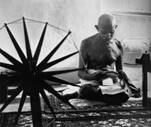
image005

This self-reliance that stems from a certain deep intangible knowledge reminds us of the principles of Swadeshi. The word Swadeshi derives from Sanskrit and is a sandhi or conjunction of two Sanskrit words. Swa means “self” or “own” and desh means country. Swadeshi, as a strategy, was a key focus of Mahatma Gandhi, who described it as the soul of Swaraj (self-rule). Now, the term Swadeshi has become extinct and is replaced by “inclusive growth”. Interestingly in a positive move, at his inaugural Independence Day speech, Modi talked about abolishing the Planning Commission that was created by Nehru in 1950 to give grand one-size-fit-all plans to guide the economy and replaced it with a new institution that gave more weight to India’s 29 states. Singapore’s founding Prime Minister Lee Kuan Yew had also argued that “India is not a real country. Instead, it is thirty-two separate nations that happen to be arrayed along the British rail line.” India is not a single investment destination or even a coherent, unified economic entity, presenting new insights to rethink about growth and business development. We will elaborate on the relevance of Modi’s “maximum governance, minimum government” later.


This Swadeshi innovator has over 100 designs registered with the Intellectual Property of Singapore (IPOS), including patents on the unique aesthetically-pleasing glass designs; curved windscreens that make buses lighter, more stable and fuel-efficient; and the interior engineering design of the coach to fit in more seats than its competitors with the same chassis. The company had once designed a rear engine cover that could be lifted vertically to allow the mechanic to easily access the inside of the bus to shorten repair time. The design was not patented and competitors rushed to copy.


We mentioned how the joint venture of Tata Motors (TM IN, MV $24bn) with Marcopolo (TTML) since May 2006 was built upon the philosophy of leveraging off one another’s strength to create a unique form of self-reliance. Tata Motors is responsible for…


<Article snipped>


We also briefly talked about the business models of other innovators in different industries that are relevant for them, including the breakthrough strategy of Paccar (PCAR US, MV $22bn) in technology-enabling its entire supply chain-manufacturing process-dealer chain and building a world-class call center to win an entirely new customer segment with the individual ‘truck-preneurs’. When we visited the facilities of this Singapore innovator, we were surprised that it does not have any reception desk and in its place is a customer call center, demonstrating its customer-centricity.


To scale up a SME sustainably requires innovation not just for the product offerings but more importantly in the business model. Since fourth-generation leader Mark Pigott took over as CEO in Jan 1997, Paccar is up nearly 100-fold from $230m to $22bn. To create and sustain long-term profitability within this industry, Paccar chose to…


<Article snipped>


Over the decade plus of interacting with entrepreneurs and innovators in Asia at various stages in their corporate lifecycle, monitoring the consistency of their words and actions, and observing the consequent changes in market valuation, we noticed one hallmark feature that distinguish the true compounders: A sense of urgency that is manifested in the no-nonsense speed to quietly tinker and improve things and an abhorrence for bureaucratic obstacles arising from “positional-based leaders” perceiving their involvement with handling rules, policies and procedures as a form of power.


The Singapore innovator has demonstrated the ability to rapidly take an idea from inspiration to fully formed expression, keeping their people curious, engaged and focused. This gravity force draws together enthusiasm, determination and the ability to solve new problems with original thought. Many companies we have seen over the decade plus do not possess this gravity force and are left in a state of weightlessness, searching for relevance and focus.


When people see the external world clearly because of their deep intangible knowledge, their sense of urgency is increased. They come to work each day determined to achieve something important, and they shed irrelevant and low-priority activities to move faster and smarter, now. There will be no idle time to waste for every moment has a strategic importance. Those with a sense of true urgency are the opposite of complacent. False urgency has a frantic feeling: running from meeting to meeting, producing volumes of paper, all with a dysfunctional orientation that often prevents people from exploiting key opportunities and addressing gnawing problems. Most often people are merely in a hurry, acting and reacting frantically to events, all of which makes them prone to errors and wasting time in the long run.


Urgency is becoming increasingly important because change is shifting from episodic to continuous. With episodic change, there is one big issue, such as making and integrating the largest acquisition in a firm’s history. With continuous change, some combination of acquisitions, new strategies, big IT projects, reorganizations, and the like comes at you in an almost ceaseless flow. With episodic change, the challenge of creating a sufficient sense of urgency comes in occasional spurts. With continuous change, creating and sustaining a sufficient sense of urgency are always a necessity. The role of the leader in this continuous change environment is to enable people experience new, often very ambitious goals, as exciting, meaningful, and uplifting – creating a call to action and a deeply felt determination to move, make it happen, and win, now. The disconnect between the outside and the inside will shrink. Complacency will be reduced.


One of the key to increasing speed and a sense of urgency is removing bureaucracy from creative thinkers. This is not the same as removing rules. It requires leaders to walk through a process to ensure that it satisfies common sense rules of working. If they find they would be annoyed by it, they should fix it or remove it. Improving the process this way engenders respect and fosters exploration over hesitation, a prerequisite to unlocking creativity. When there is a strong culture, there is no need to have prescribed policies for every permutation of a situation. Employees can rely on cultural influences to help determine what they should do – they will act with speed, and they will take initiative.


Talking about bureaucracy, we are reminded of India, which remains a notoriously difficult place to do business. In the World Bank’s most recent ease of doing business survey, India ranked 134th out of 189 countries. Even the most successful industrialists are weary of fighting through the thickets of legislative and bureaucratic obstacles planted in their way by successive governments. Hence, we are positive on Modi’s “maximum governance, minimum government” stand and quiet implementation on…


<Article snipped>


Despite its large domestic market, India’s industrial weakness means it depends on China and other exporters for goods from industrial machinery and mobile phones to more basic products such as lights and toys. The country is largely absent from the global supply chains for mass-produced items. India imported $580bn of capital goods in the past seven years. A National Manufacturing Policy launched three years ago by the Congress-led government has so far failed in its aim to create 100m manufacturing jobs and raise manufacturing as a share of GDP from 16% to 25% within a decade. Instead, the share declined further, to 15% today. Contributing factors include India’s burdensome labour regulations, poor transport and power infrastructure, the difficulty of acquiring land for factories and the failings of its bureaucracy. For instance, the much-feared postwar Industrial Disputes Act requires companies with more than 100 employees to ask permission to lay off workers – permission that is almost never given, making hiring and firing all but impossible for larger enterprises.


The rise of modern facilities in and around Pune in western India – with companies including Germany’s Volkswagen, Indian carmaker Mahindra & Mahindra (MM IN, MV $13.3bn), and autoparts maker Bharat Forge(BHFC IN, MV $2.9bn) helping turn India into a car exporting hub – suggests the industrial success is possible in parts of India. Pune is also the base for niche innovators such as Kirloskar Brothers (KKB IN, MV $353m), one of India’s oldest industrial group and India’s largest maker of pumps and valves, as well as a global exporter of industrial pumps used in everything from nuclear power stations to large buildings such as London’s Shard skyscraper.  In Gurgaon and Manesar (New Gurgaon), southwest of New Delhi, this industrialization effort is led by Maruti Suzuki(MSIL IN, MV $13.2bn) and wiring harness and auto parts maker Motherson Sumi Systems (MSS IN, MV $5.1bn).


The story of Bharat Forge, the flagship vehicle of the Kalyani Group founded by Nilkanthrao Kalyani in 1961 and built by Baba Kalyani, has been fascinating and controversial…
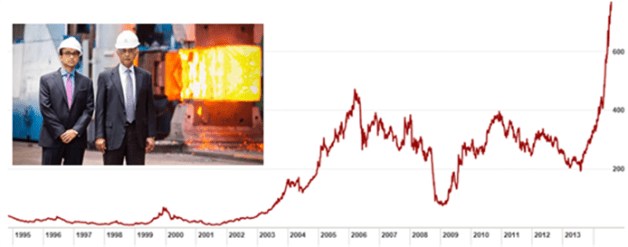
image012

Bharat Forge (BHFC IN) – Stock Price Performance, 194-2014


<Article snipped>


Can Bharat Forge follow the growth trajectory of Precision Castparts Corp (PCP), which we highlighted in an earlier article Can Asia Produce a Precision Castparts, a 1,000x Compounder? PCP grew from a small metal casting workshop to become one of the best compounders in American capital history, up over 1,700x in three decades plus to a global giant with a market cap of $34.7 billion. Bharat Forge believed…


<Article snipped>


Speed and the agility advantage is of essence (兵贵为神速) to be ready and fit for growth, as we shared with the MD of the Singapore innovator. The story of Napoleon and George Washington are worth savoring.


For thousands of years, war had been fought in essentially the same way: the commander led his large and unified army into battle against an opponent of roughly equal size. He would never break up his army into smaller units, for that would violate the military principle of keeping one’s forces concentrated; furthermore, scattering his forces would make them harder to monitor, and he would lose control over the battle. Suddenly, Napoleon changed all that. In the years of peace between 1800 and 1805, he reorganized the French military, bringing different forces together to form the Grande Armée, 210,000 men strong. He divided his army into several corps, each with its own cavalry, infantry, artillery, and general staff. Each was led by a marshal general, usually a young officer of proven strength in previous campaigns. Varying in size from 15,000 to 30,000 men, each corps was a miniature army headed by a miniature Napoleon. The key to the system was the speed with which the corps could move. Napoleon would give the marshals their mission, then let them accomplish it on their own. Little time was wasted with the passing of orders back and forth, and smaller armies, needing less baggage, could march with greater speed. Instead of a single army moving in a straight line, Napoleon could disperse and concentrate his corps in limitless patterns, which to the enemy seemed chaotic and unreadable. This was the monster that Napoleon unleashed on Europe in September 1805. Similarly, George Washington let his young leaders make their own strategic decisions in the field – capitalizing on the speed and agility advantage they had over their larger and better-trained competitors.


Understand: the future belongs to Swadeshi countries and innovators who are fluid, fast, and nonlinear. Your natural tendency as a leader may be to want to control the group, to coordinate its every movement, but that will just tie you to the past and to the slow-moving armies of history. It takes strength of character to allow for a margin of chaos and uncertainty – to let go a little – but by decentralizing your army and segmenting it into teams, you will gain in mobility what you lose in complete control. Give your different corps clear missions that fit your strategic goals, then let them accomplish them as they see fit. Smaller teams are faster, more creative, more adaptable; their officers and soldiers are more engaged, more motivated. By making officers and soldiers feel more creatively engaged, this strategy improved their performance and sped up the decision-making process. In the end, fluidity will bring you far more power and control than petty domination. With the transformational Swadeshi process which leverages on internal capabilities to exploit external opportunities with fluidity and speed, the wide-moat Bamboo Innovator is able to master the art of riding the powerful waves and staying resilient in crisis to compound value in uncertain times.


Warm regards,

KB

Managing Editor

The Moat Report Asia

www.moatreport.com

SMU: http://accountancy.smu.edu.sg/faculty/profile/108141/Kee%20Koon%20Boon


To read the exclusive article in full to find out more about the story of Bharat Forge, please visit:


The Moat Report Asia
 

“In business, I look for economic castles protected by unbreachable ‘moats’.”

– Warren Buffett


The Moat Report Asia is a research service focused exclusively on competitively advantaged, attractively priced public companies in Asia. Together with our European partners BeyondProxy and The Manual of Ideas, the idea-oriented acclaimed monthly research publication for institutional and private investors, we scour Asia to produceThe Moat Report Asia, a monthly in-depth presentation report highlighting an undervalued wide-moat business in Asia with an innovative and resilient business model to compound value in uncertain times. Our Members from North America, the Nordic, Europe, the Oceania and Asia include professional value investors with over $20 billion in asset under management in equities, secretive global hedge fund giants, and savvy private individual investors who are lifelong learners in the art of value investing.


Learn more about membership benefits here: http://www.moatreport.com/subscription/


  • Individual subscription at $1,994 per year:

https://www.moatreport.com/individual-subscription/?s2-ssl=yes


Our latest monthly issue for the month of August investigates an Asian-listed company who’s the leading ecommerce group in its home country with the complete platform coverage in the Amazon-type of B2C ecommerce of selling directly to end consumers (Sales/Net Profit: 90%/78%), Rakuten-type of B2B2C platform (Sales/Net Profit: 4%/12%) to support the online SME merchants who in turn sell to the end consumers, and the eBay-type of C2C auction site (Sales/Net Profit: 2%/21%) where individuals buy and sell to one another. This “Amazon-Alibaba” is highly profitable with recurring free cashflow (FCF yield 4.6-5% compounding at 25% in the next 3-5 years) by pioneering the world’s-first 24-hour delivery promise and guarantee when world-class logistics experts said it cannot be done. In emerging markets and Asia where logistics costs is 15-20% of GDP, most ecommerce companies fail to scale up due to lack of fulfillment capabilities and inventory risk became the killing blow as they pursue growth without the intangible know-how. The company designs and builds its own warehouses to provide fast and efficient delivery with 99.68% on-time rate and also complete backend services to suppliers, widening the gap between itself and peers. With its superior infrastructure, the company is able to provide consumers a one-stop shopping experience with all goods purchased from different vendors packaged into a single box and delivered to the client’s door. The company has consignment agreements with suppliers which allow it to have control over inventory management but carry no liability of inventory on its balance sheet, in other words, there is minimal inventory risk for the company to scale up sustainably and without the usual accounting risks that plagued the ecommerce companies.


With (1) a superior ROE of 23.6% due to its wide-moat business model in 24-hour delivery system, (2) negative cash conversion cycle (-29 days) in its unique warehouse system with minimal inventory risk, (3) a sustained 25-30% recurring earnings and cashflow growth per annum in the next 5 years, especially a long run-way in disrupting traditional retailers, and (4) potential exponential growth in its option value in the third-party electronic payment business, the company can scale up multiple times. Short-term downside risk is protected by its healthy$128m net-cash balance sheet (15% of MV) and proven management execution in prudent capex expansion to support sustainable quality earnings growth. Its terminal value and long-term downside risk will be protected by giants Alibaba, Rakuten, eBay, Amazon who wish to swallow it up to possess its valuable trust and brand equity support it enjoys and its wide-moat business model in 24-hour delivery system. The company is one of the few Asian ecommerce companies with good governance and low accounting risks with its net-value revenue recognition method and it deserves a valuation premium. Upcoming deregulation in third-party electronic payment with the passing of the law in Sep 2014 will result in various government restrictions to be removed, paving the way for the company to introduce stored-value payments, O2O payment, P2P payment (money transfer without transactions), multiple currencies’ payments, big data analysis, payment services for customers outside the group to boost transaction volume and scale up its existing proprietary PayPal/AliPay businessLed by the inspiring and highly-determined founder and Chairman who established and listed the company in 1998 and 2003 respectively, the company has overcome the multiple obstacles to ecommerce transactions in its home market. The founder described the obstacles to ecommerce transactions as ‘friction’, and that he “resolve to take on the Life’s Task to reduce this ‘friction’”.


Our past monthly issues examine:


  • An Asian-listed company who’s the global #1 and #2 maker of two types of patient monitoring devices for both clinical- and home-use. Founded in 1981 and listed in 2001, the company’s reliable manufacturing technology platform for over 30 years has enabled it to build a global durable franchise in the niche patient monitoring device market that has stable resilient growth and yet is experiencing potential disruptions led by its new innovation. A secret to its success is its in-house capabilities to combine Swiss design, high-precision electronics and sensors components with clinical healthcare to produce world-class products with cost competitiveness. The firm has competitive technology and patents especially its core competence of having an algorithm to allow fast reading/filtering of signals and outputting the accurate results in a short period of time. Thecompany has the potential to consolidate the market further. The company is also a sticky ODM partner to reputable companies including Wal-Mart, Costco, CVS and it has adiversified customer base with none of the customers accounting for more than 10% of its sales. The company demonstrated that it has bargaining power over its powerful customers with the ability to build its own brand since 1998 (62% of overall sales). 91% of its sales are to developed markets in US and Europe. The company is trading at EV/EBIT 9.7x and EV/EBITDA 8.8x and has an attractive dividend yield at 5.6% and a strong balance sheet with net cash as percentage of market value and book equity at 23% and 47% respectively. The firm has also undertaken the unusual capital management program to reduce 10% of its shares outstanding in Sep 2012 to boost capital efficiency by utilizing the comfortable net cash position. The proactive shareholder-friendly stance backed by its strong net cash position should limit any downside in share price. The company’s terminal value and downside risk will be protected by giants such as J&J, Bayer, Abbott etc who wish to swallow it up to possess its valuable manufacturing technology platform and worldwide patents in algorithm-technology. The company’s worldwide patents in algorithm-technology has been commercialized into an innovative product series that is at the heart of its total solution service business model. This valuable intangible asset is not factored into long-term valuation. The innovative product with the algorithm measurement technology are not merely additional features; it “forces” the clinical community to adopt them as the standard, which in turn helps drive home-use penetration as patients seek a consistent and integrated healthcare experience. It transforms the product into a unique strategy that incorporates software development to create value-added services for health monitoring and collaborating with hospitals and governments on tele-healthcare projects. As a result of its wide-moat, the company has a far superior ROE at 20.9% that is nearly double that of its key giant conglomerate rival. When we compare EV/EBIT relative to ROE and ROA, the company is cheaper by as much as 120-150% when compared to its key giant conglomerate rival. The stock price of the company is down nearly 20% from its recent high in end March 2014 on profit-taking by short-term investors. Share price is back to May 2013 level, representing an attractive opportunity to take position in this long-term durable franchise. The stable long-term shareholdings and patient capital by the founder and the management team who together own around 48% of the equity has enabled the firm to adopt a very long-term approach to building its business and cultivating new growth areas. While he may sometimes be slightly over-optimistic and thinking too far ahead with his long-term opinions, this  idealistic engineer-visionary-philosopher has done a fantastic job in continuously defying the odds of many skeptics by growing the company from a small startup into one of the world’s leading patient monitoring equipment company. He is the rare Asian entrepreneur who was persistent in building his own brand despite the threat of offending his ODM customers. He was also early in cultivating and coordinating a global network with high-tech component, R&D and manufacturing in his home country, manufacturing, assembly and packaging in Shenzhen, China and medical R&D and clinical testing center in Europe, including making the difficult decision to establish a direct marketing sales force in Europe and North America given the high cost. Unlike most Asian business owners whose interest and focus in the core business starts to wane due to complacency from growing personal wealth and the inability to scale the core business, the founder is genuinely passionate in the company’s ability to add value to the patients and society. The firm can effectively run without the founder with the long-term corporate culture and management system in place, yet he can inject great value as the steward in new innovations; we believe that this combination is rare for an Asian company and deserves a valuation premium.


  • The world’s #1 ODM (Original Design Manufacturer) and global #5 manufacturer of a consumer healthcare device product that is used frequently, even daily, thus providing the foundation for stable recurring cashflow. This company is also a hidden champion in a niche product segment (50-55% of group’s sales) that has become a high-growth fashion product currently accounting for less than 10% of the overall industry. The company is able to mass-manufacture this niche product, but not the giants, because of its unique process IP in flexible manufacturing system and know-how to handle large-scale complex orders. The manufacture of this product itself is difficult to replicate and requires FDA/CE licenses because of its medical device nature and the entry barrier is not capital but the know-how and R&D expertise. In particular, the manufacturing integrates different fields of science including polymer chemistry, physics, optics, engineering, materials control, process control, microbiology, and, injection molding. The firm has also developed a proprietary system of tracking the manufacturing process of different sets of product so that if a quality issue arose, when and where the problem set of products was being produced could be swiftly identified, thus diminishing the scale and cost of product recall. This system has helped the firm win the long-term trust of its ODM customers to place stable large orders. The Big Four giants do not have such a system and have to incur substantial losses from product recalls. The company also possess its own brand which has many loyal followers and support in its home market where it enjoys a 30% market share and contributes to 25% of group’s saleswhile sticky ODM customers account for 75% of group’s sales, mainly from the Japan market. As a result of its wide-moat advantages, the firm enjoys a consistently high ROE of 41%, double or triple that of the giants. From FY07 onwards, even during the depths of the Global Financial Crisis in 2007/09, the firm has not raised equity. Since listing in Mar 2004, the company has only done one rights issue in May 2005. Also, it is able to sustain a strong stable cash dividend payout (>70% with 3% yield) with its healthy net-cash balance sheet (net cash $30m; net cash-to-equity ratio 23%) and proven management execution in prudent capex expansion to support sustainable quality earnings growth. M&A deals in the healthcare and medical device sector has been growing due to their strong defensive nature and giants seeking growth to overcome their own patent cliff. The firm willalways be an attractive takeover target by giants who wish to swallow it up to possess its valuable flexible manufacturing system and know-how to fill their own missing competency gap and hence will enjoy long-term downside protection in its terminal value. In the battle between “ODM vs Brand”, we find the story of the company to be quite similar to that of TSMC (2330 TT, MV $103bn), now the largest ODM foundry in the world. “Skate to where the puck is going to be, not where it has been,” as hockey legend Wayne Gretzky advised. In our view, the profit and valuation premium in the value chain will start to skate to the “Inno-facturers” who are the hidden ODM innovators (the brand behind brands) consolidating the industry, such as TSMC and this company. While its valuation is not cheap with EV/EBIT (FY13) at 20.6x, when we compare EV/EBIT relative to ROE, the company is relatively cheap, by as much as 130-220% when compared to giants and other comparables. When we compare EV/EBITDA relative to ROE, the valuation gap is 90-160%. This long-term valuation gap implies that the company, with its far superior and sustainable ROE, could potentially double to $2.4bn, as it continues to consolidate its niche product segment and enter into a new product cycle of an innovative product whose patents are expiring in 2014/15 (US/worldwide) to make ASP/margin improvements in sustaining quality profits and cashflow. Its share price has dropped 18% from its recent high and underperformed the index by 26% in the last six months. This will present a buying opportunity for long-term value investors who can penetrate beyond conventional valuation metrics because of a deep understanding of its business model and underlying source of its wide-moat advantages. In Asia, many firms break apart or become value traps due to shareholder conflict, envy and differences in opinion on the business direction of the company. The stable long-term corporate culture infused by the late founder, who established the company in 1986 with the current executive chairman and 2 other key shareholders, to combine the energy and ideas of everyone to work hard to keep the business running forever is underappreciated.


  • The Home Depot of Asiawhich has the largest market share in its home country and now seeks to expand regionally. It is one of the few home improvement retailers in the world which is able to achieve a structural negative cash conversion cycle (CCC) at -39 days for resilient, recurring and sustainable operating cashflow to enable the expansion of its store network while keeping a healthy balance sheet. It is hard to achieve negative cash conversion cycle (CCC) as a home retailer as compared to a supermarket retailer as the product nature is more durable. Even Home Depot, Lowe’s and Bed Bath & Beyond (BBBY) are not able to achieve a negative CCC. Led by the capable owner-operators since 1995, the company is a pioneer in proactively creating awareness and demand in the minds of consumers that upgrading your home can be fun and in incremental affordable steps. Its creative branding has resulted in the firm to become the “first on customers’ mind”, or what Charlie Munger elucidated as the “psychological wide-moat” advantage. 80% of sales are generated customers looking for home improvement and renovation ideas and solutions.  Growth is supported by the management’s proven ability to identify and cater to dynamic changes in customer preferences. The firm’s comprehensive pre and aftersales service creates brand loyalty and sustains long-term sales. The merchandizing management is tailored to the peculiarities of customer preferences in each area to drive same store sales growth with creative customization by store, location, season and events. Its key strategy to expand its profit margin is to increase its higher-margin house brands and product-mix management. Its EBITDA/sqm of $400/sqm was higher than Home Depot until Home Depot experienced a rebound last year to $500/sqm. The firm’s resilient sales are supported by its unrivalled network of diverse locations throughout the country. Its bold vision and successful “Blue Ocean” execution in the highly fragmented second-tier markets has created a powerful wide-moat advantage that will last for many years to come. In short, the management have proven their ability to execute in difficult market and industry conditions especially in the past 5 to 7 years during the 2007/09 global financial crisis with the firm emerging much stronger. The Illinois Institute of Technology engineering graduate and quiet billionaire owner behind the home retailer is one of the few Asian business tycoons who has the thirst to scale up the business in a sustainable way, as opposed to opportunistic ventures, having been largely influenced by his early years experience observing the success of American wide-moat firms. If we can adjust the EV/EBITDA valuation metric to reflect the CCC, the company’s EV/EBITDA of 18.5x will be lower at 10-11x, while Home Depot’s EV/EBITDA 11x will be higher at 13x. Noteworthy is that Home Depot has a negative free cashflow throughout FY1989-2001 (13 consecutive years!) and yet market cap has climbed from $1.5bn to $103bn. Home Depot compounded despite the ugly valuations during the capex ramp-up. This once again highlights that the power of wide-moat is often underappreciated, misunderstood and overlooked. When Home Depot generated $180m in operating cashflow in FY1992, quite similar to this Asian firm now, Home Depot is valued at $5bn (vs $3bn). Store network is expected to double in the next 4-5 years, representing a potential doubling in market value.


  • The Northeast Asian-listed companywho is the world’s largest maker of an essential component with applications in apparel, shoes, diapers, car seats etc. All top 20 global athletic shoe brands, including Nike, Adidas, Reebok, Sketchers, UnderArmor are customers and this Asian innovator with R&D capabilities has forged long-term “spec-in” partnerships with them. Its broad product offering is protected by over 110 patents. By locating its Pan-Asian production plant network in China, Taiwan, Vietnam and Indonesia close to its major clients, including sales/customer service centers and warehouses in US and Europe, the firm is better positioned to understand their requirements, deliver fast and meet their needs. While top 10 athletic shoe brands account 40% of its revenue, the firm has a diversified clientele base of over 10,000 customers, giving it resilience and growth with both the established and emerging brands as clients. The company is trading at PE14e 12x, EV/EBITDA 7.1x and EV/EBIT 10.6x with a dividend yield of 3.9%. Interestingly, its EBITDA margin is double that of Adidas and its 8.7% net margin is higher than Adidas’ 5.4%, though below Nike’s 9.8%. Given the tipping point of its Pan-Asian production network and contributions from its new products and as capex tapers off in the next few years, free cashflow could be around $50-60m and applying a P/FCF of 15x would yield a market value of $750-900m,, representing a potential upside of 100-150%. Thus, the firm offers a similar quality growth trajectory to Nike/Adidas with its unique knowledge-based business model and yet trades at a more attractive valuation and higher dividend yield as downside protection.


  • The Middleby of Asia commanding a dominant market share of over 80% in hypermarkets, 50% in chain outlets, 30% in 4- to 5-star hotels in China and an overall 30% in its home market. Yet, no single customer accounts for more than 5% of its revenue. Just to recall for value investors, NYSE-listed Middleby, with its sleepy and boring business, has compounded 100-fold from around $50m to $5.7bn since its tipping point in 1999. The founders of this Asian family business demonstrated clear dedication in building up the company with its wide-moat business model backed by a strong and unique distribution/marketing network in finding, winning and binding new customers to build massive brand equity and long-lasting relationships with clients over time. Their devotion to its core product for nearly 20 years results in maximum problem-solving skills, innovative strength and product leadership and hence, to ever greater customer benefit that will protect the company to consolidate the fragmented market and provide ample opportunities to continue its profitable growth. The company is currently trading at PE13e 15.8x and an undemanding EV/EBIT 10.1x and EV/EBITDA 9.5xand its growth potential based on its unique business model is not priced in. There is a structural re-rerating of niche business models with (1) diversified client base, (2) steady revenue streams, (3) lean capex requirements that creates ample free cashflow and defensive growth. Based on PE, P/CFO and EV/EBIT, the company is trading at a 40-50% discount to the foreign listed comparables despite more efficient use of assets in generating profits and cashflow. It has an attractive 7% earnings yield growing at 20% over the next 3-5 years and a 3.8% dividend yield that is supported by its strong cashflow generation ability, steady revenue stream and lean capex requirements to limit downside risks in valuation. Based on the growth plans to penetrate new product and customer segments; build its third plant in India in addition to the ones in its home market and in China; and potential bolt-on acquisition opportunities with its healthy balance sheet in net-cash position, it has the potential to double its operating cashflow in the next 3-5 years and market value could double, representing an upside potential of 100-140%.


  • An emerging Asian Walgreens which is a top 3 community pharmacy operator in its home market. Walgreens is a classic neglected American compounder up over 272-fold to $54 billion from under $200m as it quietly consolidates the market. Over the decade, we observed that it is difficult to scale services-based businesses without an entrepreneurial mindset, committment and execution and the bold and unique management system of the company since 2000 allowed the pharmacists to be part-owner of the business which will lead to increased level of commitment and an owner’s mindset in growing the business for the long-term in the community. The firm has strong cash generation ability due to its negative cash conversion cycle (CCC) in the business modelto help the business stay resilient during difficult times and to fund capex needs internally without straining the business model scalability as the network expands. The centralized logistics system provide regular deliveries to all of its community pharmacies enables the outlets to maximize retail space without the need to have space to keep stocks. This also enables the community pharmacies to optimize retail space to carry a wide range of products which is important as consumers increasingly have top-of-mind recall for the company as the destination to go to for their healthcare needs. Like Walgreens, the company believed in the power of embedding technology into the business model to better compete and its financial and warehousing/inventory management systems are integrated with its in-house POS (point-of-sale) system which is linked among all its community pharmacies and head office via virtual private network. The company is founded by five college friends who were somewhat frustrated that their pharmacy degrees were underappreciated and under-rewarded as compared to their medical degree counterparts even though they had studied hard for 4-5 years and had in-depth medical knowledge. They were eager to prove themselves that they are as capable, if not more so. This restless spirit to prove their capabilities resulted in them coming together to be entrepreneurs and they wish to provide the platform for similar restless pharmacists to apply their hard-earned knowledge acquired in the university. We find that this common purpose and camaraderie spirit is rare in Asian companies and makes the company unique to scale up sustainably. The company is currently trading at a EV/EBIT of 13.9x and EB/EBITDA 12.6%. In the next two to three years as the company expands its network of outlets, operating cashflow (CFO) could increase 50-60% and a re-rerating could result in a doubling in market value.


  • An Asian-listed pharmaceutical company which has a dominant franchise in a neglected but growing diseaseand is a leader with a domestic market share of 49% in this niche segment and is the only fully-integrated player amongst the few pre-qualified WHO firms, giving it >30% EBITDA margin, better pricing power compared to the competition, and significant advantage over other players in ramping up the global business from the current 30% market share in the most-common treatment drug (vs Novartis 50%). Furthermore, the pharma company has the second-highest GP/TA (gross profit/ total asset) ratio in the industry at 56.3% and the most conservative accounting practice in the industry which “depresses” earnings relative to its peers i.e. it is the only domestic firm which expenses, and does not capitalize, all R&D. With the new plant for formulations export to US, the deepening of the niche drug franchise, growing wins in chronic pain and other niche areas and the commercialization of the potential blockbuster product of blood thinner by FY16/17, EBITDA could potentially double to $200m in the next 4-5 years, triggering a valuation re-rating to a market value of $3.4bn, a 130% upside.


  • An Australian-listed company with market value $405m, EV/EBITDA 7.5x, EV/EBIT 10x, div 3%, 70% domestic market sharewhose management made the controversial bold decision to stop overseas exports in order to focus on cultivating the higher-margin domestic market with innovative marketing strategy and new products and is potentially doubling its supply in the next 3-5 years. It is in its 10th year of listing after piling the foundation in consolidation, investment, rationalization for its next stage. It has an all-time low debt-equity position 18.6% with healthy balance sheet. “Buffett of Nordic” recently increased position between Apr-Sep this year in the peer comparable of the company and the billionaire investor announced in Nov an acquisition of a rival in a wave of global consolidation and with the view on a sustained recovery in product prices.


  • Northeast Asia-listed company with global #1 market share leadership in 4 different products, including making the components for an innovative consumer product whose sales have climbed from $90 million to $526 million in the recent three years. The company is a hidden global consolidator with underappreciated growth. The stock is trading at PE 11.5x, EV/EBITDA 9x and generates a sustainable dividend yield 5.75%.


  • Taiwanand Southeast-Asian-listed entrepreneurial company, both with a dominant 80% domestic market share and have innovative business models to generate substantial cashflow to support both expansion and a 4-5% dividend yield.


  • There is also a behind-the-scene conversation with the CEOsof the companies to understand their thinking process in building up the business.


The Moat Report Asia Members’ Forum has been getting penetrating quality dialogues from our subscribers.Questions range from:


  • The nuances of internal dealings in Asia, including the case discussion of the recent deal in which HK billionaire’s Lee Shau-kee Henderson Landacquiring Towngas or Hong Kong & China Gas (3 HK) from his family holdings, seemingly déjà vu from the early Oct 2007 transaction when the market peak.
  • The case of F&N Singaporespinning out its property unit FCL Trust and getting “free” special dividend-in-specie and the potential risk in asset swap restructuring to deleverage the hidden debt in the entire Group balance sheet.
  • The dilemma of whether to invest in a Southeast Asian-listed company and hidden champion with a domestic market share of 60% due to family squabbles and a legal suit over the company’s ownership.
  • Discussion of the wise and thoughtful 107-year-old Irving Kahn’s investment into a US-listed but Hong Kong-based electronics company with development property project in Shenzhen’s Qianhai zone and the possible corporate governance risks that could be underestimated or overlooked, as well as their history of listing some assets in HK in 2004.. This is also a case study of “buy one get one free” in John’s highly-acclaimed book The Manual of Ideasin which the “free” property is lumped together with the (eroding) core business to make the combined entity look cheap and undervalued. What are the potential areas that value investors need to watch out for when adapting the SOTP (sum-of-the-parts) valuation method in Asia?
  • And many more intriguing questions.


Do find out more in how you can benefit from authentic and candid on-the-ground insights that sell-side analysts and brokers, with their inherent conflict-of-interests, inevitable focus on conventional stock coverage and different clientele priorities, are unwilling or unable to share. Think of this as pressing the Bloomberg “Help Help” button to navigate the Asian capital jungle. Institutional subscribers also get access to the Bamboo Innovator Index of 200+ companies and Watchlist of 500+ companies in Asia and the Database has eliminated companies with a higher probability of accounting frauds and  misgovernance as well as the alluring value traps.


Professional Development Workshops for Executives and Lifelong Learners
 

Our 8th run of the series of workshop From the Fund Management Jungles: Value Investing Exposed and Explored– (Part 1) Moat Analysis, (Part 2) Tipping Point Analysis and (Part 3) Detecting Accounting Fraud – on 14 June 2014 has been well-received with serious value investors, professionals, and serious lifelong learners attending, with some who flew in from Jakarta and KL!..


Our 9th workshop will be on Detecting Accounting Fraud Ahead of the Curve sometime later in the year.


Thank you for your support all this while!


Thank you so much for reading as always.


Warm regards,

KB Kee

Managing Editor

The Moat Report Asia

Singapore

Mobile: +65 9695 1860


A Service of BeyondProxy LLC

1608 S. Ashland Avenue #27878

Chicago, Illinois 60608-2013

Other offices: London, Singapore, Zurich


P.S.1 Here is a little more about my background:

KB Kee has been rooted in the principles of value investing for over a decade as an analyst in Asian capital markets. He was head of research and fund manager at a Singapore-based value investment firm. As a member of theinvestment committee, he helped the firm’s Asia-focused equity funds significantly outperform the benchmark index. He was previously the portfolio manager for Asia-Pacific equities at Korea’s largest mutual fund company.


He holds a Masters in Finance and degrees in Accountancy and Business Management, summa cum laude, from Singapore Management University (SMU) and had also published articles on governance and investing in the media, as well as published an empirical research paper Why ‘Democracy’ and ‘Drifter’ Firms Can Have Abnormal Returns: The Joint Importance of Corporate Governance and Abnormal Accruals in Separating Winners from Losers in the Special Issue of Istanbul Stock Exchange 25th Year Anniversary Best Paper Competition, Boğaziçi JournalReview of Social, Economic and Administrative Studies, Vol. 25(1): 3-55. KB has also presented his thought leadership as a keynote speaker in global investing conferences. KB has trained CEOs, entrepreneurs, CFOs, management executives in business strategy, value investing, macroeconomic, industry trends, and detecting accounting frauds in Singapore, HK and China, and had taught accounting at the SMU where he is currently an adjunct lecturer.


P.S.2  Why do I care so much about doing The Moat Report Asia for you?

My personal motivation in embarking on this lifelong journey has been driven by disappointment from observing up close and personal the hard-earned assets of many investors, including friends and their families, burnt badly by the popular mantra: “Ride the Asian Growth Story!” I witnessed firsthand the emotional upheavals that they go through when they invest their hard-earned money – and their family’s – in these “Ride The Asian Growth Story” stocks either by themselves or through money managers, and these stocks turned out to be the subject of some exciting “theme” but which are inherently sick and prey to economic vicissitudes. They may seem to grow faster initially but the sustainable harvest of their returns is far too uncertain to be the focus of a wise program in investment. Worse still, the companies turned out to be involved in accounting frauds. Their financial numbers were “propped up” artificially to lure in funds from investors and the studiously-assessed asset value has already been “tunnelled out” or expropriated. And western-based fraud detection tools and techniques have not been adapted to the Asian context to avoid these traps.


After a decade-plus journey in the Asian capital jungles, it has been somewhat disheartening as I observe many fraud perpetrators go away scot-free and live a life of super luxury on minority investors’ hard-earned money. And these perpetrators make tempting offers to various parties in the financial community to go along with their schemes. When investors have knowledge in their hands, we have a choice to stay away from these people and away from temptations and do the things that we think are right. With knowledge, we have a choice to invest in the hardworking Asian entrepreneurs and capital allocators who are serious in building a wide-moat business.


CONNECT WITH US image004image005image007image006
MOAT REPORT ASIA    OUR TEAM    SUBSCRIBE    MEMBERS    CONTACT US

The Moat Report Asia
A Service of BeyondProxy LLC
1608 S. Ashland Avenue #27878
Chicago, Illinois 60608-2013

Other offices: London, Singapore, Zurich


Morning Bamboo Insight: 19 Aug 2014

Morning Bamboo Insight: 19 Aug 2014

Macro

  1. Fears of Renewed Instability as Fed Ends Stimulus

http://www.nytimes.com/2014/08/16/business/fears-of-renewed-instability-as-fed-ends-stimulus-program.html?ref=economy

  1. Inside the Dark, Lucrative World of Consumer Debt Collection

http://www.nytimes.com/interactive/2014/08/15/magazine/bad-paper-debt-collector.html?ref=business

Asia Pacific

  1. (Asia) – Analysis: Promise of more keeps investors hooked on Asia’s frothy markets

http://www.reuters.com/article/2014/08/18/us-markets-asia-analysis-idUSKBN0GI02R20140818

  1. (Korea) – POSCO is moving to prevent any further rise of Hyundai Steel, an affiliate of the Hyundai-Kia motor group, and has found an ally in SeAh Besteel to boost its efforts

http://www.koreatimes.co.kr/www/news/biz/2014/08/123_163066.html

  1. (Isia) – Yudhoyono Delivers Swan Song to House Ahead of Independence Day

http://www.thejakartaglobe.com/news/yudhoyono-delivers-swan-song-house-ahead-independence-day/

  1. (China) – China to audit government land income in corruption fight – paper

http://uk.reuters.com/article/2014/08/16/uk-china-corruption-land-idUKKBN0GG04320140816

  1. (China) – China Fishes for Growth with World’s Largest Aquarium

http://www.thejakartaglobe.com/international/china-fishes-growth-worlds-largest-aquarium/

  1. (Isia) – Indonesia Seeks to Cut Logistics Costs

http://www.thejakartaglobe.com/business/state-seeks-cut-logistics-costs/

  1. (India) – Indian Businesses Await Changes to Raj Era Labor Laws

http://www.thejakartaglobe.com/business/indian-businesses-await-changes-raj-era-labour-laws/

  1. (Isia) – Editorial: Independence From Graft and Ignorance; For hundreds of years the Dutch colonial authorities taught Indonesia’s elite how to steal the wealth of their own people

http://www.thejakartaglobe.com/opinion/editorial-independence-graft-ignorance/

  1. (Isia) – Sixty-Nine Years On, Sovereignty Still Eludes Indonesia

http://www.thejakartaglobe.com/news/sixty-nine-years-sovereignty-still-eludes-indonesia/

  1. (China) – Five Things China Hasn’t Changed In Five Years

http://www.forbes.com/sites/ralphjennings/2014/08/16/five-things-china-hasnt-changed-in-five-years/print/

  1. (Isia) – Indonesia Lawmakers Draft Bill to Slash Foreign Ownership of Plantations

http://www.thejakartaglobe.com/business/indonesia-lawmakers-draft-bill-slash-foreign-ownership-plantations/


  1. (China) – ‘Paris Syndrome’ Drives Chinese Tourists Away

http://www.bloomberg.com/news/print/2014-08-14/the-paris-syndrome-drives-chinese-tourists-away.html

  1. (China) – Between Truth and TV: China’s New Deng Xiaoping-Inspired Miniseries

http://blogs.wsj.com/chinarealtime/2014/08/18/between-truth-and-tv-chinas-new-deng-xiaoping-inspired-miniseries/

  1. (Spore) – Singapore to Revise Parts of Pension Plan Amid Retirement Concerns; Government Wants to Give Pensioners More Flexibility in How They Tap Savings

http://online.wsj.com/articles/singapore-to-revise-parts-of-pension-plan-amid-retirement-concerns-1408300084

  1. (China) – China Pushes Cleanup of Banks; Top Four Lenders Are Raising Capital and ‘Bad Banks’ Are Being Created to Absorb Soured Loans

http://online.wsj.com/articles/china-pushes-cleanup-of-banks-1408299591

  1. (China) – Chinese Officials Rush to Sell Luxury Homes Amid Corruption Crackdown; Real-Estate Agents Say Bureaucrats Are Selling Homes at Steep Discounts

http://online.wsj.com/articles/chinese-officials-fearing-scrutiny-amid-a-crackdown-on-graft-rush-to-sell-luxury-homes-1408316680

  1. (China) – China Contagion: Diamonds & Wine Plunge To 4-Year Lows

http://www.zerohedge.com/news/2014-08-17/china-contagion-diamonds-wine-plunge-4-year-lows

  1. (Asia) – Across Asia’s borders, labor activists team up to press wage claims

http://www.reuters.com/article/2014/08/17/us-asia-labour-idUSKBN0GH0R720140817

  1. (India) – India’s Hindu nationalists tighten grip over ruling party

http://news.asiaone.com/print/news/asia/indias-hindu-nationalists-tighten-grip-over-ruling-party

Life

  1. No Rest For The Innovators

http://techcrunch.com/2014/08/16/no-rest-for-the-innovators/

  1. 6 Things The Happiest Families All Have In Common

http://www.bakadesuyo.com/2014/08/happiest-families/

  1. Local comedians share about their battles with depression

http://yourhealth.asiaone.com/print/content/local-comedians-share-about-their-battles-depression

  1. Swire Pacific Grooms Talent for the Long Term; Hong Kong firm, which controls Cathay Pacific, develops leaders with the next 200 years in mind.

http://online.wsj.com/articles/swire-pacific-grooms-talent-for-the-long-term-1408300737

  1. Books – Nonzero: The Logic of Human Destiny

http://www.amazon.com/exec/obidos/ASIN/0679758941

  1. Henry Miller on Turning 80, Fighting Evil, And Why Life is the Best Teacher

http://www.farnamstreetblog.com/2014/08/henry-miller-on-turning-eighty/

  1. 21 of Bill Clinton’s Favorite Books

http://www.farnamstreetblog.com/2014/08/bill-clinton-favorite-books/

  1. Building Blocks and Innovation; Most innovation comes from combining well-established building blocks in new ways; “For most who are heavily engaged in creative activities, metaphor and model lie at the centre of their activities.”

http://www.farnamstreetblog.com/2013/01/building-blocks-and-innovation/

TMT

  1. Reprogramming Government: A Conversation With Mikey Dickerson who helped build Google’s computer systems. Now he’s in Washington, tasked with remaking the way the government uses computers and how citizens engage with it online

http://bits.blogs.nytimes.com/2014/08/17/reprogramming-government-a-conversation-with-mikey-dickerson/?_php=true&_type=blogs&ref=technology&_r=0

  1. For ‘Big Data’ Scientists, Hurdle to Insights Is ‘Janitor Work’; The analysis of giant data sets promises unique business insights, but much manual effort is still required to prepare the information for parsing

http://www.nytimes.com/2014/08/18/technology/for-big-data-scientists-hurdle-to-insights-is-janitor-work.html?ref=business

  1. In Silicon Valley, Mergers Must Meet the Toothbrush Test; Companies like Google, Facebook and Cisco Systems are using internal teams to handle most acquisitions instead of relying on Wall Street bankers

http://dealbook.nytimes.com/2014/08/17/in-silicon-valley-mergers-must-meet-the-toothbrush-test/?ref=business

  1. Can Bigcommerce become the next big name in e-commerce?

http://fortune.com/2014/08/15/can-bigcommerce-become-the-next-big-name-in-e-commerce/ http://fortune.com/2014/08/15/can-bigcommerce-become-the-next-big-name-in-e-commerce/

  1. Following an unprecedented series of spinoffs by major US media companies, the print news industry now faces a rocky future without financial support from deep-pocketed parent firms

http://www.thestar.com.my/Business/Business-News/2014/08/18/Bumpy-road-ahead-for-US-print-news-industry-Corporate-breakups-leave-newspaper-firms-without-financ/

Consumer

  1. (Korea/Consumer) – Private equities have hearty appetite for Korean food companies

http://www.koreatimes.co.kr/www/news/biz/2014/08/123_162934.html

  1. (Japan/Consumer) – From cradle to grave, Japan’s Kewpie adapts menu to feed ageing nation

http://uk.reuters.com/article/2014/08/17/us-japan-elderly-food-idUKKBN0GH0QZ20140817

Evening Bamboo Insight: 18 Aug 2014

Evening Bamboo Insight: 18 Aug 2014

Macro

  1. What’s the Key Economic Challenge of the Future?

http://blogs.wsj.com/cio/2014/08/15/whats-the-key-economic-challenge-of-the-future/

  1. FASB Looks to Uncomplicate Accounting-A Little, At

http://blogs.wsj.com/cfo/2014/08/15/fasb-looks-to-uncomplicate-accounting-a-little-at-least/?mod=WSJ_hpp_sections_cfo

  1. How Much U.S. Debt Does China Hold? The U.S. Isn’t Sure

http://blogs.wsj.com/economics/2014/08/15/us-treasury-unsure-exactly-how-much-us-debt-china-holds/

  1. The recent move by Norges Bank Investment Management, one the world’s biggest investors that has access to Norway oil funds amounting to US$870bil, to be more transparent on its voting intention is something worth emulating

http://www.thestar.com.my/Business/Business-News/2014/08/16/Taking-a-leaf-out-of-Norways-book/

  1. “Soros Put” Rises To Record: Is The Billionaire Investor Betting On Market Crash?

http://www.zerohedge.com/news/2014-08-15/soros-put-rises-record-billionaire-investor-betting-market-crash

  1. All tied up: Working capital management 2014

http://www.ey.com/GL/en/Services/Transactions/EY-working-capital-management

http://www.ey.com/Publication/vwLUAssets/EY-working-capital-management-2014-all_tied_up/$FILE/EY-working-capital-management-2014-all-tied-up.pdf

http://www.valuewalk.com/2014/08/consumer-products-companies

  1. Corporate founders battle boards to overturn forced exits

http://www.reuters.com/article/2014/08/15/corporate-governance-founders-feature-pi-idUSL2N0QL27D20140815

Asia Pacific

  1. (Asia) – Race- and religion-based politics slows Asia’s progress

http://www.japantimes.co.jp/opinion/2014/08/15/commentary/world-commentary/race-and-religion-based-politics-slows-asias-progress/#.U-740PmSxqU

  1. (Japan) – 20% in Japan willing to work under merit-based system without overtime pay: poll

http://www.japantimes.co.jp/news/2014/08/15/business/20-japan-willing-work-merit-based-system-without-overtime-pay-poll/#.U-74ufmSxqU

  1. (Myanmar) – As Myanmar Opens Up to the World, Corporate Behavior Is Under Scrutiny

http://www.thejakartaglobe.com/opinion/myanmar-opens-world-corporate-behavior-scrutiny/

  1. (Taiwan) – Taipei City nixes 12-year education special exam

http://news.asiaone.com/news/edvantage/taipei-city-nixes-12-year-education-special-exam

  1. (India) – Almost half of India billionaires’ wealth held by 5 tycoons

http://business.asiaone.com/print/news/almost-half-india-billionaires-wealth-held-5-tycoons

  1. (Isia) – Indonesian stock market not ready to join ASEAN Economic Community

http://www.thejakartapost.com/news/2014/08/15/indonesian-stock-market-not-ready-join-asean-economic-community.html

  1. (India) – Honoring a Hindu God With Human Pyramids; India’s Supreme Court overturns height and age limits that a lower court imposed on a towering tradition

http://online.wsj.com/articles/honoring-a-hindu-god-with-human-pyramids-1408143955

  1. (China) – China Issues Draft Rules for Property Registry; Registry Would Help Government Track Homeownership, Though Public Access Limited

http://online.wsj.com/articles/china-issues-draft-rules-for-property-registry-1408097942

  1. (China) – The Great Chinese Exodus; Many Chinese are leaving for cleaner air, better schools and more opportunity. But Beijing is keeping its eye on them.

http://online.wsj.com/articles/the-great-chinese-exodus-1408120906

  1. (Asean/Msia) – Malaysia is getting ready to chair Asean next year but the lack of awareness among all parties on what is in store for 2015 is worrying the Government

http://www.thestar.com.my/Opinion/Columnists/Mergawati/Profile/Articles/2014/08/14/Moving-Asean-into-the-spotlight/

  1. (China) – Chinese Power Consumption Crashes: Lowest Growth In 16 Months, Tumbles 10% In Shanghai, As Much As 22% Elsewhere

http://www.zerohedge.com/news/2014-08-15/chinese-power-consumption-crashes-lowest-growth-16-months-tumbles-10-shanghai-much-2

Life

  1. Can an Outside CEO Run a Family-Owned Business?

http://blogs.hbr.org/2014/08/can-an-outside-ceo-run-a-family-owned-business/

  1. Lesson from Kodak’s demise: Beware of outsourcing too much of your secret sauce

http://business.financialpost.com/2014/08/15/lesson-from-kodaks-demise-beware-of-outsourcing-too-much-of-your-secret-sauce/?__lsa=7bd9-2678

  1. Money Won’t Buy Your Kids a Future; It’s terrifying to send your kids out there in the world to take real risks with big potential costs. Unfortunately, it’s often even more dangerous to keep them “safe.”

http://www.bloombergview.com/articles/2014-08-13/money-won-t-buy-your-kids-a-future

  1. How my little book, The Hundred-Foot Journey, became a major Hollywood film produced by DreamWorks and Harpo Films

http://blogs.barrons.com/penta/2014/08/15/helen-mirren-channeled-my-character/?mod=BOL_hp_highlight_5

  1. In Life, Who Wins, the Fox or the Hedgehog?

http://online.wsj.com/articles/the-reality-behind-isaiah-berlins-fox-and-hedgehog-essay-1408144444

  1. Booz Allen Hamilton CFO: Change or Fall by the Wayside

http://blogs.wsj.com/cfo/2014/08/15/booz-allen-hamilton-cfo-change-or-fall-by-the-wayside/

  1. Book Review: ‘The Organized Mind’ by Daniel J. Levitin; Our minds were designed to succeed in an environment utterly unlike the information overload we now face

http://online.wsj.com/articles/book-review-the-organized-mind-by-daniel-j-levitin-1408137852

  1. “Once you put people first and generate brand love, you’ll unlock the magic.” Unilever veteran’s own values gel with company’s mission

http://www.thestar.com.my/Business/Business-News/2014/08/16/Creating-brand-love-Unilever-veterans-own-values-gel-with-companys-mission/

  1. Tan Sri Andrew Sheng: The importance of being moderate

http://www.thestar.com.my/Business/Business-News/2014/08/16/The-importance-of-being-moderate/

  1. Buy bubbles, bet big and backache – Soros’s secrets

http://www.irishtimes.com/business/personal-finance/buy-bubbles-bet-big-and-backache-soros-s-secrets-1.1893639

TMT

  1. For Its New Shows, Amazon Adds Art to Its Data

http://www.nytimes.com/2014/08/16/business/media/for-its-new-shows-amazon-adds-art-to-its-data.html?ref=business

  1. (China/Tech) – Doubt Is Cast on Vetting of Deals by Alibaba; accounting issues at the film company recently acquired by Alibaba are raising questions about whether the Chinese e-commerce giant was overzealous with recent takeovers

http://dealbook.nytimes.com/2014/08/15/alibaba-discovers-suspicious-accounting-at-film-unit

  1. Wayfair, the home furnishings e-commerce site, is going public at 2.2 times sales and $2 billion valuation

http://www.forbes.com/sites/abrambrown/2014/08/15/wayfair-reveals-the-inevitable-its-going-public/print/

  1. The sad devolution of Discovery Channel; Discovery’s shift away from fact-based programming is part of the much larger trend of American cable channels losing their identities

http://qz.com/249615/the-sad-devolution-of-discovery-channel/

  1. Erdogan Compares Social Media to ‘Murderer’s Knife’

http://www.thejakartaglobe.com/international/erdogan-compares-social-media-murderers-knife/

  1. (India/Tech) – IT-Savvy India No Longer Land of ‘Snake Charmers’: Modi; “Digital India is not an elite concept anymore. We have to take broadband connectivity to every village. We have to use this idea to revolutionize health and education

http://www.thejakartaglobe.com/international/savvy-india-longer-land-snake-charmers-modi/

  1. (Spore/Tech) – Singapore start-up Bubble Motion, a voice texting service, has liquidated its business, in one of the more high-profile failures of the local tech industry

http://business.asiaone.com/print/news/local-tech-start-bubble-motion-goes-liquidation

  1. (China/Tech) – Alibaba unit finds possible accounting irregularities

http://www.ft.com/intl/cms/s/0/a9a5be78-2429-11e4-be13-00144feabdc0.html#axzz3AQoDd500

Consumer

  1. Returning to Wal-Mart: Human Cashiers; Wal-Mart discovered after increasing the number of self-checkout systems that longer lines began forming at its staffed checkouts to deal with more complicated and time-consuming transactions

http://online.wsj.com/articles/wal-mart-pledges-to-staff-checkout-lanes-during-holidays-1408112765

  1. Coca-Cola’s Monster deal turns founders into billionaires

http://www.theage.com.au/business/retail/cocacolas-monster-deal-turns-founders-into-billionaires-20140815-104g6y.html

Healthcare

  1. Pervasive Medicare Fraud Proves Hard to Stop

http://www.nytimes.com/2014/08/16/business/uncovering-health-care-fraud-proves-elusive.html?ref=business

  1. (Healthcare/Tech) – Fedex faces a new charge of conspiring to launder money in a U.S. criminal case over the company’s drug deliveries for rogue online pharmacies despite warnings from law enforcement.

http://www.reuters.com/article/2014/08/15/us-fedex-drugs-investigation-idUSKBN0GF1M520140815

  1. How Agents Hunt for Fraud in Trove of Medicare Data; Law-Enforcement Officials Estimate Fraud Accounts for as Much as 10% of Medicare’s Yearly Spending

http://online.wsj.com/articles/how-agents-hunt-for-fraud-in-trove-of-medicare-data-1408069802

Investing Process

  1. Even Warren Buffett Gets Killed in the Stock Market

http://bencarlsonyahoofinance.tumblr.com/post/94816381525/even-warren-buffett-gets-killed-in-the-stock-market

  1. Web of lies: How a Spanish tech star fooled the world; Gowex’s six biggest clients worth a combined 24.5 million euros in revenue were actually linked to Marugan or trustees used by Garcia Martin

http://www.reuters.com/article/2014/08/14/us-spain-gowex-ceo-specialreport-idUSKBN0GE0R420140814

  1. Why Your Cash Isn’t Trash; Cash isn’t just a return-free anchor on your portfolio. It does something other assets don’t: It lets you take advantage of future opportunities while avoiding undue risks now

http://online.wsj.com/articles/hate-earning-no-interest-heres-why-your-cash-isnt-trashreally-1408120357

  1. Qualified opinion raises questions

http://www.thestar.com.my/Business/Business-News/2014/08/16/Qualified-opinion-raises-questions-Despite-a-special-audit-Compugates-have-revealed-little-about-RM3/

Energy

  1. Kinder Morgan CEO Wins Big in Deal: Richard Kinder stands to collect $467 million in dividend payments next year, if his company completes a complex deal to consolidate four related pipeline companies

http://online.wsj.com/articles/kinder-morgan-ceo-wins-big-in-deal-1408145793

Morning Bamboo Insight: 18 Aug 2014

Morning Bamboo Insight: 18 Aug 2014

Macro

  1. Fund managers turn gumshoe as forensic short-selling pays off; “The use of forensic accounting and investigative research techniques is noticeably increasing”

http://www.reuters.com/article/2014/08/12/us-stocks-hedgefunds-forensics-idUSKBN0GC1A120140812

Asia Pacific

  1. (China) – China TV series on Deng stirs questions on political openness

http://www.reuters.com/article/2014/08/12/us-china-censorship-deng-idUSKBN0GC14N20140812

  1. (India) – For some fans of new Indian leader, so far, so disappointing

http://www.reuters.com/article/2014/08/12/us-india-modi-idUSKBN0GC1YM20140812

  1. (India) – India’s Economic Milestone: Maruti Rolls Out People’s Car (1983) and Exit of the MNCs (1977)

http://forbesindia.com/printcontent/38439

http://forbesindia.com/printcontent/38431

  1. (China) – Winemakers, dealers eye short term investments for bigger returns

http://www.wantchinatimes.com/news-subclass-cnt.aspx?cid=1203&MainCatID=12&id=20140816000042

  1. (China) – Infrastructure spending puts China’s local governments in debt

http://www.wantchinatimes.com/news-subclass-cnt.aspx?id=20140816000014&cid=1203

  1. (HK/China) – Li Ka-shing and sons dump assets to cash in RMB80bn ($13bn)

http://www.wantchinatimes.com/news-subclass-cnt.aspx?id=20140815000131&cid=1102

  1. (India) – India’s Homemade Food Crisis: The most significant factor – one that policymakers have long ignored – is that a high proportion of the food that India produces never reaches consumers

http://english.caijing.com.cn/20140813/3654678.shtml

  1. (China) – In Emails to Employees, Gome Executives Take Aim at Online Rivals

http://english.caixin.com/2014-08-13/100716484.html

  1. (China) – Analysts Wonder If China’s Trust Industry Has Reached a Tipping Point

http://english.caixin.com/2014-08-15/100717261.html

  1. (Isia) – Indonesia Slowly Changes Its Attitudes toward Ethnic Chinese

http://english.caixin.com/2014-08-15/100717450.html

  1. (Korea) – Park delivers speech to celebrate 69th anniversary of independence

http://news.mk.co.kr/english/newsRead.php?sc=30800001&cm=Top%20Story&year=2014&no=1100887&selFlag=&relatedcode=&wonNo=&sID=308

  1. (India) – Modi prioritises factories and toilets in Independence Day speech

http://www.ft.com/intl/cms/s/0/16335128-2438-11e4-be8e-00144feabdc0.html#axzz3AX5sqtzM

Life

  1. The Wisdom of the Exile; Uprooting, if we survive it, can be a philosophical gift

http://opinionator.blogs.nytimes.com/2014/08/16/the-wisdom-of-the-exile/?_php=true&_type=blogs&ref=opinion&_r=0

  1. Reformers misunderstand how central human relationships are to the educational process

http://www.nytimes.com/2014/08/17/opinion/sunday/teaching-is-not-a-business.html?ref=opinion

  1. Carpe diem – seize the day!

http://www.thestar.com.my/Opinion/Columnists/Sunday-Starters/Profile/Articles/2014/08/17/Carpe-diem-seize-the-day-Remember-the-living-for-we-know-not-what-tomorrow-brings/

  1. Take risks and make your own luck: Five tips from self-made billionaire Michael Bloomberg

http://business.financialpost.com/2014/08/15/take-risks-and-make-your-own-luck-bloomberg/

  1. Don’t Let Your Education End at Graduation; Continued Learning is Critical, and There Are Lots of Free Resources

http://online.wsj.com/articles/dont-let-your-education-end-at-graduation-1408234349

  1. David Foster Wallace on Writing, Self-Improvement, and How We Become Who We Are

http://www.brainpickings.org/index.php/2014/08/11/david-foster-wallace-quack-this-way/

  1. Art, Inc.: A Field Guide to the Psychology and Practicalities of Becoming a Successful Artist

http://www.brainpickings.org/index.php/2014/08/12/art-inc-lisa-congdon/

  1. This Simple Strategy Can Turn Small Talk Into A Meaningful Conversation

http://www.businessinsider.sg/turn-small-talk-into-meaningful-conversation-2014-8/#.U-8FePmSxqU

  1. 12 Stephen Hawking Quotes Reveal How A Genius Thinks

http://www.businessinsider.sg/stephen-hawking-quotes-2014-8/#.U-8GBvmSxqU

  1. 30 Years, Warren Buffett Gave Away The Secret To Good Investing And Correctly Predicted No One Would Listen

http://www.businessinsider.sg/warren-buffett-graham-and-doddsville-lecture-2014-8/#.U-8EmfmSxqU

  1. Cheating rife in financial planning

http://www.theage.com.au/business/banking-and-finance/cheating-rife-in-financial-planning-20140815-104gkn.html

  1. Chocolates, Arsenal and Warren Buffett: the 10 priciest stocks in the world

http://www.theage.com.au/business/world-business/chocolates-arsenal-and-warren-buffett-the-10-priciest-stocks-in-the-world-20140815-104hkw.html

  1. Lunch with the FT: Raghuram Rajan; One year on from his appointment, the man credited with spotting the last financial crisis talks about robber-baron capitalism, the Rajan rally

http://www.ft.com/intl/cms/s/2/b049ce16-230e-11e4-a424-00144feabdc0.html#axzz3AX5sqtzM

  1. How to ignite the creative spark: So what inspires the ‘aha!’ moment? And can anybody set out to replicate it in other areas?

http://www.ft.com/intl/cms/s/2/3961d5a8-233d-11e4-a424-00144feabdc0.html#axzz3AX5sqtzM

  1. Failure, Writing’s Constant Companion

http://opinionator.blogs.nytimes.com/2014/08/15/failure-writings-constant-companion/?_php=true&_type=blogs&ref=opinion&_r=0

TMT

  1. Do You Really Need Microsoft Office Anymore? Word, Excel and PowerPoint Alternatives From Google and Apple Have Many of the Same Features, but Microsoft’s Subscription Service Comes With Perks

http://online.wsj.com/articles/do-you-really-need-microsoft-office-anymore-1407873198?mod=Tech_newsreel_1

  1. (China/Tech) – Alibaba Restructures Agreements With Alipay; Move Would Give Chinese Firm Bigger Share of Earnings From Its Financial-Services Affiliate

http://online.wsj.com/articles/alibaba-restructures-agreements-with-alipay-1407880910

  1. HP’s Ramon Baez on How to Be a Successful CIO

http://blogs.wsj.com/cio/2014/08/12/hps-ramon-baez-on-how-to-be-a-successful-cio/?mod=WSJ_TechWSJD_cioJournal

  1. Why It’s Good to Be a “Technology Company”

http://blogs.hbr.org/2014/08/why-its-good-to-be-a-technology-company/

  1. Do high valuations for Uber, Snapchat and BuzzFeed herald a new tech bubble? While some worry that overvaluation of online businesses is a warning sign, others say that this time things will be different

http://www.theguardian.com/technology/2014/aug/17/technology-bubble-uber-snapchat-buzzfeed

  1. A Q&A With SmartThings CEO Alex Hawkinson After Selling To Samsung For $200M

http://techcrunch.com/2014/08/15/a-qa-with-smartthings-ceo-alex-hawkinson-after-selling-to-samsung-for-200m/

  1. (Tech/China) – Shanghai surgeon operates wearing Google Glass

http://www.wantchinatimes.com/news-subclass-cnt.aspx?id=20140815000149&cid=1103

  1. Valuations grow for apps that offer less and less

http://www.ft.com/intl/cms/s/0/f178898e-2482-11e4-ae78-00144feabdc0.html#axzz3AX5sqtzM

  1. Book wars: Amazon’s page turner; The online retailer is accused of bullying publishers but argues its plans will aid the industry

http://www.ft.com/intl/cms/s/0/7a97f3b2-2460-11e4-be8e-00144feabdc0.html#axzz3AX5sqtzM

Consumer

  1. Pity the Potato: The Humble Spud Falls From Grace in the U.S.; Consumption Declines as Americans Cook Less and Fear Carbs

http://online.wsj.com/articles/the-humble-potato-falls-from-grace-1407867055

  1. Why the once worthless chicken wing is now worth billions; “It’s kind of almost like alcohol in the way they can get people to loosen up and have fun.”

http://business.financialpost.com/2014/08/16/why-the-once-worthless-chicken-wing-is-now-worth-billions/

  1. P&G Bets People Will ‘Swash’ Clothes; It’s Not Laundry or Dry Cleaning, but a $500 Machine That Freshens Outfits Quickly

http://online.wsj.com/articles/p-g-bets-people-will-swash-clothes-1407883656

  1. (China/Consumer) – Noodle wars: Uni-President on the ropes as Ting Hsin rolls on; The battle between the two main instant noodle producers in China sees one hemorrhaging money faster than ever

http://www.wantchinatimes.com/news-subclass-cnt.aspx?cid=1202&MainCatID=12&id=20140816000038

Healthcare

  1. Bubble Market Stunner: Revenueless Biotech Goes Public, Drops, Trades For Six Days, Then Voids Entire IPO

http://www.zerohedge.com/news/2014-08-12/bubble-market-stunner-revenueless-biotech-goes-public-drops-trades-six-days-then-voi

http://online.wsj.com/articles/vascular-biogenics-says-it-didnt-go-public-after-all-1407799783

  1. Cancer and the Secrets of Your Genes; We don’t know enough about which variations lead to disease

http://www.nytimes.com/2014/08/17/opinion/sunday/cancer-and-the-secrets-of-your-genes.html?ref=opinion

Commodities

  1. Joseph Safra, banker seeking a slice of the banana business; The Brazilian took many aback when he set out to buy Chiquita

http://www.ft.com/intl/cms/s/0/b2be9b84-23b0-11e4-be13-00144feabdc0.html#axzz3AX5sqtzM


Morning Bamboo Insight: 17 Aug 2014

Morning Bamboo Insight: 17 Aug 2014

Macro

  1. A Crisis a Century in the Making: The Arab world is still trying to sort out the unfinished business of the Ottoman Empire

http://www.nytimes.com/2014/08/11/opinion/a-crisis-a-century-in-the-making.html?ref=opinion

  1. Finance: The FICC and the dead; Banks’ once-mighty trading businesses are humbled. Will a return of volatility to the markets revive them?

http://www.ft.com/intl/cms/s/0/e2e7e170-1e3e-11e4-bb68-00144feabdc0.html#axzz3A8WRQ5S3

  1. Equity research undergoes big structural changes as a result of regulation, which is hitting at the investment banking model and playing into the hands of independent groups

http://www.ft.com/intl/cms/s/0/3175922a-2145-11e4-a958-00144feabdc0.html#axzz3A8WRQ5S3

  1. SEC Launches Examination of Alternative Mutual Funds

http://online.wsj.com/articles/sec-has-launched-examination-of-alternative-mutual-funds-1407874463

Asia Pacific

  1. (Japan) – How to profit from Japan’s ‘revolution’: An economic overhaul is underway in Japan aimed to put investors’ interests first. Can you benefit?

http://www.telegraph.co.uk/finance/personalfinance/investing/funds/11025388/How-to-profit-from-Japans-revolution.html

  1. (China) – Official suicides reflect China’s “psychological pressure”

http://www.wantchinatimes.com/news-subclass-cnt.aspx?id=20140811000009&cid=1103

  1. (China) – Majority of provinces refuse to lay bare number of ‘naked officials’; China is conducting a cross-country investigation of “naked officials,” with a focus on Fujian province, and will complete the task by the end of August

http://www.wantchinatimes.com/news-subclass-cnt.aspx?id=20140811000007&cid=1103

  1. (China) – China’s Power Politics: Xi Jinping’s war against corruption is being conducted in a “you-die-I-live” world where losers risk forfeiting far more than their jobs

http://www.nytimes.com/2014/08/12/opinion/chinas-power-politics.html?ref=opinion&_r=0

  1. (India) – A shock to Delhi’s durbar culture: Modi is discouraging his ministers from excessive socialising in the capital, lest they be seen as too cosy with special interests

http://www.ft.com/intl/cms/s/2/9f35fabc-2144-11e4-b96e-00144feabdc0.html#axzz3A8WRQ5S3

  1. (Msia) – State leadership crisis could split Malaysia’s opposition

http://www.reuters.com/article/2014/08/12/us-malaysia-opposition-idUSKBN0GC0UA20140812

  1. (Japan) – Drop a coin, grab a snack: Kiosk-in-a-box spreads in Japan

http://www.reuters.com/article/2014/08/12/us-japan-office-snacks-idUSKBN0GC09W20140812

  1. (China) – How One Police Chief Built a Graft Network over Four Decades in Power

http://english.caixin.com/2014-08-11/100715432.html

  1. (Thai) – Thai Military Rulers Look to Past For Answers on Economy; Government-Led 1980s Boom Seen as a Model

http://online.wsj.com/articles/thailands-military-rulers-look-to-past-for-solutions-to-economy-1407820419

  1. (Myanmar) – Myanmar in Talks to Get First Credit Rating; Rating Could Pave Road to Eventual Debut Global-Bond Sale

http://online.wsj.com/articles/myanmar-in-talks-to-get-first-credit-rating-1407838691?mod=asia_home

  1. (China) – Shanghai Prosecutor Approves Arrest of Former Bright Food Chairman; Wang Zongnan’s Arrest Is Latest Fall of Top Executive Because of Suspected Corruption

http://online.wsj.com/articles/shanghai-prosecutor-approves-arrest-of-former-bright-foods-chairman-1407839216

  1. (China) – Anxiety Is Local in China’s Property Woes

http://online.wsj.com/articles/anxiety-is-local-in-chinas-property-woes-1407834397

Life

  1. Korean Catholicism marked by volatile history

http://koreajoongangdaily.joins.com/news/article/article.aspx?aid=2993388&cloc=joongangdaily|home|top

  1. The Funny Story Of How Robin Williams Inspired Christopher Reeve To Embrace Life

http://www.businessinsider.sg/robin-williams-made-christopher-reeve-laugh-after-paralysis-2014-8/#.U-mL-PmSxqU

  1. Nassim Taleb Outlines Every Sin To Remember On One Card

http://www.businessinsider.sg/nassim-taleb-sins-to-remember-2014-8/#.U-mMWPmSxqU

  1. In Scenario Planning, Shell Shows the Way; Authors Wilkinson and Kupers bring insider perspective to a model strategic approach

http://www.garp.org/risk-news-and-resources/2013/august/in-scenario-planning-shell-shows-the-way.aspx?altTemplate=PrintStory

  1. Why 6 p.m. is the toughest time to be a good parent; “Gradually increasing fatigue from unremarkable activities can lead to systemic moral failure. Even ethical people can’t avoid it.”

http://www.fastcompany.com/3034269/second-shift/why-6-pm-is-the-toughest-time-to-be-a-good-parent

TMT

  1. (Australia/Tech) – Online orders help Domino’s Pizza deliver sizzling result

http://www.theage.com.au/business/online-orders-help-dominos-pizza-deliver-sizzling-result-20140812-102zpu.html

  1. (Korea/Tech) – Sharing economy triggers controversy in S. Korea; Kozaza, a company offering sharing accommodation at South Korea’s traditional housing Hanok, when the KTO launched the ‘Hanok Stay’ website

http://news.mk.co.kr/english/newsRead.php?sc=30800001&cm=Top%20Story&year=2014&no=1086086&selFlag=&relatedcode=&wonNo=&sID=308

  1. Will 3-D Printers Change the World?

http://www.nytimes.com/roomfordebate/2014/08/11/will-3-d-printers-change-the-world?ref=opinion

  1. Bridges to span Amazon’s dominance

http://www.ft.com/intl/cms/s/0/bf8ac71c-1f31-11e4-9689-00144feabdc0.html#axzz3A8WRQ5S3

  1. (China/Tech) – Carlyle Invests in Chinese Classified Ad Site Ganji.com

http://dealbook.nytimes.com/2014/08/12/carlyle-invests-in-chinese-classified-ad-site-ganji-com

  1. (Tech/Healthcare) – Apple prepares Healthkit rollout amid tangled regulatory web

http://www.reuters.com/article/2014/08/12/us-apple-healthcare-exclusive-idUSKBN0GC09K20140812?feedType=RSS&feedName=technologyNews

Consumer

  1. (China/Consumer) – China made McDonald’s and Yum Brands give up one of their most guarded secrets

http://qz.com/247463/china-made-mcdonalds-and-yum-brands-give-up-one-of-their-most-guarded-secrets/

Healthcare

  1. Tactic in Alzheimer’s Fight May Be Safe, Study Finds

http://well.blogs.nytimes.com/2014/08/11/absence-of-gene-may-help-fight-alzheimers-study-finds/?ref=health

  1. How Bionic Ears Have Changed People’s Lives

http://www.businessinsider.sg/life-changing-cochlear-implants-2014-8/#.U-mMofmSxqU

Investing Process

  1. The “Big Tent” of Value Investing: Approaches, Lessons, Ideas by John Mihaljevic of Manual of Ideas in Trani

http://cdn1.valuewalk.com/wp-content/uploads/2014/08/john-mihaljevic-vis14.pdf

Energy

  1. Kinder Morgan’s RIch Kinder, The Man Who Made $1.5 Billion In A Morning Just Did So By Outsmarting All Of Wall Street

http://www.businessinsider.sg/rich-kinder-just-outsmarted-all-his-doubters-2014-8/#.U-mLpfmSxqU


Evening Bamboo Insight: 15 Aug 2014

Evening Bamboo Insight: 15 Aug 2014

Macro

  1. Second-term presidents cost America 40 lost years; Leaders nearing the end of their time in office lose the ability to influence other actors by offering future rewards

http://www.ft.com/intl/cms/s/2/74dacab2-1e3e-11e4-ab52-00144feabdc0.html#axzz3A3IK1v5P

  1. Unwary yield hunters risk liquidity trap; Sell early to avoid rush for high-yield exit as Fed QE ends

http://www.ft.com/intl/cms/s/0/1ba98a44-1d69-11e4-8b03-00144feabdc0.html#axzz3A3IK1v5P

  1. Making Sense of Junk Bonds’ Funk

http://online.wsj.com/articles/ahead-of-the-tape-making-sense-of-junk-bonds-funk-1407786210

  1. Welcome to the World of ‘Pension Smoothing’; New Bill Extends Provision That Allows Firms to Delay Making Pension Contributions

http://online.wsj.com/articles/welcome-to-the-world-of-pension-smoothing-1407800119

  1. Easy money cannot be new norm: MAS’ Menon

http://www.businesstimes.com.sg/premium/top-stories/easy-money-cannot-be-new-norm-mas-menon-20140812

  1. Erdogan: Turkey’s ‘big master’ with eye on history; Erdogan climbed from a humble youth in Istanbul to become one of the most significant but controversial leaders in the Islamic world.

http://www.afp.com/en/news/erdogan-turkeys-big-master-eye-history

  1. Another risk of market crash? Warning bells ringing

http://www.thestar.com.my/Business/Business-News/2014/08/11/Another-risk-of-market-crash-RBI-governor-Raghuram-Rajan-is-concerned-investors-may-leave-emerging-m/

Asia Pacific

  1. (Asean) – ASEAN moves on to final phase of implementation of Economic Community Blueprint

http://news.xinhuanet.com/english/business/2014-08/10/c_133546148.htm

  1. (China) – ISIS plans to take holy war to Xinjiang

http://www.wantchinatimes.com/news-subclass-cnt.aspx?id=20140810000163&cid=1101

  1. (China) – Southern Beauty forced to sell amid anti-corruption policy

http://www.wantchinatimes.com/news-subclass-cnt.aspx?id=20140811000030&cid=1206

  1. (China) – China issues emergency order to freeze new cement, glass

http://in.reuters.com/article/2014/08/08/china-industry-overcapacity-idINL4N0QE3DH20140808

  1. (Thai) – Tos Chirathivat, Central Group: a balancing act in Bangkok

http://www.ft.com/intl/cms/s/0/3b6cac74-141a-11e4-b46f-00144feabdc0.html#axzz3A3IK1v5P

  1. (Spore) – No influx of European wealth for Singapore

http://www.ft.com/intl/cms/s/0/83f369ea-2051-11e4-890a-00144feabdc0.html#axzz3A3IK1v5P

  1. (India) – The new Indian government will launch its eagerly awaited $10bn divestment plan for state companies with the sale next month of 5 per cent of Steel Authority of India (Sail), the country’s biggest steel group by volume

http://www.ft.com/intl/cms/s/0/e3e92cf4-2051-11e4-890a-00144feabdc0.html#axzz3A3IK1v5P

  1. (India) – Where Are Foreigners Parking Their Portfolios in India? Non-Indian investors have long been the important swing voters of the stock market. Though they only own around 20% of the overall market their billions represent bonus money

http://blogs.wsj.com/indiarealtime/2014/08/11/where-are-foreigners-parking-their-portfolios-in-india/?mod=WSJAsia_hpp_LEFTTopStories

  1. (Isia/Korea) – Hallyu boom aids Korean companies in Indonesia

http://news.asiaone.com/print/news/asia/hallyu-boom-aids-korean-companies-indonesia

  1. (Thai) – Former Thai PM returns home as legal threat lingers

http://www.reuters.com/article/2014/08/11/us-thailand-politics-idUSKBN0GB0PX20140811

  1. (China) – How China’s Trying to Boost Its Economy: ‘Qualitative Easing’

http://blogs.wsj.com/chinarealtime/2014/08/11/how-chinas-trying-to-boost-its-economy-qualitative-easing/

  1. (Spore/Msia) – Crossing Link to Singapore From Malaysia May Cost You $20 More Due to Spat

http://www.thejakartaglobe.com/business/crossing-link-singapore-malaysia-may-cost-20-due-spat/

  1. (Isia) – Heeding Concerns of the Spread of ISIS Across Indonesia

http://www.thejakartaglobe.com/opinion/heeding-concerns-spread-isis-across-indonesia/

  1. (China) – Li Ka-shing, Wang Jianlin And China’s Falling Home Prices; China’s real estate billionaires have been hedging their bets in recent days by shifting their investments away from the country’s property sector

http://www.forbes.com/sites/michaelcole/2014/08/11/li-ka-shing-wang-jianlin-and-chinas-falling-home-prices/print/

  1. (Japan) – Future appears bright for indoor veggie farms; Japan has seen an increasing number of firms starting veg-growing operations in factories, as they can produce pesticide-free veg with a production efficiency up to 100 times of trad farms

http://www.japantimes.co.jp/news/2014/08/11/business/tech/future-appears-bright-indoor-veggie-farms/

Life

  1. Simplifying the Bull: How Picasso Helps to Teach Apple’s Style: Inside Apple’s Internal Training Program

http://www.nytimes.com/2014/08/11/technology/-inside-apples-internal-training-program-.html?ref=technology

  1. The Poet, Scientist, Journalist, Boxer Approach To Entrepreneurship

http://techcrunch.com/2014/08/09/the-poet-scientist-journalist-boxer-approach-to-entrepreneurship/

  1. How To Stop Being Lazy And Get More Done – 5 Expert Tips

http://www.bakadesuyo.com/2014/08/how-to-stop-being-lazy/

  1. The 10 secrets to successful people’s calm

http://qz.com/246278/the-10-secrets-to-successful-peoples-calm/

  1. Civil-service reform: Modernising the mandarins; Tight finances and rising expectations are remaking civil services

http://www.economist.com/news/international/21611149-tight-finances-and-rising-expectations-are-remaking-civil-services-modernising

  1. How to turn every child into a “math person”

http://qz.com/245054/how-to-turn-every-child-into-a-math-person/

  1. The Benefits of Lucid Dreaming; Researchers Decipher Clues From Those With Greater Awareness, Control of Behavior in Dreams

http://online.wsj.com/articles/the-benefits-of-lucid-dreaming-1407772779

  1. Value in Old Guitars: The market for valuable guitars has its ups, downs and idiosyncrasies. But that’s the fun of it

http://blogs.barrons.com/penta/2014/08/11/value-in-old-guitars/?mod=BOLBlog?mod=BOL_hp_highlight_1

  1. Britain’s billionaires who never went to university; These British entrepreneurs shunned university and set up shop instead – earning billions in the process. We chart how they did it

http://www.telegraph.co.uk/finance/personalfinance/fameandfortune/11003122/Britains-billionaires-who-never-went-to-university.html

TMT

  1. 50 Million New Reasons BuzzFeed Wants to Take Its Content Far Beyond Lists; The viral media site will use a $50 million investment to diversify its content, expand its video arm and create an in-house incubator for new technology

http://www.nytimes.com/2014/08/11/technology/a-move-to-go-beyond-lists-for-content-at-buzzfeed.html?ref=business&_r=0

  1. (Asia/Tech) – Microsoft’s emerging markets problem: Few want to pay for genuine product

http://uk.reuters.com/article/2014/08/11/uk-microsoft-emergingmarkets-idUKKBN0GA0UZ20140811

  1. Origami Inspires Rise of Self-Folding Robot

http://www.nytimes.com/2014/08/08/science/a-self-folding-robot-inspired-by-origami.html?ref=science

  1. (Australia/Tech) – Freelancer ‘feels like eBay in 1997’: CEO

http://www.theage.com.au/business/freelancer-feels-like-ebay-in-1997-ceo-20140811-102lyv.html

  1. (China/Tech) – Alibaba’s land speculation under guise of e-commerce

http://www.wantchinatimes.com/news-subclass-cnt.aspx?id=20140810000112&cid=1102&MainCatID=0

  1. (India/Tech) – India’s e-retailers gear up for turf war

http://www.ft.com/cms/s/0/d3f71204-1cbc-11e4-b4c7-00144feabdc0.html#axzz3A47Vbtg4

  1. (China/Tech) – Zhongguancun, China’s iconic technology park, is to expand out of the capital under the coordinated development initiative for Beijing, Tianjin and Hebei

http://news.xinhuanet.com/english/china/2014-08/08/c_133543041.htm

  1. The Logic Of Crazy Valuations

http://techcrunch.com/2014/08/10/the-logic-of-crazy-valuations/

  1. (Korea/Asean/Tech) – Samsung Localizes Southeast Asia Strategy; World’s Top Smartphone Maker Uses Apps to Tailor Content, Deals to Individual Countries

http://online.wsj.com/articles/samsung-localizes-southeast-asia-strategy-1407769967

  1. Two Upstarts Plot Each Other’s Demise; Uber and Lyft Also Aim to Supplant Taxi Industry

http://online.wsj.com/articles/two-tech-upstarts-plot-each-others-demise-1407800744

  1. An App Like Yo Could Turn Out to Be Bigger Than Twitter; It Makes Use of Alerts, the Most Valuable Property in the Media Universe

http://online.wsj.com/articles/yo-this-app-isnt-so-dumb-1407714995

  1. Internet Travel Service Priceline To Ramp Up TV Ad

http://online.wsj.com/articles/pricelines-profit-forecast-disappoints-1407756243

Consumer

  1. How online retailer Novosbed is giving the mattress industry a wake-up call

http://business.financialpost.com/2014/08/09/how-online-retailer-novosbed-is-giving-the-mattress-industry-a-wake-up-call/

  1. (Australia/Consumer/Tech) – Online strategy: Woolworths opens first supermarket without customers

http://www.brw.com.au/p/business/online_strategy_woolworths_opens_GaWvtasFtJaFVEvVF4dxiN

  1. (Consumer/China) – Pret’s private equity owner eyes China expansion

http://www.ft.com/intl/cms/s/0/95adb964-1666-11e4-8210-00144feabdc0.html#axzz3A47Vbtg4

  1. Playing P&G’s Brand Cleanup: Options investors can use a combination of puts and calls to position themselves for P&G’s divestitures

http://online.barrons.com/news/articles/SB50001424053111904329504580071540333732342

  1. (Consumer/Commodities) – Going bananas: rival bidder threatens Chiquita-Fyffes $1bn inversion deal

http://www.telegraph.co.uk/finance/commodities/11026256/Going-bananas-rival-bidder-threatens-Chiquita-Fyffes-1bn-inversion-deal.html

Investing Process

  1. Teachings from 50 years of investing

http://www.ft.com/intl/cms/s/0/6a0acbb8-2346-11e2-a46b-00144feabdc0.html#axzz3A8WRQ5S3

  1. Misunderstanding Buffett

http://advisorperspectives.com/actions/generate_pdf.php

Energy

  1. Kinder Morgan to Consolidate Empire: Gas-Pipeline Company Says Master Limited Partnerships Structure Has Become Too Unwieldy

http://online.wsj.com/articles/kinder-morgan-to-consolidate-in-70-billion-deal-1407704960

  1. Brazil’s Petrobras: Tarred by corruption; An investigation into the state oil company has tarnished political reputations

http://www.ft.com/intl/cms/s/0/6d00da0c-1c7c-11e4-98d8-00144feabdc0.html#axzz3A3IK1v5P


Evening Bamboo InsightL 14 Aug 2014

Evening Bamboo InsightL 14 Aug 2014

Macro

  1. Investors in junk bond funds face a Matrix moment; Liquidity and pricing have become disconnected from reality

http://www.ft.com/intl/cms/s/0/e264f1e4-1ef1-11e4-ad93-00144feabdc0.html#axzz39wvzlxuq

  1. Small vs. Large Countries: Which Are More Successful?

https://www.credit-suisse.com/ch/en/news-and-expertise/research/credit-suisse-research-institute/news-and-videos.article.html/article/pwp/news-and-expertise/2014/07/en/the-success-of-small-countries.html

https://publications.credit-suisse.com/tasks/render/file/?fileID=1CC21D53-CD3A-CB77-C15AD96D67EE1210

  1. Traders brace for research crackdown as easy money dries up

http://www.reuters.com/article/2014/08/10/us-brokerage-banks-regulations-idUSKBN0GA0ID20140810

  1. Calpers Rethinks Its Risky Investments

http://online.wsj.com/articles/calpers-rethinks-its-risky-investments-1407710758

  1. Yield Hunters’ New Tune Echoes Financial Engineering’s Past

http://online.wsj.com/articles/heard-on-the-street-yield-hunters-new-tune-echoes-financial-engineerings-past-1407697786?mod=_newsreel_3

Asia Pacific

  1. (Msia) – Malaysia Builders Hit by Tax Amid Worst Slump Since 1998

http://www.thejakartaglobe.com/business/malaysia-builders-hit-tax-amid-worst-slump-since-1998/

  1. (Taiwan/China) – Taiwan and China are expected to resume negotiations on reaching a merchandise trade agreement by the end of August, amid hopes of catching up with similar progress made between the mainland and South Korea

http://www.wantchinatimes.com/news-subclass-cnt.aspx?id=20140809000103&cid=1201

  1. (China) – Michael Pettis On The Political Upheaval In China

http://www.valuewalk.com/2014/08/michael-pettis-political-upheaval-china/

  1. (Msia) – Toll hike: Johor leaders fear impact on Iskandar

http://transport.asiaone.com/print/news/general/story/toll-hike-johor-leaders-fear-impact-iskandar

  1. (China) – Food and flirting; how firms learn to live with China antitrust raids

http://www.reuters.com/article/2014/08/10/us-china-antitrust-raids-idUSKBN0GA0UX20140810

  1. (HK) – High-End ‘Micro-Flats’ Latest Trend for Hong Kong Home Buyers

http://www.thejakartaglobe.com/business/property-business/high-end-micro-flats-latest-trend-hong-kong-home-buyers/

  1. (Spore) – Disclosing GIC’s returns in Singapore dollars will reveal its poor performance; Since March 2009, the US dollar fell 15%; an additional $101bn CPF, excluding tens of billions in reserves, was injected into GIC from 2008 to 2013

http://www.tremeritus.com/2014/08/11/disclosing-gic%E2%80%99s-returns-in-sg-will-reveal-its-poor-performance/

  1. (China) – China’s Energetic Enforcement of Antitrust Rules Alarms Foreign Firms

http://www.nytimes.com/2014/08/11/business/international/china8217s-energetic-enforcement-of-antitrust-rules-alarms-foreign-firms.html?ref=business

Life

  1. A Guide for the Perplexed: Mapping the Meaning of Life and the Four Levels of Being

http://www.brainpickings.org/index.php/2014/08/05/a-guide-for-the-perplexed-schumacher/

  1. Books – A Guide for the Perplexed

http://www.amazon.com/exec/obidos/ASIN/0060906111

  1. Singapore succeeded in the early years because we had exceptionally bold leaders, who were unafraid of taking risks and learning from their mistakes as they fought against major odds to survive and prosper.

http://news.asiaone.com/print/news/singapore/big-idea-no-7-be-bold

  1. Taking A Wait-And-See Approach With Disruptive Innovations

http://techcrunch.com/2014/08/08/taking-a-wait-and-see-approach-with-disruptive-innovations/

  1. Keys to Mastery; Great learners are captivated by the process of getting better; the struggle and work itself is rewarding in its own right. As they move closer to mastery, they are more fascinated by a focus on simple fundamentals

http://adamhgrimes.com/blog/keys-mastery/

  1. Books – The Organized Mind: Thinking Straight in the Age of Information Overload

http://www.amazon.com/gp/product/052595418X/

  1. The Common Pattern To Procrastination

http://www.farnamstreetblog.com/2014/08/the-common-pattern-to-procrastination/

  1. The Procrastination Equation: How to Stop Putting Things Off and Start Getting Stuff Done

http://www.amazon.com/exec/obidos/ASIN/0061703621

  1. Here’s An Easy Way To Get People To Pay You More

http://www.businessinsider.sg/charge-more-freelancing-2014-8/#.U-bOV_mSxqU

  1. Lunch with the FT: Jefferson Hack, the co-founder of ‘alternative style bible’ Dazed & Confused who talks about his digital empire – and being inspired by Playboy

http://www.ft.com/intl/cms/s/2/fc444a8a-1cab-11e4-88c3-00144feabdc0.html#axzz39wvzlxuqwa

  1. 4 Strategies For Remembering Everything You Learn

http://www.businessinsider.sg/strategies-for-remembering-everything-you-learn-2014-8/#.U-bQRvmSxqU

  1. No optical illusion: Obama balances world crises with golf, time off

http://www.reuters.com/article/2014/08/09/us-obama-optics-idUSKBN0G90OW20140809

  1. 17 Small Productivity Habits

http://www.farnamstreetblog.com/2014/08/habit-stacking/

  1. Richard Feynman’s Letter on What Problems to Solve: “No problem is too small or too trivial if we can really do something about it.”

http://www.farnamstreetblog.com/2014/08/richard-feynman-what-problems-to-solve/

  1. The Ability To Focus And Make The Best Move When There Are No Good Moves

http://www.farnamstreetblog.com/2014/04/the-ability-to-focus-and-make-the-best-move-when-there-are-no-good-moves/

  1. Honda’s global strategy? Go local.

http://www.washingtonpost.com/business/how-honda-makes-globalization-work/2014/08/07/b84f16be-1cd0-11e4-ab7b-696c295ddfd1_story.html?wpisrc=nl_head&wpmm=1

  1. Why CEOs swear by Swatches

http://fortune.com/2014/08/10/ceos-swatches/

TMT

  1. The World Of Everything-As-A-Service

http://techcrunch.com/2014/08/09/everything-as-a-service/

  1. Arrogance Is Good: In Defense of Silicon Valley

http://www.businessweek.com/printer/articles/218325-arrogance-is-good-in-defense-of-silicon-valley

  1. Starbucks Secret Weapon Is Machine From Sleepy Swiss Village

http://www.bloomberg.com/news/print/2014-08-05/starbucks-secret-weapon-is-machines-from-sleepy-swiss-village.html

  1. (India/Tech) – The Great Indian Smartphone Shakeout

http://forbesindia.com/blog/no-wires-attached/the-great-indian-smartphone-shakeout/

  1. IBM Develops a New Chip, Named TrueNorth, That Functions Like a Brain

http://www.nytimes.com/2014/08/08/science/new-computer-chip-is-designed-to-work-like-the-brain.html?ref=science&_r=0

  1. (China/Tech) – Alibaba Cleans Up ‘Gray Market’ for Some Prestigious Brands; Labels That Open Tmall Stores Get Help in Curbing Unauthorized Vendors

http://online.wsj.com/articles/alibaba-cleans-up-gray-market-for-some-prestigious-brands-1407699693

  1. (China/Tech) – Suit Against Alibaba Opens Window on Issue of Counterfeiting; Gucci’s Owner Said Chinese E-Commerce Firm Fostered ‘Army of Counterfeiters’

http://online.wsj.com/articles/suit-against-alibaba-opens-window-on-counterfeiting-allegations-1407714242

  1. Priceline’s Success Comes at a Price

http://online.wsj.com/articles/ahead-of-the-tape-pricelines-success-comes-at-a-price-1407693823


Consumer

  1. (Thai/Consumer) – How a third-generation young leader Rawit Hanutsaha revived the flagging fortunes of Srichand; Srichand’s turnaround owed much to Rawit’s decision to enter the modern-trade channel about five years ago

http://www.nationmultimedia.com/business/How-a-young-leader-revived-the-flagging-fortunes-o-30240671.html

Healthcare

  1. (Isia/Healthcare) – Indonesia’s largest pharmaceutical firm Kalbe Farma to start producing cancer drugs

http://www.thejakartapost.com/news/2014/08/09/kalbe-farma-start-producing-cancer-drugs.html-0

  1. The ‘bionic ear’: the couple who helped the world to hear: Ingeborg and Erwin Hochmair hope to further advance their cochlear implant credited as the first device ever to replace a sensory organ

http://www.theguardian.com/business/2014/aug/10/bionic-ear-couple-hochmairs-cochlear-implant-innovators

  1. (Healthcare/Tech) – Talking healthcare tech with Humana’s CEO about the rise of big data and telemedicine and how it will impact your health care

http://fortune.com/2014/08/10/qa-humana-ceo-bruce-broussard/

Investing Process

  1. Capital Allocation: Evidence, Analytical Methods, and Assessment Guidance

https://doc.research-and-analytics.csfb.com/docView?language=ENG&format=PDF&source_id=em&document_id=1036635381&serialid=dS5DGgP0K8DZZDJ4Obe7o2c3tj9TdQfSLapezyCWcwg%3d

  1. 30 Years Of Accounting Lessons: Penman, Piotroski, Beneish, And More

http://www.valuewalk.com/2014/08/accounting-penman-piotroski

Commodities

  1. From ‘Mr Copper’ to Lord Farmer, metals trading legend becomes British peer

http://uk.reuters.com/article/2014/08/10/us-hedgefunds-redkite-farmer-idUKKBN0GA0XW20140810

  1. (China/Commodities) – Citigroup and Swiss-based trader Mercuria Energy Group are battling in a London court over payments relating to metals-backed financing arrangements in China valued at over $270 million

http://online.wsj.com/articles/citigroup-swiss-firm-wage-court-battle-over-metals-payments-1407715125

“Choinomics” and Implications of Corporate Tax Policies in Asia for Value Investors

 image001

“Bamboo Innovators bend, not break, even in the most terrifying storm that would snap the mighty resisting oak tree. It survives, therefore it conquers.”

BAMBOO LETTER UPDATE | August 11, 2014
Bamboo Innovator Insight (Issue 45)

  • The weekly insight is a teaser into the opportunities – and pitfalls! – in the Asian capital jungles.
  • Get The Moat Report Asia– a monthly in-depth presentation report of around 30-40 pages covering the business model of the company, why it has a wide moat and why the moat may continue to widen, a special section on “Conversation with Management” to understand their thinking process in building up the business, the context – why now (certain corporate or industry events or groundbreaking news), valuations (why it can compound 2-3x in the next 5 years), potential risks and how it is part of the systematic process in the Bamboo Innovator Index of 200+ companies out of 15,000+ in the Asia ex-Japan universe.
  • Our paid Members from North America, Europe, the Oceania and Asia include professional value investors with over $20 billion in asset under management in equities, some of the world’s biggest secretive global hedge fund giants, and savvy private individual investors who are lifelong learners in the art of value investing.
 

“Choinomics” and Implications of Corporate Tax Policies in Asia for Value Investors


“The hardest thing to understand in the world is the income tax.”

– Albert Einstein


“In this world nothing can be said to be certain, except death and taxes.”

– Benjamin Franklin


“The income tax created more criminals than any other single act of the government.”

– Barry Goldwater (1909-1998), the late United States senator and Presidential nominee


Over the five years prior to its bankruptcy, Enron reported $13bn of income to investors, and $63m to the tax authorities: A 200-to-1 book-tax difference (BTD). The unravelling of Chinese accounting frauds often reveal the grave inconsistency of the revenue and profit numbers in the financial statements and in the tax filings to the Chinese authorities in a “two-book” system. The BTD measure, to be elaborated later, is an overlooked tool to detect accounting fraud, tunneling/expropriation and earnings management risks.


The focus on legal institutions has been helpful in explaining cross-country variation in capital market developments, dividend policies, capital allocation, firm valuation, and insider private control risks. However, extra-legal institutions, specifically tax policies, have the potential to expand our current knowledge about corporate ownership and control structures and their associated agency costs.  The role of extra-legal institution in mitigating corporate governance risks and limiting insider income management and tunnelling/ expropriation has come to the forefront of the investing landscape in Asia with the controversial tax code revision plan unveiled on Aug 6 by Korea’s deputy prime minister and finance minister Choi Kyung-hwan to buttress the $40bn “Choinomics” stimulus plan.

image003-2

A cornerstone of the tax reform plan is the taxing of the excess corporate cash holdings of companies with the intent to induce companies to tap cash reserves to pay higher dividends, raise wages or invest to boost household income. Finance Ministry data show South Korea’s ratio of dividends as percentage of profits in 2013 was 21.1% – about half the world average. The ratio is 34.6% in the U.S., 30.1% in Japan, 55.1% in France, and 43.3% in Germany. Korea now followed the steps of Taiwan who currently imposes a punitive tax on enterprises with excessive idle funds, a move intended to encourage enterprises to release more dividends to shareholders and attract more international capital.


The new tax code aims at imposing 10% on companies that do not spend 60 to 80% of their corporate income on investment, dividends and salaries. The new tax code will be applied for three years for corporate income to be generated from 2015. Tax on corporate cash holdings targets companies whose equity capital exceeds W50bn ($48.5m). SMEs will be excluded from the tax code. Around 4,000 companies will be subjected to the new code. 200 KOSPI-listed firms have to pay a combined W331.2bn in tax. To avert the tax burden, they have to spend around W3.3tr ($3.1bn), 10 times higher than the tax, for dividends, investments and wages. Of 200 KOSPI-listed companies, 46 are subject to tax on excess corporate cash holdings. The internal reserves, including cash and cash equivalents, of South Korea’s top 10 enterprises totalled W341tr at the end of 2013. It is estimated that the top 10 conglomerates would have to pay up to W1.1tr ($1.07bn) in extra taxes under the new plan. Samsung Electronics (KOSPI: 005930 KS, MV $178bn) is at the top of the list, with an extra annual tax bill of $360m, though in 2013, it spent roughly 85% of its W30.5tr net profit on capital expenditures and dividend payments, exempting it from the additional taxation. The key to determining the hit on these large companies is whether overseas investment would count toward the expenditure target. The Finance Ministry had not yet decided whether to distinguish between investment in South Korea and investment that occurs overseas. More than half of Samsung’s capex were spent overseas.


Some of the unintended ills of this tax policy will be companies mal-investing in real estate or other forms of liquid assets to avoid the punitive tax. Korean business leaders have not demonstrated a good track record in capital allocation. It will be critical for the government to restrict the investments in the tax plan to productive capex, R&D and innovation to widen the economic moat.


Perhaps this tax policy can also mitigate the governance risk of Asian controlling shareholders, such as the case of Satyam’s Ramalinga Raju with the “missing” billion dollar cash, from tunnelling or expropriating cash through related-party transactions hidden under the opaque group business structure. Many value investors are attracted to invest in the Asian companies with high net cash in the balance sheet, and some even tried the activist approach to force the owners to disburse the cash through dividend payouts or share buybacks. However, the net-cash in the balance sheet could be a case of “cash equivalent” that are promissory notes or short-term loans to related companies (repayable in say 20 days and classified by the auditors as “cash equivalent”) which are rolled forward and never repaid. It will be interesting to assess the impact of this new tax policy on the performance and valuation of Korea companies.


As was pointed out in one of our previous Weekly articles (Willingness to be Misunderstood and the Swedish Corporate Model to Scale an Asian Wide-Moat Compounder: The Story of “Korea’s IKEA” Hanssem), we have been intrigued by the Swedish tax system whereby tax rules that regulate cashflows within the business pyramid substitute for weak minority protection and limits incentives for outright stealing (expropriation/ tunneling) that is prevalent in Asian firms. In essence, Swedish holding company’s…


<Article snipped>


The tax reforms in Korea and Taiwan also reminded us of what the grandmaster in accounting researcher Ray Ball had boldly argued in his Journal of Accounting & Economics paper “Incentives versus Standards: Properties of Accounting Income in Four East Asian Countries”. Ball commented that the East Asian countries of Hong Kong, Malaysia, Singapore and Thailand have accounting standards that are generally viewed as “high-quality” as their standards derive from common law sources that are viewed as higher quality than code law standards, but they have institutional structures that give preparers incentives to issue low-quality financial reports. Thus, it is misleading to classify countries by standards (the “form”), ignoring incentives (the “substance”). Transparency ratings, such as PwC’s “opacity index” (which ranks Singapore higher than US and Britain), are largely based on standards.


… In the table below… countries with high earnings management include Indonesia, Malaysia, India, Germany and Greece. We like to point out that Thailand is the only country with…

image009-2

BTC = Book-tax conformity index; Dacc = Discretionary accruals; Discacc = Discretionary current accruals; Disrev = Discretionary revenue; EMA = Aggregate earnings management index; TP = Tax avoidance index; TPA = Aggregate tax planning index


<Article snipped>


The School of Accountancy of the Singapore Management University (SMU) has recently partnered with the Tax Academy of Singapore (TA) to launch the SMU-TA Centre for Excellence in Taxation (CET) to produce impactful research in international and regional tax issues for policy development.


To guarantee a form of corporate governance that is capable of sustaining long-term value creation, it is critical that firm performance is reported in a true and fair manner so that external stakeholders can monitor their claims and exercise their rights. We hope that future tax research in accounting led by SMU-TA CET can broaden our thinking by integrating the multi-disciplines of economics and finance and incorporating the effects of firm-level corporate governance structures. Like Roosevelt who eliminated the pyramid business group structure by applying double taxation to intercorporate dividends, we look forward to the tax authorities in Asia acting as the additional governance mechanism for the firm in an integral part of the extra-legal institutional fabric. Hopefully, minority investors in Asian companies will suffer less of the abuse of the prevalent tunneling and expropriation risks enacted by the controlling shareholders.


Warm regards,

KB

Managing Editor

The Moat Report Asia

  1. moatreport.com

Singapore Management University: http://accountancy.smu.edu.sg/faculty/profile/108141/Kee%20Koon%20Boon


To read the exclusive article in full to find out more about the BTD (boot-tax differences) measure to detect earnings management and China’s unique institutional setting for tax, as well as the implications of the tax policy in Asia for value investors, please visit:


  • “Choinomics” and Implications of Corporate Tax Policies in Asia for Value Investors, Aug 11, 2014 (Moat Report AsiaBeyondProxy)


The Moat Report Asia
 

“In business, I look for economic castles protected by unbreachable ‘moats’.”

– Warren Buffett


The Moat Report Asia is a research service focused exclusively on competitively advantaged, attractively priced public companies in Asia. Together with our European partners BeyondProxy and The Manual of Ideas, the idea-oriented acclaimed monthly research publication for institutional and private investors, we scour Asia to produce The Moat Report Asia, a monthly in-depth presentation report highlighting an undervalued wide-moat business in Asia with an innovative and resilient business model to compound value in uncertain times. Our Members from North America, the Nordic, Europe, the Oceania and Asia include professional value investors with over $20 billion in asset under management in equities, secretive global hedge fund giants, and savvy private individual investors who are lifelong learners in the art of value investing.


Learn more about membership benefits here: http://www.moatreport.com/subscription/


  • Individual subscription at $1,994 per year:

https://www.moatreport.com/individual-subscription/?s2-ssl=yes


Our latest monthly issue for the month of August investigates an Asian-listed company who’s the leading ecommerce group in its home country with the complete platform coverage in the Amazon-type of B2C ecommerce of selling directly to end consumers (Sales/Net Profit: 90%/78%), Rakuten-type of B2B2C platform (Sales/Net Profit: 4%/12%) to support the online SME merchants who in turn sell to the end consumers, and the eBay-type of C2C auction site (Sales/Net Profit: 2%/21%) where individuals buy and sell to one another. This “Amazon-Alibaba” is highly profitable with recurring free cashflow (FCF yield 4.6-5% compounding at 25% in the next 3-5 years) by pioneering the world’s-first 24-hour delivery promise and guarantee when world-class logistics experts said it cannot be done. In emerging markets and Asia where logistics costs is 15-20% of GDP, most ecommerce companies fail to scale up due to lack of fulfillment capabilities and inventory risk became the killing blow as they pursue growth without the intangible know-how. The company designs and builds its own warehouses to provide fast and efficient delivery with 99.68% on-time rate and also complete backend services to suppliers, widening the gap between itself and peers. With its superior infrastructure, the company is able to provide consumers a one-stop shopping experience with all goods purchased from different vendors packaged into a single box and delivered to the client’s door. The company has consignment agreements with suppliers which allow it to have control over inventory management but carry no liability of inventory on its balance sheet, in other words, there is minimal inventory risk for the company to scale up sustainably and without the usual accounting risks that plagued the ecommerce companies.


With (1) a superior ROE of 23.6% due to its wide-moat business model in 24-hour delivery system, (2) negative cash conversion cycle (-29 days) in its unique warehouse system with minimal inventory risk, (3) a sustained 25-30% recurring earnings and cashflow growth per annum in the next 5 years, especially a long run-way in disrupting traditional retailers, and (4) potential exponential growth in its option value in the third-party electronic payment business, the company can scale up multiple times. Short-term downside risk is protected by its healthy $128m net-cash balance sheet (15% of MV) and proven management execution in prudent capex expansion to support sustainable quality earnings growth. Its terminal value and long-term downside risk will be protected by giants Alibaba, Rakuten, eBay, Amazon who wish to swallow it up to possess its valuable trust and brand equity support it enjoys and its wide-moat business model in 24-hour delivery system. The company is one of the few Asian ecommerce companies with good governance and low accounting risks with its net-value revenue recognition method and it deserves a valuation premium. Upcoming deregulation in third-party electronic payment with the passing of the law in Sep 2014 will result in various government restrictions to be removed, paving the way for the company to introduce stored-value payments, O2O payment, P2P payment (money transfer without transactions), multiple currencies’ payments, big data analysis, payment services for customers outside the group to boost transaction volume and scale up its existing proprietary PayPal/AliPay businessLed by the inspiring and highly-determined founder and Chairman who established and listed the company in 1998 and 2003 respectively, the company has overcome the multiple obstacles to ecommerce transactions in its home market. The founder described the obstacles to ecommerce transactions as ‘friction’, and that he “resolve to take on the Life’s Task to reduce this ‘friction’”.


Our past monthly issues examine:


  • An Asian-listed company who’s the global #1 and #2 maker of two types of patient monitoring devices for both clinical- and home-use. Founded in 1981 and listed in 2001, the company’s reliable manufacturing technology platform for over 30 years has enabled it to build a global durable franchise in the niche patient monitoring device market that has stable resilient growth and yet is experiencing potential disruptions led by its new innovation. A secret to its success is its in-house capabilities to combine Swiss design, high-precision electronics and sensors components with clinical healthcare to produce world-class products with cost competitiveness. The firm has competitive technology and patents especially its core competence of having an algorithm to allow fast reading/filtering of signals and outputting the accurate results in a short period of time. Thecompany has the potential to consolidate the market further. The company is also a sticky ODM partner to reputable companies including Wal-Mart, Costco, CVS and it has a diversified customer base with none of the customers accounting for more than 10% of its sales. The company demonstrated that it has bargaining power over its powerful customers with the ability to build its own brand since 1998 (62% of overall sales). 91% of its sales are to developed markets in US and Europe. The company is trading at EV/EBIT 9.7x and EV/EBITDA 8.8x and has an attractive dividend yield at 5.6% and a strong balance sheet with net cash as percentage of market value and book equity at 23% and 47% respectively. The firm has also undertaken the unusual capital management program to reduce 10% of its shares outstanding in Sep 2012 to boost capital efficiency by utilizing the comfortable net cash position. The proactive shareholder-friendly stance backed by its strong net cash position should limit any downside in share price. The company’s terminal value and downside risk will be protected by giants such as J&J, Bayer, Abbott etc who wish to swallow it up to possess its valuable manufacturing technology platform and worldwide patents in algorithm-technology. The company’s worldwide patents in algorithm-technology has been commercialized into an innovative product series that is at the heart of its total solution service business model. This valuable intangible asset is not factored into long-term valuation. The innovative product with the algorithm measurement technology are not merely additional features; it “forces” the clinical community to adopt them as the standard, which in turn helps drive home-use penetration as patients seek a consistent and integrated healthcare experience. It transforms the product into a unique strategy that incorporates software development to create value-added services for health monitoring and collaborating with hospitals and governments on tele-healthcare projects. As a result of its wide-moat, the company has a far superior ROE at 20.9% that is nearly double that of its key giant conglomerate rival. When we compare EV/EBIT relative to ROE and ROA, the company is cheaper by as much as 120-150% when compared to its key giant conglomerate rival. The stock price of the company is down nearly 20% from its recent high in end March 2014 on profit-taking by short-term investors. Share price is back to May 2013 level, representing an attractive opportunity to take position in this long-term durable franchise. The stable long-term shareholdings and patient capital by the founder and the management team who together own around 48% of the equity has enabled the firm to adopt a very long-term approach to building its business and cultivating new growth areas. While he may sometimes be slightly over-optimistic and thinking too far ahead with his long-term opinions, this  idealistic engineer-visionary-philosopher has done a fantastic job in continuously defying the odds of many skeptics by growing the company from a small startup into one of the world’s leading patient monitoring equipment company. He is the rare Asian entrepreneur who was persistent in building his own brand despite the threat of offending his ODM customers. He was also early in cultivating and coordinating a global network with high-tech component, R&D and manufacturing in his home country, manufacturing, assembly and packaging in Shenzhen, China and medical R&D and clinical testing center in Europe, including making the difficult decision to establish a direct marketing sales force in Europe and North America given the high cost. Unlike most Asian business owners whose interest and focus in the core business starts to wane due to complacency from growing personal wealth and the inability to scale the core business, the founder is genuinely passionate in the company’s ability to add value to the patients and society. The firm can effectively run without the founder with the long-term corporate culture and management system in place, yet he can inject great value as the steward in new innovations; we believe that this combination is rare for an Asian company and deserves a valuation premium.


  • The world’s #1 ODM (Original Design Manufacturer) and global #5 manufacturer of a consumer healthcare device product that is used frequently, even daily, thus providing the foundation for stable recurring cashflow. This company is also a hidden champion in a niche product segment (50-55% of group’s sales) that has become a high-growth fashion product currently accounting for less than 10% of the overall industry. The company is able to mass-manufacture this niche product, but not the giants, because of its unique process IP in flexible manufacturing system and know-how to handle large-scale complex orders. The manufacture of this product itself is difficult to replicate and requires FDA/CE licenses because of its medical device nature and the entry barrier is not capital but the know-how and R&D expertise. In particular, the manufacturing integrates different fields of science including polymer chemistry, physics, optics, engineering, materials control, process control, microbiology, and, injection molding. The firm has also developed a proprietary system of tracking the manufacturing process of different sets of product so that if a quality issue arose, when and where the problem set of products was being produced could be swiftly identified, thus diminishing the scale and cost of product recall. This system has helped the firm win the long-term trust of its ODM customers to place stable large orders. The Big Four giants do not have such a system and have to incur substantial losses from product recalls. The company also possess its own brand which hasmany loyal followers and support in its home market where it enjoys a 30% market share and contributes to 25% of group’s saleswhile sticky ODM customers account for 75% of group’s sales, mainly from the Japan market. As a result of its wide-moat advantages, the firm enjoys a consistently high ROE of 41%, double or triple that of the giants. From FY07 onwards, even during the depths of the Global Financial Crisis in 2007/09, the firm has not raised equity. Since listing in Mar 2004, the company has only done one rights issue in May 2005. Also, it is able to sustain a strong stable cash dividend payout (>70% with 3% yield) with its healthy net-cash balance sheet (net cash $30m; net cash-to-equity ratio 23%) and proven management execution in prudent capex expansion to support sustainable quality earnings growth. M&A deals in the healthcare and medical device sector has been growing due to their strong defensive nature and giants seeking growth to overcome their own patent cliff. The firm will always be an attractive takeover target by giants who wish to swallow it up to possess its valuable flexible manufacturing system and know-how to fill their own missing competency gap and hence will enjoy long-term downside protection in its terminal value. In the battle between “ODM vs Brand”, we find the story of the company to be quite similar to that of TSMC (2330 TT, MV $103bn), now the largest ODM foundry in the world. “Skate to where the puck is going to be, not where it has been,” as hockey legend Wayne Gretzky advised. In our view, the profit and valuation premium in the value chain will start to skate to the “Inno-facturers” who are the hidden ODM innovators (the brand behind brands) consolidating the industry, such as TSMC and this company. While its valuation is not cheap with EV/EBIT (FY13) at 20.6x, when we compare EV/EBIT relative to ROE, the company is relatively cheap, by as much as 130-220% when compared to giants and other comparables. When we compare EV/EBITDA relative to ROE, the valuation gap is 90-160%. This long-term valuation gap implies that the company, with its far superior and sustainable ROE, could potentially double to $2.4bn, as it continues to consolidate its niche product segment and enter into a new product cycle of an innovative product whose patents are expiring in 2014/15 (US/worldwide) to make ASP/margin improvements in sustaining quality profits and cashflow. Its share price has dropped 18% from its recent high and underperformed the index by 26% in the last six months. This will present a buying opportunity for long-term value investors who can penetrate beyond conventional valuation metrics because of a deep understanding of its business model and underlying source of its wide-moat advantages. In Asia, many firms break apart or become value traps due to shareholder conflict, envy and differences in opinion on the business direction of the company. The stable long-term corporate culture infused by the late founder, who established the company in 1986 with the current executive chairman and 2 other key shareholders, to combine the energy and ideas of everyone to work hard to keep the business running forever is underappreciated.


  • The Home Depot of Asiawhich has the largest market share in its home country and now seeks to expand regionally. It is one of the few home improvement retailers in the world which is able to achieve a structural negative cash conversion cycle (CCC) at -39 days for resilient, recurring and sustainable operating cashflow to enable the expansion of its store network while keeping a healthy balance sheet. It is hard to achieve negative cash conversion cycle (CCC) as a home retailer as compared to a supermarket retailer as the product nature is more durable. Even Home Depot, Lowe’s and Bed Bath & Beyond (BBBY) are not able to achieve a negative CCC. Led by the capable owner-operators since 1995, the company is a pioneer in proactively creating awareness and demand in the minds of consumers that upgrading your home can be fun and in incremental affordable steps. Its creative branding has resulted in the firm to become the “first on customers’ mind”, or what Charlie Munger elucidated as the “psychological wide-moat” advantage. 80% of sales are generated customers looking for home improvement and renovation ideas and solutions.  Growth is supported by the management’s proven ability to identify and cater to dynamic changes in customer preferences. The firm’s comprehensive pre and aftersales service creates brand loyalty and sustains long-term sales. The merchandizing management is tailored to the peculiarities of customer preferences in each area to drive same store sales growth with creative customization by store, location, season and events. Its key strategy to expand its profit margin is to increase its higher-margin house brands and product-mix management. Its EBITDA/sqm of $400/sqm was higher than Home Depot until Home Depot experienced a rebound last year to $500/sqm. The firm’s resilient sales are supported by its unrivalled network of diverse locations throughout the country. Its bold vision and successful “Blue Ocean” execution in the highly fragmented second-tier markets has created a powerful wide-moat advantage that will last for many years to come. In short, the management have proven their ability to execute in difficult market and industry conditions especially in the past 5 to 7 years during the 2007/09 global financial crisis with the firm emerging much stronger. The Illinois Institute of Technology engineering graduate and quiet billionaire owner behind the home retailer is one of the few Asian business tycoons who has the thirst to scale up the business in a sustainable way, as opposed to opportunistic ventures, having been largely influenced by his early years experience observing the success of American wide-moat firms. If we can adjust the EV/EBITDA valuation metric to reflect the CCC, the company’s EV/EBITDA of 18.5x will be lower at 10-11x, while Home Depot’s EV/EBITDA 11x will be higher at 13x. Noteworthy is that Home Depot has a negative free cashflow throughout FY1989-2001 (13 consecutive years!) and yet market cap has climbed from $1.5bn to $103bn. Home Depot compounded despite the ugly valuations during the capex ramp-up. This once again highlights that the power of wide-moat is often underappreciated, misunderstood and overlooked. When Home Depot generated $180m in operating cashflow in FY1992, quite similar to this Asian firm now, Home Depot is valued at $5bn (vs $3bn). Store network is expected to double in the next 4-5 years, representing a potential doubling in market value.


  • The Northeast Asian-listed companywho is the world’s largest maker of an essential component with applications in apparel, shoes, diapers, car seats etc. All top 20 global athletic shoe brands, including Nike, Adidas, Reebok, Sketchers, UnderArmor are customers and this Asian innovator with R&D capabilities has forged long-term “spec-in” partnerships with them. Its broad product offering is protected by over 110 patents. By locating its Pan-Asian production plant network in China, Taiwan, Vietnam and Indonesia close to its major clients, including sales/customer service centers and warehouses in US and Europe, the firm is better positioned to understand their requirements, deliver fast and meet their needs. While top 10 athletic shoe brands account 40% of its revenue, the firm has a diversified clientele base of over 10,000 customers, giving it resilience and growth with both the established and emerging brands as clients. The company is trading at PE14e 12x, EV/EBITDA 7.1x and EV/EBIT 10.6x with a dividend yield of 3.9%. Interestingly, its EBITDA margin is double that of Adidas and its 8.7% net margin is higher than Adidas’ 5.4%, though below Nike’s 9.8%. Given the tipping point of its Pan-Asian production network and contributions from its new products and as capex tapers off in the next few years, free cashflow could be around $50-60m and applying a P/FCF of 15x would yield a market value of $750-900m,, representing a potential upside of 100-150%. Thus, the firm offers a similar quality growth trajectory to Nike/Adidas with its unique knowledge-based business model and yet trades at a more attractive valuation and higher dividend yield as downside protection.


  • The Middleby of Asia commanding a dominant market share of over 80% in hypermarkets, 50% in chain outlets, 30% in 4- to 5-star hotels in China and an overall 30% in its home market. Yet, no single customer accounts for more than 5% of its revenue. Just to recall for value investors, NYSE-listed Middleby, with its sleepy and boring business, has compounded 100-fold from around $50m to $5.7bn since its tipping point in 1999. The founders of this Asian family business demonstrated clear dedication in building up the company with its wide-moat business model backed by a strong and unique distribution/marketing network in finding, winning and binding new customers to build massive brand equity and long-lasting relationships with clients over time. Their devotion to its core product for nearly 20 years results in maximum problem-solving skills, innovative strength and product leadership and hence, to ever greater customer benefit that will protect the company to consolidate the fragmented market and provide ample opportunities to continue its profitable growth. The company is currently trading at PE13e 15.8x and an undemanding EV/EBIT 10.1x and EV/EBITDA 9.5xand its growth potential based on its unique business model is not priced in. There is a structural re-rerating of niche business models with (1) diversified client base, (2) steady revenue streams, (3) lean capex requirements that creates ample free cashflow and defensive growth. Based on PE, P/CFO and EV/EBIT, the company is trading at a 40-50% discount to the foreign listed comparables despite more efficient use of assets in generating profits and cashflow. It has an attractive 7% earnings yield growing at 20% over the next 3-5 years and a 3.8% dividend yield that is supported by its strong cashflow generation ability, steady revenue stream and lean capex requirements to limit downside risks in valuation. Based on the growth plans to penetrate new product and customer segments; build its third plant in India in addition to the ones in its home market and in China; and potential bolt-on acquisition opportunities with its healthy balance sheet in net-cash position, it has the potential to double its operating cashflow in the next 3-5 years and market value could double, representing an upside potential of 100-140%.


  • An emerging Asian Walgreens which is a top 3 community pharmacy operator in its home market. Walgreens is a classic neglected American compounder up over 272-fold to $54 billion from under $200m as it quietly consolidates the market. Over the decade, we observed that it is difficult to scale services-based businesses without an entrepreneurial mindset, committment and execution and the bold and unique management system of the company since 2000 allowed the pharmacists to be part-owner of the business which will lead to increased level of commitment and an owner’s mindset in growing the business for the long-term in the community. The firm has strong cash generation ability due to its negative cash conversion cycle (CCC) in the business modelto help the business stay resilient during difficult times and to fund capex needs internally without straining the business model scalability as the network expands. The centralized logistics system provide regular deliveries to all of its community pharmacies enables the outlets to maximize retail space without the need to have space to keep stocks. This also enables the community pharmacies to optimize retail space to carry a wide range of products which is important as consumers increasingly have top-of-mind recall for the company as the destination to go to for their healthcare needs. Like Walgreens, the company believed in the power of embedding technology into the business model to better compete and its financial and warehousing/inventory management systems are integrated with its in-house POS (point-of-sale) system which is linked among all its community pharmacies and head office via virtual private network. The company is founded by five college friends who were somewhat frustrated that their pharmacy degrees were underappreciated and under-rewarded as compared to their medical degree counterparts even though they had studied hard for 4-5 years and had in-depth medical knowledge. They were eager to prove themselves that they are as capable, if not more so. This restless spirit to prove their capabilities resulted in them coming together to be entrepreneurs and they wish to provide the platform for similar restless pharmacists to apply their hard-earned knowledge acquired in the university. We find that this common purpose and camaraderie spirit is rare in Asian companies and makes the company unique to scale up sustainably. The company is currently trading at a EV/EBIT of 13.9x and EB/EBITDA 12.6%. In the next two to three years as the company expands its network of outlets, operating cashflow (CFO) could increase 50-60% and a re-rerating could result in a doubling in market value.


  • An Asian-listed pharmaceutical company which has a dominant franchise in a neglected but growing diseaseand is a leader with a domestic market share of 49% in this niche segment and is the only fully-integrated player amongst the few pre-qualified WHO firms, giving it >30% EBITDA margin, better pricing power compared to the competition, and significant advantage over other players in ramping up the global business from the current 30% market share in the most-common treatment drug (vs Novartis 50%). Furthermore, the pharma company has the second-highest GP/TA (gross profit/ total asset) ratio in the industry at 56.3% and the most conservative accounting practice in the industry which “depresses” earnings relative to its peers i.e. it is the only domestic firm which expenses, and does not capitalize, all R&D. With the new plant for formulations export to US, the deepening of the niche drug franchise, growing wins in chronic pain and other niche areas and the commercialization of the potential blockbuster product of blood thinner by FY16/17, EBITDA could potentially double to $200m in the next 4-5 years, triggering a valuation re-rating to a market value of $3.4bn, a 130% upside.


  • An Australian-listed company with market value $405m, EV/EBITDA 7.5x, EV/EBIT 10x, div 3%, 70% domestic market sharewhose management made the controversial bold decision to stop overseas exports in order to focus on cultivating the higher-margin domestic market with innovative marketing strategy and new products and is potentially doubling its supply in the next 3-5 years. It is in its 10th year of listing after piling the foundation in consolidation, investment, rationalization for its next stage. It has an all-time low debt-equity position 18.6% with healthy balance sheet. “Buffett of Nordic” recently increased position between Apr-Sep this year in the peer comparable of the company and the billionaire investor announced in Nov an acquisition of a rival in a wave of global consolidation and with the view on a sustained recovery in product prices.


  • Northeast Asia-listed company with global #1 market share leadership in 4 different products, including making the components for an innovative consumer product whose sales have climbed from $90 million to $526 million in the recent three years. The company is a hidden global consolidator with underappreciated growth. The stock is trading at PE 11.5x, EV/EBITDA 9x and generates a sustainable dividend yield 5.75%.


  • Taiwanand Southeast-Asian-listed entrepreneurial company, both with a dominant 80% domestic market share and have innovative business models to generate substantial cashflow to support both expansion and a 4-5% dividend yield.


  • There is also a behind-the-scene conversation with the CEOsof the companies to understand their thinking process in building up the business.


The Moat Report Asia Members’ Forum has been getting penetrating quality dialogues from our subscribers.Questions range from:


  • The nuances of internal dealings in Asia, including the case discussion of the recent deal in which HK billionaire’s Lee Shau-kee Henderson Landacquiring Towngas or Hong Kong & China Gas (3 HK) from his family holdings, seemingly déjà vu from the early Oct 2007 transaction when the market peak.
  • The case of F&N Singaporespinning out its property unit FCL Trust and getting “free” special dividend-in-specie and the potential risk in asset swap restructuring to deleverage the hidden debt in the entire Group balance sheet.
  • The dilemma of whether to invest in a Southeast Asian-listed company and hidden champion with a domestic market share of 60% due to family squabbles and a legal suit over the company’s ownership.
  • Discussion of the wise and thoughtful 107-year-old Irving Kahn’s investment into a US-listed but Hong Kong-based electronics company with development property project in Shenzhen’s Qianhai zone and the possible corporate governance risks that could be underestimated or overlooked, as well as their history of listing some assets in HK in 2004.. This is also a case study of “buy one get one free” in John’s highly-acclaimed book The Manual of Ideasin which the “free” property is lumped together with the (eroding) core business to make the combined entity look cheap and undervalued. What are the potential areas that value investors need to watch out for when adapting the SOTP (sum-of-the-parts) valuation method in Asia?
  • And many more intriguing questions.


Do find out more in how you can benefit from authentic and candid on-the-ground insights that sell-side analysts and brokers, with their inherent conflict-of-interests, inevitable focus on conventional stock coverage and different clientele priorities, are unwilling or unable to share. Think of this as pressing the Bloomberg “Help Help” button to navigate the Asian capital jungle. Institutional subscribers also get access to the Bamboo Innovator Index of 200+ companies and Watchlist of 500+ companies in Asia and the Database has eliminated companies with a higher probability of accounting frauds and  misgovernance as well as the alluring value traps.


Professional Development Workshops for Executives and Lifelong Learners
 

Our 8th run of the series of workshop From the Fund Management Jungles: Value Investing Exposed and Explored – (Part 1) Moat Analysis, (Part 2) Tipping Point Analysis and (Part 3) Detecting Accounting Fraud – on 14 June 2014 has been well-received with serious value investors, professionals, and serious lifelong learners attending, with some who flew in from Jakarta and KL!..


Our 9th workshop will be on Detecting Accounting Fraud Ahead of the Curve sometime later in the year.


Thank you for your support all this while!


Thank you so much for reading as always.


Warm regards,

KB Kee

Managing Editor

image002

The Moat Report Asia

Singapore

Mobile: +65 9695 1860


A Service of BeyondProxy LLC

1608 S. Ashland Avenue #27878

Chicago, Illinois 60608-2013

Other offices: London, Singapore, Zurich


  1. S.1 Here is a little more about my background:

KB Kee has been rooted in the principles of value investing for over a decade as an analyst in Asian capital markets. He was head of research and fund manager at a Singapore-based value investment firm. As a member of the investment committee, he helped the firm’s Asia-focused equity funds significantly outperform the benchmark index. He was previously the portfolio manager for Asia-Pacific equities at Korea’s largest mutual fund company.


He holds a Masters in Finance and degrees in Accountancy and Business Management, summa cum laude, from Singapore Management University (SMU) and had also published articles on governance and investing in the media, as well as published an empirical research paper Why ‘Democracy’ and ‘Drifter’ Firms Can Have Abnormal Returns: The Joint Importance of Corporate Governance and Abnormal Accruals in Separating Winners from Losers in the Special Issue of Istanbul Stock Exchange 25th Year Anniversary Best Paper Competition, Boğaziçi JournalReview of Social, Economic and Administrative Studies, Vol. 25(1): 3-55. KB has also presented his thought leadership as a keynote speaker in global investing conferences. KB has trained CEOs, entrepreneurs, CFOs, management executives in business strategy, value investing, macroeconomic, industry trends, and detecting accounting frauds in Singapore, HK and China, and had taught accounting at the SMU where he is currently an adjunct lecturer.


  1. S.2 Why do I care so much about doing The Moat Report Asiafor you?

My personal motivation in embarking on this lifelong journey has been driven by disappointment from observing up close and personal the hard-earned assets of many investors, including friends and their families, burnt badly by the popular mantra: “Ride the Asian Growth Story!” I witnessed firsthand the emotional upheavals that they go through when they invest their hard-earned money – and their family’s – in these “Ride The Asian Growth Story” stocks either by themselves or through money managers, and these stocks turned out to be the subject of some exciting “theme” but which are inherently sick and prey to economic vicissitudes. They may seem to grow faster initially but the sustainable harvest of their returns is far too uncertain to be the focus of a wise program in investment. Worse still, the companies turned out to be involved in accounting frauds. Their financial numbers were “propped up” artificially to lure in funds from investors and the studiously-assessed asset value has already been “tunnelled out” or expropriated. And western-based fraud detection tools and techniques have not been adapted to the Asian context to avoid these traps.


After a decade-plus journey in the Asian capital jungles, it has been somewhat disheartening as I observe many fraud perpetrators go away scot-free and live a life of super luxury on minority investors’ hard-earned money. And these perpetrators make tempting offers to various parties in the financial community to go along with their schemes. When investors have knowledge in their hands, we have a choice to stay away from these people and away from temptations and do the things that we think are right. With knowledge, we have a choice to invest in the hardworking Asian entrepreneurs and capital allocators who are serious in building a wide-moat business.


CONNECT WITH US image003image004image005image007image006
MOAT REPORT ASIA    OUR TEAM    SUBSCRIBE    MEMBERS    CONTACT US

The Moat Report Asia
A Service of BeyondProxy LLC
1608 S. Ashland Avenue #27878
Chicago, Illinois 60608-2013

Other offices: London, Singapore, Zurich


Morning Bamboo Insight: 14 Aug 2014

Morning Bamboo Insight: 14 Aug 2014

Macro

  1. Mergers and acquisitions: When giant deals fail, life rarely goes back to normal

http://www.economist.com/news/business/21611161-when-giant-deals-fail-life-rarely-goes-back-normal-coming-unstuck

  1. US groups ponder the great tax escape

http://www.ft.com/intl/cms/s/0/3157acac-1f14-11e4-9d7d-00144feabdc0.html#axzz39ro3mEbz

  1. How to Get America Moving Again; The world is in turmoil and needs a stronger U.S. It’s time to wake the sleeping giant by taking these specific steps to rev up the economy

http://online.wsj.com/articles/george-p-shultz-how-to-get-america-moving-again-1407536979

Asia Pacific

  1. (Asia) – Neither truth nor justice: Efforts to confront Asian atrocities founder on the rocks of political expediency

http://www.economist.com/news/asia/21611106-efforts-confront-asian-atrocities-founder-rocks-political-expediency-neither-truth-nor

  1. (India) – India’s civil-service exams: The unlevel field; Fights over English speak to deeper problems in education

http://www.economist.com/news/asia/21611150-fights-over-english-speak-deeper-problems-education-unlevel-field

  1. (Msia) – Malaysian politics: What’s Malay for gerrymandering? This year’s delineation of electoral boundaries will determine the future of Malaysian politics

http://www.economist.com/news/asia/21611139-years-delineation-electoral-boundaries-will-determine-future-malaysian-politics-whats

  1. (Thai) – Thailand: Peace, order, stagnation; As the economy stumbles, the junta has an image problem

http://www.economist.com/news/asia/21611133-economy-stumbles-junta-has-image-problem-peace-order-stagnation

  1. (India) – India’s car market shifts up a gear

http://www.ft.com/intl/cms/s/0/b0d2a7d0-1eeb-11e4-ad93-00144feabdc0.html#axzz39ro3mEbz

  1. (China) – Meet China’s Boomerang Kids: One-Third of Graduates Still Rely on Parents, Survey Says

http://blogs.wsj.com/chinarealtime/2014/08/07/meet-chinas-boomerang-kids-one-third-of-graduates-still-rely-on-parents-survey-says/

Life

  1. Leading light: The man who invented the study of corporate leadership, Warren Bennis, died on July 31st aged 89

http://www.economist.com/news/business/21611101-man-who-invented-study-corporate-leadership-warren-bennis-died-july-31st-aged

  1. Unilever: In search of the good business; For the second time in its 120-year history, Unilever is trying to redefine what it means to be a virtuous company

http://www.economist.com/news/business/21611103-second-time-its-120-year-history-unilever-trying-redefine-what-it-means-be

  1. The Guy Who’s Trying To Build The Next Microsoft Wrote This Epic Resignation Letter When He Left Yahoo

http://www.businessinsider.sg/stewart-butterfield-epic-resignation-letter-2014-8/#.U-WqTfmSxqU

  1. How Great Entrepreneurs Think

https://www.linkedin.com/today/post/article/20140731203519-66003538-how-great-entrepreneurs-think?trk=tod-posts-post1-psum

  1. The 13 Best Books The Army Wants Its Leaders To Read

http://www.businessinsider.sg/army-reading-list-2014-8/#.U-Wod_mSxqU

http://www.history.army.mil/html/books/105/105-1-1/CMH_Pub_105-5-1_2014.pdf

  1. Barbie as a role model; Barbie had notched up 150 careers by the age of 50, including dolphin trainer

http://www.ft.com/intl/cms/s/2/40cd9cd8-f867-11e3-815f-00144feabdc0.html#axzz39ro3mEbz

  1. The Youngest Are Hungriest: Why do eldest sons in India overshadow their siblings? Because they’re literally taller

http://www.nytimes.com/2014/08/10/opinion/sunday/the-youngest-are-hungriest.html?emc=edit_th_20140809&nl=todaysheadlines&nlid=36114517&_r=0

8. A Field Guide to Getting Lost: Rebecca Solnit on How We Find Ourselves

http://www.brainpickings.org/index.php/2014/08/04/field-guide-to-getting-lost-rebecca-solnit/

  1. On Doubt

http://www.capitalideasonline.com/articles/index.php?id=4713

  1. Books – Philosophy Bites Back

http://www.amazon.com/Philosophy-Bites-Back-David-Edmonds/dp/0198705964/

  1. Art & Physics: Leonard Shlain on Integrating Wonder and Wisdom

http://www.brainpickings.org/index.php/2014/08/07/art-physics-leonard-shlain/

  1. Books – Bobby Fischer Goes to War: How A Lone American Star Defeated the Soviet Chess Machine

http://www.amazon.com/Bobby-Fischer-Goes-War-American/dp/0060510250/

TMT

  1. Travel websites: David vs two Goliaths; TripAdvisor could challenge the big two providers of online travel services

http://www.economist.com/news/business/21611100-tripadvisor-could-challenge-big-two-providers-online-travel-services-david-vs-two

  1. Why This Extremely Hyped-Up Startup Completely Disappeared For Two Years

http://www.businessinsider.sg/wireless-charging-startup-ubeam-2014-8/#.U-WqrfmSxqU

  1. (China/Tech) – Alibaba Tells Media Watchdog about Tech Magazine’s ‘Organized Extortion’; Net titan says IT Times and an affiliated website are trying to get it to pay to stop negative coverage ahead of New York listing

http://english.caixin.com/2014-08-08/100714755.html

  1. (China/Healthcare/Tech) – Backed by Investors, Chinese Health Apps Flex Muscle

http://english.caixin.com/2014-08-06/100713683.html

  1. Big Data’s High-Priests of Algorithms; ‘Data Scientists’ Meld Statistics and Software for Find Lucrative High-Tech Jobs

http://online.wsj.com/articles/academic-researchers-find-lucrative-work-as-big-data-scientists-1407543088

Consumer

  1. (China/Consumer) – 5 Ways Starbucks Is Different In China

http://www.businessinsider.sg/how-starbucks-is-different-in-china-2014-8/#.U-WpSvmSxqU

Healthcare

  1. Patents that kill: The patent system encourages pharmaceuticals to pump out drugs aimed at those who have no chance of survival

http://www.economist.com/blogs/freeexchange/2014/08/innovation

Investing Process

  1. Finding Smart Beta in the Factor Zoo

http://www.researchaffiliates.com/Our%20Ideas/Insights/Fundamentals/Pages/223_Finding_Smart_Beta_in_the_Factor_Zoo.aspx

Morning Bamboo Insight: 11 Aug 2014

Morning Bamboo Insight: 11 Aug 2014

Macro

  1. Accounting Rule Makers Diverge on Lease Expensing

http://blogs.wsj.com/cfo/2014/08/08/accounting-rule-makers-diverge-on-lease-expensing/

  1. Why ISIL is worse than al-Qaeda-and any other terrorist group that came before

http://qz.com/246923/why-isil-is-worse-than-al-qaeda-and-any-other-terrorist-group-that-came-before/

Asia Pacific

  1. (China) – For Foreign Executives in China, Rising Concern About Legal Limbo; Risks Include Jail, Detention, Limits on Personal Freedom

http://online.wsj.com/articles/for-foreign-executives-in-china-concern-about-legal-limbo-1407526058?mod=WSJ_LatestHeadlines

  1. (HK/China) – Hurdles for China-Hong Kong Stock Link Up

http://online.wsj.com/articles/hurdles-for-china-hong-kong-stock-link-up-1407485947?mod=yahoo_hs

  1. (Msia) – Billionaire Robert Kuok’s “Massimo” bread, which entered the market in 2011, gained popularity very quickly underpinned by its aggressive pricing strategy and benefited from his ownership of flour mill

http://www.thestar.com.my/Business/Business-News/2014/08/09/High5-white-knights-stand-firm-They-seek-a-turnaround-with-fundamentals-of-the-business-unchanged/

  1. (India) – A Banker Buys India Too Much Slack

http://www.bloombergview.com/articles/2014-08-07/a-banker-buys-india-too-much-slack

  1. (Isia) – Chairul Tanjung Quells Indonesia’s Doubts as Chief Economics Minister

http://www.thejakartaglobe.com/news/chairul-tanjung-quells-indonesias-doubts/

  1. (India) – Big fat Indian weddings get bigger and fatter

http://fortune.com/2014/08/08/indian-weddings/

  1. (China/Macro) – China’s anti-corruption crackdown threatens to spill over into Canada

http://business.financialpost.com/2014/08/08/chinas-anti-corruption-crackdown-threatens-to-spill-over-into-canada/

  1. (China) – The Tricks of China’s Trade

http://www.project-syndicate.org/print/zhang-monan-exposes-the-faulty-data-underlying-china-s-status-as-the-world-s-largest-trading-economy

Life

  1. Networking with Cisco’s John Chambers: The Cisco CEO on ‘Star Trek,’ dyslexia and the importance of failure

http://online.wsj.com/articles/networking-with-ciscos-john-chambers-1407522067

  1. On fund-managers, rats and hermit crabs: reversion to familiar habits under stress

http://emotionalfinance.net/2014/08/03/on-fund-managers-rats-and-hermit-crabs-reversion-to-familiar-habits-under-stress/

  1. How Math Got Its ‘Nobel’: The true story behind the field’s most prestigious award

http://www.nytimes.com/2014/08/10/opinion/sunday/how-math-got-its-nobel-.html?ref=opinion

  1. Taking A Wait-And-See Approach With Disruptive Innovations

http://techcrunch.com/2014/08/08/taking-a-wait-and-see-approach-with-disruptive-innovations/

TMT

  1. PayPal’s vision for a global marketplace

http://www.mckinsey.com/insights/High_Tech_Telecoms_Internet/PayPals_vision_for_a_global_marketplace?cid=DigitalEdge-eml-alt-mip-mck-oth-1408

  1. Big Data’s High-Priests of Algorithms; ‘Data Scientists’ Meld Statistics and Software for Find Lucrative High-Tech Jobs

http://online.wsj.com/articles/academic-researchers-find-lucrative-work-as-big-data-scientists-1407543088

  1. (Tech/India) – Amazon Takes a Long View With $2 Billion India Investment; Q&A: How Amazon Will Spend $2 Billion in India

http://online.wsj.com/articles/amazon-takes-a-long-view-with-2-billion-india-investment-1407474521

http://blogs.wsj.com/indiarealtime/2014/08/08/qa-how-amazon-will-spend-2-billion-in-india/

4. (China/India/Tech) – Arrival of Chinese Phone Brands Sets Stage for Price War in India; Low-Cost Handset Makers Challenge Dominance of Micromax, Karbonn Mobiles

http://online.wsj.com/articles/arrival-of-chinese-phone-brands-sets-stage-for-price-war-in-india-1407493144?tesla=y&mg=reno64-wsj&url=http://online.wsj.com/article/SB10001424052702303800604580078983703611458.html

  1. Many SAP Customers Can’t Make a Business Case for HANA

http://blogs.wsj.com/cio/2014/08/08/many-sap-customers-cant-make-a-business-case-for-hana/?mod=WSJ_hpp_sections_cio

  1. Zulily Calls In-House Software a ‘Differentiator for Competitive Advantage’

http://blogs.wsj.com/cio/2014/08/08/zulily-calls-in-house-software-a-differentiator-for-competitive-advantage/

  1. Lean Principles in the Digital Economy

http://blogs.wsj.com/cio/2014/08/08/lean-principles-in-the-digital-economy/

  1. Taking Stock of Automated Financial Advisers; Online Services Such as Wealthfront and Betterment Charge Far Less Than Traditional Brokerages

http://online.wsj.com/articles/taking-stock-of-automated-financial-advisers-1407519771

  1. (Isia/Tech) – Rise of Fashion E-Commerce in Indonesia; Indonesian retail pioneers in exploring the new world of the online market

http://www.thejakartaglobe.com/features/rise-fashion-e-commerce-indonesia/

  1. (China/Tech) – Alibaba Saga IV: A Crocodile In The Yangtze River

http://www.forbes.com/sites/helenwang/2014/08/07/alibaba-saga-iv-a-crocodile-in-the-yangtze-river/print/

  1. (China/Tech) – Online Education Craze in China Lures Increasingly More VC Money

http://technode.com/2014/08/08/online-education-vc-money/

  1. (Korea/Tech) – Samsung’s restructuring is to cut cost and create tensions

http://news.mk.co.kr/newsReadPrint.php?year=2014&no=1077870

Consumer

  1. How Lego lost its innocence: Child’s play is now big business. Lego abused our trust with cynical marketing and toys that limit development – then it did a deal with Shell

http://www.theguardian.com/commentisfree/2014/aug/08/lego-child-play-big-business-marketing-toys-shell

  1. While farmers in India once left cashew apples to rot, some are now selling them as the source of what Pepsi hopes could be the next coconut water

http://www.nytimes.com/2014/08/09/business/international/cashew-juice-the-apple-of-pepsis-eye.html?ref=business&_r=0

  1. (Asia/Consumer) – Asia is actually 60 per cent of the men’s skincare market and South Korea is actually the biggest men’s skincare market in the world

http://www.brw.com.au/p/entrepreneurs/think_world_biggest_men_skincare_NMPcYDum6t7KNIQ7WwFkBN

Morning Bamboo Insight: 09 Aug 2014

Morning Bamboo Insight: 09 Aug 2014

Macro

  1. Once Flashy, Hedge Funds Now Seen as Staid but Consistent

http://dealbook.nytimes.com/2014/08/06/hedge-funds-now-seen-as-unflashy-new-report-says/?_php=true&_type=blogs&emc=edit_dlbkam_20140807&nl=business&nlid=36114517&_r=0

  1. Boeing, United Technologies Stockpile Titanium Parts; U.S. Firms Amass Reserves in Case Ukraine Tensions Affect Russian Titanium Producer

http://online.wsj.com/articles/boeing-united-technologies-stockpiling-titanium-parts-1407441886?mod=rss_whats_news_us

  1. Saudis have lost the right to take Sunni leadership; The kingdom spews out the corrosive poison that helps fuel religion-based fanaticism

http://www.ft.com/intl/cms/s/0/ab1b61c4-1cb6-11e4-b4c7-00144feabdc0.html#axzz39mDKRSze

  1. Viking raiders will bring Norse sense to company votes; Norway’s oil fund readies a raid against complacent boards

http://www.ft.com/intl/cms/s/0/da9a500c-1e20-11e4-ab52-00144feabdc0.html#axzz39mDKRSze

  1. Practice makes imperfect: Even experienced fund managers don’t beat the market

http://www.economist.com/news/finance-and-economics/21611090-even-experienced-fund-managers-dont-beat-market-practice-makes-imperfect

  1. Tilted marine: New techniques show the damage done by subsidies at the heart of global trade

http://www.economist.com/news/finance-and-economics/21611109-new-techniques-show-damage-done-subsidies-heart-global

Asia Pacific

  1. (India) – In cat-and-mouse game, India uncovers new gold smuggling route

http://www.reuters.com/article/2014/08/07/us-india-gold-smuggling-idUSKBN0G70FV20140807

  1. (China) – China’s “Prelude To A Storm” As Record Private Bonds Mature

http://www.zerohedge.com/news/2014-08-06/chinas-prelude-storm-record-private-bonds-mature

  1. (India) – Modi sympathizers among India’s public intellectuals are penning columns oozing disappointment

http://qz.com/246073/modi-sympathizers-among-indias-public-intellectuals-are-penning-columns-oozing-disappointment

  1. (China) – Luxury brands ditch Shanghai Bund

http://www.wantchinatimes.com/news-subclass-cnt.aspx?id=20140807000142&cid=1202

  1. (HK) – Hong Kong tycoon Albert Yeung cleared to sue Google over ‘triad’ link

http://news.asiaone.com/print/news/asia/hong-kong-tycoon-cleared-sue-google-over-triad-link

  1. (China) – In China, Writers Don’t Need Books to Make Big Bucks; Some of Country’s Highest-Paid Authors Write Online-Only Novels Catering to Young Males

http://online.wsj.com/articles/in-china-writers-dont-need-books-to-make-big-bucks-1407423045?tesla=y&mg=reno64-wsj&url=http://online.wsj.com/article/SB10001424052702303800604580076811595203850.html

  1. (China) – M&M’s Rides the Chocolate Wave in China; Mars Inc. to Open Candy Tourist-Attraction Store in Shanghai for Its Popular Brand

http://online.wsj.com/articles/m-ms-rides-the-chocolate-wave-in-china-1407445382?mod=asia_home

  1. (Msia) – Bursa Malaysia has publicly reprimanded and imposed a RM500,000 fine on Melvin Yap Han Khoon and ordered him to be struck off as a trader for engaging in manipulative dealing activities in three securities

http://www.thestar.com.my/Business/Business-News/2014/08/08/Trader-Yap-reprimanded/

  1. (Isia) – Can Indonesian Leadership Change Turn the Tide on Resource Nationalism?

http://www.thejakartaglobe.com/opinion/can-indonesian-leadership-change-turn-tide-resource-nationalism/

  1. (Spore) – 49 years of Singapore’s successes through risks; Republic must continue to manage risks to achieve next phase of growth, safeguard future

http://www.businesstimes.com.sg/premium/editorial-opinion/opinion/49-years-singapores-successes-through-risks-20140808

  1. (China) – China universities’ tuition fees see first hike in 10 years

http://news.asiaone.com/print/news/asia/china-universities-tuition-fees-see-first-hike-10-years

  1. (China) – Upstart in China Rides High on I.P.O. Crest

http://dealbook.nytimes.com/2014/08/07/upstart-in-china-rides-high-on-i-p-o-crest/?ref=business

  1. (Korea) – “Inefficient politics bother economic growth”; Korea’s politics characterized by inefficiency and fighting is the largest stumbling block that blocks the nation’s economic reform

http://news.mk.co.kr/english/newsRead.php?sc=30800001&cm=Top%20Story&year=2014&no=1074698&selFlag=&relatedcode=&wonNo=&sID=308

  1. (Taiwan) – Two Taiwanese tycoons brought down by ethics issues: Farglory chairman Chao Teng-hsiung and Yuanta chairwoman Judy Tu

http://www.chinapost.com.tw/print/414226.htm

  1. (China) – Tight credit means losses for SMEs in China’s paper industry

http://www.wantchinatimes.com/news-subclass-cnt.aspx?id=20140807000067&cid=1202

  1. (Spore) – Remuneration of Temasek-GIC vs Norwegian sovereign wealth fund

http://www.tremeritus.com/2014/08/08/disclose-100s-of-millions-paid-to-gictemasek-directors-managers/

  1. (Thai) – Thailand’s political future: Five hundred days of dictatorship

http://www.economist.com/blogs/banyan/2014/08/thailands-political-future

  1. (Japan) – After shopping spree, Japanese trading houses take hard look at resources

http://www.reuters.com/article/2014/08/08/us-japan-trading-idUSKBN0G80ZF20140808

  1. (China) – Erasing the Memory of China’s Currency Swoon

http://online.wsj.com/articles/heard-on-the-street-erasing-the-memory-of-chinas-currency-swoon-1407482410

Life

  1. Navigating Innovation’s Perilous First Mile

http://www.strategy-business.com/blog/Navigating-Innovations-Perilous-First-Mile?gko=3f4be

  1. Three Secrets of Organizational Effectiveness: How the practices of “pride builders” can help you develop a high-performance culture

http://www.strategy-business.com/article/00271?gko=d819d

  1. Does Your Company Keep Its Promises? Despite best intentions, many businesses struggle with “commitment drift.”

http://www.strategy-business.com/article/00267?gko=c4691

  1. Should Leaders Be Heroes or Relationship Builders?

http://www.strategy-business.com/blog/Should-Leaders-Be-Heroes-or-Relationship-Builders?gko=2828d

  1. Lead by Doing, Not by Delegating

http://www.strategy-business.com/blog/Lead-by-Doing-Not-by-Delegating?gko=60f2f

  1. Why Christ, Mao And The Buddha Are Making A Comeback In China

http://www.huffingtonpost.com/2014/08/06/china-religion_n_4860813.html

  1. Why implementation matters: How important is the way you implement a major change effort? We surveyed more than 2,000 global executives to find out-and to learn from the best

http://www.mckinsey.com/insights/operations/Why_implementation_matters?cid=other-eml-alt-mip-mck-oth-1408

  1. Is Your Company Addicted to Value Extraction? Is your company focused on creating value – or on siphoning it off from others?

http://sloanreview.mit.edu/article/is-your-company-addicted-to-value-extraction

  1. The Best Leaders “Talk the Walk”

http://blogs.hbr.org/2014/08/the-best-leaders-talk-the-walk/

  1. How Urban Ladder climbed atop the furniture business; By scaling down before they scaled up, the two-year-old Urban Ladder has climbed to the top of India’s online furniture retail market

http://forbesindia.com/printcontent/38349

  1. Craig Hanson: Great Entrepreneurs “Simply See Things Differently.”

http://forbesindia.com/printcontent/38274

  1. The wisdom of less: How Procter & Gamble can grow by shrinking

http://fortune.com/2014/08/07/why-pg-can-grow-by-shrinking/

  1. How David Prior grew yoghurt brand five:am to an $80m company in five years

http://www.brw.com.au/p/entrepreneurs/how_david_prior_grew_yoghurt_brand_QmmDkCGV8mDC1sRE6E2lLN

  1. Introspective or Narcissistic?

http://www.nytimes.com/2014/08/08/opinion/david-brooks-introspective-or-narcissistic.html?ref=opinion

  1. Reforming Leviathan: Mandarin lessons; Governments need to rethink how they reward and motivate civil servants

http://www.economist.com/news/leaders/21611068-governments-need-rethink-how-they-reward-and-motivate-civil-servants-mandarin-lessons

TMT

  1. Butt batteries: Scientists store energy in used cigarette filters

http://www.reuters.com/article/2014/08/06/us-cigarette-butts-energy-idUSKBN0G61RP20140806

  1. (China/Tech) – China Cracks Down on Messaging Apps; China Says Rules Aim to ‘Help Build a Clean Cyberspace’ and Safeguard National Security

http://online.wsj.com/articles/china-issues-new-restrictions-on-messaging-apps-1407405666

  1. Netflix now has more subscription revenue than HBO

http://qz.com/245763/netflix-now-has-more-subscription-revenue-than-hbo/

  1. (Korea/Tech) – South Koreans Less Willing Than Chinese to Pay for Smartphone Games

http://blogs.wsj.com/korearealtime/2014/08/07/south-koreans-less-willing-than-chinese-to-pay-for-smartphone-games/

  1. Plot Thickens as 900 Writers Battle Amazon

http://www.nytimes.com/2014/08/08/business/media/plot-thickens-as-900-writers-battle-amazon.html?ref=business

  1. (China/Tech) – Alibaba’s IPO May Herald the End of U.S. E-Commerce Dominance

http://www.businessweek.com/printer/articles/218153-alibabas-ipo-may-herald-the-end-of-u-dot-s-dot-e-commerce-dominance

  1. (China/Tech) – Xiaomi creative destruction may reach beyond China; Xiaomi’s frugal yet funky model may ultimately succeed only in making the smartphone industry a more competitive – and less lucrative – business

http://english.caijing.com.cn/20140806/3645164.shtml

  1. No IPO Needed: Rocket Internet’s Samwer Brothers Become Billionaires On PLDT Investment

http://www.forbes.com/sites/ryanmac/2014/08/07/no-ipo-needed-rocket-internets-samwer-brothers-become-billionaires-on-pldt-investment/print/

Consumer

  1. Italian Coffee Producer Massimo Zanetti Seeks to List Shares

http://dealbook.nytimes.com/2014/08/07/italian-coffee-producer-massimo-zanetti-looks-to-list-shares/?emc=edit_dlbkam_20140807&nl=business&nlid=36114517

Investing Process

  1. In search of the world’s best investment advice

http://www.afr.com/p/national/arts_saleroom/in_search_of_the_world_best_investment_y0pX120BCa4hDjJlWlawUI

Commodities

  1. The GMO Fight Ripples Down the Food Chain; Facing Consumer Pressure, More Firms Are Jettisoning GMOs From Their Foods

http://online.wsj.com/articles/the-gmo-fight-ripples-down-the-food-chain-1407465378?mod=WSJ_hpp_MIDDLENexttoWhatsNewsThird

Singapore’s National Day Special: Reminscence of Economic Wizard Dr KS Goh and the SG50 Economic Vision

image001

“Bamboo Innovators bend, not break, even in the most terrifying storm that would snap the mighty resisting oak tree. It survives, therefore it conquers.”

BAMBOO LETTER UPDATE | August 8, 2014
Bamboo Innovator Insight (Issue 44)

  • The weekly insight is a teaser into the opportunities – and pitfalls! – in the Asian capital jungles.
  • Get The Moat Report Asia– a monthly in-depth presentation report of around 30-40 pages covering the business model of the company, why it has a wide moat and why the moat may continue to widen, a special section on “Conversation with Management” to understand their thinking process in building up the business, the context – why now (certain corporate or industry events or groundbreaking news), valuations (why it can compound 2-3x in the next 5 years), potential risks and how it is part of the systematic process in the Bamboo Innovator Index of 200+ companies out of 15,000+ in the Asia ex-Japan universe.
  • Our paid Members from North America, Europe, the Oceania and Asia include professional value investors with over $20 billion in asset under management in equities, some of the world’s biggest secretive global hedge fund giants, and savvy private individual investors who are lifelong learners in the art of value investing.
 

Dear Friends and All,


Singapore’s National Day Special: Reminiscence of Economic Wizard Dr KS Goh and the SG50 Economic Vision


Every year on August 9, Singapore celebrates our National Day commemorating our independence in 1965. Question: What do Berkshire Hathaway (the $318 billion conglomerate) and Singapore (GDP $300 billion) have in common?


Both are “listed” in the same year – in 1965. Both have visionary founders who bring important experiences and make critical choices early in the firm’s or country’s history that leave a lasting organisational imprint. Buffett is the capital allocation genius and investor-extraordinaire at Berkshire; Lee Kuan Yew is credited by Charlie Munger, the vice-chairman of Berkshire and billionaire partner of Mr Buffett, at the Wesco 2010 Annual Meeting, as a ‘very practical man’ who ‘tuned a country with no resources or agriculture into a prosperous country, starting from zero miles per hour’. Also, both Berkshire and Singapore took off from a winning combination of teamwork. Mr Munger’s contribution was to nudge Mr Buffett towards ‘the direction of not just paying for bargains’, as was taught to Mr Buffett by Ben Graham. Mr Buffett went on to add: ‘It took a powerful force to move me on from Graham’s limiting view. It was the power of Charlie’s mind. Boy, if I had listened only to Ben, would I ever be a lot poorer; I became very interested in buying a wonderful business at a moderate price.’ Singapore had the winning team of Lee Kuan Yew as the political visionary, Goh Keng Swee as the economic and financial architect, and Hon Sui Sen as the builder and administrator par excellence. The Ministry of Finance, Monetary Authority of Singapore (MAS), Economic Development Board (EDB), Temasek and GIC that Singapore has today were the creations of the entrepreneurs of Singapore Inc.


Four years ago, we wrote a trilogy series together with Hock about Berkshire Hathaway and Singapore that was published in Business Times Singapore, archived now in the Singapore Management University. In the end, we painted a bold SG50 (Singapore’s next 50 years) scenario: To reach a US$2 trillion GDP in 2065, Singapore must create and build commercial assets with a special quality. A Chinese version was also published in the local Lianhe Zaobao newspaper on August 9, 2010. Time flies. We like to share them with you in this Singapore’s National Day special.


The first article about the business and investment insights from the Berkshire-Singapore connection that we wrote inBusiness Times Singapore was actually published on May 15, 2010, a day after Singapore’s economic wizard Dr. Goh Keng Swee (KS) passed away. So the very first article was very meaningful to me on a personal level because I have great respect for the wise KS Goh. This is one of my all-time favorite stories that illuminates the whole-hearted dedication of KS:


Ngiam Tong Dow: “When I started work in the Singapore EDB in 1961, our mission was to do everything possible to find jobs for Singaporeans. Ten percent of a workforce of about 2m was unemployed. What nearly overwhelmed us were the 25,000 to 30,000 school-leavers entering the labor market each year. Our first Minister for Finance, Dr Goh Keng Swee, one day told me that he felt depressed every time he passed by a school at the end of the school day at 1pm, or 6pm. Because of a shortage of classrooms, Singapore operated a two-session school day, 7.30am to 1pm, and from 1.30pm to 6pm. When I asked Dr Goh why he felt depressed, he asked me how we were going to find gainful employment for the 25,000 to 30,000 school-leavers each year.”


KS believed that sincere words and actions can connect to the heartbeats of his fellow men, and he desired “to explain, exhort, encourage, inform, educate, advise”. Like the painter descending into the clay pits to study the rudiments of colour, value investors go deep down into the jungles of markets to study companies, their business models, and the people who build and manage them, including their actions and words. And in the dangerous jungle, the ground in the bamboo grove hold firm even in earthquakes and the wise investors stay amongst the Bamboo Innovators.


We have, and will, never forget our original motivation to do up the Moat Report Asia in highlighting the overlooked, neglected, misunderstood, underappreciated and undervalued wide-moat Bamboo Innovators: “to explain, exhort, encourage, inform, educate, advise”, in the spirit of the timeless wise words of KS.


Enjoy reading!


Part 1: The power of vision

The success of Berkshire Hathaway and Singapore can be traced to their visionary leaders who work with winning teams

http://www.smu.edu.sg/sites/default/files/smu/news_room/smu_in_the_news/2010/sources/LHZB_20100809_2.pdf

Part 2: Lion Infrastructure and value investing

Both of them are an ongoing team process that demands sacrifice, hard work and soberness to scale new heights

http://www.businesstimes.com.sg/?dlink=/sub/views/story/0,4574,389848,00.html

Part 3: Lion Infrastructure is the way to go

To reach a US$2 trillion GDP in 2065, Singapore must create and build commercial assets with a special quality

http://www.smu.edu.sg/sites/default/files/smu/news_room/smu_in_the_news/2010/sources/BT_20101230_1.pdf

The Trilogy in One Document:

http://www.slideshare.net/KeeKoonBoon/lion-trilogy-lion-entrepreneurs-and-lion-infrastructure-media-articles


Warm regards,

KB

Managing Editor

The Moat Report Asia

  1. moatreport.com


The Moat Report Asia
 

“In business, I look for economic castles protected by unbreachable ‘moats’.”

– Warren Buffett


The Moat Report Asia is a research service focused exclusively on competitively advantaged, attractively priced public companies in Asia. Together with our European partners BeyondProxy and The Manual of Ideas, the idea-oriented acclaimed monthly research publication for institutional and private investors, we scour Asia to produce The Moat Report Asia, a monthly in-depth presentation report highlighting an undervalued wide-moat business in Asia with an innovative and resilient business model to compound value in uncertain times. Our Members from North America, the Nordic, Europe, the Oceania and Asia include professional value investors with over $20 billion in asset under management in equities, secretive global hedge fund giants, and savvy private individual investors who are lifelong learners in the art of value investing.


Learn more about membership benefits here: http://www.moatreport.com/subscription/


  • Individual subscription at $1,994 per year:

https://www.moatreport.com/individual-subscription/?s2-ssl=yes


Our latest monthly issue for the month of August investigates an Asian-listed company who’s the leading ecommerce group in its home country with the complete platform coverage in the Amazon-type of B2C ecommerce of selling directly to end consumers (Sales/Net Profit: 90%/78%), Rakuten-type of B2B2C platform (Sales/Net Profit: 4%/12%) to support the online SME merchants who in turn sell to the end consumers, and the eBay-type of C2C auction site (Sales/Net Profit: 2%/21%) where individuals buy and sell to one another. This “Amazon-Alibaba” is highly profitable with recurring free cashflow (FCF yield 4.6-5% compounding at 25% in the next 3-5 years) by pioneering the world’s-first 24-hour delivery promise and guarantee when world-class logistics experts said it cannot be done. In emerging markets and Asia where logistics costs is 15-20% of GDP, most ecommerce companies fail to scale up due to lack of fulfillment capabilities and inventory risk became the killing blow as they pursue growth without the intangible know-how. The company designs and builds its own warehouses to provide fast and efficient delivery with 99.68% on-time rate and also complete backend services to suppliers, widening the gap between itself and peers. With its superior infrastructure, the company is able to provide consumers a one-stop shopping experience with all goods purchased from different vendors packaged into a single box and delivered to the client’s door. The company has consignment agreements with suppliers which allow it to have control over inventory management but carry no liability of inventory on its balance sheet, in other words, there is minimal inventory risk for the company to scale up sustainably and without the usual accounting risks that plagued the ecommerce companies.


With (1) a superior ROE of 23.6% due to its wide-moat business model in 24-hour delivery system, (2) negative cash conversion cycle (-29 days) in its unique warehouse system with minimal inventory risk, (3) a sustained 25-30% recurring earnings and cashflow growth per annum in the next 5 years, especially a long run-way in disrupting traditional retailers, and (4) potential exponential growth in its option value in the third-party electronic payment business, the company can scale up multiple times. Short-term downside risk is protected by its healthy $128m net-cash balance sheet (15% of MV) and proven management execution in prudent capex expansion to support sustainable quality earnings growth. Its terminal value and long-term downside risk will be protected by giants Alibaba, Rakuten, eBay, Amazon who wish to swallow it up to possess its valuable trust and brand equity support it enjoys and its wide-moat business model in 24-hour delivery system. The company is one of the few Asian ecommerce companies with good governance and low accounting risks with its net-value revenue recognition method and it deserves a valuation premium. Upcoming deregulation in third-party electronic payment with the passing of the law in Sep 2014 will result in various government restrictions to be removed, paving the way for the company to introduce stored-value payments, O2O payment, P2P payment (money transfer without transactions), multiple currencies’ payments, big data analysis, payment services for customers outside the group to boost transaction volume and scale up its existing proprietary PayPal/AliPay businessLed by the inspiring and highly-determined founder and Chairman who established and listed the company in 1998 and 2003 respectively, the company has overcome the multiple obstacles to ecommerce transactions in its home market. The founder described the obstacles to ecommerce transactions as ‘friction’, and that he “resolve to take on the Life’s Task to reduce this ‘friction’”.


Our past monthly issues examine:


  • An Asian-listed company who’s the global #1 and #2 maker of two types of patient monitoring devices for both clinical- and home-use. Founded in 1981 and listed in 2001, the company’s reliable manufacturing technology platform for over 30 years has enabled it to build a global durable franchise in the niche patient monitoring device market that has stable resilient growth and yet is experiencing potential disruptions led by its new innovation. A secret to its success is its in-house capabilities to combine Swiss design, high-precision electronics and sensors components with clinical healthcare to produce world-class products with cost competitiveness. The firm has competitive technology and patents especially its core competence of having an algorithm to allow fast reading/filtering of signals and outputting the accurate results in a short period of time. Thecompany has the potential to consolidate the market further. The company is also a sticky ODM partner to reputable companies including Wal-Mart, Costco, CVS and it has a diversified customer base with none of the customers accounting for more than 10% of its sales. The company demonstrated that it has bargaining power over its powerful customers with the ability to build its own brand since 1998 (62% of overall sales). 91% of its sales are to developed markets in US and Europe. The company is trading at EV/EBIT 9.7x and EV/EBITDA 8.8x and has an attractive dividend yield at 5.6% and a strong balance sheet with net cash as percentage of market value and book equity at 23% and 47% respectively. The firm has also undertaken the unusual capital management program to reduce 10% of its shares outstanding in Sep 2012 to boost capital efficiency by utilizing the comfortable net cash position. The proactive shareholder-friendly stance backed by its strong net cash position should limit any downside in share price. The company’s terminal value and downside risk will be protected by giants such as J&J, Bayer, Abbott etc who wish to swallow it up to possess its valuable manufacturing technology platform and worldwide patents in algorithm-technology. The company’s worldwide patents in algorithm-technology has been commercialized into an innovative product series that is at the heart of its total solution service business model. This valuable intangible asset is not factored into long-term valuation. The innovative product with the algorithm measurement technology are not merely additional features; it “forces” the clinical community to adopt them as the standard, which in turn helps drive home-use penetration as patients seek a consistent and integrated healthcare experience. It transforms the product into a unique strategy that incorporates software development to create value-added services for health monitoring and collaborating with hospitals and governments on tele-healthcare projects. As a result of its wide-moat, the company has a far superior ROE at 20.9% that is nearly double that of its key giant conglomerate rival. When we compare EV/EBIT relative to ROE and ROA, the company is cheaper by as much as 120-150% when compared to its key giant conglomerate rival. The stock price of the company is down nearly 20% from its recent high in end March 2014 on profit-taking by short-term investors. Share price is back to May 2013 level, representing an attractive opportunity to take position in this long-term durable franchise. The stable long-term shareholdings and patient capital by the founder and the management team who together own around 48% of the equity has enabled the firm to adopt a very long-term approach to building its business and cultivating new growth areas. While he may sometimes be slightly over-optimistic and thinking too far ahead with his long-term opinions, this  idealistic engineer-visionary-philosopher has done a fantastic job in continuously defying the odds of many skeptics by growing the company from a small startup into one of the world’s leading patient monitoring equipment company. He is the rare Asian entrepreneur who was persistent in building his own brand despite the threat of offending his ODM customers. He was also early in cultivating and coordinating a global network with high-tech component, R&D and manufacturing in his home country, manufacturing, assembly and packaging in Shenzhen, China and medical R&D and clinical testing center in Europe, including making the difficult decision to establish a direct marketing sales force in Europe and North America given the high cost. Unlike most Asian business owners whose interest and focus in the core business starts to wane due to complacency from growing personal wealth and the inability to scale the core business, the founder is genuinely passionate in the company’s ability to add value to the patients and society. The firm can effectively run without the founder with the long-term corporate culture and management system in place, yet he can inject great value as the steward in new innovations; we believe that this combination is rare for an Asian company and deserves a valuation premium.


  • The world’s #1 ODM (Original Design Manufacturer) and global #5 manufacturer of a consumer healthcare device product that is used frequently, even daily, thus providing the foundation for stable recurring cashflow. This company is also a hidden champion in a niche product segment (50-55% of group’s sales) that has become a high-growth fashion product currently accounting for less than 10% of the overall industry. The company is able to mass-manufacture this niche product, but not the giants, because of its unique process IP in flexible manufacturing system and know-how to handle large-scale complex orders. The manufacture of this product itself is difficult to replicate and requires FDA/CE licenses because of its medical device nature and the entry barrier is not capital but the know-how and R&D expertise. In particular, the manufacturing integrates different fields of science including polymer chemistry, physics, optics, engineering, materials control, process control, microbiology, and, injection molding. The firm has also developed a proprietary system of tracking the manufacturing process of different sets of product so that if a quality issue arose, when and where the problem set of products was being produced could be swiftly identified, thus diminishing the scale and cost of product recall. This system has helped the firm win the long-term trust of its ODM customers to place stable large orders. The Big Four giants do not have such a system and have to incur substantial losses from product recalls. The company also possess its own brand which has many loyal followers and support in its home market where it enjoys a 30% market share and contributes to 25% of group’s saleswhile sticky ODM customers account for 75% of group’s sales, mainly from the Japan market. As a result of its wide-moat advantages, the firm enjoys a consistently high ROE of 41%, double or triple that of the giants. From FY07 onwards, even during the depths of the Global Financial Crisis in 2007/09, the firm has not raised equity. Since listing in Mar 2004, the company has only done one rights issue in May 2005. Also, it is able to sustain a strong stable cash dividend payout (>70% with 3% yield) with its healthy net-cash balance sheet (net cash $30m; net cash-to-equity ratio 23%)and proven management execution in prudent capex expansion to support sustainable quality earnings growth. M&A deals in the healthcare and medical device sector has been growing due to their strong defensive nature and giants seeking growth to overcome their own patent cliff. The firm will always be an attractive takeover target by giants who wish to swallow it up to possess its valuable flexible manufacturing system and know-how to fill their own missing competency gap and hence will enjoy long-term downside protection in its terminal value. In the battle between “ODM vs Brand”, we find the story of the company to be quite similar to that of TSMC (2330 TT, MV $103bn), now the largest ODM foundry in the world. “Skate to where the puck is going to be, not where it has been,” as hockey legend Wayne Gretzky advised. In our view, the profit and valuation premium in the value chain will start to skate to the “Inno-facturers” who are the hidden ODM innovators (the brand behind brands) consolidating the industry, such as TSMC and this company. While its valuation is not cheap with EV/EBIT (FY13) at 20.6x, when we compare EV/EBIT relative to ROE, the company is relatively cheap, by as much as 130-220% when compared to giants and other comparables. When we compare EV/EBITDA relative to ROE, the valuation gap is 90-160%. This long-term valuation gap implies that the company, with its far superior and sustainable ROE, could potentially double to $2.4bn, as it continues to consolidate its niche product segment and enter into a new product cycle of an innovative product whose patents are expiring in 2014/15 (US/worldwide) to make ASP/margin improvements in sustaining quality profits and cashflow. Its share price has dropped 18% from its recent high and underperformed the index by 26% in the last six months. This will present a buying opportunity for long-term value investors who can penetrate beyond conventional valuation metrics because of a deep understanding of its business model and underlying source of its wide-moat advantages. In Asia, many firms break apart or become value traps due to shareholder conflict, envy and differences in opinion on the business direction of the company. The stable long-term corporate culture infused by the late founder, who established the company in 1986 with the current executive chairman and 2 other key shareholders, to combine the energy and ideas of everyone to work hard to keep the business running forever is underappreciated.


  • The Home Depot of Asiawhich has the largest market share in its home country and now seeks to expand regionally. It is one of the few home improvement retailers in the world which is able to achieve a structural negative cash conversion cycle (CCC) at -39 days for resilient, recurring and sustainable operating cashflow to enable the expansion of its store network while keeping a healthy balance sheet. It is hard to achieve negative cash conversion cycle (CCC) as a home retailer as compared to a supermarket retailer as the product nature is more durable. Even Home Depot, Lowe’s and Bed Bath & Beyond (BBBY) are not able to achieve a negative CCC. Led by the capable owner-operators since 1995, the company is a pioneer in proactively creating awareness and demand in the minds of consumers that upgrading your home can be fun and in incremental affordable steps. Its creative branding has resulted in the firm to become the “first on customers’ mind”, or what Charlie Munger elucidated as the “psychological wide-moat” advantage. 80% of sales are generated customers looking for home improvement and renovation ideas and solutions.  Growth is supported by the management’s proven ability to identify and cater to dynamic changes in customer preferences. The firm’s comprehensive pre and aftersales service creates brand loyalty and sustains long-term sales. The merchandizing management is tailored to the peculiarities of customer preferences in each area to drive same store sales growth with creative customization by store, location, season and events. Its key strategy to expand its profit margin is to increase its higher-margin house brands and product-mix management. Its EBITDA/sqm of $400/sqm was higher than Home Depot until Home Depot experienced a rebound last year to $500/sqm. The firm’s resilient sales are supported by its unrivalled network of diverse locations throughout the country. Its bold vision and successful “Blue Ocean” execution in the highly fragmented second-tier markets has created a powerful wide-moat advantage that will last for many years to come. In short, the management have proven their ability to execute in difficult market and industry conditions especially in the past 5 to 7 years during the 2007/09 global financial crisis with the firm emerging much stronger. The Illinois Institute of Technology engineering graduate and quiet billionaire owner behind the home retailer is one of the few Asian business tycoons who has the thirst to scale up the business in a sustainable way, as opposed to opportunistic ventures, having been largely influenced by his early years experience observing the success of American wide-moat firms. If we can adjust the EV/EBITDA valuation metric to reflect the CCC, the company’s EV/EBITDA of 18.5x will be lower at 10-11x, while Home Depot’s EV/EBITDA 11x will be higher at 13x. Noteworthy is that Home Depot has a negative free cashflow throughout FY1989-2001 (13 consecutive years!) and yet market cap has climbed from $1.5bn to $103bn. Home Depot compounded despite the ugly valuations during the capex ramp-up. This once again highlights that the power of wide-moat is often underappreciated, misunderstood and overlooked. When Home Depot generated $180m in operating cashflow in FY1992, quite similar to this Asian firm now, Home Depot is valued at $5bn (vs $3bn). Store network is expected to double in the next 4-5 years, representing a potential doubling in market value.


  • The Northeast Asian-listed companywho is the world’s largest maker of an essential component with applications in apparel, shoes, diapers, car seats etc. All top 20 global athletic shoe brands, including Nike, Adidas, Reebok, Sketchers, UnderArmor are customers and this Asian innovator with R&D capabilities has forged long-term “spec-in” partnerships with them. Its broad product offering is protected by over 110 patents. By locating its Pan-Asian production plant network in China, Taiwan, Vietnam and Indonesia close to its major clients, including sales/customer service centers and warehouses in US and Europe, the firm is better positioned to understand their requirements, deliver fast and meet their needs. While top 10 athletic shoe brands account 40% of its revenue, the firm has a diversified clientele base of over 10,000 customers, giving it resilience and growth with both the established and emerging brands as clients. The company is trading at PE14e 12x, EV/EBITDA 7.1x and EV/EBIT 10.6x with a dividend yield of 3.9%. Interestingly, its EBITDA margin is double that of Adidas and its 8.7% net margin is higher than Adidas’ 5.4%, though below Nike’s 9.8%. Given the tipping point of its Pan-Asian production network and contributions from its new products and as capex tapers off in the next few years, free cashflow could be around $50-60m and applying a P/FCF of 15x would yield a market value of $750-900m,, representing a potential upside of 100-150%. Thus, the firm offers a similar quality growth trajectory to Nike/Adidas with its unique knowledge-based business model and yet trades at a more attractive valuation and higher dividend yield as downside protection.


  • The Middleby of Asia commanding a dominant market share of over 80% in hypermarkets, 50% in chain outlets, 30% in 4- to 5-star hotels in China and an overall 30% in its home market. Yet, no single customer accounts for more than 5% of its revenue. Just to recall for value investors, NYSE-listed Middleby, with its sleepy and boring business, has compounded 100-fold from around $50m to $5.7bn since its tipping point in 1999.The founders of this Asian family business demonstrated clear dedication in building up the company with its wide-moat business model backed by a strong and unique distribution/marketing network in finding, winning and binding new customers to build massive brand equity and long-lasting relationships with clients over time. Their devotion to its core product for nearly 20 years results in maximum problem-solving skills, innovative strength and product leadership and hence, to ever greater customer benefit that will protect the company to consolidate the fragmented market and provide ample opportunities to continue its profitable growth. The company is currently trading at PE13e 15.8x and an undemanding EV/EBIT 10.1x and EV/EBITDA 9.5xand its growth potential based on its unique business model is not priced in. There is a structural re-rerating of niche business models with (1) diversified client base, (2) steady revenue streams, (3) lean capex requirements that creates ample free cashflow and defensive growth. Based on PE, P/CFO and EV/EBIT, the company is trading at a 40-50% discount to the foreign listed comparables despite more efficient use of assets in generating profits and cashflow. It has an attractive 7% earnings yield growing at 20% over the next 3-5 years and a 3.8% dividend yield that is supported by its strong cashflow generation ability, steady revenue stream and lean capex requirements to limit downside risks in valuation. Based on the growth plans to penetrate new product and customer segments; build its third plant in India in addition to the ones in its home market and in China; and potential bolt-on acquisition opportunities with its healthy balance sheet in net-cash position, it has the potential to double its operating cashflow in the next 3-5 years and market value could double, representing an upside potential of 100-140%.


  • An emerging Asian Walgreens which is a top 3 community pharmacy operator in its home market. Walgreens is a classic neglected American compounder up over 272-fold to $54 billion from under $200m as it quietly consolidates the market. Over the decade, we observed that it is difficult to scale services-based businesses without an entrepreneurial mindset, committment and execution and the bold and unique management system of the company since 2000 allowed the pharmacists to be part-owner of the business which will lead to increased level of commitment and an owner’s mindset in growing the business for the long-term in the community. The firm has strong cash generation ability due to its negative cash conversion cycle (CCC) in the business modelto help the business stay resilient during difficult times and to fund capex needs internally without straining the business model scalability as the network expands. The centralized logistics system provide regular deliveries to all of its community pharmacies enables the outlets to maximize retail space without the need to have space to keep stocks. This also enables the community pharmacies to optimize retail space to carry a wide range of products which is important as consumers increasingly have top-of-mind recall for the company as the destination to go to for their healthcare needs. Like Walgreens, the company believed in the power of embedding technology into the business model to better compete and its financial and warehousing/inventory management systems are integrated with its in-house POS (point-of-sale) system which is linked among all its community pharmacies and head office via virtual private network. The company is founded by five college friends who were somewhat frustrated that their pharmacy degrees were underappreciated and under-rewarded as compared to their medical degree counterparts even though they had studied hard for 4-5 years and had in-depth medical knowledge. They were eager to prove themselves that they are as capable, if not more so. This restless spirit to prove their capabilities resulted in them coming together to be entrepreneurs and they wish to provide the platform for similar restless pharmacists to apply their hard-earned knowledge acquired in the university. We find that this common purpose and camaraderie spirit is rare in Asian companies and makes the company unique to scale up sustainably. The company is currently trading at a EV/EBIT of 13.9x and EB/EBITDA 12.6%. In the next two to three years as the company expands its network of outlets, operating cashflow (CFO) could increase 50-60% and a re-rerating could result in a doubling in market value.


  • An Asian-listed pharmaceutical company which has a dominant franchise in a neglected but growing diseaseand is a leader with a domestic market share of 49% in this niche segment and is the only fully-integrated player amongst the few pre-qualified WHO firms, giving it >30% EBITDA margin, better pricing power compared to the competition, and significant advantage over other players in ramping up the global business from the current 30% market share in the most-common treatment drug (vs Novartis 50%). Furthermore, the pharma company has the second-highest GP/TA (gross profit/ total asset) ratio in the industry at 56.3% and the most conservative accounting practice in the industry which “depresses” earnings relative to its peers i.e. it is the only domestic firm which expenses, and does not capitalize, all R&D. With the new plant for formulations export to US, the deepening of the niche drug franchise, growing wins in chronic pain and other niche areas and the commercialization of the potential blockbuster product of blood thinner by FY16/17, EBITDA could potentially double to $200m in the next 4-5 years, triggering a valuation re-rating to a market value of $3.4bn, a 130% upside.


  • An Australian-listed company with market value $405m, EV/EBITDA 7.5x, EV/EBIT 10x, div 3%, 70% domestic market sharewhose management made the controversial bold decision to stop overseas exports in order to focus on cultivating the higher-margin domestic market with innovative marketing strategy and new products and is potentially doubling its supply in the next 3-5 years. It is in its 10th year of listing after piling the foundation in consolidation, investment, rationalization for its next stage. It has an all-time low debt-equity position 18.6% with healthy balance sheet. “Buffett of Nordic” recently increased position between Apr-Sep this year in the peer comparable of the company and the billionaire investor announced in Nov an acquisition of a rival in a wave of global consolidation and with the view on a sustained recovery in product prices.


  • Northeast Asia-listed company with global #1 market share leadership in 4 different products, including making the components for an innovative consumer product whose sales have climbed from $90 million to $526 million in the recent three years. The company is a hidden global consolidator with underappreciated growth. The stock is trading at PE 11.5x, EV/EBITDA 9x and generates a sustainable dividend yield 5.75%.


  • Taiwanand Southeast-Asian-listed entrepreneurial company, both with a dominant 80% domestic market share and have innovative business models to generate substantial cashflow to support both expansion and a 4-5% dividend yield.


  • There is also a behind-the-scene conversation with the CEOsof the companies to understand their thinking process in building up the business.


The Moat Report Asia Members’ Forum has been getting penetrating quality dialogues from our subscribers. Questions range from:


  • The nuances of internal dealings in Asia, including the case discussion of the recent deal in which HK billionaire’s Lee Shau-kee Henderson Landacquiring Towngas or Hong Kong & China Gas (3 HK) from his family holdings, seemingly déjà vu from the early Oct 2007 transaction when the market peak.
  • The case of F&N Singaporespinning out its property unit FCL Trust and getting “free” special dividend-in-specie and the potential risk in asset swap restructuring to deleverage the hidden debt in the entire Group balance sheet.
  • The dilemma of whether to invest in a Southeast Asian-listed company and hidden champion with a domestic market share of 60% due to family squabbles and a legal suit over the company’s ownership.
  • Discussion of the wise and thoughtful 107-year-old Irving Kahn’s investment into a US-listed but Hong Kong-based electronics company with development property project in Shenzhen’s Qianhai zone and the possible corporate governance risks that could be underestimated or overlooked, as well as their history of listing some assets in HK in 2004.. This is also a case study of “buy one get one free” in John’s highly-acclaimed book The Manual of Ideasin which the “free” property is lumped together with the (eroding) core business to make the combined entity look cheap and undervalued. What are the potential areas that value investors need to watch out for when adapting the SOTP (sum-of-the-parts) valuation method in Asia?
  • And many more intriguing questions.


Do find out more in how you can benefit from authentic and candid on-the-ground insights that sell-side analysts and brokers, with their inherent conflict-of-interests, inevitable focus on conventional stock coverage and different clientele priorities, are unwilling or unable to share. Think of this as pressing the Bloomberg “Help Help” button to navigate the Asian capital jungle. Institutional subscribers also get access to the Bamboo Innovator Index of 200+ companies and Watchlist of 500+ companies in Asia and the Database has eliminated companies with a higher probability of accounting frauds and  misgovernance as well as the alluring value traps.


Professional Development Workshops for Executives and Lifelong Learners
 

Our 8th run of the series of workshop From the Fund Management Jungles: Value Investing Exposed and Explored – (Part 1) Moat Analysis, (Part 2) Tipping Point Analysis and (Part 3) Detecting Accounting Fraud – on 14 June 2014 has been well-received with serious value investors, professionals, and serious lifelong learners attending, with some who flew in from Jakarta and KL!..


Our 9th workshop will be on Detecting Accounting Fraud Ahead of the Curve sometime later in the year.


Thank you for your support all this while!


Thank you so much for reading as always.


Warm regards,

KB Kee

Managing Editor

image002

The Moat Report Asia

Singapore

Mobile: +65 9695 1860


A Service of BeyondProxy LLC

1608 S. Ashland Avenue #27878

Chicago, Illinois 60608-2013

Other offices: London, Singapore, Zurich


  1. S.1 Here is a little more about my background:

KB Kee has been rooted in the principles of value investing for over a decade as an analyst in Asian capital markets. He was head of research and fund manager at a Singapore-based value investment firm. As a member of the investment committee, he helped the firm’s Asia-focused equity funds significantly outperform the benchmark index. He was previously the portfolio manager for Asia-Pacific equities at Korea’s largest mutual fund company.


He holds a Masters in Finance and degrees in Accountancy and Business Management, summa cum laude, from Singapore Management University (SMU) and had also published articles on governance and investing in the media, as well as published an empirical research paper Why ‘Democracy’ and ‘Drifter’ Firms Can Have Abnormal Returns: The Joint Importance of Corporate Governance and Abnormal Accruals in Separating Winners from Losers in the Special Issue of Istanbul Stock Exchange 25th Year Anniversary Best Paper Competition, Boğaziçi JournalReview of Social, Economic and Administrative Studies, Vol. 25(1): 3-55. KB has also presented his thought leadership as a keynote speaker in global investing conferences. KB has trained CEOs, entrepreneurs, CFOs, management executives in business strategy, value investing, macroeconomic, industry trends, and detecting accounting frauds in Singapore, HK and China, and had taught accounting at the SMU where he is currently an adjunct lecturer.


  1. S.2 Why do I care so much about doing The Moat Report Asiafor you?

My personal motivation in embarking on this lifelong journey has been driven by disappointment from observing up close and personal the hard-earned assets of many investors, including friends and their families, burnt badly by the popular mantra: “Ride the Asian Growth Story!” I witnessed firsthand the emotional upheavals that they go through when they invest their hard-earned money – and their family’s – in these “Ride The Asian Growth Story” stocks either by themselves or through money managers, and these stocks turned out to be the subject of some exciting “theme” but which are inherently sick and prey to economic vicissitudes. They may seem to grow faster initially but the sustainable harvest of their returns is far too uncertain to be the focus of a wise program in investment. Worse still, the companies turned out to be involved in accounting frauds. Their financial numbers were “propped up” artificially to lure in funds from investors and the studiously-assessed asset value has already been “tunnelled out” or expropriated. And western-based fraud detection tools and techniques have not been adapted to the Asian context to avoid these traps.


After a decade-plus journey in the Asian capital jungles, it has been somewhat disheartening as I observe many fraud perpetrators go away scot-free and live a life of super luxury on minority investors’ hard-earned money. And these perpetrators make tempting offers to various parties in the financial community to go along with their schemes. When investors have knowledge in their hands, we have a choice to stay away from these people and away from temptations and do the things that we think are right. With knowledge, we have a choice to invest in the hardworking Asian entrepreneurs and capital allocators who are serious in building a wide-moat business.


CONNECT WITH US  image003image004image005image006image007
MOAT REPORT ASIA    OUR TEAM    SUBSCRIBE    MEMBERS    CONTACT US

The Moat Report Asia
A Service of BeyondProxy LLC
1608 S. Ashland Avenue #27878
Chicago, Illinois 60608-2013

Other offices: London, Singapore, Zurich


Morning Bamboo Insight: 08 Aug 2014

Morning Bamboo Insight: 08 Aug 2014

Macro

  1. Capital Group Bets on a Different Kind of Tech; Firm’s recent filing to launch nontransparent actively managed ETFs is a wager on new distribution technology

http://news.morningstar.com/articlenet/article.aspx?id=659594&

  1. World will have 13 ‘super-aged’ nations by 2020

http://www.ft.com/intl/cms/s/0/f356f8a0-1d8c-11e4-8f0c-00144feabdc0.html#axzz39gWMsOOH

  1. Risk culture must change to protect financial system; Key causes of past financial crises are being forgotten

http://www.ft.com/intl/cms/s/0/5991c892-19a1-11e4-b06c-00144feabdc0.html#axzz39gWMsOOH

  1. A critical autumn nears for EM currencies

http://www.ft.com/intl/cms/s/0/99e72382-1d3a-11e4-8b03-00144feabdc0.html#axzz39gWMsOOH

  1. Older firms increasingly dominate our economy. It challenges the conventional wisdom that the Internet’s relentless advance attests to the economy’s underlying vitality

http://www.washingtonpost.com/opinions/robert-samuelson-where-have-all-the-entrepreneurs-gone/2014/08/06/e01e7246-1d7c-11e4-82f9-2cd6fa8da5c4_story.html?wpisrc=nl_opin&wpmm=1

Asia Pacific

  1. (China) – China’s Top Stock Fund Sees 15% Rally on Graft Crackdown

http://www.bloomberg.com/news/print/2014-08-05/china-s-top-stock-fund-sees-15-rally-on-graft-crackdown.html

  1. (China) – Is China No Longer a Copycat?

http://www.forbes.com/sites/williambrent/2014/08/06/is-china-no-longer-a-copycat/print/

3. (India/Consumer) – Caravan Craft adds dose of ethnic, global styles to offer unique merchandise

http://forbesindia.com/printcontent/38347

  1. (India) – India’s Narendra Modi confounds devotees and detractors alike

http://www.ft.com/intl/cms/s/0/8aeab4d2-1cb5-11e4-b4c7-00144feabdc0.html#axzz39gZPNZkF

  1. (Korea) – Of 200 KOSPI-listed companies, 46 are subject to tax on excess corporate cash holdings

http://news.mk.co.kr/english/newsRead.php?sc=30800001&cm=Top%20Story&year=2014&no=1070794&selFlag=&relatedcode=&wonNo=&sID=308

  1. (Korea) – Cross-shareholding structures halve at S. Korea conglomerates

http://news.mk.co.kr/english/newsRead.php?sc=30800016&cm=Finance&year=2014&no=1068874&selFlag=sc&relatedcode=&wonNo=&sID=308

  1. (Korea) – S. Korea’s 400 richest own $445mn on average

http://news.mk.co.kr/english/newsRead.php?sc=30800003&cm=Economy&year=2014&no=1060967&selFlag=sc&relatedcode=&wonNo=&sID=308

  1. (Korea) – Korean Ministry outlines 3-pronged corporate tax plan targeting two primary goals: making excess corporate cash reserves flow into households and reducing the tax burden on the middle class

http://koreajoongangdaily.joins.com/news/article/article.aspx?aid=2993146&cloc=joongangdaily|home|top

  1. (China) – China’s latest anti-trust probes revive protectionism concerns

http://www.reuters.com/article/2014/08/07/us-china-antitrust-idUSKBN0G70VA20140807

  1. (Isia) – Jokowi tested as parties want in

http://news.asiaone.com/print/news/asia/jokowi-tested-parties-want

Life

  1. Here Is The Mathematical Equation That Can Predict What Will Make You Happy

http://www.forbes.com/sites/daviddisalvo/2014/08/06/what-makes-you-happy-captured-in-an-equation/print/

  1. Understanding ‘target’ market helps brand globalization

http://www.koreatimes.co.kr/www/news/biz/2014/08/123_162479.html

  1. Quote of the day: “Clutter is taking a toll on both morale and productivity. Ability to think creatively fell markedly if working days were punctuated with meetings. They did far better if left to focus on their projects without interruption

http://signalvnoise.com/posts/3768-clutter-is-taking-a-toll-on-both-morale-and

  1. The sudden death of the English Academy; The internet is destroying language standardization

http://www.ft.com/intl/cms/s/0/427838da-1bc2-11e4-adc7-00144feabdc0.html#axzz39gWMsOOH

  1. 10 Extremely Wealthy Tech Executives Who Choose To Live Frugally

http://www.businessinsider.sg/10-frugal-tech-executives-2014-8/#.U-MiKPmSxqU

  1. Dilbert Creator: The Financial Industry Is The World’s Biggest Scam

http://www.businessinsider.sg/scott-adams-advisors-make-stocks-risky-2014-8/

http://www.dilbert.com/blog/entry/how_to_make_more_money_in_stocks/

  1. 22 Quotes That Take You Inside Albert Einstein’s Revolutionary Mind: “The aim [of education] must be the training of independently acting and thinking individuals who, however, see in the service to the community their highest life problem.”

http://www.businessinsider.sg/22-quotes-from-albert-einstein-2014-8/#.U-MjtvmSxqU

  1. Why implementation matters: How important is the way you implement a major change effort? We surveyed more than 2,000 global executives to find out-and to learn from the best

http://www.mckinsey.com/insights/operations/Why_implementation_matters?cid=other-eml-alt-mip-mck-oth-1408

TMT

  1. (China/Tech) – Priceline Expands China Options With Ctrip Investment

http://www.bloomberg.com/news/print/2014-08-06/priceline-investing-500-million-in-ctrip-travel-agency.html

  1. (Korea/Tech) – Pantech calls for help as big S Korean rivals dominate

http://www.ft.com/intl/cms/s/0/de14620c-1d46-11e4-8b03-00144feabdc0.html#axzz39gWMsOOH

  1. (China/Tech) – Amid Xiaomi frenzy, China’s smartphone market undergoes a revolution

http://www.wantchinatimes.com/news-subclass-cnt.aspx?id=20140807000040&cid=1206

  1. Aiming to Be the Netflix of Books

http://www.nytimes.com/2014/08/07/technology/personaltech/aiming-to-be-the-netflix-of-books.html

Healthcare

  1. TCM trial for stroke survivors

http://yourhealth.asiaone.com/print/content/tcm-trial-stroke-survivors

Morning Bamboo Insight: 07 Aug 2014

Morning Bamboo Insight: 07 Aug 2014

Macro

  1. Corporate America’s ‘ABC’ policy – Anything But Capex

http://www.reuters.com/article/2014/08/06/us-markets-investment-capex-analysis-idUSKBN0G60CC20140806

  1. Risk and Reward on Market Frontier; Investors Pouring Billions Into Booming Smaller Markets, Prompting Warnings

http://online.wsj.com/articles/risk-and-reward-on-market-frontier-1407312789

  1. What if the SEC were to Launch a Largecap Fraud Task Force: the Ode to the SEC Edition

http://thelongshorttrader.com/2014/08/06/what-if-the-sec-were-to-launch-a-largecap-fraud-task-force-the-ode-to-the-sec-edition/

  1. Private Equity Finds a Foothold in Israel, the Land of Venture Capital

http://knowledge.wharton.upenn.edu/article/israel-private-equity/

Asia Pacific

  1. (China) – China Default Storm Seen as Record Private Bonds Mature

http://www.bloomberg.com/news/print/2014-08-05/default-storm-seen-as-record-private-bonds-mature-china-credit.html

  1. (Korea) – S. Korea sets rules to tax excessive corporate cash reserves; a large company will be levied a 10% tax on surplus funds when it spends less than 80% of net profit on dividend payouts, additional wages or investment in facilities

http://www.thestar.com.my/Business/Business-News/2014/08/06/S-Korea-sets-rules-to-tax-excessive-corporate-cash-reserves/

  1. (Taiwan) – Billionaire’s Media Push Tests The Toughness Of A Taiwan “Strawberry”

http://www.forbes.com/sites/russellflannery/2014/08/06/billionaires-media-push-tests-the-toughness-of-a-taiwan-strawberry/print/

  1. (China) – Senior suicides become the norm in rural parts of China

http://www.wantchinatimes.com/news-subclass-cnt.aspx?id=20140806000012&cid=1503

  1. (China) – China’s ever more precarious towers

http://ftalphaville.ft.com/2014/08/06/1919002/chinas-ever-more-precarious-towers/

  1. (China) – China warns of corporate bond market risks, may raise threshold for new issues

http://www.reuters.com/article/2014/08/06/us-china-bonds-idUSKBN0G60Q420140806

  1. Deals’ Demise Wrecks Funds’ Bets; Busted Buyouts and Warning by Obama Sting Big Investors; It’s ‘Arbageddon’

http://online.wsj.com/articles/deals-demise-wrecks-funds-bets-1407368591

  1. Bank Regulators Roar at $700-Trillion Market

http://online.wsj.com/articles/heard-on-the-street-bank-regulators-roar-at-700-trillion-market-1407361223

  1. Summertime Living Isn’t Easy for Macro Funds; Graham Capital, Rubicon Among Hedge-Fund Firms Feeling Heat of Poor Returns

http://online.wsj.com/articles/summertime-living-isnt-easy-for-macro-funds-1407356551

  1. Statist Strongmen Putin-Xi See History Alive in Capitalism Clash; State capitalism isn’t confined to China and Russia. The emirates of the Persian Gulf have long fused state and bazaar

http://www.thejakartaglobe.com/business/statist-strongmen-putin-xi-see-history-alive-capitalism-clash/

  1. (Japan) – Japan’s top banks are seeking out riskier borrowers with an eagerness not seen since the early 1990s

http://online.wsj.com/articles/japanese-lenders-seek-out-riskier-borrowers-1407362343

  1. (China) – China Steps Up Antitrust Duel With West

http://online.wsj.com/articles/china-regulator-probes-microsoft-accenture-offices-1407310450?mod=mktw

  1. (Spore) – Singapore IPO Market in a Slump; City-State Suffers Worst Year for IPOs Since 2009

http://online.wsj.com/articles/samudra-pulls-out-of-ipo-1407296817

  1. (Japan) – Unlock the Potential of Japan’s Savings; Governance reform and diversification at Japan’s largest pension fund will benefit the whole economy

http://online.wsj.com/articles/unlock-the-potential-of-japans-savings-1407343928

  1. (Thai) – The New Thai Dictatorship; The junta lays the groundwork for an illiberal regime.

http://online.wsj.com/articles/the-new-thai-dictatorship-1407344124

  1. (Korea) – South Korea Unveils Tax Targeting Corporate Cash Hoarders; Seoul Presses Businesses to Put Excess Funds to Work in Driving Economy

http://online.wsj.com/articles/south-korea-unveils-tax-on-corporate-cash-hoards-1407301382

Life

  1. Why Your Company Should Recognize Individuals, Not Worker Bees

http://www.forbes.com/sites/johnhall/2014/08/03/why-your-company-should-recognize-individuals-not-worker-bees/print/

  1. Why Is Innovation So Hard?

http://www.forbes.com/sites/darden/2014/08/04/why-is-innovation-so-hard/print/

  1. ‘Live And Let Live’ And 4 Other Happiness Tips From Pope Francis

http://www.businessinsider.sg/pope-francis-tips-for-happiness-2014-8/#.U-JGMvmSxqU

http://www.catholicnews.com/data/stories/cns/1403144.htm

  1. Books – Location Is (Still) Everything: The Surprising Influence of the Real World on How We Search, Shop, and Sell in the Virtual One

http://www.amazon.com/Location-Still-Everything-Surprising-Influence/dp/0544262271

  1. NTU students to get second bite at failed modules

http://www.todayonline.com/print/735161

  1. How Fiction and Finance Go Hand in Hand; For Swedish CFO Anna Belfrage, who has written six novels in her spare time, each activity improves the other

http://ww2.cfo.com/people/2014/08/fiction-finance-go-hand-hand

  1. Hiroshima marks anniversary of atomic bombing

http://news.asiaone.com/print/news/asia/hiroshima-marks-anniversary-atomic-bombing

  1. Fine-Art Students Get Lessons in Business; Juilliard, Berklee Embrace Programs That Develop Entrepreneurial Acumen Alongside Artistic Ability

http://online.wsj.com/articles/fine-art-students-get-lessons-in-business-1407350818

  1. FT & McKinsey Business Book of the Year Award

http://www.ft.com/intl/cms/s/2/3e23d114-1c93-11e4-98d8-00144feabdc0.html#axzz39fiGXhl4

  1. Malaysia’s invisible man of beverages; Ean Yong Tin Sin was already in his early 50s when he started Orgabio in 2002 to provide contract and private-label manufacturing for instant coffee and health drinks

http://www.thestar.com.my/Business/SME/2014/08/07/The-invisible-man-of-beverages-Companys-work-is-to-produce-other-peoples-brands/

TMT

  1. New Buying Strategy as Facebook and Google Transform Into Web Conglomerates

http://dealbook.nytimes.com/2014/08/05/new-strategy-as-tech-giants-transform-into-conglomerates

  1. Why Location is King for E-commerce, Too

http://knowledge.wharton.upenn.edu/article/location-ecommerce/

  1. Korea/Tech) – Samsung’s next reinvention challenge: itself

http://in.reuters.com/article/2014/08/06/samsung-elec-culture-idINL4N0Q01R220140806

Consumer

  1. In Africa, haircare becomes a multi-billion dollar industry

http://www.reuters.com/article/2014/08/06/us-africa-hair-idUSKBN0G60A020140806

Healthcare

  1. (China/Healthcare) – China’s rural timebomb: half a billion elderly people with chronic diseases and no care

http://www.chinesemedicalnews.com/2014/08/chinas-rural-timebomb-half-billion.html

Investing Process

  1. New From Mauboussin: Capital Allocation Evidence, Analytical Methods, and Assessment Guidance

http://cdn1.valuewalk.com/wp-content/uploads/2014/08/document-1036635381.pdf

Commodities

  1. (Commodities/China) – Milk prices sink as ‘white gold’ floods even China demand

http://news.asiaone.com/print/news/business/milk-prices-sink-white-gold-floods-even-china-demand

Evening Bamboo Insight: 06 Aug 2014

Evening Bamboo Insight: 06 Aug 2014

Macro

  1. Managers should ask themselves: what would Carl Icahn see?

http://www.ft.com/intl/cms/s/0/babeb858-1bb0-11e4-9db1-00144feabdc0.html?siteedition=intl#axzz39Tzztfi8

  1. Germany seeks to limit investor protection to save trade deal

http://www.ft.com/intl/cms/s/0/bcb8ab98-1bdb-11e4-adc7-00144feabdc0.html#axzz39Tzztfi8

  1. Fund managers: Assets or liabilities? Regulators worry that the asset-management industry may spawn the next financial crisis

http://www.economist.com/news/finance-and-economics/21610297-regulators-worry-asset-management-industry-may-spawn-next-financial

  1. FCA bans sale of financial product to retail investors for first time; City regulator uses new power to block contingent covertible securities, or CoCos, which it called highly risky and untested

http://www.theguardian.com/business/2014/aug/05/fca-bans-sale-financial-product-retail-investors-first-time

  1. The inequality debate avoids asking who is harmed

http://www.ft.com/intl/cms/s/0/b46a586e-1be6-11e4-9db1-00144feabdc0.html#axzz39ZlCXz8X

  1. Corporate acquirors take early aim at their target’s investors

http://www.ft.com/intl/cms/s/0/19f3121c-1420-11e4-9acb-00144feabdc0.html#axzz39Zm7qMSg

Asia Pacific

  1. (China) – Anti-graft campaign is not all it seems; Nature of Chinese justice undermines Xi’s corruption drive

http://www.ft.com/intl/cms/s/0/2ebe2150-1970-11e4-8730-00144feabdc0.html#axzz39Tzztfi8

  1. (Thai) – Thai junta bans computer game simulating dictatorship

http://news.asiaone.com/print/news/asia/thai-junta-bans-computer-game-simulating-dictatorship

  1. (China) – Investors Stung by Losses After Exiting Struggling Property Fund in China; Stake Bought for $120 Million in 2008 Recently Sold for Less Than $49.8 Million

http://online.wsj.com/articles/investors-stung-by-losses-after-exiting-struggling-property-fund-in-china-1407234183?mod=_newsreel_5

  1. (Japan) – Toyota Steps Off Currency Accelerator; Profit Growth Slowed Sharply as Yen Stopped Falling

http://online.wsj.com/articles/heard-on-the-street-toyota-steps-off-currency-accelerator-1407234776

  1. (China) – Elites Tremble as Xi Cleans House; Even After Top-Level Takedown, Antigraft Purges Aren’t Losing Steam

http://online.wsj.com/articles/elites-tremble-as-xi-cleans-house-1407222978?mod=asia_home

  1. (China) – Profile: Wang Qishan, China’s anti-corruption tsar; ‘Chief of the fire brigade’: Mr Wang’s willingness to say what he thinks is what first endeared him to party leaders

http://www.ft.com/intl/cms/s/0/bb14b9c4-1bce-11e4-9db1-00144feabdc0.html

  1. (Korea) – Part-time policy creates low-quality jobs in SKorea

http://news.asiaone.com/print/news/asia/part-time-policy-creates-low-quality-jobs-skorea

  1. (India) – India Is Luring Real-Estate Investors Again; Stronger Economy, Political Changes Have Foreigners Returning After Financial Crisis

http://online.wsj.com/articles/india-is-luring-real-estate-investors-again-1407263766?mod=WSJAsia_hpp_LEFTTopStories

  1. (Korea) – Royce: South Korea’s Influence on Asia is Hard to Ignore

http://www.roycefunds.com/insights/2014/08/south-korea-influence-asia-hard-ignore

  1. (HK) – Royce: Hong Kong: A Rich Market for Long-Term Investors

http://www.roycefunds.com/insights/2014/07/hong-kong-rich-market-long-term-investors

  1. (Japan) – Royce: Why We’re Optimistic About Japanese Micro-Caps

http://www.roycefunds.com/insights/2014/05/why-optimistic-about-japanese-micro-caps

  1. (Msia) – Bank mergers in Malaysia get difficult

http://www.thestar.com.my/Business/Business-News/2014/08/06/Bank-mergers-get-difficult-Pairing-of-lenders-in-Malaysia-will-become-unpredicta/

  1. (Japan) – Corporate governance – The next catalyst for Japanese equities: Columbia Management

http://blog.columbiamanagement.com/corporate-governance-the-next-catalyst-for-japanese-equities

  1. Singapore Real Estate Billionaire Koh Wee Meng Seeks Safer Ground In Australia

http://www.forbes.com/sites/forbesasia/2014/07/23/property-developer-koh-wee-meng-seek-terrain-in-australia/print/

  1. (India) – How SREI Infra recovered money from Kingfisher Airlines

http://forbesindia.com/printcontent/38339

  1. (Korea) – Major Korean conglomerates shy on dividend payouts

http://www.koreatimes.co.kr/www/news/biz/2014/08/127_162368.html

  1. (Asia) – Asia’s Next Crisis Is a Flood of Debt

http://www.thejakartaglobe.com/opinion/asias-next-crisis-flood-debt/

  1. (Australia) – How Australia’s best mid-market businesses think and act global

http://www.brw.com.au/p/business/mid-market/how_australia_best_mid_market_businesses_mdeKiTUy4DdyNzggV3rMQO

  1. (Korea) – S. Korea manufacturing industry facing ‘perfect storm’

http://news.mk.co.kr/english/newsRead.php?sc=30800001&cm=Top%20Story&year=2014&no=1066610&selFlag=&relatedcode=&wonNo=&sID=308

  1. (Korea) – Time to Take Down Korea’s Stumbling Giants

http://www.bloombergview.com/articles/2014-07-31/time-to-take-down-korea-s-stumbling-giants

  1. (HK) – Confidence in HK’s mandatory provident fund schemes reached a nadir last month; 24 percent of the respondents, aged between 18 and 64, said they had “zero confidence” in the retirement protection scheme

http://www.thestandard.com.hk/news_detail.asp?we_cat=2&art_id=148073&sid=42752295&con_type=1&d_str=20140806&fc=4

  1. (India) – Confidence in India’s state lenders shaken by bribery scandal

http://www.ft.com/intl/cms/s/0/479968d4-1c99-11e4-98d8-00144feabdc0.html#axzz39Zm7qMSg

  1. (Thai) – Thai unrest knocks GM off course in Asean

http://www.ft.com/intl/cms/s/0/1bbb90d0-1c75-11e4-98d8-00144feabdc0.html#axzz39Zm7qMSg

  1. (Korea) – South Korean Shipyard Workers Wear Robo-Suits For Super-Strength

http://www.businessinsider.sg/daewoo-robotic-exoskeletons-2014-8/#.U-GYlvmSxqU

  1. (Asia) – Innovation blowback: Disruptive management practices from Asia

http://www.mckinsey.com/insights/innovation/innovation_blowback_disruptive_management_practices_from_asia

Life

  1. Wall Street CEO Gives His Employees 10 Life Lessons He Wants Them All To Learn This Summer

http://www.businessinsider.sg/jefferies-dick-handler-life-lessons-2014-8/#.U-BRv_mSxqU

  1. 7 Management Strategies From Some Of History’s Greatest Generals

http://www.businessinsider.sg/war-strategies-for-management-2014-8/#.U-BSSPmSxqU

  1. For Honda, Waigaya Is the Way; At the Japanese auto giant Honda, unplanned, agenda-free meetings are ubiquitous and indispensable

http://www.strategy-business.com/article/00269?gko=48bd9&cid=20140805enews&utm_campaign=20140805enews

  1. “Guardians of The Galaxy” Director James Gunn On His Path To Big-Budget Filmmaking: Remember Who You’re Creating For and Why

http://www.fastcocreate.com/3033473/then-and-now/guardians-of-the-galaxy-director-james-gunn-on-his-path-to-big-budget-filmmakin

  1. In Canada, a Feud Divides the Irving Family Empire: A schism is growing within the once tight-knit and still powerful Irving family business

http://online.wsj.com/articles/in-canada-a-feud-divides-the-irving-family-empire-1407205802

  1. Books – World Right Side Up: Investing Across Six Continents

http://www.amazon.com/World-Right-Side-Investing-Continents/dp/1118171403

  1. 11 Ways You Can Finally Stop Procrastinating

http://www.businessinsider.sg/how-to-stop-procrastinating-2014-8/#.U-EAQPmSxqU

  1. ‘Guardians Of The Galaxy’ Director Writes Awesome, Heartfelt Letter To Fans

http://www.businessinsider.sg/guardians-of-the-galaxy-director-james-gunns-letter-to-fans-2014-8/#.U-EAWfmSxqU

  1. How to Develop Your Personal Presence on Social Media and in Real Life; Presence, a Mix of How You Look, How You Communicate and How You Behave, Influences Your Social Stature and Ability to Climb the Ranks

http://online.wsj.com/articles/how-to-develop-your-personal-presence-on-social-media-and-in-real-life-1407279919

  1. Venture Capitalists Get Paid Well to Lose Money

http://blogs.hbr.org/2014/08/venture-capitalists-get-paid-well-to-lose-money/

http://www.kauffman.org/~/media/kauffman_org/research%20reports%20and%20covers/2012/05/we%20have%20met%20the%20enemy%20and%20he%20is%20us(1).pdf

  1. The Crooked Ladder: The criminal’s guide to upward mobility

http://www.newyorker.com/magazine/2014/08/11/crooked-ladder

  1. Rising Above Illness & Misfortune in a bamboo-thatched house

http://www.thejakartaglobe.com/features/rising-illness-misfortune/

  1. How to build your personal brand, with Ogilvy & Mather chair Shelly Lazarus

http://www.brw.com.au/p/leadership/lazarus_shelly_build_your_personal_mzhxVPSxpzmSLgAKiq4lrK

TMT

  1. University students are cashing in on lecture and texbook notes by selling them online using a new service

http://www.theage.com.au/digital-life/digital-life-news/australian-duo-turn-uni-lecture-notes-into-cash-20140730-zy2g0.html.html

  1. (China/Tech) – Alibaba Has a Computing Cloud, and It’s Growing, Too

http://bits.blogs.nytimes.com/2014/08/04/alibaba-has-a-computing-cloud-and-its-growing-too/

  1. (Korea/Tech) – Samsung’s Cellphone Foothold in Asia Is Challenged; Local Carriers in China and India Outpace South Korean Technology Giant

http://online.wsj.com/articles/samsungs-cellphone-foothold-in-asia-challenged-1407241638

  1. (Media/Tech) – Gannett becomes the latest media firm to split its print, TV assets

http://fortune.com/2014/08/05/gannett-spin-off-publishing/

  1. (China/Tech) – China’s phone makers fear Qualcomm retaliation after probe

http://www.wantchinatimes.com/news-subclass-cnt.aspx?cid=1206&MainCatID=12&id=20140805000150

  1. The Dark Age Of Enterprise Software Is Ending

http://techcrunch.com/2014/08/05/the-dark-age-of-enterprise-software-is-ending/

  1. Newspapers Press On, on Their Own: Gannett Is Latest Media Giant Splitting in Two, Separating Publishing From TV

http://online.wsj.com/articles/newspapers-press-on-on-their-own-1407281083

  1. Shoppers Are Fleeing Physical Stores

http://online.wsj.com/articles/shoppers-are-fleeing-physical-stores-1407281362?mod=_newsreel_2

  1. (China/Tech) – Alibaba and Tencent step up rivalry in apps market

http://www.wantchinatimes.com/news-subclass-cnt.aspx?id=20140805000108&cid=1206

  1. (China/Tech) – Continued rapid growth tests Xiaomi’s R&D strength; “Xiaomi now has an R&D team of 1,800 members, covering the fields of hardware, MIUI, cloud-end services, TV, set-top boxes, and e-commerce”

http://www.wantchinatimes.com/news-subclass-cnt.aspx?cid=1206&MainCatID=12&id=20140805000113

Consumer

  1. Why Coke’s experiment with vitaminwater turned sour

http://qz.com/244483/why-cokes-experiment-with-vitaminwater-turned-sour/

Healthcare

  1. Christofer Toumazou’s ‘lab on a chip’ makes preventing illness possible; Greek-Cypriot engineer wins European inventor award for USB device that decodes patient’s DNA within minutes outside a lab

http://www.theguardian.com/business/2014/jul/27/christopher-toumazou-lab-chip-dna-european-inventor-award

Rebirth: The Acid Test for an Outstanding Asian Entrepreneur

 image001

“Bamboo Innovators bend, not break, even in the most terrifying storm that would snap the mighty resisting oak tree. It survives, therefore it conquers.”

BAMBOO LETTER UPDATE | August 4, 2014
Bamboo Innovator Insight (Issue 43)

  • The weekly insight is a teaser into the opportunities – and pitfalls! – in the Asian capital jungles.
  • Get The Moat Report Asia– a monthly in-depth presentation report of around 30-40 pages covering the business model of the company, why it has a wide moat and why the moat may continue to widen, a special section on “Conversation with Management” to understand their thinking process in building up the business, the context – why now (certain corporate or industry events or groundbreaking news), valuations (why it can compound 2-3x in the next 5 years), potential risks and how it is part of the systematic process in the Bamboo Innovator Index of 200+ companies out of 15,000+ in the Asia ex-Japan universe.
  • Our paid Members from North America, Europe, the Oceania and Asia include professional value investors with over $20 billion in asset under management in equities, some of the world’s biggest secretive global hedge fund giants, and savvy private individual investors who are lifelong learners in the art of value investing.
 

Dear Friends and All,


Rebirth: The Acid Test for an Outstanding Capital Allocator


They say we experience a rebirth when we have our children as we see the world through their eyes. Their joys and pains are felt in the parents’ bones and fiber. Can we better understand and sense an Asian innovator-entrepreneur in the same light?


In our latest monthly issue of the Moat Report Asia for our valued Members who continued to be so encouraging (Mr K: I enjoy the Moat Report Asia immensely”), we highlighted one of Asia’s largest listed but almost unknown ecommerce group (see below “Can You Guess This Asian Company?”). We were inspired by the experience of the founder and Chairman Mr. J whom we felt has experienced a “rebirth”, the acid test for an outstanding capital allocator beyond the accounting numbers. Specifically, in our observation and interaction with the entrepreneurs, tycoons and family business owners (and their scions) over the past decade plus in the Asian capital jungle, we feel that like the loving parent who is reborn, these exceptional Compounders embody the following:


1)      They cherish and nurture the relationship with their creation with astonishingly gentleness, quiet thoughtfulness and tough grit. Mr J: “[The Company wants] to become the trusted and credible partner of online consumers, so that we will boldly bear any problems for our consumers whom we treasure dearly. The online customer relationship is worthy of treasuring. Just think, in the vast internet universe, they manage to find your website. Just imagine the difficulties that they face when they make purchases, such as the lack of information, and they need to overcome their fears, so this relationship that is established is not easy and needs to be cherished.”


2)       They work hard to be the role model to their creation – this profound feeling is special as it underscores the idea that they deeply understand that the creation is distinctive and separate from them, that the creation is outside of their body, and yet inside their heart. Most Asian entrepreneurs and family business owners simply treat their companies as their own personal ATM machines and honeypot to fund their lifestyle, or to use the money success from the creation to buy personal fame and power, rationalizing that it is the owner’s right, after all the stress and strain of getting the business off the ground and keeping it afloat. This is the kiss of death for anyone with a long-term view to building a strong business. It is also thoroughly demotivating for employees. Whether you are working for a large or small business, there’s nothing worse than watching owners siphon off the profits. Your business is a third party, separate from you, and the profits belong to the business. Do this, and you will have created a clear moral universe for your employees to work within, with a far healthier business as a result.


3)      Above all, they understand that their creation is not just an extension of themselves but also that the living creature stands for something and belongs to world to create value for others, to be useful in society, to grow stronger with time, to co-involve others to build something lasting together. Mr J: “I describe the obstacles to ecommerce transactions as ‘friction’, and I resolve to take on the Life’s Task to reduce this ‘friction’.”


Below is (A) an excerpt from the section on “Inside the Asian Leader’s Mind” from the monthly Moat Report Asia for the month of August, translated into English from the local language used by Mr J, as well as (B) a brief description of the company:


(A) Excerpt from “Inside the Asian Leader’s Mind”:


Q: “You have been an inspiring leader and resilient entrepreneur. You really embody the characteristics of a Bamboo Innovator, bend and not break with the ability to bounce back and emerge stronger. What advice do you have for people?”


Mr J: “I am not the best entrepreneur but I believe in the power of perseverance. Any things that you encounter and feel strongly for, just do it, just try if you have the opportunity. By embracing that particular risk and challenge that you are afraid to take on could lead you, at every twist and corner, something unexpectedly beautiful. If you see the right direction, then you must continue to persevere, to press on, to stand fast, no matter the hardships and sacrifices. To persevere in walking a lonely and misunderstood path is very difficult, to grit up the teeth to withstand and endure the immense pressure is even harder. To create new ventures and new ideas requires courage, to defend the emerging innovation and to build a competitive moat requires persistence and determination, to withstand the pressure requires transforming it with the evolving times. A person has to do only one thing to the best of ability in one’s lifetime and that is the definition that one is successful. The key is that you must believe strongly in the work and you must do it. Above all, endure the pain and sufferings that no one else is willing to; take on the hardship that no one else can; embrace the risk that no one else dares; carry the burden that that no one is willing to.”


(B) Brief description of the company:


Our latest monthly issue for the month of August investigates an Asian-listed company who’s the leading ecommerce group in its home country with the complete platform coverage in the Amazon-type of B2C ecommerce of selling directly to end consumers (Sales/Net Profit: 90%/78%), Rakuten-type of B2B2C platform (Sales/Net Profit: 4%/12%) to support the online SME merchants who in turn sell to the end consumers, and the eBay-type of C2C auction site (Sales/Net Profit: 2%/21%) where individuals buy and sell to one another. This “Amazon-Alibaba” is highly profitable with recurring free cashflow (FCF yield 4.6-5% compounding at 25% in the next 3-5 years) by pioneering the world’s-first 24-hour delivery promise and guarantee when world-class logistics experts said it cannot be done. In emerging markets and Asia where logistics costs is 15-20% of GDP, most ecommerce companies fail to scale up due to lack of fulfillment capabilities and inventory risk became the killing blow as they pursue growth without the intangible know-how. The company designs and builds its own warehouses to provide fast and efficient delivery with 99.68% on-time rate and also complete backend services to suppliers, widening the gap between itself and peers. With its superior infrastructure, the company is able to provide consumers a one-stop shopping experience with all goods purchased from different vendors packaged into a single box and delivered to the client’s door. The company has consignment agreements with suppliers which allow it to have control over inventory management but carry no liability of inventory on its balance sheet, in other words, there is minimal inventory risk for the company to scale up sustainably and without the usual accounting risks that plagued the ecommerce companies.


With (1) a superior ROE of 23.6% due to its wide-moat business model in 24-hour delivery system, (2) negative cash conversion cycle (-29 days) in its unique warehouse system with minimal inventory risk, (3) a sustained 25-30% recurring earnings and cashflow growth per annum in the next 5 years, especially a long run-way in disrupting traditional retailers, and (4) potential exponential growth in its option value in the third-party electronic payment business, the company can scale up multiple times. Short-term downside risk is protected by its healthy $128m net-cash balance sheet (15% of MV) and proven management execution in prudent capex expansion to support sustainable quality earnings growth. Its terminal value and long-term downside risk will be protected by giants Alibaba, Rakuten, eBay, Amazon who wish to swallow it up to possess its valuable trust and brand equity support it enjoys and its wide-moat business model in 24-hour delivery system. The company is one of the few Asian ecommerce companies with good governance and low accounting risks with its net-value revenue recognition method and it deserves a valuation premium. Upcoming deregulation in third-party electronic payment with the passing of the law in Sep 2014 will result in various government restrictions to be removed, paving the way for the company to introduce stored-value payments, O2O payment, P2P payment (money transfer without transactions), multiple currencies’ payments, big data analysis, payment services for customers outside the group to boost transaction volume and scale up its existing proprietary PayPal/AliPay businessLed by the inspiring and highly-determined founder and Chairman who established and listed the company in 1998 and 2003 respectively, the company has overcome the multiple obstacles to ecommerce transactions in its home market. The founder described the obstacles to ecommerce transactions as ‘friction’, and that he “resolve to take on the Life’s Task to reduce this ‘friction’”.


********

Note: We will be making some changes in order to create more value-added content and insights for our Members. During the week when the Monthly Moat Report Asia is published, there will be no Bamboo Innovator Weekly Insight article. In additional to the continuous building up of knowledge, the time will be devoted to starting the book project “Compounders Vs Extractors: Value Investing in the Asian Capital Jungle”. Thank you for your understanding as always.


The pursuit of the lifelong fascination on why economies, institutions and companies wax and wane, why people rise and fall, and how and why they experience that exponential “flood” at the “tipping point” has led to the idea of Resilience. Whenever anyone talks about resilience, the mental image that first comes to mind must be the Bamboo, which bend and not break even in the wildest storm that would snapped the mighty oak tree. There is much more to resilience than simplistic oak-like strength, which is achieved typically by efficiency in the hardening of assets of a system. The unique characteristics of the Bamboo led to the “R.E.S.-ilience framework in value creation” to use in the search for wide-moat compounders in the Asian capital jungles. The Bamboo led to a sort of rebirth with the creation of the Moat Report Asia in partnership and friendship with John and Oliver.


We sincerely hope that the love for the timeless principles of what the Bamboo stands for can inspire us all to become a better person and stay resilient in the face of the inevitable traumatic knocks of life and bounce back to scale greater heights. We are also living during an epidemic crisis of conditional love. Many parents bestow or withdraw affection depending on how well their children are achieving, producing millions of outwardly oak-like young people without secure emotional foundations, who pine for any kind of approval. Only when the humanizing emotion of love is kept alive within us all is our rebirth complete.


Hopefully, the flames of the Bamboo can keep burning… so that the Bamboo will belong, economically and emotionally, to the co-creators, friends and partners.


We like to give our congratulations and best wishes to Oliver and wife who are going to become proud loving parents with the upcoming birth of their child!


Warm regards,

KB

Managing Editor

The Moat Report Asia

  1. moatreport.com


The Moat Report Asia
 

“In business, I look for economic castles protected by unbreachable ‘moats’.”

– Warren Buffett


The Moat Report Asia is a research service focused exclusively on competitively advantaged, attractively priced public companies in Asia. Together with our European partners BeyondProxy and The Manual of Ideas, the idea-oriented acclaimed monthly research publication for institutional and private investors, we scour Asia to produce The Moat Report Asia, a monthly in-depth presentation report highlighting an undervalued wide-moat business in Asia with an innovative and resilient business model to compound value in uncertain times. Our Members from North America, the Nordic, Europe, the Oceania and Asia include professional value investors with over $20 billion in asset under management in equities, secretive global hedge fund giants, and savvy private individual investors who are lifelong learners in the art of value investing.


Learn more about membership benefits here: http://www.moatreport.com/subscription/


  • Individual subscription at $1,994 per year:

https://www.moatreport.com/individual-subscription/?s2-ssl=yes


Our latest monthly issue for the month of August investigates an Asian-listed company who’s the leading ecommerce group in its home country with the complete platform coverage in the Amazon-type of B2C ecommerce of selling directly to end consumers (Sales/Net Profit: 90%/78%), Rakuten-type of B2B2C platform (Sales/Net Profit: 4%/12%) to support the online SME merchants who in turn sell to the end consumers, and the eBay-type of C2C auction site (Sales/Net Profit: 2%/21%) where individuals buy and sell to one another. This “Amazon-Alibaba” is highly profitable with recurring free cashflow (FCF yield 4.6-5% compounding at 25% in the next 3-5 years) by pioneering the world’s-first 24-hour delivery promise and guarantee when world-class logistics experts said it cannot be done. In emerging markets and Asia where logistics costs is 15-20% of GDP, most ecommerce companies fail to scale up due to lack of fulfillment capabilities and inventory risk became the killing blow as they pursue growth without the intangible know-how. The company designs and builds its own warehouses to provide fast and efficient delivery with 99.68% on-time rate and also complete backend services to suppliers, widening the gap between itself and peers. With its superior infrastructure, the company is able to provide consumers a one-stop shopping experience with all goods purchased from different vendors packaged into a single box and delivered to the client’s door. The company has consignment agreements with suppliers which allow it to have control over inventory management but carry no liability of inventory on its balance sheet, in other words, there is minimal inventory risk for the company to scale up sustainably and without the usual accounting risks that plagued the ecommerce companies.


With (1) a superior ROE of 23.6% due to its wide-moat business model in 24-hour delivery system, (2) negative cash conversion cycle (-29 days) in its unique warehouse system with minimal inventory risk, (3) a sustained 25-30% recurring earnings and cashflow growth per annum in the next 5 years, especially a long run-way in disrupting traditional retailers, and (4) potential exponential growth in its option value in the third-party electronic payment business, the company can scale up multiple times. Short-term downside risk is protected by its healthy $128m net-cash balance sheet (15% of MV) and proven management execution in prudent capex expansion to support sustainable quality earnings growth. Its terminal value and long-term downside risk will be protected by giants Alibaba, Rakuten, eBay, Amazon who wish to swallow it up to possess its valuable trust and brand equity support it enjoys and its wide-moat business model in 24-hour delivery system. The company is one of the few Asian ecommerce companies with good governance and low accounting risks with its net-value revenue recognition method and it deserves a valuation premium. Upcoming deregulation in third-party electronic payment with the passing of the law in Sep 2014 will result in various government restrictions to be removed, paving the way for the company to introduce stored-value payments, O2O payment, P2P payment (money transfer without transactions), multiple currencies’ payments, big data analysis, payment services for customers outside the group to boost transaction volume and scale up its existing proprietary PayPal/AliPay businessLed by the inspiring and highly-determined founder and Chairman who established and listed the company in 1998 and 2003 respectively, the company has overcome the multiple obstacles to ecommerce transactions in its home market. The founder described the obstacles to ecommerce transactions as ‘friction’, and that he “resolve to take on the Life’s Task to reduce this ‘friction’”.


Our past monthly issues examine:


  • An Asian-listed company who’s the global #1 and #2 maker of two types of patient monitoring devices for both clinical- and home-use. Founded in 1981 and listed in 2001, the company’s reliable manufacturing technology platform for over 30 years has enabled it to build a global durable franchise in the niche patient monitoring device market that has stable resilient growth and yet is experiencing potential disruptions led by its new innovation. A secret to its success is its in-house capabilities to combine Swiss design, high-precision electronics and sensors components with clinical healthcare to produce world-class products with cost competitiveness. The firm has competitive technology and patents especially its core competence of having an algorithm to allow fast reading/filtering of signals and outputting the accurate results in a short period of time. Thecompany has the potential to consolidate the market further. The company is also a sticky ODM partner to reputable companies including Wal-Mart, Costco, CVS and it has a diversified customer base with none of the customers accounting for more than 10% of its sales. The company demonstrated that it has bargaining power over its powerful customers with the ability to build its own brand since 1998 (62% of overall sales). 91% of its sales are to developed markets in US and Europe. The company is trading at EV/EBIT 9.7x and EV/EBITDA 8.8x and has an attractive dividend yield at 5.6% and a strong balance sheet with net cash as percentage of market value and book equity at 23% and 47% respectively. The firm has also undertaken the unusual capital management program to reduce 10% of its shares outstanding in Sep 2012 to boost capital efficiency by utilizing the comfortable net cash position. The proactive shareholder-friendly stance backed by its strong net cash position should limit any downside in share price. The company’s terminal value and downside risk will be protected by giants such as J&J, Bayer, Abbott etc who wish to swallow it up to possess its valuable manufacturing technology platform and worldwide patents in algorithm-technology. The company’s worldwide patents in algorithm-technology has been commercialized into an innovative product series that is at the heart of its total solution service business model. This valuable intangible asset is not factored into long-term valuation. The innovative product with the algorithm measurement technology are not merely additional features; it “forces” the clinical community to adopt them as the standard, which in turn helps drive home-use penetration as patients seek a consistent and integrated healthcare experience. It transforms the product into a unique strategy that incorporates software development to create value-added services for health monitoring and collaborating with hospitals and governments on tele-healthcare projects. As a result of its wide-moat, the company has a far superior ROE at 20.9% that is nearly double that of its key giant conglomerate rival. When we compare EV/EBIT relative to ROE and ROA, the company is cheaper by as much as 120-150% when compared to its key giant conglomerate rival. The stock price of the company is down nearly 20% from its recent high in end March 2014 on profit-taking by short-term investors. Share price is back to May 2013 level, representing an attractive opportunity to take position in this long-term durable franchise. The stable long-term shareholdings and patient capital by the founder and the management team who together own around 48% of the equity has enabled the firm to adopt a very long-term approach to building its business and cultivating new growth areas. While he may sometimes be slightly over-optimistic and thinking too far ahead with his long-term opinions, this  idealistic engineer-visionary-philosopher has done a fantastic job in continuously defying the odds of many skeptics by growing the company from a small startup into one of the world’s leading patient monitoring equipment company. He is the rare Asian entrepreneur who was persistent in building his own brand despite the threat of offending his ODM customers. He was also early in cultivating and coordinating a global network with high-tech component, R&D and manufacturing in his home country, manufacturing, assembly and packaging in Shenzhen, China and medical R&D and clinical testing center in Europe, including making the difficult decision to establish a direct marketing sales force in Europe and North America given the high cost. Unlike most Asian business owners whose interest and focus in the core business starts to wane due to complacency from growing personal wealth and the inability to scale the core business, the founder is genuinely passionate in the company’s ability to add value to the patients and society. The firm can effectively run without the founder with the long-term corporate culture and management system in place, yet he can inject great value as the steward in new innovations; we believe that this combination is rare for an Asian company and deserves a valuation premium.


  • The world’s #1 ODM (Original Design Manufacturer) and global #5 manufacturer of a consumer healthcare device product that is used frequently, even daily, thus providing the foundation for stable recurring cashflow. This company is also a hidden champion in a niche product segment (50-55% of group’s sales) that has become a high-growth fashion product currently accounting for less than 10% of the overall industry. The company is able to mass-manufacture this niche product, but not the giants, because of its unique process IP in flexible manufacturing system and know-how to handle large-scale complex orders. The manufacture of this product itself is difficult to replicate and requires FDA/CE licenses because of its medical device nature and the entry barrier is not capital but the know-how and R&D expertise. In particular, the manufacturing integrates different fields of science including polymer chemistry, physics, optics, engineering, materials control, process control, microbiology, and, injection molding. The firm has also developed a proprietary system of tracking the manufacturing process of different sets of product so that if a quality issue arose, when and where the problem set of products was being produced could be swiftly identified, thus diminishing the scale and cost of product recall. This system has helped the firm win the long-term trust of its ODM customers to place stable large orders. The Big Four giants do not have such a system and have to incur substantial losses from product recalls. The company also possess its own brand which hasmany loyal followers and support in its home market where it enjoys a 30% market share and contributes to 25% of group’s saleswhile sticky ODM customers account for 75% of group’s sales, mainly from the Japan market. As a result of its wide-moat advantages, the firm enjoys a consistently high ROE of 41%, double or triple that of the giants. From FY07 onwards, even during the depths of the Global Financial Crisis in 2007/09, the firm has not raised equity. Since listing in Mar 2004, the company has only done one rights issue in May 2005. Also, it is able to sustain a strong stable cash dividend payout (>70% with 3% yield) with its healthy net-cash balance sheet (net cash $30m; net cash-to-equity ratio 23%) and proven management execution in prudent capex expansion to support sustainable quality earnings growth. M&A deals in the healthcare and medical device sector has been growing due to their strong defensive nature and giants seeking growth to overcome their own patent cliff. The firm will always be an attractive takeover target by giants who wish to swallow it up to possess its valuable flexible manufacturing system and know-how to fill their own missing competency gap and hence will enjoy long-term downside protection in its terminal value. In the battle between “ODM vs Brand”, we find the story of the company to be quite similar to that of TSMC (2330 TT, MV $103bn), now the largest ODM foundry in the world. “Skate to where the puck is going to be, not where it has been,” as hockey legend Wayne Gretzky advised. In our view, the profit and valuation premium in the value chain will start to skate to the “Inno-facturers” who are the hidden ODM innovators (the brand behind brands) consolidating the industry, such as TSMC and this company. While its valuation is not cheap with EV/EBIT (FY13) at 20.6x, when we compare EV/EBIT relative to ROE, the company is relatively cheap, by as much as 130-220% when compared to giants and other comparables. When we compare EV/EBITDA relative to ROE, the valuation gap is 90-160%. This long-term valuation gap implies that the company, with its far superior and sustainable ROE, could potentially double to $2.4bn, as it continues to consolidate its niche product segment and enter into a new product cycle of an innovative product whose patents are expiring in 2014/15 (US/worldwide) to make ASP/margin improvements in sustaining quality profits and cashflow. Its share price has dropped 18% from its recent high and underperformed the index by 26% in the last six months. This will present a buying opportunity for long-term value investors who can penetrate beyond conventional valuation metrics because of a deep understanding of its business model and underlying source of its wide-moat advantages. In Asia, many firms break apart or become value traps due to shareholder conflict, envy and differences in opinion on the business direction of the company. The stable long-term corporate culture infused by the late founder, who established the company in 1986 with the current executive chairman and 2 other key shareholders, to combine the energy and ideas of everyone to work hard to keep the business running forever is underappreciated.


  • The Home Depot of Asiawhich has the largest market share in its home country and now seeks to expand regionally. It is one of the few home improvement retailers in the world which is able to achieve a structural negative cash conversion cycle (CCC) at -39 days for resilient, recurring and sustainable operating cashflow to enable the expansion of its store network while keeping a healthy balance sheet. It is hard to achieve negative cash conversion cycle (CCC) as a home retailer as compared to a supermarket retailer as the product nature is more durable. Even Home Depot, Lowe’s and Bed Bath & Beyond (BBBY) are not able to achieve a negative CCC. Led by the capable owner-operators since 1995, the company is a pioneer in proactively creating awareness and demand in the minds of consumers that upgrading your home can be fun and in incremental affordable steps. Its creative branding has resulted in the firm to become the “first on customers’ mind”, or what Charlie Munger elucidated as the “psychological wide-moat” advantage. 80% of sales are generated customers looking for home improvement and renovation ideas and solutions.  Growth is supported by the management’s proven ability to identify and cater to dynamic changes in customer preferences. The firm’s comprehensive pre and aftersales service creates brand loyalty and sustains long-term sales. The merchandizing management is tailored to the peculiarities of customer preferences in each area to drive same store sales growth with creative customization by store, location, season and events. Its key strategy to expand its profit margin is to increase its higher-margin house brands and product-mix management. Its EBITDA/sqm of $400/sqm was higher than Home Depot until Home Depot experienced a rebound last year to $500/sqm. The firm’s resilient sales are supported by its unrivalled network of diverse locations throughout the country. Its bold vision and successful “Blue Ocean” execution in the highly fragmented second-tier markets has created a powerful wide-moat advantage that will last for many years to come. In short, the management have proven their ability to execute in difficult market and industry conditions especially in the past 5 to 7 years during the 2007/09 global financial crisis with the firm emerging much stronger. The Illinois Institute of Technology engineering graduate and quiet billionaire owner behind the home retailer is one of the few Asian business tycoons who has the thirst to scale up the business in a sustainable way, as opposed to opportunistic ventures, having been largely influenced by his early years experience observing the success of American wide-moat firms. If we can adjust the EV/EBITDA valuation metric to reflect the CCC, the company’s EV/EBITDA of 18.5x will be lower at 10-11x, while Home Depot’s EV/EBITDA 11x will be higher at 13x. Noteworthy is that Home Depot has a negative free cashflow throughout FY1989-2001 (13 consecutive years!) and yet market cap has climbed from $1.5bn to $103bn. Home Depot compounded despite the ugly valuations during the capex ramp-up. This once again highlights that the power of wide-moat is often underappreciated, misunderstood and overlooked. When Home Depot generated $180m in operating cashflow in FY1992, quite similar to this Asian firm now, Home Depot is valued at $5bn (vs $3bn). Store network is expected to double in the next 4-5 years, representing a potential doubling in market value.


  • The Northeast Asian-listed companywho is the world’s largest maker of an essential component with applications in apparel, shoes, diapers, car seats etc. All top 20 global athletic shoe brands, including Nike, Adidas, Reebok, Sketchers, UnderArmor are customers and this Asian innovator with R&D capabilities has forged long-term “spec-in” partnerships with them. Its broad product offering is protected by over 110 patents. By locating its Pan-Asian production plant network in China, Taiwan, Vietnam and Indonesia close to its major clients, including sales/customer service centers and warehouses in US and Europe, the firm is better positioned to understand their requirements, deliver fast and meet their needs. While top 10 athletic shoe brands account 40% of its revenue, the firm has a diversified clientele base of over 10,000 customers, giving it resilience and growth with both the established and emerging brands as clients. The company is trading at PE14e 12x, EV/EBITDA 7.1x and EV/EBIT 10.6x with a dividend yield of 3.9%. Interestingly, its EBITDA margin is double that of Adidas and its 8.7% net margin is higher than Adidas’ 5.4%, though below Nike’s 9.8%. Given the tipping point of its Pan-Asian production network and contributions from its new products and as capex tapers off in the next few years, free cashflow could be around $50-60m and applying a P/FCF of 15x would yield a market value of $750-900m,, representing a potential upside of 100-150%. Thus, the firm offers a similar quality growth trajectory to Nike/Adidas with its unique knowledge-based business model and yet trades at a more attractive valuation and higher dividend yield as downside protection.


  • The Middleby of Asia commanding a dominant market share of over 80% in hypermarkets, 50% in chain outlets, 30% in 4- to 5-star hotels in China and an overall 30% in its home market. Yet, no single customer accounts for more than 5% of its revenue. Just to recall for value investors, NYSE-listed Middleby, with its sleepy and boring business, has compounded 100-fold from around $50m to $5.7bn since its tipping point in 1999. The founders of this Asian family business demonstrated clear dedication in building up the company with its wide-moat business model backed by a strong and unique distribution/marketing network in finding, winning and binding new customers to build massive brand equity and long-lasting relationships with clients over time. Their devotion to its core product for nearly 20 years results in maximum problem-solving skills, innovative strength and product leadership and hence, to ever greater customer benefit that will protect the company to consolidate the fragmented market and provide ample opportunities to continue its profitable growth. The company is currently trading at PE13e 15.8x and an undemanding EV/EBIT 10.1x and EV/EBITDA 9.5xand its growth potential based on its unique business model is not priced in. There is a structural re-rerating of niche business models with (1) diversified client base, (2) steady revenue streams, (3) lean capex requirements that creates ample free cashflow and defensive growth. Based on PE, P/CFO and EV/EBIT, the company is trading at a 40-50% discount to the foreign listed comparables despite more efficient use of assets in generating profits and cashflow. It has an attractive 7% earnings yield growing at 20% over the next 3-5 years and a 3.8% dividend yield that is supported by its strong cashflow generation ability, steady revenue stream and lean capex requirements to limit downside risks in valuation. Based on the growth plans to penetrate new product and customer segments; build its third plant in India in addition to the ones in its home market and in China; and potential bolt-on acquisition opportunities with its healthy balance sheet in net-cash position, it has the potential to double its operating cashflow in the next 3-5 years and market value could double, representing an upside potential of 100-140%.


  • An emerging Asian Walgreens which is a top 3 community pharmacy operator in its home market. Walgreens is a classic neglected American compounder up over 272-fold to $54 billion from under $200m as it quietly consolidates the market. Over the decade, we observed that it is difficult to scale services-based businesses without an entrepreneurial mindset, committment and execution and the bold and unique management system of the company since 2000 allowed the pharmacists to be part-owner of the business which will lead to increased level of commitment and an owner’s mindset in growing the business for the long-term in the community. The firm has strong cash generation ability due to its negative cash conversion cycle (CCC) in the business modelto help the business stay resilient during difficult times and to fund capex needs internally without straining the business model scalability as the network expands. The centralized logistics system provide regular deliveries to all of its community pharmacies enables the outlets to maximize retail space without the need to have space to keep stocks. This also enables the community pharmacies to optimize retail space to carry a wide range of products which is important as consumers increasingly have top-of-mind recall for the company as the destination to go to for their healthcare needs. Like Walgreens, the company believed in the power of embedding technology into the business model to better compete and its financial and warehousing/inventory management systems are integrated with its in-house POS (point-of-sale) system which is linked among all its community pharmacies and head office via virtual private network. The company is founded by five college friends who were somewhat frustrated that their pharmacy degrees were underappreciated and under-rewarded as compared to their medical degree counterparts even though they had studied hard for 4-5 years and had in-depth medical knowledge. They were eager to prove themselves that they are as capable, if not more so. This restless spirit to prove their capabilities resulted in them coming together to be entrepreneurs and they wish to provide the platform for similar restless pharmacists to apply their hard-earned knowledge acquired in the university. We find that this common purpose and camaraderie spirit is rare in Asian companies and makes the company unique to scale up sustainably. The company is currently trading at a EV/EBIT of 13.9x and EB/EBITDA 12.6%. In the next two to three years as the company expands its network of outlets, operating cashflow (CFO) could increase 50-60% and a re-rerating could result in a doubling in market value.


  • An Asian-listed pharmaceutical company which has a dominant franchise in a neglected but growing diseaseand is a leader with a domestic market share of 49% in this niche segment and is the only fully-integrated player amongst the few pre-qualified WHO firms, giving it >30% EBITDA margin, better pricing power compared to the competition, and significant advantage over other players in ramping up the global business from the current 30% market share in the most-common treatment drug (vs Novartis 50%). Furthermore, the pharma company has the second-highest GP/TA (gross profit/ total asset) ratio in the industry at 56.3% and the most conservative accounting practice in the industry which “depresses” earnings relative to its peers i.e. it is the only domestic firm which expenses, and does not capitalize, all R&D. With the new plant for formulations export to US, the deepening of the niche drug franchise, growing wins in chronic pain and other niche areas and the commercialization of the potential blockbuster product of blood thinner by FY16/17, EBITDA could potentially double to $200m in the next 4-5 years, triggering a valuation re-rating to a market value of $3.4bn, a 130% upside.


  • An Australian-listed company with market value $405m, EV/EBITDA 7.5x, EV/EBIT 10x, div 3%, 70% domestic market sharewhose management made the controversial bold decision to stop overseas exports in order to focus on cultivating the higher-margin domestic market with innovative marketing strategy and new products and is potentially doubling its supply in the next 3-5 years. It is in its 10th year of listing after piling the foundation in consolidation, investment, rationalization for its next stage. It has an all-time low debt-equity position 18.6% with healthy balance sheet. “Buffett of Nordic” recently increased position between Apr-Sep this year in the peer comparable of the company and the billionaire investor announced in Nov an acquisition of a rival in a wave of global consolidation and with the view on a sustained recovery in product prices.


  • Northeast Asia-listed company with global #1 market share leadership in 4 different products, including making the components for an innovative consumer product whose sales have climbed from $90 million to $526 million in the recent three years. The company is a hidden global consolidator with underappreciated growth. The stock is trading at PE 11.5x, EV/EBITDA 9x and generates a sustainable dividend yield 5.75%.


  • Taiwanand Southeast-Asian-listed entrepreneurial company, both with a dominant 80% domestic market share and have innovative business models to generate substantial cashflow to support both expansion and a 4-5% dividend yield.


  • There is also a behind-the-scene conversation with the CEOsof the companies to understand their thinking process in building up the business.


The Moat Report Asia Members’ Forum has been getting penetrating quality dialogues from our subscribers.Questions range from:


  • The nuances of internal dealings in Asia, including the case discussion of the recent deal in which HK billionaire’s Lee Shau-kee Henderson Landacquiring Towngas or Hong Kong & China Gas (3 HK) from his family holdings, seemingly déjà vu from the early Oct 2007 transaction when the market peak.
  • The case of F&N Singaporespinning out its property unit FCL Trust and getting “free” special dividend-in-specie and the potential risk in asset swap restructuring to deleverage the hidden debt in the entire Group balance sheet.
  • The dilemma of whether to invest in a Southeast Asian-listed company and hidden champion with a domestic market share of 60% due to family squabbles and a legal suit over the company’s ownership.
  • Discussion of the wise and thoughtful 107-year-old Irving Kahn’s investment into a US-listed but Hong Kong-based electronics company with development property project in Shenzhen’s Qianhai zone and the possible corporate governance risks that could be underestimated or overlooked, as well as their history of listing some assets in HK in 2004.. This is also a case study of “buy one get one free” in John’s highly-acclaimed book The Manual of Ideasin which the “free” property is lumped together with the (eroding) core business to make the combined entity look cheap and undervalued. What are the potential areas that value investors need to watch out for when adapting the SOTP (sum-of-the-parts) valuation method in Asia?
  • And many more intriguing questions.


Do find out more in how you can benefit from authentic and candid on-the-ground insights that sell-side analysts and brokers, with their inherent conflict-of-interests, inevitable focus on conventional stock coverage and different clientele priorities, are unwilling or unable to share. Think of this as pressing the Bloomberg “Help Help” button to navigate the Asian capital jungle. Institutional subscribers also get access to the Bamboo Innovator Index of 200+ companies and Watchlist of 500+ companies in Asia and the Database has eliminated companies with a higher probability of accounting frauds and  misgovernance as well as the alluring value traps.


Professional Development Workshops for Executives and Lifelong Learners
 

Our 8th run of the series of workshop From the Fund Management Jungles: Value Investing Exposed and Explored – (Part 1) Moat Analysis, (Part 2) Tipping Point Analysis and (Part 3) Detecting Accounting Fraud – on 14 June 2014 has been well-received with serious value investors, professionals, and serious lifelong learners attending, with some who flew in from Jakarta and KL!..


Our 9th workshop will be on Detecting Accounting Fraud Ahead of the Curve sometime later in the year.


Thank you for your support all this while!


Thank you so much for reading as always.


Warm regards,

KB Kee

Managing Editor

image002

The Moat Report Asia

Singapore

Mobile: +65 9695 1860


A Service of BeyondProxy LLC

1608 S. Ashland Avenue #27878

Chicago, Illinois 60608-2013

Other offices: London, Singapore, Zurich


  1. S.1 Here is a little more about my background:

KB Kee has been rooted in the principles of value investing for over a decade as an analyst in Asian capital markets. He was head of research and fund manager at a Singapore-based value investment firm. As a member of the investment committee, he helped the firm’s Asia-focused equity funds significantly outperform the benchmark index. He was previously the portfolio manager for Asia-Pacific equities at Korea’s largest mutual fund company.


He holds a Masters in Finance and degrees in Accountancy and Business Management, summa cum laude, from Singapore Management University (SMU) and had also published articles on governance and investing in the media, as well as published an empirical research paper Why ‘Democracy’ and ‘Drifter’ Firms Can Have Abnormal Returns: The Joint Importance of Corporate Governance and Abnormal Accruals in Separating Winners from Losers in the Special Issue of Istanbul Stock Exchange 25th Year Anniversary Best Paper Competition, Boğaziçi JournalReview of Social, Economic and Administrative Studies, Vol. 25(1): 3-55. KB has also presented his thought leadership as a keynote speaker in global investing conferences. KB has trained CEOs, entrepreneurs, CFOs, management executives in business strategy, value investing, macroeconomic, industry trends, and detecting accounting frauds in Singapore, HK and China, and had taught accounting at the SMU where he is currently an adjunct lecturer.


  1. S.2 Why do I care so much about doing The Moat Report Asiafor you?

My personal motivation in embarking on this lifelong journey has been driven by disappointment from observing up close and personal the hard-earned assets of many investors, including friends and their families, burnt badly by the popular mantra: “Ride the Asian Growth Story!” I witnessed firsthand the emotional upheavals that they go through when they invest their hard-earned money – and their family’s – in these “Ride The Asian Growth Story” stocks either by themselves or through money managers, and these stocks turned out to be the subject of some exciting “theme” but which are inherently sick and prey to economic vicissitudes. They may seem to grow faster initially but the sustainable harvest of their returns is far too uncertain to be the focus of a wise program in investment. Worse still, the companies turned out to be involved in accounting frauds. Their financial numbers were “propped up” artificially to lure in funds from investors and the studiously-assessed asset value has already been “tunnelled out” or expropriated. And western-based fraud detection tools and techniques have not been adapted to the Asian context to avoid these traps.


After a decade-plus journey in the Asian capital jungles, it has been somewhat disheartening as I observe many fraud perpetrators go away scot-free and live a life of super luxury on minority investors’ hard-earned money. And these perpetrators make tempting offers to various parties in the financial community to go along with their schemes. When investors have knowledge in their hands, we have a choice to stay away from these people and away from temptations and do the things that we think are right. With knowledge, we have a choice to invest in the hardworking Asian entrepreneurs and capital allocators who are serious in building a wide-moat business.


CONNECT WITH US  image003image004image005image006image007
MOAT REPORT ASIA    OUR TEAM    SUBSCRIBE    MEMBERS    CONTACT US

The Moat Report Asia
A Service of BeyondProxy LLC
1608 S. Ashland Avenue #27878
Chicago, Illinois 60608-2013

Other offices: London, Singapore, Zurich


Morning Bamboo Insight: 05 Aug 2014

Morning Bamboo Insight: 05 Aug 2014

Macro

  1. Big US banks shedding star financiers and traders

http://www.thestar.com.my/Business/Business-News/2014/08/04/Big-US-banks-shedding-star-financiers-and-traders/

  1. For FedEx and UPS, a Cheaper Route: the Post Office; Agency Stretches to Handle Business From Express Couriers; Is the Price Right?

http://online.wsj.com/articles/u-s-mail-does-the-trick-for-fedex-ups-1407182247?mod=WSJ_hp_RightTopStories

  1. Hedge funds eye a profit from European bank research retreat

http://in.reuters.com/article/2014/08/04/uk-financials-research-idINKBN0G40S620140804

  1. Why Buffett’s Berkshire Hathaway Is Clearly a Buy; At 1.35 times book value, shares remain attractive, especially with cash swelling to $49 billion

http://online.barrons.com/news/articles/SB50001424053111904329504580071753684230316?mod=BOL_twm_da

  1. Q&A: An African leader on why the continent could be the next great growth story

http://fortune.com/2014/08/04/qa-an-african-leader-on-why-the-continent-could-be-the-next-great-growth-story/

Asia Pacific

  1. (Isia) – Jakarta welcomes first ethnic Chinese governor

http://news.asiaone.com/print/news/asia/jakarta-welcomes-first-ethnic-chinese-governor

2. (China) – China Using Antimonopoly Law to Pressure Foreign Businesses; Experts Says Beijing Seeking Greater Sway Over Prices Paid by Chinese Companies and Consumers

http://online.wsj.com/articles/china-using-antimonopoly-law-to-pressure-foreign-businesses-1407154916?mod=WSJ_hp_LEFTWhatsNewsCollection

  1. (China) – After China port fraud probe, messy legal fight chills metal trade

http://www.reuters.com/article/2014/08/03/us-china-qingdao-lawsuit-idUSKBN0G30RJ20140803

  1. (China) – Xi Jinping’s tiger slaying distracts from party infighting: Duowei

http://www.wantchinatimes.com/news-subclass-cnt.aspx?id=20140804000061&cid=1101

  1. (China) – The mysterious family of Zhou Yongkang

http://www.wantchinatimes.com/news-subclass-cnt.aspx?id=20140804000016&cid=1101

  1. (India) – India’s Toilet Race Failing as Villages Don’t Use Them

http://www.bloomberg.com/news/print/2014-08-03/india-s-toilet-race-failing-as-villages-don-t-use-them.html

7. (China) – Mapping China’s Zhou Yongkang’s Web Of Power, Money, & Connections

http://www.scmp.com/infographics/article/1562539/infographic-sprawling-empire

  1. (Taiwan) – Taiwan Leaves Itself Behind; Ratifying a pact with China is the first step to diversified trade

http://online.wsj.com/articles/taiwan-leaves-itself-behind-1407171366

  1. (India) – India vs. the World: Scuttling a WTO trade deal hurts the Modi government’s attempt to project a reformist image to the world

http://online.wsj.com/articles/dhume-india-vs-the-world-1407171127

  1. (India) – Shares of India’s Syndicate Bank Fall After Chairman’s Arrest; Federal Investigators Say Sudhir Kumar Jain Accepted Bribes to Secure Loan Extensions

http://online.wsj.com/articles/shares-of-indias-syndicate-bank-fall-after-chairmans-arrest-1407166639?mod=yahoo_hs

  1. (India) – Polaris Industries Throws Down Against Mighty Harley-Davidson; Company Tries to Grab Attention for Indian, Victory Brands at Sturgis, S.D., Motorcycle Rally

http://online.wsj.com/articles/polaris-throws-down-against-mighty-harley-davidson-1407185344

  1. (Spore) – Singapore Airlines jet minutes away when MH17 shot down

http://news.asiaone.com/print/news/singapore/singapore-airlines-jet-minutes-away-when-mh17-shot-down

  1. (Spore) – Singapore contributed just S$227 million to Bosch’s total sales of S$18.3 billion in the Asia-Pacific

http://www.businesstimes.com.sg/premium/singapore/spore-vital-market-boschs-new-technologies-20140805

  1. (Msia) – The Malaysian equities market recorded a whopping RM13bil in net outflows of foreign portfolio funds over a 15-month period, and industry experts remain divided as to whether this negative trend will continue

http://www.thestar.com.my/Business/Business-News/2014/08/05/Local-equities-market-sees-RM13bil-net-outflows-over-15-months/

  1. (Spore/China) – Singapore’s Great Sale That Wasn’t: China Tourists Stay Away; “We will never come here again to shop on purpose”

http://www.thejakartaglobe.com/business/singapores-great-sale-wasnt-china-tourists-stay-away/

Life

  1. Margaret Thatcher was renowned for surviving on just four hours of sleep a night, and now scientists may have found the source of her extraordinary ability

http://www.theage.com.au/technology/sci-tech/thatcher-gene-key-to-thriving-on-less-sleep-20140802-zzp9q.html

  1. 4 Ways to Retrain Your Brain to Handle Information Overload

http://www.fastcompany.com/3033845/the-future-of-work/4-ways-to-retrain-your-brain-to-handle-information-overload?partner=newsletter

  1. The Remarkable Legacy of Warren Bennis, A Leader Of Leaders

http://www.huffingtonpost.com/bill-george/the-remarkable-legacy-of_b_5647728.html

http://blogs.hbr.org/2014/08/warren-bennis-leadership-pioneer/

http://www.forbes.com/sites/stevedenning/2014/08/02/a-tribute-to-warren-bennis-a-leader-of-leaders/print/

http://www.nytimes.com/2014/08/02/business/warren-g-bennis-scholar-on-leadership-dies-at-89.html?_r=0

  1. Five Simple Ways To Bring Out The Best In Others

http://www.forbes.com/sites/brucekasanoff/2014/08/04/five-simple-ways-to-bring-out-the-best-in-others/print/

  1. World War I Centenary Marked in Liège; World Leaders Gather in Belgian City Where Fighting Started

http://online.wsj.com/articles/world-war-i-centenary-marked-in-liege-1407146650?mod=WSJAsia_hpp_LEFTTopStories

  1. A Perfect Dose of Pessimism: A negative outlook at times can help you manage anxiety and stay healthy

http://online.wsj.com/articles/a-perfect-dose-of-pessimism-1407196064

  1. Singaporean founder of American food subscription service talks about the challenges she faced launching her startup in the US

http://www.businesstimes.com.sg/specials/sme-inc/others/love-food-hungry-success-20140805

  1. Great books remind us that our lives and collective history is more meaningful than the petty ambitions and bickering of leaders

http://www.thestar.com.my/Opinion/Columnists/Ceritalah/Profile/Articles/2014/08/05/We-can-still-learn-from-history/

  1. The Role Of Family In Good Education Is Really Important: James Heckman

http://forbesindia.com/printcontent/38337

  1. Winning Strategies For the Solution Economy

http://forbesindia.com/printcontent/38152

  1. Market Basket Shows the Best and Worst of Family Business

http://blogs.hbr.org/2014/08/market-basket-shows-the-best-and-worst-of-family-business/

  1. Don’t Trust Your Company’s Reputation to the Quants

http://blogs.hbr.org/2014/08/dont-trust-your-companys-reputation-to-the-quants/

  1. Lafley’s P&G Brand Cull and the 80/20 Rule

http://blogs.hbr.org/2014/08/lafleys-pg-brand-cull-and-the-8020-rule/

  1. New Singapore: Grandma sleeps in TTSH Hospital’s corridor for 2 days

http://www.tremeritus.com/2014/08/04/grandma-sleeps-in-ttshs-corridor-for-2-days/

  1. Education no cure-all for bad decisions; Explaining how pensions work might alarm rather than empower

http://www.ft.com/intl/cms/s/0/40af4b06-1b2c-11e4-b649-00144feabdc0.html#axzz39Tzztfi8

TMT

  1. (India/Media) – Indian media fret as conglomerate buys up major news channel

http://www.reuters.com/article/2014/08/03/us-india-media-idUSKBN0G300R20140803

  1. (China/Tech) – Xiaomi Overtakes Samsung in China Smartphone Market

http://blogs.wsj.com/digits/2014/08/04/xiaomi-overtakes-samsung-in-china-smartphone-market/?mod=WSJ_hp_Asia_EditorsPicks

  1. (China/Tech) – SAIC, Alibaba developing internet-connected cars

http://www.wantchinatimes.com/news-subclass-cnt.aspx?id=20140804000087&cid=1206

  1. Why Standalone Apps Are Supposed To Fail

http://techcrunch.com/2014/08/04/why-standalone-apps-are-supposed-to-fail/

  1. (China/Tech) – Xiaomi transformed from a niche player into the biggest smartphone maker in China, seemingly overnight. How did that happen so fast?

http://bits.blogs.nytimes.com/2014/08/04/xiaomi-tops-chinese-smartphone-market/?ref=technology

  1. Chegg, dubbed the “Netflix of books” Finds Partner to Handle Its Textbooks; The move by Chegg is an attempt to answer investors who may be wary that its signature business is becoming obsolete

http://www.nytimes.com/2014/08/05/business/media/chegg-finds-partner-to-handle-its-textbooks.html?

Consumer

  1. (Consumer/Tech) – Can this startup kill off the supermarket? Farmigo, a small farm-delivered food service, has an audacious dream: It thinks it can help wipe out the likes of Kroger and Albertsons

http://fortune.com/2014/08/04/can-this-startup-kill-off-the-supermarket/

  1. Procter and Gamble’s CEO is dismantling the behemoth he spent a decade building; “The problem is that focusing on fewer and bigger brands assumes that these will be the preferred choices for shoppers all around the world”

http://qz.com/244464/procter-and-gamble-brand-divestment/

Healthcare

  1. (China/Healthcare) – GE’s expensive equipment weighs down rural China’s telemedical market

http://www.wantchinatimes.com/news-subclass-cnt.aspx?id=20140804000088&cid=1206

Investing Process

1. Research – The Geography of Financial Misconduct

http://www.nber.org/papers/w20347?utm_campaign=ntw&utm_medium=email&utm_source=ntw

  1. Research – History of American Corporate Governance: Law, Institutions, and Politics

http://www.nber.org/papers/w20356?utm_campaign=ntw&utm_medium=email&utm_source=ntw

  1. The mess behind Banco Espirito Santo and its €3.6bn loss: Unusual accounting practices and related-party transactions, including apparently overvaluing certain assets and selling debt to its retail-banking clients

http://online.wsj.com/articles/espirito-santo-saga-entangles-swiss-company-1407149961

http://online.wsj.com/news/articles/SB10001424052702304014504579249151194382842