Working late at the office, milking it too; White-collar criminals are often dedicated employees with a problem they can’t share, but are they getting off lightly?

Working late at the office, milking it too

July 20, 2013

Ben Butler

White-collar criminals are often dedicated employees with a problem they can’t share, but are they getting off lightly? Ben Butler reports.

HP_ben_narrow-20130719210619171434-300x0

They are quietly beavering away at the accounts, stalwart senior managers willing to shoulder more than their share of the management load, trusted members of the team who have put in plenty of years and are perhaps a little overdue for a pay rise, but don’t complain. And they’re stealing from the company. Forget the portrait of embezzlers as snakes in suits, sharp operators and office psychopaths who talk fast and bully others to get their way. New research based on interviews with convicted white-collar criminals shows the average person who decides to steal a substantial amount of money from work is a self-sacrificing hard worker with a problem he or she can’t share. Usually it’s gambling, but the pressure to maintain appearances can also drive managers and company owners – especially men – to dip their fingers in the till. Read more of this post

Inside the shady world of Asian finance; “Nothing Gained” is a thriller that paints an intriguing, if unsettling, portrait of the world of investment banking

2013-07-19 17:11

Inside the shady world of Asian finance

By Kim Young-jin

After the 2008 financial crisis, plenty of ink was spilt to explain why stock markets plunged and governments bailed out large financial institutions. For those unversed in the jargon of international finance, it was not an easy event to understand. The evictions, foreclosures and unemployment that followed in some parts of the world, of course, were a gut-punch for millions. But factors such as sub-prime mortgages and high risk, complex financial products didn’t exactly make for riveting reading. Phillip Y. Kim, a first-time novelist with a long history in the banking industry, is out to change that. His new book, “Nothing Gained,” is a thriller that paints an intriguing, if unsettling, portrait of the world of investment banking. Having worked for 25 years at such firms as Lehman Brothers and Morgan Stanley, the Korean-American is well placed to shed light on some of the more colorful, if unsavory, aspects of the industry. Rife with details about the high-rolling lifestyles of the nouveau riche, and with a plot filled with intrigue, Kim is able to expose readers to the complicated world of banking in Asia and the pitfalls of unfettered greed. “The pursuit of wealth inevitably attracts unique and charismatic personalities, and often leads to incredible circumstances,” Kim said in an email interview. “I wanted to tell an entertaining story that was based on some of the events I witnessed or heard about over the years. The plot stems from the drowning death of Jason Donahue, a wealthy expat banker in Hong Kong, which sends tremors through the corporate elite. Cheryl, his wife, is forced to deal with his web of unethical business dealings, including the matter of $20 million unaccounted for.  To protect her family, Cheryl, a Korean-American, engages with a motley crue of shady characters, and traverses the globe to find the one person that can help her. He is aided by Todd Leahy, Jason’s chief of staff. We asked Kim ­ who has spent much of his career in Asia ― about the transition from banker to novelist, Asia’s “one percent,” and the role of Asian economies in global finance. Read more of this post

Record Downgrades in China Foreshadow First Onshore Debt Default; “The government can’t save everyone. In the future, downgrades may spread to high-grade bonds, especially those which rely heavily on support from the central or local government

Record Downgrades Foreshadow First Onshore Default

China’s rating firms cut the most bond issuer rankings on record in June and brokerages said they are preparing for the onshore market’s first default as the world’s second-biggest economy slows.

A total of 38 issuers were downgraded last month, according to Guotai Junan Securities Co., the most since the nation’s third-biggest brokerage started compiling the data in 2005. Some 86 firms were upgraded, down from 88 a year earlier. China Chengxin Securities Rating Co. lowered Zhuhai Zhongfu Enterprise Co. (000659)’s debt rating to AA- from AA on June 28, causing the yield on the beverage package maker’s May 2015 bonds to almost triple to 15.01 percent. Read more of this post

Can Market Timers Beat the Index? Even those who do beat a buy-and-hold strategy in one market cycle have no greater odds of success in the next cycle

July 19, 2013, 6:25 p.m. ET

Can Market Timers Beat the Index?

Even those who do beat a buy-and-hold strategy in one market cycle have no greater odds of success in the next cycle.

MARK HULBERT

BF-AF382_HULBER_G_20130719133904

If you think you will know it when this bull market finally comes to an end, you are kidding yourself. The vast majority of professional advisers who try to get in and out of the stock market at the right time end up doing worse than those who simply buy and hold through bull and bear markets alike. Even those few who beat a buy-and-hold strategy during one period rarely beat it in the next one. What makes you so confident you can do better? Read more of this post

Are You Overpaying for Your Parents’ Care? Overseeing home health care for loved ones can be as big a drain on families’ resources as paying for institutional care.

July 19, 2013, 6:21 p.m. ET

Are You Overpaying for Your Parents’ Care?

Overseeing home health care for loved ones can be as big a drain on families’ resources as paying for institutional care. Here are some overlooked ways to trim the bill.

KELLY GREENE

BF-AF380_20WIws_G_20130719182419BF-AF379_20pare_G_20130719161203

A child’s work is never done—especially when it comes to caring for an elderly parent. Time isn’t the only cost. Families often spend a small fortune even before their loved ones check into a long-term-care facility. Making matters worse, adult children juggling jobs, caregiving and their own kids often miss ways to mitigate costs, from tax breaks to hiring home caregivers on their own. All told, needless expenditures can add up to thousands of dollars a year. Read more of this post

More Pain Doctors Require Patients to Take Urine Tests; Behind New Rules Is a Fear of Lawsuits Tied to Overdose Deaths

Updated July 19, 2013, 7:27 p.m. ET

More Pain Doctors Require Patients to Take Urine Tests

Behind New Rules Is a Fear of Lawsuits Tied to Overdose Deaths

TIMOTHY W. MARTIN

NA-BX325A_PILLT_G_20130719183012

For decades, William Piechal trusted patients who said they were taking their pain medications as prescribed. Now, he is asking them to prove it. The Fayetteville, Ark., physician is one of a growing number of pain doctors across the country requiring patients to submit urine samples to demonstrate they are taking pain medications such as oxycodone as directed. Individuals also are being asked to sign written agreements promising they won’t sell their drugs on the side and will seek prescription painkillers only from Dr. Piechal’s clinic while under his care. If they refuse, he said, he won’t provide them with a prescription. Read more of this post

A newly discovered pandoravirus is 1,000 times the size of the flu virus and has nearly 200 times as many genes. And giant viruses turn out to be everywhere.

July 18, 2013

Changing View on Viruses: Not So Small After All

By CARL ZIMMER

There was a time not that long ago when it was easy to tell the difference between viruses and the rest of life. Most obviously, viruses were tiny and genetically simple. The influenza virus, for example, measures about 100 nanometers across, and has just13 genes.

Those two standards, it’s now clear, belong in the trash. Over the past decade, scientists have discovered a vast menagerie of viruses that are far bigger, and which carry enormous arsenals of genes. French researchers are now reporting the discovery of the biggest virus yet. The pandoravirus, as they’ve dubbed it, is 1,000 times bigger than the flu virus by volume and has nearly 200 times as many genes — 2,556 all told. Read more of this post

New-Car Salesmen Are Lonely in Europe

July 19, 2013

New-Car Salesmen Are Lonely in Europe

By FLOYD NORRIS

NewCar

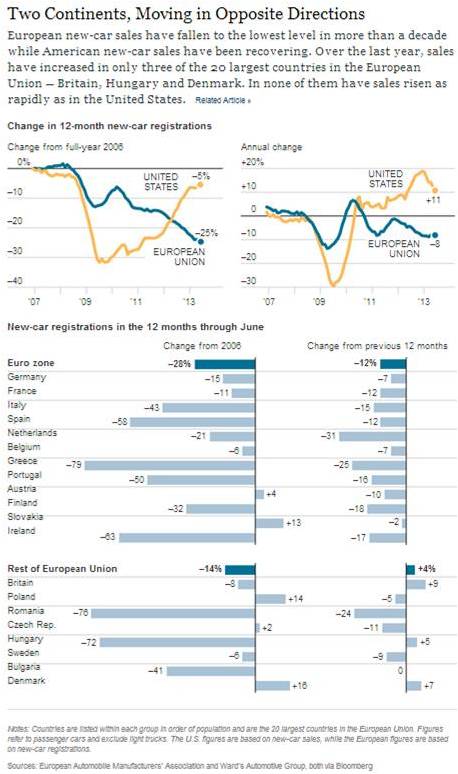
IN Europe, new cars are becoming rare items. The European Automobile Manufacturers’ Association reported this week that new-car registrations in the European Union were down 6 percent in June compared with those in the month a year earlier and were running at their slowest pace since 1996. Even in Germany, whose economy has been stronger than those of most of its European brethren, sales were the lowest for any June since the country was unified in 1990.

Read more of this post

Fed rethinks move allowing banks to trade physical commodities

Fed rethinks move allowing banks to trade physical commodities

7:47pm EDT

By David Sheppard and Josephine Mason

NEW YORK (Reuters) – The U.S. Federal Reserve is “reviewing” a landmark 2003 decision that first allowed regulated banks to trade in physical commodity markets, it said on Friday, a move that may send new shockwaves through Wall Street.

While it is well known that the Fed is considering whether or not to allow banks including Morgan Stanley (MS.N: Quote, Profile, Research, Stock Buzz) and JPMorgan (JPM.N: Quote, Profile, Research, Stock Buzz) to continue owning trading assets like oil storage tanks or metals warehouses, Friday’s one-sentence statement suggests that it is also reconsidering the full scope of banks’ activities in physical markets, which help generate billions in profits. Read more of this post

How GlaxoSmithKline missed red flags in China; With more compliance officers in China than in any country bar the United States, British drugmaker GlaxoSmithKline Plc seemed well-positioned to do things right

How GlaxoSmithKline missed red flags in China

With more compliance officers in China than in any country bar the United States, British drugmaker GlaxoSmithKline Plc seemed well-positioned to do things right. -Reuters
Fri, Jul 19, 2013
Reuters

LONDON – With more compliance officers in China than in any country bar the United States, British drugmaker GlaxoSmithKline Plc seemed well-positioned to do things right. But despite conducting up to 20 internal audits in China a year, including an extensive 4-month probe earlier in 2013, GSK bosses were blindsided by police allegations of massive corruption involving travel agencies used to funnel bribes to doctors and officials. The scale of funds signed off by GSK to pay travel agencies for organising educational medical meetings has triggered heated debate, with some saying such spending would have looked legitimate but others arguing it should have raised alarms inside GSK and at its external auditor PricewaterhouseCoopers. Read more of this post

Hedge Fund Alpha is Negative; Down Around 1700 BPs in 11 Years

Hedge Fund Alpha is Negative; Down Around 1700 BPs in 11 Years

July 11, 2013

By Jacob Wolinsky

hedge-fund-alpha-1024x443 hedge-fund-correlation

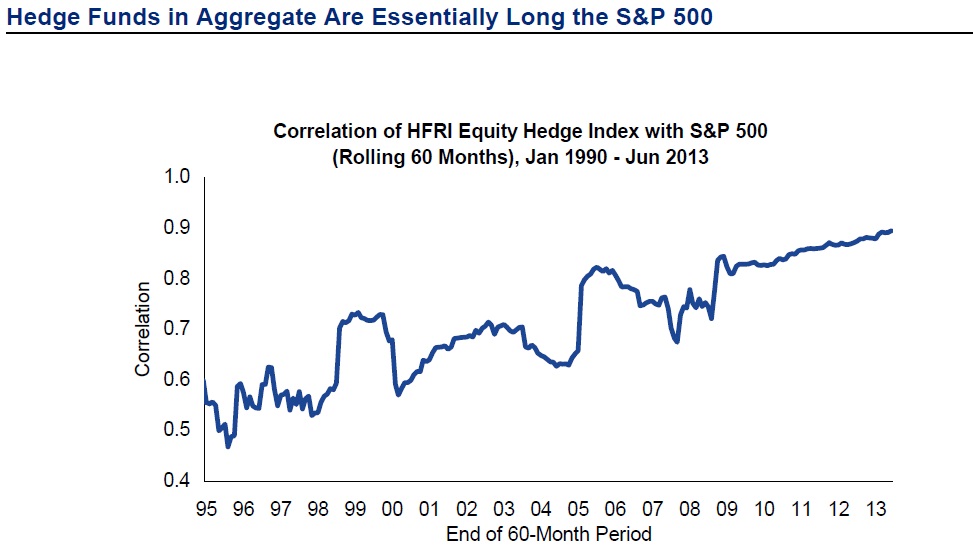
Adam Parker of Morgan Stanley is out with a new report on the S&P 500. He notes that hedge fund alpha has tanked since early 200s and today is still negative, with a drop of about 1700 basis points. At the same time correlation is up making many hedge funds appear to be nothing more than closet index funds.

Adam S. Parker, Ph.D., Chief US Equity Strategist, Morgan Stanley, is out with a great new report titled ‘US Equity Strategy’. In the 99 page report Parker has nearly a hundred interesting charts. Morgan Stanley sees the S&P 500 (.INX) in 2014 at 1600 in the base case scenario . However, the most interesting data is on hedge fund alpha and hedge fund correlation with the S&P 500 (.INX).  Read more of this post

Why the Surface RT Failed and the iPad Did Not

JULY 19, 2013, 10:34 AM

Why the Surface RT Failed and the iPad Did Not

By NICK BILTON

At first glance, to most consumers, the Apple iPad and Microsoft Surface RT tablet computer look somewhat similar. They are both rectangular, have crisp screens and can boast a slick and clean design interface. Yet on Thursday Microsoft announced that it was taking a $900 million write-down to reflect unsold inventory of the Surface RT. That’s a stark comparison to Apple’s iPad, which continues to break record sales and has sold more than 100 million devices. So why is one still succeeding while the other has failed? I have a theory. But it begins with a story. Read more of this post

Japan Tells Firms: Stop Sitting on Cash; Government Wants Companies to Invest More at Home

July 19, 2013, 6:12 p.m. ET

Japan Tells Firms: Stop Sitting on Cash

Government Wants Companies to Invest More at Home

YOREE KOH, MITSURU OBE and MAYUMI NEGISHI

BF-AF398_JCASH_G_20130719173004

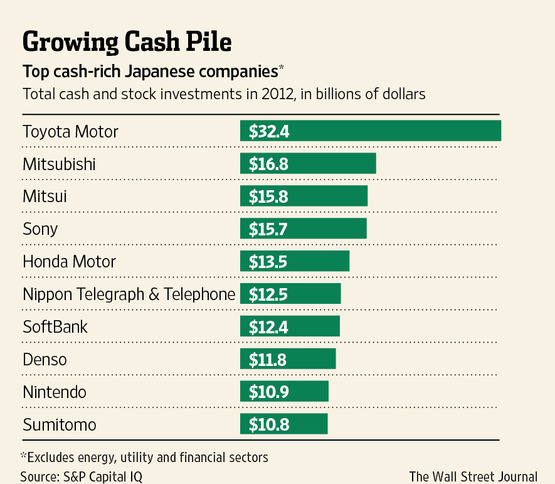
TOKYO—Okuma Corp., 6103.TO -3.64% a Japanese machine-tool maker, has seen its stock price rise around 30% this year. Its customers have outdated machinery that needs replacing. But, for now, the company isn’t investing. Instead, it is sitting on a pile of cash worth about $280 million—50% higher than its pile a decade ago, equivalent to one-fifth its annual sales, and more than twice the level required for the firm to be deemed loan-worthy by a bank. Why? Senior director Chikashi Horie says the answer is simple. Okuma’s clients “are not investing, not even to raise efficiency, so we are not investing either,” he says. Read more of this post

The People’s Choice: Distrust; Collapsing confidence in government is bad news, but there’s a way out; Government has to work better, meaning that it needs to modernize and become more useful in our everyday lives

July 19, 2013, 7:24 p.m. ET

The People’s Choice: Distrust

Collapsing confidence in government is bad news, but there’s a way out

GERALD F. SEIB

Senate Majority Leader Harry Reid sat in an elegant room in the Capitol on Monday afternoon, knowing that the body he leads was in imminent danger of a partisan meltdown. A bitter dispute was still raging over a seemingly simple task—the confirmation of presidential nominees. The crisis led him to muse about the broader consequences of what sometimes appears to be permanent congressional dysfunction.

“When I ran the first time, the approval rating of Congress was at 45%,” said Sen. Reid, who came to Washington from his home state of Nevada three decades ago. “Now it’s at 10%. In all the time Gallup has been doing its polling, no institution has ever been recorded at lower than that.” Read more of this post

Funds Stick With Bets Against Chinese Banks; Wagers that midsize lenders’ share prices will fall remain at high levels

July 19, 2013, 7:41 a.m. ET

Funds Stick With Bets Against Chinese Banks

Wagers that midsize lenders’ share prices will fall remain at high levels

MIA LAMAR

HONG KONG—Short-sellers are sticking to heavy bets against China’s banks a month after a cash crunch gripped the country’s banking system, reflecting their belief that there is more stress to come even as banking shares rebound.

The wagers by hedge funds and other alternative funds started building in Hong Kong in June as a sudden shortage of cash among mainland lenders spooked investors. Banks scrambled to raise money to meet a wide range of funding demands, dumping short-term bonds, pushing interbank rates up to as high as 30% and sending the Shanghai benchmark stock index to a four-year low. Read more of this post

It’s Official: General Motors Sees Tesla As A Threat; “If we ignore it and say it’s a bunch of laptop batteries, then shame on us.”

It’s Official: General Motors Sees Tesla As A Threat

ANTONY INGRAM, GREEN CAR REPORTS JUL. 19, 2013, 5:34 PM 2,512 10

“History is littered with big companies that ignored innovation that was coming their way because you didn’t know where you could be disrupted.” General Motors will be hoping those words, from vice chairman Steve Girksy as the automaker begins to study electric upstart Tesla Motors [NSDQ:TSLA], don’t become too prophetic. They’re a clear indication that major automakers are starting to worry about the startup electric automaker, as GM CEO Dan Akerson looks into how Tesla may affect the 104-year old GM’s business. According to Bloomberg, studying Tesla is just one way that Akerson is hoping to change GM’s culture after its financial difficulties in 2009. Read more of this post

How German-based SAP is creating a startup ecosystem from Silicon Valley

How German-based SAP is creating a startup ecosystem from Silicon Valley

BY FRITZ NELSON 
ON JULY 19, 2013

The story of nearly every traditional (read: stodgy) enterprise technology provider — IBM, Microsoft, Dell, HP, Oracle, SAP, Cisco — goes something like this: Create a cash cow (maybe two), watch the business get disrupted by new ideas and more nimble upstarts, use size to squash those ideas or, eventually, embrace them or buy the companies behind them, and attempt to re-invent the business before the cash cow bleeds out.

So try this iteration on for irony: 40-year-old SAP has built an impressive ecosystem around HANA, a fledgling technology with its heart in the company’s Waldorf, Germany headquarters and its head in Silicon Valley, home to SAP Startup Focus. Read more of this post

RetailMeNot’s 94% Margins Usher In Post-Facebook IPO Glee

RetailMeNot’s 94% Margins Usher In Post-Facebook IPO Glee

Since the flop of Facebook Inc. (FB)’s initial public offering last year, only two U.S. consumer Web companies have gone public: real estate site Trulia Inc. and travel search engine Kayak Software Corp.

Twitter Inc. remains on the sidelines with an estimated $9.8 billion valuation, more than 95 percent of companies in the Nasdaq Composite Index. (CCMP) Other startups, such as cloud-storage company Dropbox Inc., mobile-payment platform Square Inc. and room-sharing service Airbnb Inc., sport valuations of more than $1 billion. It may be up to an online coupon site from Austin, Texas, to get those companies off the bench. Read more of this post

Microsoft shares hit by biggest sell-off since 2009

Microsoft shares hit by biggest sell-off since 2009

6:45pm EDT

(Reuters) – Microsoft Corp shares fell more than 11 percent on Friday, their biggest plunge in more than four years, a day after the software company posted dismal quarterly results due to weak demand for its latest Windows system and poor sales of its Surface tablet.

The stock’s selloff, from five-year highs, is the biggest in percentage terms since January 2009, when the world’s largest software company cut 5,000 jobs during the recession. At one point in the day, losses exceeded 12 percent, making it the biggest fall since the Internet stock bubble burst in 2000.

About $34 billion was wiped off Microsoft’s market value on Friday, exceeding the size of rival Yahoo Inc. Read more of this post

Apple Said to Buy HopStop, Pushing Deeper Into Maps

Apple Said to Buy HopStop, Pushing Deeper Into Maps

Apple Inc. (AAPL) agreed to buy online transit-navigation service HopStop.com Inc., people with knowledge of the deal said, seeking to improve mapping tools after a rocky debut for its directions software last year.

The people asked not to be identified because the deal isn’t public. AllThingsD reported earlier today that Cupertino, California-based Apple is purchasing Locationary Inc., a Toronto-based company focused on business-location maps. Read more of this post

Li Ka-Shing’s Hutchison May Sell ParknShop supermarket chain for $2 Billion because the industry is mature and growing slowly; ParkNShop and Dairy Farm had a combined 73 percent market share in HK

Hutchison May Sell ParknShop for $2 Billion, WSJ Reports

Hutchison Whampoa Ltd. (13), controlled by Hong Kong’s richest man Li Ka-shing, is looking to sell its ParknShop supermarket chain for between $1 billion and $2 billion, the Wall Street Journal said yesterday. The company, which operates businesses from global ports to telecommunications, has hired Goldman Sachs Group Inc. and Bank of America Merrill Lynch to handle the sale, the WSJ said, citing unidentified people. Read more of this post

Fake wines in China may be on rise

Fake wines in China may be on rise

20130718.162602_china-wine-reuters

Mr Charles Gaudfroy, a manager of a French restaurant, showing a bottle of fake Romanee-Conti which was found at a wine shop in southern China. According to Mr Gaudfroy, “Vin Blanc” (white wine) and “Vin Rouge” (red wine) should not be printed on the same label.

Liquor stores, restaurants and supermarkets in China wage a constant battle against fake wines. -TNP

Fri, Jul 19, 2013
The New Paper

CHINA – The cellar master at a vineyard in China can’t stop laughing while describing a bottle of supposedly French wine a friend gave him two years ago. It’s white wine, with a label proclaiming it is from the vineyards of Romanee-Conti, the bottle bearing the logo that is on bottles of Chateau Lafite-Rothschild. It declares its origin as Montpellier in southern France. Domaine de la Romanee-Conti, better known for highly prized and highly priced vintages from France’s Burgundy region, makes only a tiny amount of white wine, labelled Montrachet. It has nothing to do with the equally prestigious Lafite, which is from the Bordeaux region, and neither brand is produced anywhere near Montpellier. Read more of this post

Chow Tai Fook, the world’s largest listed jewelry chain, Among Shanghai Jewelers in Price-Fixing Probe

Chow Tai Fook Among Jewelers in Probe: People’s Daily

Chow Tai Fook Jewellery Group Ltd. (1929), the world’s largest listed jewelry chain, and other gold shops in Shanghai are being probed by Chinese regulators for price manipulation, the official People’s Daily reported online, citing unidentified people.

Chow Sang Sang Holdings International Ltd. (116) was also named as one of several companies “rectifying” their practices, after a National Development and Reform Commission investigation found wrongdoing, according to the report, which was reposted on a website controlled by the Ministry of Commerce. Chow Sang Sang isn’t being probed and doesn’t know why it was named in the report, Cathy Tam, a spokeswoman, said by phone today. Read more of this post

Geography and CEO Luck: Where Do CEOs Tend to be Lucky?

Geography and CEO Luck: Where Do CEOs Tend to be Lucky?

Pandej Chintrakarn Mahidol University International College (MUIC)

Napatsorn Jiraporn State University of New York at New Paltz

Pornsit Jiraporn Pennsylvania State University – SGPS; National Institute of Development Administration (NIDA), Mahidol University, College of Management (CMMU), Bangkok, Thailand

July 10, 2013

Abstract: 
CEOs are “lucky” when they receive stock option grants on days when the stock price is the lowest in the month of the grant, implying opportunistic timing (Bebchuk, Grinstein, and Peyer, 2010). We extend Bebchuk et al. (2010) by investigating the geographic peer effects of CEO luck. Our evidence shows that a CEO is significantly more likely to be lucky when other CEOs in the surrounding area are not lucky. It appears that a CEO tends to practice opportunistic timing of option grants when such a practice is less prevalent and thus less noticeable in the nearby area, probably in order to avoid detection. We estimate that the marginal geographic effect on a given CEO’s luck is 18.36%, which is both statistically and economically significant. Our results suggest that regulators should look for corporate opportunistic behavior where it is not expected.

Founding Family Ownership and Firm Performance in Consumer Goods Industry: Evidence from Indonesia

Founding Family Ownership and Firm Performance in Consumer Goods Industry: Evidence from Indonesia

Margaretha Bambang Bina Nusantara University (Binus) – Binus Business School

Marko Hermawan Victoria University of Wellington

July 11, 2013

Abstract:      
This research investigates the significant influence of family ownership on the firm performance in order to provide information to decision maker and other interested parties. The analysis includes comparison between family and non-family firm performance in Indonesia. The samples are taken from 31 consumer goods companies, listed in Indonesian Stock Exchange, ranging from 2005 to 2009. The result describes that non-family firms perform better than family firms and no significant influence between family ownership and firm’s profitability. On the other hand, family ownership has negative contribution to firm market valuation. The study suggests that family firms have less financial performance than that of non-family. Family member within the top position and have major control rights contribute negative influence to firm performance. The evidence raises concerns about possible profit manipulation and weak governance law in Indonesia, and as a result there is an expropriation of wealth to the majority and family related shareholders.

The Role of Institutional Investors in Public-to-Private Transactions

The Role of Institutional Investors in Public-to-Private Transactions

Emanuele Bajo University of Bologna – Department of Management

Massimiliano Barbi University of Bologna – Department of Management

Marco Bigelli University of Bologna – Department of Management

David Hillier University of Strathclyde, Glasgow – Department of Accounting and Finance

July 5, 2013
Journal of Banking and Finance, Forthcoming

Abstract: 
In Italy, as in many other European countries, listed firms will normally go dark through controlling owner-initiated tender offers. We find that institutional investors play a central role in the bid process and can protect minority shareholders from being frozen out in the bid. Specifically, tender offers are less likely to succeed when a firm has institutional investors in its ownership structure. When public-to-private offers are accepted, bid premiums are significantly greater if a financial institution (particularly when it is foreign, independent or activist) has a stake in the firm. We explore the effect of a number of hitherto unexplored factors on the takeover premium and find that shareholder agreements facilitate public-to-private acquisitions. Other factors, such as a threat to merge the target if the bid fails, or external validation of the offer price, have no impact on either the likelihood of delisting or the premium paid by the bidder.

Profiting from adversity: Maria Xynias’s brilliant start-up idea Ladies Running Errands, the “extra helping hand for people who need an extra pair of hands”

Profiting from adversity: Maria Xynias’s brilliant start-up idea

PUBLISHED: 1 HOUR 9 MINUTES AGO | UPDATE: 1 HOUR 9 MINUTES AGO

009e01ac-ed19-11e2-8b13-fa19f3af555d_749190184--646x363

Entrepreneur Maria Xynias’s clients range from the elderly and people living alone to young parents: “I get a lot of baby-boomer clients who are working or time-poor and need someone to take their elderly parent to the doctor”.

ANNE FULWOOD

When Maria Xynias suffered a serious illness which left her unable to work for two years, she relied on her network of family for support, transport and sustenance. Time in convalescence gave her pause for thought: “I have a big Greek family network and lots of support but I wonder what happens to ­people who aren’t as lucky as me.” Therein lies the genesis of her start-up business, Ladies Running Errands , which is what Xynias calls the “extra helping hand for people who need an extra pair of hands”. – rather like a trusted family member without being a member of the family. She is one of the growing number of Australian women who take a break from long-term employment for a range of reasons, then work for themselves as sole traders. Xynias had worked her way up through store manager ranks at Target for 15 years, followed by a stint in a duty-free store at ­Sydney Airport. She launched Ladies Running Errands in January 2011. “It’s a very personal service and covers anything to make people’s daily lives easier. I take my responsibility very seriously.” Read more of this post

The biggest decision most of us leave to chance

The biggest decision most of us leave to chance

BY FRANCISCO DAO 
ON JULY 18, 2013

mponeydoney_bw1

Recently, a friend of mine told me his goal was to make some “fuck you money.” This was a new development for him, as he had never before prioritized a big score. As we talked about his options, he described several promising opportunities that he decided not to pursue, because they weren’t interesting to him. Despite his proclamation that making money was his new priority, he couldn’t change the fact that he wasn’t strictly wired to be financially motivated. I’ve seen many people try to convince themselves that making money was their primary goal even when it wasn’t. I’ve been guilty of doing it myself. Truthfully, I think life would be much simpler if I were coin operated, but I’m not. And despite what others like my friend might claim, the vast majority of people aren’t either. Most people don’t realize it, but the pull of non-financial motivations creates one of the biggest decisions many of us face in life. Unless you’re one of the lucky ones whose interests are naturally lucrative, here is the choice you face. Do you do something you care about which might be more difficult, or even impossible, to make financially lucrative? Or do you set aside your personal motivations and pursue whatever provides the best opportunity for making the most money with the fewest obstacles? I’m sure you’ve thought about this question before, but you probably did so only as a philosophical exercise. Did you really think about it when you accepted your last job? For the entrepreneurs reading this, do you really love your startup? Or did a random opportunity present itself, and you just went along with it while you convinced yourself that mailing stuff in a box is your dream company?

The decision often seems one-sided because there’s no external measure of our internal motivations. Only you know how much they matter to you. In contrast, we’re bombarded with messages that correlate financial success with absolute success. We end up losing sight of the decision because one side of the equation is screaming at us with big houses, fancy cars, and the respect of our peers, while the other side offers nothing that the rest of the world can even measure. Considered this way, there hardly seems to be a decision at all. But just because one side speaks more quietly than the other doesn’t mean it carries any less weight. Despite the fact that this decision determines the course of our lives, very few of us really take it seriously. We hypocritically quote Confucius and tell people to, “Choose a job you love, and you will never have to work a day in your life,” while we spend our own days at jobs we honestly don’t care for that much. Somehow, when it came time to make this decision for ourselves, we probably didn’t really think about it. Most likely, we let circumstance or convenience make the choice for us and ended up with whatever was put in front of us instead of choosing our own path.

Unless my friend gets lucky with a really fast score, I don’t think he’ll be able to follow through on his goal of making, “fuck you money.” He just isn’t built that way and I don’t think he can force himself to pursue the cash if his heart isn’t in it. For me, it took a string of choices that left me wondering, “Why the hell am I doing this?” before I decided all of my work decisions would be guided solely by my personal interests and nothing more. It’s a decision that has made me happy, but without question I’ve left a lot of financial opportunities on the table. How about you? Have you made the choice for yourself? Or have you let the decision fall to chance?
Head of another Taobao online retail outlet dies due to overwork at age 36

Head of another Taobao outlet dies due to overwork

Staff Reporter 2013-07-19

W020130717411257268165-164813_copy1

Wu Lijun was 36. (Internet photo)

Wu Lijun, who was president of Yunifang, an online retailer that sells mud masks and skincare products on Taobao, one of China’s largest e-commerce platforms, died on July 15. The cause of death is suspected to be overwork, a situation that is becoming worringly common among people who earn their living by selling goods online, reports the Beijing Youth Daily, the official newspaper of the Communist Youth League committee in Beijing. Yunifang had become the leading seller of cosmetic mask products on Taobao after only six months on the platform. The retailer was later listed on Taobao’s top 50 outlets. Wu died due to a brain condition in Changsha in south-central China at the age of only 36. There have been several cases of death due to overwork in the online retail sector. Taobao reportedly conducted a survey into the health of 74 of their retails and are said to have found the results worrying. The earlier death of a 24-year-old Taobao retailer in Hangzhou was the first to prompt discussion about how hard people in the industry were working to sell tehir goods and promote their outlet. Taobao posted an official expression of condolences on that occasion and reminded its retailers to take care of their health. It has been taken for granted that to succeed in the emerging e-commerce business, it is necessary to work hard and for long hours to process and shipp orders and ensure customers are satisfied. Overwork has become an acknowledged feature of the industry.

How Europe’s Bank Crisis Swamped Pescanova Seafood Empire; The downfall of Spanish fishing company Pescanova is a cautionary tale of the still-rippling European banking crisis

Updated July 18, 2013, 11:04 p.m. ET

How Europe’s Bank Crisis Swamped Pescanova Seafood Empire

Ripples of Region’s Credit Crunch Led to Downfall of Spain’s Fishing Giant

MATT MOFFETT

P1-BM362A_PESCA_G_20130718174814 P1-BM365_pensac_G_20130718185029

REDONDELA, Spain—The downfall of Manuel Fernández de Sousa, who builtPescanova SA PVA.MC -19.26% from a provincial Spanish fishing company into a multinational giant, is a cautionary tale of the still-rippling European banking crisis. His troubles began at a Feb. 27 board meeting where Pescanova’s two newest directors grilled him about the company’s proposed financial results. Read more of this post