China’s banking regulator has taken further steps to tighten its oversight of wealth management products by asking banks to register these products before selling them to the public

July 12, 2013, 7:42 a.m. ET

China Orders Banks to Register Wealth Management Products

China’s banking regulator tightens supervision over fast-growing segment

BEIJING—China’s banking regulator has taken further steps to tighten its oversight of wealth management products by asking banks to register these products before selling them to the public, according to a document seen by The Wall Street Journal on Friday.

The new rule would give the regulator increased information on these high-yield products, though it could slow the speed at which they come to market, a local banker who received the document said. Read more of this post

‘Diaosi’ become mainstream consumer force in China; “Diaosi” is originally a derogatory term referring to unattractive, poor, hopeless young people who stay at home playing online games

‘Diaosi’ become mainstream consumer force in China

Staff Reporter

2013-07-11

“Diaosi,” originally a derogatory term referring to unattractive, poor, hopeless young people who stay at home playing online games, has gained widespread use as a mainstream social group. The term is especially favored by programmers and those in the media, aged between 30-39.

Shi Yuzhu, owner of a major e-commerce firm, likes to call himself a diaosi, as he found that those people are major patrons of his website. Read more of this post

China’s Fund Management Firms Seek to Emulate Alibaba’s Yu E Bao’s Success

07.12.2013 14:48

Fund Management Firms Seek to Emulate Yu E Bao’s Success

Manulife Teda starts recruiting service personnel as other firms mull an e-investment presence on Taobao

By staff reporter Cao Wenjiao

(Beijing) – Fund management companies are hurrying to establish their presence on Alibaba’s Internet platforms, after online shoppers showed great interest in Yu E Bao, a money market fund the e-commerce giant recently launched.

Beijing-based Manulife Teda Fund Management Co. has started recruiting client service personnel for its planned virtual store on Taobao, Alibaba’s e-commerce website. Read more of this post

Setting the Tone at the Top: Defining Moments in Leadership From the Hebrew Bible

Setting the Tone at the Top: Defining Moments in Leadership From the Hebrew Bible

Dov Fischer CUNY Brooklyn College

June 25, 2013
Journal of Accounting, Ethics and Public Policy, Vol. 14, No. 3, 2013

Abstract: 
This study provides leadership examples from the Bible to help modern organizations implement internal controls that comply with the COSO Internal Control – Integrated Framework. The Framework’s first principle is a commitment by the organization to integrity and ethical conduct, namely by setting an example through a positive, “tone at the top”. This paper provides examples of, “defining moments in leadership”, from the Hebrew Bible to help contemporary leaders make ethical choices when faced with such defining moments. Defining moments; which are confronted by leaders, as well as ordinary people; can shape the legacy of a person, leader, organization, or even a nation. Some leaders make the right decision and go on to become role models, heroes, and even legends; others make a bad choice and their names become synonymous with failure. This paper examines the actions and choices of several heroes from the Hebrew Bible to see how they reacted when confronted with a critical choice during such defining moments; lessons to be learned include prudence, responsibility, and justice.

When Sell-Side Analysts Meet High-Volatility Stocks: An Alternative Explanation for the Low-Volatility Puzzle

When Sell-Side Analysts Meet High-Volatility Stocks: An Alternative Explanation for the Low-Volatility Puzzle

Jason C. Hsu Research Affiliates, LLC; University of California, Los Angeles – Anderson School of Business

Hideaki Kudoh Nomura Asset Management Co., Ltd. (NAM)

Toru Yamada Nomura Holdings, Inc. (NHI) – Nomura Asset Management Co., Ltd. (NAM)

June 14, 2013
Journal Of Investment Management (JOIM), Second Quarter 2013

Abstract: 
Using a global equity dataset that includes emerging markets, we confirm that high-volatility stocks tend to deliver low average returns; this effect is robust to adjustments for for country and style factors. We also show that sell-side analysts earnings growth forecasts for high-volatility stocks are more biased. It is well-known that sell-side analysts are predictably optimistic; however, the relationship between the degree of optimism and a stocks volatility has not been documented before. We hypothesize that analysts inflate earnings forecasts more aggressively for volatile stocks, in part because the inflation would be more difficult for investors to detect. Because investors are known to overreact to analyst forecasts (under-adjust to analyst bias), this contributes to systematic overvaluation and low returns for high-volatility stocks. Additionally, we find sell-side analysts research informative despite the biases; stocks that have high forward E/P ratios based on analyst earnings forecasts tend to outperform and produce significantly positive FamaFrench alphas. This evidence rejects the cynical view of some in our industry that sell-side analysts are unskilled. More interestingly, we find high forward E/P stocks also exhibit high analyst bias, which supports an interpretation that analysts are more willing to inflate earnings forecasts for stocks that they believe are likely to deliver high returns or for which their inflated forecasts are likely to do no harm.


Unethical Culture, Suspect CEOS, and Corporate Misbehavior

Unethical Culture, Suspect CEOS, and Corporate Misbehavior

Lee Biggerstaff University of Tennessee, Knoxville – Department of Finance

David C. Cicero University of Alabama – Culverhouse College of Commerce & Business Administration

Andy Puckett University of Tennessee, Knoxville

June 2013

Abstract: 
We show that firms with CEOs who personally benefited from options backdating were more likely to engage in other forms of corporate misbehavior, suggestive of an unethical corporate culture. These firms were more likely to overstate firm profitability and to engage in less profitable acquisition strategies. The increased level of corporate misbehavior is concentrated in firms with suspect CEOs who were outside hires, consistent with adverse selection in the market for chief executives. Difference-in-differences tests confirm that the propensity to engage in these activities is significantly increased following the arrival of an outside-hire ‘suspect’ CEO, suggesting that causation flows from the top executives to the firm. Finally, while these suspect CEOs appear to have avoided market discipline when the market was optimistic, they were more likely to lose their jobs, and their firms were more likely to experience dramatic declines in value during the ensuing market correction.

Fraud, Market Reaction, and Role of Institutional Investors in Chinese Listed Firms

Fraud, Market Reaction, and Role of Institutional Investors in Chinese Listed Firms

Reena Aggarwal Georgetown University – Robert Emmett McDonough School of Business

May Hu Curtin University of Technology

Jingjing Yang Jiangxi Normal University

July 3, 2013

Abstract: 
We examine the extent of fraud and the type of financial fraud committed by listed firms in China, stock market reaction to the detection and announcement of fraud, the characteristics of firms committing fraud, and the association between institutional ownership and financial fraud. One of our objectives is to study the monitoring role of different types of institutional investors, such as mutual funds, pension funds and insurance companies. Using fraud data from the Chinese Securities Regulatory Commission between 2001 and 2011, we find wide occurrence of fraud, and a strong negative market reaction on the announcement date, particularly in cases of serious fraud. Fraud is more likely to take place at firms that have a smaller proportion of independent directors, and at poorly performing firms. We find firms with higher mutual fund ownership subsequently have fewer incidences of fraud. We do not find any association between ownership by grey financial institutions, such as insurance companies and pension funds that are likely to have business ties with firms, and future corporate fraud. Our results show that ownership by independent institutions, such as mutual funds, enhances corporate governance in Chinese capital markets, and serves as an effective monitoring mechanism.

Grandstanding and Spinning in VC Backed IPOs on AIM UK

Grandstanding and Spinning in VC Backed IPOs on AIM UK

Alberto Dell’Acqua SDA Bocconi

Antonio Guardasole Bocconi University

Stefano Bonini Bocconi University – Department of Finance; NYU Stern

May 14, 2013

Abstract: 
We study a hand-collected dataset that includes 507 IPOs on the UK Alternative Investment Market (AIM) from FY2004 to FY2010. IPOs backed by venture capitalists registered an average underpricing of 25.8 percent; almost double that of non-venture-backed IPOs (14.6%). We provide new empirical evidence that grandstanding and spinning increase IPO underpricing. Conversely venture capitalists provide a certification role when they avoid moral hazard behaviors. Firms may strategically exploit these phenomena to accelerate growth while market regulators have to evaluate this evidence in light of stricter or more prone to laissez faire policies.

Are CEOs and CFOs Rewarded for Disclosure Quality?

Are CEOs and CFOs Rewarded for Disclosure Quality?

Kai Wai Hui Hong Kong University of Science & Technology – Department of Accounting

Steven R. Matsunaga University of Oregon

June 1, 2013

Abstract: 
In this study, we provide insight into the economic determinants and consequences of disclosure quality by examining the extent to which boards consider disclosure quality to be an important responsibility of the CEO and CFO. Specifically, we examine whether CEO and CFO pay is related to the firm’s disclosure quality, as measured using the index from Anderson, Duru and Reeb (2009) and management forecast accuracy. We find changes in cash compensation for both the CEO and CFO to be positively associated with changes in each measure of disclosure quality. We also investigate factors that influence the extent to which boards reward the managers for disclosure quality. We find that the relation is stronger for high growth firms and firms that have stronger governance structures. Overall, our findings provide empirical evidence that boards’ view disclosure quality to be an important determinant of firm value and provide managers financial incentives to provide high quality disclosures.

How do you become truly influential? When You’ve Done Enough, Do More

When You’ve Done Enough, Do More

by Mark Goulston and John Ullmen  |  11:00 AM July 12, 2013

How do you become truly influential? We’ve found that the most highly respected leaders avoid techniques to gain short-term compliance; they also steer clear of a self-centered “How can I get people to do what I want?” mindset. Instead, they take a different approach altogether.

We interviewed over 100 high-impact influencers from a wide range of industries and organizations for our recent book. To achieve real influence, they tend to follow four steps that turn typical persuasion strategies upside down. These steps are action guidelines all of us can use to get things done with people in ways that not only yield great results, but also strengthen relationships and enhance credibility. Read more of this post

How Share-Price Fixation Killed Enron

How Share-Price Fixation Killed Enron

by Lawrence Weiss  |  10:00 AM July 11, 2013

In December, 2001, just prior to filing for bankruptcy, Enron Corporation had approximately $2 billion in cash and no debt coming due. Despite its infamous financial chicanery, it still appeared to be a viable, profitable firm. So why did Enron go bankrupt? Was it because of the fraud, or was there another reason?

At the annual conference of the Association of Certified Fraud Examiners late last month, former Enron Chief Financial Officer Andrew Fastow, who served six years in prison for his part in Enron’s deceptions, offered an explanation. In a keynote speech, he said Enron went bankrupt because of“decisions” made in October 2001. He didn’t say which decisions. But after hearing Fastow speak twice to my Financial Statement Accounting class and reviewing independent evidence, I think I have good idea. It appears that Enron’s final fatal mistake was to try to support its stock price instead of living up to key contractual obligations required to maintain its credit rating. Read more of this post

Banks jolted as regulators seek to crack down on leverage

Banks jolted as regulators seek to crack down on leverage

10:21am EDT

By Steve Slater

LONDON (Reuters) – New demands from regulators to force banks to keep a lid on risk-taking after the financial crisis has re-ignited a debate over how best to strengthen the industry without stifling lending or alienating investors.

Bank regulators in the United States this week set out plans to impose a leverage ratio on banks that caps their lending based on a simple assessment of their equity. Britain and Switzerland have also demanded their banks “gold-plate” a global rule for this leverage cap or ratio. Read more of this post

ETF Simplicity Betrayed by Volatility in Market Selloff

ETF Simplicity Betrayed by Volatility in Market Selloff

Emerging-market stocks can be volatile to begin with. Investing in them through exchange-traded funds can add another layer of price swings for investors, especially in times of market stress.

Share prices for the 10 largest diversified emerging-market ETFs on average were 42.6 percent more volatile than their underlying indexes from May 22 to June 24, when comments by Federal Reserve Chairman Ben S. Bernanke triggered a selloff that sent emerging-market stocks to a one-year low, according to data compiled by Bloomberg. The group included ETFs from BlackRock Inc. (BLK), State Street Corp. and Vanguard Group Inc., the largest managers of the products. The five biggest emerging-market index mutual funds, by contrast, were 4.8 percent more volatile than their indexes. Read more of this post

A Peek at Trucking Data, and Then the Stock Surged; Glimpses of Key Figures Can Aid Investors in Truck Stocks, Soybeans, Bed Makers and Others

July 11, 2013, 11:34 p.m. ET

A Peek at Trucking Data, and Then the Stock Surged

Glimpses of Key Figures Can Aid Investors in Truck Stocks, Soybeans, Bed Makers and Others

MICHAEL ROTHFELD, JOHN CARREYROU and BRODY MULLINS

OB-YE026_2INDIC_G_20130711233009

Just before the stock market closed March 4, an industry-research firm emailed a monthly report on commercial-truck orders to hedge funds and other subscribers that pay the group $1,700 a year for the exclusive service. The early peek was worth the expense. The next day, after the bullish truck numbers were reported in the media, shares in truck makers surged, generating a tidy profit for investors who traded on the report in the late moments of the previous session. Even as federal, state and congressional investigators examine the preferential release to investors of broad economic data—such as the University of Michigan consumer-sentiment survey—some investors tap numerous other more narrowly focused and less well-known industry indicators ahead of the rest of the investing public. Read more of this post

China case shows war on drug costs in emerging markets

China case shows war on drug costs in emerging markets

10:16am EDT

By Ben Hirschler, Adam Jourdan and Lavinia Mo

LONDON/HONG KONG (Reuters) – International drugmakers are under fire in emerging markets as governments crack down on high prices and corporate malpractice, raising a risk to the price premiums global players enjoy over local rivals.

China’s probe into pricing by 60 firms, including local units of multinationals, and its dramatic charge against GlaxoSmithKline Plc of widespread bribery to boost sales and prices are the latest salvos. Read more of this post

Thrift trumps Abenomics as Japan shoppers stick to bargains

Thrift trumps Abenomics as Japan shoppers stick to bargains

5:42am EDT

By Sophie Knight

TOKYO (Reuters) – Japanese apparel firm Fast Retailing Co Ltd (9983.T: Quote, Profile, Research, Stock Buzz) has a problem: sales are surging, full-year net profits are expected to rise nearly 28 percent but the customers thronging the stores of its popular Uniqlo brand are far too frugal for its liking.

Prime Minister Shinzo Abe would also disapprove. Abe’s aggressive economic stimulus measures, aimed at lifting Japan out of two decades of deflation, hinge on a pick-up in consumer spending, but eight months after its launch, “Abenomics” has yet to convince many Japanese to part with their thrifty ways. Read more of this post

In Search of Concepts: The Effects of Speculative Demand on Returns and Volume

In Search of Concepts: The Effects of Speculative Demand on Returns and Volume

Owain Ap Gwilym Bangor Business School

Qingwei Wang Bangor Business School; Centre for European Economic Research (ZEW)

Iftekhar Hasan Fordham University; Bank of Finland

Ru Xie Bangor Business School

May 28, 2013
Bank of Finland Research Discussion Paper No. 10/2013

Abstract: 
Using a novel proxy of investors’ speculative demand constructed from online search interest in “concept stocks”, we examine how speculative demand affects the returns and trading volume of Chinese stock indices. We find that returns and trading volume increase with the contemporaneous speculative demand. In addition, the high speculative demand causes lower near future returns, while recent high past returns cause the high speculative demand. Moreover, the speculative demand explains more variation in returns and trading volume of A shares (more populated by retail investors) than B shares (less populated by retail investors). Our findings support the attention theory of Barber and Odean (2008).

Philip Caldwell, Ford CEO After Henry Ford II, Dies at 93

Philip Caldwell, Ford CEO After Henry Ford II, Dies at 93

Philip Caldwell, Ford Motor Co.’s first chief executive officer who wasn’t a member of the founder’s family, and who gambled the automaker’s future on the Taurus sedan in the 1980s, has died. He was 93. He died yesterday at his home in New Canaan, Connecticut, his family said in a statement provided by the company. The cause was complications of a stroke. Caldwell followed in the footsteps of more famous executives. He became president of Ford in 1978 after Henry Ford II, grandson of founder Henry Ford, fired Lee Iacocca and chose Caldwell to lead the Dearborn, Michigan-based automaker, first as CEO in 1979 and as chairman the following year. His close relationship with Henry Ford II earned Caldwell the nickname “The Prince” inside the company, according to a New York Times profile in 1979. He was “remarkably cool and resolute in a crisis,” wrote Paul Ingrassia and Joseph B. White in their 1994 book, “Comeback: The Fall and Rise of the American Automobile Industry.” He “had enormous analytical skills and the determination to examine any problem from every conceivable angle,” they wrote. As president and then CEO, Caldwell presided over a turnaround. Ford endured almost $3.3 billion of losses during two U.S. recessions from 1980 through 1982, as well as questions over the design and safety of its Pinto model. Read more of this post

Sibling rivalry a trademark of enterprises in Taiwan

Sibling rivalry a trademark of enterprises in Taiwan

sg_taiwan

Wednesday, Jul 10, 2013

Lee Seok Hwai, The Straits Times

EAT Seven Bowls is suing Eat Seven Bowls, but it’s all in the family. The founder of a popular maker of savoury glutinous rice and other traditional Chinese dishes is taking the almost identically named business of his younger brother to court, four years after they went their separate ways. Mr Lee Tung-yuan of Taipei-based Eat Seven Bowls, a trademark he registered in 1986, wants the eatery run by his brother and sister-in-law in Taichung to use its own Eat Seven Bowls trademark and stop using his. As it is, the two trademarks are easily confused. That of the older Mr Lee is rendered in the Minnan dialect, Chia Qiih Warh , while his brother’s uses Mandarin, Chi Qi Wan – with only the character for “eat” rendered differently. Mr Lee filed an injunction with the intellectual property court last month. He told the China Times newspaper he wished only to protect the reputation of his business, which is much more successful than his brother’s. Read more of this post

China Leverage Risks Bypass Super-Saver Households as GDP Slows

China Leverage Risks Bypass Super-Saver Households as GDP Slows

China’s campaign to rein in credit growth, a move that’s spread panic among the nation’s automobile dealers as they worry about access to financing, is a side-issue for 27-year-old lawyer Kevin Han.

Han is an archetype of Chinese workers who on average sock away 30.6 percent of their disposable income, amounting to 6.9 trillion yuan ($1.1 trillion) in total household savings in 2012, according to Louis Kuijs, chief China economist at Royal Bank of Scotland Group Plc in Hong Kong. Han’s breakfast is 5 yuan for a cup of soybean milk and a hardboiled egg or a steamed bun. He has a 20-yuan lunch of white rice, with small portions of meat and vegetables, in the cafeteria at his Beijing workplace. He spends about the same for dinner. Read more of this post

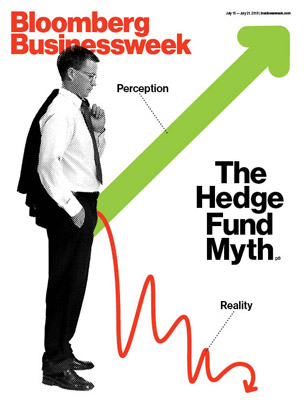
Hedge Funds Are for Suckers

Hedge Funds Are for Suckers

By Sheelah Kolhatkar on July 11, 2013

BBW-HFMyth-Cover-29-wobarcode-7.15BW29_OR_hedge_605inline1 BW29_OR_hedge_605inline2

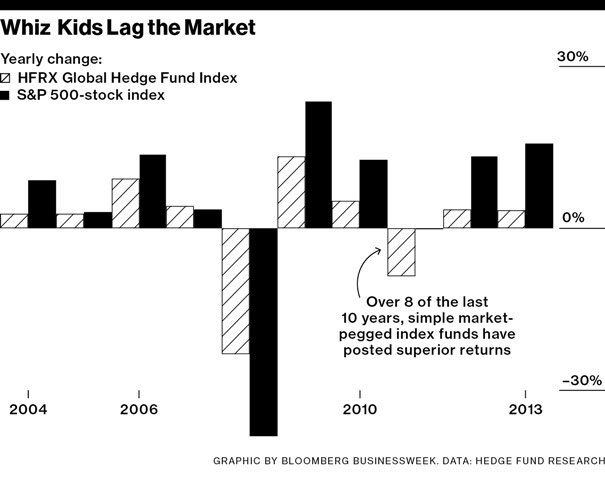
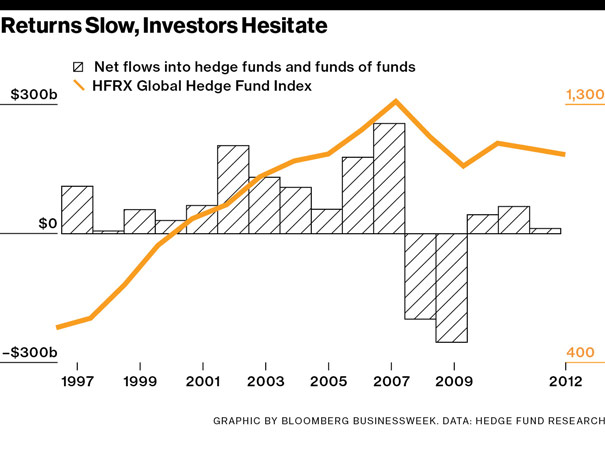
At the height of the financial crisis in 2008, a group of famous hedge fund managers was made to stand before Congress like thieves in a stockade and defend their existence to an angry public. The gilded five included George Soros, co-founder of the Quantum Fund; James Simons of Renaissance Technologies; John Paulson of Paulson & Co.; Philip Falcone of Harbinger Capital; and Kenneth Griffin of Citadel. Each man had made hundreds of millions, or billions, of dollars in the preceding years through his own form of glorified gambling, and in some cases, the investors who had poured money into their hedge funds had done OK, too. They were brought to Washington to stand up for their industry and their paychecks, and to address the question of whether their business should be more tightly regulated. They all refused to apologize for their success. They appeared untouchable.

Read more of this post

Toxic China Lake Incites Next Generation as Xi Eases GDP Focus

Toxic China Lake Incites Next Generation as Xi Eases GDP Focus

Ian Chen recalls his father quietly accepting he could no longer wade into a lake near their home in southern China where he’d swum his whole life. The raw sewage and agricultural waste spilling into the water meant it wasn’t safe anymore.

Twenty years later, Chen worries a new source of pollution may be about to envelop his hometown of Kunming. Silence wasn’t an option for the 29-year-old who sold flat-screen televisions on London’s Oxford Street before returning to Kunming, where he now owns three cake shops. He took to the Internet to drum up opposition to a refinery planned on the edge of town that residents fear will spew toxic particles. Read more of this post

How DailyLook grew its international revenue from 0 to 25% in one month; To incentivize its current and new members to help spread the word, DailyLook offered 1,000 “look points” for each friend that joins and makes a purchase

How DailyLook grew its international revenue from 0 to 25% in one month

BY MICHAEL CARNEY 
ON JULY 11, 2013

Less than three weeks into its international launch and Los Angeles women’s fast fashion etailer DailyLook is already seeing 25 percent of its business come from overseas. This is no small feat given its early success domestically, which saw the company generating on the order of $1 million per month in revenue, according to those close to the company, from more than 400,000 highly engaged email subscribers. So what was the key to translating this success overseas so quickly? According to CEO Brian Ree, it was a viral launch strategy. In late Spring, DailyLook posted a counter on its website tracking the progress toward 50,000 international signups, announcing that it would cut the ribbon on its international business if and when this milestone was met. The company further created an artificial deadline of June 23rd, saying that would abandon the plan if it couldn’t gather enough sign ups in time — a threat which it came within days of having to make good on.

To incentivize its current and new members to help spread the word, DailyLook offered 1,000 “look points” for each friend that joins and makes a purchase, where each 2,000 look points converts into a $20 credit on the site. The company then turned to fashion bloggers to spread the word. Needless to say, the strategy appears to have worked. Read more of this post

At Sears, Billionaire Eddie Lampert’s Warring Divisions Model Adds to the Troubles

Billionaire Eddie Lampert Is Running Sears Like The Coliseum, And It’s A Disaster

MAX NISEN JUL. 11, 2013, 5:50 PM 6,154 12

feature_sears29__02__inline605

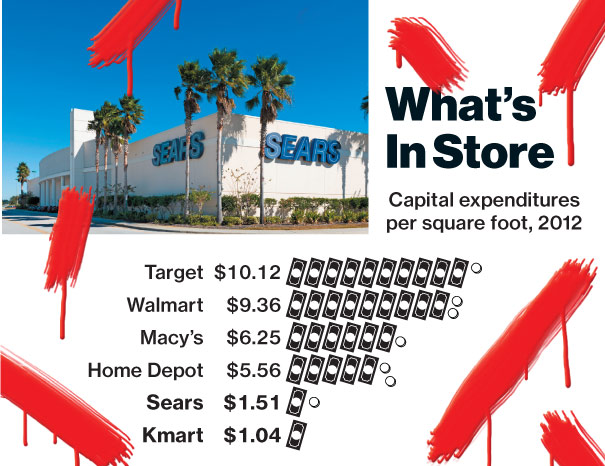
Five years ago, Sears Chairman Eddie Lampert broke the company into 30 plus autonomous businesses, each with its own president, chief marketing officer, board, and separately measured profit and loss. His idea was to harness the power of the free market, and to produce better and deeper data than anyone else. But the radical restructuring went horribly wrong, as divisions engaged in cutthroat competition against each other, reports Mina Kimes at Bloomberg Businessweek. Some highlights from her report: In order for a division to get help from the IT or HR departments, it had to write up a formal agreement or use a contractor. Since each company had its own board of directors, some executives were on five or six of them and spent all day in meetings. Executive bonuses were based on individual unit performance, so people tried to boost their own division’s profit at the expense of others. Read more of this post

Scandal-hit Thai monk seems to be a master of marketing

Scandal-hit monk seems to be a master of marketing

20130712.085635_youtube_luang 

Luang Pu Nenkham is a controversial monk today. But months ago, thousands of people held complete faith in him. -The Nation/ANN 
Fri, Jul 12, 2013
The Nation/Asia News Network

THAILAND – How did he manage to command their overwhelming respect and support? The answer might be as simple as a well-crafted marketing plan. It all began many years ago when someone in his close circle reportedly took notice of people wondering why he looked much older in a photo than his true age, then decided to spread a story that he was born to liberate Buddhists from the chain of suffering. Since the rumours circulated, the monk has attracted a huge following. He came to be called a “Luang Pu” – a title usually reserved for a monk old enough to be a grandfather, instead of a man still in his 30s today. Read more of this post

New rehab device to give stroke patients feedback; The system is expected to cost $2,000 to $3,000 per unit. The first prototypes should be available later this year.

New rehab device to give stroke patients feedback

health_johnson_lu

Friday, Jul 12, 2013
The Straits Times
By Jonathan Kwok

SINGAPORE – Recovering from a debilitating stroke can be a tough and challenging process, with patients needing to spend countless hours re-learning basic motor skills.

Traditionally, occupational therapists have helped the patient with his exercises, but with Singapore’s manpower crunch there is an increasing need to automate this process. That is where NeuroStyle comes in. The local start-up is developing a promising product to help patients with their rehabilitation at home. Read more of this post

China Finance Chief Lou Says 6.5% Growth Wouldn’t Pose Problem, signaling the government may tolerate a slower pace of expansion than officials have previously indicated

China Finance Chief Lou Says 6.5% Growth Wouldn’t Pose Problem

By Ye Xie – Jul 11, 2013

Chinese Finance Minister Lou Jiwei said a 6.5 percent economic-growth rate wouldn’t be a “big problem,” signaling the government may tolerate a slower pace of expansion than officials have previously indicated.

Lou, speaking yesterday at the U.S.-China Strategic and Economic Dialogue in Washington, also said he’s confident in achieving a 7 percent growth rate this year. That’s lower than the government’s 2013 target of 7.5 percent, given in March. First-half expansion was probably below 7.7 percent “but not too far from it,” he said. Read more of this post

Asia is fighting a new disease that has reduced shrimp output in Thailand as much as 40%, driving prices higher for Western restaurants and retailers.

Updated July 11, 2013, 6:44 p.m. ET

Disease Kills Shrimp Output, Pushes U.S. Prices Higher

NOPPARAT CHAICHALEARMMONGKOL in Bangkok and JULIE JARGON in Chicago

MK-CE660_THAISH_G_20130711134506

Asia is fighting a new disease that has reduced shrimp output in Thailand as much as 40%, driving prices higher for Western restaurants and retailers.

The disease appeared in Thailand, the world’s largest shrimp exporter, late last year after ravaging shrimp stocks in China in 2009 and then in Vietnam. With production plunging, shrimp prices in the U.S. have jumped 20% in recent months, according to Thailand’s leading exporter. Grocery stores and restaurant chains in the U.S. say they hope the shrimp shortage will be short-lived and manageable, though they may have to raise prices to avoid a hit to earnings. Read more of this post

Online Education a New Frontier in China

July 11, 2013, 12:56 p.m. ET

Online Education a New Frontier in China

WEI GU

In a country as obsessed with education as China, it makes sense that online teaching has huge potential.

Wealthy Chinese spend hundreds of thousands of dollars to send their children abroad for what they perceive as a better education. And China’s scale means online-education companies can serve vast audiences, justifying up-front investments. There is a history of private-education companies in China, and for years the business of preparing students for exams using traditional study centers grew dramatically. About eight Chinese education companies with combined revenue of $1.5 billion last year have listed their shares in the U.S. Read more of this post

Activision’s World of Warcraft No Longer Rules in China

World of Warcraft No Longer Rules in China

By Bruce Einhorn and Ludi Wang on July 11, 2013

http://www.businessweek.com/articles/2013-07-11/world-of-warcraft-no-longer-rules-in-china

World Joyland is a Chinese theme park featuring centaurs and werewolves. It’s a weird homage to the online role-playing game World of Warcraft. Built in 2011, the park in Changzhou, several hours by high-speed train and shuttle bus from Shanghai, is filled with characters and attractions that look remarkably like those in the game developed by Activision Blizzard (ATVI)—with just enough changes that the Santa Monica (Calif.)-based software company, which hasn’t authorized the park to use them, can’t do much about it. The way things are going, World Joyland might want to look elsewhere for inspiration. Read more of this post