China Penalizes (Only) Two Brokerages in Crackdown on IPO Fraud

China Penalizes Two Brokerages in Crackdown on IPO Fraud

China’s securities regulator punished two brokerages for violating the country’s securities rules and banned four bankers from the industry for life as it steps up a crackdown on fraud in initial public offerings.

The China Securities Regulatory Commission plans to fine Minsheng Securities Co. 2 million yuan ($326,024) for failed due diligence in Shanxi Tianneng Technology Co.’s bid to list shares in 2011 and confiscate the 1 million yuan fee it earned from the deal, the agency said on its website today. Nanjing Securities Co. will be given a warning for a similar offense committed when it advised Guangdong Xindadi Biotechnology Co. in 2012, the CSRC said. The agency said both IPOs were pulled after reports of fraud were published by unidentified media. Read more of this post

Shenzhen banks suspend financing amid dodgy trade figures

Shenzhen banks suspend financing amid dodgy trade figures

Staff Reporter

2013-06-01

An unusual amount of speculative capital has flooded into Shenzhen of late, with speculators using false trade to conduct heavy cross-border arbitrages, thus forcing the renminbi to repeatedly hit new highs against the dollar and confounding the true figures of China’s imports and exports. The Shenzhen city government has therefore announced a new policy to suspend trade financing by partial banks, our affiliate Commercial Times reports.

The move has triggered plenty of complaints, however, especially from banks and foreign traders who say suspending financing will cause genuine import/export businesses to find it difficult to secure credit. Read more of this post

Artificial kidneys are getting closer to becoming a clinical reality, thanks to a range of advances

Medical technology: Artificial kidneys are getting closer to becoming a clinical reality, thanks to a range of advances

Jun 1st 2013 |From the print edition

AN ARTIFICIAL kidney these days still means a refrigerator-sized dialysis machine. Such devices mimic the way real kidneys cleanse blood and eject impurities and surplus water as urine. But they are nothing like as efficient, and can cause bleeding, clotting and infection—not to mention inconvenience for patients, who typically need to be hooked up to one three times a week for hours at a time. Still, for 2m people around the world who suffer from chronic kidney failure, dialysis is the best option—unless they qualify for one of the 76,000 or so kidney transplants performed each year. Even those lucky few endure a lifetime on drugs to stop their bodies rejecting the foreign tissue.

A world in which new kidneys are grown using a patient’s own cells remains some way off. In the meantime, human patients are likely to be offered tiny versions of the dialysis machine. None is available yet, but last year America’s Food and Drug Administration (FDA) picked a couple of candidates to participate in a fast-track process called Innovation Pathway 2.0, which aims to bring promising medical gizmos to market more promptly. Read more of this post

A new technique aims to prevent blood loss and save lives by using a rapidly expanding foam

A new technique aims to prevent blood loss and save lives by using a rapidly expanding foam

Jun 1st 2013 |From the print edition

ON OBSERVING that most injured soldiers died before receiving medical attention, Dominique-Jean Larrey, a young surgeon in Napoleon’s army, proposed installing surgical teams near the front lines. Horse-drawn carriages would whisk the wounded from the battlefield to the closest field hospital, dramatically reducing casualties. Today the whisking is done by helicopter or ambulance and the treatment on arrival is incomparably better.

But whereas clever bandages help deal with external injuries, little progress has been made in helping soldiers with innards ravaged by bullets or shrapnel survive the trip to the operating table. Upma Sharma and her colleagues at Arsenal Medical, a start-up based in Massachusetts, hope to change that. They are developing a way to help a field medic stanch blood loss from punctured organs. Read more of this post

Zapping mosquitoes, and corruption: Technology and government: How the clever use of mobile phones is helping to improve government services in Pakistan

Zapping mosquitoes, and corruption: Technology and government: How the clever use of mobile phones is helping to improve government services in Pakistan

Jun 1st 2013 |From the print edition

LIVE in a crowded South Asian city and a host of problems—smog, contagious disease, corruption—may plague you. Each winter, the air grows foul. The monsoon season brings mosquitoes, bloodsuckers capable of carrying nasties such as dengue and malaria. As cities expand and people are packed closer, they are more likely to pass on infections. Overwhelmed municipalities, especially if weakened by corruption, offer a weak response. In Lahore, Pakistan’s second-most populous city, there were 21,292 confirmed dengue patients in 2011, a particularly dire year. At least 350 of them died, victims of associated haemorrhages or shock.

The usual response is to send out fogging lorries to spray a choking mixture of insecticide (such as DDT) and kerosene to kill mosquitoes. Public officials also advise residents to drain every reservoir of water near their homes. Mosquito larvae flourish in puddles, even inside old tyres or old flower pots. But foggers sometimes spread their helpful poison too liberally, where no dengue-infected mosquitoes are present, or too rarely, perhaps neglecting poor neighbourhoods. Municipal workers skip puddle-hunting, or fail to tip chemicals into ponds to kill the larvae. Crooked workers sell their insecticides or refuse to spray without bribes from residents. Read more of this post

Desalination: A useful application may have been found for graphene: improving access to fresh water in the developing world

Desalination: A useful application may have been found for graphene: improving access to fresh water in the developing world

Jun 1st 2013 |From the print edition

ALLOTROPES of carbon—varying forms of the element in which the atoms are stuck together in different patterns—have a mixed record of practical use. Diamonds, famously, are a girl’s best friend. Graphite makes good pencil lead. But buckminsterfullerene, in which the atoms are arranged like the geodesic domes beloved of the eponymous American architect, though hailed as a wonder material, proved largely useless.

Graphene, which looks like atomic-scale chicken-wire, may be in the useful camp. At room temperature, it is the best conductor of heat yet found. It is being developed as a photoreceptor, to convert light into electricity. And now two groups of engineers, one at Lockheed Martin, an American aerospace company, the other at the Massachusetts Institute of Technology (MIT), are trying to use it to desalinate water. That could change the world. Read more of this post

Teaching old microphones new tricks with sensor technology: Microphones are designed to capture sound. But they turn out to be able to capture other sorts of information, too

Microphones as sensors

Teaching old microphones new tricks

Sensor technology: Microphones are designed to capture sound. But they turn out to be able to capture other sorts of information, too

Jun 1st 2013 |From the print edition

20130601_TQD005_0

MICROPHONES exist in many shapes and sizes, and work in many different ways. In the late 19th century, early telephones relied on carbon microphones, pioneered by Thomas Edison; today’s smartphones contain tiny microphones based on micro-electro-mechanical systems, commonly called MEMS. Specialist microphones abound in recording studios; others are used by spies. But whatever the technology, these microphones all do the same thing: they convert sound waves into an electrical signal.

It turns out, however, that with the addition of suitable software, microphones can detect more than mere audio signals. They can act as versatile sensors, capable of tuning into signals from inside the body, assessing the social environment and even tracking people’s posture and gestures. Researchers have reimagined microphones as multi-talented collectors of information. And because they are built into smartphones that can be taken anywhere, and can acquire new abilities simply by downloading an app, they are being put to a range of unusual and beneficial uses. Read more of this post

Concrete, heal thyself! Civil engineering: A building material that can perform running repairs on itself, fixing small cracks and holes, is on the horizon

Concrete, heal thyself! Civil engineering: A building material that can perform running repairs on itself, fixing small cracks and holes, is on the horizon

Jun 1st 2013 |From the print edition

IT IS useful stuff, concrete, but it does have drawbacks. One of the biggest is that it is not as weatherproof as the stone it often substitutes for. Salt and ice routinely turn microscopic fractures in its fabric into gaping holes. These let water soak in. That, in time, can cause the structure to fail. The upshot is that concrete needs constant repair by teams of workmen assigned to fill in the newly formed gaps, which is tedious and expensive. It would be better if the stuff could heal such damage by itself. And that, as he reports in Applied Materials & Interfaces, is exactly what Chan-Moon Chung of Yonsei University in South Korea hopes to get it to do.

Self-healing concrete is not a new idea. In 2009 a team at the Delft University of Technology in the Netherlands showed that it is possible to mix special bacteria, which release crack-sealing chemicals, into concrete before it is poured. These bacteria do, indeed, keep the concrete healthy—but only while they are alive. Experience shows that they last for no more than a year or so. Read more of this post

“Talent exchanges” on the web are starting to transform the world of work

Online labour exchanges

The workforce in the cloud

“Talent exchanges” on the web are starting to transform the world of work

Jun 1st 2013 | REDWOOD CITY, CALIFORNIA |From the print edition

20130601_WBD001

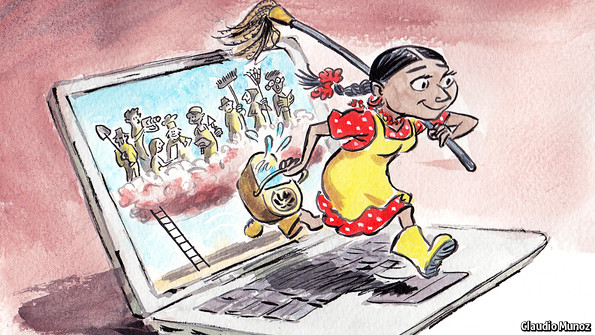
FOR translating a 22-minute video from English into Spanish at short notice, 7Brands Global Content, a professional-translation firm based in New York, quoted “approximately $1,500”. This fee seems in line with the local going rate for the job from a firm which boasts membership of three professional associations and clients such as Chase and Bank of America. Not so long ago, paying the local rate was the only option. Today anyone seeking to get this sort of job done is only a click away from the whole world of professionals competing to do it far cheaper. Read more of this post

For Wearable Computers, Future Looks Blurry

May 30, 2013, 7:29 p.m. ET

For Wearable Computers, Future Looks Blurry

At the D11 Confab, the Silicon Valley Elite Debate Google Glass’s Mainstream Appeal

By EVELYN M. RUSLI

RANCHO PALOS VERDES, Calif.—If you haven’t heard, the future is wearable computing. But how that future—seen through Google GOOG +0.05% Glass specs—will go mainstream is still out of focus.

At the D11: All Things Digital conference here, the tech elite buzzed about the promise of microcomputers that attach onto humans. They opined not just about fitness-tracking bands, which are already becoming ubiquitous, but also about multipurpose mobile gadgets that we can strap onto our wrists, heads or other body parts.

Tim Cook, CEO of Apple Inc., AAPL -0.41% which is reported to be working on a watch-like device, said wearable computers will likely be “another key branch” of the Apple tree. But in reference to competitor Google Inc.’s Glass headgear, Mr. Cook said high-tech eyeglasses would be “difficult” to pull off as a mainstream product. On stage, he wore a Nike+ FuelBand bracelet that tracks physical activity. Read more of this post

Killer cloud: report says Amazon Web Services threatens all IT incumbents

Killer cloud: report says Amazon Web Services threatens all IT incumbents

By Barb Darrow | GigaOM.com, Published: May 31

Amazon Web Services faces growing competition from a dozen or more legacy name-brand IT giants. But instead of taking a hit, it poses a bigger-than-ever threat to the those vendors — all of which are building their own competitive clouds, according to new Morgan Stanley research.

Oh, and the researchers project that AWS will hit $24 billion in revenue by 2022. Amazon doesn’t break out AWS revenue, but most pundits figure it passed the $2 billion-a-year mark about a year ago.

The fact that AWS has a huge lead in cloud over the rest of the world is not news to anyone who’s been watching, but these projections could be a wakeup call to investors who think tech incumbents — companies like IBM, Microsoft, HP, VMware, Red Hat, as well as every telco and hosting provider — can challenge Amazon in cloud computing.

“Applying retail economics to the delivery of technology services well positions Amazon Web Services [to be] a Top 5 vendor within the $152 TAM [total addressable market], ” according to Morgan Stanley analysts Scott Devitt, Keith Weiss and team. Read more of this post

Bumi Says $201 Million Missing After Review of Berau Finances

Bumi Says $201 Million Missing After Review of Berau Finances

Bumi Plc (BUMI), the coal producer at the center of an ownership dispute between its founders, said a review of spending at one of its two Indonesian units found $201 million of outlays with “no clear business purpose.”

In addition to the $152 million determined to be missing from PT Berau Coal Energy’s finances in 2012, $49 million was identified for the 2011, Bumi said in a statement. The Berau Coal review delayed Bumi’s results by more than two months. It today reported a net loss of $2.3 billion for 2012, compared with the year-earlier loss of $337 million after booking charges of $2.2 billion on its Indonesian coal businesses.

Bumi has been at the center of a battle for control between co-founders Nathaniel Rothschild and Indonesia’s Bakrie family since the $3 billion deal that brought them together started to sour in late 2011. Trading in the stock will remain suspended while the company “continues to enhance its internal systems and controls,” it said today.

Bumi took an impairment charge of $815 million on the Berau assets. PT Bumi Resources, in which Bumi Plc holds a 29 percent stake, posted a net loss of $666.2 million for 2012 as lower coal prices hurt sales at Indonesia’s biggest coal producer. Bumi took a non-cash charge of $1.4 billion on the value of its equity stake in Bumi Resources, it said today. Read more of this post

Frustration Mounts as Brazil’s Real Tumbles

Updated May 31, 2013, 3:56 p.m. ET

Frustration Mounts as Brazil’s Real Tumbles

By PAULO WINTERSTEIN

SÃO PAULO—Brazil’s currency tumbled to a four-year low Friday, underscoring investors’ frustration with the world’s sixth-largest economy.

The real dropped as low as 2.1443 reais per dollar, its weakest since May 2009, while stocks slipped to a six-week low. Friday’s selloff capped a week that saw Brazilian markets battered by mounting evidence that a hoped-for economic recovery isn’t materializing, as well as an interest-rate increase that threatens to further reduce growth.

With the economy slowing, inflation pressures rising and the country’s fiscal situation worsening, policy makers are running out of options to steady what was once South America’s rising star. Read more of this post

US bond investors wake up to QE withdrawal

Last updated: May 31, 2013 9:54 pm

US bond investors wake up to QE withdrawal

By Ralph Atkins in London and Michael MacKenzie in New York

What is the difference between 1.6 per cent and 2.2 per cent? Either: not much, or a potentially explosive shift in the way global investors view the world that presages turbulent market conditions ahead.

Yields on US government debt, which move inversely to prices, have surged during May and peaked this week, leaving holders nursing their worst monthly loss since December 2010. Ten-year Treasury yields hit 2.23 per cent on Wednesday, up from 1.61 per cent at the start of May, and were back to 2.20 per cent in volatile Friday trading. Read more of this post

A New Twist in Monetary Policy: Divergence Between Emerging and Developed Markets; Emerging markets are cutting interest rates in response to disinflation and slowing growth while investors speculate on an early exit, or taper, by the Fed

A New Twist in Monetary Policy: Divergence Between Emerging and Developed Markets

31 MAY 2013 – TOM BUERKLE

For the past five years, policymakers in emerging-markets countries have criticized their U.S. counterparts, arguing that the Federal Reserve Board’s zero interest rates and quantitative easing have flooded the world with cheap money, pushed up asset prices and fanned inflationary pressures in their economies. Japan’s recent entry into the QE club merely generated more such complaints.

Behind that chatter, however, a significant shift is taking place. Advanced economies and emerging markets remain out of sync, but with a twist: While investors are increasingly speculating that the Federal Reserve Board will begin exiting or tapering its easy-money policies sooner than expected this year in response to stronger growth, emerging markets have been cutting rates lately in the wake of a slowdown in growth and waning inflation pressures. Many analysts and investors believe this new trend has plenty of room to run. Read more of this post

Jim Rogers: “Nobody Gets Out Of This Situation Until There’s A Crisis”; new book Street Smarts is the best book written by Jim Rogers

Jim Rogers: “Nobody Gets Out Of This Situation Until There’s A Crisis”

Tyler Durden on 05/30/2013 22:48 -0400

The following is GoldMoney contributing author Felix Moreno’s interview with famed investor Jim Rogers. We hope you enjoy it.

Félix Moreno: Please tell us about your new book, Street Smarts. What was your motivation for writing it?

Jim Rogers: To my surprise people tell me it’s my best book. I never would have expected this reaction. I’ve written a few books about specific things, but my publisher said, “look, you’ve never sort of pulled it together: how did you get from the backwoods of Alabama to Singapore” – among a few things. I had a few setbacks along the way, and a couple of successes. So I sat down to put it all together in the book, how it all worked and everything seemed to be worth it. Some people seem to enjoy it, to my delight. Read more of this post

Is This China’s ‘Minsky Moment’?

Is This China’s ‘Minsky Moment’?

Tyler Durden on 05/30/2013 22:18 -0400

20130530_china120130530_china2

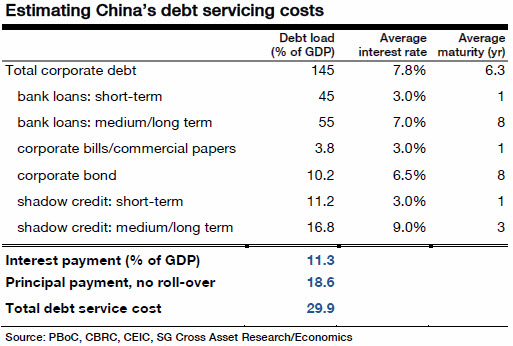
China’s credit growth has been outstripping economic growth for five quarters with the corporate debt bubble looking increasingly precarious (as we explained here and here). This raises one key question: where has the money gone? As SocGen notes, although such divergence is not unprecedented, it potentially suggests a trend that gives greater cause for concern – China is approaching a Minsky moment. At the micro level, SocGen points out that a non-negligible share of the corporate sector and local government financial vehicles are struggling to cover their financial expense. At the macro level, they estimate that China’s debt servicing costs have significantly exceeded underlying economic growth. As a result, the debt snowball is getting bigger and bigger, without contributing to real activity (see CCFDs for a very big example).This is probably where most of China’s missing money went. Read more of this post

Zuckerberg’s Step Into Politics Pushes Tech Friends Away

Zuckerberg’s Step Into Politics Pushes Tech Friends Away

Facebook founder Mark Zuckerberg’s bipartisan political organization is losing friends.

The group backed by technology millionaires and billionaires, called FWD.us, began advocating in April for changes to U.S. immigration law. Within weeks, FWD.us surprised some of its members by setting up partisan offshoots and airing ads promoting Democratic Senator Mark Begich’s support for oil drilling and Republican Senator Lindsey Graham’s backing of the Keystone XL pipeline.

It’s a strategy intended to give political cover to some senators who may support an immigration bill by reminding uneasy voters of the lawmakers’ other policy priorities. Yet the tactic angered some pro-environment donors and sparked a social-media campaign against Zuckerberg. Read more of this post

Halsey Minor, the CNET Networks founder who sold the company for $1.8 billion five years ago, filed for bankruptcy to liquidate his assets and pay his creditors

CNET Founder Minor Files for Bankruptcy After Selling Art

Halsey Minor, the CNET Networks Inc. (3549162Q) founder who sold the company for $1.8 billion five years ago, filed for bankruptcy to liquidate his assets and pay his creditors.

The Chapter 7 petition filed May 24 in U.S. Bankruptcy Court in Los Angeles listed assets of as much as $50 million and debt of as much as $100 million. In Chapter 7, a U.S. Trustee, or sometimes a judge, appoints an impartial trustee to administer the case and sell assets such as automobiles.

Minor, 47, sold CNET to CBS Corp. (CBS) in 2008. His Minor Ventures invested in early-stage technology startups including GrandCentral Communications Inc., which Google Inc. (GOOG) bought in 2007 for about $65 million and renamed Google Voice. Read more of this post

Former Prime Minister Kevin Rudd Puts Canberra House Up for Sale for A2.25m; bought in Sep 2010 at A$2.175m

Former Prime Minister Kevin Rudd Puts House Up for Sale

Former Australian Prime Minister Kevin Rudd has put his five-bedroom house in Canberra up for sale with an asking price of A$2.25 million ($2.18 million) after abandoning any aspirations to again lead the country.

The 465-square-meter (5,005-square-foot) house in the suburb of Yarralumla, a five-minute drive from Australia’s Parliament House, was listed for sale on May 29, said Shane Killalea, an agent at broker Peter Blackshaw Canberra, who is marketing the property. Rudd and his wife Therese bought the house in 2010. They moved out at the end of 2011 after their son Marcus completed his schooling in Canberra, Rudd’s office said in an e-mailed statement.

Rudd, 55, became prime minister when the Labor party won power in the November 2007 election. The former diplomat, who represents the seat of Griffith in Brisbane where he lives, was ousted in a late-night coup that installed current Prime Minister Julia Gillard in June 2010. Read more of this post

Growth Not Missile Threat Tops President Park’s South Korea Agenda; “If there are more people like you, we will be able to create the world we dream of,” Park, 61, told the smiling Gates

Growth Not Missile Threat Tops Park’s South Korea Agenda

With North Korea escalating its threats to test a ballistic missile, South Korean President Park Geun Hye was conferring with Bill Gates on another pressing matter. Seated across from Microsoft Corp.’s billionaire co-founder on April 22 at a formal dining table in the Blue House, her official residence, Park picked the tech mogul’s brain about how to nurture entrepreneurs to keep the world’s 15th-largest economy humming.

“If there are more people like you, we will be able to create the world we dream of,” Park, 61, told the smiling Gates.

By most measures, South Korea has already implanted itself among the globe’s economic success stories, Bloomberg Markets magazine will report in its July issue. The one-time agrarian backwater has emerged as an icon of manufacturing, technology — and cool. Read more of this post

Taiwan Capital Gains Tax Revisions Delayed by Opposition Party; Lawmakers are weighing a tax cut after stock trading volume declined by as much as 30 percent in the first four months of the year

Taiwan Capital Gains Tax Revisions Delayed by Opposition Party

Taiwanese opposition lawmakers today delayed cutting a controversial capital gains tax on share sales of more than NT$1 billion ($33.3 million) and removing an index price threshold that depressed shares.

Tsai Chi-chang, a Democratic Progressive Party lawmaker, said his party doesn’t support the ruling Kuomintang’s proposals and favors its own plan for a flat tax on all capital gains, which “fits the idea of fairness and justice and increasing government revenue.” The benchmark Taiex index rose 0.5 percent to 8,281.42 as of 11:21 a.m. local time.

Lawmakers are weighing a tax cut after stock trading volume declined by as much as 30 percent in the first four months of the year, according to Credit Suisse Group AG. President Ma Ying-jeou’s administration and legislators argued over about 10 versions of the tax last year, prompting then-Finance Minister Christina Liu to step down. The Taiex lost 13 percent during the period. Read more of this post

How Stravinsky’s Rite of Spring has shaped 100 years of music; From start to finish The Rite of Spring exalts in a new and explosive sense of musical movement

How Stravinsky’s Rite of Spring has shaped 100 years of music

Piece first performed in Paris exactly 100 years ago emblematic of era of great scientific, artistic and intellectual ferment

George Benjamin, The Guardian, Wednesday 29 May 2013

Stravinsky in 1914Stravinsky’s Rite of Spring

Stravinsky in 1914. Photograph: Lebrecht Music & Arts Photo Library; A section of a facsimile of Stravinsky’s manuscript for Rite of Spring, which was published this year to mark the centenary

The Rite of Spring was a revolutionary work for a revolutionary time. Its first performance in Paris, exactly 100 years ago on Wednesday, was a key moment in cultural history – a tumultuous scandal.

Written on the eve of the first world war and the Russian revolution, the piece is the emblem of an era of great scientific, artistic and intellectual ferment. No composer since can avoid the shadow of this great icon of the 20th century, and score after score by modern masters would be unthinkable without its model. Read more of this post

China’s shadow banks: The credit kulaks

China’s shadow banks: The credit kulaks

The growth in wealth-management products reflects deeper financial distortions

Jun 1st 2013 | HONG KONG |From the print edition

20130601_FND00120130601_FNC719

AS THE grandson of a “rich farmer”, a stigmatised class in communist China, Joe Zhang grew up on the wrong side of the ideological tracks. At school he envied the town-kids who could look forward to a cushy job minding grain-stores or writing propaganda. But after winning a spot at university, he eventually escaped into central banking in Beijing and, later, investment banking in Hong Kong. By pleading, petitioning and playing a lot of ping pong (a sport he hates) he was even admitted into the Communist Party in 1985.

Then, in 2011, his social climb suffered an abrupt reversal. He took on a role that remains stigmatised and discriminated against in today’s China: he became a shadow banker. His new book, “Inside China’s Shadow Banking: the Next Subprime Crisis?”, recounts his trials as the head of a microlender in Guangdong. Elsewhere in the world, microcredit is a respectable, even canonised, endeavour. In China, Mr Zhang complains in his book, it is “only slightly more respectable than perhaps massage parlours or nightclubs.”

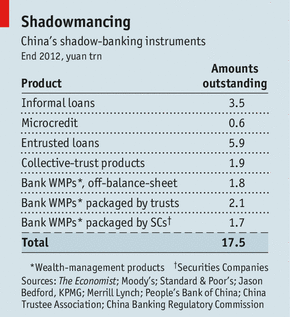
He describes the variety of institutions and instruments that operate and innovate in the shadow of China’s mammoth banks, where they are hard for the authorities to see. They include the informal lenders, kerbside capitalists and back-alley bankers for which China is famous. But the most important institutions are China’s 67 trust companies, lightly regulated finance firms that make loans and other investments but cannot collect deposits. And the most significant instruments are the uncountable wealth-management products (WMPs), which raise money from better-off investors, in large increments (at least 50,000 yuan, about $8,160) and for short periods (typically less than six months, sometimes much less). Read more of this post

Export Champions: How I sell tea to China; Alex Probyn, founder of Kent-based business Blends for Friends, on the trials and triumphs of selling tea to China

Export Champions: How I sell tea to China

Alex Probyn, founder of Kent-based business Blends for Friends, on the trials and triumphs of selling tea to China.

Alexprobyn_2577549b

Alex Probyn founded Blends for Friends, which exports tea around the globe. He expects the company to increase its exports from 10pc of turnover to 30pc within two years

By James Hurley

7:45PM BST 30 May 2013

How does a small company from Kent go about exporting tea to China? By selling the “quintessential English experience” first, says Alex Probyn, founder of Blends for Friends, a tea maker that is enjoying a brisk trade with the world’s second-largest economy.

Mr Probyn, a former master tea blender at Tetley, said his six-year-old business is benefiting from the growing Chinese middle class.

“It’s hilarious from our point of view because, although we’re exporting good quality tea, it’s stuff the average Chinese person on the street wouldn’t dream of drinking. But in cities they want afternoon tea with cakes and sandwiches – really, they’re buying that experience as much as the tea.” Read more of this post

Bre-X, Canada’s largest mining fraud in history, class action settlement approved after 16 years since its claim of a major gold discovery in Indonesia proved to be a fake; investors get tiny fraction of losses

Bre-X class action settlement approved; investors get fraction of losses

Hugh McKenna, Canadian Press | 13/05/30 7:17 PM ET

David Walsh, mapA1.27MAY.JOHN.TA

National Post filesBre-X became known as the largest mining fraud in Canadian history back in 1997 when its claim of a major gold discovery in Indonesia proved to be a fake.

TORONTO — The lengthy battle by Bre-X investors to recover billions in Canada’s largest mining fraud appears to be over in what one of the original plaintiff lawyers in the case called a “sad day” for accountability in Canada. Under a settlement approved Thursday by the Alberta Court of Queens Bench, the remaining class-action suits were dismissed against the main defendants in the case, the estate of Bre-X’s late founder and CEO, David Walsh, and chief geologist John Felderhof. The Calgary court made the ruling at the request of bankruptcy trustee Deloitte and Touche, which said there was no realistic prospect of realizing any significant recovery through the litigation and that the costs of proceeding were prohibitive. As a result, all parties agreed to a payment of $5.2-million to be divided among investors who apply for a settlement. Read more of this post

A photo from the Mars Curiosity Rover reveals what appears to be a small animal or lizard on Mars

Curiosity photo shows lizard on Mars

2013-05-31 00:00:35 GMT2013-05-31 08:00:35(Beijing Time)  Xinhua English

A photo from the Mars Curiosity Rover reveals what appears to be a small animal or lizard on Mars. The photo was taken on February 20, 2013 by Curiosity’s MASTCAM and a high resolution copy is available on NASA’s JPL/Caltech website. The image was originally discovered by a Japanese researcher in March and uploaded to Youtube on May 14. (Source: xxcb.com.cn)

U166P5029T2D595085F26DT20130531080035

Meet the $200m bushy, Tom Brinkworth; You won’t find this controversial pastoralist in the social pages nor in the saddling enclosure on Melbourne Cup day. Rather, you will find him sleeping rough as he traverses his vast estate in South Australia

Meet the $200m bushy, Tom Brinkworth

PUBLISHED: 13 HOURS 46 MINUTES AGO | UPDATE: 2 HOURS 36 MINUTES AGO

811fa640-c1b9-11e2-b70d-0d631bec6b0c_A68C7009 copy--646x363

Brinkworth in a trophy room bearing the results of the family’s passion for hunting. Photo by Nic Walker

TONY WALKER

Tom Brinkworth is presiding in what he calls his home office – a farmer’s kitchen – with its skillets and meat hooks, cleavers and boning knives, venison chunks and homilies about life and work, and shelves crowded with sauce bottles and condiments. On a refrigerator door, a fridge magnet bears the Churchillian words: Never, Never, Never Give Up. Whatever else friends and detractors – and there are plenty of the latter – might say about the enigmatic 76-year-old, no-one would ever accuse him of giving up, certainly when it comes to accumulating land.

Can acquisition of land become an obsession, I ask? “No, it’s a habit,” Brinkworth laughs. He recounts a friend’s observation that: “Brinkworth would buy out the whole of Australia if the price was right.” Queensland is his next frontier beyond holdings in South Australia and NSW, judging by coloured-in sections of a map of southern Queensland on a long refectory table in a crowded “trophy room” adjoining the kitchen. Brinkworth’s hunting exploits are captured in the mounted heads and antlers of seven species of deer, wild boar and various species of duck. The latter reflects his passion for game-shooting on his wetlands properties.

Tom Brinkworth of Watervalley station, 50 kilometres west as the crow flies from Kingston in South Australia, controls, at last count, 1 million hectares of agricultural land spread across 99 properties in his home state and NSW. By the time this article appears, he may well have brought up his century, such is his appetite for additional land, provided the price is right. Read more of this post

Canadian VCs urge young entrepreneurs to break ‘unrealistic’ expectations

Canadian VCs urge young entrepreneurs to break ‘unrealistic’ expectations

Matthew Braga | 13/05/30 | Last Updated: 13/05/30 2:37 PM ET
Young Canadian entrepreneurs tend to suffer from an “unrealistic expectation of values,” according to WIND Mobile CEO Anthony Lacavera, who spoke on a panel of Canadian venture capitalists Wednesday afternoon.

The group gathered to discuss the gap in understanding that exists between those with ideas and those with funding.

Mr. Lacavera stressed a need for better education of young entrepreneurs – but also a need to “break through that culture of risk aversion” that plagues Canadian VCs, who don’t act nearly as fast or aggressively as those in the U.S. Read more of this post

In Big Companies, Lean Is Only One Piece of the Puzzle; before you use lean to build the next product that could go on to change the world, make sure you’ve established a solid foundation for intrapreneurial success inside your own company

In Big Companies, Lean Is Only One Piece of the Puzzle

by Maxwell Wessel and James Allworth  |  11:00 AM May 30, 2013

In 2010, one of us was sitting in a room at the Harvard Business School with Eric Ries and a number of budding entrepreneurs. They were pitching their ideas and plans to Eric and their peers; once the pitch was complete, the group would then brainstorm. One of these young entrepreneurs in particular stood out. He was not your standard internet entrepreneur — the student presenting was pitching a project to increase sub-Saharan farm income, by helping farmers shift from traditional crops to rubber trees. He had developed an extensive plan, and had the promise of grant money behind him. The problem with the effort, of course, was that building both the necessary African infrastructure and the logistics network needed to transport the non-indigenous crops was going to be a very expensive proposition indeed.

Eric sat patiently and listened, jotting down a handful of notes. After some reflection, he jumped in with a set of questions. Each question focused on an underlying assumption of the business plan. Because the model relied on providing long-term loans, Eric asked questions about repayment and cultural bias. He asked how significant the education costs would be to sign up additional farmers. He asked exactly how big the income increases would be for the farmers who opted into the program. The student presenter acknowledged the risks and simply stated, “Well, we won’t know any of that for a long time… rubber trees take years to mature.” Read more of this post