Wan Long: Former factory worker who rose to lead Shuanghui as chairman to take over US pork producer Smithfield

Last updated: May 30, 2013 1:47 pm

Wan Long: Former factory worker who rose to lead Shuanghui

By Paul J Davies in Hong Kong

wanlong pledges

For Wan Long, the $4.7bn deal to take over US pork producer Smithfield is a long way from the Shuanghui International chairman’s simple beginnings. “What I do is kill pigs and sell meat,” he told a local paper last year. A native of Luohe in Henan province, home to the group’s headquarters, he joined Shuanghui as an ordinary factory worker in 1968 after a stint in the army. It was a single money-losing plant, ranked ninth out of 10 state-owned meat processing companies in Henan, according to the Chinese magazine Caixin. Mr Wan, now in his early seventies, was elected plant manager in 1985. That year it reported profits of Rmb5m, the magazine said. He now runs a business that turned a net profit of Rmb2.9bn last year. As China’s biggest meat producer, it produces 2.7m tonnes of meat annually from 30m pigs. It also gets through 300,000 heads of cattle, 600,000 tonnes of chicken, 50,000 tonnes of eggs and 50,000 tonnes of soy protein in processing pork into an array of cooked, fresh and frozen products. “Our goal is to achieve sales revenue of Rmb100bn within the period of the 12th five-year plan [ending in 2015], then I’ll retire,” Mr Wan told Caixin in an interview two years ago. Shuanghui is forecast to hit Rmb50bn ($8.2bn) in sales this year, according to Bloomberg data, whileSmithfield should generate $13bn – so this deal will help Mr Wan hit his target two years early. It is by far the largest takeover ever pursued by a Chinese company overseas in the food and beverage sector, according to Dealogic. Given China’s population and its growing appetite for a higher protein diet as it becomes wealthier, bankers expect to see many more deals for meat, fish and dairy producers. The past decade was about China’s hunt for energy and metals, but the next could well be about its need to secure safe food supplies. “This deal looks like a wonderful opportunity for two complementary companies to come together and for Shuanghui to access the technology it needs to take its food safety and productivity to a higher level,” says a Beijing based agri-industry expert. The homespun charm of the companies’ two executives appear to complement each other as well, with Mr Wan’s simple take on the pig industry chiming with words from Larry Pope, Smithfield’s chief executive. “We’re not exporting tanks and guns and cyber security,” he said on Wednesday in assessing concerns about US regulatory intervention. “These are pork chops.” Read more of this post


The new number crunchers; One of the world’s first data scientists turned his geeky love of maths into a lucrative career

May 30, 2013 5:12 pm

The new number crunchers

By Emma Jacobs

When Jeff Hammerbacher lies in bed at night trying to sleep, he meditates on a maths problem. “I find it peaceful,” he says. Reflecting on “timeless entities in your brain allows you to get to the objective truth. It makes me calm inside my head”. Relaxation can be a problem for Mr Hammerbacher, who was diagnosed with general anxiety disorder. “I do have a lot of thoughts in my head, metaphysical dilemmas.”

Meditating on numbers is more than a cure for insomnia. It drives the 30 year old professionally. He is a “data scientist”, the hottest job title in Silicon Valley. Harvard Business Review ran an article co-authored by data scientist D.J. Patil, calling it “the sexiest job of the 21st century”. Mr Hammerbacher actually coined the term in 2008 with Mr Patil, who was the head of data and analytics at LinkedIn when he was leading Facebook’s team.

Mr Hammerbacher calls good data scientists “data rats”. Athletes are often considered “gym rats” if they spend a lot of time in the gym, so Mr Hammerbacher believes “data rats” need to spend a lot of time with data. So, when he has downtime he tries to get in some data science. Read more of this post

An Economy of Microserfs: Your Facebook ‘likes’ and Twitter witticisms are making tech companies super-rich. Shouldn’t you get a cut?

May 30, 2013, 4:44 p.m. ET

An Economy of Microserfs

Your Facebook ‘likes’ and Twitter witticisms are making tech companies super-rich. Shouldn’t you get a cut? Steven Levy reviews Jaron Lanier’s “Who Owns the Future.”

By STEVEN LEVY

Critics of technology abound, but none cuts as deeply as a Geek Apostate. During the 1990s that role was held by a Berkeley astronomer named Clifford Stoll, who outsmarted a destructive hacker and wrote a book about it. Not satisfied with one best seller, Mr. Stoll staked out ground as a professional tech skeptic. He zeroed in on what he considered the ludicrously optimistic predictions of Internet enthusiasts. He failed to notice that such predictions were not fantasies but understatements. His 1995 essay in Newsweek—in which he mocked the idea that people would ever buy a book, make a restaurant reservation or look up a historical fact online—periodically goes viral on the social networks that Mr. Stoll insisted would never take off.

Jaron Lanier, our current alpha Geek Apostate, is on firmer ground. His tech credentials are impressive: At an early age he found himself in MIT artificial-intelligence guru Marvin Minsky’s circle. After a stint as a dreadlocked and dreamy game designer, he rose to prominence in the early 1990s as the father of virtual reality. (I wrote a profile of him for Rolling Stone in that period.) But something snapped. Now, despite holding a day job at Microsoft‘s MSFT +0.43% research division, he blasts the tech world he helped create. Read more of this post

Microsoft Invented A Tablet A Decade Before Apple And Totally Blew It

Microsoft Invented A Tablet A Decade Before Apple And Totally Blew It

Julie Bort | May 30, 2013, 1:38 PM | 7,181 | 34

Apple’s iPad is a revolutionary product that is cratering the PC industry. But it wasn’t Steve Jobs’ idea. A full decade before Jobs launched the iPad in 2010, Bill Gates launched Microsoft’s touch input tablet computer. Here it is:

bill-gates-tablet-2000-1

Bill Gates with a Microsoft tablet in 2000

Two years later, Gates showed up with an improved model, a color tablet. It used the Windows XP Tablet operating system.

Here it is: Bill Gates in 2002

bill-gates-tablet-2002

Unlike today, Microsoft didn’t manufacture the tablet itself. Lenovo produced the tablet in 2000 and other partners, like Fujitsu, made the XP tablet in 2002. Here’s a closer look at the Fujitsu tablet. So if Microsoft was a decade ahead, why did Apple become the King of the Tablets? Last July, during an interview with Charlie Rose, Bill Gates explained that Jobs “did some things better than I did. His timing in terms of when it came out, the engineering work, just the package that was put together. The tablets we had done before, weren’t as thin, they weren’t as attractive.”

BCG Classics Revisited: The Experience Curve and its relevance to today’s business environment

BCG Classics Revisited: The Experience Curve

by Martin Reeves, George Stalk, and Filippo L. Scognamiglio Pasini

MAY 28, 2013

To mark The Boston Consulting Group’s fiftieth anniversary, BCG’s Strategy Institute is taking a fresh look at some of BCG’s classic thinking on strategy to explore its relevance to today’s business environment. This second in a planned series of articles examines the experience curve, an idea developed by BCG in the mid-1960s about the relationship between production experience and cost.

Experience_Curve_Ex1_lg_tcm80-135019Experience_Curve_Ex2_lg_tcm80-135022

The experience curve is one of BCG’s signature concepts and arguably one of its best known. The theory, which had its genesis in a cost analysis that BCG performed for a major semiconductor manufacturer in 1966, held that a company’s unit production costs would fall by a predictable amount—typically 20 to 30 percent in real terms—for each doubling of “experience,” or accumulated production volume. The implications of this relationship for business, argued BCG’s founder, Bruce Henderson, were significant1.  In particular, he said, it suggested that market share leadership could confer a decisive competitive edge, because a company with dominant share could more rapidly accumulate valuable experience and thus achieve a self-perpetuating cost advantage over its rivals.

The experience curve theory proved a valuable descriptor and predictor of competitive dynamics across much of the business landscape through the 1970s, providing a sound guide for investment and pricing decisions and an invaluable tool for strategists. Is the idea applicable to today’s environment? Yes, but in some industries it is no longer sufficient by itself as a blueprint for competitive advantage. In contrast to the 1960s and 1970s, when the general business environment was relatively stable and new-product introduction relatively infrequent, today’s business climate is characterized by higher volatility, less stable industry structures, and frequent product launches in response to rapidly changing technologies and tastes. Read more of this post

Closely held Seventh Generation Inc. is buying a maker of reusable filtered water bottles known as bobble, the company’s first brand acquisition outside of its namesake household cleaners and baby products

May 30, 2013, 7:43 p.m. ET

Seventh Generation Picks Up Bobble Brand

In Bid to Expand Reach, Firm to Buy Filtered Water Bottle Maker

By SERENA NG

MK-CD631_Sevent_G_20130530194508

Seventh Generation, known for its household cleaners, is buying the bobble, the reusable filtered water bottle brand, for an undisclosed sum.

Closely held Seventh Generation Inc. is buying a maker of reusable filtered water bottles known as bobble, the company’s first brand acquisition outside of its namesake household cleaners and baby products.

The acquisition for an undisclosed sum comes as Seventh Generation is looking to expand into new product areas through acquisitions, said Chief Executive John Replogle. The Burlington, Vt., company is looking for more brands and consumer products that fit with its mission of healthy living and sustainability, he said.

Seventh Generation was founded 25 years ago as a catalog company and now makes plant-based cleaning products, diapers and baby wipes that it touts as safer for people and the environment. Retail sales of its products topped $200 million last year and grew in double-digit terms during the recession, Mr. Replogle said. Read more of this post

A Lone Voice Raises Alarms on Lucrative Diabetes Drugs; “We have all these people out there taking these drugs,” Dr. Butler said, “and the problem is: What is happening to their pancreases?”

A Lone Voice Raises Alarms on Lucrative Diabetes Drugs

Dr. Peter C. Butler heads endocrinology at U.C.L.A. and is a former editor of Diabetes, the American Diabetes Association journal.

By ANDREW POLLACK

Published: May 30, 2013 100 Comments

LOS ANGELES — Dr. Peter C. Butler initially declined a request by the drug maker Merck to test whether its new diabetes drug, Januvia, could help stave off the disease in rats. “I said, I’m not interested in your money, go away,” Dr. Butler recalled.

Merck no doubt now wishes it had. When Dr. Butler finally agreed to do the study, he found worrisome changes in the pancreases of the rats that could lead to pancreatic cancer. The discovery, in early 2008, turned Dr. Butler into a crusader whose follow-up studies now threaten the future of not only Januvia but all the drugs in its class, which have sales of more than $9 billion annually and are used by hundreds of thousands of people with Type 2 diabetes. Read more of this post

The drive to develop cancer drugs that harness the immune system looks like the next big thing for Bristol-Myers, Merck and Roche

THURSDAY, MAY 30, 2013

Invest for the Cure

By JOHANNA BENNETT | MORE ARTICLES BY AUTHOR

The drive to develop cancer drugs that harness the immune system looks like the next big thing for Bristol-Myers, Merck and Roche.

Scientists have been laboring for years to develop treatments that harness the body’s immune system to destroy cancer. All that effort may finally be about to pay off for patients and drug makers, not to mention investors. The race to develop so-called immunotherapies takes center stage at this year’s meeting of the American Society of Clinical Oncology, which begins May 31 in Chicago. Preliminary data from early-stage studies unveiled ahead of the conference have fueled convictions that these drugs are the new front in the war on cancer. It has also fueled stock prices.

Read more of this post

Writers’ platform Quill backed by Spotify investor; Quill, a former naval officer’s start-up, is attempting to build a “worldwide platform for web writers”.

Writers’ platform backed by Spotify investor

Entrepreneurs and investors behind companies including Spotify, Songkick and Mr & Mrs Smith have backed Quill, a former naval officer’s start-up which is attempting to build a “worldwide platform for web writers”.

Quill already uses 1,000 writers working in 17 countries and covers 30 languages Photo: ALAMY

By James Hurley

11:50AM BST 29 May 2013

Quill, which produces online content for large businesses, has secured £1m from a group of investors including Spotify backer Shakil Khan. Founder Ed Bussey said his business is building a network of writers around the world to produce online content in various languages for companies including retailer Shop Direct Group, insurer AXA and advertising giant WPP. Quill already uses 1,000 writers working in 17 countries and covers 30 languages, Mr Bussey said. Read more of this post

Behind the ‘Internet of Things’ Is Android—and It’s Everywhere

Behind the ‘Internet of Things’ Is Android—and It’s Everywhere

By Ashlee Vance on May 30, 2013

tech_android23__01b__630x420

Ken Oyadomari’s work space at NASA Ames Research Center in Mountain View, Calif., looks like a triage tent for smartphones. Parts from dozens of disassembled devices are strewn on workbenches. A small team of young engineers picks through the electronic carnage, carefully extracting playing card-size motherboards—the microprocessing heart of most computers—that will be repurposed as the brains of spacecraft no bigger than a softball. Satellites usually cost millions of dollars to build and launch. The price of Oyadomari’s nanosats, as they’ve become known, is around $15,000 and dropping. He expects them to be affordable for high school science classes, individual hobbyists, or anyone who wants to perform science experiments in space. A big reason nanosats are so small and cheap: They run on Google’s (GOOG) Android operating system, familiar to anyone who’s shopped for a smartphone or tablet. It’s the No. 1 mobile OS by a wide margin; Android handsets outsell Apple’s (AAPL) iPhones globally by about 4 to 1. Impressive as those numbers are, they actually understate Android’s prevalence, because increasingly it’s the operating system behind just about anything with a computer chip. Along with Oyadomari’s nanosats, three of which recently went into orbit, Android runs espresso makers, video game consoles, refrigerators, rifles that post video to Facebook (FB), and robotic harvesters for farms.

Android is becoming the standard operating system for the “Internet of things”—Silicon Valley’s voguish term for the expanding interconnectedness of smart devices, ranging from sensors in your shoe to jet engine monitors. As each of these devices hits the market, Google further outflanks Apple and Microsoft (MSFT) as the dominant software player in a connected world. Read more of this post

Jack Xu Talks about Failure in Copying Tumblr

Jack Xu Talks about Failure in Copying Tumblr

By Tracey Xiang on May 30, 2013

Jack Xu admitted that Diandian, a pixel-by-pixel Tumblr copy, was a failure and a painful experience at the Silicon Dragon Beijing 2013 yesterday. To be fair, Diandian is just one of the dozens of Tumblr copies in China and none of them really gained traction but hype.

As one of the first projects incubated by Innovation Works, Diandian was released in February 2011 — about half a year after Sina Weibo’s launch. After securing millions of dollars angel investment from Innovation Works, it raised more than USD10 million from Sequoia China and Ceyuan Ventures later that year. With the money Diandian launched massive marketing campaigns such as giving away movie tickets in order to have 10 million users by the end of that year and 100 million in the next two to three years.

But by April 2012 the number only reached 6 million — Sina Weibo announced 300 million users and $10 million in advertising revenue as of that quarter. According to some Diandian’s customers, there may be only one or two staff working on Diandian from early this year. Read more of this post

UCWeb: China’s Last Great Tech Takeover Target

UCWeb: China’s Last Great Tech Takeover Target

By Bruce Einhorn on May 30, 2013

It’s dealmaking time in Chinese cyberspace. As more mainlanders go online via smartphones and tablets, the country’s biggest Web players are gearing up for the era of mobile e-commerce. That’s one reason e-commerce giant Alibaba Group paid $586 million for 18 percent of Twitter-like service Weibo in April and $294 million in May for a 28 percent stake in mapping company AutoNavi (AMAP). Around that time, search engine Baidu (BIDU) set aside $370 million to buy the streaming video service of PPS Net TV, aiming to become the leader in mobile video.

Another potential prize is UCWeb, maker of China’s most popular mobile browser. The company hit the 300 million-user mark in March 2012 and by yearend was at 400 million, says Yu Yongfu, UCWeb’s chief executive officer. More than 60 percent of China’s Android users rely on it, according to the company. Of all the acquisition targets in China, UCWeb is “probably the last one that’s worth anything,” says Michael Clendenin, managing director of RedTech Advisors in Shanghai. In theory, buying the browser operator could help Baidu as it tries to keep up with Alibaba and Tencent (700), China’s biggest Web company by revenue. Baidu boss Robin Li and his team “need to make a big audacious, overpriced investment to get a stake in this guy,” Clendenin says. Read more of this post

Macro control, micro problems; History shows the limits of macroprudential policy in curbing dangerous risk-taking

Macro control, micro problems

History shows the limits of macroprudential policy in curbing dangerous risk-taking

Jun 1st 2013 |From the print edition

AMERICA’S Federal Reserve faces a dilemma: to put the economy back on its feet it is keeping interest rates at zero and buying bonds; but in doing so, it worries, it is egging on dangerous risk-taking. Cue “macroprudential” policy. In theory, central banks would use regulatory and supervisory authority to stamp out excesses in specific markets while leaving monetary policy to take care of inflation and employment.

History suggests this is easier said than done. “Macroprudential” may be new jargon, but America has tried variants of it for decades, from credit controls to down-payment limits. And the record is not a ringing endorsement for macroprudential policy, according to a new working paper by Douglas Elliott of the Brookings Institution, Greg Feldberg of America’s Treasury Department and Andreas Lehnert of the Fed. They found controls were often circumvented by regulatory arbitrage. And when controls worked, political pressure sometimes led to their repeal. Read more of this post

China’s second-largest wind turbine maker Sinovel Announces It Is Under securities regulator CSRC Investigation which questions company financial data

05.30.2013 17:59

Sinovel Announces It Is Under CSRC Investigation

Wind turbine maker says it will coordinate with securities regulator, which questions company financial data

By staff reporter Cao Wenjiao

(Beijing) – Sinovel Wind Group Co. Ltd. announced on May 29 that it was being investigated by the China Securities Regulatory Commission (CSRC) over suspected violations of securities laws and regulations. Sinovel, one of the largest wind turbine manufacturers in the country, said it would coordinate with the CSRC in its investigation and disclose the required information. The CSRC’s Beijing bureau said on April 11 that some of Sinovel’s financial data was not accurate, and the profit the company reported for 2011 was inflated. On April 7, the company said there were accounting errors in its 2011 financial report, which originally gave a net profit figure of 776 million yuan. After correcting for accounting errors, the company said this figure was 168 million yuan too high. A source at the company said Sinovel would make a detailed announcement later. Sinovel listed in Shanghai in January 2011 and its issue price was 90 yuan per share. On May 29, the company’s closing share price was 5.76 yuan. Sinovel had operating revenue of 684 million yuan in the first three months of this year, down 40.98 percent compared to the same period in 2012, the company’s financial report shows. Its net profit was down 968.86 percent. Wei Wenyuan, Sinovel chairman and acting president, resigned on May 13. Company director Liu Hui resigned the same day.

Korean firms urged to overhaul business models

2013-05-30 21:59

Korean firms urged to overhaul business models

By Park Ji-won

A global IT expert has called for major Korean technology giants, such as Samsung and LG, to reinvent themselves as software-centered companies to survive an ongoing transition in the IT industry led by two key trends ― integration and convergence.

In a recent interview with The Korea Times, Wilbert Charlton Adams, former president of the Institute of Electrical and Electronics Engineers Standard Association (IEEE-SA), suggested Korean players overhaul their business models to become more agile. Read more of this post

Aging Chinese Face a Bleak Picture; High Rates of Poverty, Disability and Mental Illness Haunt Elderly, Pose Growing Economic Challenge

Updated May 30, 2013, 11:43 p.m. ET

Aging Chinese Face a Bleak Picture

High Rates of Poverty, Disability and Mental Illness Haunt Elderly, Pose Growing Economic Challenge

By TOM ORLIK

WO-AN968D_CELDE_G_20130530225704

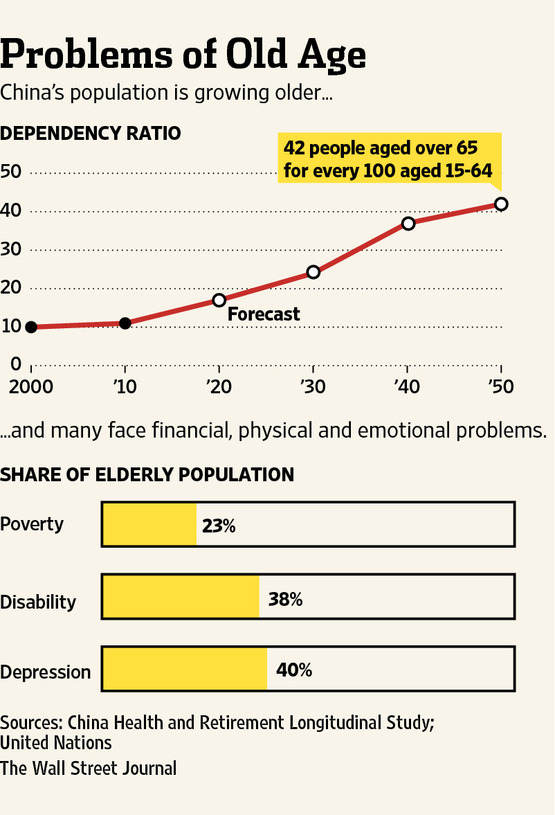
BEIJING—China’s elderly are poor, sick and depressed in alarming numbers, according to the first large-scale survey of those over 60, an immense challenge for Beijing and one of the greatest long-term vulnerabilities of the Chinese economy.

The survey of living conditions for China’s 185 million elderly paints a bleak picture that defies the efforts of the government to build what it calls a “harmonious society,” one dedicated to human welfare rather than simply economic growth. Of the generation that built China’s economic boom, 22.9%—or 42.4 million—live in poverty with consumption of less than 3,200 yuan a year ($522).

The fear of being old and poor, which prompts many Chinese to stash away their earnings, also cuts against another of Beijing’s priorities: to rebalance the economy toward stronger consumption. Read more of this post

Promising African Development Fund Collapses; A program financed by the Agency for International Development is dissolving because of mismanagement, insider dealings and a lack of federal oversight.

Promising African Development Fund Collapses

By BARRY MEIER and RON NIXON

Published: May 30, 2013

The initiative began two decades ago, with the best of intentions, after apartheid fell and southern Africa’s future brightened.

Today that program, the Southern Africa Enterprise Development Fund, is in its death throes, apparently victimized by mismanagement, insider dealings and a lack of oversight by federal officials. Current and former fund officials are fighting over money, and the eventual cost to American taxpayers of the fund’s missteps could run into the tens of millions of dollars, public filings indicate.

On one level, the plight of this obscure fund is a common tale involving the hazards of foreign aid. But on another level, experts say, it points to wider problems bedeviling the federal agency that financed the fund, the United States Agency for International Development, orU.S.A.I.D. In fiscal 2013, the agency had a budget of $1.6 billion and helped administer more than $40 billion in foreign assistance. Read more of this post

Americans have rebuilt less than half of wealth lost to the recession, study says

Americans have rebuilt less than half of wealth lost to the recession, study says

By Ylan Q. Mui, Friday, May 31, 12:00 AM

American households have rebuilt less than half of the wealth lost during the recession, leaving them without the spending power to fuel a robust economic recovery, according to a new analysis from the Federal Reserve.

From the peak of the boom to the bottom of the bust, households watched a total of $16 trillion in wealth disappear amid sinking stock prices and the rubble of the real estate market. Since then, Americans have only been able to recapture 45 percent of that amount on average, after adjusting for inflation and population growth, according to the report from the St. Louis Fed released Thursday.

In addition, the report showed most of the improvement was due to gains in the stock market, which primarily benefit wealthy families. That means the recovery for other households has been even weaker. Read more of this post

Indian power shortage is Achilles heel of economy

May 30, 2013 11:07 am

Indian power shortage is Achilles heel of economy

By Victor Mallet in Noida, India

Electricity, 24 hours a day, is a service taken for granted in industrialised economies. But not in the industrial zone of Noida on the outskirts of New Delhi – and especially not in the baking heat of summer. “We hardly get 50 per cent of our requirement,” says S. Singhvi, finance director of Ginni Filaments, a textiles and clothing company with 5,000 employees across India. “Compared to last year, it’s getting worse.” With daytime temperatures reaching nearly 50C, and householders and farmers demanding ever more power for air conditioners and water pumps, he complains that Ginni’s Noida garment factory must deal with repeated power disruptions and run its own generators to produce electricity at five times the cost of the supply from the grid.

Read more of this post

“What do you know about making cars?” President Park Chung-hee asked Hyundai’s founder Chung Ju-yang at the opening ceremony. According to legend, Chung replied: “I can do it.”

May 30, 2013 6:46 pm

Hyundai: Changing the mould

By Simon Mundy

The carmaker focuses on forging a premium brand

Snaking over 266 miles from Seoul to the port city of Busan, the Gyeongbu Expressway was one of the proudest achievements of Hyundai Group founder Chung Ju-yung. But when it opened in 1970, some ridiculed South Korea’s decision to build an eight-lane motorway across two mountain ranges, because the poor country only had 60,000 cars.

“What do you know about making cars?” President Park Chung-hee asked Chung at the opening ceremony. According to legend, Chung replied: “I can do it.”

In fact, he had already been assembling cars for two years but no one expected the scale of Hyundai’s transformation over the next four decades. Chung’s expressway is now thronged with millions of cars each year, most of them made by the automotive group he founded. Millions more Hyundai vehicles are now an increasing presence around the world, proof of the company’s evolution into the world’s fifth-biggest carmaker by unit sales. Read more of this post

China: a bubble in the tea market?

China: a bubble in the tea market?

May 30, 2013 11:05am by Julie Zhu

Commodity markets may have lost their lustre as many investors have gone elsewhere. But there’s often a chance of a profit for those who know where to look.

Pu’er, a strong, earthy tea produced in China’s Yunnan province has seen its price rise by as much as 80 per cent over the past six months – even as prices for other Chinese teas have remained stable. Pu’er traders have seen it before – in a speculative bubble that burst six years ago. This time the run-up in prices has been more modest – so far.

In Kunming, capital of Yunnan province, Old Banzhang, a type of the finest Pu’er, last year went for Rmb5,000 a kilo in the form of tea leaves pressed into cakes. Now it commands almost Rmb9,000 a kilo, according to China Securities Journal, citing a local tea shop manager.

Zhou Chonglin, a Kunming-based tea expert and co-author of “War of Tea”, believes the price surge of Pu’er could have been predicted. He told beyondbrics that Pu’er investors, who left the market in 2007, started to come back late last year, in response to the increasing demand from the public for the tea, which is widely believed to have medicinal value. Read more of this post

The political scandal and criminal investigation that has accompanied the shutdown of the Hong Kong Mercantile Exchange has created more drama than the exchange ever did trading gold and silver futures.

Updated May 30, 2013, 2:21 p.m. ET

Inquiry Into Bourse Widens

Sixth Person Arrested Amid Closure of the Hong Kong Mercantile Exchange

By TE-PING CHEN

HONG KONG—The political scandal and criminal investigation that has accompanied the shutdown of the Hong Kong Mercantile Exchange has created more drama, including a sixth arrest on Thursday, than the small, struggling exchange ever did trading gold and silver futures.

The exchange’s closure after two years of trading was a blow to the ambitions of its backers, including a close ally to Hong Kong’s top official and Russian billionaire Oleg Deripaska, whose EN+ Group took a 10% stake in the exchange to help launch it in 2010. They had hoped the HKMEx would capitalize on China’s voracious appetite for commodities, but it failed to survive stiff competition from better-established players in Hong Kong and Shanghai, as well as in the West. Read more of this post

South Korea Can’t Just Order Up Creative Economy

South Korea Can’t Just Order Up Creative Economy

South Korea’s economy has yet to catch up to its people. They are the world’s most-wired citizenry and the most advanced at using smartphones. Korean stars are Asia’s most popular; Korean gadgets and fashions the coolest.

Yet at home, huge manufacturing conglomerates, or chaebol, such as Hyundai Motor Group (005380), Samsung Group (005930) and LG Group (066570) remain the mainstays of an export-focused system established after the Korean War by strongman Park Chung Hee. In fact, as the July edition of Bloomberg Markets magazine points out, the chaebols have become even more dominant. Sales of the top 30 conglomerates accounted for 82 percent of South Korea’s gross domestic product in 2012, compared with 53 percent in 2002.

As in other parts of Asia, in Korea a top-heavy system no longer delivers for ordinary citizens. Wage growth has slowed, while the costs of housing and education have jumped: According to the McKinsey Global Institute, most middle-income Korean households are now cash-flow constrained. The ranks of the middle class have shrunk from more than three-quarters of the population to about two-thirds. Read more of this post

Swoon in Bonds Puts Eye on Fed

May 30, 2013, 8:06 p.m. ET

Swoon in Bonds Puts Eye on Fed

Investors Debate: Bubble, Confusion or Sign of Health?

By DAVID WESSEL and VICTORIA MCGRANE

P1-BL730_BONDS_G_20130530190606

The bond market’s monthlong plunge has pushed long-term interest rates on mortgages and U.S. Treasurys to their highest levels in more than a year, sparking a debate: Is this a bursting bubble, the aftereffect of clumsy Federal Reserve communication or a welcome sign the U.S. economy is, at last, on the mend.

Yields on the benchmark 10-year U.S. Treasury note now stand above 2.1%—still low by historic standards, but nearly half a percentage point higher than at the start of May.

Rates on 30-year fixed-rate mortgages rose a hair above 4% this week, according to HSH Associates. Six months ago, they were below 3.5%. Read more of this post

Bank of Korea Governor Fears Fed Tightening

May 30, 2013, 9:13 p.m. ET

Bank of Korea Governor Fears Fed Tightening

By ALEX FRANGOS

A move by the Federal Reserve to unwind its monetary easing in the near future is a major risk for emerging economies, the head of South Korea’s central bank said.

In an interview late Thursday in Shanghai, Bank of Korea Governor Kim Choong-soo warned that the withdrawal of Fed stimulus could shake global financial markets.

“That is one of the most important concerns for me,” he said. When the Fed begins to dial back its stimulus program, “volatility in the capital markets is likely to remain high for a relatively long period of time,” he said. Read more of this post

NYC Pension Chief Seeks $500,000 Managers Not Wall Street

NYC Pension Chief Seeks $500,000 Managers Not Wall Street

New York City’s $140 billion retirement system pays Wall Street money managers about $360 million a year, the only one of the 11 biggest U.S. public-worker pensions that refuses to manage any assets internally. Larry Schloss, the city’s chief investment officer, says the practice must end.

Schloss, 58, points to Ontario’s C$130 billion ($126 billion) teachers’ pension fund, which has returned an average 9.6 percent annually on its investments since 2003 — 1.6 percentage points better than New York’s funds. The Canadian system reaped those gains mostly without paying outside asset managers. Schloss says the same in-house approach could work in New York.

“I’m not looking for John Paulson,” said Schloss, who earns $224,000 a year, referring to the billionaire hedge-fund manager. “I’m just looking for a VP at MetLife (MET) who makes 500,000 bucks.” Read more of this post

Oil Fields Under Olive Groves Offer Italy Economic Boost

Oil Fields Under Olive Groves Offer Italy Economic Boost

Underneath the groves that make southern Italy the world’s second-largest olive oil producer, geologists have found a more lucrative liquid: Europe’s biggest onshore crude oil fields.

Basilicata, a mountainous, sparsely populated province that sits in the arch of Italy’s boot, holds more than 1 billion barrels, offering the country a weapon to fight a two-year recession. Rome-based Eni SpA (ENI) and France’s Total SA (FP) plan to double production raising Italy’s output to almost 200,000 barrels a day, making the country Europe’s third-largest oil producer behind the U.K. and Norway.

Since the field started production in the 1990s, its development has been held back by environmental campaigns and bureaucratic delays. Those impediments are falling away, analyst Carlo Stagnaro said, because the priority for Italy’s government is kickstarting an economy that’s shrunk for six straight quarters and where more than 35 percent of young people are unemployed. Read more of this post

Dividend stocks lose shine as U.S. bond yields rise

Analysis: Dividend stocks lose shine as U.S. bond yields rise

7:08pm EDT

By Chuck Mikolajczak

NEW YORK (Reuters) – As the S&P 500 stormed to a gain of 16 percent for the first five months of the year, the run was fueled by investors searching for yield.

With central banks driving interest rates lower, slower-growth sectors with big dividends like utilities and telecom were attractive because they offered better returns over government debt along with the possibility of price appreciation.

Those sectors led stocks higher for several months – but that outperformance appears to have come to an end as U.S. Treasury bond yields climbed to 13-month highs this week. The economic outlook in the United States has improved, and rumblings of a pullback in the Federal Reserve’s massive bond-buying program have caused investors to pull away from the big dividend payers. Read more of this post

Running out of cash, Australian miners get creative to survive

Running out of cash, Australian miners get creative to survive

6:51pm EDT

By James Regan

SYDNEY (Reuters) – From pooling office space to paying bills with company stock, small and mid-sized Australian miners are finding new ways to stay afloat during one of the sector’s worst downturns. China’s slowdown has helped cool a decade-long commodities boom that pushed gold, copper, iron ore and coal prices to record highs, leaving Australian miners facing a painful transition to lower margins and weak investment interest. Only a year ago, with miners flush with cash and desperate to retain staff, six-figure salaries and executive-style perks for everyone from truck drivers to kitchen help were commonplace. Now, with traditional funding drying up, smaller miners are devising novel ways to keep from going broke. Unable to pay bills in cash, some are offering drill rig operators, caterers and even public relations firms company stock to keep them on the job – acts of desperation last seen at the height of the 2008-2009 financial crisis. Read more of this post

Sallie Mae Shocks Bondholders in Asset Strip

Sallie Mae Shocks Bondholders in Asset Strip: Corporate Finance

SLM Corp. (SLM) dealt bondholders a blow as the student loan company prepares to move cash-generating assets out of their reach and rely more heavily on secured funding as it seeks to split into two separate entities.

Fitch Ratings cut the company known as Sallie Mae to speculative grade yesterday, citing the new structure’s weaker credit profile while Standard & Poor’s and Moody’s Investors Service said they may reduce the credit as well. Newark, Delaware-based SLM’s bonds lost more than $200 million in value after the disclosure, according to data compiled by Bloomberg.

Sallie Mae is separating its education loan business from its consumer lending operation, following legislation in 2010 that cut companies out of the government-guaranteed student loan market. The lender’s $17.9 billion of unsecured bonds will be serviced by the company housing Sallie Mae’s $118 billion portfolio of U.S.-backed loans that it’s winding down, while the earnings, cash flow and equity of the newly formed SLM Bank will be moved out of bondholders’ reach, according to Moody’s.

“Anytime you split a company up like this and some portion of the cashflows that could have been available to support debt payments is no longer available, it is incrementally negative for bondholders,” Sameer Gokhale, an analyst at Janney Montgomery Scott LLC, said in a telephone interview. “The question is: how negative?” Read more of this post