Gamblers Betting $1.6 Million a Visit Aid Macau Casinos

Gamblers Betting $1.6 Million a Visit Aid Macau Casinos

Sky 32, an elite oasis of luxury on the 32nd floor of the Galaxy Macau casino, offers commanding views, a waterfall, a bar with vintage single malt whiskeys — and six sumptuous rooms where players must commit to betting at least 10 million yuan ($1.6 million) per visit.

Just a few months ago, even over-the-top pampering like that available in Sky 32 wasn’t enough to attract big bettors from China, as many steered clear of Macau, the world’s top-grossing gambling hub.

Now, the high-rollers are coming back to Macau, which raked in $38 billion in revenue last year, more than six times that of the Las Vegas strip. After reining in spending for part of last year, so-called VIP players from China helped drive Macau casino revenue to a record $3.9 billion in March, according to data from the city’s gaming regulator.

“The VIP market is gaining momentum,” said Robert Drake, chief financial officer of Galaxy Entertainment Group Ltd (27) (27)., which owns Galaxy Macau. The industry’s April revenue “was second-highest in history. We are off to a great start for the year.” Read more of this post
Mao’s Red Flag May Need to Evoke Panda DNA to Beat Audi; “The Red Flag is like a panda that grew up in a man-made environment. It won’t survive unless it has the toughest type of DNA in its blood.”

Mao’s Red Flag May Need to Evoke Panda DNA to Beat Audi

Chairman Mao Zedong’s Red Flag sedans go on sale to the public tomorrow after a $300 million overhaul, pitting the symbol of Communist privilege against Volkswagen AG (VOW3)’s Audi for China’s elite.

China FAW Group Corp. (CHFAWZ), which built the first Hongqi — as the brand is known in Chinese — for Mao in 1958, will hold an event tomorrow evening to mark the start of retail sales, according to Fan Xiaojing, a marketing executive with the state-owned automaker. He declined to provide pricing details.

Formerly called First Automotive Works (CHFAWZ), started by the Communist Party as a linchpin of China’s industrial policy, FAW Group has delivered more than 500 Red Flags to government agencies and has been included by the Commerce Ministry as an item for foreign aid. To win private sales, FAW will have to compete against brands from Audi to Bayerische Motoren Werke AG (BMW)’s BMW and Daimler AG (DAI)’s Mercedes-Benz.

“China’s auto market is like a jungle full of ferocious beasts,” Cao He, an analyst with China Minzu Securities Co. in Beijing, said by telephone. “The Red Flag is like a panda that grew up in a man-made environment. It won’t survive unless it has the toughest type of DNA in its blood.” Read more of this post

China Credit-Bubble Call Pits Fitch’s Chu Against S&P; “It’s a big black box, and it’s quite scary.”

China Credit-Bubble Call Pits Fitch’s Chu Against S&P

Chinese banks are adding assets at the rate of an entire U.S. banking system in five years. To Charlene Chu of Fitch Ratings, that signals a crisis is brewing.

Total lending from banks and other financial institutions in China was 198 percent of gross domestic product last year, compared with 125 percent four years earlier, according to calculations by Chu, the company’s Beijing-based head of China financial institutions. Fitch cut the nation’s long-term local-currency debt rating last month, in the first downgrade by one of the top three rating companies in 14 years.

“There is just no way to grow out of a debt problem when credit is already twice as large as GDP and growing nearly twice as fast,” Chu, 41, said in an interview.

Chu’s view puts her in a minority among those charting the future of the world’s biggest nation. She questions how long China can maintain the model of growth driven by bank lending that has allowed its economy to sidestep the global financial crisis. Fitch’s sovereign-debt downgrade to A+, the fifth-highest level has sparked a debate in which Chu’s calculations have been called “biased” by an Australia & New Zealand Banking Group Ltd. economist and a “misinterpretation” by Everbright Securities Co.

Her views have struck a nerve. “Everyone is talking about credit — about the credit cycle, leverage and credit-quality problems,” said Stephen Green, head of Greater China research at Standard Chartered Plc in Hong Kong, adding that there’s not enough good data available. “It’s a big black box, and it’s quite scary.” Read more of this post

Beijing reports 2nd H7N9 infection; Drug resistance in new China bird flu raises concern

Beijing reports 2nd H7N9 infection

English.news.cn   2013-05-2

BEIJING, May 28 (Xinhua) — Health authorities in Beijing Tuesday reported a second human infection of the H7N9 strain of bird flu in the Chinese capital.

A six-year-old boy who lives in the Haidian district was confirmed to have been infected with the H7N9 strain Tuesday afternoon, the Beijing municipal health bureau said in a statement.

The child developed symptoms including fever and headache on May 21 and he was sent to a hospital for medical treatment on the same day. His body temperature returned to normal on May 23 and he returned to kindergarten the next day, according to the statement.

The boy was sent to the Beijing Ditan Hospital for further medical observation after being confirmed of the H7N9 infection Tuesday. Read more of this post
Trading Companies and the Business of Illusion; Firms are using a difference in the yuan exchange rates in Hong Kong and Shenzhen to make money off fake trades, especially involving gold

05.28.2013 17:15

Trading Companies and the Business of Illusion

Firms are using a difference in the yuan exchange rates in Hong Kong and Shenzhen to make money off fake trades, especially involving gold

By staff reporters Fu Yanyan and Tian Lin

(Beijing) – Last year, the owner of an export processing company who we will call Lin Minyao learned of an easy way to make money in Shenzhen, the port city next to Hong Kong.

Like his fellow traders, Lin said he could set up two shell companies, one in Hong Kong and the other in special areas set up to encourage trade in Shenzhen, to fake trades and profit from the two city’s differing yuan exchange rates.

It was quite a tempting opportunity, he said. “The return rate could reach up to 20 percent, much higher than the 3 to 5 percent from real trades.” Read more of this post

Harsh trading lessons are legacy of HKMEx saga

May 28, 2013 7:15 pm

Harsh trading lessons are legacy of HKMEx saga

By Jeremy Grant

Derivatives exchange plans new products as trading stops

In the space of a few days this month, what had seemed like a perfectly sensible business proposition – a derivatives exchange based in Hong Kong tapping into China’s insatiable demand for commodities – has all but collapsed.

The Hong Kong Mercantile Exchange (HKMEx), created in 2008, surrendered its trading licence to the territory’s market regulator, saying it did not earn enough revenues to cover its operating expenses. Read more of this post

When blue becomes the new white; Unemployment means that Chinese graduates are taking manual jobs

May 28, 2013 7:31 pm

When blue becomes the new white

By Patti Waldmeir in Shanghai

Unemployment means that Chinese graduates are taking manual jobs, writes Patti Waldmeir

My maid and her husband, a driver, have scrimped and saved and crammed themselves into a tiny flat in Shanghai for decades with one goal in mind: to give their only son a crack at the “Chinese dream”.

Now those decades of deprivation have reached their climax as the cherished child of these hard-working people graduates from university and takes his first job: as a construction worker. And he counts himself lucky to have a job. Read more of this post

The breadth of China’s recently released economic agenda has led some observers of China to call it radical. But it’s too early to celebrate. Here’s why.

China’s economic reform: Don’t hold your breath

May 28, 2013: 1:38 PM ET

The breadth of China’s recently released economic agenda has led some observers of China to call it radical. But it’s too early to celebrate. Here’s why.

By Minxin Pei

FORTUNE — Those who have been waiting for China’s new leadership to unveil their economic reform program finally got some good news last week. The new premier, Li Keqiang, vowed to reduce the government’s influence on China’s economy in a speech to senior Communist Party officials.

More importantly, the State Council, the country’s cabinet, endorsed a set of reform objectives drafted by the National Development and Reform Commission (NDRC), the economic super-agency in charge of planning and regulation. Read more of this post

Why China’s concession to US accounting regulators is worth little to investors

Tuesday, May 28, 2013

Why China’s concession to US accounting regulators is worth little to investors

After months of silence on its standoff with Chinese securities regulators, the US body that oversees accounting practices of US-listed firms has finally given investors what, at first blush, sounds like a breakthrough.

The Public Company Accounting Oversight Board (PCAOB)announced Friday it will gain access to financial documents from Chinese companies listed in the US, a key tool in pinpointing fraud. The board has pursued the documents since a string of fraud at Chinese companies that started in 2010 and has threatened to take measures that would eventually delist all Chinese firms from US if mainland authorities ultimately failed to comply.

Now, the PCAOB will gain access to financial paperwork but only for the purpose of investigations. That means it will not be allowed to finger through auditing reports from Chinese firms without first explaining the reason for the inquiry. Read more of this post

In China’s Xinjiang, a region plagued by ethnic strife, the growth of immigrant-dominated settlements is adding to the tension

Settlers in Xinjiang

Circling the wagons

In a region plagued by ethnic strife, the growth of immigrant-dominated settlements is adding to the tension

May 25th 2013 | 38th REGIMENT, SOUTHERN XINJIANG |From the print edition

20130525_SRM934

MANY hours’ drive along what was once the southern Silk Road, through a featureless desert landscape punctuated by swirling dust-devils and occasional gnarled trees, a curious sight eventually confronts the traveller: row upon row of apartment blocks with vivid red roofs, as if a piece of Shanghai suburbia has been planted in the wilderness (see picture). Following the military-style nomenclature of immigrant settlements in China’s far west, it calls itself 38th Regiment. It is home to thousands of people, in a spot where just a few years ago there was nothing but sand.

The town is the latest addition to a vast network of such communities in the Xinjiang Uighur Autonomous Region, China’s biggest province by land area and also its most ethnically troubled. Neighbouring Tibet has long been roiled by ethnic tension, too, but rarely has it witnessed the kind of violence that has troubled Xinjiang: a low-level insurgency involving ethnic Uighurs whose Muslim faith and Central Asian culture and language set them apart from the Han Chinese who dominate places like 38th Regiment. On April 23rd, 21 people were killed near Kashgar during an encounter between police and alleged separatists. An explosion of inter-ethnic violence in 2009 in the regional capital, Urumqi, that left nearly 200 dead, by official reckoning, exacerbated the divide. The expansion of the settlement network is deepening it further. Read more of this post

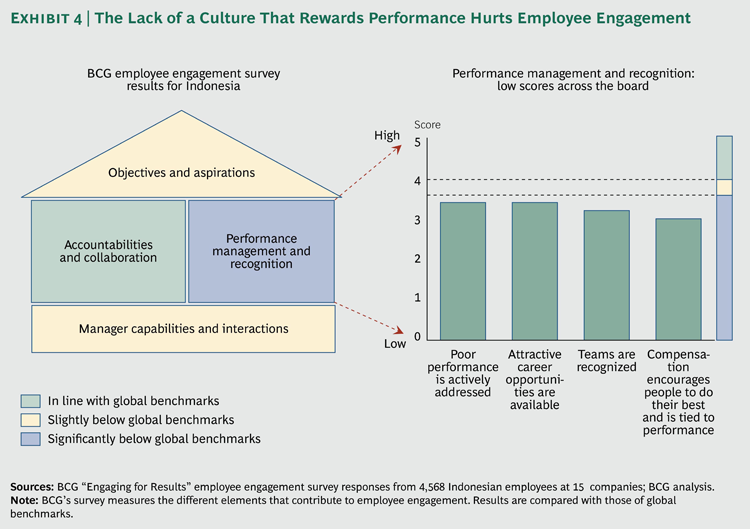
Tackling Indonesia’s Talent Challenges

Tackling Indonesia’s Talent Challenges

Growing Pains, Lasting Advantageby Dean Tong and Bernd WaltermannMAY 28, 2013

Tackling-Indonesia's-Talent_ex1_large_tcm80-134797Tackling-Indonesia's-Talent_ex4_large_tcm80-134806

Overview

In the mid-1990s, after the Indonesian football team was eliminated early in a regional tournament, President Suharto lamented: “We have more than 200 million people. There must be 11 of them with decent football skills.”

Indonesia has added 40 million people in the past two decades, but its shortage of talent has grown worse—and not just in football. Talent shortages threaten to undermine the country’s recent run of impressive economic performance.

Indonesia’s economy will likely break into the top 15 in the world in the next decade or so, but many companies may be left behind. They may need to scale back their growth plans unless they can recruit, develop, and retain the right people. This should be a top priority for chief executives in Indonesia. Fortunately, companies that act with foresight and persistence can become employers of choice and fulfill their growth aspirations. Others will falter. Read more of this post

Stock Investors in India Bypass IPOs

Updated May 28, 2013, 11:58 a.m. ET

Stock Investors in India Bypass IPOs

By ASHUTOSH JOSHI and SHEFALI ANAND

India is on pace for its worst year for initial public offerings since the global financial crisis, largely because two key groups of investors—foreign institutions and the Indian public—are staying away.

“I doubt if we will see a rush of IPOs for the rest of the year, given the poor retail participation in markets,” said Avinash Gupta, vice president of research at Globe Capital Market Ltd. in New Delhi.

It has certainly been a slow year thus far. Including search engine Just Dial Ltd., which raised $166 million last week in the country’s biggest IPO of the year, three companies have raised a total of $234 million—the lowest since 2009, according to data provider Dealogic. By comparison, there were 26 IPOs through May 28, 2010, that raised $2 billion. Read more of this post

Brazil investments have a long, potholed road ahead

Brazil investments have a long, potholed road ahead

3:12pm EDT

By Brad Haynes and Silvio Cascione

SAO PAULO (Reuters) – If you think you’re seeing light at the end of the tunnel for Brazil’s economy, look again: it’s just brake lights from a growing line of 18-wheelers.

Investment in Brazil probably grew at the fastest pace in three years in the first quarter, official data should show on Wednesday. But as much as two-thirds of the rise may have come from the construction of heavy trucks – hardly the steady capital spending that Brazil so badly needs.

If anything, the new trucks highlight one of the country’s great weaknesses: paltry investments in rail and waterways are forcing more and more goods onto a crumbling patchwork of highways. As more vehicles crowd the same lousy roads, shipping times have lengthened – which perversely creates a need for even more trucks. Read more of this post

Paid-for currents accounts could become the next bank mis-selling scandal as increasing numbers of customers complain that they cannot use the advertised perks, the financial watchdog warns.

Paid for current accounts may be next scandal, watchdog warns

Paid-for currents accounts could become the next bank mis-selling scandal as increasing numbers of customers complain that they cannot use the advertised perks, the financial watchdog warns.

Banks are also switching current account customers to paid-for accounts without their knowledge, the watchdog warned Photo: Rex Features

By Josie Ensor

6:00AM BST 29 May 2013

The Financial Ombudsman Service (FOS) has received a record number of complaints from people unhappy with the accounts offered by major high street banks after discovering that the included insurance deals were unsuitable.

Banks are also switching current account customers to paid-for accounts without their knowledge, the watchdog warned, with many only noticing when they see the charge debited from their account. Read more of this post

Germany fears revolution if Europe scraps welfare model

Germany fears revolution if Europe scraps welfare model

4:40pm EDT

By Ingrid Melander and Nicholas Vinocur

PARIS (Reuters) – German Finance Minister Wolfgang Schaeuble warned on Tuesday that failure to win the battle against youth unemployment could tear Europe apart, and dropping the continent’s welfare model in favor of tougher U.S. standards would spark a revolution.

Germany, along with France, Spain and Italy, backed urgent action to rescue a generation of young Europeans who fear they will not find jobs, with youth unemployment in the EU standing at nearly one in four, more than twice the adult rate. Read more of this post

London’s Irish Exiles Turn Failing Economy Into Sporting Success

London’s Irish Exiles Turn Failing Economy Into Sporting Success

Ireland’s troubles are London’s opportunity, at least when it comes to Gaelic football.

The U.K. capital’s team will play Leitrim in the semifinal of the Connacht Championship next month after winning its first game in the competition since 1977. The tournament is a gateway into the All-Ireland Championship, which will climax in September with a final in front of 80,000 people in Dublin. Most of the 15-man group arrived in London during the last four years, many as a result of Ireland’s near financial collapse, said Declan Flanagan, a spokesman for the club.

“We have definitely seen an upsurge,” said Flanagan, originally from Monaghan in the northeast of Ireland. “The economic downturn has had a significant impact. We’ve seen a lot more professional, better-educated guys arrive.”

The exodus follows the implosion of Ireland’s real-estate bubble, which plunged the country into its worst recession on record. In all, about 300,000 people left the country of 4.6 million in the four years through April 2012, according to the country’s statistical office. Many are devotees of Gaelic football, which is a cross between soccer, rugby and basketball. Read more of this post

Investors who have lent money at low rates this year to high-profile, deep-pocketed U.S. companies got a good look at the down side of that strategy

May 28, 2013, 7:28 p.m. ET

When Model Borrowers Bite Back

By MIKE CHERNEY

MI-BW229B_MKTLE_G_20130528190604

Investors who have lent money at low rates this year to high-profile, deep-pocketed U.S. companies got a good look Tuesday at the down side of that strategy.

The prices of bonds issued by Apple Inc., AAPL -0.83% Merck & Co., MicrosoftCorp., MSFT +2.19% Nike Inc. NKE +0.78% and McDonald’s Corp. MCD +0.95%tumbled along with U.S. Treasurys, underscoring the risk of purchasing high-rated corporate bonds at a time when interest rates are near record lows. These high-grade companies have raised nearly $27 billion in the past month on bonds that often yield within a percentage point of U.S. government debt. Read more of this post

NYSE Margin Debt Rises To New All Time High As Net Worth Slides To Record Low

NYSE Margin Debt Rises To New All Time High As Net Worth Slides To Record Low

Tyler Durden on 05/28/2013 18:28 -0400

Margin debt net free credit_0

With everything else in uncharted territory: central bank balance sheets, the stock market, global debt, it was only a matter of time before that old-school indicator of exuberance – margin debt – also joined the ranks of things that are “off the charts.” Never one to disappoint (except when Waddell and Reed dumps a “massive” 75,000 ES trade which promptly kills its liquidity replenishment points of course), the NYSE has reported that April margin debt, as expected, hit all time records, just in time for the S&P’s own all time high fireworks spectacular.  Rising from the just shy of summer of 2007 levels posted in March, or $380 billion, April margin debt not surprisingly rose to a record high of $384 billion. Additionally, even when netting out account credit metrics, such as Free Credit Cash and Credit Balances in margin accounts, total investor net worth just hit an all time record low of ($106) billion.

In short: investors have never been more levered. Read more of this post

Presenting The Full Impact Of Stock Buybacks On S&P 500 “Earnings”

Presenting The Full Impact Of Stock Buybacks On S&P 500 “Earnings”

Tyler Durden on 05/28/2013 14:23 -0400

There has been much speculation in the recent past over what the bottom-line impact of surging stock buyback activity has been on the overall S&P earnings: after all, by removing shares from circulation, the denominator in “per share” calculation gets smaller and smaller with every incremental buyback. Courtesy of JPM we finally have a definitive answer to this long-running question. Of the change in S&P TTM operating earnings between Q3 2011 and the just completed Q1 2013, a stunning 60% or $2.20, of all “gains” of $3.70 have been the result of buybacks. The remainder: a tiny $1.50 is due to actual organic growth. This means that nearly 60% of the bridge between the LTM operating earnings of $94.60 as of Q3 2011 to $98.30 at Q1 2013 has come from corporate management teams engaging in shareholder friendly activity.

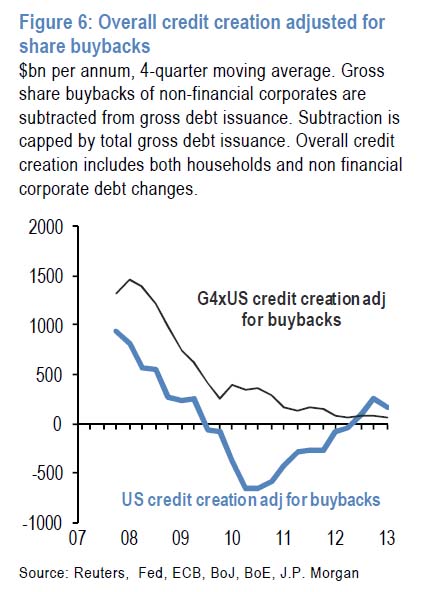
S&P divisorStock buybacks vs cash flow_0credit creation Read more of this post

What can you do with a DSGE model?

Monday, May 27, 2013

What can you do with a DSGE model?

When the Bank of England invited me to give a talk at their workshop on macroeconomics, I wasn’t sure if they wanted me to provoke (i.e. troll) them with the kind of skeptical stuff I usually write on this blog, or to talk about my own research on artificial markets and expectations. So I did both. Now, this is a central bank event, which means secrecy prevails – so I can’t tell you what the reaction was to my talk, or what other people said in theirs. But I thought I’d reproduce part of my talk in a blog post – the part where I talked about DSGE models. (In other words, the provocative part.)

“DSGE” is a loose term. It usually implies much more than dynamics, stochastics, and general equilibrium; colloquially, to be “DSGE” your model probably has to have things like infinitely far-sighted rational expectations, rapid clearing of goods markets, certain simple types of agent aggregation, etc. So when I talk about “DSGE models”, I’m loosely referring to ones whose form is based on the 1982 Kydland & Prescott “RBC” model. Read more of this post

Why bosses should be careful when using performance-related pay

Why bosses should be careful when using performance-related pay

May 25th 2013 |From the print edition

20130525_FND000_0

OF ALL a firm’s inputs, its workers’ effort is perhaps the oddest. It is as vital as land, factories or machines, but much harder to control. It is often impossible even to measure. A manager can gauge the firm’s output, but not the effort people put in, beyond crude gauges such as the time they spend on the job. Employees have the informational edge, knowing their own effort, output and skill level. This asymmetry makes it hard for managers to distinguish, for instance, between the low-skilled but diligent and the skilled but lazy. Monitoring schemes to reward hard-working employees and punish slackers can boost effort, but they can backfire badly, too.

What should firms do? A good place to start is with the worst kind of behaviour: crime. In a paper published in 1968 Gary Becker, of the University of Chicago, set out the factors which policymakers should consider when deciding on what resources they should devote to detection. In his model criminals calculate the risks and benefits of bad behaviour, taking into account the possible monetary reward, the probability of being caught and the subsequent punishment. To cut crime authorities must increase the probability of being caught, the severity of the punishment, or both. This approach can also be applied to less extreme forms of bad behaviour, such as slow or sloppy work: firms may have to monitor individual workers, and then reward the good and punish the bad. Read more of this post

India is considering letting its business houses run banks. It should think twice

India is considering letting its business houses run banks. It should think twice

May 25th 2013 | MUMBAI |From the print edition

20130525_FND001_0

BANKING in India is a vast problem and a huge opportunity. Only 35% of adults have formal accounts. A grim reminder of the risks for the 600m-odd unbanked folk came in April. A multi-billion-dollar, barely regulated, “chit fund” in Kolkata collapsed, destroying the savings of hundreds of thousands of poor people. Up to a dozen committed suicide, one by immolation. Precisely because the banking market is so underpenetrated, it should offer lots of growth. Although there are 196 domestic banks, a majority are state-controlled and stodgy. Lending margins are high. So when new licences for private players are granted, fortunes are made. The last two permits, awarded in 2003-04 when the industry was recovering from bad debts, have helped make $10 billion for their backers. Now the Reserve Bank of India (RBI), the central bank, plans to issue new licences. Applications are due by July 1st and a frenzy is building. Vikram Pandit, the Indian-born ex-boss of Citigroup, an American bank, has teamed up with a local outfit. There could be up to 100 entries for perhaps ten licences, reckons a banker.

Read more of this post

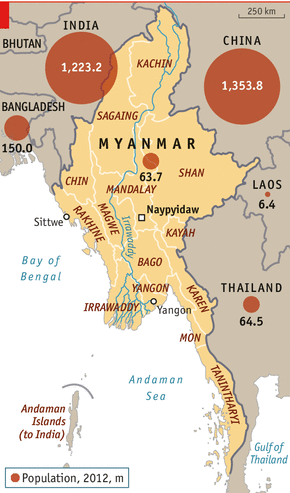
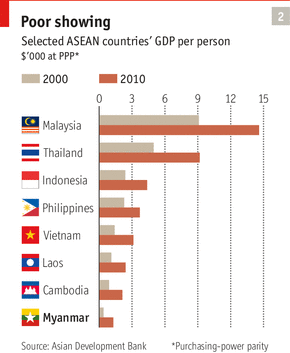
Why Myanmar’s military rulers are giving power to the people; Why investors still need to proceed with caution

Why Myanmar’s military rulers are giving power to the people

May 25th 2013 |From the print edition

20130525_SRM937 20130525_SRC485 20130525_src935 20130525_SRM934

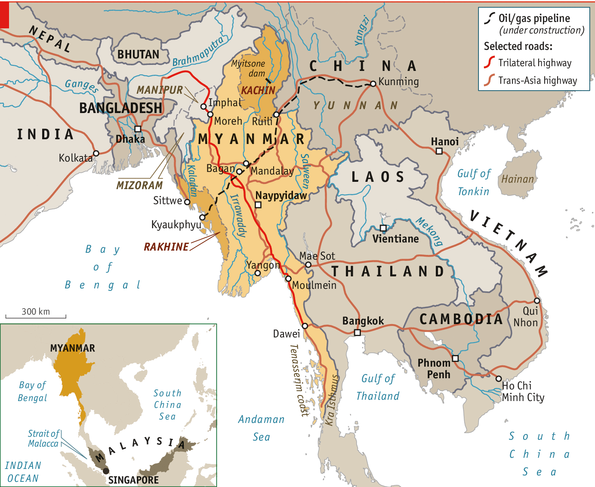
MYANMAR’S TRANSITION HAS been a top-down affair. This, more than anything, distinguishes it from other recent upheavals such as the “people power” revolutions of the Arab spring, the fall of communism in Europe and the toppling of Indonesia’s President Suharto. At crucial moments the threat of mass protests hurried the process along. Government advisers concede that in 2011 they were afraid of an Arab spring on the streets of Yangon. The army had mercilessly oppressed protests such as the aborted “saffron revolution” in 2007, led by monks, and the pro-democracy uprising in 1988 that had first propelled Miss Suu Kyi to national prominence. Those 1988 protests led to elections in 1990 which were won by the NLD but annulled by the government. For the main part, though, Myanmar now stands as a rare example of an authoritarian regime changing itself from within. Read more of this post

Do Shilajit, Other Rock Extracts Boost the Immune System?

May 27, 2013, 5:21 p.m. ET

Do Shilajit, Other Rock Extracts Boost the Immune System?

By LAURA JOHANNES

The Claim: Minerals and acids taken from rocks, including shale in the U.S. and tar from India, are good for your health. Rock ingredients vary, but can include fulvic and humic acids, and dozens of metals and minerals including iron, zinc, gold and silver, scientists say. Proponents say these ingredients soothe inflammation, boost the immune system and act as an antioxidant. A well-known rock-based treatment is shilajit, (pronounced shil-a-jeet), a tar-like substance scraped from rocks in the Himalayas.

The Verdict: “There is no known benefit of shilajit or other rock extracts” and they haven’t been adequately tested for safety in humans, says Philip J. Gregory, a pharmacist at ConsumerLab.com., which does independent testing on dietary supplements. Composition of rock-based therapies may vary from sample to sample, so it’s hard to be sure exactly what you’re getting, he adds.

PJ-BO502_ACHES_DV_20130527170737

Blk Enterprises’s Blk mineral-infused water sells for $2.49 for a 16.9-oz. bottle, while Pure Shilajit, a Himalaya tar-like resin which can be mixed in a liquid, sells for $380 for 90 grams.

The idea of consuming the nutrients in rocks for health benefits goes back thousands of years, says Dhaval Dhru, acting chairman of the department of Ayurvedic Sciences at Bastyr University in Kenmore, Wash. In ayurveda, or traditional Indian medicine, a small amount of shilajit is taken in warm milk, he says, to improve libido and treat a range of health problems such as diabetes and anemia. Read more of this post

A Better Way to Treat Anxiety; For Teens, Therapy Turns Parents Into ‘Exposure Coaches,’ Not Protectors

May 27, 2013, 5:42 p.m. ET

A Better Way to Treat Anxiety

For Teens, Therapy Turns Parents Into ‘Exposure Coaches,’ Not Protectors

By LAURA LANDRO

OB-XP842_INFORM_G_20130527185202

Getting up the nerve to order in a coffee shop used to be difficult for 16-year-old Georgiann Steely. Speaking in front of classmates was unthinkable.

The high-school sophomore overcame a crippling case of social anxiety as a patient in the Child and Adolescent Anxiety Disorders program at the Mayo Clinic in Rochester, Minn. Therapists there use an innovative approach early in treatment, gradually exposing children to things they fear most and teaching parents to act as “exposure coaches” rather than enable their children to avoid things and situations as a protective measure.

When parents help children to escape from feared situations, anxiety symptoms may worsen and children frequently become more impaired, says Stephen Whiteside, a Mayo pediatric psychologist. Read more of this post

New York rolled out a long-awaited bike-share program, an effort dubbed the city’s first new public-transit option in 75 years with $95 annual membership fee, $25 weekly passes and $9.95 day passes

May 27, 2013, 9:06 p.m. ET

Bike Share Gets Rolling Across City

Mayor Bloomberg Rolls Out Bike-Share Program With a Ding of a Bicycle Bell

By JOSH DAWSEY

NY-CJ227_BIKE_G_20130527162908

Toby Miller returns a bicycle to a bike-sharing kiosk on Monday. Straddling a bike but never pedaling, New York Mayor Michael Bloomberg rolled out a long-awaited bike-share program with a ding of a bicycle bell on Monday, an effort dubbed the city’s first new public-transit option in 75 years. A signature Bloomberg administration initiative, Citi Bike—named for its main sponsor, a financial-services company—made its debut with more than 6,000 bicycles available at 330 stations in Manhattan and Brooklyn for about 15,000 people who paid a $95 annual membership fee. Starting Sunday, others who don’t have annual memberships can buy day passes for $9.95 and weekly passes for $25.

Read more of this post

Indonesia’s Weak Institutions Spark Nostalgia for New Order; power abuse by elites and uneven growth has left people yearning for Suharto

Indonesia’s Weak Institutions Spark Nostalgia for New Order

A jurist and an economist say power abuse by elites and uneven growth has left people yearning for Suharto

By Ezra Sihite on 8:55 am May 27, 2013.

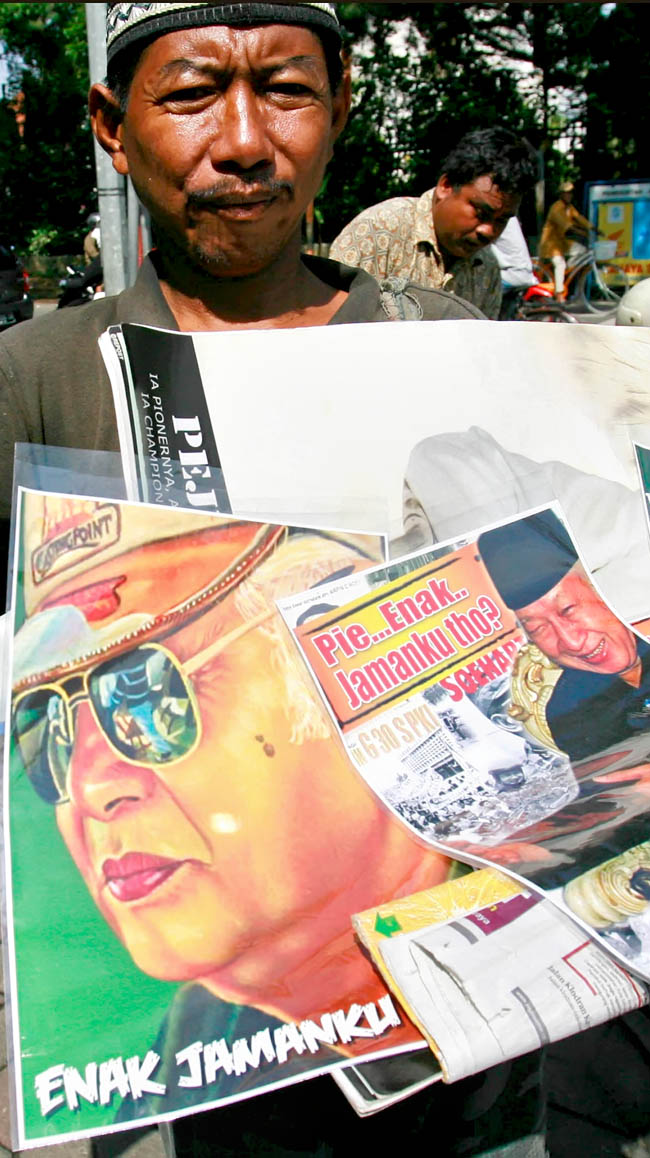
310313poster-soeharto2.jpg

President Suharto’s image can be found on posters around Indonesia in increasing numbers, as people seek the stability that his often-brutal leadership brought to the country. (JG Photo/Ali Lutfi)

Many Indonesians believe that life in the New Order era under President Suharto was better than today and that social elites dominate modern politics and law, according to a senior former jurist.

Speaking at a forum in Jakarta, former Constitutional Court chief justice Mahfud M.D. said that Indonesia is blighted by an oligarchy of elites that prioritize their interests over the public interest and do not abide by social rules, causing disillusionment and a lack of confidence in the law.

“Don’t be surprised to see people today wanting to see the military back [in power] because of oligarchic [conditions]. In Yogyakarta, you see stickers on cars with picture of a smiling Suharto reading, ‘Wasn’t it good during my time?’ ” Mahfud said. Read more of this post

Sick workers pay price for Chinese growth

Sick workers pay price for Chinese growth

By Carol Huang (AFP) – 1 hour ago

SHUANGXI, China — As China boomed around 200 men set out from Shuangxi’s rural idyll to build its infrastructure and skyscrapers. Now lung disease from dust has killed a quarter of them and 100 more are waiting to die.

Back home amid rice paddies and forested hills, Xu Zuoqing walks outside and his face contorts in pain from the effort. As he struggles to breathe, his wife rushes over a stool so he can recuperate.

“It’s like my lungs are being choked. My chest feels so tight,” says the 44-year-old who worked on construction sites for about 15 years, his voice strained at times.

“I just wish I could die comfortably… Well, I wish I didn’t have to die.” Read more of this post

The Ultimate Resume-Booster: Communist Party Membership; How China maintains interest in its ruling party, even as communist belief fades away

May 27, 2013 | by Lotus Yuen

The Ultimate Resume-Booster: Communist Party Membership

How China maintains interest in its ruling party, even as communist belief fades away

Zhang Xi’en, professor from the School of Politics and Public Administration at Shandong University, recently suggested that the Chinese Communist Party (CPP) should limit the number of its incumbent party members to 30 million and maintain a “moderate scale” of 51 million members in the future. Professor Zhang deemed this necessary because:

Various people, speculators included, have attempted to make personal gains in the name of being a ruling party member. They swarm into the Party, rapidly expanding its scale, and bringing tremendous danger to the Party.

The CCP, the largest political party in the world, had over 82 million party members as of 2011, 2.33 million more than in the previous year. It takes up around 6% of the total population of mainland China, and the total number is increasing by an average of one million people each year. Read more of this post

Corrupt Chinese officials turn to paying ‘black’ PR firms who claim to help them vanish from sight, with all negative stories about them scrubbed from the internet

Corrupt Chinese officials turn to ‘black’ PR

In the middle of the biggest anti-corruption campaign for years, crooked Chinese politicians are paying to vanish from sight, with all negative stories about them scrubbed from the internet.

The black PR firms are claiming “We can clean your name from blogs, forums, news websites, Weibo [China’s version of Twitter], everything,”  Photo: ALAMY

By Malcolm Moore, Beijing

5:46PM BST 26 May 2013

“It does not matter how big or sensitive the story is, we can make it disappear,” promised a manager at Yage Times, China‘s largest and most notorious “black” public relations (PR) firm. Dozens of Chinese officials have been put under investigation in recent months, and Communist Party members at every level are genuinely worried, according to the children of two senior cadres. In particular, they fear the internet, where stories about corrupt officials often go viral, putting pressure on the Communist party to launch a high-profile investigation. Read more of this post