How Beetle Overcame Nazi Past to Become Americans’ Car

How Beetle Overcame Nazi Past to Become Americans’ Car

“Owning a VW is Like Being in Love,” Popular Mechanics announced after polling its readers in 1956. “These owners have actually fallen in love with a car.”

Popular Mechanics wasn’t alone in marveling at the U.S. reception of the small “made in Germany” car. The New York Times Magazine, Fortune, Business Week, Road and Track and the Nation added to a buzz that was vastly disproportionate to the vehicle’s market share at the time. Of the 7.9 million new automobiles sold in the U.S. in 1955, Volkswagen AG (VOW) had accounted for just 28,907.

Nonetheless, the excitement elicited by the “Volks” in the mid-1950s foreshadowed the car’s subsequent success. Annual U.S. sales rose to 120,422 in 1959 and peaked at 563,522 in 1968. The affectionately nicknamed “Beetle” or “Bug” became a lasting fixture of the cultural landscape.

For a product that started out as an initiative of Adolf Hitler’s National Socialist dictatorship, this is a surprising trajectory. Commissioned in 1934 as the Nazi “people’s car,” the vehicle owed its rounded shape and defining engineering traits — most notably its robust air-cooled rear engine — to Ferdinand Porsche, who oversaw its development. Even so, the car’s historical lineage did little to dampen its budding reputation in the U.S. during the 1950s, partly because the Nazis never mass produced it. Read more of this post

The Steve Jobs Emails That Show How To Win A Hard-Nosed Negotiation

The Steve Jobs Emails That Show How To Win A Hard-Nosed Negotiation

Zachary M. Seward, Quartz | May 22, 2013, 1:15 PM | 31,749 | 20

The U.S. government’s price-fixing lawsuit against Apple goes to trial next month in New York. Ahead of its court date, the U.S. released emails that purport to show Apple was the “ringleader” in a scheme to set artificially high e-book prices with some of the largest American publishers, which have already settled the case.

The emails have mostly been viewed in the context of the lawsuit, but they also provide an extraordinary view of high-stakes negotiations between the leaders of two powerful firms, Apple and News Corp. They start far apart, but over the course of five days, Apple’s then-CEO Steve Jobs successfully pulls the son of News Corp. CEO Rupert Murdoch over to his side.

Jobs was a famously hard-nosed negotiator who won these kinds of battles all the time. Before book publishers, there was the movie industry. And before that, music record labels. But most of those negotiations were hidden from view. What follows are the emails released last week along with some context; spelling and grammar have been preserved from the originals.  Read more of this post

Wily Mutant Cockroaches Learn to Avoid Sugar to Outsmart Traps

Mutant Cockroaches Learn to Avoid Sugar to Outsmart Traps

Roaches that have been hard to exterminate may be a variety that have decided sugar doesn’t taste quite so sweet as bait anymore, researchers found.

Most cockroach baits cover poison in a layer of glucose, a sugar. Some mutant German roaches, the most common species of pest found in houses, apartments, restaurants and hotels, now taste glucose as bitter, researchers said in a study released in the journal Science. This change in palate enables them to avoid traps.

The scientists collected 19 roach populations, mostly from the U.S. and Puerto Rico, to look at how common the glucose-spurning had become. They found seven populations that had the taste trait, said Coby Schal, a study author and a professor of entomology at North Carolina State University in Raleigh. He expects the numbers would have been higher had his group asked exterminators to send sample roaches from infestations that had been difficult to control by ordinary means. Read more of this post

Prime Numbers Are The Secret To The Cicada’s Success

Prime Numbers Are The Secret To The Cicada’s Success

John Matson, Scientific American | May 23, 2013, 5:24 PM | 1,746 | 

“Periodical cicadas have the longest life cycles known for insects. They are called ‘periodical’ because in any one population all but a trivially small fraction are exactly the same age. The nymphs suck juices from the roots of forest trees and finally emerge from the ground, become adults, mate, lay their eggs, and die, all within the same few weeks of every 17th (or in the South, every 13th) year. Not one species does this, but three, and they always do it together.” —Monte Lloyd and Henry S. Dybas, 1966

There is safety in numbers or, at least, there is survival in numbers. That is the maxim that periodical cicadas live by.

Periodical cicadas — insects of the genus Magicicada — are remarkable creatures. They develop extremely slowly, underground, before surfacing en masse at either 13- or 17-year intervals, when the ground temperature reaches 64 degrees Fahrenheit. As described in the epigraph above, they quickly mate, lay eggs and die, disappearing from view until their offspring crawl out of the ground more than a dozen years later. Read more of this post

Three Stories About Steve Jobs, Einstein, And Ben Franklin Prove That Creative Beats Smart

Three Stories About Steve Jobs, Einstein, And Ben Franklin Prove That Creative Beats Smart

Max Nisen | May 23, 2013, 1:55 PM | 2,948 | 6

There are few commencement speeches that last beyond the day they’re given. One is Steve Jobs’ 2005 address to Stanford’s graduating class, where he famously used three stories to memorably define his life.  Jobs’ biographer Walter Isaacson used the same format in his Sunday commencement speech at Pomona College. He spoke about Jobs and his other most recent biography subjects, Benjamin Franklin and Albert Einstein, to drive home an incredibly important lesson. “You are officially credentialed as smart,” Isaacson told graduates. “That’s the good news. The bad news, as you’ll learn, is that smart people are a dime a dozen, and they usually don’t amount to much.” Using one of the phrases most associated with Jobs, Isaacson argued that it’s something other than smarts that defines the most successful people.

“What really matters is those who are creative, those who are imaginative, those like Steve Jobs, who can think different,” he said. Read more of this post

The Plateau Effect: Getting from Stuck to Success; Down-to-earth advice for getting out of a rut

May 22, 2013 4:18 pm

Down-to-earth advice for getting out of a rut

By Trisha Andres

The Plateau Effect: Getting from Stuck to Success

Bob Sullivan and Hugh Thompson

Dutton Books, $27.95

You could call it being stuck in a rut. Or, as the authors of this new book put it, you could say that effort follows the law of diminishing returns, eventually causing both people and companies to reach a point of stagnation where marginal returns disappear.

In The Plateau Effect , Bob Sullivan, an NBC News columnist, and Hugh Thompson, a maths professor and IT security expert, argue they have found a cure for this condition. They call it “constant recalibration”, or always rethinking your approach to problems. Read more of this post

The terrifying rise of the political entrepreneur who “do play the political game, and do not necessarily build a successful business.”

The terrifying rise of the political entrepreneur

By Francisco Dao, Updated: May 23, 2013

In 1999, I decided to leave the headaches of entrepreneurship behind and get a regular Silicon Valley job in an attempt to ride the dot-com wave. My timing was terrible, and by 2001 I had started another company. In that time, however, I learned that the corporate world is comprised of two groups. In one group, there are the entrepreneurs, individuals judged by actual results and forced to live by Yoda’s famous line, “Do or do not, there is no try.” Then there are the corporate stooges, for lack of a better term, who are usually judged by their ability to play corporate politics, making nice to their various bosses.

How a corporate stooge actually performed, or whether or not they produced value, was of little importance. They only had to be good at crafting an appealing image. This is what made entrepreneurs a different breed from the people who made their bones climbing the corporate ladder. Entrepreneurs were judged strictly by their bottom line results. Read more of this post

Abruptly, P.&G. Chief Robert McDonald, 59, Ends Career of 33 Years and was being replaced by his predecessor, Alan G. Lafley, 65.

May 23, 2013

Abruptly, P.&G. Chief Ends Career of 33 Years

By MICHAEL J. de la MERCED

In a surprise move, Procter & Gamble, the world’s biggest consumer products company, said on Thursday that its chief executive had resigned and was being replaced by his predecessor, Alan G. Lafley. Robert A. McDonald, 59, the company’s chief executive and president since 2009, notified the board a few days ago of his decision to retire, said a P.& G. spokesman, Paul Fox. Procter & Gamble had been under pressure from the prominent hedge fund manager William A. Ackman, who has criticized Mr. McDonald for the company’s poor stock performance. Mr. Ackman is known for publicly challenging management teams, having agitated for change at the likes of J. C. Penney and Fortune Brands. Mr. Fox said he was unaware of any health or personal reasons behind the abrupt decision by Mr. McDonald, who had worked at the company for 33 years. He also said that Mr. McDonald’s decision was not spurred by pressure from company directors. Read more of this post

Southeast Asia’s booming bond market has sparked fears of a bubble

May 22, 2013 6:57 pm

Asian debt: Beware of bubbles

By Paul J Davies in Hong Kong

Southeast Asia’s booming bond market has sparked fears of a bubble

P1-BL652A_AsiaD_G_20130523184805

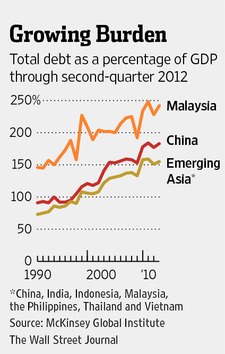
Gresik is a small industrial town of fewer than 100,000 people, just to the north of Indonesia’s second-largest city, Surabaya in East Java. But its position is critical. It sits near the Lombok Strait, the second most important shipping gateway between the Indian Ocean and the South China Sea and the vital trade route for fuel and resources between China and Australia. That is why AKR Corporindo has picked Gresik for what it hopes will become one of East Java’s biggest seaports and the only one tied directly to an industrial estate. The Indonesian logistics group has a 2,500-hectare site and has invested Rp675bn ($70m) of a projected Rp7tn-Rp8tn in the first phase of the development of both facilities. One of the most notable things about this investment is where AKR got the money: Asia’s local currency bond markets. These markets have their roots in the Asian financial crisis of 1997-98 but they have bloomed since the global financial collapse of 2008 unleashed easy money. However, the hot money flooding out of the west in search of higher returns in growing markets has stoked fears about the biggest credit boom in Asia since the spectacular implosion of the late 1990s. Read more of this post

Asia Goes on a Debt Binge as Much of World Sobers Up

May 23, 2013, 11:02 p.m. ET

Asia Goes on a Debt Binge as Much of World Sobers Up

By ALEX FRANGOS in Kuala Lumpur, Malaysia, and BOB DAVIS in Beijing

P1-BL651_AsiaDe_NS_20130523183622P1-BL652A_AsiaD_G_20130523184805

A debt-fueled building boom is under way in Kuala Lumpur, Malaysia, above. The country says investing in industry will result in faster economic growth.

In the heart of Kuala Lumpur lies the abandoned foundation of Plaza Rakyat, a never-built skyscraper and shopping mall. Rusty rebar jutting from concrete pilings and fetid green pools of rainwater serve as an unintended monument to the debt crisis that ravaged Asia in the late 1990s.

Today, less than a half mile from the abandoned project, the next boom is under way in the Malaysian metropolis. Construction has begun on a new subway line, and next to one station plans call for a 118-story zigzagging skyscraper that would be the third-tallest building in the world. Cheap credit is fueling the building spree. Read more of this post

Stanford U: The Evolution of Partnerships in China: From the Perspective of Asset Partitioning

The Evolution of Partnerships in China: From the Perspective of Asset Partitioning

Lin Lin  National University of Singapore; Stanford Law School; Stanford University – Arthur & Toni Rembe Rock Center for Corporate Governance

2013
Stanford Journal of Law, Business and Finance, Vol. 18, No. 2, pp. 212-246, 2013

Abstract: 
Two of the world’s leading corporate law scholars, Henry Hansmann and Reinier Kraakman, recently shook the foundation of organizational law theory by suggesting that the genius behind modern business organizations was a concept that they have coined “asset partitioning”. Specifically, they argue that a critically important characteristic of almost all business organizations is the creation of rules which partitions separate pools of assets between creditors of the firm and creditors of the firm’s investors. Building on this theory, in a recent Harvard Law Review article, “Law and the Rise of the Firm”, Hansmann, Kraakman and Richard Squire further posit that historical and at present “entity shielding” (i.e., the rules that protect or partition the firm’s assets from the creditors of the firm’s investors) must be created by a countries organizational law for large business organizations to develop. In fact, they suggest that entity shielding has been even more important than limited liability in the development of modern business organizational forms.

While their research presents a comprehensive “western story” of the evolution of business entities, it does not mention China and other Asian jurisdictions. This Article attempts to fill this gap in the literature by examining Hansmann and Kraakman’s influential theory in the context of China. It accomplishes this by examining whether entity shielding existed in ancient China, which was one of the most advanced societies and economies in the ancient world. If this examination reveals that entity shielding did exist in ancient China then it will reinforce Hansmann and Kraakman’s prominent theory by demonstrating that it can make sense of the development of business organizations both in the East and the West. This finding would also reinforce their suggestion that entity shielding generally is a universal prerequisite for large business organizations to effectively function. On the contrary, if there was an absence of entity shielding in ancient China, it would force us to rethink this theory further and it would bring new insight to the divergence between the East and West on the matter of entity shielding.

This Article brings unique insights from the complex evolution of Chinese partnerships to the recent debate on asset partitioning. By illustrating how Chinese partnerships have evolved and how Chinese perception has influenced this process, this Article shows that ancient Chinese partnerships did not exhibit a feature comparable to entity shielding vis-à-vis their European counterparts, especially the partnerships during Ancient Rome and Italian Middle Ages.

It demonstrates that beneath the surface of great divergence in the institutionalization of business practices between China and the West is the great differences between both societies. These differences include different social and legal traditions, different social attitudes towards merchants and commerce and differing levels of development of commodity markets. In particular, Confucian distaste of profits and merchants, the emperors’ concern on maintaining centralized control over the state, the governments’ custom of utilizing merchants created huge obstacles to the development of partnerships as well as partnership law in ancient China. Also, there were alternative means for ordering behavior and protection of creditors, such as kinship obligations, lineage trust, local customs and social norms. All these factors shaped Chinese business practice and led to the lack of rule of entity shielding.

Buyer Beware: The Risk to Institutional Investors Financing China’s Local Government Debt

Buyer Beware: The Risk to Institutional Investors Financing China’s Local Government Debt

by Ryan Rutkowski | May 23rd, 2013 | 12:16 pm

Owners of the debt of local government special purpose vehicles (SPVs) should choose wisely and be cautious. At least this is the message central government officials are communicating to China’s financial markets. Two weeks ago, Premier Li Keqiang identified “controlling the risks of local government debt” as one of his administrations key reform initiatives. But who exactly should be worried about the risk of holding local government debt? The answer used to be banks but recently institutional investors have increased their role.

During the late 1990s up to 2008, China Development Bank (CDB) used to be behind most of local government debt in China. The policy bank pioneered the model of lending to local government SPVs. The bank was able to provide long term loans to localities which the localities paid off using revenues from local land sales to pay down interest and principal until project cash flows came online. This system seemed to work well until 2008 when the return-on-assets of CDB began to fall behind most commercial banks. CDB’s difficulties were not soon enough to discourage commercial banks from lending to local governments. Read more of this post

Exclusive: China $6.5 trillion urbanization plan hits roadblock over spending fears

Exclusive: China urbanization plan hits roadblock over spending fears – sources

9:44am EDT

By Kevin Yao

BEIJING (Reuters) – China’s plan to spend $6.5 trillion on urbanization to bolster the economy is running into snags, sources close to the government said, as top leaders fear another spending binge could push up local debt levels and inflate a property bubble. Premier Li Keqiang has rejected an urbanization proposal drafted by the National Development and Reform Commission (NDRC), seeking changes to put more emphasis on economic reform, according to the sources, who are familiar with the matter. Many local authorities have already lobbied to get funding for projects, ringing alarm bells among top leaders in Beijing. Read more of this post

CJ Group Chairman Lee Jay-hyun has been banned from leaving the country in a widening investigation into his massive slush fund, prosecutors said Thursday

2013-05-23 17:15

CJ chairman banned from leaving nation

By Kim Jae-won
CJ Group Chairman Lee Jay-hyun has been banned from leaving the country in a widening investigation into his massive slush fund, prosecutors said Thursday.
Besides the initially-cited 7 billion won, prosecutors suspect that the size of Lee’s slush funds is far larger and gave a significant portion of it to his children, they said.
Sources in the Seoul Central District Prosecutors’ Office say that in 2006 Lee allegedly transferred a combined 50 billion won to his two children — 25 billion won each — in cash without paying gift taxes, raising suspicions that it was part of the slush fund. The group also is suspected of helping CJ America and CJ Indonesia expand their businesses by buying their products at inflated prices. Read more of this post

There is probably money to be made in analyzing the foibles of money managers, to create new strategies by taking on the opposite of what they are doing.

The Rules, Part XXXVIII

23 May, Aleph Blog

There is probably money to be made in analyzing the foibles of money managers, to create new strategies by taking on the opposite of what they are doing.

What errors do most money managers make today?

  • Chasing performance
  • Over-diversification
  • Benchmarking / Hugging the index
  • Over-trading
  • Relying too heavily on earnings growth
  • Analyzing the income statement only
  • Refusing to analyze industries
  • Buy newsy companies
  • Relying on the sell-side
  • Trusting management too much Read more of this post

Bird Flu Virus Is Capable of Human Spread, Ferret Studies Show

Bird Flu Virus Is Capable of Human Spread, Ferret Studies Show

The bird flu virus that’s killed 36 people in China is capable of human-to-human spread, scientists found in animal studies that highlight its pandemic potential.

Ferrets experimentally infected with the new H7N9 strain passed it to other ferrets occupying the same cage, indicating the virus’s ability to spread via direct contact, researchers at the Chinese Center for Disease Control and Prevention in Beijing and the University of Hong Kong said. Flu transmission in ferrets is a predictor of patterns in humans, the authors said in the study, published yesterday in Science Express.

The research will help health officials tailor their response to the H7N9 strain, which is known to have infected 131 people since March, mostly through contact with virus-laden poultry. No cases have been reported since May 8, weeks after authorities curbed live poultry sales in the eastern cities of Shanghai, Nanjing and Hangzhou. So far, there is no evidence of sustained human-to-human transmission — a feature required for flu to spark a pandemic — the World Health Organization said. Read more of this post

H7N9 bird flu found to spread through the air, a team at the University of Hong Kong found after extensive laboratory experiments.

H7N9 bird flu found to spread through the air

Friday, 24 May, 2013, 12:00am

Jeanette Wang jeanette.wang@scmp.com

Virus can also infect pigs, say HKU researchers, who warn officials to maintain tight scrutiny even though threat seems under control

The H7N9 bird flu virus can be transmitted not only through close contact but by airborne exposure, a team at the University of Hong Kong found after extensive laboratory experiments. Read more of this post

Chinese banks barred from sponsoring IPOs; Securities brokerages at centre of China regulator’s crackdown

May 23, 2013 3:29 pm

Securities brokerages at centre of China regulator’s crackdown; Chinese banks barred from sponsoring IPOs

By Simon Rabinovitch

On the first anniversary of its stock market listing last month, Xi’an Longi Silicon Materials Corp served its factory workers steaming plates of simmered fish, an unusual delicacy for the staff canteen. It was to “ensure that all employees would share in the happy occasion”, the company says.

Just over three weeks later, on May 3, Xi’an Longi received a visit from the stock market regulator. The China Securities Regulatory Commission was launching an investigation, on suspicion that the company had violated the nation’s securities law by failing to disclose a steep fall in profits in the run-up to its listing.

The questions surrounding Xi’an Longi, a producer of silicon wafers and semiconductor ingots, are just one front in a much bigger battle being fought over how China polices its financial industry. At the centre of this battle are the securities brokerages that bring companies to the stock market in initial public offerings. Read more of this post

In Indonesia, soccer is kicked around by political parties; “If you can control football, you are half way to controlling Indonesia”

In Indonesia, soccer is kicked around by political parties

Thu, May 23 2013

By Janeman Latul

JAKARTA (Reuters) – As monsoon rains swept the stadium, the chanting grew louder. “Indonesia! Indonesia!” More than 60,000 people packed into Gelora Bung Karno Stadium in Jakarta on a recent Saturday night to see the national soccer team play. Another 100 million tuned in to television to watch the match, underlining the appeal of soccer in Indonesia where attendance rivals the top English and German soccer leagues. Among the fans are two of Indonesia’s most powerful people – President Susilo Bambang Yudhoyono and politically ambitious businessman Aburizal Bakrie. Their parties have long been battling for control over the sport and its huge audience, hoping this could be a factor in elections next year. Bakrie, who leads the Golkar party and has said he will be a presidential candidate, seems to have wrested control of a unified soccer association that was formed in March after almost two years of the two groups running parallel associations and parallel leagues. The association in charge of the sport controls marketing in the stadiums and on television. “If you can control football, you are half way to controlling Indonesia,” said a senior official at the Indonesian national soccer association, or PSSI. Read more of this post

No trespassing: Instituting better property protections is essential to China’s transitioning economy

No trespassing

Thursday, May 23, 2013

Instituting better property protections is essential to China’s transitioning economy, writes Andrew Sheng and Xiao Geng

Andrew Sheng, President of the Fung Global Institute, is a former chairman of the Hong Kong Securities and Futures Commission, and is currently an adjunct professor at Tsinghua University in Beijing. Xiao Geng is Director of Research at the Fung Global Institute.

Too often, debate about the relationship between the state and the market casts them as opposing forces locked in a zero-sum struggle. But this simplistic approach quickly turns constructive discussion into a casualty of the ideological battle between advocates of both sides. Read more of this post

Party ends for Western Australia’s investment boom

Party ends for Western Australia’s investment boom

English.news.cn   2013-05-24 by Christian Edwards

SYDNEY, May 24 (Xinhua) — It’s over. Official figures released Thursday by the Bureau of Resources and Energy Economics (BREE) show that Australia’s burgeoning resource state of Western Australia is staring down at the now empty barrel of the China- driven investment boom, leaving experts scanning the economic horizon for the next ray of hope. Projects worth over 175 billion Australian dollars, which have already been on the pipeline or under construction, are now slowly being shelved.

New gas projects that have been planned include the 53 billion Australian dollar Gorgon gas project, the 30 billion Australian dollar Browse LNG (liquefied natural gas) project, and the 29 billion Australian dollar Chevron-Wheatstone LNG project, in addition to a range of iron ore, gold and other projects. For more than six months fears have been growing that the party could be over. Read more of this post

Aussie Dollar Is Villain as Ford Ends Mad-Max Land Output

Aussie Dollar Is Villain as Ford Ends Mad-Max Land Output

Ford Motor Co. (F) Falcons, driven by Mel Gibson in Australia’s 1979 movie “Mad Max,” have rolled off a Melbourne production line for 53 years. Now, like Max’s “last of the V-8s,” their days are numbered. Ford, in Australia since 1925, said yesterday it will close its local manufacturing plants in October 2016, resulting in 1,200 job losses. General Motors Co. (GM)’s Holden unit, which traces its roots to 1856 when it started as a saddler business, said on April 8 it will cut about 500 workers as currency devaluations overseas make its operations among the world’s costliest.

The villain has been Australia’s dollar: Up 76 percent versus the yen since October 2008, it has helped send Japanese car imports to a record and sales of domestically made vehicles down 18 percent in four years. Ford’s local President Bob Graziano yesterday said that costs are double those in Europe and four times those of its Asian divisions, and that even twice as much government aid couldn’t make the unit sustainable. Read more of this post

The U.S. and China have struck an agreement giving U.S. accounting regulators access to documents from Chinese accounting firms.

Updated May 24, 2013, 1:08 a.m. ET

U.S., China Set Pact On Auditor Access

By MICHAEL RAPOPORT

The U.S. and China have struck an agreement giving U.S. accounting regulators access to documents from Chinese accounting firms. The deal, expected to be announced Friday, could help U.S. regulators investigate the auditors of U.S.-listed Chinese companies that might have been involved in accounting fraud. The agreement will allow the U.S. Public Company Accounting Oversight Board to see audit records and other documents held by Chinese audit firms. The China Securities Regulatory Commission and China’s Ministry of Finance will help the PCAOB obtain the documents. More than 100 Chinese companies listed in the U.S. have faced questions about their accounting and disclosure from regulators, auditors and short-sellers, and investors lost billions of dollars when those companies’ shares plunged. Read more of this post

Many investors may not be living in the real world

May 23, 2013 7:39 pm

Many investors may not be living in the real world

By Stephen King

A recovery in the global economy would appear to be hallucinatory, writes Stephen King

No one can be strong when China is weak. That, at least, appeared to be the message from the economic data this week. New data suggest lacklustre growth in China – sparking nervous sell-offs in other countries. A one-day decline of over 7 per cent in the Nikkei stock market index might seem like an overreaction but, last year, China was Japan’s most important export destination, accounting for more than 18 per cent of its goods exports. China now accounts for one-quarter of South Korea’s exports. China is also the third-largest destination for US exports, after Mexico and Canada.

Stock market wobbles cannot be attributed toChina alone. Ben Bernanke, Federal Reserve chairman, revealed that asset purchases associated with quantitative easingmight be tapered earlier than investors expected, providing another reason for stock markets to lurch down. Meanwhile, rising bond yields in Japan have led to a new sense of unease: financial bets are no longer all one way. Read more of this post

Imprisoned Entrepreneurs and Russia’s Economic Slump

Imprisoned Entrepreneurs and Russia’s Economic Slump

President Vladimir Putin’s popularity throughout much of Russia is founded on an implicit social compact: People have given up some freedom in return for economic prosperity.

Now, Putin’s authoritarian ways could be killing the economic growth that has helped keep him in power.

Time and time again, Russia’s leaders have pledged to restructure the country’s economy, making it less dependent on oil and gas. In an interview this week to mark the first anniversary of his move to the prime minister’s job from the presidency, Dmitri Medvedev effectively admitted failure. “We must change the structure of our economy,” he told the popular daily Komsomolskaya Pravda. “In the past 13 to 14 years we just did not have enough time to do it.” Read more of this post

Bundesbank chief says ECB has done a lot to fight crisis, can’t solve it

Bundesbank chief says ECB has done a lot to fight crisis, can’t solve it

Filed 13 hours ago

Germany’s federal reserve Bundesbank President Jens Weidmann stands beside the door of a giant safe as he poses for a photograph at the money museum next to the Bundesbank headquarters during a photo shoot with Reuters in Frankfurt May 17, 2013. REUTERS/Kai Pfaffenbach

By Ingrid Melander

PARIS – Bundesbank chief Jens Weidmann said on Thursday it was not up to the European Central Bank to solve the euro zone crisis, resisting pressure from other ECB policymakers for the bank to widen its range of policy tools. Speaking in Paris, Weidmann declined to comment on U.S. Federal Reserve chairman Ben Bernanke’s remarks that the U.S. central bank may start to trim its bond purchases at one of its next policy meetings. Focusing on the situation in the euro zone he said: “Monetary policy, that is to say the Eurosystem (of euro zone central banks) has already done a lot to curtail the crisis.” “But monetary policy cannot solve the crisis, we are completely united on that in the ECB Governing Council,” Weidmann, a member of the policymaking body, told a conference. Read more of this post

Primary Dealers Saw Fed’s Confusing Strategy Reducing QE Impact

Primary Dealers Saw Fed’s Confusing Strategy Reducing QE Impact

The 21 primary dealers that trade securities directly with the Federal Reserve Bank of New York, said that confusion about the central bank’s intentions for its bond-buying program is reducing the policy’s effectiveness.

The dealers’ views were shared with the New York Fed in a survey of primary dealers that the Federal Open Market Committee reviewed at their April 30-May 1 meeting. A diversity of Fed speakers expressing different views has left the primary dealers unsure of the central bank’s intentions, according to the survey results released today by the New York Fed.

“Some dealers noted that the dispersion of views expressed by FOMC participants as to how the FOMC would make decisions regarding the future pace of asset purchases has decreased clarity around the program,” the survey said. “Of these dealers, several suggested that the differing views on monetary policy may reduce the policy’s effectiveness.” Read more of this post

Bonds Rigged as Stocks Expensive for Scots Manager Doubling Fund

Bonds Rigged as Stocks Expensive for Scots Manager Doubling Fund

From his view of the world in Scotland, Bruce Stout says investors risk getting burned because optimism is too high for stocks and bond yields are too low. The markets might be proving him right.

The MSCI World Index, a gauge of developed stock markets, sank by the most yesterday since April 15, while Japan’s Topix Index lost 6.9 percent. Stout, whose 1.5 billion-pound ($2.3 billion) Murray International Trust (MYI) at Aberdeen Asset Management Plc (ADN) posted triple-digit returns during the past four years, has been selling shares he reckons are now too expensive, while his fixed-income holdings are the lowest in 25 years.

“The higher prices go the more short-term expectations can distort things and then you can lose your money,” Stout said at his office in Edinburgh. “That’s why we’re in a capital preservation mode to try and not lose money.” Read more of this post

Fears grow over EM sovereign bond bubble

May 23, 2013 9:18 am

Fears grow over EM sovereign bond bubble

By Robin Wigglesworth

As far as financial follies go, tulip mania takes some beating. But future economic historians may look back at the time when investors financed a convention centre in Rwanda as the moment that the rush into emerging market bonds became frothy.

Despite a large chunk of Rwanda’s budget coming from overseas aid – some of which was withheld last year after it was accused of backing rebels in neighbouring Democratic Republic of Congo – investors rushed to get a slice of the country’sinaugural $400m bond last month. The proceeds are largely to be used to pay for a new conference centre in Kigali, the central African country’s capital. Read more of this post

Delinquent Student Loans Hit Record, 30% Of 20-24 Year Olds Are Unemployed And Not In School

Delinquent Student Loans Hit Record, 30% Of 20-24 Year Olds Are Unemployed And Not In School

Tyler Durden on 05/23/2013 11:37 -0400

Almost a year ago we shared a calculation according to which “Over $120 Billion In Federal Student Loans In Default“, suggesting that the next credit crisis has already arrived. Since then the topic of the student loan bubble has become a household topic. Sadly, that does not mean it has gotten any better. In fact, according to the latest Education Department data it has gotten as bad as it has ever been. As Bloomberg reports, not only have overdue student loans reached an all-time high but the number of young people aged 20-24 out of school and unemployed is at a record high: not quite astronomic by European standards, but hardly a ringing endorsement of an economy set to transition labor tasks to the next generation, especially with the employment of those 55 and older at all time highs. Read more of this post