As Of This Moment Ben Bernanke Own 30.5% Of The US Treasury Market… And Will Own All By 2018

As Of This Moment Ben Bernanke Own 30.5% Of The US Treasury Market… And Will Own All By 2018

Tyler Durden on 05/23/2013 21:37 -0400

As is well-known by everyone, the Fed monetizes the US deficit on a daily basis, thanks to the 45 minutes of POMO love each day when it buys Treasuries from Dealers. Of course, the Fed monetizes bonds from across the entire curve (mostly the longer end), which is why it is somewhat complicated to express the amount of risk transfer the Fed takes on every time the S&P posts an uptick as a result of yet another bond purchase by the hedge fund with the largest fixed income portfolio in the history of the world. However, one simple way of expressing just this risk is through the use of ten year equivalents: Ten-year equivalents are the amount of 10-year notes that must be held by the Fed in order to remove the same amount of interest rate risk from the market as its current holdings. What this methodology allows is to represent the Fed’s holdings of all marketable securities on a linear continuum, and represent the remainder, or those bonds held by the private sector, on the side. So what may come as a surprise to most, is that as of this week’s H.4.1 update, the amount of ten-year equivalents held by the Fed increased to $1.583 trillion from $1.576 trillion in the prior week, which reduces the amount available to the private sector to $3.637 trillion from $3.668 trillion in the prior week. And also, thanks to maturities, and purchase by the Fed from the secondary market, there were $5.219 trillion ten-year equivalents outstanding, down from $5.244 trillion in the prior week.

Fed holdings 5.23-2_0 Read more of this post

Inside Google’s Secret Lab

Inside Google’s Secret Lab

By Brad Stone on May 22, 2013

covertrail22_v3_304feature_google22__02__inline605Illustration by Rami Neimi“Anything which is a huge problem for humanity we’ll sign up for”feature_google22__03__inline605Illustrations by Rami Neimi“Incremental improvements are not good enough”


Illustration by Rami NeimiAbsurdity is not a barrier to considerationfeature_google22__01__inline605feature_google22__01__950

Last February, Astro Teller, the director of Google’s (GOOG) secretive research lab, Google X, went to seek approval from Chief Executive Officer Larry Page for an unlikely acquisition. Teller was proposing that Google buy Makani Power, a startup that develops wind turbines mounted on unmanned, fixed-wing aircraft tethered to the ground like a kite. The startup, Teller told Page, was seeing promising results, and, he added proudly, its prototypes had survived all recent tests intact.

Page approved Google X’s acquisition of Makani, which was being completed for an undisclosed amount at press time. He also had a demand. “He said we could have the budget and the people to go do this,” Teller says, “but that we had to make sure to crash at least five of the devices in the near future.” Read more of this post

Now this is why I would fork over $1500 and risk looking like a tool to wear a pair of Google Glasses: face recognition.

Google Glass gets face recognition

PUBLISHED: 9 HOURS 19 MINUTES AGO | UPDATE: 0 HOUR 0 MINUTES AGO

JOHN DAVIDSON

713a5e36-c3ef-11e2-821c-f7d31f9028fe_Google Glasses--646x363

Updated: Now this is why I would fork over $1500 and risk looking like a tool to wear a pair of Google Glasses: face recognition.

Lambda Labs, a San Francisco-based augmented reality company, says it has developed facial recognition software for Google’s not-so-soon-to-be-released Glasses, that will tell you the name of who you’re looking at. The software will be made available to Google Glass app developers within the week.

The software spots faces in your field of vision, and then puts names to that face, ranked in order of probability, based on a pool of mug shots that you’ve already uploaded to some servers somewhere. Presumably you can turn it off, so it’s not trying to name every passerby as you walk along the street, and you only turn it on when you arrive at a party or a meeting where you’re worried that you’ll forget a name. Read more of this post

IPhone Urinalysis Draws First FDA Inquiry of Medical Apps

IPhone Urinalysis Draws First FDA Inquiry of Medical Apps

An iPhone application that lets users check levels of blood, protein and other substances in their urine is the first target of U.S. regulators seeking boundaries in a burgeoning industry for medical diagnosis on-the-go.

Biosense Technologies Private Ltd.’s uChek system isn’t cleared by the Food and Drug Administration and the agency said it wants to know why not, in a first-of-its-kind letter to a maker of a mobile-device application. The app relies on users, such as diabetics checking their glucose, to dip test strips in urine and use the smartphone’s camera to allow the system to processes and generate automated results. Read more of this post

Is Supercell the Fastest-Growing Game Company Ever?

Is Supercell the Fastest-Growing Game Company Ever?

by Karsten Strauss | May 24, 2013

topimg_21727_ilkka_paananen_600x400IS THIS THE FASTEST-GROWING GAME COMPANY EVER.indd

In less than a year, Supercell has launched two of the biggest apps in Apple’s history. It’s now grossing $70 million—a month

Ilkka Paananen says the best way to make money in mobile gaming is to stop thinking about it. Think about fun instead. Fighting a mild case of flu and jet lag from a San Francisco flight back home to Helsinki, Paananen says companies that place revenue above fun (we’re talking to you, Zynga) will ultimately fail. “It really is that simple—just design something great, something that users love,” says the 34-year-old.

Paananen is CEO of Supercell, a startup that has had astonishing growth almost overnight. It has only two titles in Apple’s App Store—a tower defence game called Clash of Clans and a social-farming game called Hay Day—but it grossed $100 million last year and $179 million in the first quarter of 2013. Supercell netted $104 million in the quarter, after expenses and Apple’s 30 percent cut. Read more of this post

Beijing Shuts Down Taobao’s ‘Take a Number’ Service for Hospitals, But Consumers Cry Foul

Beijing Shuts Down Taobao’s ‘Take a Number’ Service for Hospitals, But Consumers Cry Foul

May 24, 2013 by C. Custer

Chinese hospitals are, to put it mildly, a bureaucratic nightmare. Just checking into one generally involves, among other processes, waiting in line to take a number and often also waiting in another line to pay for taking that number. Monster e-commerce siteTaobao was attempting to take some of the sting out of that with a new service launched earlier this week that allowed customers to book numbers and in some cases also pay online. But yesterday, after just three days open, the service was shut down in Beijing by the city’s health department on the grounds that healthcare is an issue of “public interest” and thus ‘take a number’ services should be non-profit. It also suggested that providing health information to a third party caused a potential information security risk.

That would be a compelling argument, except that many of China’s hospitals themselves aren’t even non-profit, and even in non-profit hospitals there is often a fair amount of under-the-table cash expected from patients if they want to receive good service. Perhaps healthcare in China should be non-profit, but since it very clearly isn’t, why target Taobao for making money off of the convenience of online ‘take a number’ services when for-profit hospitals are profiting daily off of their patients? Read more of this post

Google Copies Amazon’s Playbook

May 23, 2013, 4:56 p.m. ET

Google Copies Amazon’s Playbook

By GREG BENSINGER And AMIR EFRATI

MK-CD229_COPYCA_NS_20130521180903

SAN FRANCISCO—Google Inc. GOOG -0.75% co-founders Larry Page and Sergey Brin say they don’t pay much attention to rivals. But the search company increasingly appears to be following Amazon.com Inc.’s AMZN -0.44% lead.

The latest example involves cable ties, AC-DC adapters, radiation detectors and the like. In April of last year, Amazon rolled out AmazonSupply, an e-commerce site featuring such industrial goods. Google followed suit this January, testing Google Shopping for Suppliers, which also helps shoppers find items tailored for businesses.

Both sites represent a relatively new foray for the technology companies—business-to-business sales—though Google’s doesn’t sell the items directly and its service is limited to suppliers of certain types of electrical equipment. Read more of this post

Amazon Vs. Costco: Which Is Better For Buying In Bulk?

Amazon Vs. Costco: Which Is Better For Buying In Bulk?

Stacey Bumpus, GoBankingRates.com | May 23, 2013, 2:08 PM | 3,685 | 

Saving money is on the minds of most Americans, which is why so many make a special effort to purchase items in bulk and join discount clubs. It’s also the reason so many businesses are creating opportunities for consumers to access those savings. One program to crop up in recent years is Amazon Subscribe and Save, which touts savings of up to 15 percent to members who meet specific criteria. But is this program as amazing as it seems, or is it possible that subscribers are actually losing dollars by committing to make purchases over the long term?

What Is Amazon Subscribe and Save?

If you are not accustomed to purchasing groceries and other household items online, or simply haven’t heard of this program, you may wonder what is Amazon Subscribe and Save? Amazon Subscribe and Save is a program launched in 2007 that offers discounts on items typically sold in bulk. In addition to a reduction in costs, the program offers free shipping. The lower costs are offered in exchange for a subscription agreement that involves having specific items automatically shipped every one, two, three, four, five or six months. But probably the biggest benefit of joining the program is paying no upfront fees to subscribe. Members only need to pay for items when they are shipped. You can probably see the similarities between Amazon Subscribe and Save and memberships to wholesale clubs like Costco with one clear exception: Amazon subscribers don’t have to worry about placing orders as they are placed automatically. With this and other conveniences, one would think there could be no downside to a program like Amazon’s. However, great discount programs are not always as fantastic as they seem.

How Amazon Subscribe and Save Compares to Costco

Individuals trying to decide whether to join Amazon Subscribe and Save or stick with a traditional wholesale membership with a company like Costco have several pros and cons to weigh. But before getting started, here are a few basics to know about Costco. Read more of this post

Twitter pitches to advertisers with system to track TV watchers

May 23, 2013 4:36 pm

Twitter pitches to advertisers with system to track TV watchers

By Emily Steel in New York

Twitter is attempting to secure its position at the nexus between television and digital media, announcing on Thursday a new TV ad-targeting programme along with a flurry of partnerships with media companies including Major League Baseball, Time Inc, Vevo and Vice.

The new ad product taps special technologies to “watch” television and note when a commercial airs. At the same time, it “listens” to Twitter for people posting about the same show. The technology then allows advertisers to target ads on Twitter to people who likely saw their commercials on television.

Twitter also unveiled its Twitter Amplify programme, a series of partnerships with media companies that will introduce into users’ news feeds more video clips as well as real-time sponsorships that link ads on television to promotions on Twitter. Amplify extends Twitter media partnerships beyond television to include magazine publishers, sports leagues and music groups. Read more of this post

CIOs Debate ‘Cockroach Technology’

May 23, 2013, 1:58 PM ET

CIOs Debate ‘Cockroach Technology’

Michael Hickins

CAMBRIDGE, MASS. — Several CIOs participating in panel discussions at the MIT Sloan CIO Symposium here Wednesday said vendors of cloud computing software are making their lives more difficult by selling directly to business users rather than going through traditional IT channels.

CIOs said so-called shadow IT often results in duplicate purchases of similar systems, and makes it difficult for CIOs to use data collected by organizations to best effect. But in a display of disagreement increasingly rare at industry events of this type, one CIO suggested that complexity has always been a way of life for CIOs, and that business users have had to go around IT to purchase cloud computing because IT hasn’t been responsive enough. Read more of this post

Enterprise companies, which sell software and services to businesses rather than individuals, have risen 37 percent, on average, in the two years since their IPOs, compared with 13 percent for consumer companies

ChannelAdvisor soars in debut

2:30pm EDT

By Alistair Barr and Tanya Agrawal

(Reuters) – ChannelAdvisor Corp shares soared more than 40 percent in their market debut on Thursday as investors bet the e-commerce software company will benefit from the rapid global spread of online buying and selling. The company’s shares opened up 25 percent, after its initial public offering of 5.8 million shares was priced at $14 per share, the high end of its pricing range. ChannelAdvisor shares were trading up 40 percent at $19.54 on the New York Stock Exchange. They touched an intraday high of $19.73, valuing the company at about $400 million. Other IPOs on Thursday did not perform as well. Global Brass and Copper and Ply Gem Holdings rose less than 20 percent and Constellium declined 5.5 percent. ChannelAdvisor, founded in 2001, helps companies sell via online marketplaces and websites such as Amazon.com Inc, Google Inc and eBay Inc. Customers include Ann Taylor, eBags.com, J&R Electronics and Jos. A. Bank Clothiers. E-commerce is growing at about 15 percent a year and Forrester Research estimates that global online consumer spending will top $1 trillion by 2016. ChannelAdvisor gets fees when its customers generate an agreed-upon volume of sales using its software. When sales exceed those levels, customers pay a little more in what the company calls a “shared-success model.” “We have about 2,000 customers and handled over $3.5 billion in gross merchandise volume last year,” said Scot Wingo, chief executive of ChannelAdvisor. “That’s really the tip of the iceberg. We have a lot of wood to chop, as these bankers like to say.” ChannelAdvisor generated a net loss of $4.9 million last year, compared with a loss of $3.9 million in 2011 and $4.7 million in 2010. Revenue rose to $54 million in 2012, up from $44 million in 2011 and $37 million in 2010, according to the company’s SEC filings. Read more of this post

Ten IT-enabled business trends for the decade ahead

Ten IT-enabled business trends for the decade ahead

As technological change accelerates and adoption rates soar, ten pivotal trends loom large on the top-management agenda.

May 2013 | byJacques Bughin, Michael Chui, and James Manyika

Three years ago, we described ten information technology-enabled business trends that were profoundly altering the business landscape.1 The pace of technology change, innovation, and business adoption since then has been stunning. Consider that the world’s stock of data is now doubling every 20 months; the number of Internet-connected devices has reached 12 billion; and payments by mobile phone are hurtling toward the $1 trillion mark.

This progress both reflects the trends we described three years ago and is influencing their shape. The article that follows updates our 2010 list. (For a more detailed treatment, download the related white paper [PDF–1MB] from the McKinsey Global Institute.) In addition to describing how several trends have grown in importance, we have added a few that are rapidly gathering momentum, while removing those that have entered the mainstream. Read more of this post

What the economists call a market failure, the entrepreneurs call a market opportunity; How Platforms are Shaping Markets Through Market Failures

Firm/Market Equivalency: How Platforms are Shaping Markets Through Market Failures

Denis Lescop TELECOM Ecole de Management

Elena Lescop TELECOM Ecole de Management

May 13, 2013

Abstract: 
What the economists call a market failure, the entrepreneurs call a market opportunity. Firms today are the intricate interlacing of interactions, which arise in response to market failures. Market opportunities that emerge as a result are addressed by the firms through market support strategy, i.e. platform creation. Not only do the firms facilitate market activity by providing participants with basic resources, firms also take up a leading role in the regulation of all of its creation’s activities. The purpose of this paper is to explore the phenomenon of concurrent double function of firm: market creation and market support through the concept of firm/market equivalency.

Snapple Guy’s Overnight Success Took Decades; Leonard Marsh transformed a tiny fruit-juice supplier into Snapple, a national brand of fruit-flavored beverages and iced tea powered by quirky marketing and bold flavors

May 22, 2013, 7:41 p.m. ET

Snapple Guy’s Overnight Success Took Decades

By STEPHEN MILLER

MK-CD460_REM_MA_G_20130522182400

Leonard Marsh transformed a tiny fruit-juice supplier into Snapple, a national brand of fruit-flavored beverages and iced tea powered by quirky marketing and bold flavors.

Leonard Marsh launched Snapple with two friends in the early 1970s. So successful was the brand that Snapple inspired dozens of imitators and prompted major soft-drink companies to introduce their own fruit and tea beverages to compete. Mr. Marsh, who died Tuesday at age 80, launched Snapple in New York with two friends in the early 1970s to supply natural fruit juices to health-food stores. After introducing lemonade and fruit-flavored ice tea in distinctive wide-mouth bottles, the company went public in a much-ballyhooed initial public offering in 1992. Snapple became a “New Age” beverage, touted by the company as “Made from the best stuff on earth.” Read more of this post

The Bronze Swan Arrives: Is The End Of Copper Financing China’s “Lehman Event”?

The Bronze Swan Arrives: Is The End Of Copper Financing China’s “Lehman Event”?

Tyler Durden on 05/23/2013 10:06 -0400

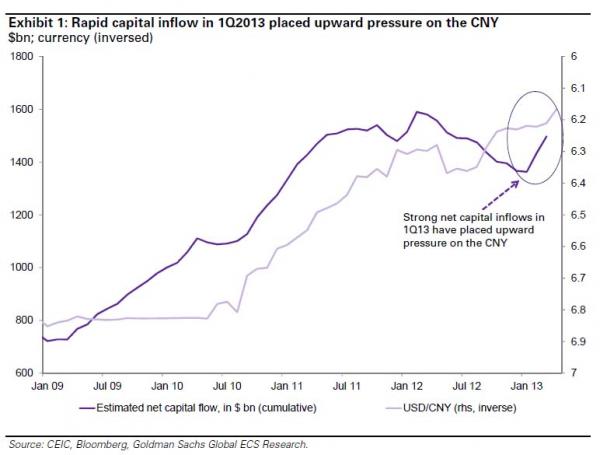
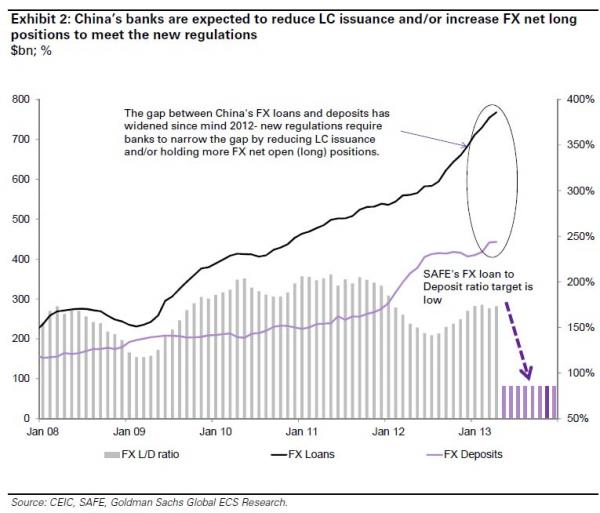
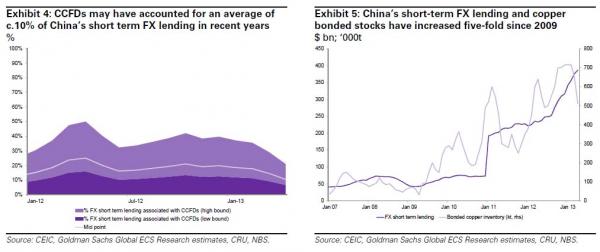
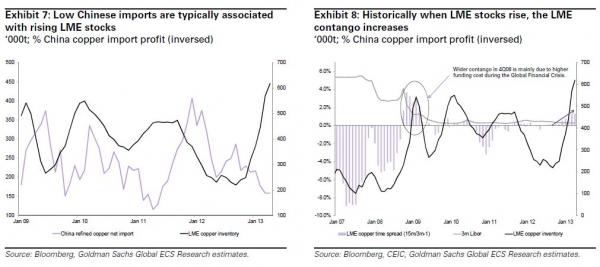
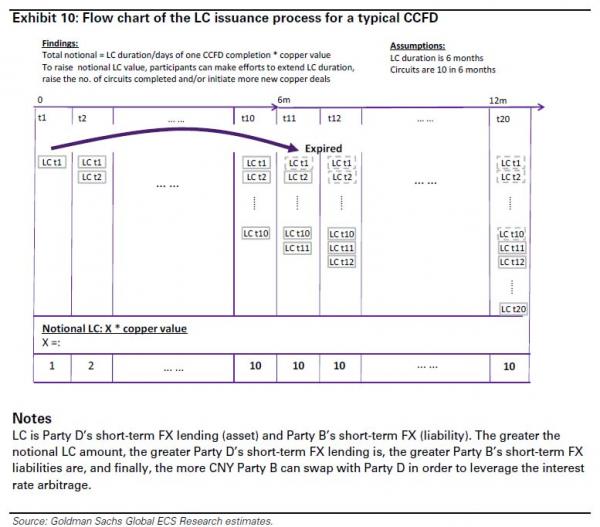
In all the hoopla over Japan’s stock market crash and China’s PMI miss last night, the biggest news of the day was largely ignored: copper, and the fact that copper’s ubiquitous arbitrage and rehypothecation role in China’s economy through the use of Chinese Copper Financing Deals (CCFD) is coming to an end. Copper, as China pundits may know, is the key shadow interest rate arbitrage tool, through the use of financing deals that use commodities with high value-to-density ratios such as gold, copper, nickel, which in turn are used as collateral against which USD-denominated China-domestic Letters of Credit are pleged, in what can often result in a seemingly infinite rehypothecation loop (see explanation below) between related onshore and offshore entities, allowing loop participants to pick up virtually risk-free arbitrage (i.e., profits), which however boosts China’s FX lending and leads to upward pressure on the CNY. Since the end result of this arbitrage hits China’s current account directly, and is the reason for the recent aberrations in Chinese export data that have made a mockery of China’s economic data reporting, China’s State Administration on Foreign Exchange (SAFE) on May 5 finally passed new regulations which will effectively end such financing deals. The impact of this development can not be overstated: according to independent observers, as well as firms like Goldman, this will not only impact the copper market (very adversely) as copper will suddenly go from a positive return/carry asset to a negative carry asset leading to wholesale dumping from bonded warehouses, but will likely take out a substantial chunk of synthetic shadow leverage out of the Chinese market and economy. Naturally, for an economy in which credit creation is of utmost importance, the loss of one such key financing channel will have very unintended consequences at best, and could potentially lead to a significant “credit event” in the world’s fastest growing large economy at worst.

China 1_0China 2_0China 3_0China 4_0China 5_0China 6_0 Read more of this post

Why Do I Teach? We should judge teaching not by the amount of knowledge it passes on, but by the enduring excitement it generates

MAY 22, 2013, 11:45 AM

Why Do I Teach?

By GARY GUTTING

As I wind up another semester of teaching at Notre Dame, I’ve been thinking about what I’m actually accomplishing in the classroom.  The standard view is that teaching imparts knowledge, either knowing how (skills) or knowing that (information).  Tests seem important because they measure the knowledge students have gained from a course.  But how well would most of us do on the tests we aced even just a few years ago?  Discuss the causes of the Thirty Years War.  Mary is 20 years old, which is twice the age Ann was when Mary was the age Ann is now: how old is Ann?  How do Shakespeare’s early comedies differ from his late romances?  Give a quick summary of Mendel’s Laws.

Overall, college education seems a matter of mastering a complex body of knowledge for a very short time only to rather soon forget everything except a few disjointed elements. (To return to the test questions above: it was about religion; you would need to set up an equation; the comedies were supposed to be funny, the romances not so much; something about the genetics of peas).  Of course, almost everyone eventually learns how to read, write, and do basic arithmetic—along with the rudiments of other subjects such as history and geography.  But that’s because such knowledge is constantly reviewed as we deal with e-mail, pay bills and read newspapers— not because we learned it once and for all in, say, third grade. Read more of this post

Investors Beware: Corporate Financial Statements Decline in Predictive Value

Investors Beware: Corporate Financial Statements Decline in Predictive Value

by Bill Snyder | May 22, 2013

Over time, financial statements of public corporations show more losses, intangibles, and earnings restatements, which lower their value for predicting corporate bankruptcies

Corporate bankruptcies, like earthquakes, are rare events. But when they do occur, says Maureen F. McNichols of Stanford’s Graduate School of Business, the results can be financially devastating for investors and other stakeholders. An important role of financial statement information is to permit investors to assess the likely timing and amount of future cash flows. Recent research by McNichols and coauthors examines the usefulness of financial statement and market data for investors who want to ascertain the likelihood of bankruptcy. The results of that research are not completely reassuring.  Read more of this post

Embrace the Business Model That Threatens You

Embrace the Business Model That Threatens You

by Leonard Fuld  |   8:00 AM May 22, 2013

If your company is already well established and has smart management, it is likely that it will become a hybrid in the next ten years, blending its legacy business with a new business model that is rising to threaten it. Take Walmart, for example. After suffering several years of Amazon’s online hegemony, Walmart responded with a hybrid approach. Merchandise ordered online can now be drop-shipped for same-day pickup at local stores. This and other creative solutions have driven over $9 billion of online sales to Walmart. (It’s no surprise that Amazon — which has no physical stores — has mirrored the move from the other direction, installing lockers in neighborhood stores to allow for direct pickup.)

Entertainment and medicine are other industries where hybrid models are beginning to emerge as resilient success stories. Netflix, formerly a media distributor increasingly threatened by the very entertainment companies whose programming it sells, has begun producing its own original programming (such as the recently released series House of Cards.) According to Netflix, offering popular original programming has attracted its customers to order more items from the rest of its media catalog — a hybrid win-win. The Veterans Administration hospital system has formed an alliance with Bosch Healthcare to offer a more efficient means to monitor and diagnose the elderly or infirm remotely, from their homes. Read more of this post

How to Create True Customer Advocates

How to Create True Customer Advocates

by Bill Lee  |  12:00 PM May 22, 2013

Who sells your products or services? This may seem like a silly question, the answer being of course, the sales & marketing team. But increasingly, the most important person selling what you’re offering is — your customer. More specifically, your customer advocates. And, as buyers increasingly expect to learn about products and services from their peers who are using them, companies are getting more creative at putting their happy customers in front of those buyers. The forms that this kind of community marketing can take are varied, and might include straightforward references and referrals, customer blogging or video (an area of exceptional creativity), participating in communities, associations or consortiums, speaking at industry events…it’s a growing list. One predictable result of this activity has been increasing demand from marketing and sales leaders to find more such advocates to showcase, in some cases creating a “beast that needs to be fed” similar to what you see in traditional media channels — like sports or the entertainment industry — that experience rapid growth in popularity. So the question becomes: in order to keep the advocate pipeline filled, should you incent customers with rewards, discounts, even payments of some sort? My strong suggestion — based on actual experiences from companies who are not incenting customers to advocate — is to avoid this slippery slope. It’s not good for them, or for your business. So then, how do you make this happen? How do you create the conditions that generate not only happy customers, but true customer advocates? Here are some key elements for creating an overarching value proposition that fosters customer advocates and preserves the integrity of their advocacy:  Read more of this post

How Email App Mailbox Turned A Desperate Situation Into An ~$100 Million Exit 37 Days After It Launched

How Email App Mailbox Turned A Desperate Situation Into An ~$100 Million Exit 37 Days After It Launched

Alyson Shontell | May 22, 2013, 5:09 PM | 2,593 | 1

8551241646_ec6ceb9795_b

Gentry Underwood, co-founder of Mailbox

In January, an email organization app called Mailbox launched, and it promised to help users reach inbox zero. Thirty-seven days later, cloud storage company Dropbox acquired it for a reported $100 million. We sat down with the app’s founder, Gentry Underwood, who told us how he was able to flip the app so quickly and what it is like working for $4 billion Silicon Valley company, Dropbox. To summarize:

Underwood isn’t sure if his app is actually worth $100 million. He also wouldn’t confirm if that was the actual sale price.

Underwood says the quick sale was the result of Underwood’s team being able to determine product-market fit.

Mailbox went viral before the app even launched. Here’s how he drummed up attention for it: Read more of this post

VMware Public Cloud Software Challenges Amazon, Microsoft

VMware Public Cloud Software Challenges Amazon, Microsoft

VMware Inc. (VMW) is debuting a service that lets customers use the Web to access information and programs stored in its data centers, an effort to challenge Amazon.com Inc. (AMZN) and Microsoft Corp. (MSFT) in cloud computing.

Early testers of the vCloud Hybrid Service include News Corp. (NWSA)’s Fox Broadcasting and the state of Michigan, VMware Chief Executive Officer Pat Gelsinger in an interview. The product will be more widely available in the third quarter, he said.

VMware, the biggest provider of software that lets computers run multiple operating systems, is expanding in cloud-computing to bolster sales as U.S. customers trim technology spending. With the new product, VMware is entering the fastest-growing part of the cloud market, according to Gartner Inc., which estimates that sales of so-called infrastructure-as-a-service will surge by an average 38 percent annually to $30.6 billion by 2017 from $6.17 billion last year. Read more of this post

5 Mobile Payments Data Points That Will Blow Your Mind

5 Mobile Payments Data Points That Will Blow Your Mind

Josh Luger | May 22, 2013, 12:56 PM | 1,376 | 1

Consumers gravitate to convenience. That’s as true with payment technologies as it is with anything else. A prime example is the decades-old trend away from cash or checks and toward credit cards. Now, the mass adoption of smartphones and tablets has set the stage for a new move — away from fixed-point, card-based transactions and toward those completed on mobile. The old dream of the “digital wallet” is coming true in a very particular mobile-led fashion. In a recent report from BI Intelligence,  we explain the main types of mobile payments, analyze the state of the mobile payments race, examine the matchup between card readers and near-field communications (NFC), look at how traditional banks, credit card companies, and card processors are responding to the mobile payments threat, and detail who is furthest along in developing the all-in-one solution for merchants and consumers.

Here are 5 data points that help underscore the explosion:

$640 million: eMarketer has estimated mobile payments as adding up to $640 million in transaction volume in the U.S., up from $170 million in 2011. However, this figure does not include swipes on mobile credit card readers like Square and PayPal Here, only consumer-side mobile payments in-store.

$10 billion: Card readers are building real scale. Square’s mobile payments volume rose to $10 billion in 2012, up from $2 billion in 2011. Starbucks is switching its credit and debit card processing to Square, and as of January 2013 accepts the “Square Wallet” app at 7,000 locations. 

$14 billion: Though much of that volume was from PayPal-enabled mobile commerce, and not in-store payments, that’s still evidence of mobile catching on as a transactional platform.

7.9 million: As of year-end 2012, only 7.9 million U.S. consumers (less than 90 percent of the total) had adopted a consumer-facing NFC-compatible system like “Google Wallet,” or apps that use QR codes or other methods to generate a payment. Card readers seem to be way ahead in the game.

$3.95 trillion: With more than $3.95 trillion of non-cash transaction volume recorded in the U.S. alone in 2011, the stakes are high in this space.

How Marc Beer Scipted Aegerion Pharma’s Success Story

How Marc Beer Scipted Aegerion Pharma’s Success Story

by Matthew Herper | May 23, 2013

topimg_21723_marc_beer_and_daniel_rader_300x400

Marc Beer (right) and Daniel Rader created a great drug—and a hot stock

Marc Beer was done starting companies—until he met a doctor who could help patients with a rare and terrible disease. Investors couldn’t be happier

When Marc Beer sold his first public company, the biotech ViaCell, to PerkinElmer for $300 million in 2007 it seemed like the beginning of an amazing entrepreneurial career. But just months later it was cut short: His wife of 18 years died suddenly from a pulmonary embolism at the age of 42, and he committed himself to parenting his three teenagers full-time. Two years later, his 14-year-old daughter told him to start another company. “Dad, you’ve been preaching purpose to me my entire life,” she said. “I don’t think purpose is driving me home from school.” Just a few weeks after that conversation, Daniel Dubin, a physician, old friend and vice chairman of Leerink Swann, told him about a promising drug being shunned by investors but backed by one of cardiology’s best minds: Daniel Rader, chief of translational medicine and human genetics at the University of Pennsylvania. Beer called Rader and found himself sold. “All I did was listen,” Beer says. “He just needed to be listened to.” The result of that listening is one of this year’s biggest biotech success stories: Aegerion Pharmaceuticals. On Christmas Eve, less than two years after Beer took the helm, the tiny company won approval from the Food & Drug Administration to sell its drug, Juxtapid, as a treatment for patients with a rare genetic disease that frequently causes fatal heart attacks before age 20.

SECOND CHANCES.indd Read more of this post

Can China’s leaders revive the economy and reform it at the same time?

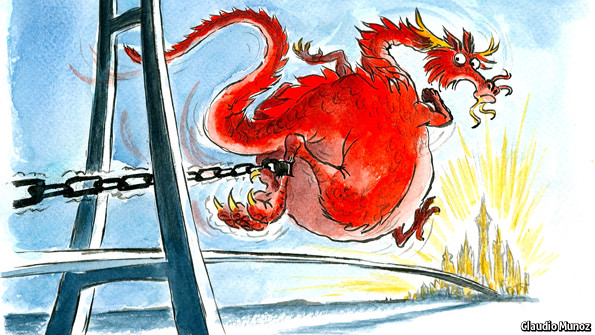
Can China’s leaders revive the economy and reform it at the same time?

May 18th 2013 | HONG KONG |From the print edition

20130518_CND001_0

EVERY economy, like every story, has two sides: supply and demand. The supply side of China’s economy is the stuff of legend: 767m workers, perhaps $20 trillion-worth of machinery, buildings and other kinds of capital, combined with rapidly advancing techniques and technologies, many of them assimilated from abroad. This combination of labour, capital and know-how dictates how much the economy can produce. But whether it actually does produce all it can depends on the other side of the economy—the demand side—which reflects the spending decisions of consumers and investors. The supply side sets the scene; the demand side provides the drama. Sadly, demand is recovering more slowly than expected. Figures released this week showed somewhat disappointing growth in fixed-asset investment and industrial production last month, following a similarly underwhelming first quarter. Economists who were expecting growth of 8-8.5% this year are now projecting something closer to 7.5%.

But as the drama darkens, the scene may also be shifting. A meeting of the State Council, China’s cabinet, on May 6th outlined a long list of structural reforms designed to improve the supply side of the economy. Some of the reforms, such as extending the value-added tax to services, are already under way. Others, such as liberalising capital flows, will reach fruition only gradually. The reforms are also in keeping with pronouncements by former leaders like Wen Jiabao, who liked to talk the reform-talk. But the new agenda “goes far beyond Wen-era platitudes in its boldness and specificity,” argues Andrew Batson of GaveKal Dragonomics, a consultancy in Beijing. The “walk-to-talk” ratio is improving, he believes. Read more of this post

About China’s capacity to absorb more capital

About China’s capacity to absorb more capital

Kate Mackenzie | May 22 10:30 | 42 comments | Share

We’ve all heard, many times, the story that China’s capital stock is nowhere near that of more advanced economies, therefore it will inevitably increase. And we can count on continued efforts to build roads, buildings, airports, and other infrastructure — just look at how the less-developed eastern provinces have been pouring money into new projects, the argument has gone, more recently. Or went. We really hope it’s not necessary, here, to go into the weaknesses of that argument. Here are a few places to start, but it’s partly a causal problem — does growth cause increased capital stock or vice versa? What kind of growth are we talking about, anyway? Fine. But surely investment is still a net positive if it creates infrastructure that people will actually use, sooner or later? Leaving aside the question of financing burdens, we’ve struggled here with the idea that there’s ‘bad’ and ‘good’ investment. How does one know, in the short term, which is which? Read more of this post

China Should Stop ‘Micromanaging’ Auto Industry, Researcher Says

China Should Stop ‘Micromanaging’ Auto Industry, Researcher Says

China should refrain from “micromanaging” the automotive industry and allow market competition to spur innovation and weed out weaker automakers, the Chinese Academy of Social Sciences said in a report.

The government should focus instead on building a fair and competitive environment and abandon monopolistic polices aimed at creating fewer and bigger automakers, the state-backed research institute said in an annual report on industrial competitiveness released this week. Read more of this post

China Rule Changes May Halt Copper-Financing, Goldman Says

China Rule Changes May Halt Copper-Financing, Goldman Says

New rules from China to control capital inflows are likely to end commodity-financing deals, hurting the short-term outlook for copper, analysts at Goldman Sachs Group Inc. wrote in a research report today.

The regulations from the State Administration of Foreign Exchange, effective from June, will probably mean an end to Chinese use of copper as a tool to enable interest rate arbitrage, Goldman said. The London Metal Exchange market may need to “carry” as much as 250,000 metric tons of additional physical copper over one to three months, about 4 percent to 5 percent of quarterly global supply, the bank said. Read more of this post

In China, food scares put Mao’s self-sufficiency goal at risk

In China, food scares put Mao’s self-sufficiency goal at risk

Wed, May 22 2013

By David Stanway and Niu Shuping

BEIJING (Reuters) – The discovery of dangerous levels of toxic cadmium in rice sold in the southern city of Guangzhou, the latest in a series of food scandals, has piled more pressure on China to clean up its food chain – possibly at the expense of Mao Zedong’s cherished goal of self-sufficiency.

The ruling Communist Party has long staked its legitimacy on its ability to guarantee domestic staple food supplies, and has pledged to be at least 95 percent self-sufficient even as demand increases and the fastest and biggest urbanization process in history swallows up arable land. Read more of this post

China’s Not Hiring; the number of new jobs advertised on leading recruitment website Zhaopin.com fell sharply by 22% in April, the steepest decline since Zhaopin started collecting data in 2010

May 22, 2013, 11:29 p.m. ET

China’s Not Hiring

By TOM ORLIK

China’s labor market has been a bright spot amid economic gloom. Strong jobs data over the past year has helped offset concerns about slowing growth. But there are signs employment is beginning to weaken too. The official job numbers in China are irregular and, in some cases, inaccurate. But other sources of data fill in the blanks. For instance, the number of new jobs advertised on leading recruitment website Zhaopin.com fell sharply in April. With the first quarter peak hiring season, some falling off in April is expected. But a 22% drop in new job postings from the previous month was the steepest decline since Zhaopin started collecting data in 2010. Business surveys suggest the downturn is broad-based across manufacturing and services too. The preliminary reading for the HSBC HSBA.LN -3.23% China Manufacturing Purchasing Managers’ Index in May showed factories trimming their workforce for a second month. Worryingly, the HSBC Markit services PMI also points to job losses. If labor markets are turning down, they are at least doing so from a position of strength. China’s private sector wages rose 14% in real terms in 2012 according the National Bureau of Statistics. Demand for workers outstripped supply by a record amount in the first quarter. The drop in new job adverts on Zhaopin came after a record high in March. Read more of this post

China’s SASAC Steps in to Save Bleeding SOEs

SASAC Steps in to Save Bleeding SOEs

By Kang Yi (康怡) and Zhang Xiangdong (张向东)
Issue 620, May 20, 2013
Over recent weeks, some of China’s biggest state-owned enterprises have been visited by their biggest investor – the State-owned Assets Supervision and Administration Commission (SASAC).  The supervisory body that administers the operations of more than a hundred of China’s biggest and most powerful state-owned companies has been dropping by the offices of those companies that have dragged down the overall profits of the state sector in 2012 with their huge losses.  Read more of this post