How Funds Massage Numbers, Legally
April 1, 2013 Leave a comment
March 31, 2013
How Funds Massage Numbers, Legally
By CAROLYN T. GEER
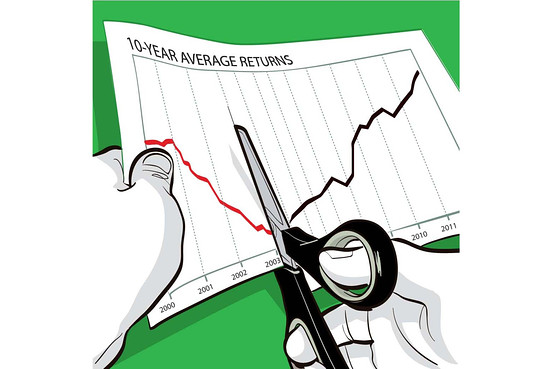
Most investors are familiar with the boilerplate disclaimer that past performance doesn’t guarantee future results. Far fewer are aware of how past performance numbers themselves can be misleading.
Sometimes only a “trick of the calendar” is to blame, as noted in a recent market commentary from Vanguard Group. The 10-year average annual return of the total U.S. stock market shot to 8% as of year-end 2012, from 4% a year earlier. Sure, U.S. stocks were up 16% in 2012, versus 1% for 2011. But more important, the negative 21% return from 2002—the last year of the 2000-2002 bear market—rolled out of the 10-year return calculations.
This year, the negative 37% return from 2008 rolls off the five-year return calendar, so that even if stocks go nowhere in 2013, their five-year average annual return will jump from the current 2% to 12%, by Vanguard’s calculations.Such tricks of the calendar are why Ken Solow, chief investment officer of Pinnacle Advisory Group, urges investors to evaluate portfolio managers’ returns over both bull and bear markets. Unfortunately, he adds, this is sometimes easier said than done.
Mutual funds must follow strict performance reporting requirements, but private money managers have more latitude. For example, some money managers went to cash during the 2007-2009 bear market but missed the bottom, meaning they failed to get reinvested before stocks rebounded. This hurt their performance in later years.
No matter. Some simply eliminated their three-year returns from their performance reports, Mr. Solow says. Why dwell on the recent past?
Even worse, portfolio managers are allowed to crank out pages of numbers and colorful charts purporting to show the returns they would have earned in years past if they had been investing the way they do today. These are known as back-tested returns. Make sure you know the difference between these “made-up” returns and those that were actually earned in real time, advises Mr. Solow.
Then there’s the problem of “survivorship bias.” Typically, this refers to overstating aggregate fund performance by excluding the results of underperforming funds that were liquidated or merged out of existence.
Take large-cap value funds. Sixty-two percent of those that survived over a recent five-year period outperformed their benchmarks. However, accounting for funds that closed reduces that percentage to 46%, according to an analysis by Vanguard.
Financial advisers have their own version of this, says Jerry Miccolis, chief investment officer at wealth-management firm Brinton Eaton. Some hire outside firms, known as separate-account managers, to invest their clients’ money. Inevitably, some of these managers do better than others. But when prospecting for new clients, the advisers might highlight only the impressive track records of their top-performing managers, conveniently ignoring the underperformers they may have since sent packing.
Make sure you see the returns for all the managers an adviser actually chose for existing clients over the relevant time period, not just the ones handpicked for you in retrospect, says Mr. Miccolis, whose firm manages its clients’ money in-house.
Finally, Mr. Miccolis tells of a client who came across some promotional material for what looked like a portfolio of stocks that would have tripled the client’s money in eight years. The problem: There was no portfolio.
The purveyor was a stock-picking service that, for a fee, provided buy recommendations and, less frequently, sell recommendations. To earn the purported returns, an investor would have had to buy and hold every stock recommended over the eight years.
“Sounds simple,” says Mr. Miccolis, “but there’s no way you could have done that.”
Here’s why: Say you had $100,000 to invest. If you had invested all of it in the first stocks that were recommended, you would have had to sell some of the shares prematurely to raise money for subsequent investments. If instead you’d kept some of your $100,000 in cash, earning nothing, and invested it as new recommendations were made, the cash would have dragged down your returns.
“Either way you look at it,” Mr. Miccolis says, “it was physically impossible.”
Sometimes, when it comes to performance numbers, you really can’t get there from here.
 About bambooinnovator
 Bamboo Innovator