Thailand’s Pichai Chunhavajira will draw on his experience during the dark days to help him resolve SME Bank’s ingrained woes
April 1, 2013 Leave a comment
Changing the system from the inside out
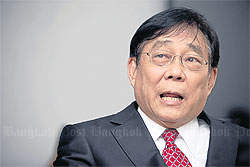
Pichai Chunhavajira will draw on his experience during the dark days to help him resolve SME Bank’s ingrained woes.
Published: 1 Apr 2013 at 00.00
Are we in a new bubble? It certainly seems like it, considering the massive trading volume on the stock exchange, the long queues at the Bangkok International Motor Show and the ever-changing city skyline as new buildings seemingly appear each day.
“You have to admit there are some areas that are overheating, but overall it’s not that bad,” said Pichai Chunhavajira, executive chairman of the Small and Medium Enterprise Development Bank of Thailand (SME Bank).
One major difference today is that speculation aside, most of the country’s banks and top companies remember the lessons learned from the Asian economic crisis. Risk management, asset diversification and balance sheets today for the country’s top firms have all significantly improved over the course of the past several years. Debt-to-equity ratios have fallen sharply, as many chief financial officers remember painfully the dangers of excessive leveraging and overdependence on banks for funds.“I don’t worry about large companies. After the 1997 crisis, the big companies that survived have all become stronger,” Mr Pichai told the Bangkok Post.
A decade ago, Mr Pichai was the financial chief for PTT Plc, helping to steer the consolidation and financial restructuring of oil refineries and petrochemical firms under the PTT umbrella.
Today PTT is by far the country’s largest listed company, with a market capitalisation of 925 billion baht.
Mr Pichai’s job now is to oversee the rehabilitation of the loss-ridden SME Bank and refocus the state-owned institution on its core job of helping the country’s small and medium-sized enterprises to grow.
Liberalisation and regionalisation means Thai small businesses must continue to adapt and expand beyond the country’s borders, he said, adding that a crisis today would affect small businesses first.
Mr Pichai said companies in industries with high competition should think carefully and methodically about how to gain an advantage, but top performers with a clear competitive edge should take advantage of the favourable environment and push for rapid growth.
Good planning is the key, and investors will pay a premium to invest in companies with forward-thinking management and clear business plans, said Mr Pichai.
But for now, the focus is to turn around SME Bank, which has been plagued with asset quality problems, management changes and charges of mismanagement in recent years.
“We have to return to profitability and address non-performing loans (NPLs),” said Mr Pichai.
NPLs at the SME Bank are as high as 39 billion baht or 40% of total loans based on criteria set by the Bank of Thailand.
Mr Pichai said SME Bank expects to recover 20 billion baht from its NPLs over two and a half years through loan restructuring.
For the rest, it will foreclose on collateral and auction off seized assets.
Over the medium term, the bank must refocus on its original mandate to support small companies. At present, only 40% of its loan customers represent companies with outstanding credit of less than 20 million baht, a proportion Mr Pichai wants to change to 80%.
Loan rates and interest rate spreads must also be reset to levels not just attractive to borrowers but also supportive of bank profitability and future growth. Staffing levels of 1,745 across 100 branches will be frozen for the near future, while upcountry branches will gain increased flexibility to manage their lending to small companies to support growth.
Mr Pichai said SME Bank must also recapitalise, and it plans to raise its capital-adequacy ratio to the standard 8.5% of risk assets this year from -0.95% now.
Most importantly, the bank and its management team must re-examine its current processes and procedures to close the loopholes that helped to create the problems.
 About bambooinnovator
 Bamboo Innovator