Schaefer, Caterpillar CEO Who Changed Company Name, Dies

Schaefer, Caterpillar CEO Who Changed Company Name, Dies

George Schaefer, who led Caterpillar Inc. (CAT) from losses to a period of record profits from 1985 to 1990 and removed “Tractor” from its name, has died. He was 84.

He died today in Peoria, Illinois, where Caterpillar is based, according to a statement by the company. No cause was given. Caterpillar is the world’s largest maker of construction equipment and, since 1991, has been one of the 30 companies that make up the Dow Jones Industrial Average.

Schaefer’s five years as chairman and chief executive officer culminated a 39-year career with the company that began in accounting. Caterpillar, which had endured losses and initiated a cost-cutting campaign in the early 1980s, posted record profits during Schaefer’s tenure and took steps toward worker-manager collaboration, according to accounts in the New York Times.

“George Schaefer will be remembered as one of the great leaders in Caterpillar’s history,” current chairman and CEO Doug Oberhelman said in the statement. “He pushed the company to move away from a centralized model to its current business unit structure during the late 1980s, a significant and difficult decision that positioned Caterpillar for the remarkable growth and success that has followed.”

Schaefer’s decision in 1986 to change the company’s name from Caterpillar Tractor Co. recognized “that we had become much more than just a tractor company,” Oberhelman said. Read more of this post

Can Firms Aim to Do Good if It Hurts Profit? A dozen states now recognize benefit corporations, for-profit companies that pursue social and environmental goals

April 10, 2013, 8:23 p.m. ET

Can Firms Aim to Do Good if It Hurts Profit?

Investors Could Sue, Citing Corporate Governance Laws, but Some States Are Providing Cover Via Benefit Corporations

By ANGUS LOTEN

MK-CC313_SBCORP_G_20130410182114

Blake Jones of Boulder, Colo., is one of the many modern entrepreneurs who say their goals extend beyond increasing the bottom line to such pursuits as reducing child poverty or protecting the environment. But he worries that embracing a mission other than maximizing profits could open the door to shareholder lawsuits because of decades-old corporate governance laws.

A co-founder and chief executive of Namaste Solar, Mr. Jones says his eight-year-old company gives 20% of its annual after-tax profits to local projects, such as a nearby children’s museum and a bicycle-recycling program. It also offers up to $30,000 in solar-system installation grants to schools and other nonprofits. But “according to state law,” he says, “we don’t have any legal protection for doing business the way we do” even though such practices attract customers who also “want to do good.”

A dozen states in the past three years, including New York and California, have adjusted their incorporation laws—the same laws that set the “Inc.” or the “Co.” after a company name—to create a new corporate structure known as a benefit corporation. These structures seek to provide some legal cover for entrepreneurs such as Mr. Jones to consider the local community or the environment in corporate decisions, rather than just their shareholders. Read more of this post

China Communist Party probes Jilin carmaker’s missing billions

Communist Party probes Jilin carmaker’s missing billions

Thursday, 11 April, 2013, 12:00am

Li Jing jing.li@scmp.com

More than 100 senior managers at one of the mainland’s leading carmakers, the First Automobile Works Group (FAW), have been questioned, and some have been detained, by Communist Party investigators looking into missing company assets, according to a report by the 21st Century Business Herald.

Citing anonymous sources, the report said that more than 10 billion yuan (HK$12.4 billion) worth of capital vanished from the Jilin -based company over an undisclosed period, and initial investigations found that the money had been embezzled.

Zhou Yongjiang, a deputy chief economist at FAW, and other managers have been placed under shuanggui, in which party members are detained and interrogated, the report said. Zhou was allegedly involved in irregular real estate deals. Calls to FAW’s publicity department went unanswered yesterday.

The far-reaching case is still unfolding and may send shockwaves as one of the region’s senior leaders, a deputy party secretary of Jilin province, was reportedly questioned by the party’s top graft-busting agency. Read more of this post

Prison Ties Bind Malaysia Opposition in Election: Southeast Asia

Prison Ties Bind Malaysia Opposition in Election: Southeast Asia

After Malaysia’s leaders locked up more than 100 dissidents in 1987, Lim Guan Eng found himself in the same prison as Muslim politicians whose party advocated Islamic punishments like stoning and amputation.

Lim, an ethnic Chinese member of a party pushing for a secular government in the Muslim-majority country, began interacting with members of the Pan-Malaysian Islamic party, known as PAS, for the first time. Following months of lengthy discussions on theology and politics, he realized they could work together even while disagreeing on Islamic law.

“When they detained us, they forced us to live together, and we found that we have the same stand on many issues,” Lim said last month in an interview. “It is a friendship formed in bondage of iron, of pain, of suffering. When you suffer together and you don’t give in, that is an unbreakable bond.” Read more of this post

How the CSIRO cheated a global drugs giant into buying anti-counterfeit technology which could be easily compromised – passing off cheap chemicals it had bought from China as a ”trade secret” formula

How the CSIRO cheated a global drugs giant

April 11, 2013, Linton Besser and Nicky Phillips

csiro-wide-620x349

The CSIRO has duped one of the world’s biggest pharmaceutical companies into buying anti-counterfeit technology which could be easily compromised – passing off cheap chemicals it had bought from China as a ”trade secret” formula.

The Swiss-based multinational Novartis signed up two years ago to use a CSIRO invention it was told would protect its vials of injectible Voltaren from being copied, filled with a placebo and sold by crime syndicates.

Police and drug companies are battling counterfeiters who are selling fake medicines that have killed hundreds of people. Last year Interpol seized 3.75 million units of fake drugs and arrested 80 people. Read more of this post

Europe’s Glitziest Show, Now In Austerity Mode; Eurovision Song Contest, one of the planet’s most wildly popular mega-events—which helped propel household names like ABBA and Celine Dion—is going on a financial diet

Updated April 10, 2013, 6:46 p.m. ET

Europe’s Glitziest Show, Now In Austerity Mode

By ANNA MOLIN

OB-XA332_EUROVI_G_20130410225103

As fiscal austerity sweeps the European continent, one of the planet’s most wildly popular mega-events—which helped propel household names like ABBA and Celine Dion—is going on a financial diet.

Every year in late spring, more than 100 million people in more than 40 nations pack into pubs, attend kitschy theme parties or dive into their couches at home—all glued to the same television broadcast. Their focus: the Eurovision Song Contest, a weeklong Olympics-meet-“American Idol” singing competition that features one chosen act from each participating nation. (Most are from Europe, but some countries outside the continent have also competed, including Israel and Cyprus.) The extravaganza is famous for its parade of aging crooners, exuberantly sequined pop singers and dark-horse acts like last year’s gaggle of singing grannies in babushka scarves.

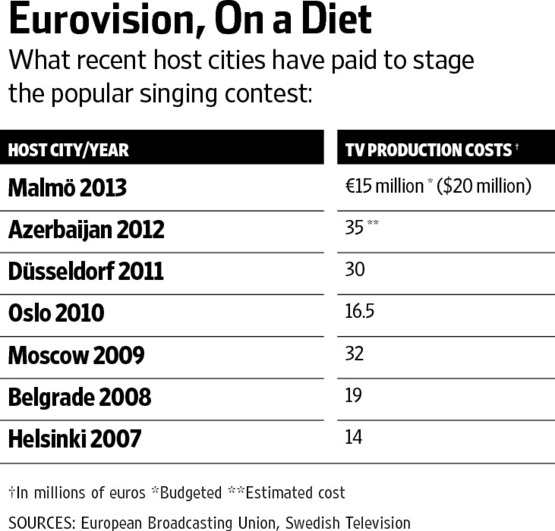
Sweden, the country set to host next month, plans to slash the 58-year-old event’s television-production budget to $20 million, less than half what it was last year, by using a smaller venue, fewer lights and less media fanfare. The goals: to survive in a tough economy, reignite the interest of nations hobbled by fiscal cutbacks—and in the process, create a more intimate affair that returns the focus to the music itself. Read more of this post

Regulators Feeling ‘Social’ Pressure; In Age of Twitter, Decades-Old Rules That Don’t Address New Media Pose Challenge for Officials

April 10, 2013, 6:04 p.m. ET

Regulators Feeling ‘Social’ Pressure

In Age of Twitter, Decades-Old Rules That Don’t Address New Media Pose Challenge for Officials

By JESSICA HOLZER

WASHINGTON—The Securities and Exchange Commission’s move allowing companies to convey market-moving corporate news via social-media sites stems from a continuing debate at regulatory agencies: how to protect consumers, depositors and investors in the age of Facebook and Twitter.

Agencies from the SEC to the Federal Trade Commission are under increasing pressure from businesses clamoring for guidance on how they can use social media without running afoul of federal securities, advertising and other laws. Financial-advisory firms want clearer guidance from the SEC about how investment advisers can use social-media sites to court clients, while Wall Street firms want to relax rules requiring them to store every video, tweet or other piece of content their employees post on sites.

In the middle are regulators, who say they are wary of updating sometimes-decades-old rules over fears of chipping away at long-standing protections and who worry about their ability to keep up with the proliferation of social-media sites. Read more of this post

Online sales reach a trillion in a single year for the first time

Online sales reach a trillion

April 11, 2013, Michael Baker

It’s official. In 2012, business-to-consumer e-commerce passed a trillion dollars US in a single year for the first time, according to a report from US-based research firm eMarketer. Read more of this post

Shodan: The scariest search engine on the Internet; Shodan navigates the Internet’s back channels. It’s a kind of “dark” Google, looking for the servers, webcams, printers, routers and all the other stuff that is connected to and makes up the Internet

Shodan: The scariest search engine on the Internet

By David Goldman @CNNMoneyTech April 8, 2013: 1:41 PM ET

NEW YORK (CNNMoney)

“When people don’t see stuff on Google, they think no one can find it. That’s not true.”

That’s according to John Matherly, creator of Shodan, the scariest search engine on the Internet.

Unlike Google (GOOGFortune 500), which crawls the Web looking for websites, Shodan navigates the Internet’s back channels. It’s a kind of “dark” Google, looking for the servers, webcams, printers, routers and all the other stuff that is connected to and makes up the Internet. (Shodan’s site was slow to load Monday following the publication of this story.)

Shodan runs 24/7 and collects information on about 500 million connected devices and services each month. Read more of this post

How VCs Are Driving a Tech-valuation ‘Feeding Frenzy’

How VCs Are Driving a Tech-valuation ‘Feeding Frenzy’

Published: April 10, 2013 in Knowledge@Wharton

Venerable retailer J.C. Penney opened its doors more than a century ago and boasts annual revenues of nearly $13 billion from its 1,100 stores. Yet a three-year-old website with an untested business model and little discernible revenue is closing in on the department store chain’s $3 billion market cap: Pinterest. The online scrapbooking site recently raised $200 million in venture capital funds to bring its implied valuation to $2.5 billion, according to a February 20 story in The Wall Street Journal. Founded by three young entrepreneurs in March 2010, the tech start-up has 48 million users as of December 2012, up from nine million in the prior year, the article noted. While Pinterest is wildly popular, its business model remains unproven. Users, including businesses, sign up for free accounts. The company is just gearing up to accept paid advertising and recently unveiled a free analytics tool for users with business-related accounts to track what has been pinned from their sites. Pinterest may be thinking hard about ways to make money, but it remains unclear whether the firm’s financial strategies can bring in enough revenue to cover costs and generate a healthy profit, which will be especially important once the company goes public. No matter. Pinterest has garnered the interest of such Silicon Valley blue-chip venture capital firms as Andreessen Horowitz (as in Netscape co-founder Marc Andreessen). For now, Pinterest has money to burn.

The company is one of at least 25 start-ups that command market caps of one billion dollars or more, according to a February 4 story in The New York Times. The billion-dollar start-ups club includes such familiar names as productivity application Evernote, travel rental site Airbnb, online questionnaire software SurveyMonkey and streaming music service Spotify. But such high valuations are bringing back concerns that the market is entering another tech bubble like the dot-com frenzy in the late 1990s that led to scores of Internet companies going belly up and investors losing vast fortunes. Read more of this post

Acquisitions Key to Samsung Success

Updated April 10, 2013, 9:55 a.m. ET

Acquisitions Key to Samsung Success

By MIN-JEONG LEE

To maintain its new lead over Apple Inc. AAPL +2.04% in the global smartphone market, South Korea’s Samsung Electronics Co. 005930.SE +0.33% will need to get busier buying the assets it needs to continue to innovate and expand its client base, bankers and analysts say.

Samsung, which overtook Nokia Corp. NOK1V.HE +3.25% last year as the world’s largest mobile-phone maker and surpassed Apple in smartphones, has already been buying technologies and investing in companies no one else wants, largely to differentiate itself. And with cash and cash equivalents of more than $30 billion, it is sure to keep buying, bankers say.

In a recent interview, Samsung Co-Chief Executive J.K. Shin said the company is on the lookout for acquisitions, especially “intellectual property, advanced technology, components and areas that will enable us to offer better applications on smartphones.”

Thus far, its acquisitions have been small. In the past year, its purchases have included a 5% stake in stylus maker Wacom Co. of Japan, the mobile-technology business of the U.K.’s CSR CSR.LN +3.85% PLC, and California-based storage-software pioneer NVELO. Those deals have given Samsung access to technology to develop a better stylus for its smartphones and tablets, advanced wireless connectivity, and software that enables its phones to retrieve data faster. Read more of this post

PC quarterly sales plummet, sharpest drop on record

PC quarterly sales plummet, sharpest drop on record

5:20pm EDT

By Bill Rigby

SEATTLE (Reuters) – Personal computer sales plunged 14 percent in the first three months of the year, the biggest decline in two decades of keeping records, as tablets continue to gain in popularity and buyers appear to be avoiding Microsoft Corp’s new Windows 8 system, according to a leading tech tracking firm. The huge drop over a year ago, the steepest since International Data Corp started publishing sales numbers in 1994, mark a new milestone in the apparent decline of the age of the PC as computing goes mobile via tablets and smartphones. Read more of this post

Restraining Overconfident CEOs

Restraining Overconfident CEOs

Suman Banerjee Nanyang Business School

Mark Humphery-Jenner University of New South Wales – Australian School of Business; Financial Research Network (FIRN); Nuvest Capital

Vikram K. Nanda Georgia Institute of Technology – College of Management

March 26, 2013

Abstract: 
Prior literature posits that while some CEO overconfidence may benefit shareholders, high levels of overconfidence do not. We investigate whether improvements in governance can help to mitigate the adverse effects of overconfidence while preserving its positive aspects. We use the passage of the Sarbanes-Oxley (SOX) Act as a natural experiment to examine whether improvements in regulation and governance help to mitigate investment distortions and moderate risk-taking tendencies of the more overconfident CEOs. We conduct tests using options-based proxies for CEO overconfidence. The results indicate that, after SOX, overconfident CEOs reduced investment, improved performance and market value, reduced their risk-exposure, increased dividends and substantially improved long-term performance following acquisitions. We also find that these SOX-related benefits are concentrated in the firms that were SOX non-compliant prior to its passage. While the beneficial aspects of SOX in restraining overconfident CEOs may have been an unintended consequence, the message of our paper is simple: CEO over-confidence can be monitored and regulated — just like any other CEO attribute. 

Gravity-Defying Aussie Gouges Industry as Prosperity Bites Back

Gravity-Defying Aussie Gouges Industry as Prosperity Bites Back

From skyrocketing rents in remote mining towns to the decline of the auto industry, Australia is grappling with the downside of world-beating economic growth that has driven the nation’s currency to record highs.

Policymakers and executives at the Bloomberg Australia Economic Summit in Sydney yesterday singled out the local dollar’s strength as the biggest challenge for business, while conceding there’s little that can be done to restrain it. Terry Davis, managing director at Coca-Cola Amatil Ltd., said the Aussie is “decimating” manufacturers, while Robert Mead, head of portfolio management in Sydney at Pacific Investment Management Co., said businesses are deferring spending.

Australia’s defiance of the global slowdown is now backfiring on manufacturing after the currency soared 75 percent against the U.S. dollar and 87 percent versus the yen from its low in October 2008 after the collapse of Lehman Brothers Holdings Inc. roiled financial markets. The government and Reserve Bank of Australia say the cash flowing into the economy — fueled by quantitative easing in the U.S. and Japan — is beyond the control of policy makers in a small nation.

“That’s the hand that the world has dealt us,” RBA Assistant Governor for economics Christopher Kent said at the summit, reiterating that the central has no plans for intervention to weaken the so-called Aussie. “Businesses in a number of industries are under quite a deal of pressure — part of that’s because of the exchange rate.” Read more of this post

Toronto Condo Kings Retreating to Avert Crash: Mortages

Toronto Condo Kings Retreating to Avert Crash: Mortages

Toronto condo builders are slowing development in a bid to avoid a crash after a decade-long boom led to 159 towers now under construction.

So far this year, they’ve announced 13 new condominium projects, the fewest since the recession in 2009, when there were just three over the same period, figures from real estate researcher RealNet Canada Inc. show. In the same period last year, 29 new projects were announced, including Tridel Corp.’s Ten York, the third-tallest residential tower in the country at 75-stories when it was first marketed.

“Most developers have their hands in their pockets right now,” said Brad Lamb, president of Brad J. Lamb Realty Inc., a developer and the city’s largest condominium broker. His firm, which is marketing more than 45 high-rise developments in the city, won’t start a new project until 2014, Lamb said in an interview at Bloomberg’s office in Toronto. Lamb said he has eight projects in Toronto and Ottawa “on the drawing board.”

The slowdown comes as a near-record supply of condos comes to market in a city with the most towers being constructed in the world, according to BuzzBuzzHome, a Toronto-based real estate listings and research firm. Developers are trying to manage the slowdown as buyers retreat amid tighter mortgage rules, a slowing economy and the burden of record consumer debt. The supply of new high-rise units reached 21,262 in February, 34 percent more than the same period a year ago and close to a record 21,696 in October 2012, RealNet figures show. About 61,000 units are currently under construction — the most ever — and a record 35,757 residential units will come on stream next year, RealNet said. Read more of this post