The True Chinese Credit Bubble: 240% Of GDP And Soaring

The True Chinese Credit Bubble: 240% Of GDP And Soaring

Tyler Durden on 04/11/2013 15:54 -0400

Several months ago we pointed out something not fully grasped by the broader public: the Chinese corporate debt bubble is the largest of any developed and developing country, and at 151% of GDP (and rising rapidly) is the biggest in the world. What is better known is that corporate debt is just one part of the total debt picture, which also includes consumer loans, government debt and other “shadow debt” credit in the case of China. So how does China’s true debt picture as a percentage of debt look? As the chart below from Goldman shows, in 2013 the total credit outstanding in China is expected to rise to a whopping 240% of GDP, and continue rising from there at an ever faster pace. What is even more concerning is that in order to maintain its breakneck economic “growth” of ~8% per year, China has to continue injecting massive amounts of debt, the so called “credit impulse” or “flow” which according to assorted views, is what is the true driver of an economy, and where GDP growth is merely a reflection of how much credit is entering (or leaving) the system. The chart below shows that total Chinese social financing flow just hit a record for the month of March. Completing the picture is the estimated economic response to a surge in credit. As the last chart shows, in China the biggest benefit to a surge in flow is felt in the quarter immediately following the credit injection, as one would expect, with the effect tapering off and even going negative in future quarters, thus requiring even more debt creation to offset the adverse impacts of prior such injections. What should become obvious is that in order to maintain its unprecedented (if declining) growth rate, China has to inject ever greater amounts of credit into its economy, amounts which will push its total credit pile ever higher into the stratosphere, until one day it pulls a Europe and finds itself in a situation where there are no further encumberable assets (for secured loans), and where ever-deteriorating cash flows are no longer sufficient to satisfy the interest payments on unsecured debt, leading to what the Chinese government has been desperate to avoid: mass corporate defaults. At that point it will be up to the PBOC to do what the Fed, the ECB, the BOE and the BOJ have been doing: remove any pretense of money creation via the commercial bank complex (even if these are merely glorified government-controlled entities), and proceed to outright monetization of de novo created assets, thus flooding the system with as much money as is needed to preserve the illusion of growth. Naturally, with the Chinese stock market having proven itself to be a horrible inflation trap (and as a result the bulk of new levered money creation goes into real estate), the inflation explosion that would result would be epic. At that point the chart of the price of gold (in any currency) due to on the ground demand for capital preservation will make the Bitcoin chart pre-bubble pop, seem outright flat.
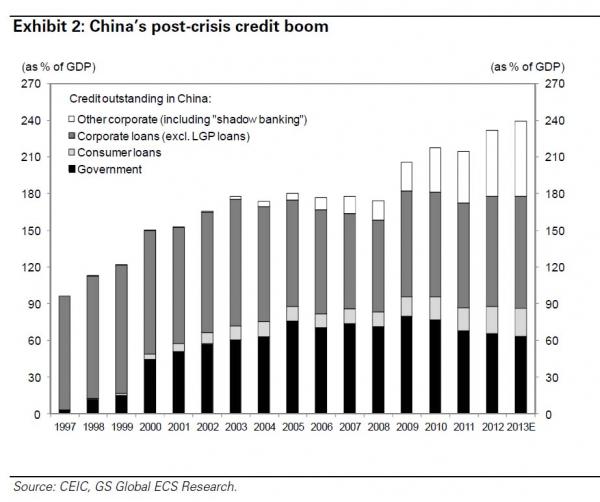
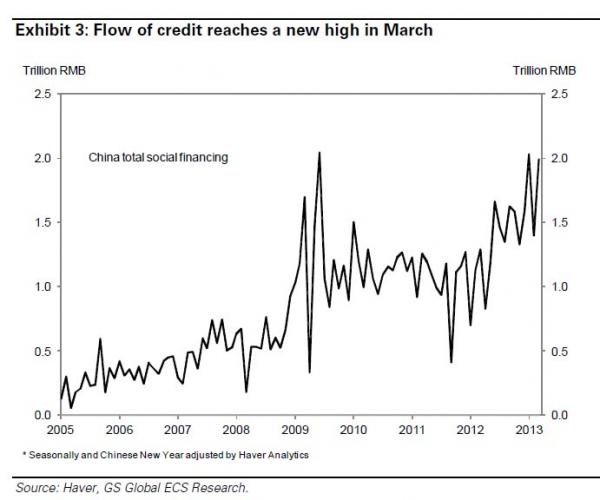
China Credit_0China flow of credit_0China response to credit surge_0

A Chinese government spokesman said he gave “incorrect” and “groundless” investment data sourced from the Internet, underscoring concern at the credibility of official numbers.

China Customs Official Apologizes for Incorrect Data

A Chinese government spokesman said he gave “incorrect” and “groundless” investment data sourced from the Internet at a briefing yesterday, underscoring concern at the credibility of official numbers.

Zheng Yuesheng, spokesman and head of the statistics department at the Beijing-based General Administration of Customs, said in a statement today that he “expresses deep apologies” for citing unconfirmed investment data from online sources he didn’t identify.

Zheng was referring to remarks he made at a customs administration press conference yesterday where he also acknowledged concerns that China’s export data may be overstated. During the briefing, held to discuss March and first-quarter trade figures, Zheng said the National Development and Reform Commission, the nation’s top economic planning agency, had approved about 7 trillion yuan of investment projects in the fourth quarter of 2012, including new roads, railroads and airports.

He gave the figure when discussing the improvement in first-quarter trade to illustrate the recovery in China’s economic growth.

“The information was sourced from relevant reports on the Internet, which were groundless and must be corrected,” Zheng said in a seven-line statement on the agency’s website. Read more of this post

Pentagon Says Nuclear Missile Is in Grasp for North Korea

April 11, 2013

Pentagon Says Nuclear Missile Is in Grasp for North Korea

By THOM SHANKERDAVID E. SANGER and ERIC SCHMITT

WASHINGTON — A new assessment by the Pentagon’s intelligence arm has concluded for the first time, with “moderate confidence,” that North Korea has learned how to make a nuclear weapon small enough to be delivered by a ballistic missile.

The assessment by the Defense Intelligence Agency, which has been distributed to senior administration officials and members of Congress, cautions that the weapon’s “reliability will be low,” apparently a reference to the North’s difficulty in developing accurate missiles or, perhaps, to the huge technical challenges of designing a warhead that can survive the rigors of flight and detonate on a specific target.

The existence of the assessment was disclosed on Thursday by Representative Doug Lamborn, Republican of Colorado, three hours into a budget hearing of the House Armed Services Committee with Defense Secretary Chuck Hagel and the chairman of the Joint Chiefs of Staff, Gen. Martin E. Dempsey. General Dempsey declined to comment on the assessment because of classification issues. Read more of this post

How to Defeat North Korea

How to Defeat North Korea

Let’s start with the bad news: The North Korean problem has no simple or quick solution. The North’s weapons-grade plutonium and nuclear devices have already been manufactured, and are now safely hidden in underground facilities. China, and to a lesser degree Russia, remains unwilling to support a truly rigorous (read: efficient) sanctions regime. More narrow financial sanctions that target the money used to reward regime insiders with perks, like bottles of Hennessy cognac and Mercedes cars, won’t have much impact. Most of the North Korean elite believe that regime stability is a basic condition for their survival. No doubt, they would be willing to put up with locally produced liquor and used Toyotas if the alternative was being strung from the lampposts.

More international aid would be most welcome in Pyongyang, no doubt — but not enough for the regime to give up its nuclear program. Once the money was spent (and it would be spent quickly), a nonnuclear North Korea would be just another impoverished country, competing for attention with places such as Sudan and Zimbabwe. A U.S. security guarantee — another carrot held out by some in Washington — wouldn’t be any more enticing. North Koreans don’t believe in the value of foreigners’ promises, especially when such promises are made in democratic systems where leaders and policies change every few years. Read more of this post

Tepco Faces Decision to Dump Radioactive Water in Pacific Ocean

Tepco Faces Decision to Dump Radioactive Water in Pacific Ocean

Tokyo Electric Power Co. (9501)’s discovery of leaks in water storage pits at the wrecked Fukushima atomic station raises the risk the utility will be forced to dump radioactive water in the Pacific Ocean.

Leaks were found in three of seven pits in the past week, reducing the options for moving contaminated water from basements of reactor buildings. Water in the basements is from the months after the earthquake and tsunami disabled the plant two years ago, when disaster teams used hose pipes and pumps to try and cool the reactors.

While the company has since built a makeshift sealed cooling system, underground water is breaching basement walls at a rate of about 400 tons a day and becoming contaminated, according to Tepco’s estimate. With Japan’s rainy season approaching, contaminated water levels are likely to increase at the plant 220 kilometers (137 miles) northeast of Tokyo.

Reducing radiation levels in the water and pouring it into the sea is one of two options the utility has, said Kazuhiko Kudo, a research professor of nuclear engineering at Kyushu University. The other option is “to keep building above-ground storage tanks,” said Kudo. That’s a fight Tepco can’t win without stopping the underground water that’s pouring into the basements, Kudo said.

“It is like a well. No matter how much water you draw from a well, underground water keeps seeping into the well,” said Kudo, who also served on a safety advisory board for the Fukushima plant after the disaster for the now defunct Nuclear and Industrial Safety Agency. Read more of this post

Rahul Gandhi’s Bumbling, Befuddling `Beehive Speech’; He offered, according to a member of the audience, “no road map, no plan, no solution.”

A Gandhi’s Bumbling, Befuddling `Beehive Speech’

The young Indian politician Rahul Gandhi, whose bloodline includes three former prime ministers, is widely expected to be his party’s nominee for that post when elections are held in the first half of 2014. But even Gandhi’s supporters within his Congress Party were frequently bemused by a speech he made to more than 1,000 prominent members of the Indian business community last week.

At a meeting organized by the Confederation of Indian Industry, the 42-year-old Gandhi stood out among the elegant suits and saris of businessmen and women. He chose to wear the male Indian politician’s traditional garb of a simple white kurta-pajama. His words, however, were less distinctive. It was always going to be difficult to recover from a beginning as hokey as:

“There is a tendency to look at India as a country. In our everyday life we see India as a national structure. But if you go back slightly more than that, go back a hundred, two hundred years, you would find that India is energy, it is a force.”

Holding the stage for more than an hour, he presented a vision of the state of the nation and its future that was a grab bag of disjointed metaphors and rambling platitudes. (“Embracing the excluded is essential to the wealth of the nation. If we do not embrace them, we will all suffer.”) He offered, according to a member of the audience, “no road map, no plan, no solution.” Read more of this post

IPhone Outpaced in Surging India by Less Costly Rivals

IPhone Outpaced in Surging India by Less Costly Rivals

Apple Inc. (AAPL) and Samsung Electronics Co. (005930) are being beaten in the fast-growing Indian smartphone market by a couple of aggressive local competitors.

Sales growth at Bangalore-based Karbonn Mobiles India Pvt. and Micromax Informatics Ltd. is being fueled by Indians buying their first smartphone to surf the Internet, which will be accessed by more than 300 million people by 2017. Their secret: the price.

In a country where about 800 million people live on less than $2 a day, Karbonn handsets start from 3,599 rupees ($66) and Micromax’s from 3,999 rupees, less than the cheapest Apple and Samsung smartphones. The iPhone 4 is available for 26,500 rupees and Samsung’s Galaxy Y Duos Lite for 6,110 rupees.

“India is poised for a smartphone boom; just look at the Internet penetration and potential,” Deepak Mehrotra, chief executive officer of Gurgaon-based Micromax, said in an interview. “But we don’t see any point to offering a Ferrari.” Read more of this post