Cyprus bailout cost surges from €17.5bn to €23bn – larger than the size of the country’s economy; The Cypriot developments came as Portugal was disclosed to be facing a second bail-out
April 13, 2013 Leave a comment
Cyprus bailout cost surges to €23bn
The financial crisis ravaging Cyprus deepened on Thursday after the cost of the country’s bail-out surged from €17.5bn to €23bn – larger than the size of the country’s economy.
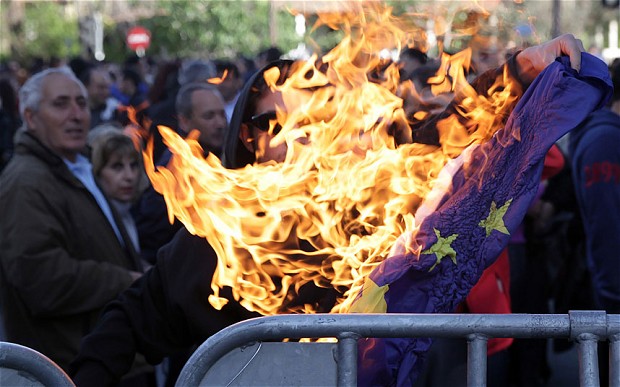
A demonstrator burns a European Union flag outside the parliament in the Cypriot capital, Nicosia Photo: AFP
By Bruno Waterfield, in Brussels
7:29PM BST 11 Apr 2013
Cyprus will have to find an €6bn extra to contribute to its own bail-out, less than a month after the original EU-IMF deal was agreed, putting the already teetering economy in danger of collapse and further endangering large bank depositors. It also emerged that the government in Nicosia has agreed to sell gold reserves to raise around €400m to help finance its part of its own bail-out. The Cypriot developments came as Portugal was disclosed to be facing a second bail-out.The cost of the increased demands on Cyprus emerged in a draft document prepared by the country’s creditors. Cyprus is now having to find €13bn to secure €10bn from the EU and the IMF. Previously it was thought that Cyprus would only have to raise €7.5bn.
“It’s a fact the memorandum of November talked about €17.5bn in financing needs. And it has emerged this figure has become €23bn,” said government spokesman Christos Stylianides.
Under the preliminary terms of a bail-out agreed last month, Cyprus will drastically reduce the size of its bloated banking sector, raise taxes, downsize the public sector workforce and privatise some state-owned firms.
Stylianides was commenting on a new assessment of Cyprus’s financing needs that eurozone finance ministers, including that of Cyprus, are to discuss in Dublin from Friday in a bid to reach a final deal.
Under the original March bail-out deal, the country’s failed lender Laiki Bank is being wound up and its healthy assets transferred to the Bank of Cyprus.
To cover part of Cyprus’s revenue-raising needs, there was talk that customers with deposits of more than €100,000 at Bank of Cyprus could lose up to 60pc of those holdings. That figure could now be even higher. Those in Laiki will have to wait years to see any of their money over €100,000.
It was also announced on Thursday night that the threshold on bank transactions domestically has been raised to €30,000 and travellers can now take €2,000 abroad – a rise of €1,000. The threshold for company payments abroad has been raised to €20,000 from €5,000.
Other restrictions, such as a cash withdrawal limit of €300 per day, remain in place.
Meanwhile, other leaked documents on Thursday also brought the focus back onto Portugal, which is struggling to implement its own eurozone austerity measures.
Currently, the country will owe the EU and IMF €78bn in bail-out loans when it has to return to the financial markets for financing in July next year. But the documents showed that this will be nigh on impossible because Portugal will need to borrow €14.1bn in 2014, 30pc more annually than before the bail-out, at higher interest costs than those that caused its initial crisis in 2011.
The leaked troika documents, to be discussed by Europe’s finance ministers this weekend, set out options to help both Portugal and Ireland by extending the repayment plan for loans.
Eurozone ministers are expected to agree to give both countries an extra seven years but a confidential analysis of Portugal predicts that even with extra time for repayments the country could need a second bail-out.
Portugal was plunged into a new round of political crisis last weekend after its constitutional court blocked austerity measures contained the country’s 2013 budget, measures that are the condition of continued EU-IMF funding.
 About bambooinnovator
 Bamboo Innovator