Death toll hits 16 in China bird flu outbreak; Online pictures of dead birds spur China flu openness
April 17, 2013 Leave a comment
Online pictures of dead birds spur China flu openness
POSTED: 16 Apr 2013 4:21 PM
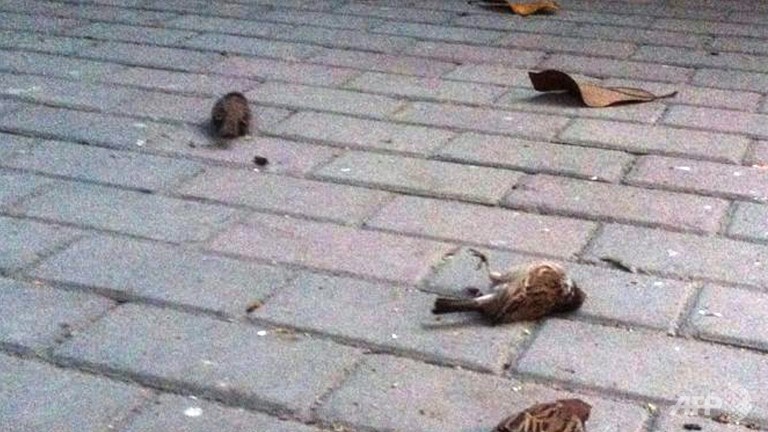
Photos of 10 dead sparrows on a Chinese pavement that went viral on social media and drew a swift official response show how hard covering up a bird flu outbreak would be in the Internet age.
SHANGHAI – Photos of 10 dead sparrows on a Chinese pavement that went viral on social media and drew a swift official response show how hard covering up a bird flu outbreak would be in the Internet age.
China has won international praise for its transparency on the H7N9 strain, which has killed 14 people so far, in sharp contrast to criticism for trying to conceal the 2003 Severe Acute Respiratory Syndrome (SARS) epidemic.
But analysts say the government has little choice, as technological change over the past decade and the proliferation of Twitter-like “weibo” microblogs help drive greater official openness.
The images of the dead sparrows by weibo user Mao Xiaojiong (who also uses the weibo name Mao Lanlanlan), shot beneath a magnolia tree near her home in the city of Nanjing — which banned live poultry trading and culled birds after confirming H7N9 in people — were a case in point.
When she posted them on her weibo account earlier this month, asking authorities to investigate, they were reposted 20,000 times, racked up hundreds of thousands of views, and became a top topic on Internet portal Sina.Police whisked away one of the dead birds the same night to test for H7N9, and within two days authorities publicly ruled out the virus as a cause of death.
Mao said the spread of her post “showed this matter received great attention from the public”.
“It made it easier to attract attention of the government,” she told AFP.
But she also deleted her original post because of worries over the uproar she caused.
“Really nervous seeing so many reposts… As it hasn’t been confirmed by officials, I deleted the post so as not to cause panic,” she explained at the time.
China keeps a tight grip on the Internet, censoring content it deems politically sensitive and keeping a close watch even on euphemisms that citizens use to evade scrutiny.
In the face of H7N9, it has also used a more old-fashioned tool of control, detaining at least a dozen people for spreading false information online about outbreaks where they lived, saying their actions had heightened public fears.
Censorship on the new outbreak appears limited compared to past political and health scandals, but whatever authorities’ intentions, the number and speed of postings on microblogs has made it far more difficult to control information.
“The weibo has put a lot more scrutiny (on the government),” said David Bandurski of the University of Hong Kong’s China Media Project, which researches Chinese journalism.
“Weibo is working as this big kind of steam machine — it lets everyone let off steam about a very generalised frustration.”
But the new medium faces limitations in bringing real political change, he added, as the one-party state still exercises control over the Internet and traditional media.
Rumours about SARS, which later proved true, eventually forced China to be more forthcoming about that disease, which originated in the country and went on to kill about 800 people around the world.
The World Health Organization said it was pleased with China’s information sharing on H7N9, while US public health experts said it had quickly released the genome sequences needed to develop a vaccine and research the virus.
“We are very satisfied and pleased with the level of information shared and we believe we have been kept fully updated on the situation,” the WHO’s representative in China, Michael O’Leary, said last week.
Chinese Internet users have questioned a three-week gap between the first deaths from the H7N9 outbreak and the official announcement on March 31.
Chinese officials say time was needed to confirm the virus in people for the first time, but one poster drew a parallel with SARS, writing: “Delayed action 10 years ago, delayed action 10 years later… Only the virus has changed.”
According to the overseas-based China Digital Times, which tracks Chinese censorship, searches for the post have been blocked.
Death toll hits 16 in China bird flu outbreak
POSTED: 17 Apr 2013 8:25 AM
URL: http://www.channelnewsasia.com/news/asiapacific/death-toll-hits-16-in/640972.html#
H7N9 bird flu has claimed two more lives in Shanghai, Chinese state media said on Tuesday, bringing the death toll from the disease to 16.
SHANGHAI: H7N9 bird flu has claimed two more lives in Shanghai, Chinese state media said on Tuesday, bringing the death toll from the disease to 16.
China has confirmed 77 human cases of H7N9 avian influenza since announcing two weeks ago that it had found the strain in people for the first time.
The new strain of the flu had been confined to the eastern city of Shanghai and nearby Zhejiang, Jiangsu and Anhui until Saturday when the first case was reported in Beijing.
It has since spread west to the central province of Henan where two new cases were reported on Sunday.
China confirmed 14 new H7N9 cases between 6 pm on Monday and 8 pm Tuesday, Xinhua said, with two more deaths reported in Shanghai.
A total of 30 cases, including 11 ending in death, have now been reported in Shanghai, said Xinhua.
Eight of the people reported on Tuesday to have contracted H7N9 bird flu were said to be in critical condition.
Three of these were in Jiangsu, according to Xinhua, which cited the province’s health department. They are a 21-year-old woman, and two men aged 56 and 72.
The other five were in Zhejiang, where three men and two women aged between 56 and 72 tested positive for the virus.
As of Tuesday, Zhejiang has confirmed 21 H7N9 cases, including two that have ended in death.
A seven-year-old girl in Beijing who tested positive for H7N9 in the capital’s only reported case so far will be discharged from hospital on Wednesday, Xinhua said.
She has been treated for the past six days and is now testing negative for the virus.
A four-year-old boy who had tested positive was discharged from a Shanghai hospital last Wednesday, said Xinhua citing local health authorities.
He has been the only confirmed case to make a full recovery.
Health authorities in China say they do not know exactly how the virus is spreading, but it is believed to be crossing from birds to humans, prompting mass culls in several cities.
Experts fear the prospect of the virus mutating into a form easily transmissible between humans, which would have the potential to trigger a pandemic — but the World Health Organization (WHO) has said there is no evidence yet of such a development.
International experts are preparing to head to China to probe the outbreak, the WHO said on Tuesday.
The mission, including four international flu specialists, is due to arrive in the coming days for a week-long investigation.
Taiwan announced on Tuesday that it is planning a permanent ban on the killing of live poultry in traditional markets amid concerns over the spread of the H7N9 avian flu virus in China.
Chinese state media on Monday urged people to keep eating chicken and help revive the poultry industry, which lost 10 billion yuan ($1.6 billion) in the week after the virus began infecting humans.
 About bambooinnovator
 Bamboo Innovator