False Start: Urbanization Drive Fails to Meet Expectations in China

False Start: Urbanization Drive Fails to Meet Expectations – Economic Observer Online – In-depth and Independent

By Kang Yi, Jiang Yunzhang, Zhang Xiaodong and Xiao Wei (康怡,降蕴彰, 张向东 ,肖薇)

Issue 615, April 15, 2013

After a period of optimism spurred on by high hopes for rapid urbanization, the steel industry is now wistfully watching customers change the way they buy steel in order to capitalize on falling prices. Ge Xin (葛昕), a researcher with the Beijing Lange Steel Information Research Center, reports that he heard of this trend recently at an industry meeting. He says in the past companies might book 10,000 tons of steel from a trader two months before construction and pay the entire cost upfront. Now however, they might divide shipment of that 10,000 tons over eight weeks and pay whatever the market price of the steel is at the time of delivery. Lower cash availability among these companies is one reason for delaying purchases, but it has more to do with a desire to take advantage of falling steel prices.

“At the end of last year and especially in January this year, people all felt steel had a bright future,” Ge said. “It appeared that the steel market was booming. After Chinese New Year almost all steel factories increased production, and these increases were quite large.” However, in March, the price for reinforcing steel (rebar) dropped more than 200 yuan per ton. The steel industry over the past three months has been described as a “roller coaster” and producers now feel they were overly optimistic. Read more of this post

What Happens When Asia’s Water Tower Dries Up? Drought in the Yunnan province of China affects most of the major rivers of Asia

What Happens When Asia’s Water Tower Dries Up?

Drought in the Yunnan province of China affects most of the major rivers of Asia

By Coco Liu and ClimateWire  | Tuesday, April 16, 2013 | 11

what-happens-when-asias-water-tower-dries-up_1

Lijiang Old City, Black Dragon Park. The whole region repeatedly suffers from drought. Recently, they have become more frequent.Image: Flickr/Winston Smith

LIJIANG, China — After photographing Black Dragon Lake here for eight years, He Jiaxin knows of more places where he can get the lake to mirror the majesty of its surrounding mountains than anyone else. But this year, he has a problem: The lake has disappeared.

Since its springs dried up last year, no water has flowed into Black Dragon Lake for more than 400 days. At the same time, hot weather caused a high evaporation rate, turning a large part of the lake into a play yard for children.

“I’ve never seen such a dry-up before,” He, a 36-year-old local photographer, said while staring at the parched lake bed. “It hasn’t rained in Lijiang for a really long time.”

Lijiang is hardly alone. Similar situations are happening across other parts of Yunnan province, which usually has more rain than half of China’s regions. But it has experienced extremely low rainfall for the past three years. Read more of this post

Treatment Woes Can Bolster Hospitals’ Profit; The study underscores the challenges of improving the safety of medicine when few hospitals have financial inducements to do so

Updated April 16, 2013, 4:10 p.m. ET

Treatment Woes Can Bolster Hospitals’ Profit

By CHRISTOPHER WEAVER

Hospitals have faced pressure for years to make visits to their wards safer. But their investments in everything from hand-washing campaigns to infection-fighting robots have done little to curb the thousands of yearly injuries and deaths caused by avoidable medical complications.

New research suggests one obstacle: Treatment complications and infections can inadvertently bolster the bottom line.

Surgical complications such as infections and procedure-related strokes were on average twice as lucrative as operations that went smoothly at one large hospital system, researchers from Harvard Medical School, Boston Consulting Group and Texas Health Resources, reported Tuesday in the Journal of the American Medical Association.

The study underscores the challenges of improving the safety of medicine when few hospitals have financial inducements to do so, the researchers said. Texas Health, a Dallas-based hospital network, which made medical and financial records of more than 34,000 surgeries available for the study, said it would discuss the results with insurers in hopes of better aligning payments to reward successes. Read more of this post

TIPS Investors Rush for Exit

April 16, 2013, 8:48 p.m. ET

TIPS Investors Rush for Exit

Treasury Inflation-Protected Securities Lose Favor as Fears of Rising Prices Ease

By CAROLYN CUI

MI-BV391_MKTLED_G_20130416174506

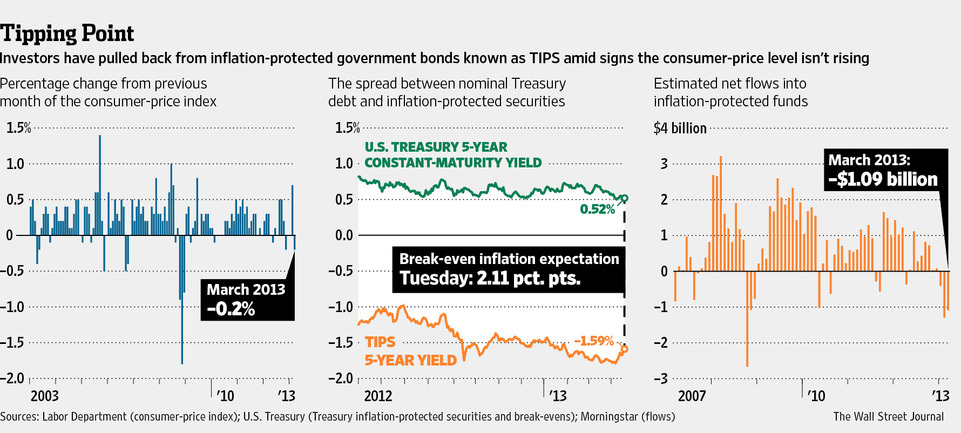
A surprise drop in gasoline prices has jolted a corner of the bond market, easing investors’ inflation fears and triggering an exodus from a popular form of Treasury securities.

Bond investors have been pouring into the $883 billion market for Treasury inflation-protected securities, or TIPS, over the past year, in a bid to protect their purchasing power in case of rising prices. TIPS holders receive adjustments to the principal value of their bonds tied to the rate of inflation, protecting their holdings from being eroded by rising price levels. Read more of this post

Facebook Charging $1 Million For New, Intrusive Video Ads; Facebook has previously claimed its logged-in audience is equivalent to three Super Bowls every day

Facebook Charging $1 Million For New, Intrusive Video Ads

Jim Edwards | Apr. 16, 2013, 8:43 AM | 2,455 | 14

Facebook wants $1 million from advertisers who want to be the first to run video ads in users’ news feeds this summer, according to Ad Age. And users won’t have a choice over whether they see them: the 15-second spots will be on “autoplay,” meaning that they’ll run like regular video ads on any other website, starting up whether users like it or not. The move was expected. Business Insider noted in December that Facebook was considering autoplay video ads. The company believes it can take a significant share of ad money currently being spent on TV by showing advertisers superior return on investment measurement. Facebook is already the second biggest server of online video, after YouTube. Facebook has previously claimed its logged-in audience is equivalent to three Super Bowls every day — making it the perfect place to launch new movie trailers. Read more of this post

A senior Chinese auditor has warned that local government debt is “out of control” and could spark a bigger financial crisis than the US housing market crash.

Last updated: April 16, 2013 5:32 pm

China local authority debt ‘out of control’

By Simon Rabinovitch in Beijing

A senior Chinese auditor has warned that local government debt is “out of control” and could spark a bigger financial crisis than the US housing market crash.

Zhang Ke said his accounting firm, ShineWing, had all but stopped signing off on bond sales by local governments as a result of his concerns.

“We audited some local government bond issues and found them very dangerous, so we pulled out,” said Mr Zhang, who is also vice-chairman of China’s accounting association. “Most don’t have strong debt servicing abilities. Things could become very serious.”

The International Monetary Fund, rating agencies and investment banks have all raised concerns about Chinese government debt. But it is rare for a figure as established in the Chinese financial industry as Mr Zhang to issue such a stark warning.

“It is already out of control,” Mr Zhang said. “A crisis is possible. But since the debt is being rolled over and is long-term, the timing of its explosion is uncertain.” Read more of this post

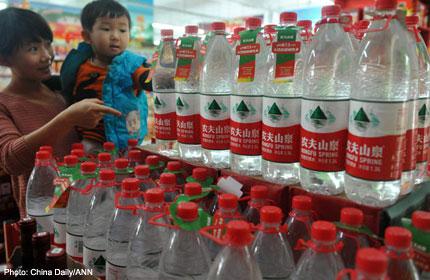
Quality concerns over China’s bottled water

Quality concerns over China’s bottled water

chiday_water

Wednesday, Apr 17, 2013
China Daily/Asia News Network
By Wang Zhenghua and Yan Yiqi

CHINA – A debate over the production standards adopted by bottled water giant Nongfu Spring has aroused safety concerns.

Several bottled water retailers in eastern China approached by China Daily said they have yet to see a major setback in sales of Nongfu Spring’s bottled water, but some consumers remain sceptical about the quality of its products. Read more of this post

IMF: Financial instability shifting from banks to pensions

Financial instability shifting from banks to pensions

17 April 2013

Author: Rachel Fixsen

Financial sector risk may be shifting to pension funds and other institutions as a result of global central banks’ exceptionally easy monetary policy – including bond-buying programmes – according to a new report from the International Monetary Fund (IMF).  Read more of this post

An H7N9 patient in Zhejiang province was sick for weeks and died before authorities had diagnosed the virus, making effective treatment impossible

Zhejiang cook died without knowing he had H7N9

Staff Reporter, 2013-04-17

An H7N9 patient in Zhejiang province was sick for weeks and died before authorities had diagnosed the virus, making effective treatment impossible, reports the People’s Daily. The man consulted four doctors and was not diagnosed as having contracted what is now known to be the latest strain of avian flu. He was reportedly infected after preparing two chickens which were carrying the disease, even though he did not eat their meat. Read more of this post

Moves to curb house prices trigger fake divorces in Shanghai

Moves to curb house prices trigger fake divorces in Shanghai

Staff Reporter, 2013-04-16

China’s recent attempts to cool the country’s overheated housing market have triggered a wave of phony divorces in Shanghai, with critics questioning the long-term effectiveness of government attempts to hold down soaring prices.

Jiahegongcheng, a Chinese non-profit offering marriage consultancy, said it had recently provided services to many couples staging a fake divorce in order to sidestep restrictions and purchase an additional home. The trend began after the Shanghai government limited families to buying only one additional new home among other measures started in 2010.

There were 43,964 couples in Shanghai which filed for divorce in 2012 and 8,068 of them later remarried, according to statistics.

Fake divorce has become a common way to avoid the law, and the government should not allow the trend to continue, said Hu Zonggen, a real estate consultant based in Shanghai. He suggested during a conference in March that the city should address the issue by banning new home purchases to people in their first year after a divorce. Read more of this post

FAW-Volkswagen Car chairman resigns amid corruption scandals; 10 billion yuan (US$1.6 billion) had evaporated from the group’s real estate business

FAW Car chairman resigns amid corruption scandals

Staff Reporter, 2013-04-17

First Automobile Works Group chairman Xu Jianyi has resigned as chairman and as member of the board at the group’s subsidiary FAW Car. The development has fueled speculation that his exit is a result of the series of corruption scandals within the state-owned enterprise.

FAW Car released a statement on Friday saying Xu’s resignation was due to work demands and he will not be taking up any other posts at the subsidiary. Xu will however remain as chairman of the group.

The statement came a day after reports that 10 billion yuan (US$1.6 billion) had evaporated from the group’s real estate business and that 200 senior managers had been whisked away by investigators for questioning. Read more of this post

China’s department stores losing out to e-commerce, higher costs; Retailing specialists said many department stores are being used purely as “fitting rooms” as shoppers have taken to trying on clothes at the store and then placing their orders online to save money

China’s department stores losing out to e-commerce, higher costs

Staff Reporter,  2013-04-17

Department stores in China have been under increasing pressure from rising rent and labor costs as well as greater competition from online retailers.

Department stores reported a total of 228.2 billion yuan (US$36.8 billion) in sales in 2012, up 8.92% from 2011, a rate far lower than the average annual growth rate of 16.5% recorded between 2006 and 2011, according to the China Commerce Association for General Merchandise.

Retailing specialists in China said local department stores were currently reporting net profits of only 2%-3% due to rising labor and rental costs. Labor costs have been increasing at a rate of over 10% annually, while rent has jumped over 10-fold during the past eight years.

Increased competition from e-commerce websites has also contributed to the slide.

Retailing specialists said many department stores are being used purely as “fitting rooms” as shoppers have taken to trying on clothes at the store and then placing their orders online to save money. Read more of this post

Death toll hits 16 in China bird flu outbreak; Online pictures of dead birds spur China flu openness

Online pictures of dead birds spur China flu openness

POSTED: 16 Apr 2013 4:21 PM

a-photo-from-weibo-user-mao-lanlanlan-on-april-15-shows-dead-sparrows-on-the-ground-in-nanjing-eastern-china-4
Photos of 10 dead sparrows on a Chinese pavement that went viral on social media and drew a swift official response show how hard covering up a bird flu outbreak would be in the Internet age.

SHANGHAI – Photos of 10 dead sparrows on a Chinese pavement that went viral on social media and drew a swift official response show how hard covering up a bird flu outbreak would be in the Internet age.

China has won international praise for its transparency on the H7N9 strain, which has killed 14 people so far, in sharp contrast to criticism for trying to conceal the 2003 Severe Acute Respiratory Syndrome (SARS) epidemic.

But analysts say the government has little choice, as technological change over the past decade and the proliferation of Twitter-like “weibo” microblogs help drive greater official openness.

The images of the dead sparrows by weibo user Mao Xiaojiong (who also uses the weibo name Mao Lanlanlan), shot beneath a magnolia tree near her home in the city of Nanjing — which banned live poultry trading and culled birds after confirming H7N9 in people — were a case in point.

When she posted them on her weibo account earlier this month, asking authorities to investigate, they were reposted 20,000 times, racked up hundreds of thousands of views, and became a top topic on Internet portal Sina. Read more of this post

Bird Flu Fears Mount in China as Herbal Remedies Run Out

Bird Flu Fears Mount in China as Herbal Remedies Run Out

A popular herb called ban lan gen, or blue root, has been flying off pharmacy shelves across China as local governments encourage people to consider traditional remedies to ward off the latest bird flu virus.

With scientists so far unable to pinpoint the H7N9 influenza virus’ animal host, locals are preparing for a possible pandemic by stocking up on popular plant remedies as well as face masks and hand sanitizers and other over-the- counter remedies.

“Chinese people associate ban lan gen with anti-virus,” said Shen Jiangang, assistant director for research at the University of Hong Kong’s school of Chinese medicine. “So when they hear about bird flu, they immediately think it might be effective to protect themselves although there is no experimental evidence.”

Ayurvedic and Chinese medicines have used the remedy for centuries. Scientists have proved it can relieve bacterial conjunctivitis in eye drops and found it has an antiviral effect in test tubes. There is no test to show it works against influenza.

That hasn’t stopped buyers. Chinese consumers, especially older ones, tend to believe in traditional formulations especially when it comes to cold and flu remedies, said Iwona Mamczur, an analyst at Mintel International Group Ltd. The market for over-the-counter medicines was worth 77.5 billion yuan ($12.5 billion) in 2011, according to a report from the London-based researcher. Read more of this post

The Role of Management Quality in the IPOs of Venture-Backed Entrepreneurial Firms

The Role of Management Quality in the IPOs of Venture-Backed Entrepreneurial Firms

Thomas J. Chemmanur Boston College – Carroll School of Management

Karen Simonyan Suffolk University – Department of Finance

Hassan Tehranian Boston College – Department of Finance

April 4, 2013

Abstract: 
We make use of hand-collected data on the quality and reputation of the management teams of a large sample of entrepreneurial firms going public to analyze the role of management quality in the IPOs of venture capital (VC)-backed firms for the first time in the literature. We hypothesize that management quality may affect a VC-backed firm’s IPO characteristics and post-IPO operating performance through two channels: a “certification” channel, where firms with higher management quality face reduced information asymmetry in the IPO market, and therefore find it easier and cheaper to go public; and an “ability” channel, where firms with higher quality managements select better projects and implement them more ably. Further, VC-backing may itself affect a firm’s IPO, indirectly by affecting a firm’s management quality and directly through the above certification and ability channels. These hypotheses imply that VC-backing will be associated with higher management quality, and both management quality and VC-backing will have a favorable effect on firms’ IPO characteristics, increase IPO participation by financial market players, allow firms to go public earlier, yield higher IPO and immediate after-market valuations, and will be positively related to changes in post-IPO operating performance. Our OLS regression, propensity-score matching, and instrumental variable analyses provide empirical support for the above hypotheses. While VC-backing and management quality act as substitutes in their effect on a firm’s IPO characteristics, they act as complements in their effect on firms’ IPO and secondary market valuations and post-IPO operating performance.

Chasing that elusive dengue vaccine

Chasing that elusive dengue vaccine

The scourge of dengue extends throughout the tropical world and now encroaches on subtropical areas, even as in Singapore last week, the number of cases (492) hit a high for this year.

4 HOURS 14 MIN AGO

The scourge of dengue extends throughout the tropical world and now encroaches on subtropical areas, even as in Singapore last week, the number of cases (492) hit a high for this year.

A recent study estimated that nearly 400 million people are infected each year; another three billion are at risk of infection. Yet, there is neither a vaccine that can prevent infection nor a specific antiviral drug for a severe case of the disease.

The lack of an effective vaccine is not for want of effort. Interestingly, the call for a global effort to develop a dengue vaccine was made here in Singapore in 1977. Read more of this post

Forget the personality pigeonholes; backlash against the dominance of extroversion in the workplace; More people are sick of being told they have to work constantly in groups to be creative and spend three-quarters of their day in meetings

Forget the personality pigeonholes

April 16, 2013

The Venture

Promotion of the strong, silent types  introverts  gets louder by the day. A growing number of authors and academics argue introverts are potentially more creative than their extroverted peers, better team players and superior managers.

The most recent cheerleading for introversion is an article in the prestigious Academy of Management Journal: “The downfall of extroverts and rise of neurotics: the dynamic process of status allocation in task groups,” by UCLA Anderson School of Management’s Corinne Bendersky and Rutgers Business School’s Neha Parikh Shah.

It follows Susan Cain’s excellent 2012 book Quiet: the power of introverts in a world that can’t stop talking, and her widely watched TED video that espoused the benefits of introversion. Other management experts are surely queuing up to push the case for introversion over extroversion, such is the growing interest in the topic.

Worthy as it is, none of this research considers the merits of introversion over extroversion from a start-up entrepreneurship perspective.

What’s your view?

  • Do you need to be extroverted to get a venture off the ground and grow it quickly – at least in the first few years?
  • Is it much harder for introverted start-up entrepreneurs to succeed?
  • Can you be an effective salesperson if you are introverted?
  • Can introverts change to extroversion when needed, with practice?

 What are the benefits of introversion in start-up entrepreneurship?

I suspect the big push for introversion is, in part, a backlash against the dominance of extroversion in the workplace. More people are sick of being told they have to work constantly in groups to be creative, have open-plan offices and spend three-quarters of their day in meetings.

They know they are more creative and effective in a quiet work space on their own, yet find opportunities to shut the door and think deeply about issues are increasingly limited. Cain’s book forcefully argued the case to give workers more time to think on their own. Read more of this post

When Swindlers Worked the ‘Big Con’ on Stock Investors; Enter the confidence man, who calibrated his pitch just right: He wasn’t offering something for nothing; he was looking for a wide-awake investor who knew how to read the winds.

When Swindlers Worked the ‘Big Con’ on Stock Investors

In the 1900s and 1910s, hundreds of swindling teams worked the Big Con in U.S. cities.

The time was right because, by the beginning of the century, the sensational exploits of robber barons and the vast fortunes to be had from railroad, mining and other industrial enterprises had created an appetite for financial speculation that most Americans couldn’t satisfy.

The stock markets were open only to the few who could afford the high share minimum and margin requirements. This moment in history — after gambling ceased to be widely considered immoral and before securities became a standard part of retirement funds — left middle-class businessmen quivering for opportunity.

Enter the confidence man, who calibrated his pitch just right: He wasn’t offering something for nothing; he was looking for a wide-awake investor who knew how to read the winds. Read more of this post

LDK Delinquency Flags Chance of Another Solar Bust: China Credit

LDK Delinquency Flags Chance of Another Solar Bust: China Credit

LDK Solar Ltd. (LDK)’s failure to fully pay notes this week has raised the prospect of China’s second solar-industry failure this year as the company needs to repay a loan 10 times larger by June.

The world’s second-biggest maker of wafers that convert sunlight into power couldn’t repay all of the $23.8 million of dollar-denominated convertible bonds that matured on April 15, according to a company statement yesterday. Before the delinquency, its 2014 yuan notes dropped below 50 yuan per 100 yuan face value, according to data compiled by Bloomberg. The yield reached a six-month high of 125 percent last week, compared with the 79 percent for Bonn-based Solarworld AG. (SWV)

LDK, which will probably report a second year of losses tomorrow, must repay a $240 million loan unless it spins off its polysilicon unit by June 3, according to regulatory filings. Suntech Power Holdings Co. (STP), once the world’s largest panel maker, was dragged into insolvency days after it defaulted on a $541 million bond repayment on March 15.

LDK failed to repay about $7 million of bonds for which it could not reach a settlement, and may receive a notice of default, said Edward Guinness, a fund manager at Guinness Atkinson Funds in London who oversees about $800 million, including a “tiny” position in LDK.

“It’s out of LDK’s hands,” he said in an interview yesterday. “The lenders can choose to give them an extension. It’s up to them to push LDK into bankruptcy.” Read more of this post

If Gold < $1175, Then Cyprus Out Of Eurozone?

If Gold < $1175, Then Cyprus Out Of Eurozone?

Tyler Durden on 04/16/2013 12:16 -0400

One of the unexpected consequences of the recent plunge in the price of gold (for whatever reason, and there are many proposed explanations for why gold has tumbled, none of them completely accurate or comprehensive) is that when the European Commission set the precedent with the forced sale of Cypriot sale for a total of €400 million “to cover ELA losses” as Mario Draghi dictated to the aptly named head of the Cyprus Central Bank, Panicos, he set a line in the sand especially when it comes to German expectations. Because while the size of the Cypriot bailout will likely keep expanding, the one fixed component is the €10 billion loan that Merkel has still to get approval for in parliament. This number is set in stone, and any additional bailout “funding” will have to come from either further depositor impairment (until eventually even the insured depositors become impaired, again) or as the case may be, the country is forced to sell all of its sovereign hard assets, like its gold. Which means that no matter what, Cyprus will have to sell enough gold to cover a €400MM shortfall, as point 29 of the Debt Sustainability Analysis demanded.

And therein lies the rub.

While a week ago, when gold was $1600/ounce the self-funded component (read “gold sale”) of the Cypriot bailout amounted to just over 10 tons of gold, as of today’s price and EURUSD rate, Cyprus would now have to sell 12 tons of gold to cover the gap, if it were to hit the sell button today (assuming a price of $1385/ounce and a 1.315 EURUSD exchange rate). As far as we know, Cyprus hasn’t sold one ounce yet. But what if gold keeps tumbling as it has in the past three days? Well, the problem as most know, is that as of March based on IMF data, Cyprus only has 13.9 metric tons of “excess” (as the EC defined it) gold.

This means one can extrapolate below what price Cyrpus is out of luck and the proposed European Commission bailout fails as one of the key self-funded elements simply will not have enough cash to fill the €400 MM hold.  That price for gold, once again assuming a 1.315 EURUSD, is roughly $1175/ounce. Read more of this post

Since Friday morning, the value of total above-ground stocks of gold bullion has fallen by more than $1 trillion, “could fall to $1,050”

Gold loses $1 trillion of total global value, “could fall to $1,050”

BY BEN TRAYNOR

April 16, 2013 • Reprints

Spot market gold prices fell to a fresh two-year low in Tuesday’s Asian trading, dropping to $1,322 per ounce, before rallying back above $1,386, as stock markets extended yesterday’s losses.

Silver dropped to its lowest level since September 2010 at $22.10 an ounce before it too recovered some ground. Oil was down on the day by lunchtime in London, while copper ticked slightly higher.

Since Friday morning, the value of total above-ground stocks of gold bullion, estimated by metals consultancy Thomson Reuters GFMS at around 174,000 tonnes, has fallen by more than $1 trillion. Read more of this post

Pension Funds Ignoring Kim Buy Cheapest Korea Stocks Since 2007

Pension Funds Ignoring Kim Buy Cheapest Korea Stocks Since 2007

South Korea’s biggest investors are buying more equities than ever at a time of worsening relations with North Korea, lured by the cheapest shares since 2007.

Domestic institutions bought a net 2.2 trillion won ($1.97 billion) of stocks in the two weeks after North Korea announced its highest combat level on March 26, the first among escalating threats from Kim Jong Un’s regime. The purchases were larger than those following seven previous flare-ups, from North Korea’s first nuclear test in 2006 to its detonation of a nuclear device in February, data compiled by Bloomberg show.

While the Kospi index has retreated 3.1 percent since March 26 amid 2.2 trillion won of net equity sales by foreigners, Korea Teachers Pension and Shinyoung Asset Management Co. added to holdings as valuations fell to the lowest level in six years relative to MSCI Inc.’s Asia Pacific Index. Investors who bought Kospi shares in the two weeks after previous bouts of tension were rewarded with three-month gains of 5 percent on average.

“There’s ample upside in the Kospi this year from the current level,” Young Soo Shim, the head of asset outsourcing team at Korea Teachers Pension, the nation’s second-largest public pension fund with the equivalent of $12.5 billion under management, said by phone on April 12. “We spent more than initially planned in March as we have flexibility in executing money, with North Korea continuing to ratchet up threats.” Read more of this post

Malaysian Poll Upset Would Pose Risk to Tycoons: Southeast Asia

Malaysian Poll Upset Would Pose Risk to Tycoons: Southeast Asia

Malaysian companies controlled by billionaires T. Ananda Krishnan and Syed Mokhtar Al-Bukhary face the risk of increased competition and government scrutiny should opposition parties win next month’s election.

Anwar Ibrahim’s three-party Pakatan Rakyat, or People’s Alliance, pledged in its manifesto to abolish monopolies in industries including pay television, which is dominated by Ananda’s Astro Malaysia Holdings Bhd. (ASTRO) Anwar said in a March 8 interview he will scrutinize government agreements made with Syed Mokhtar, whose DRB-Hicom Bhd. (DRB) bought a 32 percent stake in the national postal service in 2011.

Astro and DRB shares have fallen at least 5 percent this year, compared with the FTSE Bursa Malaysia KLCI Index (FBMKLCI)’s 0.7 percent gain. Polls show Pakatan Rakyat is poised to wrest more seats from Prime Minister Najib Razak’s Barisan Nasional coalition in elections due on May 5. Najib’s approval rating slipped in February to the lowest level in 18 months, according to a survey by the Merdeka Center for Opinion Research.

“Things seem to be shaping up to be a fairly close election,” Rahul Bajoria, regional economist for Asia at Barclays Plc, said by phone from Singapore on April 12. “There is some market concern generally that the PR coalition has indicated that they will be reviewing contracts.”

The opposition holds 75 seats in the 222-seat parliament, while Najib’s Barisan has 137 seats, according to data on the parliamentary website. Either side needs at least 112 seats to form a government. Barisan currently holds power by the slimmest margin since Malaysia’s independence from the British in 1957. Read more of this post

Snapchat processes 150 million images per day Vs Facebook’s Instagram posting 40 million photos per day

Snapchat processes 150 million images per day

By Hayley Tsukayama, Published: April 16

Snapchat, the real-time photo-sharing service has seen a three-fold increase in just four months, according to co-founder and chief executive officer Evan Spiegel.

He said Monday that the company is now processing 150 million images per day — showing a strong demand for sending photo messages that delete themselves within 10 seconds.

By comparison, the most recent statistics from Facebook’s Instagram service show users posting 40 million photos per day. Read more of this post

Turks Aim to Emulate Israel Tech as Erdogan Excoriates Netanyahu; The country “really needs to switch to higher value- added exports” and improve its education system to “compete with innovative countries like Israel,”

Turks Aim to Emulate Israel Tech as Erdogan Excoriates Netanyahu

Prime Minister Recep Tayyip Erdogan wants to catapult Turkey into the top 10 of the global economic elite over the next decade. To get there, he may need to spend more time mimicking the country he’s been feuding with.

While Turkey and Israel have both shifted to manufacturing from farming since the Jewish state was established in 1948, it’s Israel that has succeeded in building high-margin industries. The tech index on Turkey’s Borsa Istanbul has 16 members and a market value of about $790 million. Israel’s TA BlueTech-50 Index (TACT), in an economy less than one-third the size, is valued at $16.5 billion.

During Erdogan’s decade in power, which followed years of unstable and short-lived coalitions, inflation and interest rates plunged from more than 30 percent as the budget deficit and national debt shrank. The gains from that good housekeeping may be running out of steam, with economists and ministers saying Turkey needs an industrial breakthrough to achieve the next stage.

“Turkey is nearing the limits of what it can do with macroeconomic stability,” said Serdar Sayan, a professor of economics at the TOBB University of Economics and Technology in Ankara. The country “really needs to switch to higher value- added exports” and improve its education system to “compete with innovative countries like Israel,” he said. Read more of this post

The Imprinting of Founders’ Human Capital on Entrepreneurial Venture Growth: Evidence from New Technology-Based Firms

The Imprinting of Founders’ Human Capital on Entrepreneurial Venture Growth: Evidence from New Technology-Based Firms

Luca Grilli Politecnico di Milano

Paul H. Jensen University of Melbourne – Melbourne Institute of Applied Economic and Social Research

Samuele Murtinu Politecnico di Milano – Dipartimento di Ingegneria Gestionale

April 2013
Melbourne Institute Working Paper No. 14/13

Abstract: 
This paper tests the presence of an ‘entrepreneurial imprinting effect’ of founders’ human capital on entrepreneurial ventures’ performance. More specifically, we empirically explore the impact of entrepreneurs’ human capital on a firm’s sales growth performance by disentangling the effect of the stock of human capital possessed at foundation from the potential injections and losses of human capital due to exit of founders and/or addition of new owner-managers in the entrepreneurial team over time. Our analysis is based on a panel dataset composed of 338 Italian new technology-based firms (NTBFs) observed from 1995 (or since their foundation) to 2008 (or until their exit from the dataset). We consider the effects of several dimensions of entrepreneurial human capital on firm sales growth and estimate Gibrat law-type dynamic panel data models using OLS estimator and GMM-system estimator to control for endogeneity. Overall, our results point to a positive and significant presence of an ‘entrepreneurial imprinting effect’ exerted by founders’ specific work experience on venture growth which is robust to a series of controls.

World Bank: Rethinking the State’s Role in Finance

Rethinking the State’s Role in Finance

Martin Cihák World Bank

Asli Demirgüç-Kunt World Bank – Financial and Private Sector Development

April 1, 2013
World Bank Policy Research Working Paper No. 6400

Abstract: 
The global financial crisis has given greater credence to the idea that active state involvement in the financial sector can be helpful for stability and development. There is now evidence that, for example, lending by state-owned banks has helped in mitigating the impact of the crisis on aggregate credit. But evidence also points to negative longer-term effects of direct interventions on resource allocation and quality of intermediation. This suggests a need to rebalance the state’s roles from direct to less direct involvement, as the crisis subsides. The state does have very important roles, especially in providing well-defined regulations and enforcing them, ensuring healthy competition, and strengthening financial infrastructure. One of the crisis lessons is the importance of getting the basics right first: countries with complex but poorly enforced regulations suffered more during the global crisis. Evidence also suggests that instead of restricting competition, the state needs to encourage contestability through healthy entry of well-capitalized institutions and timely exit of insolvent ones. There is also new evidence that supports the state’s key role in promoting transparency of information and reducing counterparty risk. The challenge of financial sector policies is to better align private incentives with public interest, without taxing or subsidizing private risk-taking.

China slowdown shows struggle to channel money into real economy; Components of off-balance sheet financing soared

Analysis: China slowdown shows struggle to channel money into real economy

9:44am EDT

By Kevin Yao

BEIJING (Reuters) – A credit boom in China failed to keep economic recovery on track in the first quarter, suggesting the cash sloshing around the economy is not yielding the desired effect of stoking growth and could instead exacerbate property and inflationary risks.

A rapid rise in credit in recent months has been driven by the fast-growing shadow banking sector rather than formal bank lending, raising two major concerns.

One is that some of the new money is being used by debt-laden local governments to repay existing loans rather than being channeled into investment that might spur fresh economic activity.

The second is shadow banking has provided a lifeline to funding investment in the property sector, one area where the government is trying to restrict growth for fear that a house price boom could undermine the broader economy. Read more of this post