Britain is doing more of its shopping online and not just because it’s been freezing
April 19, 2013 Leave a comment
Britain is doing more of its shopping online and not just because it’s been freezing
By Leo Mirani @lmirani April 18, 2013

The weather gets blamed for an awful lot of depressing economic data in Britain. If it isn’t the Chancellor of the Exchequer blaming the snow, it is the venerable Office for National Statistics blaming the cold. According to the latest ONS retail sales report (pdf), “March 2013 was the second coldest on record, and this appears to have had a negative effect on sales in the non-food sector.” Retail spending dropped 0.7% from the previous month and 0.5% from the previous year, in terms of volume. Spending in terms of value was more-or-less flat. Now, admittedly, March was an astonishingly cold month in the United Kingdom, with freezing temperatures lasting well into the first week of April. Regardless, the numbers do not bode well for the UK’s economic recovery. And things look even worse if spending on automotive fuel is removed from the equation.
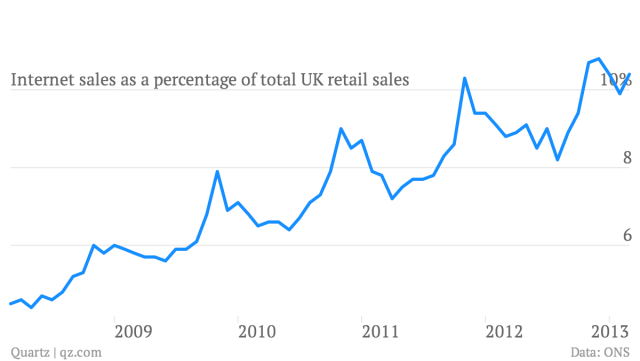
But the weather may also have been good for some retailers. Sales on the internet made up more than a tenth of total sales in March, a surprisingly high proportion for this time of year. Online spending tends to spike in November and remain high in December, when people to shop for Christmas but don’t want to get trampled underfoot on the high street. Shopping in general dips in the first few months of the new year, as people recover from the party season. Internet sales typically trail off as the weather gets better and people venture back outdoors.But this year, online shopping as a proportion of total retail sales has remained stubbornly high. After registering record highs of 10.7% of total sales in November and 10.8% in December, online spending fell only slightly to 10.4% in January. Sales on the internet dropped a bit more to 9.9% in February before recovering again to 10.4% in March. That could have something to do with the weather, but it could also suggest a change in consumer spending habits, says Katie Evans, an economist at the Centre for Economics and Business Research, a London-based consultancy. “It’s no longer just in the run up to Christmas, not just avoiding the crowd,” she said.
The ONS helpfully divides internet sales into several categories, including food, textiles and clothing, and so on. With the exception of online spending on household goods, which declined by a tenth over the previous year, online sales have grown in double digits in every category. Online sales as a whole jumped by more than a fifth from last year.
“I don’t expect we’ll see this continuing in summer months. I don’t think we’ll see 10% in June and July,” said Evans. “But I think we’re seeing some of the seasonality dropping out.” She added that internet sales may very well make up at least a tenth of sales throughout the year in the next few years.
That will be good for British business and for the economy. But it will give Britain’s politicians one less excuse when the numbers don’t look quite as rosy as they would like.
 About bambooinnovator
 Bamboo Innovator