Falling Yen Sets Stage for Profit Windfall
April 24, 2013 Leave a comment
April 23, 2013, 3:00 p.m. ET
Falling Yen Sets Stage for Profit Windfall
By MAYUMI NEGISHI And DANIEL INMAN
TOKYO—When Japan’s biggest companies begin to report earnings this week, they are expected to forecast the highest profits in six years and higher capital spending, raising hopes that this time, the country’s corporate recovery could have staying power.
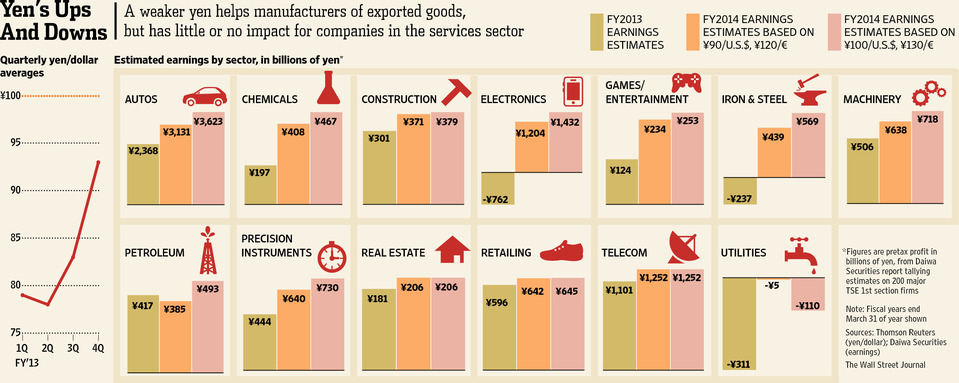
After years of belt tightening, the yen’s recent drop is expected to propel corporate earnings to new heights. At ¥100 to the dollar—around the current level—pretax profit at the top 200 Japanese companies is forecast to rise 75% to ¥16.09 trillion ($162.15 billion) in the fiscal year that started this month, according to Daiwa Securities.
In a sign of the upswing, Yaskawa Electric Corp., 6506.TO +3.31% a supplier of industrial robots to Toyota Motor Co. 7203.TO +0.91% and Nissan Motor Co., 7201.TO +2.13% last week said net profit would jump 91% in the current fiscal year, after dropping 19% last year. It will also spend 52% more this year to ramp up production capacity. Yaskawa executives said that it kept its outlook “conservative” because of economic uncertainty in the U.S., Europe, and China.
“We have streamlined operations so much that the weaker yen becomes a huge tailwind,” Yaskawa Executive Vice President Toshihiro Sawa said at a news conference.
The improving outlook is a welcome change for corporate Japan. Five years of yen appreciation have weighed on Japan’s flagship exporters, with the pain trickling down to hundreds, if not thousands, of suppliers and partners. The strong yen exacerbated the impact of the global financial crisis, supply-chain disruptions after the earthquake and tsunami of 2011, and the European debt crisis.
The weaker yen presents a windfall to Japan’s biggest companies and export-reliant economy by boosting earnings that are repatriated into yen. It also helps lower the prices of goods that are made in Japan and exported. Investors have cheered its expected benefits for the country’s automobile sector, which has led corporate Japan in streamlining costs, and the electronics sector, where earnings traditionally have swung widely on currency rates.
Since assuming power in December, Prime Minister Shinzo Abe’s government has declared a war against deflation, with aggressive easing of monetary policy and fiscal spending. The dollar has climbed 25% against the yen since elections were called in mid-November. The dollar hit ¥99.88 on Monday in Tokyo, after trading below ¥80 for much of last year, while the euro was at ¥130.58. The Nikkei Stock Average meanwhile has surged almost 55%.
Toyota’s shares have increased more than 75% since the elections were called, whileHonda Motor Co.’s 7267.TO +1.42% rose more than 60%. Japan’s struggling electronics companies also have been beneficiaries, with shares in Sony Corp.6758.TO -0.06% and Panasonic Corp. 6752.TO +0.14% gaining more than 80%.
When Toyota reports earnings May 8, expectations are that the world’s largest auto maker by sales will eclipse its profit forecasts, helped by strong sales of its sedans and sport-utility vehicles in North America, in addition to the yen depreciation.
Toyota “is going to blow the doors off,” CLSA analyst Christopher Richter wrote in a note to investors last week. The auto maker should be able to beat its forecast for operating-profit of ¥1.15 trillion by 18% in the year just ended and forecast growth of 86% in the current fiscal year, he said.
“What’s happening is a correction of a yen that was too strong. It was incredibly tough when the yen was at 79 and 80” to the dollar, Honda Chief Executive Takanobu Ito told reporters over the weekend. “The current foreign-exchange level is manageable. It’s a help to our operations.”
Sumitomo Chemical Co. 4005.TO +6.38% Chairman Hiromasa Yonekura, who also heads Japan’s biggest business lobby, Keidanren, said better results mean that Japanese companies will begin to spend.
“Companies know they need to invest more if they are to compete globally,” Mr. Yonekura said at a news conference Monday. “There is much to feel good about, so the capital spending will come. The only question is when.”
But in a sign of the sober reality that Japanese firms must face after two decades of economic malaise, Mr. Yonekura said, Japanese firms are likely to reinvest that money abroad because “companies go where the demand is.”
A weaker yen “is not a magic potion,” said Petr Kocourek, senior portfolio manager at First State Investments in Singapore. “In order to see meaningful earnings growth and market-share gains, you need to have the products to compete to get the advantage of a weaker yen plus the advantage of being a market leader.”
In addition to the dollar’s sharp rise against the yen, the surging stock market—back at levels last seen in 2008—is providing relief.
The Japanese corporate sector is a web of cross-held shareholdings, in which partner companies and creditors hold one another’s shares. While some unwinding has taken place since Japan’s asset-inflated economical bubble burst, many companies were sitting on unrealized stock losses that weighed on their finances.
Nomura Securities senior strategist Kengo Nishiyama said the surging stock market wiped away nearly all the stock-value losses booked by 1,848 nonfinancial Japanese companies at the end of September. Unrealized gains on shareholdings rose to an estimated ¥11.1 trillion at the end of March, up about 60% from a year earlier.
“Market expectations for growth are especially strong at manufacturers,” said Mr. Nishiyama. “We expect companies to use funds gained from lowering shareholdings on capital spending and acquisitions.”
 About bambooinnovator
 Bamboo Innovator