How to Predict the Next Big Bailout; Real estate agents who help Chinese investors buy homes abroad say the easier it is for their clients to buy citizenship, the likelier it is for the country’s economy to tip over into crisis
April 24, 2013 Leave a comment
April 23, 2013, 6:16 PM
How to Predict the Next Big Bailout
After Cyprus, who’s next to fall? Real estate agents in China have their own crude method for identifying the next domino. And it doesn’t involve number crunching banks’ balance sheets.
Real estate agents who help Chinese investors buy homes abroad say they can guess which country is facing financial ruin by the level of restrictions attached to their investment immigration programs. That is, the easier it is for their clients to buy citizenship, the likelier it is for the country’s economy to tip over into crisis.
 “Cyprus always had Russian investors, but started looking for more Chinese homebuyers two years ago,” said a real estate agent surnamed Yang who is based in Beijing. “Right now we’re seeing a push from Portugal.”
To be clear, China Real Time doesn’t endorse this as a method for predicting a country’s financial fate – the agents themselves admit the model completely failed to predict what happened to Greece, for example – but the correlation serves as a useful reminder to China’s wealthy would-be emigrants that nations don’t always open their doors just because they’re feeling hospitable.
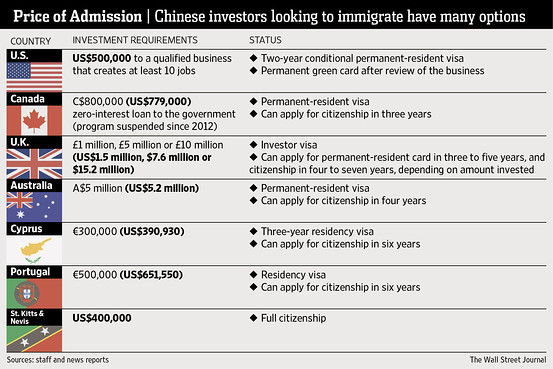
Countries hungry for investments to shore up their economies have lately pushed hard to attract immigration-oriented investors in China. They offer citizenship alongside a minimum level of investment, typically through a home purchase – an appealing option for China’s real-estate obsessed rich.
In 2012, before it was forced restructure its banks in exchange for a €10 billion ($13 billion) bailout, Cyprus was among the most aggressive courters of Chinese homebuyers, enticing them with the promise of permanent European Union residency – and the ability to apply for citizenship within six years — for a relatively small investment of €300,000.
“You get a sense which ones are really desperate,” said another Shanghai-based agent. “But such countries do not fit into the investment profile of my clients and I would not advise them to invest in Cyprus at all.”
On the other end of the ‘level of ease’ spectrum, the U.S., the U.K. and Australia – none of which appears likely to need a bailout in the near future – maintain much more costly and difficult investor immigration programs. Another financially robust nation, Canada, recently suspended all new investor immigration applications, while financially solid Singapore raised the stamp duty for foreigners buying homes to 18% from 13% early this year.
Two of the newly trendy destinations for Chinese immigrant investors: Portugal, which is struggling to secure €2 billion in bailout funds and the Caribbean nation of St. Kitts and Nevis, which is laboring under mounds of public debt amid shrunken tourism revenue.
As for Greece, which imploded in 2011 without pitching immigration to China’s rich?
“Greece was too lazy to try to attract Chinese homebuyers,” said Ms. Yang.
 About bambooinnovator
 Bamboo Innovator