Gravity Theory of Einstein’s Proved Right—Again
April 26, 2013 Leave a comment
Updated April 25, 2013, 7:28 p.m. ET
Theory of Einstein’s Proved Right—Again
By GAUTAM NAIK
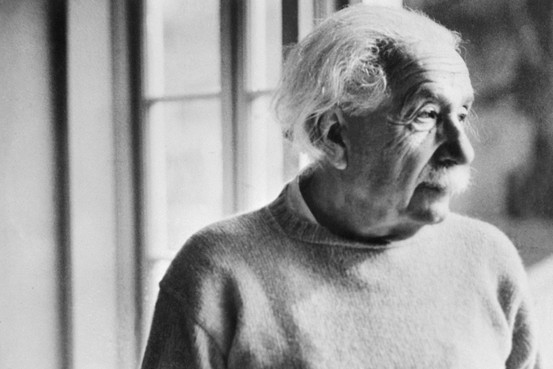
Scientists have subjected Albert Einstein’s famous theory of gravity to its toughest real-world test so far—and it has prevailed.
The theory, which was published nearly a century ago, had already passed every test it was subjected to. But scientists have been trying to pin down precisely at what point Einstein’s theory breaks down, and where an alternative explanation would have to be devised.
Einstein’s framework for his theory of gravity, for example, is incompatible with quantum theory, which explains how nature works at an atomic and subatomic level.Consider that for a black hole, Einstein’s theory “predicts infinitely strong gravitational fields and density. That’s nonsensical,” said Paulo Freire, an astrophysicist at the Max Planck Institute for Radioastronomy in Germany and co-author of the study, which appears in the journal Science.
And so scientists are testing the general theory not because they think it is wrong but because they are certain it can’t be the final explanation—just as Isaac Newton’s notion of gravitational force was superseded by Einstein’s.
Einstein’s general theory of relativity states that objects with mass cause a curvature in space-time, which we perceive as gravity. Space-time, according to Einstein’s theories of relativity, is a four-dimensional fabric woven together by space and time.
For example, a bowling ball causes a dent in a mattress, and that dent changes the otherwise straight motion of a nearby marble on the same mattress. Similarly, the mass of the sun distorts the space-time around it. A body with less mass, like the earth, travels along one path in that distorted space, which we call its orbit.
Dr. Freire and his colleagues put Einstein to the test in a cosmic laboratory 7,000 light years from earth, where two exotic stars are circling each other. One, known as a white dwarf, is the cooling remnant of a much lighter star. Its companion is a pulsar, which spins 25 times every second. Though the pulsar is just 12 miles across, it weighs twice as much as the sun.
“When you have such a big mass in such a small space you have extremely high gravity,” said Charles Wang, a theoretical physicist at the University of Aberdeen, Scotland, who wasn’t involved in the study.
The gravity on the pulsar’s surface is 300 billion times as great as the gravity on Earth. The conditions there approach the relentless, overwhelming power of a black hole, which swallows even light.
“We’re testing Einstein’s theory in a region where it has never been tested before,” said Dr. Freire.
The pulsar and white dwarf pair emit gravitational waves and the binary star system gradually loses energy. As a result, the stars will move closer to each other and orbit faster. Einstein’s theory suggests the stars’ orbital periods—the time they take to go around each other—ought to shrink by about eight-millionths of a second per year.
Dr. Freire’s and his colleagues used several telescopes to take precise measurements of the two-star system. Their results perfectly matched the Einstein-based prediction.
Though Einstein’s framework remains intact so far, “the study is significant for the way observations by astronomers are helping to identify new, extreme cases” to test his general theory of gravity, said Dr. Wang.
Einstein’s theory was first—and dramatically—confirmed during a solar eclipse within four years of its publication, making him an instant celebrity. When asked how he would have felt if he had been proven wrong, Einstein replied: “I would have felt sorry for the Lord. The theory is correct.”
 About bambooinnovator
 Bamboo Innovator