In China, the License Plates Can Cost More Than the Car; None of the top 10 passenger car models sold in China are Chinese brands
April 26, 2013 Leave a comment
In China, the License Plates Can Cost More Than the Car
By Tian Ying and Alexandra Ho on April 25, 2013
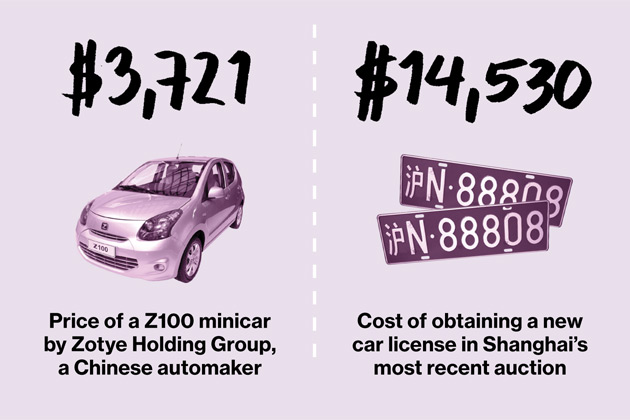
Shanghai’s busy streets teem with Buicks, Fords, Volkswagens, and Toyotas. More than 9 out of 10 cars in the world’s most populous city are made by foreign companies, and it’s not just a reflection of mainlanders’ preference for Western design. Some local automakers say the city’s license plate auctions are responsible for their weak sales. Shanghai is one of four Chinese cities that limit car purchases by imposing quotas on registrations. The prices paid at Shanghai’s license auctions in recent months—90,000 yuan ($14,530)—have exceeded the cost of many entry-level cars, the stronghold of Chinese brands such as Chery, Geely, and Great Wall. While residents with modest incomes may be able to afford an inexpensive car, the registration cost is often beyond their reach. “Whenever there’s a restriction of new car purchases through the quota system, there is always a big impact on lower-price cars like the ones we make,” says Lawrence Ang, executive director of Geely Automobile Holdings (175), whose Panda minicar sells for 37,800 yuan.
After Beijing (pop. 21 million) introduced a license plate lottery in January 2011, the combined share of Chinese brands sold there plunged by more than half, to 9.7 percent for the year, according to researcher IHS Automotive. In Shanghai, which began auctioning license plates in 1994, domestic brands made up only 8.9 percent of cars sold in 2011 (the most recent data available), less than a third the level nationwide, IHS reports.Shanghai officials have put in place a complicated—and expensive—process to purchase the right to add a car to the often-gridlocked roads of this city of 23 million people. To register for the license auction, prospective car buyers must put down 2,000 yuan as good faith money. In exchange, they get a disc loaded with software they can use to bid online. After a couple of rounds of offers, the government figures out the highest price it can charge to completely sell out the year’s new allotment of licenses. Lottery participants who had bid at least that much then get to pay for their plates.
As local officials grapple with growing traffic congestion and air pollution and seek new sources of revenue, more cities will impose license plate quotas, UBS (UBS) analysts predicted in January. Guangzhou (pop. 13 million) and Guiyang (pop. 4 million) already have them. Tianjin (pop. 13 million) may start them as early as May, China Youth Daily reported on April 11. “If the measures were followed by more Tier-2 and Tier-3 cities [China’s informal classification of medium-size metropolitan areas], the impact would be much bigger,” says Geely’s Ang.
China’s auto manufacturers face further trouble as cities tighten emission standards after toxic smog blanketed Beijing and Shanghai for much of the winter. Since Feb. 1, Beijing has used the same strict pollution regulations as the European Union on new cars, and Shanghai expects to impose them by November. The increased pollution scrutiny benefits European and American manufacturers because they have larger model lineups across which environmental compliance costs can be spread and because they already have developed models which meet the European rules.
With the combined blows of the pollution regulations and license plate quotas, some smaller domestic manufacturers have been forced to retreat from the biggest cities, according to Chi Yifeng, head of the Beijing Asian Games Village Automobile Exchange, a big dealer selling multiple car brands in the capital. “Local automakers have pretty much given up on markets like Beijing,” Chi says. “The plate lottery system is too big a test for them.”
Yet shifting their focus farther inland or to Western China won’t necessarily mean Chinese brands can escape their handicap in the biggest urban areas, says Cao He, an analyst with China Minzu Securities in Beijing. “Making their cars visible in cities like Beijing and Shanghai impresses future buyers like migrant workers when they consider buying cars back home,” Cao says. None of the top 10 car models sold in China last year were Chinese brands.
Chinese automakers have focused on cities such as Lanzhou in northwestern Gansu province and Chengdu in Sichuan. Domestic manufacturers can find plenty of growth in such cities, considered third-tier or lower despite populations ranging from 2 million to more than 10 million, says Wang Chuanfu, chairman of BYD (1211), a Shenzhen-based automaker that counts Warren Buffett’s Berkshire Hathaway (BRK/A) as an investor. “Tier-3 and Tier-4 markets are opportunities for local brands,” Wang says.
The problem is, foreign manufacturers are also beginning to train their sights on China’s hinterland. General Motors (GM)and its joint-venture partners in 2011 created a new brand, Baojun, to make cars for the emerging working class outside major cities. Volkswagen (VOW) may also introduce a new low-cost car in China. “Local automakers had to start by making low-end cars, as the threshold is lower and easier for them to get in,” says Li Dongsheng, vice secretary general of the China Association of Automobile Manufacturers. “Now the big foreign automakers are competing hard on the low end as well.”
That’s pushed some domestic automakers to build bigger, more expensive vehicles to take on the foreigners. Geely plans to introduce its EX8 sport-utility vehicle this year, and Great Wall Motor (2333) will spin off its Haval brand as a standalone nameplate focusing on higher-end models, Chairman Wei Jianjun said on March 29.
That won’t make much difference to Zhang Xin, a 40-year-old Beijing resident who works in finance. She’s been waiting for two years to win the city’s lottery for license plates, in which would-be buyers register online for a monthly draw. Last month, the odds were 80 to 1 against getting one of the 18,457 plates offered. Although the Chinese capital’s lottery is free to enter, the long wait has convinced Zhang that it’s smarter to buy a foreign brand if she ever wins. “Two years ago, I just wanted to get some cheap local-brand car to get around,” Zhang says. “Every month that I don’t win the lottery, I tell myself I’ll get the best car I can afford. A BMW X1 or an Audi A1 is what I want now.”
The bottom line: None of the top 10 car models sold in China are Chinese brands. Many local automakers are shifting their focus to smaller cities.
 About bambooinnovator
 Bamboo Innovator