Carbon-Intensive Investors Risk $6 Trillion ‘Bubble,’ Study Says

Carbon-Intensive Investors Risk $6 Trillion ‘Bubble,’ Study Says

Investors in carbon-intensive business could see $6 trillion wasted as policies limiting global warming stop them from exploiting their coal, oil and gas reserves, according to a report.

The top 200 oil, gas and mining companies spent $674 billion last year finding and developing fossil fuel resources, according to research by the Carbon Tracker Initiative and a climate-change research unit at the London School of Economics. If this rate continues for the next decade some $6 trillion risks being wasted on “unburnable” or stranded assets, according to the report, released today.

Banks, funds and institutional investors are seeking clarity from government and central banks about how greenhouse- gas emissions may affect the value of their investments. The Bank of England said last year it will evaluate whether the U.K.’s exposure to investments in polluting industries poses a risk to financial stability after a group of more than 20 investors called for a such a probe.

“If the markets carry on regardless, with the regulators looking the other away, they’re just asleep on their watch,” James Leaton, research director at Carbon Tracker, a project by non-profit Investor Watch, said in an interview in London. “The longer it goes on, the bigger the bubble will get.” Read more of this post

In Europe, Paid Permits for Pollution Are Fizzling

April 21, 2013

In Europe, Paid Permits for Pollution Are Fizzling

By STANLEY REED and MARK SCOTT

LONDON — On a showery afternoon last week in West London, a ripple of enthusiasm went through the trading floor of CF Partners, a privately owned financial company. The price of carbon allowances, shown in green lights on a board hanging from the ceiling, was creeping up toward three euros. That is pretty small change — $3.90, or only about 10 percent of what the price was in 2008. But to the traders it came as a relief after the market had gone into free fall to record lows two days earlier, after the European Parliament spurned an effort to shore up prices by shrinking the number of allowances. “The market still stands,” said Thomas Rassmuson, a native of Sweden who founded the company with Jonathan Navon, a Briton, in 2006.

Still, Europe’s carbon market, a pioneering effort to use markets to regulate greenhouse gases, is having a hard time staying upright. This year has been stomach-churning for the people who make their living in the arcane world of trading emissions permits. The most recent volatility comes on top of years of uncertainty during which prices have fluctuated from $40 to nearly zero for the right to emit one ton of carbon dioxide. More important, though, than lost jobs and diminished payouts for traders and bankers, the penny ante price of carbon credits means the market is not doing its job: pushing polluters to reduce carbon emissions, which most climate scientists believe contribute to global warming. The market for these credits, officially called European Union Allowances, or E.U.A.’s, has been both unstable and under sharp downward pressure this year because of a huge oversupply and a stream of bad political and economic news. On April 16, for instance, after the European Parliament voted down the proposed reduction in the number of credits, prices dropped about 50 percent, to 2.63 euros from nearly 5, in 10 minutes. Read more of this post

Tata Faces Crisis as $20 Billion Spent on Water: Corporate India

Tata Faces Crisis as $20 Billion Spent on Water: Corporate India

India, the world’s second-most populous nation, is doubling spending on water management to a record as conglomerates from the Tatas to Adani face shortages that the United Nations calls an impending crisis.

The federal and state governments have set aside 1.1 trillion rupees ($20 billion) for sewage treatment, irrigation and recycling for the five-year period ending March 2017, G. Mohan Kumar, special secretary in the Ministry of Water Resources, said in an interview. The nation with 1.2 billion people, which treats only 20 percent of its sewage, is pouring more money as inadequate clean water is threatening to stunt growth in industrial and farm output.

Disputes with farmers demanding rights to their irrigated land have stalled about $80 billion of investment by companies including Posco and ArcelorMittal (MT) as Prime Minister Manmohan Singh seeks to revive an economy growing at the slowest pace in a decade. Tata Steel Ltd. (TATA), India’s biggest maker of the alloy, is setting annual targets to cut water usage as two-thirds of the country faces a scarcity, H.M. Nerurkar, managing director said in an April 11 interview.

“Water availability is a very big issue and in the coming days this will be a far bigger issue,” A.P. Choudhary, chairman of Rashtriya Ispat Nigam Ltd., India’s second-biggest state-run steelmaker, said in an interview. “Water is critical for the steel industry’s growth and no company is comfortably placed.” Read more of this post

Triple A-rated Netherlands on Edge of Economic Crisis; Unemployment Surges as Home Prices Collapse

Netherlands on Edge of Economic Crisis; Unemployment Surges as Home Prices Collapse

Posted: 21 Apr 2013 12:05 PM PDT

Netherlands is underwater in more ways than one. Der Spiegel reports Underwater: The Netherlands Falls Prey to Economic Crisis

More than a decade ago, the Dutch central bank recognized the dangers of [the housing] euphoria, but its warnings went unheeded. Only last year did the new government, under conservative-liberal Prime Minister Mark Rutte, amend the generous tax loopholes, which gradually began to expire in January. But now it’s almost too late. No nation in the euro zone is as deeply in debt as the Netherlands, where banks have a total of about €650 billion in mortgage loans on their books. Consumer debt amounts to about 250 percent of available income. By comparison, in 2011 even the Spaniards only reached a debt ratio of 125 percent.  The Netherlands is still one of the most competitive countries in the European Union, but now that the real estate bubble has burst, it threatens to take down the entire economy with it. Unemployment is on the rise, consumption is down and growth has come to a standstill. Read more of this post

Canadians Surpass Americans in Net Worth, But Will it Last?

April 18, 2013, 2:30 PM

Canadians Surpass Americans in Net Worth, But Will it Last?

By Don Curren

They’ve been known to get pretty excited when a new, big-name discount retailer comes to town, but thanks to a booming housing sector, Canadians are more affluent than their American neighbors.

At least for the moment, that is.

Canada’s net worth was at a healthy 648% of gross domestic product in the final quarter of 2012, according to a report from independent economic research firm Capital Economics, which has gained something of a profile for its bearish views on Canada’s economy, and particularly its housing market.

By contrast, U.S. net worth was a more modest 550% in the same period.

The catch is that Canadians’ wealth advantage is built mostly on the big run-up in housing prices in recent years, and that’s a very shaky foundation, at least from Capital Economics’ point of view. Read more of this post

ASEAN looking a bit like ’97

ASEAN looking a bit like ’97

APR 22, 2013

This is an abridged translation of an article from the April issue of Sentaku, a monthly magazine covering Japanese political, social and economic scenes.

An economic upturn always has the potential for crisis. Members of the Association of Southeast Asian Nations (ASEAN) appear to be blessed with an economic boom. But there is a feeling of deja vu as current circumstances closely resemble those on the eve of the Asian financial crisis, which started in July 1997. Read more of this post

Yudhoyono’s Selection for Finance Minister Rattles Market

Yudhoyono’s Selection for Finance Minister Rattles Market

President Susilo Bambang Yudhoyono’s decision to opt for an acting finance minister to replace Agus Martowardojo threatens to cloud the policy outlook as Indonesia struggles to revamp its fuel-subsidy program, step up infrastructure investment and damp price pressures.

Hatta Rajasa will replace Martowardojo, who is set to become the next Bank Indonesia chief, the government said April 19. Rajasa is chairman of the National Mandate Party, a member of Yudhoyono’s Democrat Party coalition, and will also remain coordinating minister for the economy.

The Jakarta Composite Index, which has gained about 16 percent this year and reached a record last week, fell after the announcement that came an hour before the close of trade on April 19. Rajasa assumes the role as the government plan to curb fuel subsidies threatens to boost inflation that reached a 22- month high in March, adding to the burdens of an economy facing falling prices for its commodity exports including palm oil.

“The decision is quite strange — it will have a negative impact on the stock market and the rupiah,” said David Sumual, an economist at PT Bank Central Asia in Jakarta. “Indonesia needs a finance minister with a background in macroeconomic and fiscal policy, as there are so many problems in the economy.” Read more of this post

Baht Flashes Sell Signal as Prasarn Sees Froth: Market Reversal

Baht Flashes Sell Signal as Prasarn Sees Froth: Market Reversal

At least three trading patterns show Thailand’s baht, this year’s best-performing Asian currency, is poised to fall as policy makers step up warnings that its rally to a 16-year high is stretched.

The baht’s 2.3 percent advance this month pushed the 14-day relative strength indicator to 25, data compiled by Bloomberg show. A reading below 30 typically signals a reversal may occur. Trading envelope and stochastics oscillator indicators also suggest the baht’s rise has gone too far.

Central bank Governor Prasarn Trairatvorakul told reporters in Bangkok on April 19 that the baht’s advance has started to move beyond fundamentals, 10 days after he said the rally was “too fast.” Finance Minister Kittiratt Na-Ranong reiterated his call last week for the central bank to cut interest rates to deter inflows to the country’s bond market. Read more of this post

Japan Inc. Hesitates to Invest as Stocks Rally on Plummeting Yen

Japan Inc. Hesitates to Invest as Stocks Rally on Plummeting Yen

The last time Masao Namiki bought machinery for his company, Emperor Hirohito had just died, Japanese investors took the Rockefeller Center as a trophy, and a new central bank chief was about to prick the bubble economy. It was 1989.

The $1 million Namiki borrowed to outfit his workshop with computerized lathes and drills almost bankrupted him as orders from clients Canon Inc., Panasonic Inc. and NEC Corp. evaporated. As interest rates cranked up to 6 percent, crashing stock and land prices wiped out $15 trillion in wealth and triggered an economic malaise that still drags on.

The bubble, and the five recessions since, help explain why business owners like Namiki aren’t buying into investor euphoria over new Prime Minister Shinzo Abe’s campaign to end deflation. Even after the steepest five-month slide in the yen for 18 years made global companies like Toyota Motor Corp (7203). more competitive and Japan the world’s best-performing major stock market, Namiki said he’s still not ready to invest.

“If we had the orders I’d think about adding equipment, but right now the work’s just not there,” the 72-year-old said at his small factory in Tokyo’s Ota district, where he and a handful of employees have made thousands of steel molds for phones, stereos, and keyboards. “The manufacturers are still in wait-and-see mode.”

The reluctance to borrow and spend of companies like Namiki’s that don’t operate abroad and make up the bulk of Japan’s economy is the biggest threat to Abe’s plans, said Nomura Research Institute Chief Economist Richard Koo. Read more of this post

Why the Going-Concern Anomaly: Gambling in the Market?

Why the Going-Concern Anomaly: Gambling in the Market?

Asad Kausar Nanyang Technological University (NTU)

Alok Kumar University of Miami – School of Business Administration

Richard Taffler University of Warwick – Finance Group

April 11, 2013

Abstract: 
This paper investigates why the market fails to incorporate the adverse information conveyed by the going-concern (GC) opinion in a timely manner. Our main conjecture is that the lottery-like features of GC stocks attract a predominantly retail clientele who use those stocks to gamble in the market. Such trading behavior leads to the underreaction to the GC event and significant downward drift in prices over the following year. Using a sample of first time GC firms from 1993 to 2007 we show that GC stocks have extreme lottery-type characteristics. We further demonstrate that retail investors have a proclivity to be net-buyers of these stocks around the GC event, and such contrarian behavior is directly related to the lottery-like nature of GC firms. Using individual investor-level trading, socioeconomic, and demographic data we confirm that retail investors who are known to have a greater propensity to gamble are more likely to trade GC stocks. We rule out several alternative explanations for our findings, and conclude that gambling-motivated trading behavior of retail investors is the most likely driver of the anomalous short-term market reaction and the associated longer-term market response following the release of going-concern audit opinion.

How These Public School Teachers Made $4.4 Million Selling Lesson Plans Online

How These Public School Teachers Made $4.4 Million Selling Lesson Plans Online

Megan Rose Dickey | Apr. 19, 2013, 9:13 PM | 30,041 | 33

972

Teaching is by no means a very financially rewarding profession. Even though teachers are doing one of the most important jobs in society, full-time public school teachers make a mere $56,069 per year on average. That’s where Teachers Pay Teachers comes in. The online marketplace for course materials and lesson plans has attracted 1.8 million teachers, whom have collectively sold more $30 million worth of materials online. The top 10 sellers on the platform have generated more than $5 million in sales, netting around $4.4 million in total. Deanna Jump, pictured above, currently earns more than $80,000 a month. Teachers Pay Teachers features course materials for grades ranging from preschool to the collegiate level. But Teachers Pay Teachers Head of Product John Yoo says they have seen the strongest interest in the K-12 sector. On the high school level, Yoo says Tracee Orman’s material on how to integrate “The Hunger Games” into the classroom has been widely popular. “She’s not only become seen as the expert in using the Hunger Games in the classroom,” Yoo says. “She’s done what I think all good teachers do, which is marry the things that kids are interested in and turn it into really good curriculum. You know, use what they’re interested in to draw them into the classroom.” Yoo notes that not all teachers have found the same success as the top 10 sellers. In order to be successful on the platform, Yoo says they encourage teachers to leverage social media to get their name out there. “Teachers by nature need to share with each other,” Yoo says. “That’s part of what it means to be on the job. […] Whether you’re experiences or new, you need to figure out how to teach things in ways that resonate with kids.” Business Insider got in touch with many of Teachers Pay Teachers’s most successful teachers to learn more about their experiences. Read more of this post

Marc Andreessen: The World Would Be Much Better If We Had 50 More Silicon Valleys

Marc Andreessen: The World Would Be Much Better If We Had 50 More Silicon Valleys

BILLY GALLAGHER

posted 4 hours ago

Marc Andreessen, co-founder and general partner of Andreessen Horowitz, delivered a keynote speech at the she++ conference today, sharing what technology is exciting him right now, what he thinks about current startup culture, and how Sheryl Sandberg’s book, Lean In, affected his view of Silicon Valley. Andreessen described Google Glass as “potentially transformative for the entire industry. ” “You put it on and you’re like ‘Oh my God, I have the entire internet in my vision. Where have you been all my life?,’” he said. “I like to tell people that I’m beta testing the new Google Contact Lenses,” he joked to moderator Ruchi Sanghvi, VP of operations at Dropbox. He added that Facebook and Google are taking search in very different directions and opined “There’s a lot more to be done with search.” “New Facebook Graph Search capability I think is one of the coolest things I’ve ever seen…It makes me wish a little bit that I was single again,” he said to laughter. Andreessen said he switches phones every six months (between Android and iPhone) and he’ll get Facebook Home next week. Sanghvi turned the discussion to Sheryl Sandberg’s new book, Lean In. “Before Sheryl’s book, for 20 years, the answer has been, ‘Be gender blind,’” Andreessen said. “’Be gender blind.’ It’s not important; in fact, it’s not to be discussed. It certainly should not be brought into the hiring criteria and certainly should not influence how people manage. And basically have a straight meritocracy and ignore gender. Sheryl has provided a very, very provocative set of arguments that 1) That’s not actually working and 2) That managers, both female and male, actually have to take gender on squarely.” “We’ll have to completely retrain managers and executives of all kinds to be able to do this,” he continued. “[Sandberg] argues very persuasively that it’s necessary, but it’s like landmine central with the way employment law works these days.” “I think her book has been a wake up call that the current approach to solving the problem of gender imbalance— number one it’s not working, which is fairly obvious, and number two, it requires a rethink of basic communication and basic management. I think it’s a very good thing to be talking about this and debating this. I think that it’s going to take quite a while,” he said. “Startups as a general category are probably highly overrated,” he said, responding to Sanghvi’s question about Stanford students graduating and deciding between starting companies and finding jobs.

“Basically its an irrational act,” he said, explaining the right reason for starting a company. “This idea was so powerful and compelling that if I didn’t do it I’d hate myself for the rest of my life.” “I think that’s the part that’s getting lost,” he continued. “I think the cult of startups, and of course Stanford’s ground zero for this…Those startups are miserable experiences.” Andreessen argued that far too many entrepreneurs have an “incredible blind spot” to distribution, sales, and marketing in Silicon Valley right now, and shared his thoughts on immigration and innovation. Read more of this post

As Cancer Rates Rise in China, Trust Remains Low

April 17, 2013

As Cancer Rates Rise in China, Trust Remains Low

By DIDI KIRSTEN TATLOW

BEIJING — Living in China these days, we’re bombarded with scary accounts of rising cancer rates that are partly linked to some of the world’s worst pollution. The slogan this year for National Cancer Prevention and Care Week, which began Tuesday, spells it out: “Protect the Environment, Keep Cancer Away.” That even the Chinese state is highlighting a link between the poor environment and cancer reflects an atmosphere of deep concern, verging on panic, over public health, as more and more people ask: Is China killing itself in the pursuit of spectacularly fast, very dirty, economic growth? Of course, there are other, important reasons for rising rates, like an aging population and changing diet and lifestyles, as the Shanghai cancer specialists Guo Xiaomao and Long Jiang recently wrote in The Xinmin Evening News. And China’s cancer rate is still below that of the United States. About 3.5 million people are diagnosed with cancer yearly, the Zhejiang Science and Technology News Net reported Tuesday, citing a 2012 report by the National Cancer Registry. (Other news accounts put the figure at 3.12 million. Statistics in China often vary.) In the United States, with a population less than a quarter of China’s 1.35 billion, more than 1.6 million people are expected to receive a diagnosis of cancer in 2013, according to the American Cancer Society.

But cancer rates in the United States are falling, whereas in China they are rising, doctors and officials say. And China’s death rate from cancer is far higher — about 2.5 million people yearly, compared with the 580,350 expected to die in the United States this year. Complicating things further, some doctors are wondering: Is China facing a double health whammy as rising disease rates challenge a troubled medical system?

At the top of the list of reasons China may be facing a cancer crisis is the crucial issue of mistrust between patient and doctor. A new article in the Journal of Oncology Practice, published by the American Society of Clinical Oncology, illustrates this problem. The lack of trust, reflected in regular accounts in the Chinese news media of patients and their families venting anger or even physically attacking physicians, is rooted in a perception that doctors are out for personal gain and may be incompetent or corrupt. But according to the article — written by two oncologists, Dr. David H. Garfield of the United States and Dr. Harold Brenner of Israel, and a Chinese oncology nurse, Lucy Lu (who in 2011 were in a group that set up the first of several planned outpatient cancer centers in China, the article said) — doctors are afraid of being blamed by hospital administrators for “bad outcomes,” or deaths, and may act in ways that may protect themselves but may not be in the patient’s best interests. Read more of this post

Specialists See Tools to Treat Pain in Video Games

April 20, 2013

Specialists See Tools to Treat Pain in Video Games

By ASHLEY SOUTHALL

therapy-1-articleLarge

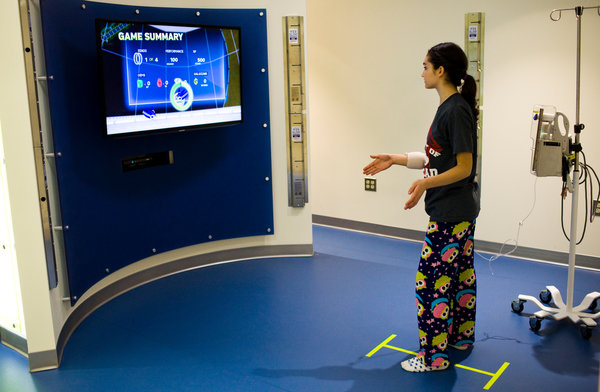
Danica Zimmerman, 14, playing a game to measure her range of motion and pain triggers at Children’s National Medical Center.

WASHINGTON — Fifteen-year-old Reilly woke up one morning with a sharp, stabbing pain in his left leg that soon spread to other parts of his body. The pain, which started early last year, forced him to quit soccer, and he spent the next four months being poked, prodded and scanned by doctors.

The test results were inconclusive. “No one could tell him why he was in a ball on the floor unable to function,” said Nina, his mother, who agreed to be interviewed only on the condition that the family’s surname be withheld.

Finally, last June, Dr. Sarah Rebstock, a pediatric anesthesiologist at Children’s National Medical Center, gave Reilly a diagnosis of chronic regional pain syndrome. The nerve disorder is characterized by chronic and severe burning pain, pathological changes in bone and skin, excessive sweating, tissue swelling and extreme sensitivity to touch.

Recently, Reilly stood in a half-lighted room of the hospital’s new Pain Medicine Care Complex, playing a video game called TubeRunner as part of his physical therapy routine.

The sight of the teenager reaching in the air and shuffling from side to side as his on-screen avatar hurled down an intergalactic tube racking up rings and gems seemed unremarkable. After all, game consoles like Microsoft’s Xbox and Nintendo’s Wii have become ubiquitous in American households, and many hospitals and clinics use them to add an element of fun to physical therapy.

But TubeRunner is one of four of galaxy-themed video games created specifically for this complex, where pain specialists and game developers are piloting an approach to measuring pain. Dr. Julia Finkel hopes that using technical data from games and interactive activities to objectively identify and monitor pain can help determine how to evaluate the techniques used to treat it. Read more of this post

Companies are using Big Data analysis to help find and nurture successful employees

April 20, 2013

Big Data, Trying to Build Better Workers

By STEVE LOHR

BOSSES, as it turns out, really do matter — perhaps far more than even they realize.

In telephone call centers, for example, where hourly workers handle a steady stream of calls under demanding conditions, the communication skills and personal warmth of an employee’s supervisor are often crucial in determining the employee’s tenure and performance. In fact, recent research shows that the quality of the supervisor may be more important than the experience and individual attributes of the workers themselves.

New research calls into question other beliefs. Employers often avoid hiring candidates with a history of job-hopping or those who have been unemployed for a while. The past is prologue, companies assume. There’s one problem, though: the data show that it isn’t so. An applicant’s work history is not a good predictor of future results.

These are some of the startling findings of an emerging field called work-force science. It adds a large dose of data analysis, a k a Big Data, to the field of human resource management, which has traditionally relied heavily on gut feel and established practice to guide hiring, promotion and career planning.

Work-force science, in short, is what happens when Big Data meets H.R. Read more of this post

China bond executives arrested in probe into alleged skimming; Relaxed quotas could give Asian central banks taste for China bonds

China bond executives arrested in probe into alleged skimming

Thu, Apr 18 2013

* Executives from CITIC, two other firms arrested

* Alleged profit skimming via complex trading practices

* Investigation could involve other institutions

* Regulation lags bond market’s explosive growth

By Gabriel Wildau

SHANGHAI, April 18 (Reuters) – Three Chinese financial industry executives have been arrested for allegedly using complex bond trading practices to skim client profits for personal gain, state media reported this week.

Executives from state-owned CITIC Securities , China’s largest brokerage by assets, unlisted fund management company Wanjia Asset Management and Qilu Bank, a small lender 20 percent owned by Commonwealth Bank of Australia , are under investigation by the Shanghai Public Security Bureau, the official Securities Times reported on Wednesday. Read more of this post

Another bird flu death in China as number of infected grows to 95

Another bird flu death in China as number of infected grows to 95

Saturday, Apr 20, 2013
Reuters

SHANGHAI – China reported another death and four new infections from a new strain of bird flu on Saturday, raising the death toll to 18, the official Xinhua News Agency said. The H7N9 virus has been found in 95 people, mostly in eastern China. The latest victim is a 69-year old man surnamed Xu from Zhejiang province who passed away Friday night after emergency treatment failed, Xinhua said. Zhejiang province reported three new infection cases with all three patients in critical condition. The eastern costal province of Jiangsu also reported another bird flu infection. On Friday health officials raised questions about the source of this strain of bird flu indicating that more than half of patients had no contact with poultry.

Read more of this post

Viruses move a lot faster than governments do. As new viruses emerge in China and the Middle East, the world is poorly prepared for a global pandemic

An ounce of prevention: As new viruses emerge in China and the Middle East, the world is poorly prepared for a global pandemic

Apr 20th 2013 | Bangkok and New York |From the print edition

IN FEBRUARY an 87-year-old man was admitted to hospital in Shanghai. What started as a cough progressed to a fever. One week later, unable to breathe and with his brain inflamed, he died. Shortly afterwards, a 27-year-old pork butcher was admitted to the same hospital with similar symptoms. He died too, within a week. A 35-year-old housewife who went to hospital in Anhui on March 19th lasted only slightly longer. On March 31st officials confirmed these were the first three cases of a strain of influenza, H7N9, that had never before been seen in humans. The government responded quickly—a far cry from its reaction, ten years ago, to a similar cluster of cases in Guangdong. That infection turned out to be SARS (severe acute respiratory syndrome). At first, officials tried to hide that disease. The deceit served to ensure its spread and it went on to kill nearly 800 people. Much has changed in the past decade. This time officials quickly posted H7N9’s genetic sequence, then published a detailed report in the New England Journal of Medicine. Even so, H7N9 has infected at least 82 people and killed 17 of them. The virus’s path of transmission is not well understood. The recent detection of H7N9 in a boy with no apparent symptoms suggests people can carry the virus unwittingly. Meanwhile a new coronavirus (the family of viruses that SARS belongs to) is circulating in the Middle East. It has killed 11 people since it was noticed in September. Though Saudi Arabia has welcomed some foreign investigators, other scientists claim the country should be more transparent. Read more of this post

Doraemon trumps Hello Kitty for Olympic Games ambassador

Doraemon trumps Hello Kitty for Olympic Games ambassador

BY AMY CHAVEZ, APR 20, 2013

Doraemon-Olympics-Tokyo-420

Japan’s most lovable anime character, el gato cosmico (the cosmic cat) has been chosen to be Japan’s ambassador in Tokyo’s bid for the 2020 Olympic and Paralympic games. It’s the first time Japan has chosen an anime character for an Olympic ambassadorship. Congratulations Doraemon!

I know what you’re thinking: That’s a cat? He doesn’t look like a cat. His tongue is too smooth. He has no fur. And he’s blue! Well, he’s a cat of the future. A robotic feline of the 22nd century, to be exact. With the ability to travel back in time, which is why he is here now.

But just because Doraemon is a cat of the future doesn’t mean he doesn’t have experience in the past. He first appeared in Japan of 1969. In 2008 he was appointed by the Foreign Ministry to be their “anime ambassador.” No one really remembers exactly what Doraemon did while in office at that time, which at least means he did nothing scandalous. Read more of this post

Roast Peking duck restaurants have seen a sharp drop in business because of the ongoing bird flu outbreak; Quanjude, a brand with 136 years experience in making roast duck, havep lummeted 17% in 12 trading days

Duck restaurants hit by bird flu outbreak

Updated: 2013-04-20 07:47

By Wang Zhuoqiong and Ye Jun ( China Daily) Read more of this post

Chinese investors short gold in London as prices tumble while the retail public buys; Tianjin Precious Metal Exchange flooded with requests from investors looking to short gold

Chinese investors short gold in London as prices tumble

Staff Reporter, 2013-04-20

Members of the public have rushed to buy gold amid the current price drop, while investors have been actively short selling. (Photo/CFP)

Chinese investors in London are increasingly short selling gold shares as the price of the precious metal has lost about 30% of its value from a year and a half ago.

The price of gold in the city hit a low of US$1,385.70 an ounce at one point on April 15, a plunge of nearly 30% from a historic high of US$1,920.38 an ounce in September 2011, according to the Chinese-language National Business Daily, which quoted an official at the research unit of Donghai Futures.

An investment consultant at Mintai Precious Metals, a member of the Tianjin Precious Metal Exchange — one of two precious metal exchanges in China approved by the State Council — said his company was flooded with requests from investors looking to short gold. Read more of this post

Rob Arnott of Research Affiliates: Most hedge funds disappoint; Funds have underperformed at a time when they are drawing more and more money from middle class retirement accounts

Rob Arnott: Most hedge funds disappoint

By Stephen Gandel, senior editor April 19, 2013: 11:51 AM ET

Funds have underperformed at a time when they are drawing more and more money from middle class retirement accounts.

rob_arnottf_2013_apr_lure_of_hedge_funds_figure1_small

Blue bar shows what happened to the portfolios risk-adjusted returns when hedge fund were added. Source: Research Affiliates

FORTUNE — Hedge funds have been a bust.

That’s how Robert Arnott, one of the nation’s most successful investment managers, sees it. That’s also the conclusion of a piece of research posted on his firm’s website this week.

The research, which is titled “The Lure of Hedge Funds,” directly refutes one of the key claims hedge funds managers make when they try to attract investors.

“There are some outstanding hedge funds, but they are considerably outnumbered by the multitudes of lousy ones,” says Arnott, who heads Research Affiliates.

Hedge funds have traditionally been investment vehicles for the rich and universities. But in the past decade or so, they have drawn more and more money from public pensions and other accounts that hold the retirement funds of the middle class. Assets in hedge funds have more than tripled in the past decade to $2.25 trillion, according to Research Affiliates.

“The results have been a disappointment, and yet asset flows continue at an astronomical rate,” says Arnott.

Part of that has to do with the sales pitch.

On the face of it, hedge funds have had a rough go of it recently. The vast majority of funds have done worse than the market for the past four years. To add insult to injury, last year even mutual funds outperformed hedge funds, which charge much higher fees than their rivals.

But hedge fund managers and the industry in general have long contended that those criticizing the funds for not having the highest returns are missing the point. They say hedge funds achieve their investment returns with less risk. You hear of the benefits of diversification, and risk-adjusted-returns. The pro-hedge fund camp argues that when you factor in the lower risk, investing in hedge funds is a better bet than just blindly putting your money in the market.

But Arnott says that’s a bunch of baloney. Read more of this post

Jim Chanos’s New China Presentation Will Have You Convinced The Country Is Doomed For A Hard Landing

Jim Chanos’s New China Presentation Will Have You Convinced The Country Is Doomed For A Hard Landing

Sam Ro | Apr. 19, 2013, 12:26 PM | 58,050 | 14

Jim Chanos gave a devastating presentation on China at Mish Shedlock’s Wine Country Conference. Chanos has been bearish on China for quite a while.  However, his new presentation is particularly fascinating because it has some pretty graphic cartoons. “The cartoons/illustrations, gruesome/silly, as they are, are FROM Chinese sources!” said Chanos in an email to Business Insider.  “That’s why we put them in-so that people know that the media inside China is becoming more skeptical itself.”

the-chinese-economic-story-is-riddled-with-red-flags Read more of this post

What It Was Like To Be Psy’s Roommate When He Was Dropout At Boston University in 1996; “He missed classes all day long. Flunked everything.”

What It Was Like To Be Psy’s Roommate When He Was Dropout At Boston University in 1996

Jim Edwards | Apr. 19, 2013, 6:21 PM | 7,618 | 4

psy-3

No other singer has made a music video that has been seen more than 1 billion times, as South Korea’s Psy has. By that measure, he’s the biggest pop phenomenon on the planet. His new song, “Gentleman M/V” has been seen 166 million times after just one week on YouTube. On its own, that’s a huge achievement. But Psy wasn’t born a pop star. He originally planned to go into business. His father is Park Won-Ho, the chairman of DI Corporation (which makes semiconductors) and his mom is Kim Young-hee, a restaurateur in the Gangnam district of South Korea. In the late 1990s he went to Boston University to study business administration, but dropped out when his interest in music eclipsed his willingness to study, or even show up to class on time. He then briefly attended Berklee College of Music, but didn’t complete that course either. He spent his leftover tuition money on a computer, a keyboard, and a MIDI, and ultimately returned to Korea. We received an email from someone claiming to be Psy’s former roommate during his time in Boston. While we can’t verify everything our source tells us — these are memories from 1996 – 1998, after all — they certainly dovetail with what we know about the pre-fame life of Psy (real name Park Jae-Sang). At the time, his disinterest in studying was legendary among his friends, the roommate tells us:

… I will tell you the broad strokes.
I lived with him 97-98.
He was still fat. Lazy. Messy. Typical Korean-male studying abroad.
His family had money so he lived well.
He missed classes all day long. Flunked everything. When we ate and drank he would put on shows at the karaoke spots.
We used to grab his chubby cheeks and tell him to “wake up! You’re never going to make it in entertainment with a fat ugly face like yours!”
He would always respond with resolve. “I will make it! I’m going to be a star! Just you watch!”

That’s pretty much everything.

Psy, apparently, has had the last laugh.

The ONE Thing: The Surprisingly Simple Truth Behind Extraordinary Results

The ONE Thing: The Surprisingly Simple Truth Behind Extraordinary Results [Hardcover]

Gary Keller (Author), Jay Papasan (Author)

16256798

Publication Date: April 1, 2013

YOU WANT LESS.

You want fewer distractions and less on your plate. The daily barrage of e-mails, texts, tweets, messages, and meetings distract you and stress you out. The simultaneous demands of work and family are taking a toll. And what’s the cost? Second-rate work, missed deadlines, smaller paychecks, fewer promotions—and lots of stress.
AND YOU WANT MORE.
You want more productivity from your work. More income for a better lifestyle. You want more satisfaction from life, and more time for yourself, your family, and your friends.
NOW YOU CAN HAVE BOTH—LESS AND MORE.
In The ONE Thing, you’ll learn to
• cut through the clutter
• achieve better results in less time
• build momentum toward your goal
• dial down the stress
• overcome that overwhelmed feeling
• revive your energy
• stay on track
• master what matters to you
The ONE Thing delivers extraordinary results in every area of your life—work, personal, family, and spiritual.
WHAT’S YOUR ONE THING? Read more of this post

Forget the long to-do lists and choose one thing to be good at

Forget the long to-do lists and choose one thing to be good at

By Vickie Elmer April 19, 2013

Success doesn’t come from a four-hour workweek or a list of seven steps. People who are extraordinarily successful are known for just one thing, one passion, one amazing skill, says Gary Keller and co-author Jay Papasan in their new book called The One Thing. That is true for Warren Buffett choosing investments or Bill Gates and computers. This notion comes partly from Italian economist Vilfredo Pareto’s principle, which showed that 80% of wealth was held by 20% of the people. This works elsewhere as the 80/20 principle, where a small portion of effort leads to oversized results. “Things don’t matter equally. …The smaller I make my life, the bigger it gets,” says Keller, the co-founder and chairman of Keller Williams Real Estate. Great bosses understand that businesses will succeed when staff are encouraged to excel in one domain. ”I want my phones answered extraordinarily. I want my contracts read extraordinarily. I want software done extraordinarily,” Keller said about his own real estate business. Here are three lessons from The One Thing:

1.  Success is sequential, not simultaneous.  Many people want it all. Yet when Keller coached “a lot of very successful men and women” in the 1990s, he would see them create a list of assignments to tackle. By their next conversation, they hadn’t accomplished the most important ones. Finally, he started making them choose one thing they would concentrate on between sessions. That led to dramatically improved results. He would ask them the focusing question: “What’s the one thing I can do such that by doing it, everything else will be easier or unnecessary?” That question runs through the book, and can serve to focus on big picture goals as well as daily priorities.

2. Nail your “one thing” by lunch.  Schedule your time block—a minimum of two hours, three or more is better—for the first part of your day when your willpower is highest. “By noon or 1 o’clock at latest, you’ve had an awesome day,” he said. “You’ve done what mattered most. Now you deal with all the other stuff.” For executive meetings, know the one thing that drives your business’ success, and make that the first item on your agenda always.

3. Everyone blows it. Keller wanted his book to be grounded in research, so the first draft came in at 400 pages. His publisher said: “Why don’t you practice what you preach?” The authors ended up cutting it in half.

U.S. Hospitals Told to Be on Lookout for H7N9 Bird Flu

U.S. Hospitals Told to Be on Lookout for H7N9 Bird Flu

U.S. hospitals are being urged to head off a spread of the new H7N9 avian influenza by looking out for people exhibiting flu-like symptoms who have traveled to China or had contact with someone who has the illness. The Centers for Disease Control and Prevention held a conference call with health-care professionals yesterday to review procedures for treating bird-flu patients and controlling infections, Erin Burns, an agency spokeswoman, said in an e- mail. The Atlanta-based agency today issued interim guidance on the use of antiviral agents to treat H7N9 infections. Issuing the guidance and holding the clinician calls “would be considered routine preparedness measures for an outbreak with pandemic potential,” Burns said.

China has recorded 92 human infections of the H7N9 strain of bird flu, with 17 of the cases fatal, according to data compiled by Bloomberg from national and provincial governments and the World Health Organization. The source of the infection hasn’t been identified and there is no evidence of person-to- person transmission, with many of the cases involving human contact with poultry, according to the CDC’s website. Read more of this post

CBRC Renews Push to Regulate Wealth Management as Credit Expands

CBRC Renews Push to Regulate Wealth Management as Credit Expands

The China Banking Regulatory Commission said it will scrutinize lenders’ wealth-management and short-term note sales, control increases in bad loans and focus on debts in an attempt to limit “severe risk.” The regulator has told banks to improve the accuracy of how they classify loans, to monitor non-performing loans and to control total lending to local government financing vehicles, according to a statement posted on the CBRC website yesterday. “The authorities are serious about the whole explosion of wealth management — and they must also be concerned at the scale of credit creation,” Michael Shaoul, chairman of New York-based Marketfield Asset Management LLC, said in an e-mail. First-quarter credit creation was about $1 trillion, he said.

Chinese banks rely on wealth-management products, which pay higher rates than regulated deposits, to retain clients who are diverting savings to other investments. The sales are transforming the stable and cheap deposit base that has supported lenders into one that is “more mobile, expensive and short-term,” creating repayment risk, Fitch Ratings has warned. The outstanding balance of banks’ wealth-management products may have been 13 trillion yuan ($2.1 trillion) at the end of 2012, compared with 8.5 trillion yuan a year earlier, according to Fitch. The pace of expansion is faster than during the 2009 credit boom and is taking place through wealth management and corporate debt-issuance systems, not through the better regulated bank-loan system, Shaoul said. Read more of this post

Jim Rogers’s daughter shows her Mandarin chops in Singapore

Jim Rogers’s daughter shows her Mandarin chops in Singapore

Xinhua and Staff Reporter, 2013-04-19

happyrogers-160141_copy1

Happy Rogers recites Tang poetry in Singapore. (Internet photo)

Happy Rogers, the nine-year-old daughter of American investor Jim Rogers, showed off her proficiency in Mandarin Chinese at an event in Singapore on Wednesday.

The student of Nanyang Primary School recited a poem by Li Qiao, a poet who lived during the Tang Dynasty (618-907).

Although it is common for young Chinese language learners to recite ancient poems, Happy’s near native fluency won a round of applause from her Singaporean audience. “I actually haven’t studied it. I just picked it up listening to native speakers,” the girl said in Chinese in response to a question from her father.

Her five-year-old sister Baby Bee also showed off her language skills by singing nursery rhymes in Chinese. Read more of this post

By God’s Nails! Careful How You Curse

April 19, 2013, 8:41 p.m. ET

By God’s Nails! Careful How You Curse

Swear words are defined by our taboos—yesterday’s aren’t today’s, and today’s won’t be tomorrow’s

By MELISSA MOHR

The English language has about a million words, give or take. Of these a very small number—10 or so, plus variants—are swear words, and they get a lot of play. They shock and offend us. They increase our heart rate and make our palms sweat. They can help us deal with emotional distress and even relieve physical pain. The words we use today to cuss someone out or to express our admiration are not the same ones people used in the past, however. Swear words are generated by cultural taboos, and these have changed over the years in some interesting ways. In the Middle Ages, cultural taboos were such that words we consider to be obscene today were perfectly acceptable, if direct. The c-word, for example, was found in medical texts, in literature, in the names of common plants and animals, in the names of streets and even in surnames.

Sard and swive were the medieval equivalents of the f-word—direct, non-euphemistic words for copulation. Far from being feared and censored, though, sard appears in a 950 translation from the Lindisfarne Gospels, in which Christ commands “Don’t sin, and don’t sard another man’s wife” (Matthew 5:27). Geoffrey Chaucer’s “Canterbury Tales,” from the late 14th century, is full of words like these. Among the more printable examples is the ending of the “Miller’s Tale,” which sums up the story with: “Thus swived was the carpenter’s wife…And Absolon hath kissed her nether eye, and Nicholas is scalded in the toute” (his behind, where the nether eye is located). Read more of this post