The precious letters of DNA; For today’s newly rich elite it is all too easy to buy art, but grabbing a one-of-a-kind piece of ‘real’ history carries cachet

April 19, 2013 5:37 pm

The precious letters of DNA

By Gillian Tett

For today’s newly rich elite it is all too easy to buy art, but grabbing a one-of-a-kind piece of ‘real’ history carries cachet

Imagine for a moment that you have just stumbled on the secret of life, aka the structure of DNA. Thrilled, you pen a letter to your 12-year-old son, outlining the discovery and concluding with the words “lots of love, Daddy.” Then, 60 years later, your children decide to sell that seven-page missive. What would it be worth? £10,000, £100,000, £1m or £10m?

It is not an academic question. Last week the letter that Francis Crick, a British scientist, really did write to his son in 1953, after he and his fellow scientist James Watson discovered the double helix structure of DNA, went to auction in New York. Before the sale, Christie’s had estimated that the letter – which starts, “Jim Watson and I have probably made a most important discovery” and describes DNA as something “beautiful … by which life comes from life” – would fetch around $800,000. Read more of this post

The lucrative allure of the double helix; DNA is one of the most valuable discoveries in the history of science, writes Clive Cookson

April 19, 2013 7:15 pm

The lucrative allure of the double helix

By Clive Cookson

DNA is one of the most valuable discoveries in the history of science, writes Clive Cookson

When Francis Crick and James Watsonrevealed the DNA double helix to the world, in a paper published in Nature 60 years ago next week, scientific glory was on their minds. Making a fortune, for themselves or others, was not.

Yet the discovery has turned out to be one of the most valuable in the history of science, ranking alongside the transistor and laser. Cracking the mystery of how genetic information is transmitted biochemically between generations has generated more than $1tn of business activity.

The corporate value of DNA was thrown into the spotlight this week with the $13.6bn sale of Life Technologies, a US manufacturer of instruments that read the chemical “letters” encoded in the intertwined spirals of the double helix. Biotechnology companies that make DNA-based diagnostics and drugs, from Amgen to Ziopharm, are worth hundreds of billions more. Read more of this post

Here Comes the Next Hot Emerging Market: the U.S.

Updated April 19, 2013, 4:07 p.m. ET

Here Comes the Next Hot Emerging Market: the U.S.

By JASON ZWEIG

BF-AE802_INVEST_G_20130419170525

The investment visionary who coined the term “emerging markets” and helped launch the first funds to invest in developing countries thinks he has spotted what you might call the next great emerging market. It is called “the United States.”

Antoine van Agtmael is arguably the founding father of emerging-markets investing. He still is an evangelist for investing in parts of Africa, Asia, Latin America and other less-developed regions, where he thinks the future remains bright. But he believes the U.S. is at the beginning of an industrial revitalization that most analysts only have begun to recognize. Read more of this post

One Way to Time the Market; VLMAP, Value Line’s Median Appreciation Potential, is used to project where the market will be in four years

April 19, 2013, 4:59 p.m. ET

One Way to Time the Market

By MARK HULBERT

The stock market in four years’ time is unlikely to be much higher than it is now. That sobering forecast comes from a simple stock-market timing model that has an impressive track record over the past five decades. Among the more than 100 market timing strategies tracked by the Hulbert Financial Digest, in fact, this model has turned in the best performance of any in forecasting the market’s four-year return. The clear investment implication is to begin reducing risk in your stock portfolio—either by building up cash or shifting your holdings toward more conservative stocks such as those with strong balance sheets and which pay high dividends.

This market timing system is based on a single number that appears each week in the Value Line VALU -1.20% Investment Survey, the flagship publication of Value Line, a New York-based research firm. The number represents the median of the percentage gains that Value Line’s analysts estimate the 1,700 widely followed stocks they monitor will produce over the next three to five years. Over the past five years, for example, this number—known as the VLMAP, for Value Line’s Median Appreciation Potential—has been as low as 45% and as high as 185%. It currently stands at 50%. Value Line itself doesn’t endorse using the VLMAP for market-timing purposes. Though the firm doesn’t actively discourage investors from relying on this number or any of the other data that it produces, Value Line instead showcases a market-timing model that has a shorter-term focus.

Read more of this post

Congestion pushes Chinese on to their bikes

April 19, 2013 5:14 am

Congestion pushes Chinese on to their bikes

By Patti Waldmeir in Hangzhou, China

For decades under communism, owning a private car was an impossible dream inChina. Now that the dream has come true for tens of millions of Chinese, they are waking up each day to a life of traffic jams and smog. Beijing’s air pollution has been so bad recently that it has captured headlines around the world – yet the capital has far from the dirtiest air in China. More and more mainland cities can boast world-class traffic congestion, parking shortages and commuting times, auto analysts say.

Under Chairman Mao Zedong, schoolchildren were taught that these were the ills associated with capitalism, but China’s urban planners were no match for half a century of pent-up demand from first-time car buyers. The country, whose showpiece industry event – the Shanghai Auto Show – starts this weekend, is now the world’s largest car market. And it is paying the price. With more than half of all Chinese living in cities, “smog and clog” are becoming big political issues. Even washing all those cars is exacerbating the country’swater shortage, according to a report last week from a Chinese NGO. The impact is so high that some cities are even thinking the unthinkable: sending China back to its roots as a nation of cyclists. Read more of this post

The Trade in the Tools of Tech Tyranny; Repressive governments around the world have been getting some help from Western technology

April 19, 2013, 8:02 p.m. ET

The Trade in the Tools of Tech Tyranny

By CHRISTOPHER RHOADS

Repressive governments around the world have been getting some help from Western technology.

Filtering devices built by Blue Coat Systems, an Internet-security company in Sunnyvale, Calif., have been used by the Syrian government to try to suppress the civil unrest engulfing the country. The company has acknowledged this happening but says it never sold the product to the Syrian government.

Amesys, a unit of French technology company BullBULL.FR +1.76% provided the Internet surveillance system deployed by Gadhafi’s regime to harass local journalists and dissidents before the Libyan government was overthrown in 2011. (The system’s workings were detailed in a 2011 series on censorship by the Journal.) In February of this year, a French judge refused to dismiss claims filed by human-rights groups that Amesys served as an accomplice to torture by selling its wares to Libya. Read more of this post

Eric Schmidt: The Dark Side of the Digital Revolution; Google’s Eric Schmidt and Jared Cohen, fresh from a visit to North Korea in January, on why the Internet is far from an unalloyed good to the citizens of dictatorships around the world

Updated April 19, 2013, 2:59 p.m. ET

The Dark Side of the Digital Revolution

Google’s Eric Schmidt and Jared Cohen, fresh from a visit to North Korea in January, on why the Internet is far from an unalloyed good to the citizens of dictatorships around the world.

By ERIC SCHMIDT and JARED COHEN

Google Chairman Eric Schmidt and Jared Cohen, director of Google Ideas, talk with WSJ’s John Bussey about what they hoped to accomplish from a visit to North Korea, and their observations about the country’s technological potential and its likelihood of embracing the Internet. Photo: Getty Images

How do you explain to people that they are a YouTube sensation, when they have never heard of YouTube or the Internet? That’s a question we faced during our January visit to North Korea, when we attempted to engage with the Pyongyang traffic police. You may have seen videos on the Web of the capital city’s “traffic cops,” whose ballerina-like street rituals, featured in government propaganda videos, have made them famous online. The men and women themselves, however—like most North Koreans—have never seen a Web page, used a desktop computer, or held a tablet or smartphone. They have never even heard of Google GOOG +4.43% (or Bing, for that matter). Read more of this post

1,424 listed firms in China got RMB57bn in subsidies last year

1,424 listed firms in China got RMB57bn in subsidies last year

Staff Reporter,  2013-04-20

The production line of Chongqing Iron & Steel, which got US$320 million in subsidies in 2012. (Photo/Xinhua)

The Chinese government last year provided 57 billion yuan (US$9.2 billion) in subsidies to 1,424 listed firms, with state enterprises receiving 70% of the funds.

BOE, a major flat panel display maker, took over 1.6 billion yuan (US$259 million) in government subsidy last year, when its accumulated net loss topped 8 billion yuan (US$1.3 billion), compared with total capital of 30 billion yuan (US$4.8 billion). China Ocean Service received 900 million yuan (US$145 million) last year, just a fraction of its staggering net loss of 9.6 billion yuan (US$1.55 billion).

Despite the rigorous financial screening for IPO plans, there are still over 700 firms lining up to list their shares on China’s stock market. “Share listing enables a company to raise funds by floating new shares and entitles it to various incentives from municipal governments, amounting to millions, tens of millions, or even one hundred millions of yuan,” said an executive with a listed securities firm. Read more of this post

Graduate schools stung by drop in Chinese applications

Graduate schools stung by drop in Chinese applications

Fri, Apr 19 2013

(Reuters) – Slowing graduate-school enrollments, including a 5 percent decline in applications from China for fall 2013, are hurting the revenues of many U.S. universities, Moody’s Investors Service said on Friday.

In a commentary, Moody’s said graduate school enrollments for the coming autumn term increased by just 1 percent, or the smallest increase in 11 years, according to data from the Council of Graduate Schools.

Private universities took the biggest blow, with applications from typically higher-paying international students off 4 percent. Public universities saw international applications go up 3 percent, Moody’s said.

Applications from China, the largest exporter of graduate students to the United States, were off 5 percent. Read more of this post

Luxury Slumps in Switzerland; glut of high-end developments and shrinking employment in the banking industry have led to a downturn in the upscale real-estate market

April 18, 2013, 10:45 p.m. ET

Luxury Slumps in Switzerland

A glut of high-end developments and shrinking employment in the banking industry have led to a downturn in the upscale real-estate market; slow sales at the Löwenbräu high-rise

Mobimo Tower is a luxury high-rise with units priced between $1.4 million and $7.4 million. After two years, about one-third of the residences remain unsold.

By MARTA FALCONI

When Mobimo Holding AG MOBN.EB +0.48% opened a 24-story luxury tower in one of Zurich’s trendiest neighborhoods, Chief Executive Christoph Caviezel expected the building’s glitzy condominiums to sell fast.

Snapshot: Zurich

  • Population: 380,500
  • Cost of living: Switzerland is currently experiencing mild deflation. Prices fell on average 0.7% in 2012, compared with a gain of 0.2% the year before.
  • Average high-low temperatures: January: 37.8°/26.4°F July: 77°/55°F
  • Biggest deal: Two detached houses sold for more than $32 million apiece last year.
  • Notable neighbors: Singer Tina Turner lives along the Gold Coast of Lake Zurich. Swiss bank UBS board member Rainer-Marc Frey reportedly bought a condo in the Mobimo Tower.
  • Conversation pieces: Zurich West, where the Mobimo Tower and the Löwenbräu high-rise were built, was formerly the city’s industrial center. Now it’s peppered with bars, restaurants and boutiques. Cultural events are often hosted in refurbished industrial sites. The Gold Coast along Lake Zurich has lured wealthy residents drawn to its quiet neighborhoods and stunning water views. The area got its nickname from the evening sunshine that bathes the area year-round.

Two years later, a third of the Mobimo Tower’s 53 units remain unsold even though they sport panoramic views, high-end fixtures and access to an on-site health club. Mobimo hopes the condominiums, which reportedly cost between 1.3 million and 7 million Swiss francs ($1.4 million and $7.4 million), will be sold by the end of 2014, a year later than previously expected.

Poor sales at the $268 million tower, its flagship property, have prompted the Lucerne, Switzerland-based developer to scrap plans for a similar luxury complex on the shores of Lake Zurich. Mobimo has already sold the land earmarked for that development, which was planned for a sun-splashed area dubbed the Gold Coast.

“It makes no sense to build more apartments in the high-price range,” Mr. Caviezel said in an interview.

Mobimo and other Swiss developers have been caught by a sudden swing in Zurich’s real-estate market. A glut of high-end developments and shrinking employment in the banking industry have hit high-end real estate hard. Efforts by the central bank, which began requiring banks in February to put an additional 1% of mortgage-related exposures aside as part of a capital cushion, are also weighing on the market. The Swiss franc is little changed compared with other currencies.

The shift has come fast for Zurich, which has been among the world’s most buoyant markets for several years. Historically low interest rates—about 1.5% for a five-year, fixed-rate mortgage—and an influx of wealthy foreigners helped push prices of upscale condominiums to nearly $2,000 per square foot, according to analysts at Credit Suisse CSGN.VX +1.03% . Confident that prices would keep rising, buyers often committed to purchases before construction of a site was completed.

Now condominium prices in the canton of Zurich, which houses Switzerland’s biggest city and the country’s financial hub, are slowing. Condo prices rose 6.5% last year, but that was down from 9.4% the previous year and 7.1% in 2010, according to Wüest & Partner, a property consultant. Analysts at Credit Suisse say price growth will “slow considerably” this year, although it will remain positive.

Properties listed for $2 million or more stayed on the market for more than 90 days in the fourth quarter of 2012, compared with more than 60 days in the third quarter, according to Wüest & Partner.

“The golden times of the last two or three years are gone now,” said Thomas Rieder, a senior economist at Credit Suisse, who says slimmer paychecks in the financial industry have weighed on the market. “It’s not so easy anymore to sell property at any price you want.”

PSP Swiss PropertyPSPN.EB +0.96%a Zug-based developer, is also struggling to complete sales in its Löwenbräu high-rise, a 20-story tower built on the site of a former brewery and just down the road from the Mobimo Tower.

Though sales opened nearly three years ago, roughly 22% of the complex’s 58 units remain empty. PSP even chopped the tower’s glamorous 6,028-square-foot penthouse in two, hoping the smaller units would be easier to sell. So far, neither of the condominiums has found a buyer.

PSP CEO Luciano Gabriel said his company wasn’t planning to cut prices yet but acknowledged prices in the luxury segment have been “not very realistic.” PSP is shifting back to commercial developments, its historic strength.

AllrealALLN.EB +0.90% a developer with commercial and residential properties in the greater Zurich area, is also changing tack, moving back to the midlevel residential market after a luxury project overlooking Lake Zurich struggled to attract buyers. Just seven of the project’s 23 units have sold, despite a desirable location in the leafy village of Meilen, about 10 miles outside of the city center.

“Looking back a few years, such a project would have been sold out in no time,” said Matthias Meier, a company spokesman. Allreal also has another luxury project along the shore of the lake that will be completed in 2014. Prices for condos there go from about $1.4 million to $5.2 million.

Mobimo, too, is refocusing on projects that will appeal to middle-class Swiss families, a move that means a lower price point. The company is working on a complex of 50 apartments in Zurich that will likely sell at about $1,000 per square foot, roughly half the price tag for luxury developments.

Mr. Caviezel, the Mobimo chief executive, says he’s bracing for a more challenging environment. With tighter credit and fewer high-paid banking jobs, he says it will take longer for the company to sell out its big projects. Amid regulatory changes in the banking industry, UBSUBSN.VX +3.23% the country’s biggest bank by assets, has reported that its head count in Switzerland fell to about 22,400 as of the end of last year, from roughly 23,200 in 2011. Credit Suisse, too, has cut jobs as it restructures its operations, reducing head count world-wide by 2,300 jobs during past year.

“We’ve been a little bit spoiled in the past, with apartments that could be sold even before they were finished,” said Mr. Caviezel. “Now it takes more time.”

Low-interest-rate environment exposes seniors to fraudsters; “Right now, because of interest rates, the fraudulent sellers aren’t having any issues finding a buyer who wants to believe the lie.”

Low-interest-rate environment exposes seniors to fraudsters

By Ylan Q. Mui, Friday, April 19, 2:37 AM

Senior citizens are being lured into riskier investments — and often outright scams — as carefully laid retirement plans have been scuttled by five years of low interest rates.

Government regulators and advocacy groups say unscrupulous dealers are taking advantage of a growing fear among seniors that they will run out of money in their final years of life. That’s in large part because many seniors have parked their cash in safe investments, such as government bonds, where returns have barely kept pace with inflation. As a result, their savings are stagnating as their life expectancy grows — and that is making many older Americans increasingly desperate.

In Georgia, state regulators nabbed a man last year who bilked seniors out of nearly $16 million by promising to generate high returns with investments in foreign currencies. In South Carolina, regulators are pressing charges against a former insurance agent who they say was able to scam 17 people out of more than $1 million by advertising certificates of deposit with returns of just 4 percent. A similar scheme in Virginia attracted more than $11 million from seniors hoping to beat bank interest rates that have fallen below 1 percent.

“What we really have now is a combination of the fraudulent seller with the needy buyer,” said A. Heath Abshure, commissioner of the Arkansas Securities Department and president of the North American Securities Administrators Association. “Right now, because of interest rates, the fraudulent sellers aren’t having any issues finding a buyer who wants to believe the lie.” Read more of this post

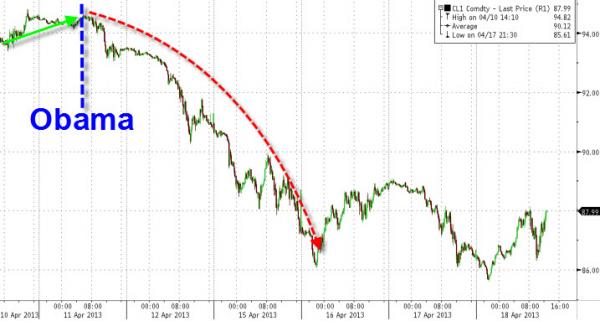
What Exactly Did Obama Say To Wall Street’s CEOs Last Thursday at 11am ET? S&P 500, Gold and Crude Oil All Peaked at 11am

What Exactly Did Obama Say To Wall Street’s CEOs Last Thursday?

Tyler Durden on 04/18/2013 22:06 -0400

Correlation is not causation; but coincidence means you’re on the right path. Looking at the charts of Stocks, Commodities, and Precious Metals, we wonder just what it was that President Obama said at his 11am ET White House meeting last Thursday… Equity markets soared out of the gate on the 11th. Jobless claims beat expectations handily (shaking off the previous week’s concerns) and all was well in the world… until just after 11am ET (when the CEOs of Wall Street’s big banks – for no apparent reason – met with President Obama)… and this happened… Gold also peaked at just after 11am ET… as did Crude oil… So what did Obama tell them?

20130418_obama1_020130418_obama2_020130418_obama3_0

Cola Wars, China Style

04.19.2013 14:47

Cola Wars, China Style

The government and a private company are battling in the market – and in court – over the country’s favorite soft drink

By staff reporter Qu Yunxu

1366353947877857

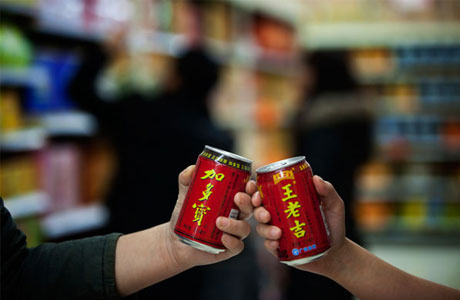
(Guangzhou) — Eighteen years ago, a Hong Kong businessman named Chan Hung-to took a sip of an herbal tea produced by a government factory in Guangzhou and tasted the future – a beverage that he imagined could be the Coca-Cola of China. The sweet, cold drink called Wanglaoji herbal tea is an acquired taste, a blend of seven medicinal herbs and flowers, including honeysuckle, mint and chrysanthemum. Chan succeeded in making it China’s favorite drink. After licensing the tea’s name and recipe, he took it out of its dowdy green package, put it in an iconic red can with a bold golden logo and spent millions of yuan on massive marketing campaigns. By 2009, it was outselling even Coke in the country. Now, Chan and his erstwhile government partners are locked in a series of bitter trademark battles. While the court hearing for the latest lawsuit is waiting to be held, the real story of Wanglaoji may be that winning in the marketplace is more important than winning in court. But whether Chan can maintain market share if he loses the rights to use the bright red can design is a question worth billions of yuan. Feng Zhimin, a senior executive at Chan’s firm, says they are almost ready to throw in the towel on legal action. “If we lose this case again, there is no justice. We will give up,” he says. Read more of this post

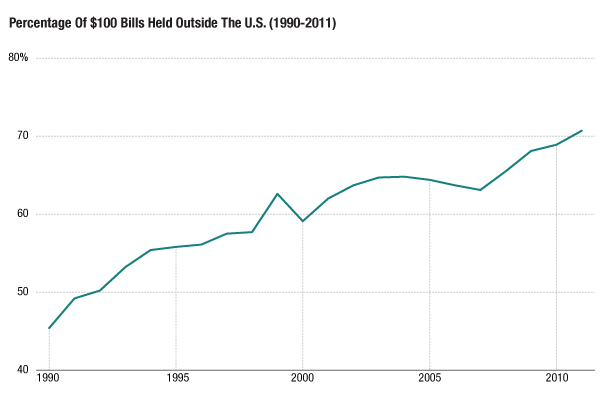
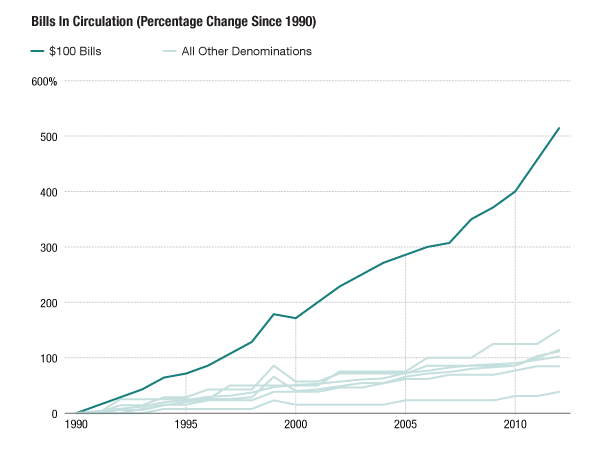
Two-thirds of all $100 bills live outside America

Most $100 Bills Live Outside The U.S.

by JACOB GOLDSTEIN, April 17, 201312:00 PM

images (8)

The world loves the U.S. dollar.

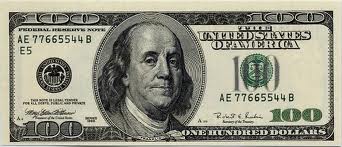
When, say, a South African businessman buys supplies from China, he pays in U.S. dollars. When central banks hold foreign reserves, they favor dollars. And, all over the world, when things start to get crazy, people start putting $100 bills under the mattress. In fact, as of 2011, roughly two-thirds of all $100 bills were held outside the U.S., according to anestimate by Ruth Judson, an economist at the Fed.

pm-gr-dollardollarbillaway-616

pm-gr-dollardollarbill-616 Read more of this post

Snoozebox (ZZZ), portable hotels made of stackable containers that have housed fans at events, has gained 55 percent since its IPO last May, outperforming European hoteliers such as Accor and InterContinental

Snoozebox Portable Hotels Conceived in Misery of Rain at Le Mans

images (7)

When Ignis Asset fund manager David Clark first heard of Snoozebox (ZZZ), portable hotels made of stackable containers that have housed fans at events such as the Le Mans 24-hour car race, he wanted to kick himself. Instead, he made sure Ignis was the biggest investor. “When I first came across it I had ‘duh’ moment,” Clark said in a phone interview. “It doesn’t take a genius to figure out the numbers of places that hold events but don’t have the accommodations for people to stay in.” Ignis now holds 14 percent of Snoozebox Holdings Plc’s shares.

Snoozebox, which transports rooms equipped with flat-screen TVs, Wi-Fi and running hot water to sporting and music events across the U.K. and beyond, may almost triple its revenue this year, said Simon French, an analyst at Panmure Gordon & Co., who recommends buying the stock. The London-based company may report 5.4 million pounds ($8.3 million) in sales for 2012 when it releases earnings April 23, he said.

The stock has gained 55 percent since its initial public offering last May, outperforming European hoteliers such as Accor SA (AC) and InterContinental Hotels Group Plc. (IHG) The MSCI Europe Hotels, Restaurants and Leisure Index has advanced about 14 percent. The shares rose 8.3 yesterday after Snoozebox said it won a contract to supply accommodation for 1,350 personnel at the G8 summit in Northern Ireland in June. Chief Executive Officer Robert Breare said the trick is to transport — by air, land or sea — 40 to 400 prebooked rooms that are placed steps from the action. Read more of this post

Australia: Crackdown on shadow banking after a spate of failures among finance companies that accepted debentures, including the $660 million collapse of Banksia last year

Crackdown on shadow banking

April 19, 2013 – 2:23PM, Clancy Yeates

The financial regulator is proposing tougher rules on non-bank finance companies that accept retail deposits after a string of collapses in the “shadow banking” sector. In new proposals published today, the Australian Prudential Regulation Authority said it would restrict companies that operate outside the Banking Act from using terms such as “deposit” and “at call” accounts. Currently there are no restrictions on use these phrases by finance companies, which are regulated much more lightly than banks. Under the proposed changes, APRA said it would remove an exemption that allows finance companies to use these terms, to avoid confusion among retail investors. It also said it would require debenture products to have a minimum maturity of 31 days. The crackdown comes after a spate of failures among finance companies that accepted debentures, including the $660 million collapse of Banksia last year.

Yoshinoya Japan slashes beef bowl prices

Yoshinoya slashes beef bowl prices

KYODO, APR 19, 2013

Yoshinoya Holdings Co. on Thursday cut prices for its mainstay “gyudon” beef-on-rice bowls to take advantage of eased restrictions on beef imports from the United States. The relaxation of strict import curbs in February is allowing the stable procurement of cheaper beef suitable for gyudon, the company said. Yoshinoya slashed beef bowl prices by ¥100 to match its two biggest rivals — Zensho Holdings Co.’s Sukiya chain and Matsuya Foods Co. — which are currently charging ¥280 for a standard bowl. The price of a large bowl dropped by ¥40 to ¥440, while the extra large bowl fell by ¥90 to ¥540. The price cuts are expected to produce about 30 percent more customers and a 15 to 20 percent boost in sales, the firm said. Prices for other ingredients, however, are starting to rise, thanks to Prime Minister Shinzo Abe’s “Abenomics” policies. Players in the fast-food industry say that lower gyudon prices are the key to winning market share.

nb20130419a3a-870x547

WHO: More than 50% of infected patients with H7N9 bird flu had no contact with poultry, further raising questions about human transmission

WHO data on bird flu raises new questions about human transmission

3:49am EDT

By Megha Rajagopalan

BEIJING (Reuters) – More than 50 percent of patients infected with a new type of bird flu in China had no contact with poultry, the World Health Organization said on Friday, further raising questions about whether the virus was transmitted between humans.

The H7N9 virus has so far infected 87 people in China and killed 17, but it remains unclear how they contracted the disease. A Chinese official earlier this week said about 40 percent of patients had been in no contact with poultry. Read more of this post

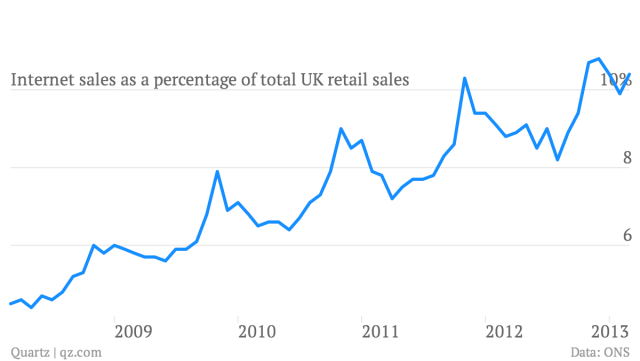
Britain is doing more of its shopping online and not just because it’s been freezing

Britain is doing more of its shopping online and not just because it’s been freezing

By Leo Mirani @lmirani April 18, 2013

ASOS internet-sales-as-a-percentage-of-total-uk-retail-sales_chart

The weather gets blamed for an awful lot of depressing economic data in Britain. If it isn’t the Chancellor of the Exchequer blaming the snow, it is the venerable Office for National Statistics blaming the cold. According to the latest ONS retail sales report (pdf), “March 2013 was the second coldest on record, and this appears to have had a negative effect on sales in the non-food sector.” Retail spending dropped 0.7% from the previous month and 0.5% from the previous year, in terms of volume. Spending in terms of value was more-or-less flat. Now, admittedly, March was an astonishingly cold month in the United Kingdom, with freezing temperatures lasting well into the first week of April. Regardless, the numbers do not bode well for the UK’s economic recovery. And things look even worse if spending on automotive fuel is removed from the equation.

But the weather may also have been good for some retailers. Sales on the internet made up more than a tenth of total sales in March, a surprisingly high proportion for this time of year. Online spending tends to spike in November and remain high in December, when people to shop for Christmas but don’t want to get trampled underfoot on the high street. Shopping in general dips in the first few months of the new year, as people recover from the party season. Internet sales typically trail off as the weather gets better and people venture back outdoors. Read more of this post

Buffett’s China BYD mulls leaner, greener “re-birth” plan

Exclusive: China’s BYD mulls leaner, greener “re-birth” plan

Thu, Apr 18 2013

By Norihiko Shirouzu

SHANGHAI (Reuters) – BYD Co, one of the better known Chinese brands thanks to a stake held by billionaire U.S. investor Warren Buffett, may stop making conventional gasoline-fuelled cars within two years and focus on ‘new energy’ battery models as part of a “re-birth plan” to arrest a slump in sales.

Shares in BYD, which once harbored long-term ambitions to be as big as Toyota Motor Corp, have tumbled by almost three quarters since a late-2009 peak, as net profit crumbled to just 81.4 million yuan ($13.15 million) last year from 3.8 billion yuan four years ago. Read more of this post

Is Pepsi better off without Pepsi? The slowing drinks business is seen as a drag on Pepsi’s growing snacks business

Is Pepsi better off without Pepsi?

By Gina Chon @GinaChon April 18, 2013

Did Pepsi CEO Indra Nooyi throw activist investors a bone today? During the call to discuss the company’s latest earnings, Nooyi said Pepsi is exploring “sensible opportunities to unlock incremental value through meaningful structural alternatives.” “Unlocking value” and “structural alternatives” are sometimes the jargon words used when considering a breakup.

Whether Pepsi, which makes an array of soft drinks, energy drinks, and snacks, goes that far remains to be seen. Nooyi said she won’t discuss the plans until next year. But she did note that the cola category, which includes Pepsi’s namesake products, has been tough as people drift away from sugary drinks for health reasons. That has brought down the performance of its North American beverage business.

Activist investor Ralph Whitworth of Relational Investors is among (paywall) the shareholders who have been pushing Pepsi to do something about its slow-growing beverage unit. One suggestion is separating that drinks business into an independent company. Investors are continuing to press for this, according to sources.

The slowing drinks business is seen as a drag on Pepsi’s growing snacks business. Today’s reported earnings beat analysts’ estimates because sales went up of products like Lays potato chips, Doritos, and Stacy’s pita chips. That gives investors even more ammunition to push for a breakup. Whitworth has discussed a separation of the North American beverage business with Nooyi in the past. Read more of this post

Putin’s friends now own 88% of Russia’s Facebook

Putin’s friends now own 88% of Russia’s Facebook

By Simone Foxman and Gideon Lichfield 9 hours ago

Censorship or investor war? That’s a subject of debate in Russia, after a fund managed by a Russian businessman with close ties to the Kremlin acquired 48% of the country’s largest social-networking site, V Kontakte (“in touch”), which is similar to Facebook.

On Wednesday, two of the founding investors in V Kontakte sold their shares to investment fund United Capital Partners. UCP is headed by Ilya Shcherbovich, a board member at the state-owned oil giant Rosneft, which makes him an ally of Russian president Vladimir Putin.

The remaining 52% of the company is controlled Pavel Durov, the 28-year-old founder of V Kontakte. Durov actually owns only 12% of V Kontakte’s shares, but last year, online firm Mail.ru handed him control of its 40% stake of the company’s shares. Mail.ru is controlled by Alisher Usmanov, another Kremlin buddy and Russia’s richest man. It’s unclear if this agreement between Mail.ru and Durov can be reversed, though Durov says his control of the stake doesn’t expire (link in Russian). Read more of this post

The Mystery of Zero-Leverage Firms

The Mystery of Zero-Leverage Firms

Ilya A. Strebulaev Stanford University – Graduate School of Business; National Bureau of Economic Research

Baozhong Yang Georgia State University – Robinson College of Business

February 20, 2013
Journal of Financial Economics (JFE), Forthcoming

Abstract: 
We present the puzzling evidence that, from 1962 to 2009, an average 10.2% of large public nonfinancial US firms have zero debt and almost 22% have less than 5% book leverage ratio. Zero-leverage behavior is a persistent phenomenon. Dividend-paying zero-leverage firms pay substantially higher dividends, are more profitable, pay higher taxes, issue less equity, and have higher cash balances than control firms chosen by industry and size. Firms with higher Chief Executive Officer (CEO) ownership and longer CEO tenure are more likely to have zero debt, especially if boards are smaller and less independent. Family firms are also more likely to be zero-levered.

110 million defective condoms in Ghana: the latest example of China’s dangerous counterfeit trade

110 million defective condoms in Ghana: the latest example of China’s dangerous counterfeit trade

By Gwynn Guilford @sinoceros April 18, 2013

China’s $250 billion knock-off trade doesn’t just mean fewer handbag sales for LVMH, or a hit to the DVD sales market. It can also have potentially lethal consequences.

Take, for example, counterfeit condoms, 110 million of which the Food and Drugs Authority of Ghana has impounded over the last week due to poor quality. Testing revealed the condoms to have holes and break under pressure. It also found that they were unusually small and insufficiently lubricated.

And those hole-riddled, flimsy, undersized condoms were made in China, the FDA confirmed Tuesday, identifying Henan Xibei Latex Company Ltd. as the manufacturer. (Here’s the company’s Alibaba.com profile, should you be in the market for defective protection). On top of that, Yenghana reports that the leaky condoms are counterfeit, and that the purported manufacturer, BeSafe, has never sold its products in Ghana.

This isn’t the first time that a Chinese company has been implicated in selling faulty or knock-off condoms. They’ve been bedeviling global public health officials for more than a decade (examples hereherehere and here). Read more of this post

Going local: Japanese carmakers turn to Chinese parts for China market; “Things like the endurance of an auto part are very hard to check unless you actually apply them in cars on the road.”

Going local: Japanese carmakers turn to Chinese parts for China market

Thu, Apr 18 2013

By Kazunori Takada

SHANGHAI (Reuters) – When Nissan Motor Co Ltd (7201.T:QuoteProfileResearchStock Buzz) was preparing to launch the Venucia marque with its China venture partner two years ago, it sourced more components locally to keep costs down – and was sent mislabeled parts and sun visors that melted in the heat.

The quality of Chinese-made car parts has since improved and, facing tougher competition in what is now the world’s biggest autos market, Nissan and its Japanese rivals Toyota Motor Corp (7203.T: QuoteProfileResearch,Stock Buzz) and Honda Motor Co Ltd (7267.T: QuoteProfileResearchStock Buzz) are having to increase the locally made content in their cars.

This is a big step for Japanese automakers that have built a global reputation for quality through close relationships with known and trusted suppliers, many of whom they own and control and with whom they jointly design and develop components. Read more of this post

Flu Experts Probe H7N9 Outbreak as Cases Double in a Week to 88 Infections

Flu Experts Probe H7N9 Outbreak as Cases Double in a Week

Influenza specialists from around the world are converging on China to help authorities identify how people are catching the new H7N9 bird flu strain after the number of reported cases there doubled in the past week.

China recorded its 88th H7N9 infection yesterday. Seventeen of the cases have been fatal and “several others” have left patients in critical condition, according to the World Health Organization.

“That’s a fairly high mortality rate,” Michael O’Leary, the WHO’s China representative, told reporters in Beijing today. Less severe cases may have escaped detection, he said. “What we don’t know is the size of the iceberg under this tip.” Read more of this post

Longest Retirements Fuel Pressure for Singapore Remodel; “The emphasis is no more on the people. I feel that the government is not improving our lives.”

World’s Longest Retirements Fuel Pressure for Singapore Remodel

Singaporean Richard Mui joined the ranks of the world’s longest-living retirees when his career ended in 2010. Three years on, the 54-year-old can no longer afford to pay his father’s medical bills, and worries about putting his two children through university.

Almost half a century after independence, Singaporeans now live the most number of years after leaving the workforce, according to the Global Sunset Index of 68 countries compiled by Bloomberg. In the world’s sixth-most expensive city, 41 percent of more than 1,000 residents surveyed by HSBC Holdings Plc (5) said they haven’t saved for retirement, with nearly half of them blaming living costs for hampering efforts.

“The standard of living has improved, but the cost of living, we’re feeling the pinch,” said Mui, who’s made S$4,000 ($3,240) in the past six months as a part-time taxi driver, compared with S$12,000 a month at digital-storage device company SM Summit Holdings Ltd. before a corporate takeover put him out of a job. “The Singapore government is one of the richest in the world but yet the people don’t feel they are rich.”

Mui’s experience encapsulates the economic success that forged Southeast Asia’s only developed nation, as well as the challenges emerging after decades of policies emphasizing self- reliance over state-funded welfare. An aging population and voter demands for more government aid for the poor and elderly have put pressure on Prime Minister Lee Hsien Loong to boost social spending even as growth slows. Read more of this post

Two Promising Places to Live, 1,200 Light-Years From Earth

April 18, 2013

Two Promising Places to Live, 1,200 Light-Years From Earth

By DENNIS OVERBYE

19planets-span-articleLarge

An artist’s impression of a sunrise on Kepler 62f. The two outer planets of the Kepler 62 system may lie in the habitable zone, where liquid water could exist on the surface.

Astronomers said Thursday that they had found the most Earth-like worlds yet known in the outer cosmos, a pair of planets that appear capable of supporting life and that orbit a star 1,200 light-years from here, in the northern constellation Lyra.

They are the two outermost of five worlds circling a yellowish star slightly smaller and dimmer than our Sun, heretofore anonymous and now destined to be known in the cosmic history books as Kepler 62, after NASA’s Kepler spacecraft, which discovered them. These planets are roughly half again as large as Earth and are presumably balls of rock, perhaps covered by oceans with humid, cloudy skies, although that is at best a highly educated guess.

Nobody will probably ever know if anything lives on these planets, and the odds are that humans will travel there only in their faster-than-light dreams, but the news has sent astronomers into heavenly raptures. William Borucki of NASA’s Ames Research Center, head of the Kepler project, described one of the new worlds as the best site for Life Out There yet found in Kepler’s four-years-and-counting search for other Earths. He treated his team to pizza and beer on his own dime to celebrate the find (this being the age of sequestration). “It’s a big deal,” he said. Read more of this post

Finding Your Place in the Competitive Jungle

Finding Your Place in the Competitive Jungle

by Vijay Govindarajan and Srikanth Srinivas  |  11:00 AM April 18, 2013

It’s a jungle out there.

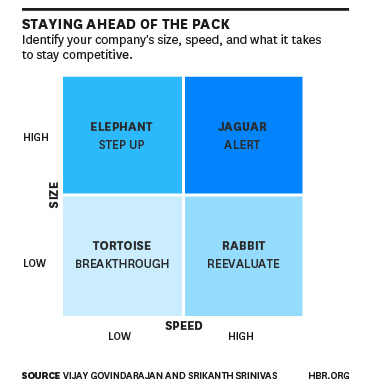
While this simple phrase has been used time and time again to discuss the many obstacles people and companies face, an animal metaphor does describe required innovation actions rather effectively. Imagine a 2×2 matrix with size on the y-axis and speed on the x-axis. Size can be represented as market share, revenue, or units sold, depending on the context. Speed is the speed of innovation of a company relative to the industry. When a company, product, or service is ahead of the competition, speed is high. When it is lagging behind the competition, speed is low.But why is relative speed so important? Consider a story where two hunters encounter a lion with no ammunition left in their guns. When one starts to run, the other claims the lion will eat him either way. The first replies, “Not as long as I can run faster than you!” Just like in the jungle, if you are not faster than the competition, you can get eaten up. The key question is, “What actions can be taken to get ahead of the pack?” — to become a jaguar or to stay a jaguar, as you see in the matrix below.

jungle-graphic2-thumb-580x611-3825 Read more of this post

Retina Institute Japan K.K., which is employing Nobel Prize-winning stem-cell technology to treat eye diseases, plans to sell a stake in itself to a group of Japanese companies

Japanese Firm Luring Investors With Nobel-Winning Technology

Retina Institute Japan K.K., which is employing Nobel Prize-winning stem-cell technology to treat eye diseases, plans to sell a stake in itself to a group of Japanese companies next month ahead of a possible initial public offering in five years.

The company, based in Fukuoka City, Japan, will raise 1 billion yen ($10.2 million) from the sale to fund development of a treatment for age-related macular degeneration — a leading cause of blindness in the elderly — using technology developed by Riken, Japan’s state-controlled research institute, Chief Executive Officer Hardy Kagimoto said in an interview.

After raising about 32 billion yen so far from investors, Retina is developing technology from a discovery that won Shinya Yamanaka, a professor at Kyoto University, the Nobel Prize for medicine in October. Yamanaka discovered a way to turn ordinary skin cells into what are called induced pluripotent stem, or iPS, cells.

“The development of retina treatment with iPS cells can lead to development of the cell-utilized therapies for a wide range of diseases,” said Akitsu Hotta, an assistant professor at Kyoto University who studies stem cells. Retina’s commercialization of the technology “will be a big milestone.”

Retina last month estimated the potential market for its treatments at $21 billion. Read more of this post