Women Cash In on Dakota Oil Service Needs to Sustain Boom

Women Cash In on Dakota Oil Service Needs to Sustain Boom

Amanda Kieson gets calls at 2:30 a.m. to collect urine samples from workers involved in accidents in western North Dakota’s oil industry. The 33-year-old mother of two says she opened her testing service two years ago to get a part of the economic bonanza engulfing the region.

“I love my business, which is weird because, you know, with what we actually have to put up with,” Kieson, the owner of Badlands Occupational Testing Services, said in a phone interview. The company in Watford City has grown to six employees and 24-hour service from demand for post-accident reports and pre-employment drug screening. “We are busy all the time.”

While men dominate the manual-labor jobs on the rigs, women are exercising entrepreneurial zeal in opening services ranging from oil well geology to occupational testing to day care and medical clinics in western North Dakota. Local authorities and company executives say the women — and the businesses they’re creating — are needed to sustain the economic boost.

“There are great opportunities for women,” Kathy Neset, 57, the president of Neset Consulting Service Inc., said in an interview. “Whatever skill you have, we need it in western North Dakota.” Read more of this post

Australian regulator fires warning over property advice for SMSFs (self-managed super fund) to borrow to invest in property; “We do not want to see SMSFs become the vehicle of choice for properties brokers.”

Regulator fires warning over property advice for SMSFs

April 19, 2013

Max Newnham

The Australian Securities and Investments Commission on Thursday released a report from a self-managed super fund taskforce it set up to look at risks in the sector. The report focused on the quality of advice given to people setting up SMSFs. Although the study showed most advice given was adequate or better, there were problems relating to funds borrowing to invest in property. Read more of this post

Australian dairy farmers cut out the middleman; “Coles and Woolworths have such a degree of market power that it makes it difficult for suppliers to make a return”

Dairy farmers cut out the middleman

April 19, 2013 – 1:33PM

Tim Bale’s dairy farm barely broke even in six years as mergers of processors and competition between supermarkets Coles and Woolworths pushed down milk prices. So 14 months ago, he decided to cut out the middleman.

“The milk processors would do a deal with Woolworths and then come back to us and drop our price,” he said. “So I wrote to Woolworths and said, ‘We can sell you milk here that’s better than what you’re getting.”

Farmers in Australia’s $4 billion dairy industry are striking direct deals with supermarkets that control 80 per cent of the country’s grocery sector, as a drive to sell milk for $1 a litre squeezes profits. That’s threatening milk processors Kirin Holdings, Parmalat, and Fonterra Cooperative.

“Coles and Woolworths have such a degree of market power that it makes it difficult for suppliers to make a return,” said Nick Green, a spokesman for Australian Dairy Farmers, a group representing both processors and farmers. “Any industry is unsustainable if it’s only barely breaking even or making a loss.” Read more of this post

VW Recall Highlights Perils of Too Much Success in China

VW Recall Highlights Perils of Too Much Success in China

Volkswagen AG (VOW), Daimler AG (DAI) and Bayerische Motoren Werke AG (BMW) posted record 2012 sales fueled by demand in China. This year, that growth is at risk as the government in Beijing steps up scrutiny of the automakers and media outlets question their quality.

VW last month recalled 384,181 vehicles in China after state television featured complaints about vibrations, loss of power and sudden acceleration in Golfs and other cars. China Central Television also reported that BMW, Audi and Mercedes owners experienced dizziness from asphalt in their vehicles.

“Of course we take the concerns in China very seriously and are investigating the matter,” Joachim Schmidt, sales chief at Mercedes, said last week. Yet he said he was surprised by the complaints. “The components we use have been thoroughly tested before and we use them in vehicles across the globe,” he said. “You would assume that customers outside China might notice something similar.”

The reports come as Chinese authorities have vowed to unmask producers of low-quality or dangerous goods. While Chinese companies haven’t been spared scrutiny, foreigners are frequent targets. In the past year, China Central Television has reported that McDonald’s Corp. sold chicken wings past their sell-by date, Carrefour SA (CA) mislabeled lower quality chicken as premium, and Apple Inc. failed to replace the back covers of iPhones after repairing electronics inside. All have issued apologies and offered fixes. Read more of this post

China Luxury Jet Sales Set to Surge Amid Xi’s Austerity Drive

China Luxury Jet Sales Set to Surge Amid Xi’s Austerity Drive

President Xi Jinping’s austerity drive is not dissuading Chinese private jet buyers.

Customers may buy about 40 private jets this year in China, compared with 27 ordered in 2012, amid a surge in wealth, said Richard Koe, managing director at Hamburg, Germany-based Wingx Advance Gmbh, a business-aviation data company. General Dynamics Corp. (GD)’s Gulfstream is among companies expanding in the country, home to 336 private planes already.

The number of billionaires in China may overtake Germany within the next year, and climb to No. 2 in the world, according to Wealth-X, a Singapore-based company, which collects data on high net worth individuals. Surging demand for planes that could cost about $65 million apiece contrasts with Xi’s vow to rein in on extravagant spending.

“There is wealth to support a much larger fleet,” said Koe. “The development of infrastructure and economic growth are encouraging demand for private jets in China.”

China may become the world’s third-biggest private-jet market by as early as 2022, from a rank below 25 now, Koe said in an interview in Singapore April 17. Xi’s push against “flamboyant” spending will do little to deter the rising demand in the country, he said. Read more of this post

Dutch Recession Woes Haunt Rutte as Deficit Breach Persists; “The increase in unemployment is alarming”

Dutch Recession Woes Haunt Rutte as Deficit Breach Persists

Record unemployment in the Netherlands is compounding Dutch Prime Minister Mark Rutte’s dilemma on how far to push austerity measures needed to curb the country’s deficit.

Consumer confidence due today and statistics on house prices, consumer spending and manufacturers’ confidence next week will confirm just how far the slump has damaged sentiment in the euro-area’s fifth largest economy. Data yesterday showed the jobless rate reached an 18-year high of 8.1 percent in March, with 643,000 people out of work.

Rutte’s coalition government agreed on a four-year, 16 billion-euro ($21 billion) austerity package in October and will decide later this year on additional measures of 4.3 billion euros for 2014. The Netherlands, in the throes of a housing- market slump and facing its third recession since 2009, has breached the European Union’s deficit limit of 3 percent of gross domestic product limit since then.

“The increase in unemployment is alarming,” Sweder van Wijnbergen, a professor of economics at the University of Amsterdam, said in an interview. “The Dutch government has to reduce its deficit, so cannot be an engine of growth. Business investment isn’t likely to pick up before a recovery, so it can’t lead us out of the recession either.” Read more of this post

ANZ Seen Bolstered by Unwinding $2 Billion Asian Bet; “If you can’t solve the ROE puzzle, pack up. It’s very easy to throw capital at it. It’s another thing to get a decent return.”

ANZ Seen Bolstered by Unwinding $2 Billion Asian Bet

After spending more money on acquisitions across Asia than any domestic rival, Australia & New Zealand Banking Group Ltd. (ANZ) would do better for its shareholders by unraveling some of that wager.

ANZ has spent at least $1.95 billion since 1999 on Asian deals, landing minority stakes in banks and brokers from China to Indonesia, according to data compiled by Bloomberg. The holdings — now valued by ANZ at $3.64 billion — have proven less lucrative than ANZ’s own operations there and selling them would reverse a strategy that has defined the bank since 2007.

With little chance ANZ will ever have management control to improve the performance of some of the Asian assets, the Melbourne-based bank’s stock has trailed Australian peers in the past year, said BBY Ltd. New rules requiring the bank to set aside more capital against the foreign stakes are making them even less appealing, said Morningstar Inc. ANZ’s return on equity is projected to slip below all three of its major domestic rivals by 2015, analysts’ estimates compiled by Bloomberg show.

“They should just sell them,” Brett Le Mesurier, an analyst at Sydney-based stockbroker BBY, said in a phone interview, referring to the minority stakes. “It makes no sense. It’s alright if it’s a road to somewhere, but we’re not seeing much evidence of that. Shareholders are running out of patience.” Read more of this post

SAP Software Sales Miss Estimates on Lower Demand in Asia

SAP Software Sales Miss Estimates on Lower Demand in Asia

SAP AG (SAP), the largest maker of business-management software, reported first-quarter software sales that trailed analysts’ estimates after the company failed to close contracts in the Asia-Pacific region.

Sales of new software licenses, an indicator of future revenue, rose 3 percent to 657 million euros ($859 million), Walldorf, Germany-based SAP said today. That was slower than the 9 percent growth in the previous quarter and fell short of the 726 million-euro median of estimates compiled by Bloomberg.

Operating profit adjusted for some items rose 8 percent to 901 million euros, also missing estimates. SAP joins other software makers in reporting slowing traditional license sales. Oracle Corp. on March 20 reported revenue and profit that fell short of analysts’ estimates as demand for Web-based programs hurt sales of its hardware and on-premise software. Read more of this post

Wall St. Redux: Arcane Names Hiding Big Risk; Investments that were vulnerable in the last financial crisis and believed to be gone for good have largely escaped new rules that were made to prevent another crisis

April 18, 2013

Wall St. Redux: Arcane Names Hiding Big Risk

By NATHANIEL POPPER

CMBS

The alchemists of Wall Street are at it again.

The banks that created risky amalgams of mortgages and loans during the boom — the kind that went so wrong during the bust — are busily reviving the same types of investments that many thought were gone for good. Once more, arcane-sounding financial products like collateralized debt obligations are being minted on Wall Street.

The revival partly reflects the same investor optimism that has lifted the stock market to new heights. With the real estate market and the economy improving, another financial crisis seems a distant prospect. What’s more, at a time when the Federal Reserve has pushed interest rates close to zero, the safest of these new investments offer interest rates almost double that paid by ultrasafe United States Treasury securities, according to RBS Securities, which was involved in such instruments in the past.

But the revival also underscores how these investments, known as structured financial products, have largely escaped new regulations that were supposed to prevent a repeat of the last financial crisis.

“All of this seems like a fairly quick round trip,” said Manus Clancy, a managing director at Trepp, a research firm that focuses on commercial real estate. “You are seeing a fair number of sins being forgiven.” Read more of this post

World’s Oldest Person Jiroemon Kimura Turns 116 in Japan; Kimura’s motto in life is “to eat light and live long”

World’s Oldest Person Turns 116 in Japan
April 19, 2013

afp20130419113603420

The world’s oldest person turned 116 on Friday as local health chiefs in Japan launch a study to find out why he and many of those around him have lived so long.

Jiroemon Kimura, who was born in 1897, was expected to celebrate his astonishing milestone with friends and family, and receive a visit from the mayor of his home city of Kyotango in the west of the country.

Kimura is one of 95 people who will be 100 years old or more in the city’s 60,000-strong population.

The centenarian does not smoke and has made it a practice to eat only until he is 80 percent full, a local official told AFP.

He drinks only a “modest” amount of alcohol, a local report said.

Kimura’s motto in life is “to eat light and live long,” said the official. Read more of this post

Fitch sees gold prices falling over next 2-3 years

Published: Friday April 19, 2013 MYT 12:39:00 PM

Fitch sees gold prices falling over next 2-3 years

KUALA LUMPUR: Fitch Ratings sees gold prices falling over the next two to three years as sentiment towards the metal changes.

“While prices could recover quickly if worries over the eurozone rise further, our base case is for prices to fall over the next two or three years,” it said on Friday.

The international ratings agency said reports that Cyprus could sell a significant volume of gold may have triggered the sharp drop in prices, “but we believe the fall represents a changing sentiment towards the metal”.

Fitch said changes of this type tend to have a snowball effect as investors head for the exit, and “we therefore expect prices to continue falling over the next two or three years”.

However, it said this trend could be temporarily reversed, if investors become more concerned about the outlook for the eurozone. Read more of this post

How Apple’s Decision To Collect 30% Of Every iOS App Sale Could Lead To Its Downfall; OpenTable collects 1.9% of money that flows through its reservation system. eBay collects 9.9% of the revenue that flows through its site

How Apple’s Decision To Collect 30% Of Every iOS App Sale Could Lead To Its Downfall

Jay Yarow | Apr. 18, 2013, 2:45 PM | 4,419 | 13

Apple‘s decision to collect a 30% tax on every digital item sold through the App Store may lead to its undoing, according to venture capitalist Bill Gurley.

It’s an extreme, hyperbolic statement. But before you dismiss it out of hand, Gurley makes a decent point which we’ve never considered before.

In short: Apple’s 30% fee was just high enough to scare off peers who could have made iOS better. Instead, they’re working through Android to build products that undermine Apple’s core business.

Gurley did a big analysis of the “rake” e-commerce companies charge. The rake is the fee a company charges. So, OpenTable collects 1.9% of money that flows through its reservation system. eBay collects 9.9% of the revenue that flows through its site. And so on.

Apple’s rake is 30% in the App Store. If a developer sells an app for $1, Apple takes $0.30, the developer gets $0.70. Or, if a developer sells a digital good inside the app for $1, Apple takes $0.30. Read more of this post

Double Entry: How the Merchants of Venice Created Modern Finance

Double Entry: How the Merchants of Venice Created Modern Finance [Paperback]

Jane Gleeson-White (Author)

9780393088960_p0_v1_s260x420

Publication Date: October 7, 2013

“Lively history. . . . Show[s] double entry’s role in the creation of the accounting profession, and even of capitalism itself.”—The New Yorker

Filled with colorful characters and history, Double Entry takes us from the ancient origins of accounting in Mesopotamia to the frontiers of modern finance. At the heart of the story is double-entry bookkeeping: the first system that allowed merchants to actually measure the worth of their businesses. Luca Pacioli—monk, mathematician, alchemist, and friend of Leonardo da Vinci—incorporated Arabic mathematics to formulate a system that could work across all trades and nations. As Jane Gleeson-White reveals, double-entry accounting was nothing short of revolutionary: it fueled the Renaissance, enabled capitalism to flourish, and created the global economy. John Maynard Keynes would use it to calculate GDP, the measure of a nation’s wealth. Yet double-entry accounting has had its failures. With the costs of sudden corporate collapses such as Enron and Lehman Brothers, and its disregard of environmental and human costs, the time may have come to re-create it for the future. Read more of this post

How a Potter Took Accounting Into the Industrial Age

How a Potter Took Accounting Into the Industrial Age

ipLedfefsESY

In the mid 1700s, Josiah Wedgwood built the world’s first industrialized pottery factory. Source: Getty Images

This week, the International Integrated Reporting Council introduced a draft of a new framework for corporate accounting that would require companies to go beyond reporting just financial capital and also encompass environmental, social and governance risks.

The structure — known as “integrated reporting” — is a response to the realization brought on by the 2008 financial crisis and increasing environmental stresses that we need a new accounting paradigm for the 21st century. The limits of current national-accounting practices were acknowledged in 2012 when the United Nations adopted a new international standard to give “natural capital” equal status to gross domestic product as a gage of a nation’s economy.

These aren’t the first such paradigm shifts in the history of accounting. At the end of the 18th century, the double-entry account-keeping practices developed by Italian merchants in the Middle Ages were updated for the new industrial era.

The first signs that double entry could be adapted to the new age of factories, wage labor and large-scale capital investment appeared in the north of England, in the works of the renowned potter Josiah Wedgwood. Read more of this post

Innovator: Ruggero Scorcioni’s App Uses Brain Waves to Block Calls

Innovator: Ruggero Scorcioni’s App Uses Brain Waves to Block Calls

By Caroline Winter on April 18, 2013

tech_innovator17__01__630x420

Neuroscientist and former software engineer Ruggero Scorcioni found himself consistently distracted by the phone while he was trying to work. “If I’m busy coding or thinking about research and have phone calls coming in, it’s hard to get back into the same mental state,” says Scorcioni, 42. “Maybe you had a great idea, but then it’s gone.” In January, on a whim, he entered an AT&T app-development hackathon, and came up with a solution.

His idea was sparked by a gift to participants: a cat-ear headset built by Neuro-wear with sensors that track the wearer’s brain waves and perk up fluffy motorized ears during periods of high brain activity. Scorcioni, who’d just finished a fellowship at the Neurosciences Institute in La Jolla, Calif., decided to hack the headset to create an app that blocks incoming calls when the receiver is concentrating. With 26 hours to complete the hackathon, he worked until the last minute, pausing only for two hours of sleep and a shower. That labor produced a working prototype of Good Times, which analyzes real-time brain wave data from the headset, then sends commands to AT&T’s telephone network to either permit or block incoming calls. Blocked callers are redirected to an automated message asking them to try again later. Scorcioni describes the app as “a mentally activated ‘Do Not Disturb’ sign.” Read more of this post

Loews Creates ‘Investment Hunter’ Comic Book to Tout Its Stock

Loews Creates ‘Investment Hunter’ Comic Book to Tout Its Stock

By Noah Buhayar on April 18, 2013

mf_valuehunter17__01__630x420

Some companies have a simple story for investors. Ford makes cars. Apple designs and sells iPhones and other devices.Loews (L), a holding company that insures businesses, operates hotels, and produces energy, has a more complex tale to tell. Last summer, Chief Executive Officer Jim Tisch was talking with designers from Addison, the firm that produces Loews’s annual reports, about ways to spread the word about the company when he made an offbeat suggestion: What about a comic? “He was thinking of a way to present the information in an engaging way, as opposed to a 60-page PowerPoint,” says Mary Skafidas, vice president for investor and media relations at Loews, who was at the meeting.

After months of work with illustrators and Addison, Loews released The Adventures of Lotta Value, Investment Hunter! on its website on April 11. The 13-page graphic novel opens in the office of private detective Lotta, a female Sam Spade. Her client, Rich Stockman, a middle-aged man in a trench coat, needs help deciding whether to put money in Loews. He tells her the key to the company’s success is “tucked away in vaults at each subsidiary.” Read more of this post

Chairman of China Jianyin Investment Securities Jumps to Death in Beijing’s Finance Street; State-owned investment co refutes online speculation that the death was tied to heavy losses incurred by gold investments

04.18.2013 17:39

Banker Jumps to Death in Beijing’s Finance Street

State-owned investment company China Jianyin Investment Securities Co. said the chairman passed away for health problems

By staff reporter Yang Lu

(Beijing) – In an apparent suicide, a high-level executive of a state-owned investment company leapt to his death in downtown Beijing.

Wang Shiqiang, 60-year-old chairman of the board of supervisors for China Jianyin Investment Securities Co., appeared to have jumped to his death on the afternoon of April 16 from the top of the office tower that houses China Jianyin.

In an issued statement, China Jianyin said the suicide was due to personal issues in Wang’s life, refuting online speculation that the death was tied to heavy losses incurred by gold investments. It is yet unclear how much risk exposure China Jianyin has to gold futures.

The company published an obituary on its website two days later which said Wang “passed away from health problems.” Read more of this post

The detention of two bank weights in China due to murky off-balance sheet deals in the interbank market has propped expectations that the country will soon start overhauling the market

China may Soon Start Clean-up in Interbank Bond Market

04-18 15:31 Caijing

The People’s Bank of China is expected to launch a campaign to rectify interbank bond market, as soon in May

The detention of two bank weights in China due to murky off-sheet deals in the interbank market has propped expectations that the country will soon start overhauling the market which has developed at an unconventional speed for nearly two years.

Zou Yu, a Shanghai-based fund manager at Wanjia Asset Management, which oversees three bond funds, was detained and under investigation for alleged holdings of others’ bonds without transferring ownership in the interbank market, Chinese media said.

Fixed-income executive director at CITIC Securities Yang Hui was taken away by authorities after being accused of illegal deals regarding Class C bond custody, also a grey area in interbank market trading. Read more of this post

Suntech’s bond default crisis worries dim sum bond investors; Global Bio-Chem Technology Group recently failed to honor its liability for bonds issued in Hong Kong following a technical issue

Suntech’s crisis worries dim sum bond investors

Staff Reporter, 2013-04-19

The ongoing reorganization of the debt-ridden Chinese solar power company Suntech could have an adverse effect on the Hong Kong dim sum bond market, Guangzhou’s 21st Century Business Herald reports.

The dim sum bond market refers to an offshore debt capital market for bonds denominated in the Chinese currency, the renminbi.

Many investors are increasingly concerned that Suntech’s financial troubles could signal a downward trend that may also hit the issuers of their bond investments.

The biotechnology company Global Bio-Chem Technology Group recently failed to honor its liability for bonds issued in Hong Kong following a technical issue. Though the company’s assets redeemed its bonds and avoided a domino effect in the market, many investors still fear the worst. Read more of this post

Tech’s Rust Belt Takes Shape: Technology has long distributed its riches unequally. But the sector has seldom seemed so sharply divided between disrupters and the disrupted

Updated April 18, 2013, 8:03 p.m. ET

Tech’s Rust Belt Takes Shape

By DON CLARK and SHIRA OVIDE

MK-CC544A_TECHE_NS_20130418183603MK-CC543_MSOFT__NS_20130418182704

Technology has long distributed its riches unequally. But the sector has seldom seemed so sharply divided between disrupters and the disrupted. Computing pioneer International Business Machines Corp. IBM -1.20% on Thursday reported its revenue dropped 5% after failing to close big software and hardware deals. IBM is also in advanced talks to sell part of its server system business to Lenovo Group Ltd., 0992.HK +4.81% according to people familiar with the matter, the same company that bought IBM’s personal-computer business in 2005. Software giant Microsoft Corp.,MSFT -0.12% once known for rapid sales of PC software, reported that the business that includes its Windows operating system turned in essentially zero growth after one-time effects of software revenue deferrals. By contrast, Internet innovator Google Inc. GOOG -2.13% said Thursday revenue grew 31% in the first quarter, while profit rose 16%.

The growth disparities are just the latest repercussions of technology shifts—including the rise of mobile devices and slowing growth in personal computers, the replacement of conventional software with online versions and outsourcing corporate internal computing operations to facilities run by other companies. Tech’s turmoil bears similarities to the way old-line industrial companies in America’s Rust Belt lost sales to rivals in Asia and other regions. But the disrupters this time are mainly domestic and born since the Internet revolution took hold in the mid-1990s, often offering free or low-cost alternatives to widely used products. Read more of this post

Struggling Indian e-commerce pioneer MakeMyTrip pins its hopes on an influx of cheap smartphones

India’s MakeMyTrip Hopes for a Revival via Smartphones

By Bruce Einhorn and Kartikay Mehrotra on April 18, 2013

tech_makemytripchart17_405

For a heady moment in August 2010, a startup outside New Delhi was the pride of India. Online plane and hotel bookerMakeMyTrip (MMYT) raised $70 million in a Nasdaq offering, the first Indian company in four years with a U.S. initial public offering. Foreign investors saw the site as India’s answer to Chinese search engine Baidu (BIDU), a chance to capitalize on a giant Asian market’s growth. The day of the IPO, MakeMyTrip shares surged 89 percent. “Investors have bought into the India story,” crowed Chief Executive Officer Deep Kalra. Now, as India struggles with high inflation and low growth, the bubble has burst for MakeMyTrip investors. The stock has fallen 68 percent since its post-IPO high in September 2010, compared with a 41 percent increase for the Nasdaq Composite. In the first fiscal year after the offering, MakeMyTrip earned $4.83 million on sales of $124.7 million. In the fiscal year ended in March, revenue is forecast to drop to $88.6 million and the company posted a $2 million loss, according to analysts’ estimates compiled by Bloomberg.

India’s limited Internet infrastructure is a major problem for MakeMyTrip. The country has “a really, really sad track record” of getting Indians online, Kalra said at a March 21 tech conference in New Delhi organized by Google (GOOG). Ten percent of Indians have Web access, and only about 1 percent of the country has connections fast enough to be “truly online,” he added. Read more of this post

China’s 2020 consumer is in a town you’ve never heard of; “I don’t save at all. Why should I?”

Insight: China’s 2020 consumer is in a town you’ve never heard of

Thu, Apr 18 2013

By Melanie Lee

ZHENGZHOU/CHONGQING, China (Reuters) – Wearing a floral brocade cardigan and toting a Huawei smartphone, Guo Qian, 22, gushes over her latest purchases on Taobao, China’s largest e-commerce platform. As an administrative worker, Guo makes only 3,000 yuan a month and spends most of it.

Not only does she spend nearly all of her own money, Guo also fritters away most of her father’s 1,000 yuan monthly pension on trinkets and clothes on Taobao. “Sometimes I feel guilty using his money, so I buy him some clothes.”

Guo, a Zhengzhou native, already owns an apartment – her parents helped finance the purchase last year – and is on the upward climb to join China’s burgeoning middle class.

As Beijing tries to engineer a crucial macroeconomic shift– toward more consumption and less investment, the crucial “rebalancing” China’s new leadership is committed to, and the rest of the world is counting on — it is young consumers like Guo Qian who may hold the key to the transition.

Raised in an era of unprecedented prosperity, Guo, like many other members of what is known as the `post-80s’ generation (anyone born after 1980) has a very different answer than her parents when it comes to a central economic question: whether to spend the money she has, or save it?

“I don’t save at all,” she told Reuters. ” Why should I?” Read more of this post

Thailand’s Farmer-Friendly Rice Subsidy Backfires; The Thai government is sitting on a loss of at least 80 billion baht because of the generous price it’s paying Thai farmers for rice

Thailand’s Farmer-Friendly Rice Subsidy Backfires

By Bruce Einhorn on April 18, 2013

Until last year, business was good for Charoen Laothamatas, the president of Thai rice exporter Uthai Produce. With Thailand dominating the global market for rice exports, Uthai enjoyed strong demand. In 2012, though, Charoen had to cut his workforce by 40 percent. The culprit: a Thai government policy that pays local farmers vastly inflated prices for their rice. While the government sees the program as a way to boost rural incomes, the policy has made Thai rice uncompetitive against rice from Vietnam and India. Before the new policy went into effect, Uthai exported 200,000 tons to the U.S., China, and Hong Kong. This year, he says, “we will be lucky if we get 80,000.”

Charoen’s troubles are related to the political challenges the kingdom has endured since a military coup ousted populist Prime Minister Thaksin Shinawatra in 2006. The current premier is his sister, Yingluck Shinawatra, and in 2011 she decided an easy way to cement her party’s grip on power was to win over farmers by paying above-market prices for their rice. “I earn more and have higher savings thanks to the program,” says Groon To-Chai, a 67-year-old farmer from Nakon Sawan province in central Thailand who says his monthly income has jumped by 50 percent, to 30,000 baht ($1,000). At $571 per metric ton, Thai rice is now much more expensive than Vietnamese and Indian rice. Read more of this post

Why More Extreme Foods Are Creeping Onto Menus; America’s $161 billion fast-food industry has embraced rich, fatty, gooey extreme foods to grab diners’ attention. Reactions have ranged from, “Oh my God, why?” to “Oh my God, why not?”

Why More Extreme Foods Are Creeping Onto Menus

By Susan Berfield and Venessa Wong on April 18, 2013

comp_fastfoodchart17_950_pop

For Americans who haven’t been to a state fair recently or who are unacquainted with Paula Deen’s style of Southern comfort food, this may come as a surprise: Some people make sandwiches with doughnuts. Now a doughnut sandwich is available for a lucky (or brave) few at none other than Dunkin’ Donuts (DNKN). The chain is testing a Glazed Donut Breakfast Sandwich—there’s a pepper fried egg and cherrywood-smoked bacon inside—in about a dozen stores in the Boston area.

“We’ve seen our customers buy doughnuts in the summertime to bring to the family cookout and put burgers on them,” says Dunkin’ executive chef Stan Frankenthaler, who runs the chain’s test kitchen. “We make sandwiches for ourselves on doughnuts.” Trying out the salty-sweet treat with customers seemed natural. Reactions to the doughnut sandwich, Frankenthaler says, have ranged from, “Oh my God, why?” to “Oh my God, why not?” Read more of this post

Trading houses go cool on commodity prices. And trading house executives believe the latest decline in prices has some way to run.

April 18, 2013 6:18 pm

Trading houses go cool on commodity prices

By FT Reporters

For the head of one of the world’s biggest commodity trading houses, Ernest Hemingway nailed the state of agriculture markets with his description of Switzerland: “a small, steep country, much more up and down than sideways.” Alberto Weisser, chief executive of Bunge, told the FT’s Global Commodities Summit in Lausanne this week this was particularly true of the last five or six years. The prices of many basic foodstuffs have gyrated sharply. Indeed, right now almost all commodity markets, including agriculture, are headed swiftly down the mountain slopes. And trading house executives believe the latest decline in prices has some way to run.

Commodities Read more of this post

Chinese President Xi Jinping’s Taxi to Nowhere

Xi Jinping’s Taxi to Nowhere

Beijing’s taxi drivers are most notable for two characteristics. First, they know and love their politics. Rightly or wrongly, they tend to consider themselves among the city’s most astute analysts of what’s happening behind the Communist Party’s many closed doors. Second, they have an almost supernatural capacity to recognize gullible passengers whom they can plunder with longer-than-necessary rides (while telling tales of the city’s powerful).

Thus it comes to pass that Guo Lixin, formerly an anonymous Beijing cabbie, set off a Chinese media firestorm on Thursday in China by fooling two of the Communist Party’s most prominent media outlets into believing that Chinese president Xi Jinping waved down his taxi for a ride to a hotel.

As recounted by Guo to the Ta Kung Pao newspaper (the story has since been deleted), the Chinese Communist Party’s mouthpiece in Hong Kong, Xi, accompanied by an unidentified man (a guard perhaps), waved down Guo’s taxi far from his official residence on March 1. He didn’t identify himself, but rather, like any other civic-minded Beijinger, chatted with the driver about the ever-present smog. Read more of this post

Heavily indebted companies are going public at the fastest clip in years

April 18, 2013, 8:06 p.m. ET

IPO Investors Conquer Fear of Debt

By TELIS DEMOS And MATT JARZEMSKY

Debt is no longer a four-letter word among investors in initial public offerings.

Heavily indebted companies are going public at the fastest clip in years, as low interest rates ease buyers’ fears about the prospects for stocks whose issuers are burdened with IOUs. Read more of this post

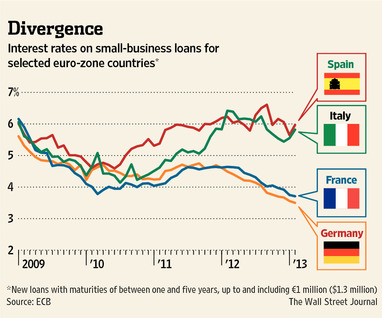
Credit Crunch Broadens European Business Rifts; large swaths of European small and midsize businesses—which employ three-quarters of the euro zone’s workers—have received precious little of this €1 trillion liquidity

Updated April 18, 2013, 9:16 a.m. ET

Credit Crunch Broadens European Business Rifts

By DEBORAH BALL And ILAN BRAT

Central banks around the world are flooding the market with liquidity in order to spark growth in the global economy. But that hasn’t helped Spaniard José Blasco. Banks have cut credit lines to Mr. Blasco’s sofa-bed maker Confortec SL to €100,000 ($131,000), compared with €500,000 several years ago. And while the Spanish state now borrows at around 5%, the 22-employee company would need to pay as much as 14% to get a bank loan—an option Mr. Blasco rejected. Over the past three years, the European Central Bank has pumped €1 trillion of cheap loans into the euro zone’s financial system, helping shore up banks and sending government borrowing rates spiraling downward. Yet large swaths of European small and midsize businesses—which employ three-quarters of the euro zone’s workers—have received precious little of this liquidity. And instead of reviving growth, the money has deepened the fault lines that separate Northern and Southern Europe, as well as big companies and small ones. “The financial system is not working, and financing is like any other raw material for industry,” Mr. Blasco says. “It’s not fair. Companies are paying for the mistakes of politicians and the financial system.”

MK-CC494_CRUNCH_NS_20130417201810 Read more of this post

Berkshire’s Munger Pledges Record $110 Million to U. Michigan; “Charlie Munger believes that educating one’s self, in the right setting, is very powerful.”

Berkshire’s Munger Pledges Record $110 Million to U. Michigan

Charles Munger, vice chairman at Warren Buffett’s Berkshire Hathaway Inc. (BRK/A), pledged $110 million of securities to the University of Michigan to fund fellowships and a graduate-student residence.

The gift is the largest single donation in the school’s 196-year history, the Ann Arbor-based university said yesterday in a statement on its website. The proposed building will have room for more than 600 occupants and contain apartments with as many as seven bedrooms and private bathrooms that share cooking, dining and living areas.

Munger, 89, studied mathematics at the university in the 1940s and has previously contributed $20 million for renovations at a housing complex. The latest pledge includes $10 million for fellowships. Recipients would live in the residence and be chosen from among the university’s 19 schools and colleges to spur interaction among students from multiple disciplines.

“This project envisions an approach that makes graduate study less isolated,” university President Mary Sue Coleman said in the statement. “Charlie Munger is passionate about improving graduate student housing, and believes that educating one’s self, in the right setting, is very powerful.” Read more of this post

East Coast’s Q1 Letter: How an Idea Goes Through Their Investment Process

Thursday, April 18, 2013

East Coast’s Q1 Letter: How an Idea Goes Through Their Investment Process

Christopher Begg’s East Coast Asset Management is out with their first quarter letter for 2012.  Entitled “The Art of Fugue,” the letter details how an opportunity goes through their investment process and they also provide an update on their portfolio. Investment process is always a work in progress, so it’s interesting to hear how other investors refine this and what they incorporate into their approach.  On East Coast’s process, Begg writes, “Once an investment idea is sourced, the idea is put through an initial checklist and if it has merit it will ultimately be categorized as a compounder, a transformation, or a workout. Next, the investment idea will go through two stages of due diligence – two individual fugues, both in six parts. In each six-part stage we always begin and resolve with our subject, or royal theme, which is a perspective on compounding.” We’ve highlighted East Coast’s investment process before, but their latest letter breaks down the six things they look at (in search of quality of the business):
– Competitive advantage
– Pricing power
– Market opportunity
– Capital itensity
– Economics
– Management
Then eventually they look to answer 4 questions:
1. Does the investment have an attractive expected rate of return? (IRR)
2. Does the investment have a sufficient margin of safety?
3. Do we understand the critical data points that will drive the success and intrinsic value of the business?
4. Do we understand first cause, or why the investment may be mispriced?
Begg then applies the above to a new holding they initiated in the quarter so you can follow along with their investment process to see how they think about everything.  It’s certainly a useful exercise and some of you may be able to guess the position.

http://www.docstoc.com/docs/document-preview.aspx?doc_id=153075680