Chasing that elusive dengue vaccine

Chasing that elusive dengue vaccine

The scourge of dengue extends throughout the tropical world and now encroaches on subtropical areas, even as in Singapore last week, the number of cases (492) hit a high for this year.

4 HOURS 14 MIN AGO

The scourge of dengue extends throughout the tropical world and now encroaches on subtropical areas, even as in Singapore last week, the number of cases (492) hit a high for this year.

A recent study estimated that nearly 400 million people are infected each year; another three billion are at risk of infection. Yet, there is neither a vaccine that can prevent infection nor a specific antiviral drug for a severe case of the disease.

The lack of an effective vaccine is not for want of effort. Interestingly, the call for a global effort to develop a dengue vaccine was made here in Singapore in 1977. Read more of this post

Forget the personality pigeonholes; backlash against the dominance of extroversion in the workplace; More people are sick of being told they have to work constantly in groups to be creative and spend three-quarters of their day in meetings

Forget the personality pigeonholes

April 16, 2013

The Venture

Promotion of the strong, silent types  introverts  gets louder by the day. A growing number of authors and academics argue introverts are potentially more creative than their extroverted peers, better team players and superior managers.

The most recent cheerleading for introversion is an article in the prestigious Academy of Management Journal: “The downfall of extroverts and rise of neurotics: the dynamic process of status allocation in task groups,” by UCLA Anderson School of Management’s Corinne Bendersky and Rutgers Business School’s Neha Parikh Shah.

It follows Susan Cain’s excellent 2012 book Quiet: the power of introverts in a world that can’t stop talking, and her widely watched TED video that espoused the benefits of introversion. Other management experts are surely queuing up to push the case for introversion over extroversion, such is the growing interest in the topic.

Worthy as it is, none of this research considers the merits of introversion over extroversion from a start-up entrepreneurship perspective.

What’s your view?

  • Do you need to be extroverted to get a venture off the ground and grow it quickly – at least in the first few years?
  • Is it much harder for introverted start-up entrepreneurs to succeed?
  • Can you be an effective salesperson if you are introverted?
  • Can introverts change to extroversion when needed, with practice?

 What are the benefits of introversion in start-up entrepreneurship?

I suspect the big push for introversion is, in part, a backlash against the dominance of extroversion in the workplace. More people are sick of being told they have to work constantly in groups to be creative, have open-plan offices and spend three-quarters of their day in meetings.

They know they are more creative and effective in a quiet work space on their own, yet find opportunities to shut the door and think deeply about issues are increasingly limited. Cain’s book forcefully argued the case to give workers more time to think on their own. Read more of this post

When Swindlers Worked the ‘Big Con’ on Stock Investors; Enter the confidence man, who calibrated his pitch just right: He wasn’t offering something for nothing; he was looking for a wide-awake investor who knew how to read the winds.

When Swindlers Worked the ‘Big Con’ on Stock Investors

In the 1900s and 1910s, hundreds of swindling teams worked the Big Con in U.S. cities.

The time was right because, by the beginning of the century, the sensational exploits of robber barons and the vast fortunes to be had from railroad, mining and other industrial enterprises had created an appetite for financial speculation that most Americans couldn’t satisfy.

The stock markets were open only to the few who could afford the high share minimum and margin requirements. This moment in history — after gambling ceased to be widely considered immoral and before securities became a standard part of retirement funds — left middle-class businessmen quivering for opportunity.

Enter the confidence man, who calibrated his pitch just right: He wasn’t offering something for nothing; he was looking for a wide-awake investor who knew how to read the winds. Read more of this post

LDK Delinquency Flags Chance of Another Solar Bust: China Credit

LDK Delinquency Flags Chance of Another Solar Bust: China Credit

LDK Solar Ltd. (LDK)’s failure to fully pay notes this week has raised the prospect of China’s second solar-industry failure this year as the company needs to repay a loan 10 times larger by June.

The world’s second-biggest maker of wafers that convert sunlight into power couldn’t repay all of the $23.8 million of dollar-denominated convertible bonds that matured on April 15, according to a company statement yesterday. Before the delinquency, its 2014 yuan notes dropped below 50 yuan per 100 yuan face value, according to data compiled by Bloomberg. The yield reached a six-month high of 125 percent last week, compared with the 79 percent for Bonn-based Solarworld AG. (SWV)

LDK, which will probably report a second year of losses tomorrow, must repay a $240 million loan unless it spins off its polysilicon unit by June 3, according to regulatory filings. Suntech Power Holdings Co. (STP), once the world’s largest panel maker, was dragged into insolvency days after it defaulted on a $541 million bond repayment on March 15.

LDK failed to repay about $7 million of bonds for which it could not reach a settlement, and may receive a notice of default, said Edward Guinness, a fund manager at Guinness Atkinson Funds in London who oversees about $800 million, including a “tiny” position in LDK.

“It’s out of LDK’s hands,” he said in an interview yesterday. “The lenders can choose to give them an extension. It’s up to them to push LDK into bankruptcy.” Read more of this post

If Gold < $1175, Then Cyprus Out Of Eurozone?

If Gold < $1175, Then Cyprus Out Of Eurozone?

Tyler Durden on 04/16/2013 12:16 -0400

One of the unexpected consequences of the recent plunge in the price of gold (for whatever reason, and there are many proposed explanations for why gold has tumbled, none of them completely accurate or comprehensive) is that when the European Commission set the precedent with the forced sale of Cypriot sale for a total of €400 million “to cover ELA losses” as Mario Draghi dictated to the aptly named head of the Cyprus Central Bank, Panicos, he set a line in the sand especially when it comes to German expectations. Because while the size of the Cypriot bailout will likely keep expanding, the one fixed component is the €10 billion loan that Merkel has still to get approval for in parliament. This number is set in stone, and any additional bailout “funding” will have to come from either further depositor impairment (until eventually even the insured depositors become impaired, again) or as the case may be, the country is forced to sell all of its sovereign hard assets, like its gold. Which means that no matter what, Cyprus will have to sell enough gold to cover a €400MM shortfall, as point 29 of the Debt Sustainability Analysis demanded.

And therein lies the rub.

While a week ago, when gold was $1600/ounce the self-funded component (read “gold sale”) of the Cypriot bailout amounted to just over 10 tons of gold, as of today’s price and EURUSD rate, Cyprus would now have to sell 12 tons of gold to cover the gap, if it were to hit the sell button today (assuming a price of $1385/ounce and a 1.315 EURUSD exchange rate). As far as we know, Cyprus hasn’t sold one ounce yet. But what if gold keeps tumbling as it has in the past three days? Well, the problem as most know, is that as of March based on IMF data, Cyprus only has 13.9 metric tons of “excess” (as the EC defined it) gold.

This means one can extrapolate below what price Cyrpus is out of luck and the proposed European Commission bailout fails as one of the key self-funded elements simply will not have enough cash to fill the €400 MM hold.  That price for gold, once again assuming a 1.315 EURUSD, is roughly $1175/ounce. Read more of this post
Since Friday morning, the value of total above-ground stocks of gold bullion has fallen by more than $1 trillion, “could fall to $1,050”

Gold loses $1 trillion of total global value, “could fall to $1,050”

BY BEN TRAYNOR

April 16, 2013 • Reprints

Spot market gold prices fell to a fresh two-year low in Tuesday’s Asian trading, dropping to $1,322 per ounce, before rallying back above $1,386, as stock markets extended yesterday’s losses.

Silver dropped to its lowest level since September 2010 at $22.10 an ounce before it too recovered some ground. Oil was down on the day by lunchtime in London, while copper ticked slightly higher.

Since Friday morning, the value of total above-ground stocks of gold bullion, estimated by metals consultancy Thomson Reuters GFMS at around 174,000 tonnes, has fallen by more than $1 trillion. Read more of this post

Pension Funds Ignoring Kim Buy Cheapest Korea Stocks Since 2007

Pension Funds Ignoring Kim Buy Cheapest Korea Stocks Since 2007

South Korea’s biggest investors are buying more equities than ever at a time of worsening relations with North Korea, lured by the cheapest shares since 2007.

Domestic institutions bought a net 2.2 trillion won ($1.97 billion) of stocks in the two weeks after North Korea announced its highest combat level on March 26, the first among escalating threats from Kim Jong Un’s regime. The purchases were larger than those following seven previous flare-ups, from North Korea’s first nuclear test in 2006 to its detonation of a nuclear device in February, data compiled by Bloomberg show.

While the Kospi index has retreated 3.1 percent since March 26 amid 2.2 trillion won of net equity sales by foreigners, Korea Teachers Pension and Shinyoung Asset Management Co. added to holdings as valuations fell to the lowest level in six years relative to MSCI Inc.’s Asia Pacific Index. Investors who bought Kospi shares in the two weeks after previous bouts of tension were rewarded with three-month gains of 5 percent on average.

“There’s ample upside in the Kospi this year from the current level,” Young Soo Shim, the head of asset outsourcing team at Korea Teachers Pension, the nation’s second-largest public pension fund with the equivalent of $12.5 billion under management, said by phone on April 12. “We spent more than initially planned in March as we have flexibility in executing money, with North Korea continuing to ratchet up threats.” Read more of this post

Malaysian Poll Upset Would Pose Risk to Tycoons: Southeast Asia

Malaysian Poll Upset Would Pose Risk to Tycoons: Southeast Asia

Malaysian companies controlled by billionaires T. Ananda Krishnan and Syed Mokhtar Al-Bukhary face the risk of increased competition and government scrutiny should opposition parties win next month’s election.

Anwar Ibrahim’s three-party Pakatan Rakyat, or People’s Alliance, pledged in its manifesto to abolish monopolies in industries including pay television, which is dominated by Ananda’s Astro Malaysia Holdings Bhd. (ASTRO) Anwar said in a March 8 interview he will scrutinize government agreements made with Syed Mokhtar, whose DRB-Hicom Bhd. (DRB) bought a 32 percent stake in the national postal service in 2011.

Astro and DRB shares have fallen at least 5 percent this year, compared with the FTSE Bursa Malaysia KLCI Index (FBMKLCI)’s 0.7 percent gain. Polls show Pakatan Rakyat is poised to wrest more seats from Prime Minister Najib Razak’s Barisan Nasional coalition in elections due on May 5. Najib’s approval rating slipped in February to the lowest level in 18 months, according to a survey by the Merdeka Center for Opinion Research.

“Things seem to be shaping up to be a fairly close election,” Rahul Bajoria, regional economist for Asia at Barclays Plc, said by phone from Singapore on April 12. “There is some market concern generally that the PR coalition has indicated that they will be reviewing contracts.”

The opposition holds 75 seats in the 222-seat parliament, while Najib’s Barisan has 137 seats, according to data on the parliamentary website. Either side needs at least 112 seats to form a government. Barisan currently holds power by the slimmest margin since Malaysia’s independence from the British in 1957. Read more of this post

Snapchat processes 150 million images per day Vs Facebook’s Instagram posting 40 million photos per day

Snapchat processes 150 million images per day

By Hayley Tsukayama, Published: April 16

Snapchat, the real-time photo-sharing service has seen a three-fold increase in just four months, according to co-founder and chief executive officer Evan Spiegel.

He said Monday that the company is now processing 150 million images per day — showing a strong demand for sending photo messages that delete themselves within 10 seconds.

By comparison, the most recent statistics from Facebook’s Instagram service show users posting 40 million photos per day. Read more of this post

Turks Aim to Emulate Israel Tech as Erdogan Excoriates Netanyahu; The country “really needs to switch to higher value- added exports” and improve its education system to “compete with innovative countries like Israel,”

Turks Aim to Emulate Israel Tech as Erdogan Excoriates Netanyahu

Prime Minister Recep Tayyip Erdogan wants to catapult Turkey into the top 10 of the global economic elite over the next decade. To get there, he may need to spend more time mimicking the country he’s been feuding with.

While Turkey and Israel have both shifted to manufacturing from farming since the Jewish state was established in 1948, it’s Israel that has succeeded in building high-margin industries. The tech index on Turkey’s Borsa Istanbul has 16 members and a market value of about $790 million. Israel’s TA BlueTech-50 Index (TACT), in an economy less than one-third the size, is valued at $16.5 billion.

During Erdogan’s decade in power, which followed years of unstable and short-lived coalitions, inflation and interest rates plunged from more than 30 percent as the budget deficit and national debt shrank. The gains from that good housekeeping may be running out of steam, with economists and ministers saying Turkey needs an industrial breakthrough to achieve the next stage.

“Turkey is nearing the limits of what it can do with macroeconomic stability,” said Serdar Sayan, a professor of economics at the TOBB University of Economics and Technology in Ankara. The country “really needs to switch to higher value- added exports” and improve its education system to “compete with innovative countries like Israel,” he said. Read more of this post

The Imprinting of Founders’ Human Capital on Entrepreneurial Venture Growth: Evidence from New Technology-Based Firms

The Imprinting of Founders’ Human Capital on Entrepreneurial Venture Growth: Evidence from New Technology-Based Firms

Luca Grilli Politecnico di Milano

Paul H. Jensen University of Melbourne – Melbourne Institute of Applied Economic and Social Research

Samuele Murtinu Politecnico di Milano – Dipartimento di Ingegneria Gestionale

April 2013
Melbourne Institute Working Paper No. 14/13

Abstract: 
This paper tests the presence of an ‘entrepreneurial imprinting effect’ of founders’ human capital on entrepreneurial ventures’ performance. More specifically, we empirically explore the impact of entrepreneurs’ human capital on a firm’s sales growth performance by disentangling the effect of the stock of human capital possessed at foundation from the potential injections and losses of human capital due to exit of founders and/or addition of new owner-managers in the entrepreneurial team over time. Our analysis is based on a panel dataset composed of 338 Italian new technology-based firms (NTBFs) observed from 1995 (or since their foundation) to 2008 (or until their exit from the dataset). We consider the effects of several dimensions of entrepreneurial human capital on firm sales growth and estimate Gibrat law-type dynamic panel data models using OLS estimator and GMM-system estimator to control for endogeneity. Overall, our results point to a positive and significant presence of an ‘entrepreneurial imprinting effect’ exerted by founders’ specific work experience on venture growth which is robust to a series of controls.

World Bank: Rethinking the State’s Role in Finance

Rethinking the State’s Role in Finance

Martin Cihák World Bank

Asli Demirgüç-Kunt World Bank – Financial and Private Sector Development

April 1, 2013
World Bank Policy Research Working Paper No. 6400

Abstract: 
The global financial crisis has given greater credence to the idea that active state involvement in the financial sector can be helpful for stability and development. There is now evidence that, for example, lending by state-owned banks has helped in mitigating the impact of the crisis on aggregate credit. But evidence also points to negative longer-term effects of direct interventions on resource allocation and quality of intermediation. This suggests a need to rebalance the state’s roles from direct to less direct involvement, as the crisis subsides. The state does have very important roles, especially in providing well-defined regulations and enforcing them, ensuring healthy competition, and strengthening financial infrastructure. One of the crisis lessons is the importance of getting the basics right first: countries with complex but poorly enforced regulations suffered more during the global crisis. Evidence also suggests that instead of restricting competition, the state needs to encourage contestability through healthy entry of well-capitalized institutions and timely exit of insolvent ones. There is also new evidence that supports the state’s key role in promoting transparency of information and reducing counterparty risk. The challenge of financial sector policies is to better align private incentives with public interest, without taxing or subsidizing private risk-taking.

China slowdown shows struggle to channel money into real economy; Components of off-balance sheet financing soared

Analysis: China slowdown shows struggle to channel money into real economy

9:44am EDT

By Kevin Yao

BEIJING (Reuters) – A credit boom in China failed to keep economic recovery on track in the first quarter, suggesting the cash sloshing around the economy is not yielding the desired effect of stoking growth and could instead exacerbate property and inflationary risks.

A rapid rise in credit in recent months has been driven by the fast-growing shadow banking sector rather than formal bank lending, raising two major concerns.

One is that some of the new money is being used by debt-laden local governments to repay existing loans rather than being channeled into investment that might spur fresh economic activity.

The second is shadow banking has provided a lifeline to funding investment in the property sector, one area where the government is trying to restrict growth for fear that a house price boom could undermine the broader economy. Read more of this post

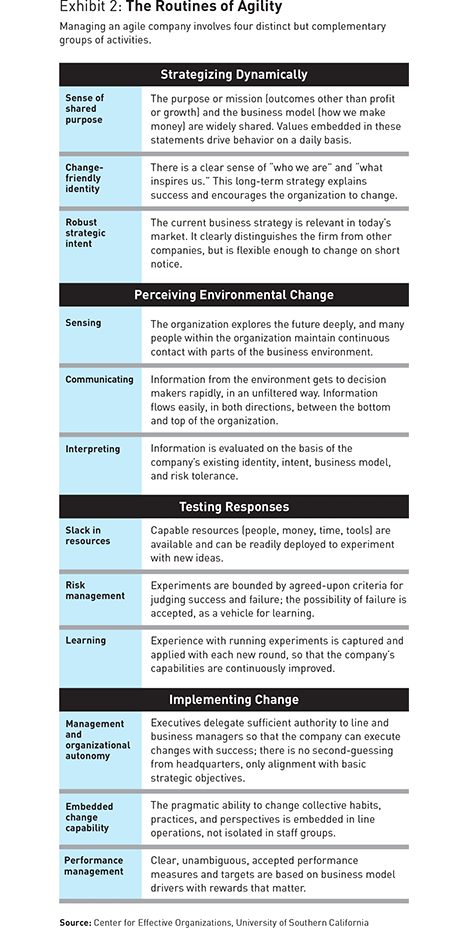
The Agility Factor: A few large companies in every industry show consistently superior profitability relative to their peers, and they all have one thing in common: a highly developed capacity to adapt their business to change

April 15, 2013

The Agility Factor

A few large companies in every industry show consistently superior profitability relative to their peers, and they all have one thing in common: a highly developed capacity to adapt their business to change.

by Thomas Williams, Christopher G. Worley, and Edward E. Lawler III

Everybody knows that big corporations, by nature, maneuver like battleships. Held back by their own inertia and current business strategies, they cannot turn quickly when the competitive environment changes. Everybody also knows that high performance, as measured by shareholder returns, is impossible to sustain over the long term; no company consistently beats the market.

But a recent in-depth study of long-term performance suggests an alternative point of view about business strategy. When the measure of performance is profitability, a few large companies in every industry consistently outperform their peers over extended periods. And they maintain this performance edge even in the face of significant business change in their competitive environments. The one factor they seem to have in common is agility. They adapt to business change more quickly and reliably than their competitors; they have found a way to turn as quickly as speedboats when necessary.

00188_ex02 Read more of this post

Counterfeit goods, mainly from China, have become as profitable for Asia’s criminal gangs as illegal drug trafficking, the United Nations said

April 16, 2013, 1:58 a.m. ET

Fake Goods Rival Drug Profits for Asia’s Criminals

By CAROLINE HENSHAW

SYDNEY—Counterfeit goods, mainly from China, have become as profitable for Asia’s criminal gangs as illegal drug trafficking, the United Nations said in a report published Tuesday.

The U.N.’s Office on Drugs and Crime, or UNODC, looked into international organized crime across much of the Asia-Pacific region. Its report, the first ever published by the agency on the topic, catalogues how rapid economic growth has led to the proliferation of criminal networks profiting from illegal trade in goods and people.

A surge in Asia’s exports, which have nearly quadrupled in the past decade or so to $5 trillion, according to the World Trade Organization, has been accompanied by a rise in the trafficking of fake-branded products including handbags and medicines, the U.N. report found. Read more of this post

Chinese billionaires nervous about BVI revelations exposed by journalists

Chinese billionaires nervous about BVI revelations: report

Staff Reporter, 2013-04-16

An in-depth report on global tax havens has made many wealthy individuals across the globe anxious due to the increasing possibility that their overseas fortunes will be exposed by journalists, reports the Guangzhou-based 21st Century Business Herald.

Reports by the International Consortium of Investigative Journalists said hundreds of thousands of billionaires around the world, including many from China, have hidden their wealth in territories like the Cayman Islands and British Virgin Islands to dodge taxes. While this is hardly a new revelation, the prospect that individuals could be named publicly has caused consternation among those who fear their financial affairs might come under investigation. Read more of this post

Cosmetic brands are targeting soldiers to secure future customers in the growing male cosmetics market

2013-04-15 19:58

Cosmetic brands targeting soldiers

Cosmetic brands are targeting soldiers to secure future customers in the growing male cosmetics market.

Lab Series, a male cosmetic brand affiliated with Estee Lauder, introduced a military membership service dubbed “LS Army,” designed exclusively for soldiers in service.

Those who sign up for membership will receive a 3,000 won telephone coupon with their first purchase. If they buy products worth more than 90,000 won, free delivery to their bases will be offered. The service is available only in Korea where army service is mandatory for all qualified male citizens.

“More Korean men realize they need to take care of their skin in the army, because the skin visibly gets worse with tough army schedules,” said Kimmie Kim, communications manager at Estee Lauder Korea. Read more of this post

Beijing defends ‘new look’ SOEs

April 15, 2013 1:43 pm

Beijing defends ‘new look’ SOEs

By Simon Rabinovitch in Beijing

The voice of the Communist party has defended the role of the state in China’s corporate sector, saying that government-owned companies are competitive on the global stage and paying important dividends to the country.

In a front-page article about the “new look” of state-owned enterprises, the People’s Daily said they were the backbone of the Chinese economy and stronger than at any point in the past two decades. Read more of this post

Fathers struggling to ‘have it all’; Men are reluctant to speak of problems with their work-life balance – but there are remedies

April 15, 2013 3:22 pm

Fathers struggling to ‘have it all’

By Naomi Shragai

A senior television executive is reading a bedtime story to his eight-year-old daughter. It is 10pm and he has just returned home from work. His phone rings – a work call – and he answers it, leaving the story unfinished.

His daughter shouts from her bed: “You’re a terrible father!” He returns to his daughter and tries to explain, with little success, why the call was important.

This executive works late and sees his daughter for only about two hours during the working week. Although he feels guilty about this and fears he is missing the best moments of family life, he seems unable to switch off from work.

This scene will be familiar to many men in senior positions who have have taxing jobs and struggle to respond to respond to the demands of family life. Read more of this post

People Are the New Channel; This new world is disorienting because pipes and people work very differently as channels. Pipes flow out; people flow in. Content is pushed out through pipes, but pulled in through people

People Are the New Channel

by Mark Bonchek and Cara France  |  11:00 AM April 15, 2013

In the past, channels delivered messages to audiences. You either owned the pipe or paid to use someone else’s. You controlled the message all the way through that pipe.

In a digital and social age, pipes are less important. People are the channel. You don’t own or rent them. You can’t control them. You can only serve and support them.

This new world is disorienting because pipes and people work very differently as channels. Pipes flow out; people flow in. Content is pushed out through pipes, but pulled in through people. Read more of this post

Why Well-Informed People Are Also Close-Minded

Why Well-Informed People Are Also Close-Minded

How do people form political beliefs? When will they change their minds? When will actual facts matter? A recent study, conducted by political scientist Brendan Nyhan of Dartmouth College and two co-authors, offers some clues. One group of participants was provided with a 2009 news article in which Sarah Palin claimed that the Barack Obama administration’s Affordable Care Act created death panels and that these panels included bureaucrats authorized to decide whether seniors were “worthy of health care.” A separate group was given the same news story, but with an appended correction saying that “nonpartisan health care experts have concluded that Palin is wrong.”

The study’s big question: Would the correction have any effect? Would people who saw the correction be less likely to believe that the Affordable Care Act calls for death panels? Not surprisingly, the correction was more likely to convince people who viewed Palin unfavorably than those who had a high opinion of her. Notably, the correction also tended to sway the participants who liked Palin but who didn’t have a lot of political knowledge (as measured by their answers to general questions, such as how many terms a president may serve).

Here’s the most interesting finding in the study. Those who viewed Palin favorably, and who also had a lot of political knowledge, were not persuaded by the correction. On the contrary, it made them more likely to believe Palin was right. Read more of this post

Are accountants and CFOs killing innovation?

Are accountants and CFOs killing innovation?

Alvin Lee | Business | Sat, April 13 2013, 2:53 PM

What can you do when penny-pinchers get in the way of your disruptive ideas to make necessary, often disruptive, changes in your company?

When Dell announced in February its decision to take the company private in a deal estimated at US$24.4 billion, founder and CEO Michael Dell said in a statement the move was part of the strategy to “continue the execution of our long-term strategy and focus on delivering best-in-class solutions to our customers as a private enterprise”.

One could have added that the deal was necessary to give Dell the breathing space it needed – away from the demands of shareholders and the market – to re-boot its strategy and recover its profits from its bread-and-butter PC business, which have been badly hit by sexier, more innovative products such Apple’s iPad and Amazon’s Kindle.

For big corporations – regardless of industry – making disruptive changes isn’t a question of money: many have substantial budgets and can ride out the disruption. It’s a question of mindset and how you position the innovative disruption on the balance sheet– and that can be the downfall.

INSEAD Associate Professor of Accounting and Control Gilles Hilary, in the research paper Does Accounting Conservatism Impede Corporate Innovation?, makes the case that firms with a greater degree of accounting conservatism are less innovative because of, among other things, the requisite accounting practice of immediately provisioning for future losses.  Read more of this post

China’s banking regulator has banned the country’s lenders from creating new loans via local government financing vehicles (LGFV) as it tries to rein in ballooning risks with rising defaults

China Regulator Bans Lenders From Creating New LGFV Loans

04-15 16:26 Caijing

“For LGFVs with a lower-than-100 percent cash flow coverage ratio or higher-than-80 percent debt-to-assets ratio, their loans as a share of total bank lending should not be higher than that in the previous year”

China’s banking regulator has banned the country’s lenders from creating new loans via local government financing vehicles (LGFV) as it tries to rein in ballooning risks with rising defaults. Banks should control loans to LGFVs and must not increase its size, according to a guideline issued by the China Banking Regulation Commission. “For LGFVs with a lower-than-100 percent cash flow coverage ratio or higher-than-80 percent debt-to-assets ratio, their loans as a share of total bank lending should not be higher than that in the previous year,” the CBRC said. The CBRC has also reiterated banks should take a “cautious” approach in holding bonds from LGFVs, and bar local governments from using public assets as loan guarantees on behalf of their financing vehicles. Most Chinese local governments are forbidden from borrowing money directly. Some have set up special financial vehicles to help get round such restrictions and provide funding for costly infrastructure projects which usually take years to generate returns. Read more of this post

Slower China Growth Signals Days of Miracles Are Waning; Prices for knife fish, a delicacy, have fallen to $13 each from $220

Updated April 15, 2013, 10:11 p.m. ET

Slower China Growth Signals Days of Miracles Are Waning

By JAMES T. AREDDY and TOM ORLIK

Shanghai property developer Sun Ping recalled offering a bloc of villas for sale in 2006, a time when buyers queued overnight and traded spots in line for money. He sold 62 houses in three hours and figures those homeowners quickly saw their investments triple in value.

“That was a miraculous time,” Mr. Sun said. A recent open house he hosted drew only a handful of shoppers.

The days of miracles appear to be over in China, the world’s second largest economy. A cleanup is under way, following an economic party of epic proportions that lifted incomes but left behind debt, corruption and a mess of the environment.

After three decades of annual economic growth averaging around 10%, many industries are experiencing less bling and more blah. Read more of this post

China’s Cities Drag Feet on Home-Price Curbs: Mortgages

China’s Cities Drag Feet on Home-Price Curbs: Mortgages

All real estate markets are local, says the industry axiom, one that China’s central government is painfully aware of as its efforts to rein in home prices are undermined by uncooperative municipal authorities.

Former Premier Wen Jiabao, in his final endeavor to make housing affordable, set an April 1 deadline for higher down payments and interest rates for second-home loans in cities with “excessively fast” price gains and ordered stricter enforcement of taxes on sales. Thirty-five provincial-level cities responded with measures insufficient to curb prices that climbed 150 percent from 2003 to 2012.

“The local governments are just making a gesture to show they are following the orders,” said Ding Shuang, a senior China economist with Citigroup Inc. in Hong Kong. “Some of the targets are almost like jokes. The government’s enforcement of policies will be compromised.” Read more of this post

Warehouses Win Investors as Unsung Internet Heroes

Warehouses Win Investors as Unsung Internet Heroes

The growth of Internet shopping in Europe is luring investors such as Axa Real Estate and Blackstone Group LP (BX) to the cinder-block world of warehouses, where yields are beating showy storefronts and sleek offices amid a space shortage.

“Net effective rents could grow by as much as 20 percent over the next four years,” Philip Dunne, president for Europe at San Francisco-based Prologis Inc. (PLD), the world’s largest warehouse owner, said of the company’s portfolio in the region. “In wider Europe, with a population bigger than the U.S., we have four-and-a-half times less modern product. That gives you some sense of the scale and opportunity for growth.”

Europe needs 25 million square meters (296 million square feet) of new distribution and storage warehouses in the next five years, about 11 percent of existing modern space, to keep up with Internet sales growth, Jones Lang LaSalle Inc. said last month. The assets generate annual income that’s 2 percentage points higher than offices and shops in Europe relative to their value and a lack of space will lift prices, said Remy Vertupier, manager of the Logistis fund run by AEW Europe, a unit of Paris- based Natixis (KN) Global Asset Management SA. Read more of this post

Paulson Gold Bet Loses Almost $1 Billion; Paulson started the year with about $9.5 billion invested across his hedge funds, of which 85 percent was in gold share classes.

Paulson Gold Bet Loses Almost $1 Billion: Chart of Day

iOnFR8etscao

Hedge-fund manager John Paulson’s wager on gold wiped out almost $1 billion of his personal wealth in the last two trading days as the precious metal plummeted 13 percent.

The CHART OF THE DAY shows gold’s tumble since the start of the year has cut his riches by $1.52 billion on paper, including about $973 million in the rout that began on April 12 and continued with today’s 9.3 percent drop. Paulson started the year with about $9.5 billion invested across his hedge funds, of which 85 percent was in gold share classes. Read more of this post

Does China Really Want a Nuclear Japan and South Korea? The potential for an atomic arms race in East Asia is real. Beijing must realize this

April 15, 2013, 7:28 p.m. ET

Does China Really Want a Nuclear Japan and South Korea?

The potential for an atomic arms race in East Asia is real. Beijing must realize this.

By BOB CORKER

North Korea’s increased belligerence has alarmed the U.S. and its allies and heightened tensions in the Asian-Pacific region. As usual, though, the hand-wringing in Washington, Tokyo, Beijing and Seoul isn’t accompanied by any new ideas on what to do to solve the perennial problem of Pyongyang and its illicit nuclear weapons program.

Most problematic, perhaps, is that nothing has altered the strategic calculus of China—the most influential player with respect to North Korea, and the one without which it is hard to see a resolution. Read more of this post

Australia Must Wean Itself From China; “I’m fed up with this government telling me, over and over, how lucky we are, how everyone is jealous of Australia. We need less talk and more help dealing with rising prices, and more progress creating new and better paying jobs.”

Australia Must Wean Itself From China

Viewed from afar, even the bad news in Australia looks pretty good. Unemployment reached a three- year high last month and is now all of 5.6 percent. Leaders such as U.S. President Barack Obama and French President Francois Hollande would kill for such a number. Australia has avoided a recession for 21 years, boasts a budget remarkably close to surplus and continues to enjoy low inflation. On any economic report card, the country deserves a string of A’s.

That stellar performance should make Prime Minister Julia Gillard a shoo-in for another term, right? Oddly, the prospects for Gillard’s Labor Party in September elections appear to dim with each new batch of economic data. Less than 30 percent of Australian voters are satisfied with the prime minister — her weakest numbers since September 2011. (Only 35 percent are satisfied with opposition leader Tony Abbott, according to a Newspoll survey published in the Australian newspaper on April 9.) Economic insecurity ranks as the main concern among voters. A reminder was delivered yesterday, when China reported slowing growth, sending Australia’s main stock index down the most in a month.

“I’m fed up with this government telling me, over and over, how lucky we are, how everyone is jealous of Australia,” Laurie Bracker, a 34-year-old insurance agent, said in Sydney last week. “We need less talk and more help dealing with rising prices, and more progress creating new and better paying jobs.” Read more of this post

Jakartans struggle to cope with city’s air pollution

Jakartans struggle to cope with city’s air pollution

20130416.103215_filephoto_afp_airpollution

Despite its poor air quality, many people living in Jakarta choose – or perhaps have no choice – to stay in the capital. -Jakarta Post/ANN
Tue, Apr 16, 2013
The Jakarta Post/Asia News Network

INDONESIA – Despite its poor air quality, many people living in Jakarta choose – or perhaps have no choice – to stay in the capital.

After leaving Jakarta for Bali for about a year for work, Devi Agustina, who moved back to the capital earlier this year, could not ignore the deteriorating quality of the air in Jakarta. “After living in a place like Bali, you realise how much you lose while living in Jakarta,” she told The Jakarta Post recently. “I miss Bali’s blue skies every time I see Jakarta’s polluted air.” Read more of this post