Big Data and numbers know a lot. But they can’t explain all the whys

April 15, 2013

What You’ll Do Next

By DAVID BROOKS

Over the past few centuries, there have been many efforts to come up with methods to help predict human behavior — what Leon Wieseltier of The New Republic calls mathematizing the subjective. The current one is the effort to understand the world by using big data.

Other efforts to predict behavior were based on models of human nature. The people using big data don’t presume to peer deeply into people’s souls. They don’t try to explain why people are doing things. They just want to observe what they are doing.

The theory of big data is to have no theory, at least about human nature. You just gather huge amounts of information, observe the patterns and estimate probabilities about how people will act in the future. Read more of this post

Demographic sands shift under Malaysian elite; Recalcitrance seems to have been woven into Malaysia’s success story as a nation

Demographic sands shift under Malaysian elite

BY:ROWAN CALLICK, ASIA-PACIFIC EDITOR 

From:The Australian

April 16, 2013 12:00AM

RECALCITRANCE seems to have been woven into Malaysia’s success story as a nation.

Mahathir Mohamad’s extraordinary spell as prime minister from 1981 to 2003 is just a part of it.

From Australia’s perspective, Malaysia has been a leading example of Asia’s inexorable progress towards a form of middle-class prosperity – while its leadership style has been from time to time decidedly edgy, especially when the ruling class has appeared to be on the ropes.

The country has been led in the 56 years through independence from Britain by Barisan Nasional – a coalition of 13 parties dominated by the United Malays National Organisation – and its predecessor coalition.

Malaysia’s next election, on May 5, is heading towards a tighter finish than the country has seen in decades. There is even a prospect – still somewhat remote – that Prime Minister Najib Razak’s BN might be defeated by the People’s Alliance Coalition (Pakatan Rakyat) led by charismatic former deputy prime minister Anwar Ibrahim, which combines his own People’s Justice Party, the Pan-Malaysian Islamic Party (PAS) and the Democratic Action Party that has recently attracted the lion’s share of ethnic Chinese voters. Read more of this post

Infosys helped make the world flat, except its own management structure

Infosys helped make the world flat, except its own management structure

By S. Mitra Kalita — 8 hours ago

S. Mitra Kalita is Quartz’s Ideas Editor. She is the author of “My Two Indias: A Journey to the Ends of Opportunity” and has reported on India’s economy, outsourcing and globalization.

Through much of the 1990s and early 2000s, Infosys ranked up there with the Taj Mahal as part of any foreign dignitary or business luminary’s India itinerary. To drive home the software developer’s significance, the trees lining the company’s sprawling Bangalore headquarters include placards with the names of the people who planted them: Bill Gates, Michael Dell, the prime ministers of Japan and Norway, among them. Infosys represented what was possible in a liberalized Indian economy. The country’s first food court in an office setting. The first Indian company to list on the Nasdaq. Office parks modeled on a college campus (down to the Domino’s Pizza on site). Tom Friedman’s best-selling The World is Flat was inspired by former CEO Nandan Nilekani who said: “The playing field is being leveled.”

Now, Infosys is just fighting to stay in the game. On April 12, the company warned that its growth in the upcoming year will be asluggish 6-10%. Infosys shares tanked on the news, a tumble they continued today. Read more of this post

Disseminating Strategy: A User’s Guide; Your new strategy looks good on paper, it looks good in the executive suite. But what does it take for the work force to get it?

Disseminating Strategy: A User’s Guide

By Charles Galunic, Professor of Organizational Behaviour with Alvin Lee, Web Editor | April 8, 2013

Your new strategy looks good on paper, it looks good in the executive suite. But what does it take for the work force to get it?

Britain’s Prime Minister during World War II, Winston Churchill, once quipped, “However beautiful the strategy, you should occasionally look at the results.”  And as managers know, an important part of getting the results you want is ensuring employees “get” the strategy so they can carry it out.

In his latest research paper titled “Embedding Strategy”, INSEAD Professor of Organisational BehaviourCharles Galunic explores how senior management can increase those odds of being able to “embed” strategy in the workforce. “We measure strategy embeddedness as basically two things,” says Galunic. “One is: Do you understand the strategy? The second issue is: Do you accept it? Do you like the strategy? So when we talk about strategic embeddedness, there’s this combination of understanding and accepting.” Read more of this post

The Psychology of Small Packages; More Foods Try Smaller Wrapping; Deciphering the Cues That Make You Eat More or Less

Updated April 15, 2013, 8:04 p.m. ET

The Psychology of Small Packages

More Foods Try Smaller Wrapping; Deciphering the Cues That Make You Eat More or Less

By SARAH NASSAUER

Did you really eat that many cookies?

Packaged-food makers might know the answer, even if you don’t. Aware that people snack a lot throughout the day, they continue to introduce new packaging that encourages consumers to eat their food anytime they have an urge to nibble, what some executives have dubbed “hand-to-mouth” eating. The psychology behind how this affects eating behavior is complicated. Sometimes small amounts of food could drive you to eat more. There are cues savvy snackers can detect.

Hershey Co. HSY -0.13% learned that individual wrappers on bite-size candy were getting in the way of people eating candy in certain settings, like in the car. The company responded with Reese’s Minis, a small, unwrapped version of its classic Reese’s Peanut Butter Cup, in a resealable bag. It facilitates “I-can-pop-one-in-my-mouth, on-the-go type of behavior,” says Michele Buck, senior vice president and chief growth officer for Hershey.

PsychologySmallPackages041513 Read more of this post

Online and TV Shopping Reshape South Korean Retailing

April 15, 2013, 1:08 p.m. ET

Online and TV Shopping Reshape South Korean Retailing

Department-Store Market, Notoriously Difficult to Crack, Starts Opening Up

By EVAN RAMSTAD

MK-CC430_SKBRAN_NS_20130415174503

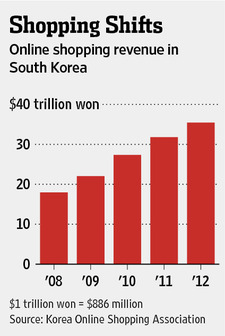
SEOUL—The look of South Korean retailing, long a stranglehold of big department stores, is being reshaped partly by cable-TV shopping and smartphones.

A decade ago, it took Lee Jie-on three years to persuade South Korean biggest retailers to stock a line of children’s skin-care products from the U.S. But the product distributor, recently had an easier time persuading them to sell U.S.-made accessories online for new moms.

She introduced the Belly Bandit line of clothing and accessories on the websites of South Korea’s department stores in January after holding just one promotional event and starting a Korean-language website. Ms. Lee says she hopes the brand will develop enough of a following online to reach the shelves of physical stores.

“Penetrating the department store in Korea is very difficult,” she says. Meanwhile, she is relying on smaller retailers and baby-products exhibitions to introduce Belly Bandit to Korean shoppers. For a small company, even cracking the online offerings of a major chain here is a big change, in part reflecting South Korean department stores reacting to the growing power of home-shopping television channels and social-commerce websites. Read more of this post

Blank cheque IPOs sprouting in Malaysia; Firms with no profit, revenue or assets entice with plans to buy corporations

Blank check IPOs bring hope and caution to Malaysia

Sun, Apr 14 16:59 PM EDT

By Yantoultra Ngui and Elzio Barreto

KUALA LUMPUR/HONG KONG, April 15 (Reuters) – Malaysia’s bull market is seeing a type of initial public offering, still fairly new to Asia, that takes a special kind of company public: one with no profits, revenues or assets.

Cliq Energy Bhd last week became the second such firm – known as a special purpose acquisition company (SPAC) – to list in Kuala Lumpur and three more are preparing IPOs. The spurt comes after Malaysian equities rose for four straight years, including a banner year for IPOs in 2012, and as investors anticipate a jump in mergers and acquisitions in Southeast Asia.

But SPACs have historically been high-risk, high-reward investments. Some U.S.-listed SPACs have performed well and built market value, while others have failed to make any acquisition and were forced to delist.

“If the historical experience in the U.S. is any indication, it should provide a warning sign that these investments may not turn out to be particularly good ones,” said Stefan Lewellen, a SPAC expert who authored a study on U.S. SPACs at Yale University. Read more of this post

Gold’s Plunge Turns New York’s Diamond District Upside Down; “We currently have a line selling precious metals. I think it is type of paranoia. They are expecting gold to hit even lower than it is, and everyone is trying to get it in as fast as they can.”

Apr 15, 2013

Gold’s Plunge Turns New York’s Diamond District Upside Down

By Michael Casey

Few businesses have been impacted more by gold’s rollercoaster price ride in recent years than the 2,600 independent firms jammed into New York’s bustling Diamond District.

And since Friday, with the international price of gold falling more in dollar terms than in any previous two-day period since at least 1974, the activity on this crowded strip on 47th Street between 5th and 6th Avenues has gotten a little crazier. Gold dealers and their customers, accustomed to buying and selling according to the so-called “London PM fix” — the second of two daily benchmark prices set by a group of London bankers — had to adjust their reference prices by the minute as a plunging real-time market left them exposed to losses.

Roni Rubinov, proprietor of New York Gold and Silver Refiners, was forced to turn away one regular customer who’d come in toting a plastic bag of gold rings, necklaces and watches. The trading price was then at $1,370 per ounce, $25 less than the London fix, on which he had based his own delivery commitments for the day to larger wholesale refiners. By the end of trading Monday, the front-month April contract had settled on the Comex division of the New York Mercantile Exchange at $1,360.60 an ounce, down 9.4% on the day to mark a 13% decline in two days. “But I have a lot,” the man said. “Can you at least do half?” Since he was a regular customer, Rubinov, who owns both a gold dealing business and a pawnbroker, said he could have bought at a $5-per-ounce loss, but not at $25 down. He advised his customer to sit on his merchandise and wait for the price to come back at a later date. The man left, a despondent look on his face. Read more of this post

Gold’s Decline Rattles Some Small Investors’ Faith

April 15, 2013, 4:56 p.m. ET

Gold’s Decline Rattles Some Small Investors’ Faith

By MATT DAY

Gold’s two-day swoon has shaken even some of the metal’s most diehard fans.

Throughout gold’s 19-month rough patch, small investors – those who buy gold coins, or own shares in exchange-traded funds that buy the metal – were one group that never lost faith.

Gold coin sellers clogged the airwaves with advertisements making the case that there has never been a better time to buy. Newsletters from self-proclaimed gold-market experts proliferated, as did financial products designed to capitalize on interest in the metal. U.S. Mint gold coin sales hit a record high in January, even though gold prices were down 11% from record highs hit in August 2011.

Some of those buyers say they’re having second thoughts this week. A wave of selling that hit the market Friday morning accelerated when the market reopened Monday. During the two days, gold futures lost 13% of their value, falling $203 to $1,361.10 a troy ounce on the Comex division of the New York Mercantile Exchange. Monday’s $140 drop was the largest in 30 years. Read more of this post

How technology is slowly developing its sense of smell

How technology is slowly developing its sense of smell

By David Meyer | GigaOM.com, Published: April 15

Last week I attended what was, I think it is fair to say, the oddest conference I have been to yet. It was the first world congress of the Digital Olfaction Society (tagline: “The Smell of Digital”), the stated goal of which is to “digitize, transmit, reproduce and recapture smells, flavors and fragrances.” You know that perennial April Fool’s joke about sending odors through the internet, most recently spun up by Google? That.

The thing is, as my colleague Barb Darrow pointed out in the wake of Google’s gag this year, there really are serious efforts underway to make the digital capture and production of aromas a reality. The conference was small, but the participants spanned the disciplines of computer science, biochemistry, engineering, smart clothing design and perfume retail. The society is the brainchild of Dr. Marvin Edeas, who is also the president and founder of International Society of Antioxidants in Nutrition and Health, and Professor Takamichi Nakamoto of the Tokyo Institute of Technology’s engineering school, whose team is gradually refining its smell detection and generation systems. Read more of this post

The Incentives for Vertical Mergers and Vertical Integration; firms in high R&D industries are less likely to vertically integrate or engage in vertical mergers, and are more likely to initiate customer or supplier relationships outside of the firm

The Incentives for Vertical Mergers and Vertical Integration

Laurent Frésard University of Maryland – Robert H. Smith School of Business

Gerard Hoberg University of Maryland – Department of Finance

Gordon M. Phillips University of Southern California; National Bureau of Economic Research (NBER)

March 31, 2013

Abstract: 
We examine the incentives for firms to vertically integrate through vertical mergers and production. We develop a new firm-specific measure of vertical integration using 10-K text to identify the extent a firm’s products span vertically related product markets. We find that firms in high R&D industries are less likely to vertically integrate or engage in vertical mergers, and are more likely to initiate customer or supplier relationships outside of the firm. These findings are consistent with firms with unrealized innovation avoiding integration to maintain ex ante incentives to make relationship specific investments and maintain residual rights of control as in Grossman and Hart (1986). In contrast, firms in high patenting industries with stable product markets are more likely to vertically integrate consistent with control rights being obtained by firms to facilitate commercialization of already realized innovation.

Discriminatory Related Party Transactions: A New Measure

Discriminatory Related Party Transactions: A New Measure

Mohammad Tareq RMIT University; University of Dhaka

Dennis William Taylor RMIT University

Clive Morley RMIT University – Graduate School of Business and Law

Nurul Houqe Victoria University of Wellington – Victoria Business School

December 18, 2012
2013 Financial Markets & Corporate Governance Conference

Abstract: 
Discretionary related party transactions (also known as tunnelling or self-dealing transactions) are non-arms length transactions with related parties of controlling shareholders for private benefit at the cost of other shareholders. Though there are studies on discriminatory related party transactions, there has been limited effort to develop a measure for such discriminatory transactions. Current measures are based on weak theoretical underpinnings and prone to high measurement error. This paper develops and tests a new measure for these discriminatory transactions. Type 1, Type 2 error rates and power of the new measurement are compared with an existing measure using computer simulated and real data. The capital market sensitivity of the new measure is also tested and compared with an existing measure. The new measure is found to be superior. This is the first systematic effort to develop a measure for discriminatory related party transactions. It will contribute in policy-making in relation to discriminatory related party transactions.

Ultimate Controlling Shareholders and Dividend Payout Policy in Chinese Stock Market

Ultimate Controlling Shareholders and Dividend Payout Policy in Chinese Stock Market

Jianan Guo School of Accounting, Economics and Finance, Deakin University

April 1, 2013

Abstract: 
Departing from the traditional cash flow rights-dividend policy framework, this study investigates whether the level of control rights and the types of control of the ultimate controlling shareholders (UCSs) of listed firms in China influence their cash dividend policy. We find that the level of control rights is positively associated with both the propensity to pay and the level of cash dividend payout, which indicates that the ultimate controlling shareholders are likely to use cash dividends to redirect financial resources from the firms as other channels of tunnelling are blocked by Chinese security regulatory body. Furthermore, different types of ultimate controllers exert dissimilar influences on the controlled firms’ cash dividend policy. The difference might stem from the historical nature of these ultimate controlling shareholders originating from China’s unique partial share issuance privatization process.

Ownership Structure and Divestiture Decisions: Evidence from Australian Firms

Ownership Structure and Divestiture Decisions: Evidence from Australian Firms

Pascal Nguyen University of Technology, Sydney (UTS); Financial Research Network (FIRN)

Nahid I. Rahman University of Technology, Sydney (UTS); Financial Research Network (FIRN)

Lucy Zhao University of Technology, Sydney (UTS); Financial Research Network (FIRN)

January 9, 2013
2013 Financial Markets & Corporate Governance Conference

Abstract: 
Divestitures have the potential to create shareholder value by helping firms optimize their portfolio of assets. Even so, firms do not necessarily take up divestitures because of agency problems. In fact, large controlling shareholders may prefer to extract private benefits of control at the expense of minority shareholders. In addition, divestitures may expose the misappropriation of corporate resources. In this paper, we explore the role that other blockholders play in constraining the largest shareholder’s influence. The results indicate that divestiture activity decreases with the ownership of the largest shareholder, which imposes a cost to minority shareholders since the firm’s value is not maximized. The presence of another significant blockholder appears to curb this negative bias towards divestitures. This finding provides an economic rationale for the higher performance of firms characterized by more balanced ownership structures. Involvement of family owners also appears to provide similar benefits.

Do Strong Shareholder Rights Mitigate Earnings Management?

Do Strong Shareholder Rights Mitigate Earnings Management?

Marshall A. Geiger University of Richmond – E. Claiborne Robins School of Business – Economics

David S. North University of Richmond – E. Claiborne Robins School of Business

April 5, 2013
Journal of Accounting, Ethics and Public Policy, Vol. 14 No. 2, 2013

Abstract: 
In this paper we examine the relationship between the strength of a firm’s shareholders rights, as part of their overall corporate governance structure, and the discretionary financial reporting choices made by the firm’s financial executives. Specifically, we examine the strength of shareholders rights and the reported levels of discretionary accounting accruals and the use of special reporting items on the income statement. We posit and find that in settings where shareholder rights are strong, after controlling for other reporting related factors, managers report lower levels of discretionary accruals and special reporting items, and use special reporting items significantly less frequently compared to firms with weak shareholder rights. Our findings suggest that having strong shareholder rights imposes additional monitoring on the firm’s financial reporting executives, leading to reduced earnings management attempts by financial executives and higher quality financial reporting.

The Separation of Investments and Management

The Separation of Investments and Management

John Morley University of Virginia School of Law

March 27, 2013
Yale Law Journal, Forthcoming

Abstract: 
This paper suggests a basic shift in the way we think about investment funds. The essence of these funds and their regulation lies not just in the nature of their investments, as is widely supposed, but also and more importantly in the nature of their organization. All types of investment funds — including hedge funds, private equity funds, venture capital funds, mutual funds, exchange-traded funds and closed-end funds — adopt a structure that I term “the separation of investments and management.” Investment enterprises place all of their investment assets into a “fund” with one set of owners, and all of their managers, workers and operational assets into a “management company” or “adviser” with a different set of owners. Investment funds also radically limit investors’ control, sometimes eliminating voting rights and boards of directors entirely. This pattern of organization has never been clearly explained or identified as a common feature of investment funds, but it has often worried and confused commentators and was recently the subject of a case in the U.S. Supreme Court. This paper explains this pattern by showing how it limits fund investors’ control over their managers and exposure to their managers’ profits and liabilities. Investors benefit from these limits for a combination of reasons having to do with exit rights, risk management and the economies of scale that managers can achieve by operating multiple funds. This pattern of organization is a large part of what defines investment funds and animates their regulation.

Gene swapping makes new China bird flu a moving target; Influenza experts say the H7N9 strain is still swapping genes with other strains, seeking to select ones that might make it fitter. If it succeeds, the world could be facing the threat of a deadly flu pandemic; bird flu death toll rises to 14

Analysis: Gene swapping makes new China bird flu a moving target

5:47am EDT

By Kate KellandHealth and Science Correspondent

LONDON (Reuters) – A new bird flu virus that has killed 13 people in China is still evolving, making it hard for scientists to predict how dangerous it might become.

Influenza experts say the H7N9 strain is probably still swapping genes with other strains, seeking to select ones that might make it fitter.

If it succeeds, the world could be facing the threat of a deadly flu pandemic. But it may also fail and just fizzle out. Read more of this post

Investor Jim Rogers Says Gold Needs Correction, Isn’t Buying Yet as it hasn’t dropped enough; Indians Defer Gold Purchases, Betting Bear Market Set to Deepen

Investor Jim Rogers Says Gold Needs Correction, Isn’t Buying Yet

Gold, which tumbled into a bear market last week, is in need of a correction, according to investor Jim Rogers, who said that he’s not buying the commodity yet as it hasn’t dropped enough. “This may be the correction that gold needs,” said Rogers, chairman of Rogers Holdings. “If it goes down enough, I will start buying it,” Rogers told reporters in Singapore today, without identifying a level. Gold extended losses to the lowest level in two years today after investors cut holdings in exchange-traded products as the U.S. recovers. Rogers, who foresaw the start of a commodity rally in 1999, has previously backed bullion to rally as central banks boosted their balance sheets to stimulate growth. Bullion for immediate delivery fell as much as 3.9 percent to $1,425.75 an ounce and was at $1,436.10 at 3:55 p.m. in Singapore. Prices tumbled 5 percent on April 12, taking losses to more than 20 percent since the record close in September 2011 and meeting the common definition of a bear market. Rogers said in April 2006 that a boom in energy and raw- material prices would help drive gold to a then-record $1,000, without giving a timeframe for that forecast. In July 2007, Rogers said that he wasn’t selling his gold position even though there were too many speculators backing further gains. In October 2009, Rogers said that gold may top $2,000 in the next decade, citing the printing of money. In August 2011, Rogers said while he wouldn’t buy more gold “right now,” the metal was still poised to rally to $2,000 “over the years.”

To contact the reporters on this story: Chou Hui Hong in Singapore at chong43@bloomberg.net; Glenys Sim in Singapore at gsim4@bloomberg.net

Indians Defer Gold Purchases, Betting Bear Market Set to Deepen

Gold buyers in India, the world’s biggest consumer, are delaying purchases in a bet that the bear market in bullion will deepen, according to the All India Gems & Jewellery Trade Federation.

“People are expecting prices to drop more as the sentiment in the market is weak and selling pressure remains,” Chairman Haresh Soni said in a phone interview from New Delhi. The price volatility is discouraging buyers, he said. The federation represents about 300,000 jewelers nationwide. Read more of this post

Slovenia’s plan to sell shares in state-owned companies failed to ease investor concern that the country will become the next euro-area nation to need a bailout

Slovenia Asset-Sale Plan Fails to Ease Debt Squeeze Concern

Slovenia’s plan to sell shares in state-owned companies failed to ease investor concern that the country will become the next euro-area nation to need a bailout. Slovenia’s default risk rose to a six-month high and bond yields hovered near records as the country prepares to tap markets this week. Prime Minister Alenka Bratusek’s April 12 announcement of plans to sell stakes in companies, including a bank, looks like an effort to stall rather than to obtain financing, according to Milan Smiljanic, head of trading at Perspektiva d.d.

“There is skepticism that they are only buying time and will try to fix debt problems, avoiding privatization,” Smiljanic said by e-mail from Ljubljana. “There are no bank bidders at the moment.” Slovenia, the European Union’s fourth-smallest economy, is trying to avoid becoming the sixth euro-area state to seek a bailout after international lenders agreed to help Cyprus. The government will sell 500 million euros ($654 million) in 18- month Treasury bills at an auction in two days as it tries to shore up confidence that it can recapitalize its ailing banks without seeking outside assistance. The cost of protecting Slovenian debt against non-payment using credit-default swaps rose to a six-month high today, advancing six basis points to 375, according to data compiled by Bloomberg. A basis point is 0.01 percentage point. Read more of this post

From Bad To Worse – European Non-Performing Loans In Context

From Bad To Worse – European Non-Performing Loans In Context

Tyler Durden on 04/15/2013 10:41 -0400

Europe remains in a critical state – despite the protestations of its leadership and the indications of its nepotistic bond markets.Unconventional monetary operations have enhanced liquidity, but have done little-to-nothing to solve the real issue – insolvency. As Jassaud and Hesse notevulnerabilities remain; as reliance on central-bank liquidity is still high especially for banks in peripheral countries. Assets continue deteriorating and remain on banks’ balance sheets, weighing on profitability. Non-performing loans (NPLs) in EU banks continue to soar, drastically outpacing loan growth. Since 2007, loans to the ‘real’ economy have decreased by 3% while NPLs increased by almost 150%, i.e., €308 billion in absolute terms. This trend shows no sign of reversal, reflecting the continued macro deterioration in parts of the EU and the absence of restructuring (until the new ‘template’). During the last European Banking Authority recapitalisation exercise, 30% of the increase in capital ratio was reached by reducing risk-weighted assets, of which one third came from risk-weighted asset ‘recalibrations’ – i.e. from rotations among the peripheral bonds that (while ultimately risky) are deemed risk-free by the ECB. For a sense of just how absolutely dire the situation is (and entirely unsustainable) across the entire Eurozone, the following chart shows thecurrent ratio of NPL-to-Total-Loans relative to Dec-2007… As ever, credit creation inflated asset prices and provided the cushion for an increase in liabilities (and never a bubble is seen) but once the bubble in asset prices begins to deflate, reality sinks in and the liabilities remain (large as ever). Thus the central bank inspired cycle of credit boom and bust continues – until, of course, there is no capacity left (and no gold to transfer).

20130414_NPL

Amazon Goes After Older Adults & Seniors With New Store

Amazon Goes After Older Adults & Seniors With New Store

SARAH PEREZ

posted 11 mins ago

50-active-healthy-living-amazon-com

Amazon has launched a new store catering to mature adults and seniors, the company announced today. But while “Amazon Seniors” would have a nice ring to it, Amazon went with a more polite, if wordy, branding: “50+ Active and Healthy Living Store.” As the name implies, the new store will be focused on a variety of “healthy living” needs, including nutritional products, wellness, exercise, fitness, medical, personal care, beauty and entertainment items and more.

The site also serves as another smart extension of one of Amazon’s lesser-known features: subscription-based ordering. Today’s its “Subscribe & Save” program allows Amazon customers to schedule automatic deliveries of household products (cleansers, paper towels, etc.) and other replenishable goods, including baby products (diapers, wipes, etc.), personal care items (deodorant, lotions, etc.), and more. Read more of this post

From Foot Soldier to Finance Minister: Takahashi Korekiyo, Japan’s Keynes

From Foot Soldier to Finance Minister: Takahashi Korekiyo, Japan’s Keynes (Harvard East Asian Monographs)[Paperback]

images (6)

Publication Date: November 30, 2009 | ISBN-10: 0674036204 | ISBN-13: 978-0674036208

From his birth in the lowest stratum of the samurai class to his assassination at the hands of right-wing militarists, Takahashi Korekiyo (1854-1936) lived through tumultuous times that shaped the course of modern Japanese history. Takahashi is considered “Japan’s Keynes” in many circles because of the forward-thinking (and controversial) fiscal and monetary policies–including deficit financing, currency devaluation, and lower interest rates–that he implemented to help Japan rebound from the Great Depression and move toward a modern economy.

Richard J. Smethurst’s engaging biography underscores the profound influence of the seven-time finance minister on the political and economic development of Japan by casting new light on Takahashi’s unusual background, unique talents, and singular experiences as a charismatic and cosmopolitan financial statesman.

Along with the many fascinating personal episodes–such as working as a houseboy in California and running a silver mine in the Andes–that molded Takahashi and his thinking, the book also highlights four major aspects of Takahashi’s life: his unorthodox self-education, his two decades of service at the highest levels of government, his pathbreaking economic and political policies before and during the Depression, and his efforts to stem the rising tide of militarism in the 1930s. Deftly weaving together archival sources, personal correspondence, and historical analysis, Smethurst’s study paints an intimate portrait of a key figure in the history of modern Japan. Read more of this post

BOJ Finds Inspiration in a 1930s Iconoclast Korekiyo Takahashi

BOJ Finds Inspiration in a 1930s Iconoclast

By Michael Schiltz  Apr 11, 2013

iqRywO9t3qDw

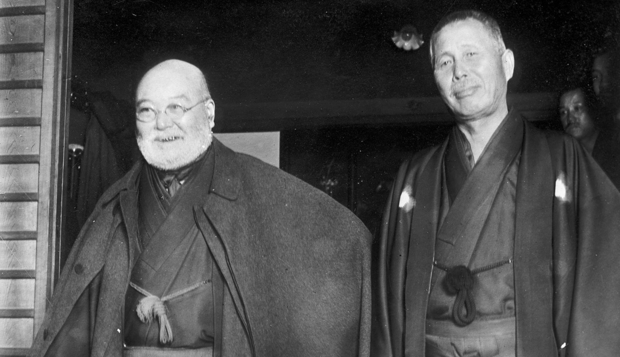
Korekiyo Takahashi, left, in an undated photo, had a long career in public office, including stints as Japan’s finance minister in the 1930s. Source: Library of Congress, Prints and Photographs Division

The Bank of Japan has decided to take bold action to reverse the nation’s economic decline.

The bank’s governor, Haruhiko Kuroda, announced a “new dimension in monetary easing,” vowing to double the purchases of government bonds and expand the monetary base. The BOJ also formally adopted a previously announced two-year target of 2 percent inflation. Quantitative easing will be the bank’s core business for the near future, a strategy that resembles the Federal Reserve’s response to the collapse of Lehman Brothers Holdings Inc.

The BOJ’s actions also mark a return, at least partly, to the unorthodox efforts of Japan’s finance minister in the early 1930s, Korekiyo Takahashi, who was praised by Fed Chairman Ben Bernanke for “brilliantly rescuing Japan from the Great Depression through reflationary policies.” Read more of this post

Chinese industry caught in vicious circle of over-production

Chinese industry caught in vicious circle of over-production

Staff Reporter, 2013-04-15

Chinese industries are caught in a vicious circle of over-production and loss, owing to conflicting government policies and expectations, according to the Guangzhou-based 21st Century Business Herald. The country’s producer price index dropped by a total of 1.9% this year due to overproduction, which includes a 5.6% slump in ferrous metals and a 2.6% fall in non-ferrous metals sectors. The country’s steel industry produced 2.2 million tonnes of steel per day in February, which was a historic high and will ultimately drive up annual production to 800 million tonnes. The record production came despite most producers operating at a loss. Aluminum production increased from 24 million tonnes in 2011 to 26 million tonnes in 2012, yet only 20 million tonnes were sold in 2012. The slump in prices caused by overproduction has prompted the government to close outdated and inefficient plants, especially those which were producing iron, steel, electrolytic aluminum and coke. Despite closing plants a different government agency has contrarily offered to subsidize electricity for the non-ferrous metal industry, especially in aluminum factories which use electricity in production. Read more of this post

Which Country’s Gold Will Be Sold Next?

Which Country’s Gold Will Be Sold Next?

Tyler Durden on 04/15/2013 08:05 -0400

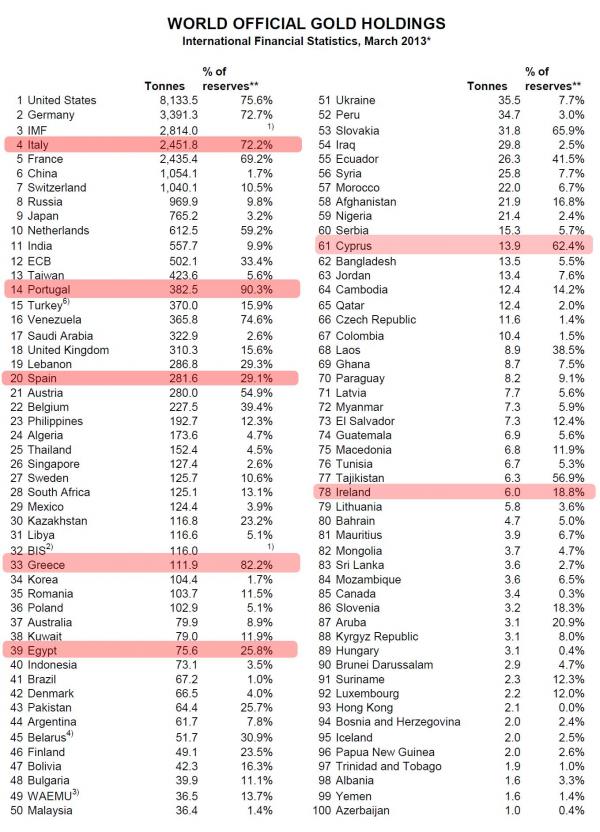
The first time the Status Quo/Troika tried to force a (not so) stealthy gold confiscation on an insolvent European country was back in early 2012, when as part of the most recent Greek bailout MOU, it was disclosed that “Greece’s lenders will have the right to seize the gold reserves in the Bank of Greece under the terms of the new deal.” However, the public outcry was so loud that the Troika had no choice but to shelve its plans and proceed with a full scale bondholder restructuring instead. Fast forward to last week, when Europe’s appetite for physical gold came back with a bang, this time as part of the Cyprus “Debt Sustainability Analysis“, and subsequent comments from Mario Draghi, demanding that tiny Cyprus, whose opposition, already weakened by the confiscation of uninsured deposits would be far less vocal than Greece’s, sell off €400MM, or virtually all of its sovereign gold, over 10 of its 13.9 total tons, to cover the excess costs of its ever ballooning sovereign bailout. So who’s next? It remains to be seen, although we are certain there will be a very clear correlation between the next country to see its gold “purchased” by the status quo, likely some time in the next 1-3 months, and the amount of total non-performing loans on said country’s bank balance sheets. The usual suspects are presented below. And, in the parlance of Goldman Sachs, these countries better scramble to sell, sell, sell now before gold hits 0, or maybe even goes negative.

sovereign gold_0

Canadians losing faith in economic “miracle”

Analysis: Canadians losing faith in economic “miracle”

1:16am EDT

By Louise Egan and Andrea Hopkins

OTTAWA/TORONTO (Reuters) – Factory worker Nelson Claros has little time for talk of the Canadian economic miracle.

The 50-year-old was laid off last year from his job of 22 years at a bus-assembly plant northwest of Toronto, and has since applied for 130 jobs. His best offer: A job at $12 an hour, half his previous wage and not enough to pay his bills.

“Really there is a recession right now. They don’t call it a recession, but the companies are closing, there are a lot of layoffs. How can this be a miracle economy?” he asked.

It wasn’t supposed to be like this. Canada’s recovery from a mild 2008-09 recession was quick and job-filled, and the country added nearly 900,000 jobs to take the jobless rate to 7.2 percent from 8.7 percent at the depths of the downturn. Read more of this post

Wells Fargo is slashing an approved list of money managers and investment vehicles that its stockbrokers market to the firm’s wealthy clients, a change of direction that has rattled the third-largest U.S. brokerage network

Exclusive: Wells Fargo cuts approved list of money managers

1:46am EDT

By Jed Horowitz

NEW YORK (Reuters) – Wells Fargo & Co is slashing an approved list of money managers and investment vehicles that its stockbrokers market to the firm’s wealthy clients, a change of direction that has rattled the third-largest U.S. brokerage network.

Executives said the clampdown protects clients from exposure to a plethora of investment models that have received little oversight. It will also reduce the firm’s risk at a time when litigation and compliance costs are rising industry wide. Read more of this post

Ahead of the curve: but bendable screens still seek breakthrough

Ahead of the curve: but bendable screens still seek breakthrough

Sun, Apr 14 2013

By Jeremy Wagstaff and Sinead Carew

SINGAPORE/NEW YORK (Reuters) – The touted arrival this year of wearable gadgets such as computer displays strapped to wrists and in wrap-around glasses is just a step towards a bigger revolution in screens – those that can be bent, folded and rolled up.

Once freed from today’s relatively heavy, breakable and fixed glass displays, tomorrow’s devices may look very different, with screens that can be rolled out, attached to uneven surfaces, or even stretched.

But there’s still some way to go.

“It becomes a product designer’s paradise – once the technology is sorted out,” says Jonathan Melnick, who analyses display technology for Lux Research. Read more of this post

Pyramid IPOs on the Chinese Growth Enterprise Market

Pyramid IPOs on the Chinese Growth Enterprise Market

Martin Holmen University of Gothenburg – Department of Economics; Göteborg University – Centre for Finance; Hanken School of Economics

Peng Wang Hanken School of Economics

March 7, 2013

Abstract: 
This paper investigates Initial Public Offerings (IPOs) of high-tech firms on the Chinese Growth Enterprise Market (GEM). Almost half of the high tech IPOs on the GEM are set up in pyramid structures. The likelihood of a pyramid structure increases with the size of the IPO firm and state control. Our results do not suggest that pyramids are set up to overcome financial constraints. However, we document that pyramid IPOs are discounted before the IPO. The price to book ratio estimated at the subscription price is significantly lower for pyramid IPOs compared to stand-alone IPOs. Furthermore, the underpricing is higher and the oversubscription is lower for pyramid IPOs. We conclude that IPO investors are reluctant to invest in pyramid firms and demand a higher risk-premium which translates into a lower subscription price and higher underpricing.

Bird Flu Surge in China Spurs H7N9 Pandemic Vaccine Preparations; “The risk of this becoming a pandemic is increasing. This is a much more serious outbreak than H5N1, which from 2003 until now only infected 43 people in China”

Bird Flu Surge in China Spurs H7N9 Pandemic Vaccine Preparations

A surge in bird flu cases in China increases the pandemic potential of the H7N9 strain, according to a Beijing-based supplier of influenza vaccines to the Chinese government.

Sinovac Biotech Ltd. (SVA), the first company to win regulatory approval for a swine flu shot in 2009, is preparing to make immunizations against the new virus that’s infected dozens of people in China and killed 13. The Nasdaq-traded company will hold off producing the shots until it’s received an order from the state, said Chief Executive Officer Yin Weidong. Flu labs around the world are developing vaccine seed strains to serve as a template for bulk immunization production, should it be required. While there is no evidence that H7N9 is spreading easily among people, it hasn’t been detected in humans before, so they have no natural immunity. That raises global public health concerns, researchers at the Centers for Disease Control and Prevention in Atlanta said last week.

“The risk of this becoming a pandemic is increasing,” Yin said in an interview at the company’s headquarters in the Chinese capital, where a second H7N9 infection was reported today. Over the past two months, 61 H7N9 cases and 13 deaths have been reported by health authorities, mostly in China’s eastern provinces. About half the infections occurred this month, suggesting the pace of transmission is increasing. The H5N1 bird flu strain, which killed at least 371 people in Asia and Africa over the past decade, hasn’t acquired the ability to spread easily among people. In 2009, a novel swine flu virus, known as H1N1, touched off the first influenza pandemic in 41 years, showing how diseases of livestock can spill over into human populations, causing a contagion.

Bigger Threat

“This is a much more serious outbreak than H5N1, which from 2003 until now only infected 43 people in China,” Yin said. Read more of this post