How the CSIRO cheated a global drugs giant into buying anti-counterfeit technology which could be easily compromised – passing off cheap chemicals it had bought from China as a ”trade secret” formula

How the CSIRO cheated a global drugs giant

April 11, 2013, Linton Besser and Nicky Phillips

csiro-wide-620x349

The CSIRO has duped one of the world’s biggest pharmaceutical companies into buying anti-counterfeit technology which could be easily compromised – passing off cheap chemicals it had bought from China as a ”trade secret” formula.

The Swiss-based multinational Novartis signed up two years ago to use a CSIRO invention it was told would protect its vials of injectible Voltaren from being copied, filled with a placebo and sold by crime syndicates.

Police and drug companies are battling counterfeiters who are selling fake medicines that have killed hundreds of people. Last year Interpol seized 3.75 million units of fake drugs and arrested 80 people. Read more of this post

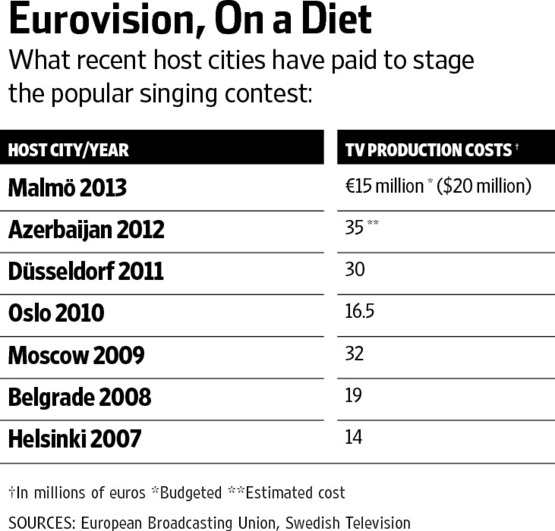
Europe’s Glitziest Show, Now In Austerity Mode; Eurovision Song Contest, one of the planet’s most wildly popular mega-events—which helped propel household names like ABBA and Celine Dion—is going on a financial diet

Updated April 10, 2013, 6:46 p.m. ET

Europe’s Glitziest Show, Now In Austerity Mode

By ANNA MOLIN

OB-XA332_EUROVI_G_20130410225103

As fiscal austerity sweeps the European continent, one of the planet’s most wildly popular mega-events—which helped propel household names like ABBA and Celine Dion—is going on a financial diet.

Every year in late spring, more than 100 million people in more than 40 nations pack into pubs, attend kitschy theme parties or dive into their couches at home—all glued to the same television broadcast. Their focus: the Eurovision Song Contest, a weeklong Olympics-meet-“American Idol” singing competition that features one chosen act from each participating nation. (Most are from Europe, but some countries outside the continent have also competed, including Israel and Cyprus.) The extravaganza is famous for its parade of aging crooners, exuberantly sequined pop singers and dark-horse acts like last year’s gaggle of singing grannies in babushka scarves.

Sweden, the country set to host next month, plans to slash the 58-year-old event’s television-production budget to $20 million, less than half what it was last year, by using a smaller venue, fewer lights and less media fanfare. The goals: to survive in a tough economy, reignite the interest of nations hobbled by fiscal cutbacks—and in the process, create a more intimate affair that returns the focus to the music itself. Read more of this post

Regulators Feeling ‘Social’ Pressure; In Age of Twitter, Decades-Old Rules That Don’t Address New Media Pose Challenge for Officials

April 10, 2013, 6:04 p.m. ET

Regulators Feeling ‘Social’ Pressure

In Age of Twitter, Decades-Old Rules That Don’t Address New Media Pose Challenge for Officials

By JESSICA HOLZER

WASHINGTON—The Securities and Exchange Commission’s move allowing companies to convey market-moving corporate news via social-media sites stems from a continuing debate at regulatory agencies: how to protect consumers, depositors and investors in the age of Facebook and Twitter.

Agencies from the SEC to the Federal Trade Commission are under increasing pressure from businesses clamoring for guidance on how they can use social media without running afoul of federal securities, advertising and other laws. Financial-advisory firms want clearer guidance from the SEC about how investment advisers can use social-media sites to court clients, while Wall Street firms want to relax rules requiring them to store every video, tweet or other piece of content their employees post on sites.

In the middle are regulators, who say they are wary of updating sometimes-decades-old rules over fears of chipping away at long-standing protections and who worry about their ability to keep up with the proliferation of social-media sites. Read more of this post

Online sales reach a trillion in a single year for the first time

Online sales reach a trillion

April 11, 2013, Michael Baker

It’s official. In 2012, business-to-consumer e-commerce passed a trillion dollars US in a single year for the first time, according to a report from US-based research firm eMarketer. Read more of this post

Shodan: The scariest search engine on the Internet; Shodan navigates the Internet’s back channels. It’s a kind of “dark” Google, looking for the servers, webcams, printers, routers and all the other stuff that is connected to and makes up the Internet

Shodan: The scariest search engine on the Internet

By David Goldman @CNNMoneyTech April 8, 2013: 1:41 PM ET

NEW YORK (CNNMoney)

“When people don’t see stuff on Google, they think no one can find it. That’s not true.”

That’s according to John Matherly, creator of Shodan, the scariest search engine on the Internet.

Unlike Google (GOOGFortune 500), which crawls the Web looking for websites, Shodan navigates the Internet’s back channels. It’s a kind of “dark” Google, looking for the servers, webcams, printers, routers and all the other stuff that is connected to and makes up the Internet. (Shodan’s site was slow to load Monday following the publication of this story.)

Shodan runs 24/7 and collects information on about 500 million connected devices and services each month. Read more of this post

How VCs Are Driving a Tech-valuation ‘Feeding Frenzy’

How VCs Are Driving a Tech-valuation ‘Feeding Frenzy’

Published: April 10, 2013 in Knowledge@Wharton

Venerable retailer J.C. Penney opened its doors more than a century ago and boasts annual revenues of nearly $13 billion from its 1,100 stores. Yet a three-year-old website with an untested business model and little discernible revenue is closing in on the department store chain’s $3 billion market cap: Pinterest. The online scrapbooking site recently raised $200 million in venture capital funds to bring its implied valuation to $2.5 billion, according to a February 20 story in The Wall Street Journal. Founded by three young entrepreneurs in March 2010, the tech start-up has 48 million users as of December 2012, up from nine million in the prior year, the article noted. While Pinterest is wildly popular, its business model remains unproven. Users, including businesses, sign up for free accounts. The company is just gearing up to accept paid advertising and recently unveiled a free analytics tool for users with business-related accounts to track what has been pinned from their sites. Pinterest may be thinking hard about ways to make money, but it remains unclear whether the firm’s financial strategies can bring in enough revenue to cover costs and generate a healthy profit, which will be especially important once the company goes public. No matter. Pinterest has garnered the interest of such Silicon Valley blue-chip venture capital firms as Andreessen Horowitz (as in Netscape co-founder Marc Andreessen). For now, Pinterest has money to burn.

The company is one of at least 25 start-ups that command market caps of one billion dollars or more, according to a February 4 story in The New York Times. The billion-dollar start-ups club includes such familiar names as productivity application Evernote, travel rental site Airbnb, online questionnaire software SurveyMonkey and streaming music service Spotify. But such high valuations are bringing back concerns that the market is entering another tech bubble like the dot-com frenzy in the late 1990s that led to scores of Internet companies going belly up and investors losing vast fortunes. Read more of this post

Acquisitions Key to Samsung Success

Updated April 10, 2013, 9:55 a.m. ET

Acquisitions Key to Samsung Success

By MIN-JEONG LEE

To maintain its new lead over Apple Inc. AAPL +2.04% in the global smartphone market, South Korea’s Samsung Electronics Co. 005930.SE +0.33% will need to get busier buying the assets it needs to continue to innovate and expand its client base, bankers and analysts say.

Samsung, which overtook Nokia Corp. NOK1V.HE +3.25% last year as the world’s largest mobile-phone maker and surpassed Apple in smartphones, has already been buying technologies and investing in companies no one else wants, largely to differentiate itself. And with cash and cash equivalents of more than $30 billion, it is sure to keep buying, bankers say.

In a recent interview, Samsung Co-Chief Executive J.K. Shin said the company is on the lookout for acquisitions, especially “intellectual property, advanced technology, components and areas that will enable us to offer better applications on smartphones.”

Thus far, its acquisitions have been small. In the past year, its purchases have included a 5% stake in stylus maker Wacom Co. of Japan, the mobile-technology business of the U.K.’s CSR CSR.LN +3.85% PLC, and California-based storage-software pioneer NVELO. Those deals have given Samsung access to technology to develop a better stylus for its smartphones and tablets, advanced wireless connectivity, and software that enables its phones to retrieve data faster. Read more of this post

PC quarterly sales plummet, sharpest drop on record

PC quarterly sales plummet, sharpest drop on record

5:20pm EDT

By Bill Rigby

SEATTLE (Reuters) – Personal computer sales plunged 14 percent in the first three months of the year, the biggest decline in two decades of keeping records, as tablets continue to gain in popularity and buyers appear to be avoiding Microsoft Corp’s new Windows 8 system, according to a leading tech tracking firm. The huge drop over a year ago, the steepest since International Data Corp started publishing sales numbers in 1994, mark a new milestone in the apparent decline of the age of the PC as computing goes mobile via tablets and smartphones. Read more of this post

Restraining Overconfident CEOs

Restraining Overconfident CEOs

Suman Banerjee Nanyang Business School

Mark Humphery-Jenner University of New South Wales – Australian School of Business; Financial Research Network (FIRN); Nuvest Capital

Vikram K. Nanda Georgia Institute of Technology – College of Management

March 26, 2013

Abstract: 
Prior literature posits that while some CEO overconfidence may benefit shareholders, high levels of overconfidence do not. We investigate whether improvements in governance can help to mitigate the adverse effects of overconfidence while preserving its positive aspects. We use the passage of the Sarbanes-Oxley (SOX) Act as a natural experiment to examine whether improvements in regulation and governance help to mitigate investment distortions and moderate risk-taking tendencies of the more overconfident CEOs. We conduct tests using options-based proxies for CEO overconfidence. The results indicate that, after SOX, overconfident CEOs reduced investment, improved performance and market value, reduced their risk-exposure, increased dividends and substantially improved long-term performance following acquisitions. We also find that these SOX-related benefits are concentrated in the firms that were SOX non-compliant prior to its passage. While the beneficial aspects of SOX in restraining overconfident CEOs may have been an unintended consequence, the message of our paper is simple: CEO over-confidence can be monitored and regulated — just like any other CEO attribute. 

Gravity-Defying Aussie Gouges Industry as Prosperity Bites Back

Gravity-Defying Aussie Gouges Industry as Prosperity Bites Back

From skyrocketing rents in remote mining towns to the decline of the auto industry, Australia is grappling with the downside of world-beating economic growth that has driven the nation’s currency to record highs.

Policymakers and executives at the Bloomberg Australia Economic Summit in Sydney yesterday singled out the local dollar’s strength as the biggest challenge for business, while conceding there’s little that can be done to restrain it. Terry Davis, managing director at Coca-Cola Amatil Ltd., said the Aussie is “decimating” manufacturers, while Robert Mead, head of portfolio management in Sydney at Pacific Investment Management Co., said businesses are deferring spending.

Australia’s defiance of the global slowdown is now backfiring on manufacturing after the currency soared 75 percent against the U.S. dollar and 87 percent versus the yen from its low in October 2008 after the collapse of Lehman Brothers Holdings Inc. roiled financial markets. The government and Reserve Bank of Australia say the cash flowing into the economy — fueled by quantitative easing in the U.S. and Japan — is beyond the control of policy makers in a small nation.

“That’s the hand that the world has dealt us,” RBA Assistant Governor for economics Christopher Kent said at the summit, reiterating that the central has no plans for intervention to weaken the so-called Aussie. “Businesses in a number of industries are under quite a deal of pressure — part of that’s because of the exchange rate.” Read more of this post

Toronto Condo Kings Retreating to Avert Crash: Mortages

Toronto Condo Kings Retreating to Avert Crash: Mortages

Toronto condo builders are slowing development in a bid to avoid a crash after a decade-long boom led to 159 towers now under construction.

So far this year, they’ve announced 13 new condominium projects, the fewest since the recession in 2009, when there were just three over the same period, figures from real estate researcher RealNet Canada Inc. show. In the same period last year, 29 new projects were announced, including Tridel Corp.’s Ten York, the third-tallest residential tower in the country at 75-stories when it was first marketed.

“Most developers have their hands in their pockets right now,” said Brad Lamb, president of Brad J. Lamb Realty Inc., a developer and the city’s largest condominium broker. His firm, which is marketing more than 45 high-rise developments in the city, won’t start a new project until 2014, Lamb said in an interview at Bloomberg’s office in Toronto. Lamb said he has eight projects in Toronto and Ottawa “on the drawing board.”

The slowdown comes as a near-record supply of condos comes to market in a city with the most towers being constructed in the world, according to BuzzBuzzHome, a Toronto-based real estate listings and research firm. Developers are trying to manage the slowdown as buyers retreat amid tighter mortgage rules, a slowing economy and the burden of record consumer debt. The supply of new high-rise units reached 21,262 in February, 34 percent more than the same period a year ago and close to a record 21,696 in October 2012, RealNet figures show. About 61,000 units are currently under construction — the most ever — and a record 35,757 residential units will come on stream next year, RealNet said. Read more of this post

China Exports Miss Forecasts as ‘Absurd’ Data Probed; China Export Gains Miss Forecasts for First Time in Four Months

China Exports Miss Forecasts as ‘Absurd’ Data Probed; China Export Gains Miss Forecasts for First Time in Four Months

China’s exports rose less than forecast for the first time in four months, leaving the world’s second-largest economy with weaker global demand to support a recovery than previous figures indicated.

Shipments abroad increased 10 percent from a year earlier, the customs administration said today in Beijing. That compares with 21.8 percent growth in February and the 11.7 percent median estimate in a Bloomberg News survey of 36 economists. Imports rose by an above-forecast 14.1 percent in March, leaving an unexpected trade deficit of $880 million.

The slowdown breaks a pattern of above-forecast figures that spurred concerns by economists at banks including Goldman Sachs Group Inc. that export gains were overstated because of companies inflating reported trade. Weaker trade growth also adds to Chinese Premier Li Keqiang’s challenges in sustaining a rebound while he tries to limit nontraditional banking and damp housing prices. Read more of this post

Soil samples across China have revealed remnants of heavy metals dating back at least a century and traces of a pesticide banned in the 1980s, revealing the extent of the country’s pollution problems

Amid China air, water pollution, soil survey reveals century-old heavy metals

As much as 65 per cent of the fertiliser in China’s countryside was improperly used and left to pollute rivers and fields.

Wed, Apr 10, 2013
Reuters

BEIJING – Soil samples across China have revealed remnants of heavy metals dating back at least a century and traces of a pesticide banned in the 1980s, an environmental official said on Wednesday, revealing the extent of the country’s pollution problems.

Street-level anger over air pollution that blanketed many northern cities this winter spilled over into online appeals for Beijing to clean water supplies as well.

The rotting corpses of thousands of pigs found last month in a river that supplies tap water to Shanghai drew even more attention to water safety.

Mr Zhuang Guotai, head of the ecological department of the Ministry of Environmental Protection, said a nationwide soil survey showed the countryside had paid a heavy price for an agricultural revolution that has seen grain production almost double in the last 30 years, despite a much reduced workforce. Read more of this post

Analysis: How Goldman’s dollar-store bet reaped a fortune

Analysis: How Goldman’s dollar-store bet reaped a fortune

12:05am EDT

By Lauren Tara LaCapra and Carrick Mollenkamp

(Reuters) – Goldman Sachs Group Inc has likely generated around $1.2 billion of revenue over six years from its dealings with discount retailer Dollar General Corp, a Reuters review shows. Just don’t expect the investment bank to boast about it.

Much of the revenue stems from an equity investment that is lumped into a catchall earnings segment called “Investing and Lending.” Goldman created the segment in 2011 to shine some light on how much money it makes from investing its own money, but it still confounds analysts and investors because the bank does not provide details on the performance of individual assets. Read more of this post

Givers take all: The hidden dimension of corporate culture; By encouraging employees to both seek and provide help, rewarding givers, and screening out takers, companies can reap significant and lasting benefits.

Givers take all: The hidden dimension of corporate culture

By encouraging employees to both seek and provide help, rewarding givers, and screening out takers, companies can reap significant and lasting benefits.

April 2013 • Adam Grant

After the tragic events of 9/11, a team of Harvard psychologists quietly “invaded” the US intelligence system. The team, led by Richard Hackman, wanted to determine what makes intelligence units effective. By surveying, interviewing, and observing hundreds of analysts across 64 different intelligence groups, the researchers ranked those units from best to worst.

Then they identified what they thought was a comprehensive list of factors that drive a unit’s effectiveness—only to discover, after parsing the data, that the most important factor wasn’t on their list. The critical factor wasn’t having stable team membership and the right number of people. It wasn’t having a vision that is clear, challenging, and meaningful. Nor was it well-defined roles and responsibilities; appropriate rewards, recognition, and resources; or strong leadership.

Rather, the single strongest predictor of group effectiveness was the amount of help that analysts gave to each other. In the highest-performing teams, analysts invested extensive time and energy in coaching, teaching, and consulting with their colleagues. These contributions helped analysts question their own assumptions, fill gaps in their knowledge, gain access to novel perspectives, and recognize patterns in seemingly disconnected threads of information. In the lowest-rated units, analysts exchanged little help and struggled to make sense of tangled webs of data. Just knowing the amount of help-giving that occurred allowed the Harvard researchers to predict the effectiveness rank of nearly every unit accurately.

The importance of helping-behavior for organizational effectiveness stretches far beyond intelligence work. Evidence from studies led by Indiana University’s Philip Podsakoff demonstrates that the frequency with which employees help one another predicts sales revenues in pharmaceutical units and retail stores; profits, costs, and customer service in banks; creativity in consulting and engineering firms; productivity in paper mills; and revenues, operating efficiency, customer satisfaction, and performance quality in restaurants.

Across these diverse contexts, organizations benefit when employees freely contribute their knowledge and skills to others. Podsakoff’s research suggests that this helping-behavior facilitates organizational effectiveness by:

  • enabling employees to solve problems and get work done faster
  • enhancing team cohesion and coordination
  • ensuring that expertise is transferred from experienced to new employees
  • reducing variability in performance when some members are overloaded or distracted
  • establishing an environment in which customers and suppliers feel that their needs are the organization’s top priority

Yet far too few companies enjoy these benefits. One major barrier is company culture—the norms and values in organizations often don’t support helping. After a decade of studying work performance, I’ve identified different types of reciprocity norms that characterize the interactions between people in organizations. At the extremes, I call them “giver cultures” and “taker cultures.” Read more of this post

WHO is looking into two suspected “family clusters” of people in China who may be infected, potentially the first evidence of human-to-human spread. “In general, no matter what their exposure, this virus so far has produced overwhelmingly severe cases”

H7N9 death toll rises as ‘family clusters’ probed

Created: 2013-4-10 1:06:39

TWO more deaths from the H7N9 bird flu virus took China’s toll from the new strain to nine yesterday.

One was an 83-year-old man in Jiangsu Province who was admitted to hospital with a fever on March 20 and confirmed as having H7N9 on April 2, Xinhua news agency reported.

The other victim was a patient in Anhui Province. No further details have been released so far.

The strain has now infected 28 people, all of them in eastern China. They include another four infections confirmed yesterday, two in Shanghai and two in Zhejiang Province, one of whom was said to be dangerously ill.

The World Health Organization said yesterday that it was looking into two suspected “family clusters” of people in China who may be infected, potentially the first evidence of human-to-human spread.

The new virus is severe in most humans, leading to fears that if it becomes easily transmissible, it could cause a deadly influenza pandemic.

“At this point there is no evidence of sustained human-to-human transmission,” WHO spokesman Gregory Hartl told a news briefing in Geneva. “There are some suspected but not yet confirmed cases of perhaps very limited transmission between close family members. Those are still being investigated.

“In general, no matter what their exposure, this virus so far has produced overwhelmingly severe cases,” he said. Read more of this post

China’s longest river is running out of fish, threatening industry and agriculture around the river basin that account for roughly 30-40% of China’s GDP, according to the WWF

China’s longest river is running out of fish

By Lily Kuo — April 9, 2013

Overfishing, pollution and infrastructure projects are quickly depleting the amount of fish in China’s Yangtze River, according to Chinese environmental officials. The consequences are environmental and economic–without enough fish the river’s eco-system could collapse, threatening industry and agriculture around the river basin that account for roughly 30-40% of China’s GDP, according to the WWF.

According to a report on April 1, Zhao Yimin, head of the fishery resource office with China’s ministry of agriculture told Global Times,”The ecological balance of the river has already collapsed.” Zhao said, noting that further exploitation could mean a recovery for the river may be too late. Read more of this post

Interviewed for a job by Sophie the robot

Interviewed for a job by Sophie the robot

PUBLISHED: 18 HOURS 35 MINUTES AGO | UPDATE: 4 HOURS 53 MINUTES AGO

92fb87bc-a0df-11e2-ba96-3567734839cb_725989455--646x363

Professor Rajiv Khosla believes robots in the workplace can improve emotional wellbeing. Photo: Jesse Marlow

RACHEL NICKLESS

With big eyes, a feminine voice and some interesting dance moves, Sophie is rather cute but don’t let that fool you.

Sophie could soon be conducting your toughest-ever job interview, monitoring not just what you say but tiny twitches in your eyebrows that give clues about how you really feel.

Sophie and her fellow “human-like” robots Charles, Matilda, Betty and Jack plus two as yet unnamed robots are the product of a research joint venture between La Trobe University Business School in Melbourne and global electronics giant NEC Corporation in Japan.

NEC provided the robots and La Trobe is adapting them for use in recruitment, health care and as “emotionally engaging learning partners” in Australia. Rajiv Khosla, who has been driving the project since its inception, says the robots are a “world first in the area of recruitment”. Read more of this post

Billabong CEO stands by turnaround strategy; At its pre-GFC peak in 2007, Billabong was valued at $3.8 billion. Today it is valued at just $256 million; Billabong, whose founder last year said he wouldn’t sell for $1 billion, slumps to a record low after entering talks on a $287 million takeover.

Billabong CEO stands by turnaround strategy

PUBLISHED: 8 HOURS 8 MINUTES AGO | UPDATE: 1 HOUR 34 MINUTES AGO

2a5d628e-a1ac-11e2-8535-6d0b98da702b_727165687--646x363

“I do believe the strategy is right,” Billabong CEO Launa Inman says. “The board has endorsed it. What we need to do now is implement this regardless of ownership at this point and time because you have to carry on with the business.” Photo: Louise Kennerley

Billabong International chief executive Launa Inman is resolute that her turnaround strategy is right for the troubled surfwear retailer but has declined to confirm guidance or earnings targets.

Ms Inman would not be drawn on the exclusive negotiations entered into on Tuesday with private equity suitor Sycamore Partners and former Billabong executive Paul Naude over their 60¢-a-share cash offer for the company. Read more of this post

Shadow banking brought America to its knees, and now it’s growing like crazy in China

Shadow banking brought America to its knees, and now it’s growing like crazy in China

By Matt Phillips — April 9, 2013

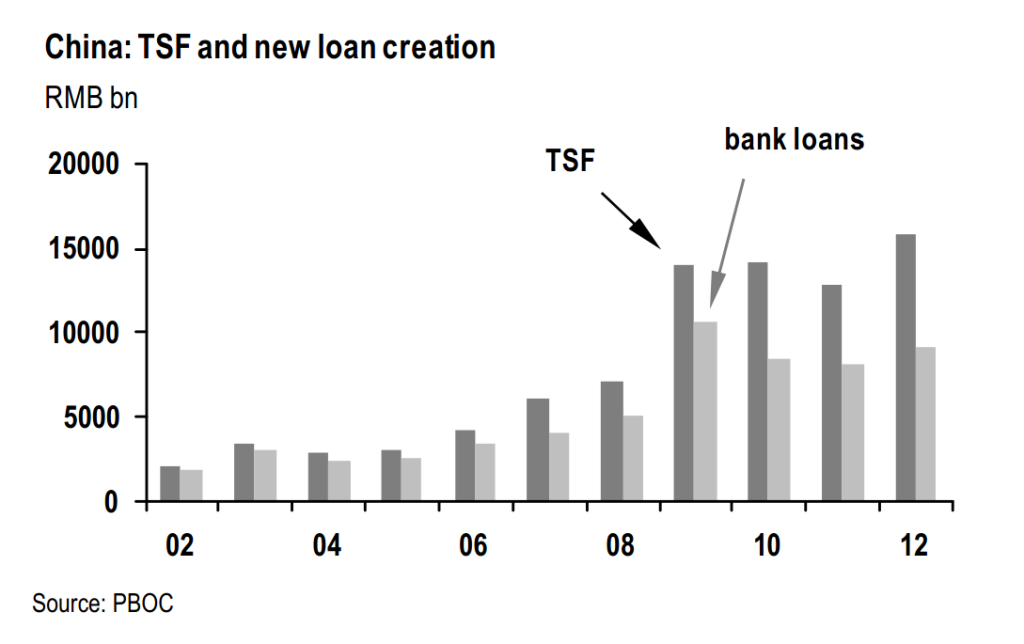
Just a few years ago, the shadow banking system brought the world’s largest economy to its knees. Will it do the same to the world’s second largest? Shadow banking—essentially when companies that aren’t regulated like banks start behaving like banks—is most definitely alive and well in China. And its growth is a key reason credit ratings firm Fitch cut its default rating on yuan-denominated debt today. The rationale is pretty plain. “Risks over China’s financial stability have grown. Credit has grown significantly faster than GDP since 2009. China experienced the second-fastest expansion of credit in real terms, behind only Qatar, between end-2009 and end-June 2012. The stock of bank credit to the private sector was worth 135.7% of GDP at end-2012, the third-highest of any Fitch-rated emerging market,” Fitch analysts wrote. And that credit growth is increasingly coming outside the banking system. Here’s a chart that shows how growth in Chinese credit—tracked using a statistic called “total social financing,” or TSF—is outpacing bank lending, from JP Morgan researchers.

screen-shot-2013-04-09-at-11-41-44-am Read more of this post

China banks “significantly exposed” to shadow financing: Fitch; “All Chinese banking is an arm of the government but that doesn’t stop loans going sour, it only stops them showing up as sour”

China banks “significantly exposed” to shadow financing: Fitch

4:18am EDT, By Kevin Yao

BEIJING (Reuters) – Chinese banks face growing risks as they are heavily exposed to the “shadow banking” being used by debt-laden local governments to raise funds, global ratings agency Fitch said on Wednesday.

Fitch’s warning over the health of China’s banking sector came a day after its cut of China’s long-term local currency debt rating by a notch to A-plus.

“The banking sector is “significantly exposed” to the shadow banking because there all sorts of ties between the banks and shadow credit channels,” Charlene Chu, head of China financial institutions at the ratings agency, told a teleconference.

Chu said a lot of “shadow credit” was going to many sectors, which included local governments. Read more of this post

Accuracy concerns over China trade data; The 3 Key Reasons Chinese Export Growth Slumped In March; still, March number could also be overstated because exports to bonded areas jumped a whopping 343 percent year-over-year in March

Last updated: April 10, 2013 4:50 am

Accuracy concerns over China trade data

By Jamil Anderlini in Beijing ©AFP

China’s latest trade figures showed a sharp decline in export growth combined with a strong rebound in imports in March, but volatility and discrepancies in the data have raised concerns about their accuracy.

Exports from China increased 10 per cent in March from the same month a year earlier, compared with a 22 per cent increase in February, while imports surged 14.1 per cent in March, compared with a year-on-year drop of more than 15 per cent the previous month, according to Chinese customs administration data released on Wednesday.

Part of the volatility was explained by the long Lunar New Year holiday, which shuts down most of the country for weeks and fell in February this year, but most analysts said there was also a problem with the data.

“The 10 per cent headline growth number [in exports] masks an uncomfortable reality – either the trade data are unreliable or if they are reliable then what are being booked as exports are not actually exports,” said Alistair Thornton, China economist at IHS Global Insight. “The breakdown of exports by destination veers towards the absurd.” Read more of this post

India car sales shrink for first time in decade, hit by a slowing economy and high interest rates

India car sales shrink for first time in decade

POSTED: 10 Apr 2013 2:50 PM
URL: http://www.channelnewsasia.com/news/business/international/india-car-sales-shrink/633898.html

India’s passenger car sales shrank for the first time in a decade, falling 6.7 percent in the year to March, hit by a slowing economy and high interest rates, a top industry body said Wednesday.

NEW DELHI: India’s once red-hot car market shrank for the first time in a decade in the last financial year, industry figures showed Wednesday, underlining the scale of the slowdown in Asia’s third-biggest economy.

Passenger car sales fell by 6.7 per cent in the financial year to March 2013 to 1.89 million units compared with from 2.03 million the previous year, the Society of Indian Automobile Manufacturers (SIAM) said in a statement.

Sales in March alone plunged 22.5 per cent year-on-year, raising questions about huge investment programmes announced by foreign car companies, such as Ford, which are building new manufacturing capacity.

“The basic problem has been the big downturn in the economy and high interest rates. They have knocked sales,” Sugato Sen, SIAM deputy director general, told AFP. Read more of this post

To Find Insider Trading, Follow The Kids’ Money

To Find Insider Trading, Follow The Kids’ Money

by SHANKAR VEDANTAM

April 09, 2013 2:56 AM

In New York and Washington, government regulators are cracking down on insider trading, the illegal practice in which people with internal information about important company events make stock market trades before ordinary investors find out what’s happening.

In recent months, regulators have launched a series of high-profile arrests and investigations. Even Congress has gotten into the spirit of things, voting to ban insider trading by members.

Now, social scientists are muscling in on the action, too.

In a new study accepted for publication in the Journal of Finance, Henk Berkman at the University of Auckland, Paul Koch at the University of Kansas and Joakim Westerholm at the University of Sydney have uncovered a novel way to spot insider trading.

The researchers tracked half a million stock market accounts over a 15-year period between 1995 and 2010. The accounts were in Finland on the Nasdaq OMX Helsinki Exchange. Why Finland? It offered researchers unusual access to information about trades and information about investors, including their age. To their surprise, when the researchers analyzed the data according to investor age, the accounts belonging to the youngest children blew all the others out of the water in terms of performance. “We were very surprised when we first found this evidence,” Koch said. “Again, we were not looking for the result we found. The group [of accounts belonging to children between the ages of zero and 10 years old] seemed to outperform all the others.” Koch isn’t implying that babies know how to make the right picks in the stock market. The people operating these children’s accounts were their parents and guardians. Read more of this post

The Fine Line Between Political Intelligence and Insider Trading

APRIL 8, 2013, 2:45 PM

The Fine Line Between Political Intelligence and Insider Trading

By PETER J. HENNING

Life in Washington is all about information – who will support or oppose an initiative, how will an agency address an issue in its rules, and when will a decision be announced. The pervasive role of the government in the economy makes that information particularly valuable to investors. And that can lead some to get a jump on the market if they learn about changes in policy before others.

“Well-timed” trading before a public disclosure of material information has all the hallmarks of insider trading. The problem is that the imprecise rules governing insider trading are an ineffective means to regulate how political intelligence firms gather, analyze and selectively disseminate such information to their clients.

Political intelligence has become a hot topic these days because of its potential to move markets. Last week, The Wall Street Journal reported about an investment firm in Washington that correctly predicted a decision by the government about reimbursement of Medicare costs; that information led to a jump of more than 6 percent in the shares of health insurers before the close of trading. Read more of this post

George Soros urges Angela Merkel to consider quitting euro

George Soros urges Angela Merkel to consider quitting euro

Billionaire speculator says single currency’s prospects would be better without Germany, the eurozone’s most dominant member

Simon Goodleyguardian.co.uk, Tuesday 9 April 2013 17.40 BST

George Soros, the billionaire speculator best known as “the man who broke the Bank of England” in 1992, has launched a stinging critique ofGermany‘s role in the euro crisis and suggested the single currency’s prospects would be improved if its most dominant member were to quit.

In an incendiary speech made on Tuesday afternoon in Germany’s financial centre of Frankfurt, the hedge fund trader told Europe‘s richest country it had gone too far during the bailout of Cyprus, was itself heading for recession and should either leave the euro or reverse its long held opposition to eurobonds – a form of sovereign debt that would mean each member country’s borrowings were guaranteed by the whole eurozone.

“My first preference is eurobonds; my second is Germany leaving the euro,” he said in his lecture, entitled: How to save the European Unionfrom the euro crisis. Read more of this post

ROSENBERG: The S&P 500 Is Nowhere Near Its All-Time High When Priced In Eggs

ROSENBERG: The S&P 500 Is Nowhere Near Its All-Time High When Priced In Eggs

Mamta Badkar | Apr. 9, 2013, 12:27 PM | 3,841 | 7

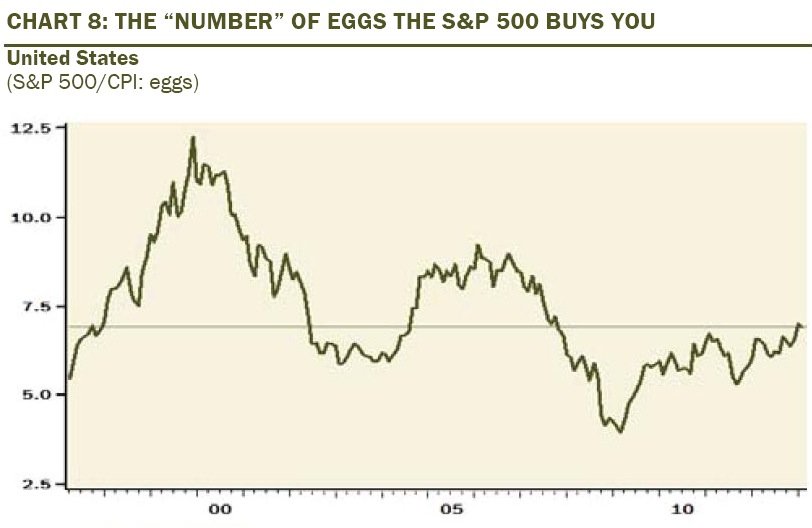
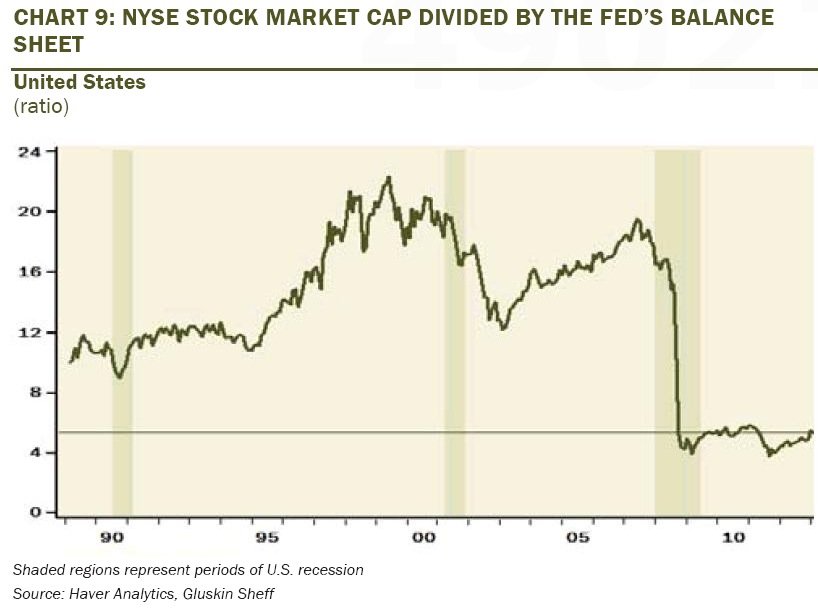
Stocks hit all-time highs in the first quarter. But many have argued that this has just been driven by central bank easing. In a new report, David Rosenberg quotes Kyle Bass (via Fred Hickey) as saying that stock market gains in real terms are weaker than those in nominal terms. In fact, Bass is quoted saying, “one of the best performing equity markets in the last decades has been Zimbabwe. But now your entire equity portfolio (in Zimbabwe) only buys you three eggs.” Rosenberg says that this made him think about the S&P 500 in egg terms. “While there has been a market recovery, it is far more subdued on this basis … in egg-adjusted terms, the S&P 500 is more than 20 percent below its pre-recession highs and about half what it was at the all-time highs 16 years ago. In milk terms, the S&P 500 is actually 15 percent below its its pre-recession highs, and in bread terms, the index is 10 percent lower. Just in case you thought I was cherry picking what’s on the breakfast table.” To really drive home his point, Rosenberg included a chart that shows the NYSE market capitalization when adjusted for the Fed’ balance sheet is still at 2009 lows.

screen shot 2013-04-09 at 11.56.46 amscreen shot 2013-04-09 at 12.04.13 pm

This Is What A $2.3 Million Pizza Looks Like; Jacksonville resident Laszlo Hanyecz purchased a pizza 3 years ago for 10,000 Bitcoin, or $25, now worth $2.3 million

This Is What A $2.3 Million Pizza Looks Like

Rob Wile | Apr. 9, 2013, 2:07 PM | 14,765 | 9

The price of a Bitcoin now stands at $234. That is really, really high. Especially given that just three years ago, Bitcoins were worth one-quarter of one cent. It was at this price when, according to Internet lore, Jacksonville resident Laszlo Hanyecz purchased a pizza for 10,000 BTC, or $25. Vice’s Brian Merchant actually had this story several days ago. But the pizza was then only worth $750,000. Here’s Hanyecz’ original post, from Bitcointalk.org:

I’ll pay 10,000 bitcoins for a couple of pizzas.. like maybe 2 large ones so I have some left over for the next day.  I like having left over pizza to nibble on later.  You can make the pizza yourself and bring it to my house or order it for me from a delivery place, but what I’m aiming for is getting food delivered in exchange for bitcoins where I don’t have to order or prepare it myself, kind of like ordering a ‘breakfast platter’ at a hotel or something, they just bring you something to eat and you’re happy! 
I like things like onions, peppers, sausage, mushrooms, tomatoes, pepperoni, etc.. just standard stuff no weird fish topping or anything like that.  I also like regular cheese pizzas which may be cheaper to prepare or otherwise acquire. If you’re interested please let me know and we can work out a deal.

Thanks,
Laszlo

As user The_egg_came_first points out on Reddit, that pizza has now cost the original purchaser over $2 million at today’s prices. At the time, Hanyecz updated a series of photos proving the purchase — here’s one:

img0984small

Mike Lazlo

This episode is a big lesson and a big cautionary tale: Anyone transacting in Bitcoin is liable to feel like an idiot the next day, as the price surges or collapses. Hence it makes more sense to just speculate, and not do anything real.

This Magical Electricity-Creating Fabric Will Soon Be Everywhere; It could revolutionize cheap, renewable energy

This Magical Electricity-Creating Fabric Will Soon Be Everywhere

Robert Ferris | Apr. 9, 2013, 2:32 PM | 5,529 | 9

david carroll - wake forest university

David Carroll is a nanotechnologist working on a simple material that he thinks will soon be a part of everything you own.  

Carroll’s research group at Wake Forest University developed a flexible fabric that makes electricity from heat or movement. It could revolutionize cheap, renewable energy.

Thermoelectrics are not exactly new, but usually made of materials that are brittle, heavy, and expensive.

Carroll’s fabric, on the other hand, is lightweight, feels like wool felt, and can be wrapped around surfaces or even sewn into clothing.

While energy can’t be “created” this fabric can essentially pull electricity out if thin air, from heat and movement.

The fabric Carroll’s group has can turn heat — from your body, the sun, anywhere — into usable electricity.

And unlike anything ever before, it can simultaneously collect power from vibrations or movement — letting your smartphone case bounce on a carseat during a long drive could charge your phone.  So could a shirt flapping in the wind.

Listening to Carroll, you get the sense that this power felt is going to be everywhere. It can be wrapped around your house, and every appliance inside it. Before you know it eager smartphone users will be fighting over heating grates instead of outlets.   Read more of this post

Prosperity requires more than rule of law; The requirements for a stable and wealthy economy go beyond property rights; while countries can learn from history, they cannot reproduce histories

April 9, 2013 5:29 pm

Prosperity requires more than rule of law

By John Kay

The requirements for a stable and wealthy economy go beyond property rights

The idea that “institutions matter” is a relatively recent amendment to the standard corpus of economic thinking. Only in the past two decades has it become a mantra of development economists.

The trigger was the recognition that plans to promote growth after decolonisation had failed. The continued poverty of many countries could not be fully explained by a shortage of capital or the legacy of foreign exploitation. Economic historians emphasised that the industrial revolution was the product not just of technological change and related investment in plant and machinery; it had also required the contemporaneous evolution of political and economic institutions.

A visit to Hong Kong is a reminder of how much institutions matter. A Chinese population under British administration created an island of prosperity, while the mainland stagnated under warlords and erratic dictators. When Chinese institutions achieved greater stability after the death of Mao Zedong, Hong Kong became a hub for the spectacular growth of the whole country. Read more of this post