GlobeAsia MD Yanto Soegiarto: Our Society of Bullies; Thuggery haunts all levels of Indonesian society. Thuggery is crime

The Thinker: Our Society of Bullies
Yanto Soegiarto | April 05, 2013

Thuggery haunts all levels of Indonesian society. Thuggery is crime.

It can be petty in some instances, but it exists in drugs, religion, politics and even in business. Thugs rule ordinary people’s markets, parking spaces, bus stations, cafes and entertainment joints.

In religion, hard-liners attack Ahmadis and prevent Christians from worshipping. In politics, lawmakers use intimidation against rival politicians and in business, lower-echelon officials often resort to extortion, which makes it difficult for foreign investors to do business in Indonesia.

Thuggery, or “ premanisme ,” flourishes because of weak leadership, lax security and poor law enforcement. And the country now is witnessing thuggery at an alarming rate despite notorious gang leaders Hercules Rosario Marshal and John Kei being in jail.  Read more of this post

Contemporary Accounting Research: The Construction of a Trustworthy Investment Opportunity: Insights from the Madoff Fraud

The Construction of a Trustworthy Investment Opportunity: Insights from the Madoff Fraud

Hervé Stolowy HEC Paris – Accounting

Martin Messner University of Innsbruck

Thomas Jeanjean ESSEC Business School

C. Richard Baker Adelphi University – School of Business

March 9, 2013
HEC Paris Research Paper No. 971/2013
Contemporary Accounting Research, Forthcoming 

Abstract: 
In this paper, we use the investment fraud of Bernard Madoff to inquire into the production of trust in the context of financial markets. Drawing upon empirical data related to U.S. individual investors (interviews and letters) as well as documentary material, we investigate the mechanisms through which investing with Madoff came to be seen as a trustworthy investment opportunity. We show how different types of information contributed to construct Bernard Madoff as a trustworthy investment manager and how Madoff avoided meeting demands for accountability by manipulating investors in face-to-face encounters. We shed particular light on the role of institution-based forms of trust which play a critical role in facilitating economic exchanges. More specifically, we suggest that the Madoff case illuminates how the provision of information can lead to an “illusion of trustworthiness” that is difficult to escape for investors. An element of such illusion, we suggest, is inherent to the functioning of financial markets more generally.

Why the Chinese Public is Telling Officials to Jump in a Lake; A new and unofficial measure of water quality is being used around the country: Will our mayor swim in that?

04.09.2013 16:48

Closer Look: Why the Public is Telling Officials to Jump in a Lake

A new and unofficial measure of water quality is being used around the country: Will our mayor swim in that?

By intern reporter Zou Zijian

1365497271192372

BEIJING – In March, the new president, Xi Jinping, had some words of advice for the major of Suzhou, in the eastern province of Jiangsu.

The mayor had just outlined a plan improve the water quality of the city’s lakes. But Xi said that, at least as far as Net users were concerned, the best measure of quality was whether the mayor himself dared to dive into local bodies of water.

A resident of Zhejiang Province, also in the east, made a splash in February when he challenged officials at the local environmental protection bureau to swim in a polluted river. Thus, a new and unofficial test of water quality was invented. Read more of this post

Poisoned Groundwater Creates Cancer Villages

Poisoned Groundwater Creates Cancer Villages

04-09 15:12 Caijing

China’s long-time practice of doling out light punishments to polluters has aggravated the problem of groundwater pollution.

By staff reporters Gao Shengke, Xu Jing, and He Tao

A recent claim that enterprises in Weifang, Shandong Province were illegally pumping wastewater underground into pressurized wells highlighted the threats to groundwater safety in China over the Spring Festival in February.

Groundwater pollution is an even bigger public hazard than the surface water pollution that contaminates China’s rivers and streams. It is also more difficult to clean up.

Underground water is the source of drinking water for 60 percent of China’s population. Currently, 360 million people in the countryside lack access to clean drinking water, while some people in rural regions drink untreated groundwater. In addition, underground water in nearly 20 percent of Chinese cities failed to reach Class III standards, which means it should not be used as a source of drinking water. Read more of this post

Catfight between Guo Meimei and Sports Car Club members revealed disturbing wealth gap in China. Chinese netizens shocked

Catfight between Guo Meimei and Sports Car Club members revealed disturbing wealth gap in China. Chinese netizens shocked

Alia | April 9th, 2013 – 9:24 pm

21

Each chip is of 50,000 yuan value; Guo showed off 10 casino chips worth RMB 5 million in total

aa

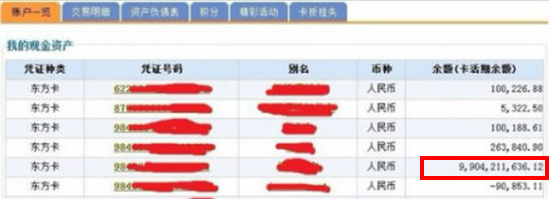
Over 3.7 billion yuan in balance; In response, one Sports Car Club (SCC) member showed off part of his bank account that had a balance of RMB 3,710,002,511.36 yuan

4

Over 9.9 billion yuan in balance Read more of this post

China’s Railways Ministry Gone, Problems Remain; with total debt at 2.66 trillion yuan, the MOR accrued 15 billion yuan in annual interest

Railways Ministry Gone, Problems Remain

04-09 15:00 Caijing

The CRC, a super monopoly which inherited all of the railways ministry’s assets, debts, and personnel, urgently needs to evolve into an efficient modern enterprise.

By staff reporters Chen Xiaoshu and Wang Kai

The dissolution of the Ministry of Railways (MOR) and subsequent establishment of China Railway Corporation (CRC) in March constitute the first step in marketization of the railways industry. But problems remain even though the MOR, which performed administrative functions and ran business operations at the same time, is no longer around.

“What about the MOR’s debts? What kind of business entity is the CRC? How will public transportation be subsidized? None of these questions have been answered yet,” said Zhao Jian, a professor at Beijing Jiaotong University who participated in brainstorming railway reform plans in 2001, 2007, and 2011 respectively.

The CRC, a super monopoly which inherited all of MOR’s assets, debts, and personnel, has 2 million staff, 1.036 trillion yuan in registered capital, and over 4.3 trillion yuan in fixed assets. The wholly state-owned enterprise urgently needs to evolve into an efficient modern enterprise.

Statistics show that the MOR had an asset-liability ratio of 61.81 percent as of Sept. 2012, with total debt at 2.66 trillion yuan, including 2.12 trillion yuan in long-term debt. With debt of that magnitude, the MOR accrued 15 billion yuan in annual interest. Read more of this post

High-rollers from China make Genting S’pore unit and others see red; gamblers have run up millions of dollars in debt and then scampered back to China, where they are effectively untouchable

Updated: Wednesday April 10, 2013 MYT 11:39:07 AM

High-rollers from China make Genting S’pore unit and others see red

An examination of court documents by Reuters and a series of interviews with lawyers and industry executives reveal that several of the gamblers have run up millions of dollars in debt and then scampered back to China, where they are effectively untouchable.

SINGAPORE: High-rollers get lavish treatment and hefty credit lines at Singapore’s two casinos, like any other gaming house in the world. But here, more of them skip town without paying their debt, a matter of increasing concern for investors.

Three years after Singapore allowed casinos to open, Genting Singapore PLC‘s Resorts World Sentosa and Las Vegas Sands Corp‘s Marina Bay Sands have become the world’s most profitable. Chinese nationals account for around half of the VIP gaming volume at their tables.

An examination of court documents by Reuters and a series of interviews with lawyers and industry executives reveal that several of the gamblers have run up millions of dollars in debt and then scampered back to China, where they are effectively untouchable.

Resorts World sued Chinese gambler Kuok Sio Kun in Singapore last year to recover S$2.2 million (1.1 million pounds). But more than six months on, the casino has not even managed to serve court papers to the Macau-based woman. Read more of this post

Little girls can’t stop talking about “Sofia the First,” the new princess Disney has cooked up; An inside look into how five years of development and testing plot lines on preschoolers gave rise to the anti-Cinderella

April 9, 2013, 8:05 p.m. ET

Test-Marketing a Modern Princess

Sofia the First Doesn’t Need a Prince to Rescue Her, but She Sure Has a Nice Tiara

By KATHERINE ROSMAN

PJ-BN621A_SOFIA_G_20130409225502

Little girls can’t stop talking about “Sofia the First,” the new princess Disney has cooked up. Katie Rosman has an inside look into how five years of development and testing plot lines on preschoolers gave rise to the anti-Cinderella. Photo: Disney Enterprises Inc.

What makes a princess irresistible to little girls who love pink—and tolerable to their parents who want modern role models?

Walt Disney Co., DIS +0.54% a company that has built mammoth product franchises out of traditional princesses, thinks she should be confident, resourceful and focused on being a good person. She should not be valued most of all for her beauty. Her royal family should include exactly zero evil stepmothers.

For five years, a Disney team of writers, child-development and early-education experts and storytelling consultants worked to create this new sort of royal girl: Sofia the First.

“We knew we didn’t want it to be a young woman looking for a man,” says Nancy Kanter, senior vice president of original programming and general manager of Disney Junior Worldwide.

“Sofia the First” was introduced to children last November when Disney Channel and Disney Junior aired a heavily promoted 45-minute pilot. Then a weekly animated program began to run on Disney Junior on Jan. 11.

The show is this year’s most-watched cable series among children 2 to 5, according to Nielsen Holdings NV NLSN +0.17% data provided by Disney. An illustrated storybook released last fall by Disney is in its fifth printing. The soundtrack ranks fourth on Billboard’s children’s music chart. Sofia is already a live attraction at Disney California Adventure and Disney Hollywood Studios in Orlando, Fla. A wide release of dolls and action figures will hit toy-store shelves this summer. Read more of this post

Companies such as Loblaw and Maple Leaf Foods that sell household staples are reaping the rewards as Canadian shoppers turn more frugal amid record consumer debt

Loblaw to Maple Leaf Surge as Need Beats Want

Companies such as Loblaw Cos. Ltd. (L) and Maple Leaf Foods Inc. (MFI) that sell household staples are reaping the rewards as Canadian shoppers turn more frugal amid record consumer debt.

The Standard & Poor’s/TSX index of consumer staples stocks has surged 11 percent in six months through yesterday, touching an all-time high on March 28, compared with a 0.6 percent decline for the Toronto benchmark. Ten of 11 members in the index have posted positive returns over that period, led by a 31 percent gain by beverage-maker Cott Corp. (COT) and a 25 percent return by Maple Leaf, a Toronto-based manufacturer of meat products and baked goods. Brampton, Ontario-based Loblaw, the nation’s biggest grocer, has returned 22 percent.

“The beauty about the consumer-staples group is what you’re really buying are companies that sell what people need, as opposed to what they want,” David Rosenberg, chief economist and strategist with Gluskin Sheff + Associates in Toronto said in a telephone interview on April 4. “You can tap into the consumer without really having to make a directional bet on the shape of the economy.”

The world’s 11th-largest economy is expanding at the slowest pace since emerging from recession in 2009, in part because the country’s indebted consumers are scaling back purchases of discretionary items and becoming more price conscious. Read more of this post

Slovenia Bailout Signaled by Worsening Debt Swaps: Euro Credit

Slovenia Bailout Signaled by Worsening Debt Swaps: Euro Credit

Slovenia’s creditworthiness is deteriorating at the fastest pace in the world after Cyprus as investors speculate a banking crisis will force it to follow the island nation and become the sixth euro country to need aid.

Credit-default swaps insuring Slovenian debt for five years soared as much as 66 percent to a six-month high of 414 basis points on March 28 from 250 on March 15, the last trading day before Cyprus announced plans for its rescue. It’s now up 35 percent at 338 basis points, compared with a 54 percent increase for Cyprus and 13 percent for Portugal in the period. Read more of this post

Forex in Delivery Room Shows Asian Women Wealth Managers Top Men; “I don’t know whether it was the baby or the exchange rate” causing the heavy breathing

Forex in Delivery Room Shows Asian Women Wealth Managers Top Men

Tan Su Shan felt her first pangs of labor while trading yen for a wealth-management client.

What to do? She took her laptop and mobile phone to a Singapore delivery room and set up a foreign-exchange operation lying flat on her back as doctors administered nitrous oxide to ease the pain of giving birth.

“I was taking gas, calling the client and trying to go, ‘Haaaaah,’” recalled Tan, 45, who was working for Morgan Stanley (MS) at the time and now heads private and consumer banking at DBS Group Holdings Ltd. (DBS) (DBS) “I don’t know whether it was the baby or the exchange rate” causing the heavy breathing.

Women like Tan are one reason why female private bankers outnumber men in Asia 3-to-2 when it comes to managing the money of the wealthy, according to executive-recruiting firm Korn Ferry International. By contrast, the female-to-male manager ratio in the U.S. is 1-to-4. In Switzerland, the world’s largest wealth-management center, it’s 1-to-9. Read more of this post

Andy Kessler: The Pension Rate-of-Return Fantasy; Counting on 7.5% when Treasury bonds are paying 1.74%? That’s going to cost taxpayers billions

Updated April 9, 2013, 7:21 p.m. ET

Andy Kessler: The Pension Rate-of-Return Fantasy

Counting on 7.5% when Treasury bonds are paying 1.74%? That’s going to cost taxpayers billions.

By ANDY KESSLER

It has been said that an actuary is someone who really wanted to be an accountant but didn’t have the personality for it. See who’s laughing now. Things are starting to get very interesting, actuarially-speaking.

Federal bankruptcy judge Christopher Klein ruled on April 1 that Stockton, Calif., can file for bankruptcy via Chapter 9 (Chapter 11’s ugly cousin). The ruling may start the actuarial dominoes falling across the country, because Stockton’s predicament stems from financial assumptions that are hardly restricted to one improvident California municipality.

Stockton may expose the little-known but biggest lie in global finance: pension funds’ expected rate of return. It turns out that the California Public Employees’ Retirement System, or Calpers, is Stockton’s largest creditor and is owed some $900 million. But in the likelihood that U.S. bankruptcy law trumps California pension law, Calpers might not ever be fully repaid. Read more of this post

What Europe’s Mistakes Teach Asia; Nations that sacrifice too much economic freedom for social security end up with neither

April 9, 2013, 3:55 p.m. ET

What Europe’s Mistakes Teach Asia

Nations that sacrifice too much economic freedom for social security end up with neither.

By SRI MULYANI INDRAWATI

A Chinese proverb tells us that it is wise to learn from your own mistakes but wiser to learn from the mistakes of others. Asian leaders should take this advice to heart as they juggle between policies for social welfare and economic dynamism. By keeping a keen eye on Europe’s fiscal crises, they can avoid the worst of the Continent’s productivity-reducing excess.

At the same time, it would be a mistake for Asia to look to Europe solely for lessons on which policies to avoid. Europe could not have attained the highest quality of life in human history without doing some things right—namely, trade and openness. Read more of this post

America’s New Energy Boom Is Bust for Foreign Suppliers

Updated April 9, 2013, 10:08 p.m. ET

America’s New Energy Boom Is Bust for Foreign Suppliers

By CHIP CUMMINS

P1-BL047_CANOIL_NS_20130409182116P1-BL048A_CANOI_G_20130409182124P1-BL050_CANOIL_G_20130409175714

EDMONTON, Alberta—For the better part of a year, Canadian officials and executives watched from afar as a shale-oil boom exploded south of the border.

But it wasn’t until last fall that the full impact of the U.S. energy boom hit the provincial government here in the heart of Canada’s oil patch.

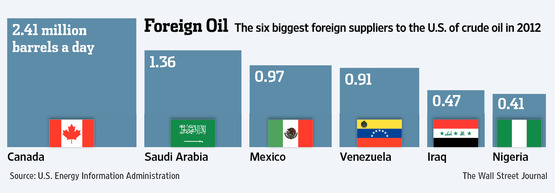
Around October, prices for Canadian bitumen—a heavy crude from the country’s vast oil sands developments—tanked, walloping the economy of America’s largest supplier of foreign oil, its biggest trading partner and one of its closest allies.

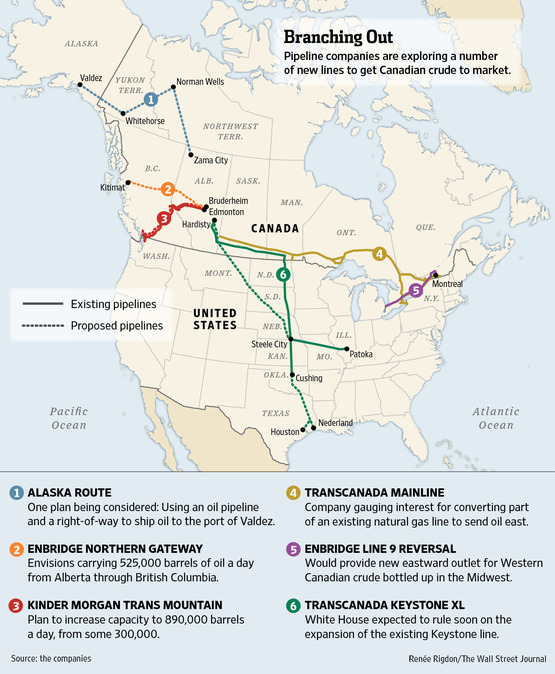
Amid a bottleneck of too few pipelines and too much new oil across the U.S. Midwest, Canadian producers had started agreeing to steeper and steeper discounts to get their oil to American refiners, their only foreign buyers. Read more of this post

Europe’s Poorest? Look North; Households in Europe’s fragile southern rim have far higher wealth—on paper, at least—than those in Germany, according to an ECB report that may fuel resistance to more bailouts

Updated April 9, 2013, 4:24 p.m. ET

Europe’s Poorest? Look North

ECB Survey Puts Southerners on Top in Household Wealth, Germans Near Bottom

By BRIAN BLACKSTONE and NINA KOEPPEN

WO-AN327D_EUPOO_G_20130409162103

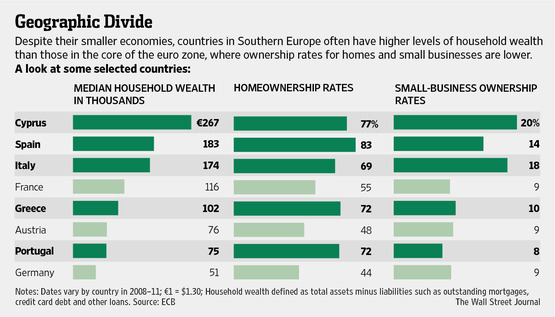
FRANKFURT—German households are among the poorest—on paper, at least—in the euro zone, according to a study by the European Central Bank that adds a new twist to the debate over how far taxpayers in Northern Europe should go to support weaker countries.

The ECB’s findings, released Tuesday, don’t give the full picture of a society’s living standards, which are affected by things like social protection and infrastructure as well. It also is based primarily on data from 2009 and 2010—early days in the still-festering euro crisis. Read more of this post

China Bird-Flu Deaths Rise to Nine

April 9, 2013, 12:19 p.m. ET

China Bird-Flu Deaths Rise to Nine

By CARLOS TEJADA and LAURIE BURKITT

AI-CA221_CFLU_NS_20130409122706

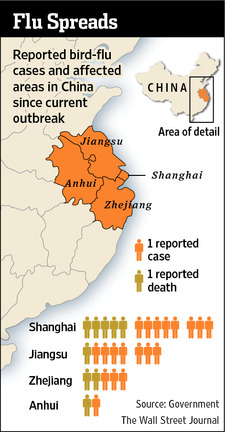
BEIJING—China reported two more fatalities from a new strain of avian flu on Tuesday, bringing the death toll to nine, and raised the total number of infections by four to 28 as the government renewed efforts to combat the spread of the disease.

Government officials said an 83-year-old man in the eastern Chinese province of Jiangsu died of the H7N9 bird flu on Tuesday. He went to a local hospital on March 20 with flulike symptoms and was diagnosed with the disease on April 2, according to the official Xinhua news agency.

Late Tuesday, authorities reported a second death for the day. A report by China Central Television said a 35-year-old woman in Anhui province died of the H7N9 bird flu Tuesday afternoon. She was diagnosed with the disease March 31, according to CCTV.

Also on Tuesday, local authorities reported two new cases in Shanghai and two more in eastern Zhejiang province. The cases remain confined to the eastern region around Shanghai, with 13 cases confirmed in China’s financial capital, eight in Jiangsu province, five in Zhejiang province, and two in Anhui province since the disease was identified on March 31. Read more of this post

Japanese Rush to Sell Gold as Price in Yen Jumps; “I learned about the rising price of gold on television and came to sell for the first time,” said 61-year-old Masako Yoshida, as she waited for about an hour to sell

April 9, 2013, 1:53 p.m. ET

Japanese Rush to Sell Gold as Price in Yen Jumps

By KANA INAGAKI And CLEMENTINE WALLOP

MI-BV247_JGOLD_NS_20130409172103

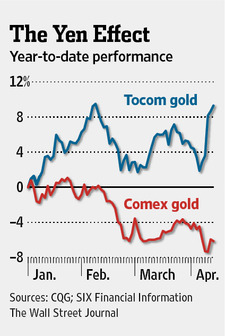
The weak yen has triggered a gold rush, literally, among Japanese households, reflecting how bold new economic policies are shaking up long-entrenched deflationary attitudes, freeing up dormant assets, and sparking new economic activity.

While gold prices have softened globally, the declining value of the yen against the dollar makes the precious metal worth a lot more in Japan. Japanese families are now scrambling to dig out gold objects from closets and jewelry boxes, and selling it to metals dealers, converting their passive assets into cash that some say they plan to put to work on everything from vacations to children’s allowances.

Long lines have formed this week outside jewelers from Tokyo to Osaka, with the price of gold in Japan jumping 4.8% this week as the dollar came close to hitting ¥100, up from about ¥80 late last year.

“I learned about the rising price of gold on television and came to sell for the first time,” said 61-year-old Masako Yoshida, as she waited for about an hour on Tuesday to sell a collection of gold rings she received from her mother about three decades ago. She said she planned to use the money to eat good food and buy souvenirs when she travels to Kyushu in southern Japan in May. Read more of this post

The Hazards of Betting on M&A in Asia

Updated April 9, 2013, 2:14 p.m. ET

The Hazards of Betting on M&A in Asia

By ISABELLA STEGER And CYNTHIA KOONS

AI-CA227_ASIADE_G_20130409222403

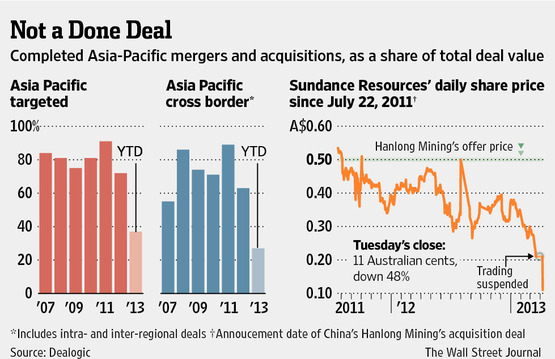
The collapse of Sichuan Hanlong Group’s acquisition of Australia’s Sundance Resources SDL.AU -2.73% —news that sent the iron-ore miner’s share price tumbling—has highlighted the challenges faced by hedge funds seeking to bet on such deals in Asia.

“The market has been saying for some time that the deal is probably off,” said Tom Elliot, chief investment officer at Beulah Capital. On Monday, Sundance said it terminated an agreement to be acquired by Sichuan Hanlong.

The collapse of the deal has burned hedge funds that have bought into Sundance, people with knowledge of the funds’ positions said, without identifying them. Hedge funds use merger-arbitrage strategies such as buying shares in a company that is being taken over at below the offer price, in hopes that the deal will be completed, yielding a profit.

“As far as I can tell, the hedge funds have not been able to fully exit the stock,” Mr. Elliot said. Read more of this post

Chinese Dilemma: 170 Auto Makers

Updated April 9, 2013, 10:31 p.m. ET

Chinese Dilemma: 170 Auto Makers

Local Government Incentives Keep Small Companies Expanding Even as Beijing Tries to Encourage Industry Consolidation

MK-CC276_CCAR_NS_20130409172708

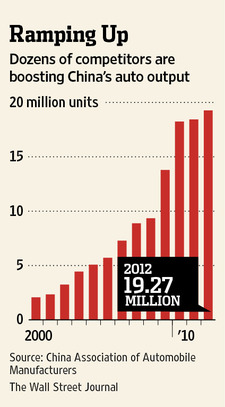
TAIZHOU, China—The U.S. auto industry has long had three big domestic car makers. China has more than 170, including tiny Zhejiang Jonway Automobile Co.

Jonway makes a sport-utility vehicle named after the Airbus A380 jumbo jet. Its A380 SUV starts at 70,000 yuan ($11,272) and is marketed as a smooth, low-maintenance ride.

Customers aren’t buying it. Last year Jonway sold about 5,000 cars compared with the more than 7,000 that Volkswagen AGVOW.XE -2.28% sells on average in China every day. Read more of this post

Why Capitalism Won’t Change North Korea’s Regime

Why Capitalism Won’t Change North Korea’s Regime

To an outside observer, the behavior of the North Korean leadership often appears short- sighted and irrational. There seems to be a tested and easy way out of their predicament — the path of Chinese-style economic reforms. While such gradual capitalist reforms might be good for the country, however, they would be far too dangerous for the current North Korean elite. As a consequence, they’re unlikely to be implemented anytime soon.

The history of East Asia after World War II has been, above all, one of spectacular economic growth. From 1960 to 2000, average per-capita gross-domestic-product growth in East Asia reached 4.6 percent, while the same indicator for the world was 2.8 percent. In 1960, in terms of per-capita GDP, South Korea ranked slightly below Somalia, while Taiwan lagged behind Senegal.

The remarkable economic transformation of those two Asian economies was overseen by governments that were decisively illiberal and undemocratic. These regimes are often described as “developmental dictatorships” — largely because they combined authoritarian politics with an obsessive focus on economic growth. The military regime in South Korea, and a hereditary dictatorship in Taiwan, spouted anti-Communist rhetoric and paid lip service to the principles of the “free world,” while pushing a market-driven but government-controlled development strategy. Lacking natural resources, they emphasized cheap labor and economic efficiency, and they were successful beyond anybody’s wildest expectations.

Perfect Machiavellians Read more of this post

Mongolia Scolds Rio Tinto on Costs as Mine Riches Replace Yurts

Mongolia Scolds Rio Tinto on Costs as Mine Riches Replace Yurts

Outside, it’s minus 30 degrees Celsius as a February wind blasts across the Central Asian steppe and through the Mongolian capital, Ulaanbaatar. Inside Government House, President Tsakhia Elbegdorj delivers a televised speech that simultaneously warms his people and chills foreign investors.

The country’s 76 legislators have convened to debate the future of one of the planet’s richest copper and gold mines, Oyu Tolgoi, which is 66 percent owned by London-based Rio Tinto Group (RIO) and 34 percent owned by the state. Elbegdorj tells them Rio Tinto has let the project’s total cost balloon by $10 billion. The higher expenses, which Rio Tinto disputes, would diminish and delay profits the government shares in, Bloomberg Markets magazine will report in its May issue.

“The time has come for the Mongolian government to take Oyu Tolgoi matters into its own hands,” Elbegdorj says to cheers from the lawmakers. His demands include giving Mongolian employees more management positions on the project, which is scheduled to begin exporting copper concentrate by June.

Few things matter more today in the political and economic life of this landlocked country of 2.8 million people than foreign investment to develop its mineral wealth. Mining money has spawned gleaming office towers, pricey gated communities and luxury-car dealerships in the capital. And yet, half of all Mongolians still live like their nomadic ancestors in circular felt yurts that can be dismantled and moved. Read more of this post

Mine Town Rents Beating Manhattan Show Aussie Pain: Commodities

Mine Town Rents Beating Manhattan Show Aussie Pain: Commodities

A furnished two-bedroom apartment in Port Hedland, the world’s biggest bulk export terminal, on Australia’s cyclone-battered north-western coast rents for almost the price of a three-bedroom penthouse in Manhattan.

The $8,155 a month price for the rental on Anderson Street – that’s typically used by mining companies to house personnel – compares with about $8,500 for three bedrooms with pool access and doorman on the Upper West Side. Port Hedland house prices gained 20 percent annually in the past 10 years, according to Real Estate Institute of Western Australia data. It’s a symptom of the high costs dogging Australia’s mining industry that’s at the tipping point of its biggest boom in a century.

The pain is set to worsen for producers, including Rio Tinto Group (RIO), which sell commodities in dollars and pay costs in the local currency that hit a 28-year high last month on a trade-weighted index. The so-called Aussie may not drop in tandem with metal prices, robbing miners of a traditional cost remedy in a nation where salaries for oil and gas industry professionals already average the equivalent of $163,600 a year, the world’s highest, according to recruiters Hays Plc. (HAS)

“If you’re in coal, it’s near a disaster at the moment,” Paul McTaggart, a Sydney-based resources analyst with Credit Suisse Group AG, said by phone. “It’ll be a problem for most sectors of the mining industry” should the so-called Aussie remain close to its near-record levels, he said. Read more of this post

China Bird Flu Outbreak May Stem From Numerous Sources; WHO’s Richard Webby: “This virus might be getting more infectious to humans”

China Bird Flu Outbreak May Stem From Numerous Sources

China’s deadly avian flu outbreak is being driven by at least two closely-related viruses, a situation that may make it more difficult to contain in humans and birds, researchers said.

The H7N9 flu has shown signs of genetic diversity since the first three patients were diagnosed, said Richard Webby, director of a World Health Organization collaborating center for the virus at St. Jude Children’s Research Hospital in Memphis. It already appears more infectious than the H5N1 strain of bird flu that has been circulating since 2003, infecting 600 people and killing 60 percent of them, he said.

Scientists from around the world are working together to understand the virus because of the potential devastation caused by novel infections. The pandemics of the past century include the 1918 Spanish flu that killed as many as 50 million people and the 2003 SARS outbreak that killed 774.

“This virus might be getting more infectious to humans,” Webby said in a telephone interview. “If this is let spread from where it is now, it will evolve further. That’s what viruses do. If it isn’t contained now, that will almost certainly happen.” Read more of this post

South Korea Braces for Possible Missile Test From North Today

South Korea Braces for Possible Missile Test From North Today

South Koreans braced for a possible North Korean missile or a nuclear weapons test as soon as today as a top American military commander said the totalitarian state has moved at least one projectile to its eastern coast.

South Korean and U.S. forces upgraded their joint surveillance “Watchcon” status by one level to monitor an imminent ballistic missile test, Yonhap reported, citing unidentified military officials. Japan deployed missile interceptors around the country as Prime Minister Shinzo Abe’s government vowed to protect its citizens.

Admiral Samuel Locklear, head of U.S. Pacific Command, confirmed yesterday to Congress that North Korea moved at least one of its medium-range Musudan missiles to its eastern coast. Efforts by Kim Jong Un’s regime to build and test weapons of mass destruction “represent a clear and direct threat to U.S. national security and regional peace and stability,” he said.

Kim’s regime has threatened to launch pre-emptive nuclear strikes against its enemies, and this week pulled workers from a joint industrial complex with South Korea. Tensions have risen since North Korea’s February atomic weapons test in defiance of tightened United Nations sanctions that were backed by China, its closest ally and biggest trading partner. Read more of this post

A former KPMG LLP partner admitted passing on stock tips about clients to a friend in exchange for cash and gifts, in a scandal that led the big accounting firm to resign as auditor for two companies

Updated April 9, 2013, 8:42 p.m. ET

Trading Case Embroils KPMG

Herbalife, Skechers Scramble to Get New Auditors as Firm Resigns Their Accounts in Wake of Probe

By JEAN EAGLESHAMJULIET CHUNG and HANNAH KARP

A former KPMG LLP partner admitted passing on stock tips about clients to a friend in exchange for cash and gifts, in a scandal that led the big accounting firm to resign as auditor for two companies.

Scott London, the Los Angeles-based partner in charge of the audits of the two clients until he was fired by KPMG, told The Wall Street Journal late Tuesday afternoon that “I regret my actions in leaking nonpublic data to a third party.”

Mr. London said his leaks “started a few years back,” adding that KPMG bore “no responsibility” for his actions.

“What I have done was wrong and against everything” he believed in, Mr. London said. Read more of this post

Corn Boom Goes Bust With U.S. Sales in Record Drop: Commodities

Corn Boom Goes Bust With U.S. Sales in Record Drop: Commodities

The record collapse in U.S. corn exports and shrinking domestic demand are leaving more grain in silos, spurring a bear market just eight months after drought drove prices to an all-time high.

Stockpiles will be 836 million bushels (21.2 million metric tons) on Aug. 31, or 32 percent more than the U.S. Department of Agriculture forecast last month, according to the average of 35 analyst estimates compiled by Bloomberg. Export sales from the world’s largest grower and shipper fell 54 percent in the year that began Sept. 1, heading for the biggest annual drop in government data that starts in 1960.

Surging grain costs last year forced Cargill Inc. and other meat producers to close plants and ethanol makers including Valero Energy Corp. (VLO) to shut distilleries, easing demand for corn supplies curbed by the worst drought since the 1930s. The USDA says output will rebound as farmers plant the most acres in 77 years. Futures fell 25 percent from their peak in August, joining wheat and soybeans in bear markets as global food costs tracked by the United Nations fell for five consecutive months.

“The corn-supply situation has gone from being underwater to having its head above water,” said Roger Fray, the executive vice president of grain at farmer-owned grain handler West Central Cooperative in Ralston, Iowa, who expects cash prices to drop 20 percent by December. “We have enough supply until what should be a record harvest.” Read more of this post

Earnings Management and Annual General Meetings: The Role of Managerial Entrenchment

Earnings Management and Annual General Meetings: The Role of Managerial Entrenchment

John Banko University of Florida

Melissa B. Frye University of Central Florida – College of Business Administration

Weishen Wang College of Charleston

Ann Marie Whyte University of Central Florida

May 2013
Financial Review, Vol. 48, Issue 2, pp. 259-282, 2013 

Abstract: 
We examine earnings management around the annual general meeting (AGM) and assess the influence of managerial entrenchment. Consistent with prior research, we show positive and statistically significant abnormal returns surrounding AGMs regardless of the level of managerial entrenchment. We find evidence of significant earnings manipulation primarily among entrenched managers. Specifically, they manage abnormal accruals downward two quarters prior to the AGM and significantly increase abnormal accruals in the quarter immediately before the AGM. Our evidence is consistent with AGMs triggering managers to disseminate information in a manner that shapes the market’s perception of the firm.

If it’s Good for the Firm, it’s Good for Me: Insider Trading and Repurchases Motivated by Undervaluation

If it’s Good for the Firm, it’s Good for Me: Insider Trading and Repurchases Motivated by Undervaluation

Shrikant Jategaonkar Southern Illinois University at Edwardsville

May 2013
Financial Review, Vol. 48, Issue 2, pp. 179-203, 2013 

Abstract: 
My findings suggest that information inherent in insider trading can be used to identify undervalued repurchasing firms. I examine the relation between insider trading and the performance of open market repurchase (OMR) firms. I show that firms with high net insider buying prior to OMR announcements not only earn abnormal stock returns in both the short‐ and long‐run, but also exhibit better operating performance. Overall, the evidence is consistent with insiders timing their trades prior to OMR announcements.

Venture Capital Backing and Overvaluation: Evidence from the High‐Tech Bubble

Venture Capital Backing and Overvaluation: Evidence from the High‐Tech Bubble

Lanfang Wang 

Susheng Wang Hong Kong University of Science & Technology (HKUST) – Department of Economics

Jin Zhang Nankai University

May 2013
Financial Review, Vol. 48, Issue 2, pp. 283-310, 2013 

Abstract: 
We investigate the association between venture capital (VC) backing and the likelihood of firm overvaluation in the high‐tech bubble period. We find strong evidence that a VC‐backed firm is more likely than a non‐VC‐backed firm to be overvalued during the bubble period. A further investigation suggests that such an association exists only for VC‐backed firms that have gone public recently and VC‐backed firms over which venture capitalists (VCs) have high ownership or control. But outside the bubble period, all the differences in overvaluation between VC‐backed and non‐VC‐backed firms disappear. Our findings provide additional evidence supporting VC opportunism in boom periods.

Due Diligence and Investee Performance

Due Diligence and Investee Performance

Douglas Cumming York University – Schulich School of Business

Simona Zambelli University of Bologna – Department of Management

March 22, 2013

Abstract: 
We quantify the value of due diligence (DD) in the context of private equity (PE) investments. We relate DD to performance, including changes in return on assets and EBITDA/sales over the first three years after the investment. Based on a new and novel dataset comprising the majority of PE investors in Italy, we find evidence highly consistent with the view that DD improves performance. The statistical and economic significance of our findings is robust to consideration of endogenous determinants of DD. Our analyses of various sample-subsets also highlight that the DD carried out internally by fund managers has a more pronounced impact on performance. Puzzling results emerge, instead, for the DD performed by external agents, highlighting the existence of apparent agency costs associated with external DD.