Lessons from America’s long history of property booms

Lessons from America’s long history of property booms

Apr 6th 2013 |From the print edition

20130406_FNC339

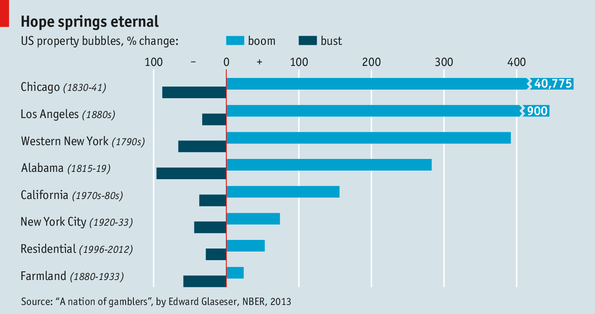
ROBERT MORRIS would have enjoyed the recent American housing boom. A signatory of the Declaration of Independence, he profited handsomely in the 1790s by “flipping” land on the American frontier. His business, acquiring millions of acres from Native Americans and friends of the crown and then selling them on to speculators, probably made him the richest man in America until dearer credit left him bankrupt. In a new paper Edward Glaeser of Harvard University argues that America’s long history of property manias has lessons for those aiming to minimise the pain of future busts. In particular, exuberant buyers may be more rational than many assume.

Robert Shiller, a Yale University economist and prescient housing-bubble spotter, reckons that “animal spirits” animate investors during bubbles. He sees America’s recent housing boom as an especially bad case of irrationality. Yet Mr Glaeser notes that the episode fits comfortably within America’s speculative past (see table). And assumptions of irrationality may let economists off the hook too easily. In fact, he writes, booms are often consistent with reasonable beliefs about the future—an important fact for bubble diagnosticians to note.

On sensible reckoning, for example, agricultural land in Alabama was a steal in the 1810s. Cotton production on Alabama farmland was highly productive, and cotton prices were surging on demand from British textile manufacturers. In 1817 land sold at about $35 per acre (in 2012 dollars), twice the national average for unimproved land. Prices almost quadrupled to $134 per acre the next year. Even those values implied large profits at going cotton prices, suggesting land remained a good buy. Yet when recession struck in 1819, farm prices dropped and leveraged buyers went bust. A prolonged price slump followed; by 1850 land cost just $5 per acre. Optimism, though warranted, led to financial carnage. Read more of this post

Five routes to more innovative problem solving; Tricky problems must be shaped before they can be solved. To start that process, and stimulate novel thinking, leaders should look through multiple lenses.

Five routes to more innovative problem solving

Tricky problems must be shaped before they can be solved. To start that process, and stimulate novel thinking, leaders should look through multiple lenses.

April 2013 • Olivier Leclerc and Mihnea Moldoveanu

Source: Strategy Practice

Rob McEwen had a problem. The chairman and chief executive officer of Canadian mining group Goldcorp knew that its Red Lake site could be a money-spinner—a mine nearby was thriving—but no one could figure out where to find high-grade ore. The terrain was inaccessible, operating costs were high, and the unionized staff had already gone on strike. In short, McEwen was lumbered with a gold mine that wasn’t a gold mine.

Then inspiration struck. Attending a conference about recent developments in IT, McEwen was smitten with the open-source revolution. Bucking fierce internal resistance, he created the Goldcorp Challenge: the company put Red Lake’s closely guarded topographic data online and offered $575,000 in prize money to anyone who could identify rich drill sites. To the astonishment of players in the mining sector, upward of 1,400 technical experts based in 50-plus countries took up the problem. The result? Two Australian teams, working together, found locations that have made Red Lake one of the world’s richest gold mines. “From a remote site, the winners were able to analyze a database and generate targets without ever visiting the property,” McEwen said. “It’s clear that this is part of the future.”1

McEwen intuitively understood the value of taking a number of different approaches simultaneously to solving difficult problems. A decade later, we find that this mind-set is ever more critical: business leaders are operating in an era when forces such as technological change and the historic rebalancing of global economic activity from developed to emerging markets have made the problems increasingly complex, the tempo faster, the markets more volatile, and the stakes higher. The number of variables at play can be enormous, and free-flowing information encourages competition, placing an ever-greater premium on developing innovative, unique solutions.

This article presents an approach for doing just that. How? By using what we call flexible objects for generating novel solutions, or flexons, which provide a way of shaping difficult problems to reveal innovative solutions that would otherwise remain hidden. This approach can be useful in a wide range of situations and at any level of analysis, from individuals to groups to organizations to industries. To be sure, this is not a silver bullet for solving any problem whatever. But it is a fresh mechanism for representing ambiguous, complex problems in a structured way to generate better and more innovative solutions.

The flexons approach

Finding innovative solutions is hard. Precedent and experience push us toward familiar ways of seeing things, which can be inadequate for the truly tough challenges that confront senior leaders. After all, if a problem can be solved before it escalates to the C-suite, it typically is. Yet we know that teams of smart people from different backgrounds are more likely to come up with fresh ideas more quickly than individuals or like-minded groups do.2 When a diverse range of experts—game theorists to economists to psychologists—interact, their approach to problems is different from those that individuals use. The solution space becomes broader, increasing the chance that a more innovative answer will be found.

Obviously, people do not always have think tanks of PhDs trained in various approaches at their disposal. Fortunately, generating diverse solutions to a problem does not require a diverse group of problem solvers. This is where flexons come into play. While traditional problem-solving frameworks address particular problems under particular conditions—creating a compensation system, for instance, or undertaking a value-chain analysis for a vertically integrated business—they have limited applicability. They are, if you like, specialized lenses. Flexons offer languages for shaping problems, and these languages can be adapted to a much broader array of challenges. In essence, flexons substitute for the wisdom and experience of a group of diverse, highly educated experts.

To accommodate the world of business problems, we have identified five flexons, or problem-solving languages. Derived from the social and natural sciences, they help users understand the behavior of individuals, teams, groups, firms, markets, institutions, and whole societies. We arrived at these five through a lengthy process of synthesizing both formal literatures and the private knowledge systems of experts, and trial and error on real problems informed our efforts. We don’t suggest that these five flexons are exhaustive—only that we have found them sufficient, in concert, to tackle very difficult problems. While serious mental work is required to tailor the flexons to a given situation, and each retains blind spots arising from its assumptions, multiple flexons can be applied to the same problem to generate richer insights and more innovative solutions.

Networks flexon

Imagine a map of all of the people you know, ranked by their influence over you. It would show close friends and vague acquaintances, colleagues at work and college roommates, people who could affect your career dramatically and people who have no bearing on it. All of them would be connected by relationships of trust, friendship, influence, and the probabilities that they will meet. Such a map is a network that can represent anything from groups of people to interacting product parts to traffic patterns within a city—and therefore can shape a whole range of business problems.

For example, certain physicians are opinion leaders who can influence colleagues about which drugs to prescribe. To reveal relationships among physicians and help identify those best able to influence drug usage, a pharmaceutical company launching a product could create a network map of doctors who have coauthored scientific articles. By targeting clusters of physicians who share the same ideas and (one presumes) have tight interactions, the company may improve its return on investments compared with what traditional mass-marketing approaches would achieve. The network flexon helps decompose a situation into a series of linked problems of prediction (how will ties evolve?) and optimization (how can we maximize the relational advantage of a given agent?) by presenting relationships among entities. These problems are not simple, to be sure.3But they are well-defined and structured—a fundamental requirement of problem solving. Read more of this post

Exclusive: Some wealth advisers take a fee for client fund assets

Exclusive: Some wealth advisers take a fee for client fund assets

12:54pm EDT

By Jed Horowitz

(Reuters) – At least three wealth management firms that market themselves as objective financial advisers are getting payments for investing their clients’ money in certain mutual funds, a practice that even some of these firms say could create conflicts of interest.

The firms, known as registered investment advisers, are typically paid by clients with fees tied to the growth or contraction of client assets, and not to specific products. But Fidelity Investments and Charles Schwab Corp are paying these financial advisers as much as 0.25 percent of the assets that their clients put into no-transaction-fee mutual funds.

Such funds are popular with ordinary investors because they don’t have to pay commissions to buy or sell them, although some advisers say they have higher expenses than funds with commissions. Brokers such as Fidelity and Schwab make hundreds of millions of dollars in fees selling funds that they and others manage. Read more of this post

In Sign of Warming, 1,600 Years of Ice in Andes Melted in 25 Years

April 4, 2013

In Sign of Warming, 1,600 Years of Ice in Andes Melted in 25 Years

By JUSTIN GILLIS

Glacial ice in the Peruvian Andes that took at least 1,600 years to form has melted in just 25 years, scientists reported Thursday, the latest indication that the recent spike in global temperatures has thrown the natural world out of balance. The evidence comes from a remarkable find at the margins of the Quelccaya ice cap in Peru, the world’s largest tropical ice sheet. Rapid melting there in the modern era is uncovering plants that were locked in a deep freeze when the glacier advanced many thousands of years ago. Dating of those plants, using a radioactive form of carbon in the plant tissues that decays at a known rate, has given scientists an unusually precise method of determining the history of the ice sheet’s margins. Read more of this post

How P&G Presents Data to Decision-Makers: Over 50,000 P&G employees now have access to a “Decision Cockpit”

How P&G Presents Data to Decision-Makers

by Tom Davenport  |   3:00 PM April 4, 2013

Those of us who believe that managers make better decisions when key data are presented visually tend to get very excited about all the innovation going on in the graphical display of information. (For a sampling of some new and cool tools, see the popular Hans Rosling TED talk.) However, if you work in a large organization and want it to make better use of data visualization, I’d argue thatcommonality is more important than creativity. If you can establish a common visual language for data, you can radically upgrade the use of the data to drive decision-making and action. The best case I can cite for this argument is Procter & Gamble, which has institutionalized data visualization as a primary tool of management. Working with visual analytics software vendor Tibco Spotfire, P&G has put visual displays of key information on desktops — over 50,000 P&G employees now have access to a “Decision Cockpit” (shown below).

MyCockpit-thumb-580x433-3673 Read more of this post

Have a fancy navigation system? It’s probably running software built by QNX, a little-known but powerful Canadian company.

QNX: The little-known company that controls your car

April 5, 2013: 7:12 AM ET

Have a fancy navigation system? It’s probably running software built by QNX, a little-known but powerful Canadian company.

By Kurt Wagner, reporter

FORTUNE — Under the bright lights of the Consumer Electronics Show in Las Vegas last January, a stunning black Bentley sat with the top down on the showroom floor. The Bentley — a Continental GTC convertible starting at $191,000 — became the center of attention throughout most of the week as thousands of geeks filed through the Las Vegas Convention Center’s North Hall. But it was not for its curvaceous sheet metal that attracted them but its futuristic dashboard inside. Developed by Ottawa-based software company QNX, this dashboard boasted 3-D maps and reverse cameras, pre-touch technology that kicks the massive 17-inch screen to life as a hand approaches, and even, per Bentley’s request: video conferencing (only functional when the car is in park, of course).

For more than a decade, QNX — the same QNX that makes BlackBerry’s (BBRY) new mobile operating system known as BlackBerry 10 — has developed software specifically tailored toward the auto industry. Ask analysts what reputation QNX carries, and you’ll get phrases like “rock solid” or “a solution for things that can’t crash,” fitting considering the potential consequences of a computer failure while traveling at freeway speeds. (In a 2003 interview, one QNX customer jokingly told Fortune, “The only way to make this software malfunction is to fire a bullet into the computer running it.”) QNX has wielded this reputation to carve out an early hold on the so-called infotainment market share, shipping more than 9 million units in 2011, over 60% of all such units sold, according to Derek Kuhn, vice president of sales and marketing. Audi, Toyota (TM), BMW, Porsche, Honda (HMC), Land Rover — QNX has been in them all, and Kuhn estimates QNX software currently operates in “tens of millions” of cars around the globe. An automotive industry report from IHS pegs infotainment revenues at $6.7 billion for 2013. Read more of this post

An Introduction to the Startup Ecosystem in Indonesia, Thailand and Vietnam

Shell, Glencore, and Other Multinationals Dominate Their Home Economies

Shell, Glencore, and Other Multinationals Dominate Their Home Economies

By Jennifer Daniel, April 04, 2013

While corporate revenues aren’t the same as GDP, the size of these companies in relation to their home countries is remarkable.

econ_gdpchart15B_405

The chemist in the kitchen: Rachel Edwards-Stuart cooked up a career from applying lab techniques to modern cuisine

April 4, 2013 5:16 pm

The chemist in the kitchen

By Emma Jacobs

images (5)

In her elements: Rachel Edwards-Stuart uses her academic studies to create culinary transformations

Nervy, nerdy Rachel Edwards-Stuart fizzes about the kitchen in her north London higgledy-piggledy flat, pulling out bits of equipment. A water bath, a blow torch, pipettes. Ah, here is the smoking gun. “The tube is over there,” she yanks a foot-long piece of rubber from a shelf. “My cleaning lady hides things in weird places.” She pauses. “I don’t know where you’d normally put a tube from a smoking gun.”

The 30-year-old food scientist is such an enthusiast for the overlapping spheres of science and gastronomy that she interrupts one train of thought with another and another.

Her primary job is to teach the science of cooking and ways of creating gastronomic experiments to chefs – professionals in restaurants as well as amateurs who aspire to make such gourmet confections at home. But she also advises chefs and the food industry. She shares the evangelising passion of a mad professor desperate to communicate their ideas while baffled by their audience’s ignorance. Read more of this post

There Is A Worrying Sign That The New Bird Flu May Spread Between Humans

There Is A Worrying Sign That The New Bird Flu May Spread Between Humans

Jennifer Welsh | Apr. 4, 2013, 5:49 PM | 7,592 | 8

A person who had been in contact with a patient that died of H7N9 has been quarantined with flu symptoms, Xinhua reports. The person had close contact with one of the five patients that have died from this new bird flu. If this person, who lives in Changhai, does have the H7N9 virus, he could be the 15th case in China. He is the first of the 400 close contacts that the WHO is monitoring for show signs of infection. Science writer Ed Yong said on Twitter that this news is a “potential catastrophe.” We agree. This could mean that the virus has the ability to spread between humans directly, making it much deadlier, especially because humans don’t have a natural immunity to this strain of virus, because it usually can’t infect us.

The Story Of A Failed Startup And A Founder Driven To Suicide

The Story Of A Failed Startup And A Founder Driven To Suicide

Alyson Shontell | Apr. 4, 2013, 8:43 PM | 86,356 | 37

jody-sherman

A few months ago, on Sunday, January 27, an entrepreneur named Jody Sherman had plans to see a movie with a friend.

But that afternoon, the friend received a call from Jody’s wife, Kerri.

Jody had gone missing. Three hours later, Kerri notified the Las Vegas Police Department, fearing something might have happened to her husband.

At 11:12 PM, the police found Sherman’s body.

He was in his car on Witch Mountain Road, near Mount Charleston, Nevada, about 25 miles from Las Vegas. Sherman had been shot in the head.

The Clark County coroner’s office determined that Sherman had killed himself. It was five days before his 48th birthday.

News of Sherman’s suicide ripped through Twitter and the technology blogs. His death left thousands aching and confused. He left no note. His last Facebook message was written by his wife:

“This is Jody’s final post, and it isn’t coming from Jody. He’s gone. This is not a bit of his wonderful twisted humor. This is sad and real and forever. He didn’t say goodbye to anyone because he knew he couldn’t. So I’m saying it for him. If you are reading this it’s because you are connected to Jody in some way. He loved you, respected you, admired you, valued your presence in his life, or felt some combination of any or all of these things. And he would want each and every one of you to know and understand exactly that. Please post anything you have to say to or about Jody here.”

Just a few days after Sherman’s suicide, his company, Ecomom, had a board meeting in which his co-founder and the board found the startup in a startling state.

A couple of weeks later, Ecomom closed its doors. The prosaic reason: The company’s liabilities were greater than its assets.

Put more simply, Ecomom was broke. The 28-person startup — which had just raised $5 million six months earlier and more than $12 million total — ran out of cash. And no one left at the company seemed to know where it had gone. Read more of this post

Feathers Fly as New Rules Loom for Kids’ Apps; Updated federal children’s online privacy rules go into effect in July. Developers of games and other mobile software are still figuring out how to comply

April 4, 2013, 7:43 p.m. ET

Feathers Fly as New Rules Loom for Kids’ Apps

By ANTON TROIANOVSKI

MK-CC160_KIDAPP_G_20130404175704

Kids love Angry Birds, but will Angry Birds love them back?

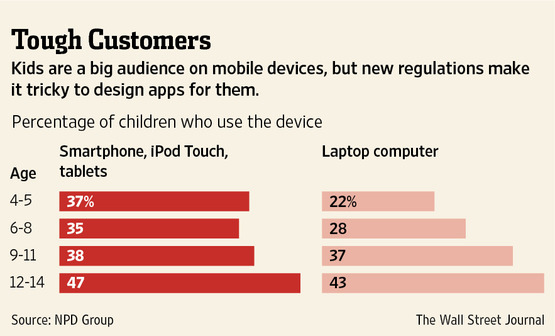
Updated federal children’s online privacy rules go into effect in July. Developers of games and other mobile software are still figuring out how to comply: They must balance their desire to tap the lucrative kids’ market and the increased regulatory headache of targeting children.

The biggest problem: data-collection practices that have become routine in the app industry could run afoul of the new rules when used in kids’ apps.

Japanese mobile games giant Gree Inc.3632.TO +3.02% and the U.K. company behind the popular kids’ website Moshi Monsters are scaling back plans to jointly build apps as they figure out how to adjust to the new rules, according to Moshi Monsters executive Rebecca Newton. Read more of this post

The Practical University: The promise of online education lies in taking care of the technical knowledge so that universities can focus on transmitting practical knowledge

April 4, 2013

The Practical University

By DAVID BROOKS

The best part of the rise of online education is that it forces us to ask: What is a university for?

Are universities mostly sorting devices to separate smart and hard-working high school students from their less-able fellows so that employers can more easily identify them? Are universities factories for the dissemination of job skills? Are universities mostly boot camps for adulthood, where young people learn how to drink moderately, fornicate meaningfully and hand things in on time?

My own stab at an answer would be that universities are places where young people acquire two sorts of knowledge, what the philosopher Michael Oakeshott called technical knowledge and practical knowledge. Technical knowledge is the sort of knowledge you need to understand a task — the statistical knowledge you need to understand what market researchers do, the biological knowledge you need to grasp the basics of what nurses do.

Technical knowledge is like the recipes in a cookbook. It is formulas telling you roughly what is to be done. It is reducible to rules and directions. It’s the sort of knowledge that can be captured in lectures and bullet points and memorized by rote. Read more of this post

Chinese Education: The Truth Behind the Boasts; Parents in China’s big cities sometimes pay donations and steep fees to middlemen to get their children into the best schools

Chinese Education: The Truth Behind the Boasts

By Dexter Roberts on April 04, 2013

In an international survey released just over two years ago, high school students from Shanghai scored at the top in math, science, and reading. Some Americans saw this as a Sputnik moment—a wake-up call for the rest of the world to better educate its young or risk falling behind the Chinese. In March, China’s leadership announced that education spending totaled 7.79 trillion yuan ($1.26 trillion) over the last five years, reaching a target of 4 percent of gross domestic product. “The quality and level of education in China was comprehensively raised,” said outgoing Premier Wen Jiabao on March 5.

The reality is China’s students receive educations of greatly varying quality. Their parents often pay a lot for it, depending on where they live and how ambitious their choice of school—even though China is committed to a system “implemented uniformly by the State,” with “no tuition or miscellaneous fee,” according to the 1986 Compulsory Education Law. Yet some rural families struggle to pay school costs as high as one-half their meager incomes, while up to 130 students crowd country classrooms, according to Yang Dongping, an education expert at the Beijing Institute of Technology and the dean of the 21st Century Education Research Institute. Yang adds that urban parents pay introduction fees of as much as $10,000 to middlemen to win entry into the better schools. Read more of this post

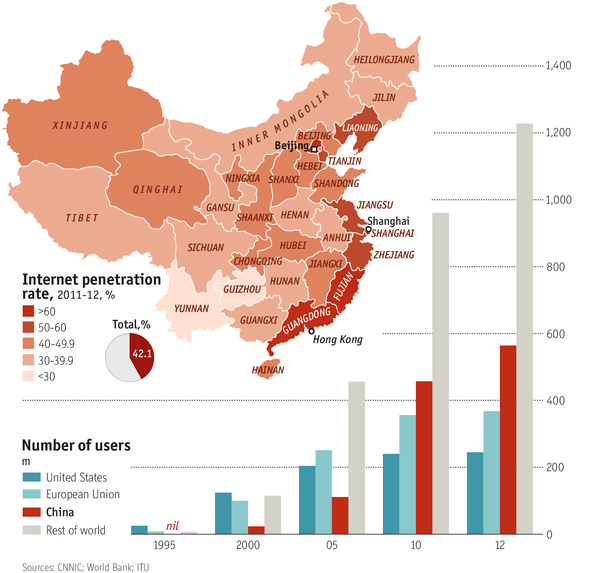
China’s internet: A giant cage; The internet was expected to help democratise China. Instead, it has enabled the authoritarian state to get a firmer grip. But for how long?

China’s internet: A giant cage

The internet was expected to help democratise China. Instead, it has enabled the authoritarian state to get a firmer grip, says Gady Epstein. But for how long?

Apr 6th 2013 |From the print edition

20130406_SRC965

THIRTEEN YEARS AGO Bill Clinton, then America’s president, said that trying to control the internet in China would be like trying to “nail Jell-O to the wall”. At the time he seemed to be stating the obvious. By its nature the web was widely dispersed, using so many channels that it could not possibly be blocked. Rather, it seemed to have the capacity to open up the world to its users even in shut-in places. Just as earlier communications technologies may have helped topple dictatorships in the past (for example, the telegraph in Russia’s Bolshevik revolutions in 1917 and short-wave radio in the break-up of the Soviet Union in 1991), the internet would surely erode China’s authoritarian state. Vastly increased access to information and the ability to communicate easily with like-minded people round the globe would endow its users with asymmetric power, diluting the might of the state and acting as a force for democracy.

Those expectations have been confounded. Not only has Chinese authoritarian rule survived the internet, but the state has shown great skill in bending the technology to its own purposes, enabling it to exercise better control of its own society and setting an example for other repressive regimes. China’s party-state has deployed an army of cyber-police, hardware engineers, software developers, web monitors and paid online propagandists to watch, filter, censor and guide Chinese internet users. Chinese private internet companies, many of them clones of Western ones, have been allowed to flourish so long as they do not deviate from the party line. Read more of this post

Samsung Electronics marketing blitz stirs debate over innovation

Samsung Electronics marketing blitz stirs debate over innovation

7:06am EDT

By Miyoung Kim

SEOUL (Reuters) – Samsung Electronics is spending more on marketing than R&D for the first time in at least three years, prompting some pundits to warn that the IT giant is sacrificing innovation at a time when the market is teeming with ever smarter gadgets.

The South Korean firm, which warned on Friday it will not post record quarterly earnings for the first time since 2011, looks set to spend big bucks on marketing upcoming mobile devices, including the Galaxy S4 smartphone, to convert more iPhone and iPad users loyal to arch rival Apple Inc.

While the new Galaxy smartphone, unveiled to much fanfare in New York last month, will boast a motion-detecting technology that stops and starts videos depending on whether someone is looking at the screen, and flip between songs and photos at the wave of a hand, industry watchers say the device would not overturn an industry that lives and dies by innovation.

“(Samsung) lagged behind in creating a new category. Apple created a new category with tablets. We are waiting to see something like that happen from Samsung,” said Rachel Lashford, an analyst at research firm Canalys in Singapore. Read more of this post

Hong Kong’s rich face exposure in tax-haven leak

Hong Kong’s rich face exposure in tax-haven leak

HONG KONG – A leak of more than two million documents detailing the offshore bank accounts and shell companies of wealthy individuals and tax-averse companies is making some of the richest and most powerful people in Hong Kong, on the mainland and elsewhere in the world very nervous, the South China Morning Post (SCMP) newspaper reported.

BY –

2 HOURS 59 MIN AGO

HONG KONG – A leak of more than two million documents detailing the offshore bank accounts and shell companies of wealthy individuals and tax-averse companies is making some of the richest and most powerful people in Hong Kong, on the mainland and elsewhere in the world very nervous, the South China Morning Post (SCMP) newspaper reported.

Described as the biggest information leak in recent history, the documents were leaked from the British Virgin Islands to the US-based International Consortium of Investigative Journalists (ICIJ). The group is working with dozens of journalists around the world to process the data and publish the secret financial information that surrounds what the Tax Justice Network estimates are assets worth at least US$21 trillion held in offshore havens, the New York Times (NYT) reported.

The investigation, titled “Secrecy for Sale”, details what it calls “complex offshore structures” used by wealthy people from all over the world, including government officials and their families. They disclose proprietary information about more than 120,000 offshore companies and trusts and nearly 130,000 individuals and agents, including the wealthiest people in more than 170 countries. Not all of those named necessarily have secret bank accounts, and in some cases only conducted business through companies they control that are registered offshore, the New York Times reported.

The ICIJ said its data analysis showed most people setting up offshore entities lived on the Chinese mainland and in Hong Kong and Taiwan, the SCMP said. “This explains why the second-largest source of capital investment flowing into China is the offshore tax haven of BVI,” it said. Read more of this post

India Jobs Program Scam Pays Wages to Dead Workers; “It’s an insult to a man who lived a life of dignity”

India Jobs Program Scam Pays Wages to Dead Workers

The corpse of Indian farmer Bengali Singh burned to ash atop a blazing funeral pyre on the banks of the river Ganges in 2006.

Five years later, the dead man was recorded as being paid by India’s $33 billion rural jobs program to dig an irrigation canal in Jharkhand state. Officials in his village and the surrounding region used at least 500 identities, including those of Singh, a disabled child of eight and a blind 94-year-old man, to fake work logs and steal wages, according to police reports.

“It’s an insult to a man who lived a life of dignity,” Rajendar Singh said, sitting next to the parched canal his father supposedly excavated in their village, Bishanpur, about six hours’ drive northwest of Kolkata. “He’s been wronged.”

District administrators and village heads have used tactics such as ghost workers, fake projects and over-billing to embezzle about $10 billion from the world’s largest workfare initiative, an investigation by Bloomberg News shows. The fraud in the seven-year-old program underscores the challenge of reducing poverty in India as graft permeates everything from food aid for children to the distribution of public grain stockpiles and debt relief for struggling farmers.

Embezzlement remains an intractable issue in the rural employment push, according to D.H. Pai Panandiker, president of the RPG Foundation, a New Delhi-based economic research group. Read more of this post

Twitter Arrives on Wall Street, Via Bloomberg

APRIL 4, 2013, 11:12 AM

Twitter Arrives on Wall Street, Via Bloomberg

By WILLIAM ALDEN

Largely blocked on Wall Street, Twitter is making its big debut on trading desks — via Bloomberg terminals.

Bloomberg L.P. announced on Thursday that it was incorporating tweets into its data service, which is widely used in the financial industry. The new feature allows traders and other professionals to monitor social media buzz and important news about companies they follow.

This arrival of Twitter comes through something of a side door. The big Wall Street banks largely ban the use of Twitter and other social media sites at work, citing regulations governing communication. Though some firms are allowing certain employees onto social media, that usage is carefully controlled.

Now, bank employees are getting a broader and more organized view of what’s being said in the Twittersphere. Some on Wall Street already use their mobile phones to monitor the site for information that could move stocks.

Bloomberg’s new service shows tweets sorted by company and topic, allowing users to search by key word and to set up alerts for when a particular company is getting an unusual amount of attention. Read more of this post

Will Singapore’s MAS match HKMA’s risk weighting move in property loans? HKMA order banks to set the risk weighting for new home loans at a minimum of 15% to help cushion against any drop in residential property values Vs Spore’s 10%, lowest in the world

Will MAS match HKMA’s risk weighting move?

Bloomberg News reported late last month Deutsche Bank analysts predicting that home prices in Hong Kong could fall by up to 20 per cent in the next two years.

BY COLIN TAN –

4 HOURS 6 MIN AGO

Bloomberg News reported late last month Deutsche Bank analysts predicting that home prices in Hong Kong could fall by up to 20 per cent in the next two years. The forecast came after major banks in the city, including HSBC and Standard Chartered, raised their home loan rates by 25 basis points in response to tighter risk rules imposed by the central bank in February. According to some property analysts, the rise in home loan rates may finally cause the housing market to cool where other measures, in particular, higher additional stamp duties, have failed to do so. On Feb 22, Hong Kong Chief Executive Leung Chun-ying doubled the stamp duty on all property transactions higher than HK$2 million (S$319,000).

However, what was not as well-publicised as the stamp duties was the Hong Kong Monetary Authority’s (HKMA) order to banks to set the risk weighting for new home loans at a minimum of 15 per cent to help cushion against any drop in residential property values. Usually, banks decide on the riskiness of their own assets, which in turn affects the capital they set aside. Depending on the banks’ own internal risk weightings before the minimum percentage imposed by the HKMA, significantly more capital may be needed to be set aside. The impact of the higher risk weightings has now worked itself into the market, leading to higher housing loan rates. One key factor driving home purchases — not just in Hong Kong but elsewhere in Asia — has been the sustained low mortgage costs. “Banks were mispricing their retail mortgage loans. Now, with the new measures from the HKMA, they will be forced to correct it,” the Bloomberg report quoted DBS Hong Kong Chief Executive Sebastian Paredes as saying.

Read more of this post

Is It Beginning? Biggest JGB Price Collapse In Over 10 Years Triggers TSE Circuit Breakers

Is It Beginning? Biggest JGB Price Collapse In Over 10 Years Triggers TSE Circuit Breakers

Tyler Durden on 04/05/2013 00:48 -0400

Just over 4 hours ago we discussed the stunning collapse in 10Y Japanese bond yields. Since then – things have taken a very dramatic turn for the worse for bonds. 10Y JGB yields have exploded higher. The move from 32bps to 65bps triggered circuit breakers on the Tokyo Stock Exchange in JGB Futures trading as JGB prices plunged by their largest amount since September 2002. We can only imagine there is liquidations galore occurring given the massive outsize moves we are seeing in Japanese bonds, stocks, FX, swaps, and CDS. Did the BoJ just lose control? Now that is a reversal!!

20130404_JGB_1_0_0

20130404_JGB_2_0

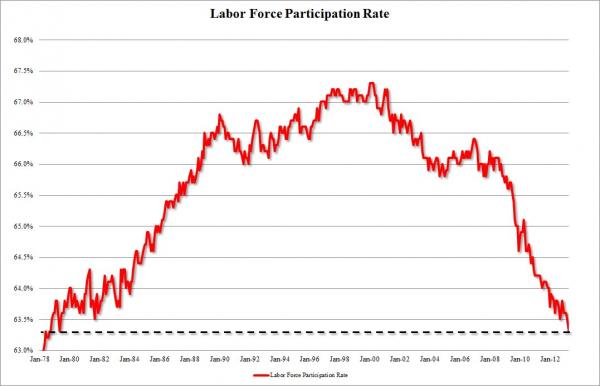
People Not In Labor Force Soar By 663,000 To 90 Million, Labor Force Participation Rate At 1979 Levels

People Not In Labor Force Soar By 663,000 To 90 Million, Labor Force Participation Rate At 1979 Levels

Tyler Durden on 04/05/2013 08:58 -0400

Things just keep getting worse for the American worker, and by implication US economy, where as we have shown many times before, it pays just as well to sit back and collect disability and various welfare and entitlement checks, than to work .The best manifestation of this: the number of people not in the labor force which in March soared by a massive 663,000 to a record 90 million Americans who are no longer even looking for work. This was the biggest monthly increase in people dropping out of the labor force since January 2012, when the BLS did its census recast of the labor numbers. And even worse, the labor force participation rate plunged from an already abysmal 63.5% to 63.3% –the lowest since 1979! But at least it helped with the now painfully grotesque propaganda that the US unemployment rate is “improving.”

Labor Force Rate_0Labor Force_0

U.S. Company on How to Go Broke Despite Dominating Vodka Sales in Russia; The company’s unlikely troubles show how timing and local knowledge are crucial

U.S. Company on How to Go Broke Selling Vodka in Russia

Going broke while dominating vodka sales in Russia and Poland may seem tough to do. A company founded by a Florida golfer, listed on Nasdaq Stock Market and until recently based in New Jersey, is almost there.

Unable to repay $258 million in bonds due last month, Central European Distribution Corp. (CEDC), which owns vodka brands including Bols, Zubrowka and Parliament and once imported Dom Perignon to Russia, is preparing to file for bankruptcy. Creditors will vote by April 4 on a restructuring plan that would hand CEDC to Russian billionaire Roustam Tariko, solidifying his control of the distiller and distributor he’s toyed with for years.

The company’s unlikely troubles show how timing and local knowledge are crucial. After almost two decades of success in Poland, CEDC expanded into Russia via acquisitions just as Poles began drinking less vodka and the Russian government raised taxes and costs to discourage alcohol consumption. The global financial crisis, a 37 percent collapse in Russia’s currency, and accounting errors that followed didn’t help either.

“If we had to do it over, we probably should have bought one company to see how it went, rather than buying three within six months,” CEDC co-founder William V. Carey, who resigned in July as chief executive officer, said in a phone interview from Warsaw, where he still lives. Russia’s “new regulations weren’t there when we invested, making it much more difficult to manage growth and profitability over the last three years.” Read more of this post

App makers say a growing group of “cloners” are mimicking their products or misappropriating their names and images to ride an original app’s success

Updated March 4, 2013, 8:05 p.m. ET

Clone Wars Roil App World

By AMIR EFRATI

In the fast-paced mobile-apps business, creating a hit app is no guarantee of success: Developers must also fend off the copycats.

App makers say a growing group of “cloners” are mimicking their products or misappropriating their names and images to ride an original app’s success.

The copycats often target top-selling apps and seek to siphon off users and potential revenue. Others carry malicious software. Despite their proliferation, app stores run by GoogleInc. GOOG -0.84% and others have been unable to weed them out.

Consider the experience of WhatsApp Inc., a Mountain View, Calif., company that makes a mobile-messaging app that has been downloaded hundreds of millions of times since its 2009 launch. After WhatsApp reached the top of the app-store rankings, WhatsApp employees noticed that other apps were hijacking its name to ride its coattails.

Today in Google’s app store, alleged WhatsApp clones include “Whatsapp Nearby,” “Whatsapp Friends,” and “Whatsapp Add Me”—none of which were made by WhatsApp but which allow users to contact each other and make new friends. Those three apps, which were made by the same developer, have been downloaded hundreds of thousands of times. The developer denies they are copycats. Read more of this post

Taiwan asset managers under scrutiny on suspicion of insider trading, manipulation of stock prices and breach of trust from 2010-2012 and profiting from state fund trades

Taiwan asset managers under scrutiny for profiting from state fund trades
(32 mins ago)

Taiwan prosecutors said they launched an investigation into alleged wrongdoing by fund managers at two securities firms that caused massive losses to a government fund.
Prosecutors raided the firms and questioned eight people on suspicion of insider trading, manipulation of stock prices and breach of trust from 2010-2012, they said in a statement yesterday. The suspects actions allegedly resulted in more than T$1 billion (US$34.5 million) in losses to the government while allowing them to make illegal profits of nearly T$100 million on the stock market, AFP reports.  Taiwan’s financial regulators started reviewing 13 securities firms trusted with handling government investment funds after a similar case surfaced late last year.

Advice from a leading industrialist: Be diligent, Be honest, Be frugal; “Corruption comes from greed and is encouraged because people respect the rich even if their dirty money comes from corruption and bribery. According to Buddhist teaching, we should have hiri and ottappa, or shame and fear of doing evil. If we show respect to corrupt people, it will further encourage the wrong attitude towards corruption.”

Advice from a leading industrialist: Be diligent, Be honest, Be frugal

Published: 4 Apr 2013 at 00.00

488266

The visitor to the headquarters of Kulthorn Kirby Plc (KKC) can’t help but notice the big sign hanging in the main lobby, which declares “Be Diligent _ Be Honest _ Be Frugal”.

“It’s also my personal motto,” says Suraporn Simakulthorn, the executive chairman of KKC, the major SET-listed maker of air-conditioner compressor motors and refrigeration product equipment.

“I started my career with the Telephone Organisation of Thailand back in 1963, then moved to work at Ericsson in 1967 for 13 years,” he explains. “Learning from my own personal experience, I believe we must be diligent and have a conviction to get the job done.

“Honesty is second to none when you work with others. In our 32-year history at Kulthorn Kirby, we’ve gone through a number of cooperative ventures with partners including Western and Asian counterparts. Honesty is the key element in business achievement.

“Last but not least is being frugal, which is similar to something we are well aware of, the ‘self-sufficient economy’. Since I used to be a corporate employee myself, I am truly aware of the importance of saving. We have to behave in a way that we spend only what is necessary and keep some savings at all times.” Read more of this post

Isaac Newton’s Nightmare During the South Sea Stock Bubble (Dec 1718 – Dec 1721)

Isaac Newton’s Nightmare — Charted By Marc Faber

Sam Ro | Apr. 2, 2013, 4:43 PM | 6,414 | 3

The parabolic move in Bitcoin prices has us thinking about some of the most notorious asset bubbles in history. We were thumbing through some of Jeremy Grantham‘s old research and saw this great chart from Marc Faber. “I can calculate the movement of stars, but not the madness of men,” Newton apparently said after he lost his fortune.

screen shot 2013-04-02 at 4.29.11 pm

Bond Traders Club Loses Cachet in Most Important Market; In the same way technology eroded the middleman role once played by travel agents and stock-market specialists, increased use of the direct-bidding system threatens government-bond traders

Bond Traders Club Loses Cachet in Most Important Market

Primary dealers, the select group of banks and brokers that have held a seat at the center of the U.S. government debt market since 1960, are losing influence.

More than 20 percent of the $538 billion of Treasury notes auctioned this year have been awarded to bidders who bypassed the dealers by using a website to place their orders, according to data provided by the U.S. Treasury Department. That’s almost double the 2011 level and up from 5.6 percent in 2009.

In the same way technology eroded the middleman role once played by travel agents and stock-market specialists, increased use of the direct-bidding system threatens government-bond traders at firms ranging from Bank of America Corp. to UBS AG. (UBSN) It also has eaten into profits from a business that’s among the least affected by the regulatory changes and new capital requirements reshaping the industry.

“You’ll see clients do a lot more things in a self- sufficient manner than they used to do before,” said Richard Prager, global head of trading at BlackRock Inc. (BLK), the world’s largest asset manager with $3.8 trillion. “It’s just the realities of today.” Read more of this post

Is Innovation Killing the Soap Business? New products ought to expand the revenue pie for manufacturers and retailers, not shrink it

Updated April 3, 2013, 7:51 p.m. ET

Is Innovation Killing the Soap Business?

By PAUL ZIOBRO and SERENA NG

MK-CC128A_LAUND_G_20130403181811

The laundry-soap business has a problem—it is shrinking—thanks to premeasured pod detergents from Procter & Gamble Co. PG -1.06% and others that keep consumers from overdosing. For years, consumer-product makers could count on extra sales from shoppers who poured in too much detergent with every load. The phenomenon became more pronounced when manufacturers rolled out increasingly concentrated detergent.

But the bubble burst when P&G introduced its new laundry product—Tide Pods capsules—which fixed the amount of detergent used per wash and ushered in the era of “unit dose” products. Total U.S. sales of laundry detergents fell 2.1% in the 12 months to March, according to market-information firm Nielsen, whose data excludes sales from Costco Wholesale Corp. COST -1.23% and some other retailers. Compared with the pre-pod age three years ago, detergent sales are down 5.1% in dollar terms, to $7.06 billion from $7.44 billion. The sales downturn has set off an unusually frank debate in the industry over when innovation goes too far, and it has led to finger-pointing about who might be at fault. James Craigie, the outspoken chief executive of Church & Dwight Co., CHD -0.90% which sells low-price detergents under the Arm & Hammer and Xtra brands, has an answer: P&G.

“Pod is killing the laundry detergent category,” Mr. Craigie said at an industry conference in February.

New products ought to expand the revenue pie for manufacturers and retailers, not shrink it, he said. That is what innovation always did in the past, he said. The last round of more-concentrated liquid, in 2008, drove laundry detergent sales up 5%, he said. At the same conference,Clorox Co. CLX -2.43% noted that concentrated bleach helped lift overall bleach sales, a fact that Mr. Craigie reiterated. Read more of this post

Consumer Tech Finds Office Role; iPads, Dropbox, Gmail Jump Hurdles in Their Transition to Business Tool; Swiss drug maker Roche is deploying Gmail to its 80,000 employees

Updated April 3, 2013, 8:49 p.m. ET

Consumer Tech Finds Office Role

iPads, Dropbox, Gmail Jump Hurdles in Their Transition to Business Tool

By RACHAEL KING

Fueled by tight budgets, more businesses are turning to consumer technologies such as iPads, file-hosting service Dropbox and Google GOOG -0.84% productivity tools that can be easier to use and less expensive than industrial-strength counterparts.

This consumerization movement gathered steam with the launch of the iPad three years ago and its embrace by sales, media and information technology executives. Since then, Google apps have found their way onto desks at drug maker Roche Holding AG, ROG.VX +0.63% which is deploying Gmail to its 80,000 employees, one of the largest corporate Gmail rollouts to date.

In part, the financial rewards of consumer technologies are a big lure. Contract manufacturer Sanmina-SCI Corp. SANM -1.99% has saved $2 million annually since it began moving 21,000 employees to Google Apps for messaging, email and calendar in 2008, said CIO Manesh Patel. Read more of this post