The Rise of the ‘Aztec Tiger’: Under a charismatic new leader, Mexico is roaring toward a turnaround

April 26, 2013, 7:33 p.m. ET

The Rise of the ‘Aztec Tiger’

Under a charismatic new leader, Mexico is roaring toward a turnaround

By NICOLAS BERGGRUEN and NATHAN GARDELS

images (9)

Two decades ago, one of Mexico’s leading social critics proclaimed Los Angeles “the heart of the Mexican dream.” Pedro P. agreed, leaving behind his native Oaxaca for work as a gardener in the city’s San Fernando Valley. After 14 years as an undocumented immigrant, however, Pedro, age 44, is heading home at the end of April, drawn by an economic resurgence south of the border that has led some observers to label Mexico the “Aztec tiger.” Read more of this post

China Top Leaders Warn on Financial Risks as Rebound Falters as PSC, China’s top decision-making group, held a special economy-focused session, the first time since 2004

Chinese leaders more worried about financial risks than slower growth

Kate Mackenzie

| Apr 26 07:59 | 14 comments Share

China’s Politburo Standing Committee, the country’s top decision-making group, held a special session yesterday to discuss the economy — apparently the first time they’ve held this sort of economy-focused meeting since 2004, according to Xu Gao at China Everbright Securities (via Bloomberg).

So what came out of it? It’s always hard to tell, but it probably wasn’t good news for anyone hoping for big stimulus measures.

The official Xinhua report is here and its headline suggests some worry at the economic growth rate. “China needs to cement its domestic economic growth momentum and guard against potential risks in financial sectors,” seems to be the key line, from the third paragraph, although it goes on to point out that Q1′s 7.7 per cent growth that had many China watchers worried was in fact higher than the 7.5 per cent official target. Read more of this post

Built in LA report shows that the LA startup ecosystem has come a long, long way

Built in LA report shows that the LA startup ecosystem has come a long, long way

BY MICHAEL CARNEY 
ON APRIL 26, 2013

There has been no shortage of talk both in and out of Los Angeles about the rise of the LA startup ecosystem over the last 12 to 18 months. As someone who’s been on the ground and deeply embedded in the community, I can attest that it has been a period of astounding growth and maturation. The problem has always been that there was little data available to back up otherwise subjective claims like these. That’s no longer the case, thanks to a new Built In L.A. 2012 Digital Startup Report. The report, released on Wednesday of this week, details the year that was arguably the most prolific in terms of company creation than any in the city’s history. In total, some 220 startups launched in Los Angeles in 2012 – and believe it or not, not all of them came out of Mike Jones and Peter Pham’sScience. The ecosystem as a whole raised $847 million during the year from 170 different VCs and angel investors, with more than 100 companies securing funding of at least $1 million during the year. There were 11 fundings over $20 million in size, another 12 between $10 million and $20 million, and 20 more between $5 million and $10 million.

Additionally, 43 LA-based companies were acquired, the most of any year on record. The largest check written was Tencent’s acquisition of majority interest in Riot Games for $400 million, in a transaction valuing the company at $472 million. This deal was followed closely by Sony’s $380 million acquisition of Gaikai (which was located a few miles south in Orange County). Read more of this post

The great surveillance boom; Video surveillance is already big business. In the aftermath of the Boston Marathon bombings, expect it to get even bigger

The great surveillance boom

April 26, 2013: 4:56 PM ET

Video surveillance is already big business. In the aftermath of the Boston Marathon bombings, expect it to get even bigger.

By Keith Proctor

FORTUNE — Video surveillance is big business. Expect it to get bigger. After law enforcement used closed-circuit television (CCTV) cameras to help identify last week’s Boston bombing suspects, lawmakers and surveillance advocates renewed calls for increased numbers of cameras nationwide. “We need more cameras, and we need them now,” ran a Slate headline. Rep. Peter King (R-NY) agrees. In an interview the day after the bombings with MSNBC’s Andrea Mitchell, he called for more video surveillance so that we can “stay ahead of the terrorists.” “So yes, I do favor more cameras,” said King, who sits on the U.S. House Homeland Security and Intelligence committees and has also called for increased monitoring of Muslim Americans. “They’re a great law enforcement method and device. And again, it keeps us ahead of the terrorists, who are constantly trying to kill us.” Law enforcement officials in New York are almost certain to oblige. NYPD Commissioner Ray Kelly wants to “increase significantly” the amount of surveillance equipment in Manhattan, which already has one of the country’s most robust systems.

The argument for greater surveillance is straightforward. Horrible events in places like Boston remind us that we’re vulnerable. The best way to limit events like last week’s bombings, the argument goes, is to accept 24-hour surveillance in public spaces. And when you see someone maimed by bomb shrapnel, privacy concerns sound coldly abstract. No amount of security can completely eliminate risk, so it’s difficult to know where to draw the line. Are 10,000 cameras really twice as good as 5,000? In tragedy’s aftermath, it can be tough to have a serious conversation about how much to invest. But when the goal is to push risk as close to zero as possible, spending can asymptotically stretch into infinity. Read more of this post


Britain to honor Winston Churchill on new banknote; The “blood, toil, tears and sweat” quotation will be inscribed beneath a portrait photograph taken in 1941

Britain to honor Winston Churchill on new banknote

8:33am EDT

Winston Churchill on next £5 bank note

LONDON (Reuters) – Britain is set to honor its revered wartime leader Winston Churchill with a banknote featuring his portrait and famous declaration “I have nothing to offer but blood, toil, tears and sweat”.

The governor of the Bank of England, Mervyn King, traveled to Churchill’s former home Chartwell in Kent, southern England on Friday to announce plans for Churchill’s image to appear on a new five-pound ($8) note to be issued in 2016.

“Sir Winston Churchill was a truly great British leader, orator and writer. Above that, he remains a hero of the entire free world,” outgoing central bank governor King told members of the Churchill family. Read more of this post

Germans fascinated by Nazi era eight decades later

Germans fascinated by Nazi era eight decades later

7:48am EDT

By Gareth Jones

BERLIN (Reuters) – An exhibition chronicling the Nazi party’s rise to power draws tens of thousands of visitors. Millions of TV viewers tune in to watch a drama about the Third Reich. A satirical novel in which Hitler pops up in modern Berlin becomes an overnight bestseller.

German interest in the darkest chapter of their history seems stronger than it has ever been as the country marks several key anniversaries this year linked to the Nazi era.

On TV talk shows, in newspapers and online, people endlessly debate the Nazi era – from what their own grandparents did and saw, to how the regime’s legacy constrains German peacekeepers on overseas missions today, or why unemployed Greek and Spanish protesters lampoon Chancellor Angela Merkel as a new Hitler.

Next month, Germans will also be painfully reminded that the Nazis can still pose a threat today, when a young woman allegedly inspired by Hitler’s ideology goes on trial over a spate of racist murders committed since 2000. Read more of this post

Japan casino lobby in legalization push; market could out-strip Vegas

Japan casino lobby in legalization push; market could out-strip Vegas

7:14am EDT

By Nathan Layne and Farah Master

TOKYO/HONG KONG (Reuters) – After Singapore, Japan?

A pro-casino group of Japanese lawmakers has tapped an influential member of the ruling Liberal Democratic Party (LDP) as its leader and plans to submit legislation this year aimed at opening the world’s third-largest economy to casino gambling. Although casinos are illegal, Japanese are already active gamblers, and a pinball-like game called pachinko generates some $200 billion in revenue each year – about the same as Toyota Motor Corp. Japan is often touted as the next major casino market after Chinese enclave Macau, the world’s biggest gambling hub, which raked in revenue of $38 billion last year.

A large and wealthy population coupled with a proximity to Shanghai and Beijing has the potential to transform Japan into a lucrative gaming center, providing tax revenues to shore up the state’s ailing finances, analysts say. Broker CLSA estimates Japan’s gaming market could be worth at least $10 billion if two large-scale integrated resorts are approved – more than Singapore’s $5.9 billion and Las Vegas’ $6.2 billion in 2012. Read more of this post

Don’t just do something, sit there; Fund managers trade too much. Retail investors can learn not to

Don’t just do something, sit there; Fund managers trade too much. Retail investors can learn not to

Apr 27th 2013 |From the print edition

20130427_FND001_0

CALL it hyperactivity, call it the temptation to fiddle. Chief executives have a tendency to make acquisitions just to show they are doing something. Similarly, fund managers, sitting at their desks all day, have the urge to trade. Otherwise why go into the office at all?

But these trades inevitably incur costs, and not just in the form of fees disclosed to mutual-fund investors as part of a fund’s total expense ratio. When a large fund sells its stake in a small company, for example, the share price may fall significantly as supply overwhelms demand. A recent paper* in the Financial Analysts Journal (FAJ) found these hidden costs were, on average, higher than the funds’ declared expenses and had a significant negative impact on returns. The academics looked at the record of 1,758 American equity mutual funds between 1995 and 2006. They estimated trading costs by looking at changes in portfolio holdings (which are revealed every quarter), checking the bid-ask spreads for the stocks concerned and making an allowance for the price impact of trades. Relying on portfolio-turnover statistics is not sufficient. Smaller stocks are less liquid than shares in multinationals, and the costs of trading in the small-cap sector are much greater. The paper found that the difference in total expense ratios between small-cap and large-cap funds was just a third of a percentage point (1.39% compared with 1.07%). But the difference in aggregate trading costs, once the price impact was factored in, was much larger, at over two percentage points a year (3.17% versus 0.84%). Read more of this post

Perverse advantage; A new book lays out the scale of China’s industrial subsidies

Perverse advantage; A new book lays out the scale of China’s industrial subsidies

Apr 27th 2013 | Shanghai |From the print edition

20130427_fnc48620130427_FNC488

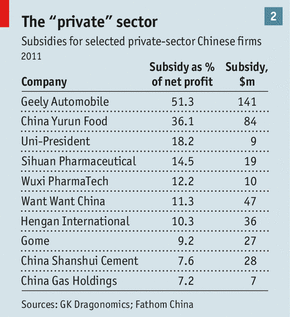
CHINA is the workshop to the world. It is the global economy’s most formidable exporter and its largest manufacturer. The explanations for its success range from a seemingly endless supply of cheap labour to an artificially undervalued currency. A provocative new book* by Usha and George Haley, of West Virginia University and the University of New Haven respectively, points to another reason for China’s industrial dominance: subsidies.

The Chinese government does not report all subsidies made to domestic industrial firms, so the Haleys plugged the holes with information from industry analysts, policy documents, non-governmental outfits and companies themselves. By looking at the gaps between end-user prices and benchmark prices, they have cobbled together numbers on many of the subsidies enjoyed by the biggest industrial state-owned enterprises (SOEs).

On their conservative calculations, China spent over $300 billion, in nominal terms, on the biggest SOEs between 1985 and 2005. This help often came in the form of cheap capital and underpriced inputs unavailable to international rivals. The glass industry got soda ash for a song, for example. The auto-parts business got subsidies worth $28 billion from 2001 to 2011 through cheap glass, steel and technology; the government has promised another $10.9 billion by 2020. The subsidies to the paper industry topped $33 billion from 2002 to 2009. All industrial SOEs benefited from energy subsidies. Read more of this post

3D printing: A new brick in the Great Wall; Additive manufacturing is growing apace in China vs “subtractive” technology of lathes, milling machines and cutting tools

3D printing: A new brick in the Great Wall; Additive manufacturing is growing apace in China

Apr 27th 2013 | BEIJING |From the print edition

20130427_STD001_0

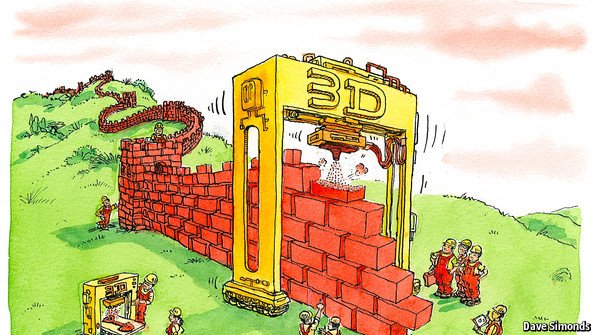
ALTHOUGH it is the weekend, a small factory in the Haidian district of Beijing is hard at work. Eight machines, the biggest the size of a delivery van, are busy making things. Yet the factory, owned by Beijing Longyuan Automated Fabrication System (known as AFS), appears almost deserted. This is because it is using additive-manufacturing machines, popularly known as three-dimensional (3D) printers, which run unattended day and night, seven days a week.

The printers require an occasional visit from a supervisor to top them up with the powdered materials they use as their “inks”, or to remove a completed item, but apart from that they can be left on their own. They build up the objects they are making one layer at a time, as the ink is sintered into place with a laser in a way that creates little waste and can make shapes impossible to achieve using the traditional “subtractive” technology of lathes, milling machines and cutting tools. Read more of this post

Titans of innovation: What can business learn from Big Science?

Titans of innovation: What can business learn from Big Science?

Apr 27th 2013 |From the print edition

20130427_WBD000_0

AS A technical feat, ATLAS takes some beating. It is the world’s biggest microscope, used by physicists at CERN, a large laboratory near Geneva, to probe the fundamental building blocks of matter. Its barrel-shaped body, 45 metres long, 25 metres tall and weighing as much as the Eiffel tower, was assembled in a cavern 100 metres beneath the Swiss countryside from 10m parts, nearly twice as many as in a jumbo jet. It generates more data each day than Twitter does.

It is also a remarkable organisational achievement. The components were designed by hundreds of scientists and engineers from dozens of institutions. They were subsequently sourced from 400-odd suppliers on four continents, at a cost of $435m. At any one time the experiment involves more than 3,000 researchers from 175 institutes in 38 countries. Read more of this post

The debt to pleasure; A Nobel prizewinner argues for an overhaul of the theory of consumer choice

The debt to pleasure; A Nobel prizewinner argues for an overhaul of the theory of consumer choice

Apr 27th 2013 |From the print edition

“SOVEREIGN in tastes, steely-eyed and point-on in perception of risk, and relentless in maximisation of happiness.” This was Daniel McFadden’s memorable summation, in 2006, of the idea of Everyman held by economists. That this description is unlike any real person was Mr McFadden’s point. The Nobel prizewinning economist at the University of California, Berkeley, wryly termed homo economicus “a rare species”. In his latest paper* he outlines a “new science of pleasure”, in which he argues that economics should draw much more heavily on fields such as psychology, neuroscience and anthropology. He wants economists to accept that evidence from other disciplines does not just explain those bits of behaviour that do not fit the standard models. Rather, what economists consider anomalous is the norm. Homo economicus, not his fallible counterpart, is the oddity.

To take one example, the “people” in economic models have fixed preferences, which are taken as given. Yet a large body of research from cognitive psychology shows that preferences are in fact rather fluid. People value mundane things much more highly when they think of them as somehow “their own”: they insist on a much higher price for a coffee cup they think of as theirs, for instance, than for an identical one that isn’t. This “endowment effect” means that people hold on to shares well past the point where it makes sense to sell them. Cognitive scientists have also found that people dislike losing something much more than they like gaining the same amount. Such “loss aversion” can explain why people often pick insurance policies with lower deductible charges even when they are more expensive. At the moment of an accident a deductible feels like a loss, whereas all those premium payments are part of the status quo. Read more of this post

Chart of the Day: Enterprising Aussies; Of those who say they are interested in becoming entrepreneurs, % who actually try to start a new business

Enterprising Aussies

Apr 26th 2013, 13:46 by Economist.com

Starting up a business down under

A NEW report by PricewaterhouseCoopers (PWC), a professional-services firm, suggests that Australia could start a lot more businesses. It predicts that online and high-tech start-ups could account for 4% of GDP and 540,000 jobs by 2033, up from 0.1% of GDP and 9,500 jobs today. The report offers signposts as to how the country might shift from mining coal to mining data. Australia has about 1,500 tech start-ups, mostly in Sydney and Melbourne. Vast untapped opportunities await in health care, an industry that will surge as the nation ages. Australia’s regulatory environment for entrepreneurs is friendly, and the country is admirably open to skilled immigration. In an annual survey of global entrepreneurship, 54% of adult Australians said they were interested in starting their own business, compared with nearly 70% of Italians. But 19% of Australians actually began the process, the highest proportion of the 21 countries in the report, whereas only 3% of Italians did so. Nonetheless, PwC frets that “fear of failure” is more common in Australia than in America or Canada, and this could be holding it back.

20130427_gdc503 Read more of this post

The cold wind of competition sweeps the legal-services market

The cold wind of competition sweeps the legal-services market

Apr 27th 2013 |From the print edition

“THE one great principle of the English law is to make business for itself,” noted Charles Dickens. These days many lawyers are struggling to do so. Few people are buying or selling houses. Divorces have been declining steadily for the past ten years. There is less crime. Legal aid is being trimmed. As a result, the proliferation of lawyers has slowed. This month the Law Society, which represents solicitors in England and Wales, announced that the number of firms and private practitioners had dropped for the first time. To make matters worse, competition is increasing.

Britain’s legal industry was once tightly regulated. Only qualified lawyers, typically operating in partnerships, were permitted to offer legal services. That changed in 2007, when the Legal Services Act allowed non-lawyers to own, run or invest in legal businesses. The first licence for an “alternative business structure”, as the new, looser arrangement is awkwardly known, was issued in March 2012. A year on, Britain’s legal market is beginning to churn. Read more of this post

WisdomTree Powers Ahead, Shares up 85% This Year; why the ETF company is one of the brightest spots in the asset management industry

April 26, 2013, 10:25 A.M. ET

WisdomTree Powers Ahead, Shares up 85% This Year

By Brendan Conway

The ascent of WisdomTree Investments (WETF) continues. This morning’s earnings report gives a few more signs why the company is one of the brightest spots in the entire asset management industry. The only publicly traded firm selling ETFs and ETFs alone reported a 53% jump in total revenue last quarter and a six-fold rise in net income. The period’s 60% growth in assets under management from a year earlier is more than twice the pace of the ETF industry’s 27% growth during 2012.

It’s not as if the company is sacrificing profitability to build up assets. WisdomTree’s average ETF advisory fee held steady at 0.54%. Costs rose, but gross margins still expanded to 72% from 63% a year earlier. Investors have responded. Shares are up nearly 85% year-to-date, including a 5% jump this morning, to $11.43.  Read more of this post

Cities are finding useful ways of handling a torrent of data

Cities are finding useful ways of handling a torrent of data

Apr 27th 2013 | CHICAGO |From the print edition

20130427_USD002_020130427_USC502

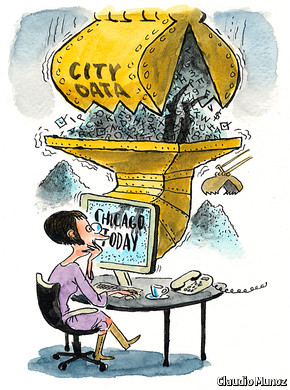
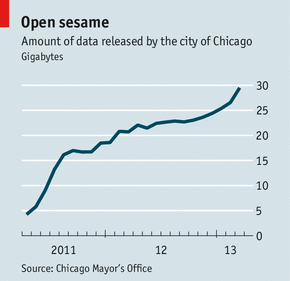
THANKS to Brett Goldstein, Chicago’s chief information officer, it is easy to discover a great deal about his city. In the past three months 5,973 vehicles were moved; since the start of 2011, 72,687 complaints about faulty lights in alleyways have been reported; and in the first half of 2012 the tourist-information website was apparently unavailable for 5,870 minutes. (The city says this was caused by a fault in the monitoring software.)

Needless to say, Mr Goldstein will want to get this fixed if he is to retain his annual salary of $154,992. Yet the nugget of data is a tiny detail in a vastly larger enterprise: to make Chicago’s data openly accessible and useful to the millions of people who live and work there.

Many cities around the country find themselves in a similar position: they are accumulating data faster than they know what to do with. One approach is to give them to the public. For example, San Francisco, New York, Philadelphia, Boston and Chicago are or soon will be sharing the grades that health inspectors give to restaurants with an online restaurant directory. Read more of this post

China finds new bird flu case in eastern Fujian province, signaling the spread of the H7N9 virus

China finds new bird flu case in eastern Fujian province: Xinhua

BEIJING (Reuters) – Chinese authorities discovered on Friday the first case of a new strain of bird flu in the eastern province of Fujian, signaling the spread of the virus which has killed 23 people in China, the official Xinhua news agency reported. The flu was first detected in March. This week, the World Health Organisation called the virus, known as H7N9, “one of the most lethal”, and said it is more easily transmitted than an earlier strain that has killed hundreds around the world since 2003. Fujian’s health authority said a 65-year-old man surnamed Luo had tested positive for the virus, Xinhua reported. Thirty-seven people who had been in close contact with the man had not shown symptoms of the flu. Chinese scientists confirmed on Thursday that chickens had transmitted the flu to humans. This week, a man in Taiwan become the first case of the flu outside mainland China. He caught the flu while travelling in China.

Published on Apr 26, 2013

SHANGHAI (AFP) – China’s deadly outbreak of H7N9 bird flu has spread to a province in the country’s south, the government said on Friday, marking the second announcement in two days of a case in a new location. The local health bureau in the south-eastern province of Fujian said a 65-year-old man was confirmed to have the virus. On Thursday, the eastern province of Jiangxi confirmed its first case of H7N9, in a 69-year-old-man. More than 110 people in mainland China have been confirmed with H7N9, with 23 deaths, since the government announced on March 31 that the virus had been found in humans. Most cases have been confined to eastern China. The island of Taiwan has also reported one case. A Chinese expert earlier this week warned of the possibility of more cases in a wider geographical area. Read more of this post

Malaysia has banned all imported chicken from China and is urging its own poultry farmers to beware of bird flu after Taiwan reported a case of the deadly strain, the first outside mainland China

April 26, 2013, 10:36 a.m. ET

Malaysia Bans Chicken Imports From China

By SHIE-LYNN LIM

Malaysia has banned all imported chicken from China and is urging its own poultry farmers to beware of bird flu after Taiwan reported a case of the deadly strain, the first outside mainland China.

Malaysia will only resume imports of China’s poultry when China is able to contain the new avian flu subtype and is declared free from the strain, Nazahiyah Sulaiman, spokeswoman at Malaysia’s Department of Veterinary Services (DVS) said. Malaysia joins Vietnam and Indonesia, which banned all poultry products from Asia’s largest economy earlier this month. Read more of this post

Shopping Tax Free on the Web Nears End

April 25, 2013, 7:48 p.m. ET

Shopping Tax Free on the Web Nears End

By ANN ZIMMERMAN in Dallas, GREG BENSINGER in San Francisco and JOHN D. MCKINNONin Washington

WASHINGTON—Online shoppers, beware. Freedom from sales taxes is on the way out. Late Thursday afternoon, in a 63-to-30 procedural vote, the Senate cleared the way for passage of a bill to effectively end tax-free shopping online. A final Senate vote is scheduled for May 6. The bill, called the Marketplace Fairness Act, would allow states to require online sellers around the country to collect sales tax for them on purchases made by their residents.

Big online sellers have expanded their physical operations nationwide, building warehouses and other facilities to speed delivery, while traditional stores increasingly have an online presence. That has turned the tables for the online retailers, which had benefitted richly from not having to charge shoppers a sales tax on their goods in most states. With their advantage eroding, the Web stores have become part of a surge of corporate support helping to propel the Senate bill toward likely passage, at least in that chamber and possibly also in the House. Read more of this post

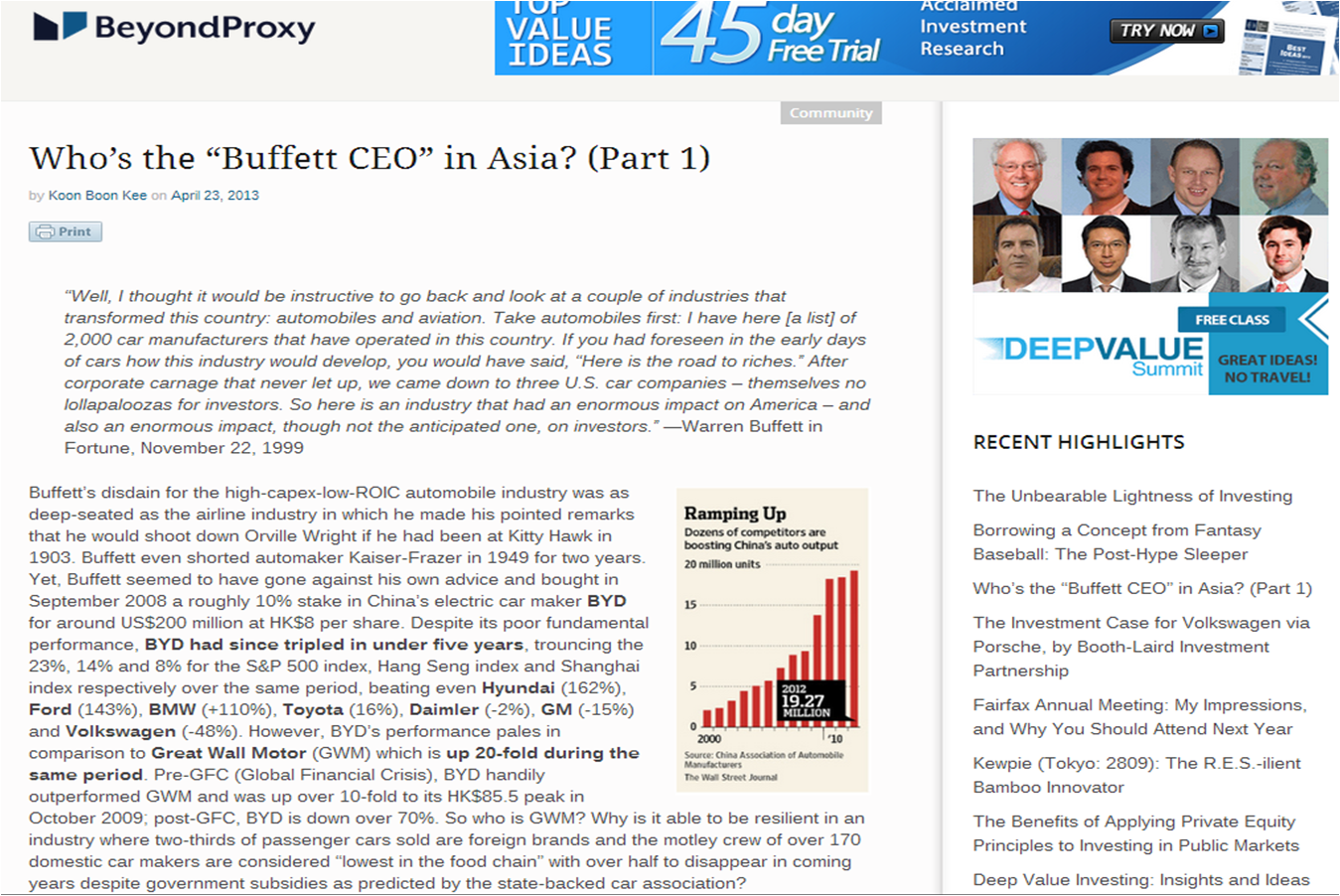
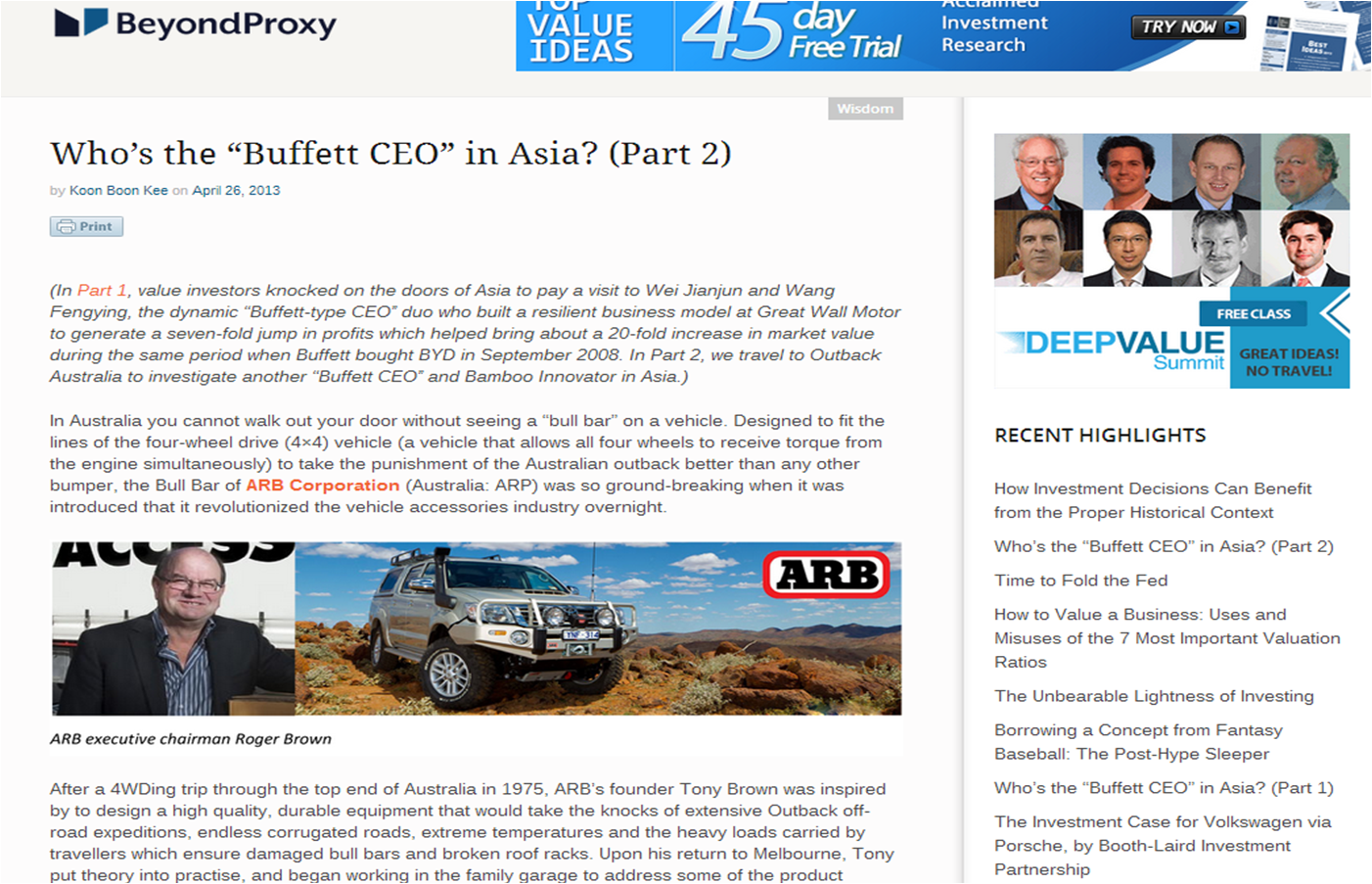
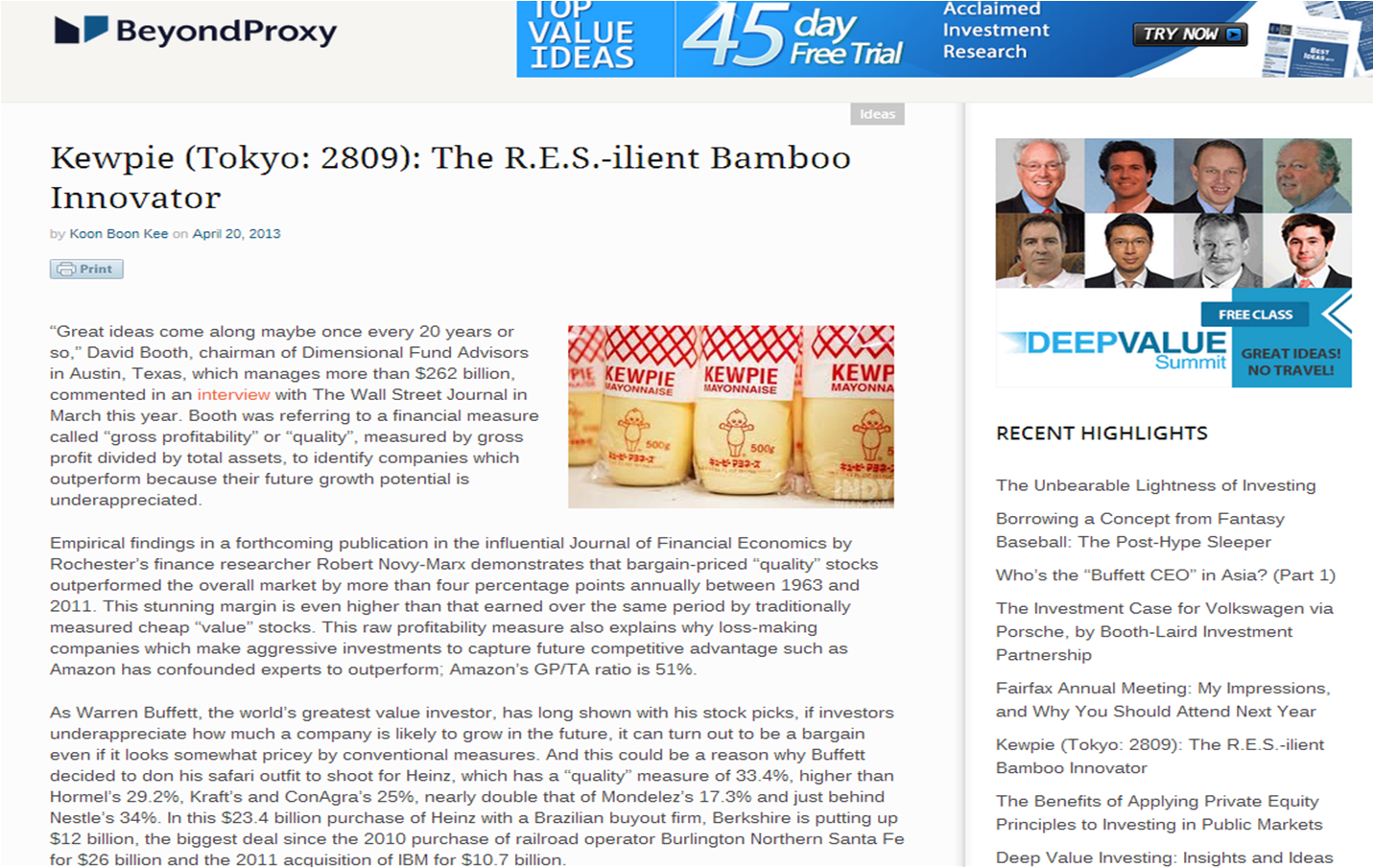
Knock, Knock, Who’s the “Buffett CEO” in Asia? Part 1 and 2 (Go to BeyondProxy.com, where value investing lives)

GWMARBKewpieJMATAsiaBamboo Innovator is featured in BeyondProxy.com, where value investing lives:

Who’s the Buffett CEO in Asia? Part 1 on China’s Great Wall Motor, April 23, 2016 (Weblink: BeyondProxy.com)

Who’s the Buffett CEO in Asia? Part 2 on Australia’s ARB Corporation, April 26, 2013 (Weblink: BeyondProxy.com)

Kewpie: Japan’s Heinz and R.E.S.-ilient Bamboo Innovator, April 20, 2013 (Weblink: BeyondProxy.com)

Value Investors in Asia: Making Sense of the Micro Vs. Macro Dilemma, April 16, 2013 (Weblink: BeyondProxy.com)

H7N9 cases likely to increase in Taiwan, health officials; 133 reported cases of flu-like illnesses starting from April 3, 30% are seasonal flu, 70% unconfirmed

H7N9 cases likely to increase in Taiwan, health officials say

Friday, Apr 26, 2013
The China Post/Asia News Network
By Ann Yu

In light of the confirmed case of H7N9 in Taiwan on April 24, Chang Feng-yih, the commander of the Central Epidemic Command Center (CECC) for H7N9 influenza has reported that the number of H7N9 cases is likely to increase following the bird migration season in Autumn, and has asked all officials to stay alert. He added that there have been 133 reported cases of flu-like illnesses starting from April 3, with 30 per cent confirmed later to be seasonal flu. Read more of this post

What Apple Can Learn From Warren Buffett

What Apple Can Learn From Warren Buffett

Give credit to Apple Inc. (AAPL) and its chief executive officer, Tim Cook, for getting serious about returning unneeded capital to shareholders. As for the details, some of them don’t seem well thought out.

The maker of iPhones and iPads this week said its board approved a sixfold increase in its stock-repurchase plan to $60 billion. Not long ago, even discussing the idea of large share buybacks was a nonstarter for Apple. Now that its stock has tanked, the company is acting like they are a must-do, no matter what else the future might bring. At about $408 a share, down 42 percent since its record high in September, Apple has a stock- market value of $383 billion.

“This is the largest single share repurchase authorization in history and is expected to be executed by the end of calendar 2015,” Apple said in an April 23 news release, the same day the company reported its first quarterly profit decline in a decade.

How could Apple be so confident it will spend the whole $60 billion by then? That’s hard to say. The company is under no obligation to complete the repurchase program, although it obviously wants the markets to believe it will. Apple’s statements this week suggested it would carry out the plan without regard to price, which should be the most important consideration of all. Read more of this post

Southeast Asia’s 2015 unity dream collides with reality; “This kind of exercise – highly ambitious, short time-lines – simply works to fracture the organization further.”

Southeast Asia’s 2015 unity dream collides with reality

Thu, Apr 25 2013

By Stuart Grudgings

BANDAR SERI BEGAWAN, Brunei (Reuters) – Southeast Asian nations have quietly begun to row back on a deadline of forming an “economic community” by 2015, confirming what many economists and diplomats have suspected for years as the diverse group hits tough obstacles to closer union.

Rather than referring to the end of 2015 as a firm goal, officials at this year’s first summit of leaders of the Association of Southeast Asian Nations (ASEAN), whose 10 members range from glitzy Singapore to impoverished Myanmar, prefer to call it a “milestone” to be built on in years ahead.

In so doing, they are bowing to the reality of slow progress and even some regression on politically sensitive goals, such as eliminating non-tariff barriers and lowering obstacles to the free flow of labor in the diverse region of 600 million people. Read more of this post

Harvard Cell Growth Discovery Seen Treating Diabetes

Harvard Cell Growth Discovery Seen Treating Diabetes

Harvard University scientists discovered a hormone that spurs the growth of beta cells, the body’s insulin factories, a finding that holds promise for treating diabetes in a new way. Researchers first found the hormone, called betatrophin, in mice, where it increases beta cell growth by as much as 33 times, said Douglas Melton, co-director of the Department of Stem Cell and Regenerative Biology at Harvard in Cambridge, Massachusetts. An almost-identical hormone in humans appears to serve the same function, Melton and his colleagues said today in the journal Cell. The discovery has drawn the interest of drugmakers looking at the $42 billion market for diabetes medicines. Harvard has applied for a patent on betatrophin, and the molecule has been licensed to Hamburg, Germany-based Evotec AG and Johnson & Johnson (JNJ), Melton said. New drugs are needed as patients develop resistance to older therapies.

“We’re very excited about this,” Melton said in a telephone interview. “The finding just makes so much sense to me, and it could be a new way forward in treating diabetes.” About 347 million people, or 5 percent of the world’s population, have diabetes, a condition that can lead to heart disease, stroke, eye disease and nerve damage, according to the World Health Organization. Many patients develop these conditions even while getting treatment, so new drugs are needed, Melton said.

Read more of this post

Milk Smugglers Top Heroin Courier Arrests in Hong Kong

Milk Smugglers Top Heroin Courier Arrests in Hong Kong

For border officials in Hong Kong, baby formula trumps heroin.

Since the former British colony on March 1 restricted outbound travelers to two 2-pound cans each, a syndicate has been cracked and more people have been arrested for smuggling milk powder than were detained all of last year for carrying heroin.

The reason? Mainland Chinese demand for the formula, fueled by distrust of locally made food after product- safety scandals that included the deaths of at least six babies due to tainted milk. The U.K. and New Zealand are among countries that restricted milk sales as bulk purchases of brands such as Danone (BN)’s Aptamil and Mead Johnson Nutrition Co. (MJN)’s Enfamil caused local shortages.

“Most of them only have one child, and the child is the most important thing in their life,” James Roy, a Shanghai- based analyst China Market Research Group, said of Chinese parents, most of whom are subject to the government’s one-child policy. “They want to be extra careful.”

The crackdown on milk buyers gives Danone (BN), Nestle SA (NESN), and Mead Johnson an opportunity increase their market share in China at the expense of domestic rivals such as China Mengiu Dairy Co. (2319) and Inner Mongolia Yili Industrial Group Co. (600887) Read more of this post

Amazon’s success formula: move bits instead of boxes

Amazon’s success formula: move bits instead of boxes

3:17am EDT

By Alistair Barr and Ben Berkowitz

SAN FRANCISCO/NEW YORK (Reuters) – Amazon.com Inc appears to have figured out the secret to being more profitable: sell less physical stuff.

The company reported slowing revenue growth and offered a disappointing outlook for this quarter on Thursday, exacerbating uncertainty about the health of its business beyond the United States. But that may be masking a fundamental shift in its business on home turf. The Internet retail giant that once specialized in moving books and other physical items quickly is increasingly trying to do the same in the digital world, where profit margins are higher, partly because e-books, music and video files and are transmitted electronically at high speed. Throw in a fast-expanding third-party merchant business, where Amazon simply books a cut of sales from seller listings on its website, and the retail giant’s margin outlook is looking a lot better.

Read more of this post

Calpers Tops $260 Billion as It Recoups $95 Billion Loss but still short $87 billion, or about 26 percent, of meeting its long-term commitments, and has had to ask the state and struggling cities to contribute more

Calpers Tops $260 Billion as It Recoups $95 Billion Loss

The California Public Employees’ Retirement System reached a market value of $260.8 billion in assets, surpassing the high set before the global financial crisis wiped out more than a third of its wealth.

The largest U.S. pension, with half of its money in equities, passed its pre-recession high of $260.6 billion on Oct. 31, 2007, according to a posting today on its website. The fund returned 13 percent in 2012, about the same gain as the Standard & Poor’s 500-stock index.

“The fund is stabilizing and the lessons we’ve applied from the past are paying off,” Chief Investment Officer Joe Dear said by e-mail. “But as remarkable as this number is, we are long-term investors and try to not get too excited when things are good or too discouraged when things are bad.”

Calpers isn’t alone in seeing gains. The 100 largest public pensions in the U.S. had $2.9 trillion in assets in the fourth quarter of 2007, according to U.S. Census Bureau data. That dropped to $2 trillion in 2009 and rebounded to almost $2.8 trillion as of Sept. 30. Even with its gains, the Sacramento-based pension is still short $87 billion, or about 26 percent, of meeting its long-term commitments, and has had to ask the state and struggling cities to contribute more. Read more of this post

Japan’s state-backed funds take risks, but what are the rewards? Possible risks to Japanese taxpayers were on full display last year when Elpida Memory failed only three years after it was saved with a 30 billion yen investment

Japan’s state-backed funds take risks, but what are the rewards?

Thu, Apr 25 2013

By Junko Fujita and Chikako Mogi

TOKYO (Reuters) – As part of Japan’s economic revival plan, the new government has added $3.2 billion to the spending power of state-linked funds investing in Japanese companies, effectively acting as venture capitalists much to the chagrin of private equity firms.

Critics argue the government largesse – the state funds spending power has now gone up to some $34 billion – will crowd out private equity in a country that desperately needs risk-taking investors to revitalize a corporate sector struggling to maintain its global competitive edge. Read more of this post

Japans’s Scary Lesson on Slashing Interest Rates; Politicians, bankers, investors and businesspeople alike get addicted to free money all too easily and clamor for more

Japans’s Scary Lesson on Slashing Interest Rates

Christine Lagarde wants her staff at the International Monetary Fund to examine what might happen to the global economy when central banks begin to raise interest rates. She’s wasting their time.

If Japan has taught us anything, it’s that slashing rates to zero and beyond is a lot easier than returning them to normalcy. Japan is on its sixth central-bank governor since its bubble burst in 1990, and like his predecessors, Haruhiko Kuroda is doubling down on quantitative easing. Why? Politicians, bankers, investors and businesspeople alike get addicted to free money all too easily and clamor for more.

Once central banks start embracing assets such as corporate debt, commercial paper, mortgage-backed securities, exchange- traded funds, real-estate trusts and the like, monetary officials tend to get stuck. That’s especially so in nations carrying large, and growing, debt burdens. Read more of this post

Malaysian Chinese May Abandon Prime Minister Najib as Fear of Riots Repeat Ebbs

Malaysian Chinese May Abandon Najib as Fear of Riots Repeat Ebbs

Malaysian businessman Stanley Thai says he’s joining thousands of fellow ethnic Chinese citizens in abandoning support for Prime Minister Najib Razak and voting for the opposition for the first time in elections next month.

“Why are the Chinese against the government — it’s simple,” Thai, 53, owner of medical glove-maker Supermax Corp. (SUCB), said in an interview last month. “We don’t want our children to suffer what we suffered, deprived from education, from career opportunities, from business opportunities.”

Chinese, who make up about a quarter of Malaysia’s population, are growing intolerant of affirmative-action programs for Malays propagated by Najib’s alliance of parties, the most recent national poll indicates. Any mass defection by Chinese voters raises the risk of the ruling coalition’s first election loss since it was formed after 1969 race riots.

The violence of 1969 helped persuade many Chinese to back Barisan Nasional, which Najib has led since 2009, as they accepted racial preferences for Malays as the cost of peace. Thai said thinking changed when the government’s electoral take sank in 2008 with little sign of renewed social unrest. “Everyone said, ‘Wow, the time has come,’” he said. Read more of this post